
Ammunition Market Outlook: Size, Share, Trends, Growth Analysis, Competitive Landscape & Forecast, 2026-2033

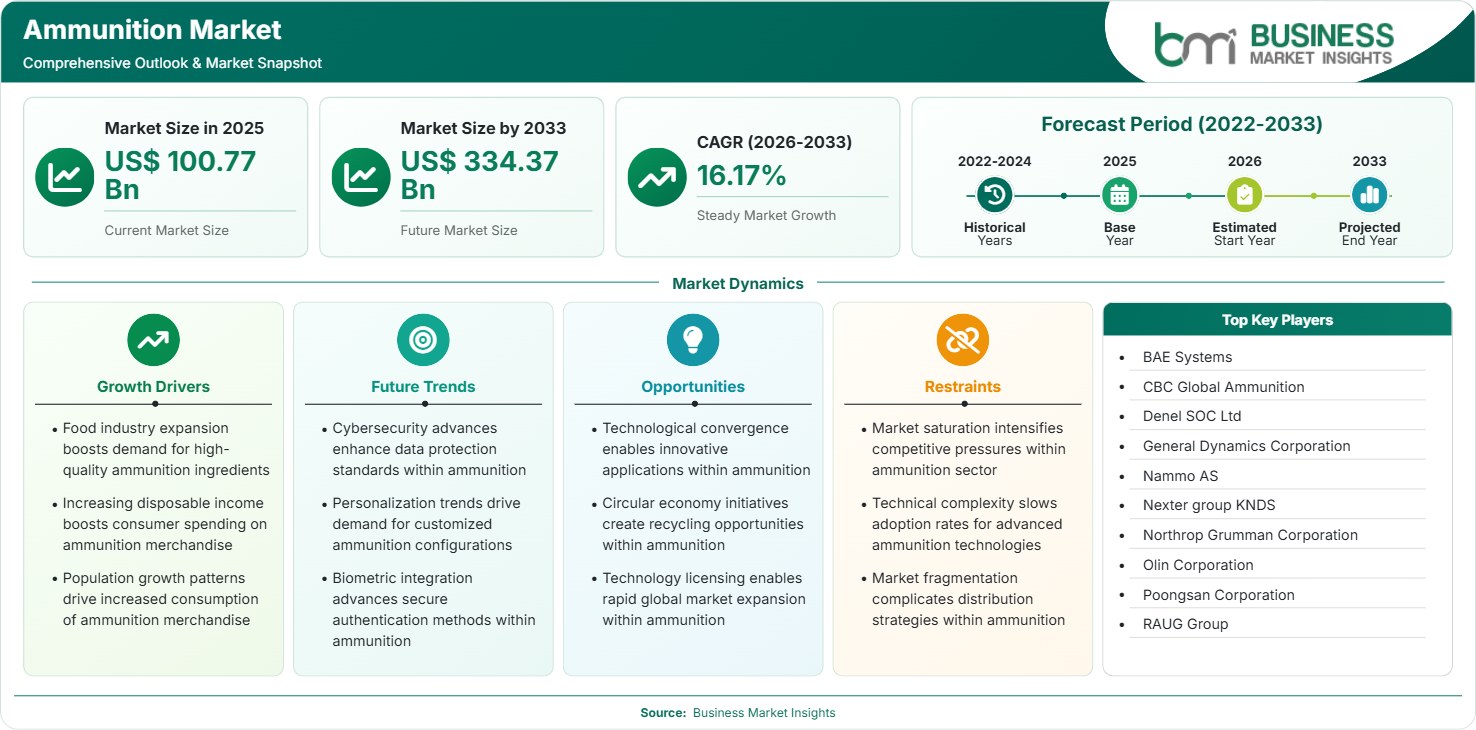
The Ammunition Market size was valued at US$ 100.77 Billion in 2025 and is projected to reach US$ 334.37 Billion by 2033, growing at a CAGR of 16.17% during 2026–2033, driven by modernization programs, defense procurement expansion, geopolitical uncertainties, and increasing demand for advanced precision-based systems.

Report Coverage
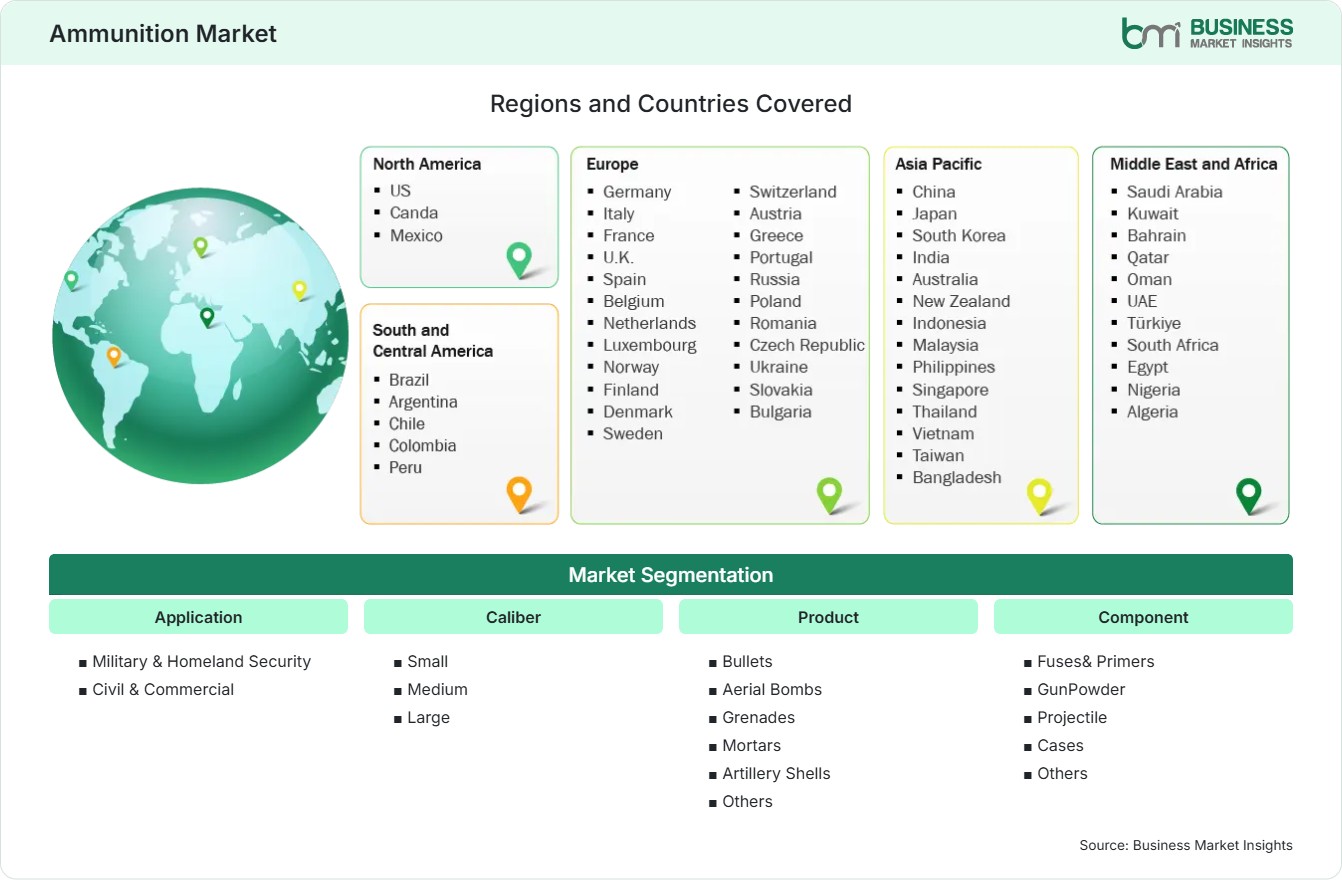
  • Application: Military & Homeland Security, Civil & Commercial
  • Caliber: Small, Medium, Large
  • Product: Bullets, Aerial Bombs, Grenades, Mortars, Artillery Shells, Others
  • Component: Fuses& Primers, GunPowder, Projectile, Cases, Others
  • Guidance: Guided, Non-Guided
US$ 100.77 Bn Market size in 2025
US$ 334.37 Bn Market Size by 2033
16.17% CAGR, 2026 - 2033
2026-2033 Forecast Period

AI Overview

Ammunition Market Summary

  • North America Region: North America holds a 38%–42% share in 2025, growing with a CAGR of 15%–17% during 2026–2033, supported by defense modernization, military readiness programs, advanced manufacturing capabilities, and rising investments in precision systems. The U.S. market analysis indicates continued expansion at a CAGR of 15%–16% due to federal defense spending, ammunition stock replenishment, and technological upgrades.
  • Fastest Growing Region: Asia Pacific accounts for a 25%–29% share in 2025, expanding at a CAGR of 17%–19% during 2026–2033, supported by increasing military expenditure, indigenous defense production, border security requirements, and modernization initiatives across China, India, South Korea, and Southeast Asia.
  • Leading Segment: Military & Homeland Security application maintains a 72%–76% share in 2025, registering a CAGR of 15%–17% during 2026–2033, driven by defense procurement cycles, strategic stockpiling, advanced weapon platforms, and national security investments worldwide.
  • High Growth Segment: Guided ammunition represents a 14%–18% share in 2025, achieving a CAGR of 19%–21% during 2026–2033, supported by precision strike capabilities, reduced collateral damage requirements, smart weapon integration, and advanced targeting technologies.
  • Key Market Opportunity: Growing adoption of smart ammunition, autonomous defense platforms, and digitally integrated battlefield systems creates opportunities for manufacturers to develop advanced solutions with improved accuracy, reliability, and operational efficiency.
  • Major Market Players: BAE Systems, CBC Global Ammunition, Denel SOC Ltd, General Dynamics Corporation, Nammo AS, KNDS, Northrop Grumman Corporation, Olin Corporation, Poongsan Corporation, RUAG International, Thales Group, and Vista Outdoor Inc.
Strategic Insights

Ammunition Market: Strategic Insights

Ammunition Market Strategic Framework
FREE PDF
Request your free sample
Request free sample
Stakeholder View

Key Takeaways

  • The ammunition ecosystem is evolving through stronger integration between raw material suppliers, component manufacturers, defense contractors, and government procurement agencies. Supply chain resilience, local production capabilities, and specialized manufacturing expertise are becoming critical competitive factors.
  • Growth opportunities are concentrated in precision-guided products, advanced caliber systems, and specialized defense applications. Manufacturers focusing on accuracy improvement, reduced weight, and enhanced operational effectiveness are positioned to capture rising procurement demand.
  • Innovation is shifting toward smart ammunition technologies, improved propulsion systems, advanced materials, and digitally connected defense platforms. Research and development efforts are focused on improving range, accuracy, reliability, and battlefield adaptability.
  • Asia Pacific presents an attractive investment landscape due to increasing defense budgets, indigenous manufacturing programs, and modernization initiatives. Countries such as India, South Korea, and Japan are strengthening domestic capabilities and expanding strategic partnerships.
  • Investment activity is being shaped by defense industry consolidation, technology partnerships, and capacity expansion initiatives. Companies are pursuing collaborations to enhance manufacturing efficiency, strengthen product portfolios, and address increasing global defense requirements.
  • Sustainability considerations are influencing ammunition manufacturing through improved production efficiency, material optimization, and environmentally conscious development approaches. Manufacturers are exploring processes that reduce waste while maintaining performance standards.
Geographic Outlook

Ammunition Market Regional Highlights

North America Ammunition Market

North America maintains a dominant position with a 38%–42% share in 2025 and records a CAGR of 15%–17% during 2026–2033. Strong military expenditure, modernization programs, and advanced defense manufacturing infrastructure support regional leadership. The Ammunition Market share is strengthened by procurement contracts from government agencies and armed forces. The United States remains the primary contributor, supported by defense innovation, domestic production capabilities, and strategic inventory expansion.

  • The United States drives regional demand through military modernization initiatives, large-scale procurement programs, and continuous investment in advanced ammunition technologies for defense applications.
  • Canada contributes through defense capability improvements, security partnerships, and increasing requirements for modern military equipment supporting regional operational readiness.
  • Advanced manufacturing capabilities and established defense contractors enable North America to maintain technological leadership across conventional and precision ammunition categories.
  • Rising investments in research, automation, and production efficiency are supporting manufacturers in meeting evolving defense requirements and improving supply chain reliability.

US Ammunition Market

The U.S. ammunition sector represents approximately 30%–34% of the global Ammunition Market share in 2025 and is projected to expand at a CAGR of 15%–16% during 2026–2033. Government defense spending, military modernization programs, and replacement of aging inventories remain important growth factors. The country maintains a strong industrial base supported by established defense manufacturers, technological innovation, and extensive military procurement networks.

  • Federal defense budgets continue supporting ammunition procurement, research programs, and modernization efforts across multiple branches of the armed forces.
  • Domestic manufacturers benefit from established supply chains, advanced engineering capabilities, and long-term government contracts supporting production stability.
  • Increasing adoption of precision systems and guided solutions is encouraging companies to enhance product development capabilities and expand specialized manufacturing facilities.
  • Private sector participation is increasing through investments in automation, advanced materials, and efficient production technologies.

Europe Ammunition Market

Europe accounts for a 20%–24% share in 2025 and is projected to grow at a CAGR of 14%–16% during 2026–2033. Regional demand is supported by defense readiness initiatives, NATO-related modernization requirements, and increasing focus on strategic ammunition reserves. The Ammunition Market share in Europe is influenced by procurement programs across France, Germany, the United Kingdom, and Poland. Increasing regional security concerns are encouraging investments in domestic production capabilities, advanced ammunition technologies, and resilient supply chains.

  • France is strengthening ammunition manufacturing through defense industrial programs, supporting advanced projectile development, export opportunities, and modernization requirements across European defense networks.
  • Germany is increasing investments in defense capabilities, with growing demand for reliable ammunition supplies, industrial partnerships, and enhanced manufacturing capacity.
  • The United Kingdom continues supporting defense innovation through procurement programs focused on operational readiness, advanced systems integration, and supply chain security.
  • Eastern European countries, including Poland, are expanding defense procurement activities due to increasing security requirements and modernization of military equipment.
  • European manufacturers are prioritizing production expansion, technology upgrades, and strategic partnerships to improve regional self-sufficiency.

Asia Pacific Ammunition Market

Asia Pacific represents a 25%–29% share in 2025 and is expected to expand at a CAGR of 17%–19% during 2026–2033. The region demonstrates strong growth potential due to rising defense budgets, border security requirements, and indigenous defense manufacturing initiatives. The Ammunition Market growth across Asia Pacific is supported by China, India, Japan, and South Korea. Increasing focus on domestic production, military modernization, and advanced defense technologies is reshaping regional procurement strategies.

  • China is expanding domestic ammunition manufacturing capabilities through advanced defense production systems, technological development, and military modernization programs.
  • India is accelerating indigenous defense manufacturing through government initiatives, private sector participation, and increased investment in locally produced military equipment.
  • South Korea is strengthening ammunition capabilities through defense exports, advanced production facilities, and continuous improvements in military technologies.
  • Japan is investing in defense modernization programs, supporting demand for advanced ammunition solutions and strategic inventory development.
  • Southeast Asian nations are increasing defense spending, creating opportunities for suppliers offering reliable ammunition systems and specialized military applications.

Rest of World Ammunition Market

Rest of World regions, including South and Central America and the Middle East and Africa, represent a 10%–14% Ammunition Market share in 2025 and are forecast to grow at a CAGR of 16%–18% during 2026–2033. Rising security requirements, military modernization programs, and regional defense investments are supporting demand. Countries across these regions are improving domestic capabilities through partnerships, procurement agreements, and technology transfers to strengthen defense preparedness.

The Middle East demonstrates increasing adoption of advanced ammunition systems due to defense modernization programs and strategic security investments. South America focuses on maintaining military readiness and improving domestic production capabilities through industrial cooperation.

  • Middle Eastern countries are investing in advanced defense systems, increasing demand for precision ammunition and modern military equipment.
  • Saudi Arabia and the UAE are expanding defense capabilities through procurement programs, industrial localization initiatives, and strategic partnerships.
  • Brazil supports regional ammunition demand through domestic manufacturing capabilities, defense exports, and modernization programs.
  • African nations are improving security infrastructure, encouraging investments in military supplies and regional defense manufacturing partnerships.
  • Growing technology transfer agreements are enabling emerging economies to strengthen local production capabilities and reduce external supply dependency.
Global Market Geography
FREE PDF
Request your free sample
Request free sample
Segment Analysis

Ammunition Market Segmentation

Application

The application segment demonstrates diverse demand patterns, with Military & Homeland Security leading adoption due to defense requirements and strategic stockpiling. This segment holds a 72%–76% share in 2025 and is expected to grow at a CAGR of 15%–17% between 2026–2033. The Ammunition Market scope expands through increasing military modernization, security operations, and government procurement programs.

  • Military & Homeland Security: This segment dominates demand through defense procurement, border security operations, military readiness programs, and requirements for advanced ammunition systems supporting national security missions.
  • Civil & Commercial: This segment serves sporting, hunting, training, and commercial applications, supported by recreational activities, regulated civilian ownership, and demand for specialized ammunition products.

Caliber

Caliber-based segmentation reflects diverse operational requirements across defense, law enforcement, and commercial applications. The segment maintains strong adoption due to varying range, impact, and performance needs. Small caliber solutions remain widely used, while medium and large caliber systems support specialized military applications. Manufacturers focus on optimizing performance, reliability, and production efficiency.

  • Small: Small caliber ammunition experiences broad adoption across military, law enforcement, training, and sporting applications due to portability, availability, and operational flexibility.
  • Medium: Medium caliber solutions support armored vehicles, aircraft systems, and specialized defense platforms requiring enhanced performance and operational effectiveness.
  • Large: Large caliber ammunition is utilized in artillery, naval systems, and heavy defense platforms where extended range and high impact capabilities are essential.

Product

The product segment includes multiple ammunition categories designed for specific operational requirements. Growing demand for advanced military platforms, precision systems, and specialized applications is influencing product innovation. Manufacturers are focusing on improving accuracy, durability, and compatibility with modern defense equipment. The Ammunition Market trends indicate increased development of specialized solutions for evolving battlefield requirements.

  • Bullets: Bullets remain essential across military, security, sporting, and training applications due to widespread compatibility and established manufacturing infrastructure.
  • Aerial Bombs: Aerial bombs support air defense operations and strategic missions requiring high-impact solutions integrated with advanced aircraft platforms.
  • Grenades: Grenades continue serving infantry and tactical operations through compact designs, improved effectiveness, and enhanced deployment capabilities.
  • Mortars: Mortar ammunition supports ground operations through flexible deployment, mobility advantages, and effective indirect fire capabilities.
  • Artillery Shells: Artillery shells remain critical for military operations requiring long-range firepower, precision capabilities, and battlefield support.

Component

The component segment includes essential elements required for ammunition performance, reliability, and operational effectiveness. Increasing focus on precision manufacturing and quality control is supporting component innovation. The segment benefits from technological advancements in materials, propulsion systems, and manufacturing processes across defense applications.

  • Fuses & Primers: Fuses and primers enable reliable ignition and controlled performance, supporting safety, accuracy, and operational reliability across ammunition systems.
  • GunPowder: Gunpowder remains a fundamental propulsion component, with manufacturers improving formulations to enhance efficiency and performance.
  • Projectile: Projectiles are evolving through advanced materials and designs focused on improved range, accuracy, and impact performance.
  • Cases: Cases provide structural protection and compatibility, supporting durability and consistent ammunition performance.

Guidance

Guidance-based solutions are gaining importance as defense organizations prioritize accuracy, reduced collateral damage, and advanced targeting capabilities. The guided segment represents a growing technology area supported by precision warfare requirements. Non-guided solutions continue maintaining demand due to affordability and established military applications.

  • Guided: Guided ammunition integrates advanced targeting technologies, sensors, and navigation systems to improve accuracy and mission effectiveness.
  • Non-Guided: Non-guided ammunition remains widely adopted due to cost efficiency, operational simplicity, and suitability for conventional military applications.

Lethality

The lethality segment reflects changing defense requirements and operational preferences. Advanced solutions are being developed to balance effectiveness, mission objectives, and regulatory considerations. Increasing demand for specialized applications is influencing product innovation and procurement decisions.

  • Lethal: Lethal ammunition supports defense operations requiring maximum operational impact, battlefield effectiveness, and strategic mission capabilities.
  • Less-Lethal: Less-lethal ammunition supports law enforcement, crowd management, and controlled intervention scenarios requiring reduced injury risks.
Market Forces

Ammunition Market Dynamics

Key Market Drivers

Rising Defense Modernization and Military Procurement Programs

The growing number of military modernization initiatives is one of the key drivers affecting the market, since governments are focusing on preparedness and stockpile buildup. There are investments by the military organizations in advanced ammunition systems, precision technology, and advanced battlefields. There is an upward trend in military expenditure around the world, hence the continuous procurement needs. The Ammunition Market trends are pointing towards digitally enabled services, intelligent devices, and improved manufacturing. Nations are working on creating robust manufacturing chains in order to make sure that there are no risks associated with supplies, and the nations have uninterrupted access to all the defense material that they need.

Growing Adoption of Precision-Guided Ammunition Technologies

The increasing need for accuracy, efficiency, and minimum collateral damage has been leading to the use of precision-guided ammunition systems. There has been an investment by military forces in terms of guidance technology, better targeting, and smart ammunition to increase efficiency in operations. Defense systems have undergone tremendous change in terms of sensors, navigation, and the digitization of battlefields. As a result of increasing demand from modernization, there have been innovations in terms of design, materials, and manufacturing of defense systems. Manufacturers are striving to create products that are more accurate, reliable, and flexible in use. This has served to bolster the position of technological-based ammunition solutions within the defense industry.

Expansion of Domestic Ammunition Manufacturing Capabilities

Governments are increasingly emphasizing domestic defense production to strengthen supply chain resilience and reduce dependency on international suppliers. Local manufacturing initiatives are encouraging investments in production facilities, advanced machinery, and defense technology partnerships. The nations have been trying to facilitate collaboration among their industries in such a way that they enhance the manufacturing capabilities of the industry while ensuring the security needs of the nation in the long run. The emergence of manufacturing eco-systems has provided the ammunition manufacturers the opportunity to develop their capabilities and customize their products for different regions.

Key Market Opportunities

Development of Smart and Digitally Integrated Ammunition Systems

The emergence of connected battlefield technologies creates significant opportunities for manufacturers developing intelligent ammunition solutions. Advanced guidance systems, digital communication capabilities, and automated targeting technologies are opening new application areas across defense platforms. The Ammunition Market Forecasts indicate that there is rising investment potential for products which will enhance efficiency and effectiveness. The defense industry is looking for systems that can work well within the current military network. Businesses that invest in technologies related to smart ammunition, electronics, and precision engineering will enjoy rising demand for defense systems.

Expansion Across Emerging Defense Manufacturing Regions

Emerging economies are creating attractive opportunities through increased defense spending, modernization programs, and local production initiatives. The countries in the Asia Pacific region, the Middle East region, and Latin America have been focusing on developing manufacturing capabilities as well as defensive partnerships. This has resulted in an increase in interest among international firms to form partnerships, set up facilities, and become part of the technology transfer process. The rising need for ammunition and defense infrastructure development is providing manufacturers with increased entry into the markets.

Growth of Specialized Ammunition Applications

Increasing demand for specialized ammunition designed for specific operational scenarios is creating new commercial opportunities. The defense industry requires custom-made products for high-level platforms and missions. Companies that will be able to offer differentiated products in terms of their performance and application will have an opportunity to capitalize on the emerging trends. Technological advancements in materials science, propulsion technology, and components are making possible the development of new solutions which are more reliable and efficient than traditional systems.

Market Restraints and Challenges

High Manufacturing Costs and Complex Production Requirements

Factor: The manufacture of the high-end ammunition demands specific infrastructure, stringent quality control measures, costly raw material, and intricate manufacturing process.

Impact: These standards contribute to increased operating costs and make entry difficult for small manufacturers looking to be involved in the industry. Military-grade production requires testing, adherence to certain protocols, and other security measures that demand substantial resources. Advanced infrastructure and complicated supply chains due to unique parts must be managed. Increasing operating costs, due to rising costs of raw material and technology advancements, may pose a challenge.

Strict Regulatory Frameworks and Export Limitations

Factor: Ammunition manufacturing and exports are tightly controlled by government laws and regulations.

Impact: Such regulations could result in delays in bringing the products to market, reduced market access, and increased compliance difficulties for manufacturers. The company has to deal with various regulatory frameworks and processes in case it is operating in several geographic locations. Restrictions on exports could also have an effect on the international strategy of the company and limit its flexibility to adapt to changes in regional demand. Effective management of the regulatory process requires good compliance mechanisms, legal knowledge, and cooperation with governments.

Company Analysis

Competitive Landscape

The Ammunition Market analysis highlights a competitive environment shaped by defense contractors, specialized ammunition manufacturers, and technology-focused companies. Leading participants are investing in production expansion, advanced materials, precision technologies, and strategic collaborations to strengthen their market position.

Company Name

Overview

Products and Services relevant to this market

BAE Systems

Global defense company providing advanced military technologies and integrated defense solutions across multiple regions.

Military ammunition systems, artillery solutions, precision munitions, and defense-related manufacturing capabilities.

CBC Global Ammunition

International ammunition manufacturer serving defense, law enforcement, and commercial sectors worldwide.

Small caliber ammunition, military cartridges, sporting ammunition, and related components.

Denel SOC Ltd

South African aerospace and defense organization focused on military technology development.

Artillery ammunition, missiles, defense systems, and specialized military products.

General Dynamics Corporation

Major defense company delivering advanced military systems and defense technologies globally.

Large caliber ammunition, combat systems, and military support solutions.

Nammo AS

Nordic defense company specializing in ammunition, propulsion systems, and aerospace technologies.

Small arms ammunition, rocket motors, specialty ammunition, and propulsion products.

KNDS

European defense group developing land systems and military technologies.

Artillery ammunition, armored vehicle ammunition, and defense solutions.

Northrop Grumman Corporation

Technology-focused defense company providing advanced military and aerospace solutions.

Precision ammunition systems, defense technologies, and advanced weapon solutions.

Olin Corporation

Chemical manufacturing company supplying materials supporting ammunition production.

Ammunition-related materials, chemical products, and manufacturing inputs.

Poongsan Corporation

South Korean manufacturer specializing in ammunition and defense products.

Military ammunition, small arms cartridges, and specialized defense products.

RUAG International

Swiss technology company supporting aerospace and defense industries.

Ammunition solutions, defense components, and military support services.

Thales Group

Global technology company providing defense electronics and security solutions.

Guided ammunition technologies, defense systems, and military electronics.

Vista Outdoor Inc.

Consumer products company serving shooting sports and outdoor markets.

Sporting ammunition, shooting products, and related accessories.

Trust & Transparency

Research Methodology

The market analysis combines proprietary research with secondary data from government agencies, company disclosures, regulatory filings, industry databases and expert interviews. Market estimates are validated through data triangulation, cross-market benchmarking and analyst review.

View Full Research Methodology

Questions Answered

Frequently Asked Questions

How are regulations affecting ammunition companies?

Regulatory frameworks influence production, exports, and international partnerships by requiring manufacturers to maintain compliance with defense trade controls, safety standards, and government approval processes.

What are emerging opportunities in ammunition manufacturing?

Opportunities are developing through domestic production programs, smart ammunition systems, specialized defense applications, and partnerships supporting regional manufacturing capabilities.

How does the Ammunition Market Report support strategic decision-making?

The Ammunition Market Report provides insights into market dynamics, competitive positioning, segmentation patterns, regional opportunities, and technology developments to help stakeholders evaluate investment and expansion strategies.

What role does technology play in ammunition development?

Technology enables improved accuracy, reliability, and operational efficiency through advanced guidance systems, smart components, digital integration, and enhanced materials used in modern defense applications.

What factors are influencing the future demand for ammunition technologies?

Growing defense modernization programs, increasing geopolitical concerns, and demand for precision-based military solutions are encouraging innovation in advanced ammunition systems, including guided technologies and improved manufacturing processes.

Access the Full Ammunition Market Report

Get segment-level forecasts, regional estimates, competitive benchmarking, company profiles and downloadable Excel datasets.

Access the full Ammunition Market Report
350 pages PDF & Excel | 2026-08-17
Similar Research

Related Market Reports