
Space Enabled Digital Transformation Market Outlook: Size, Share, Trends, Growth Analysis, Competitive Landscape & Forecast, 2026-2033

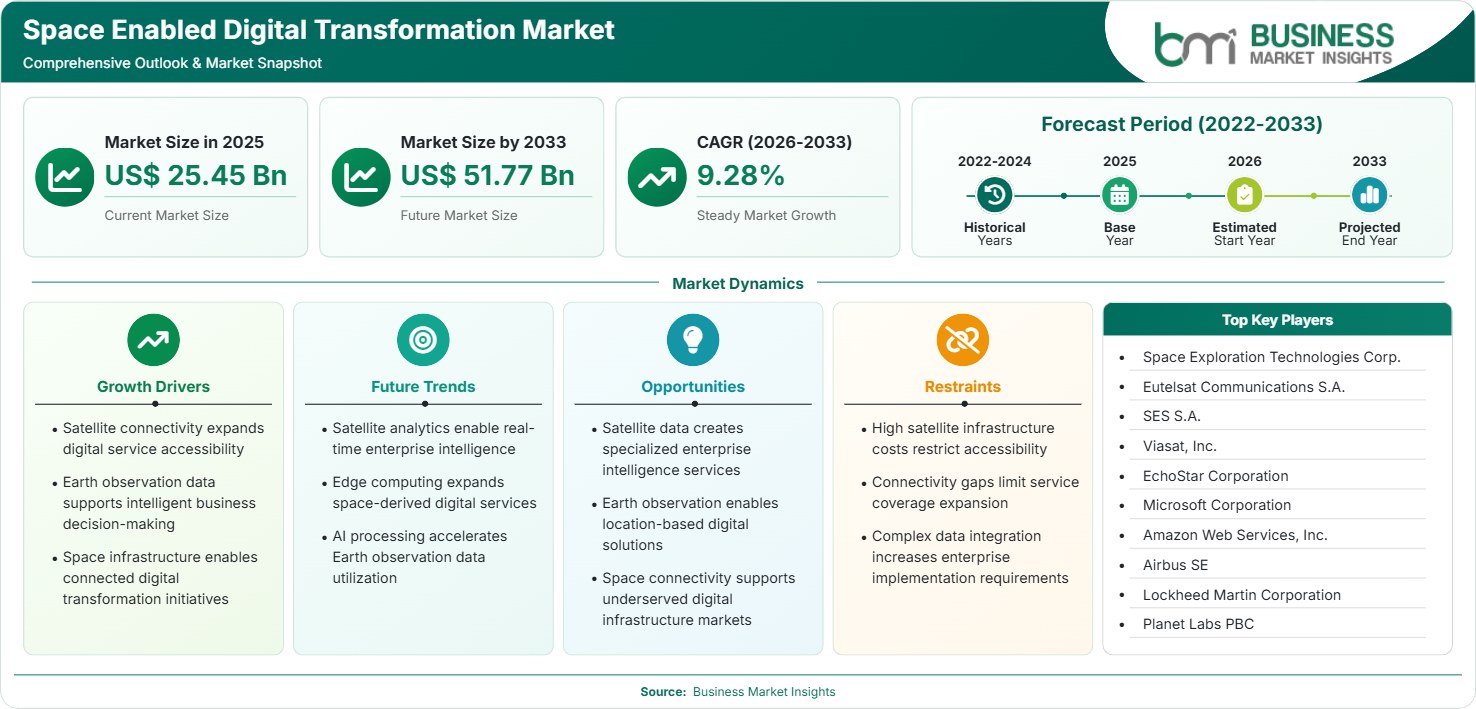
The Space Enabled Digital Transformation Market size was valued at US$ 25.45 Billion in 2025 and is projected to reach US$ 51.77 Billion by 2033, growing at a CAGR of 9.28% during 2026–2033, driven by satellite connectivity, cloud integration, AI-enabled analytics, multi-orbit networks, resilient infrastructure, and expanding enterprise use of space-derived data.

Report Coverage
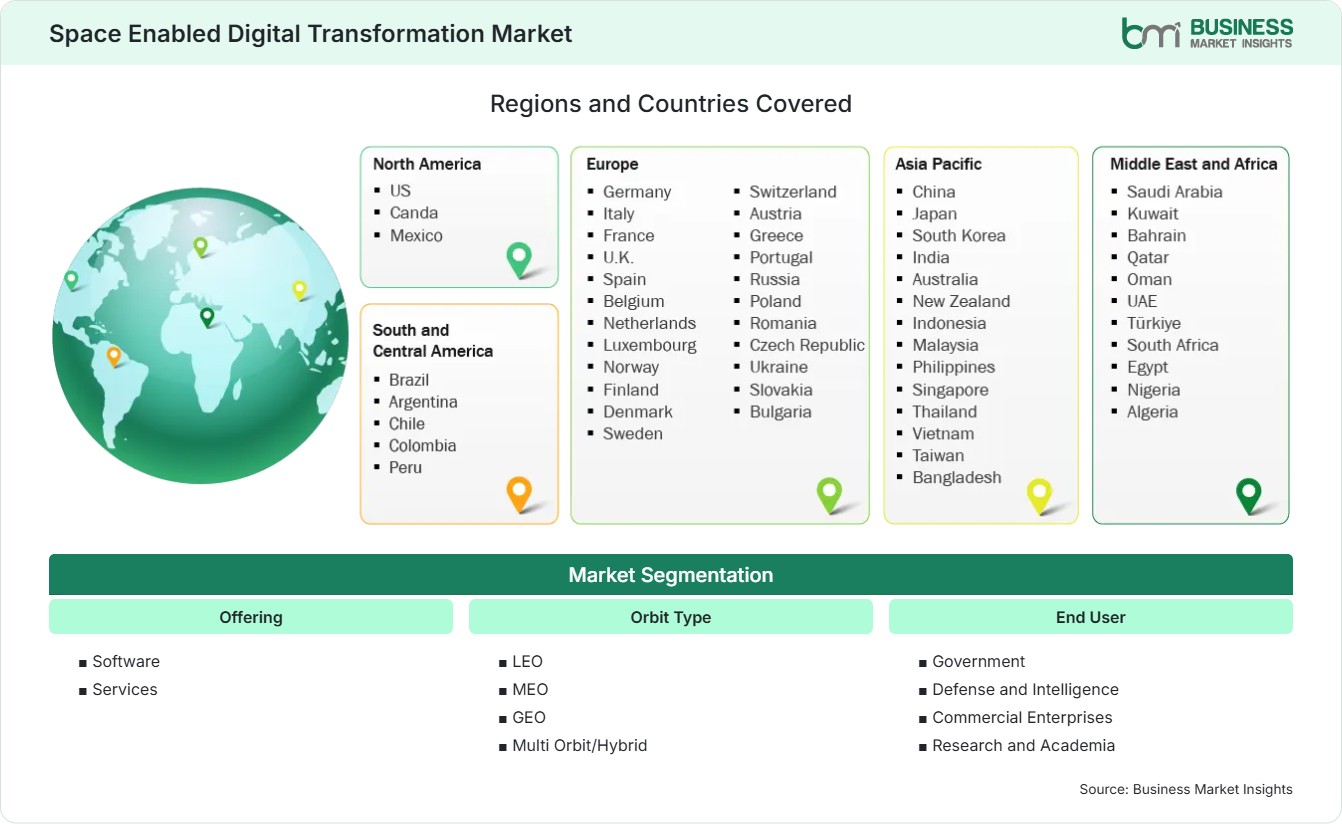
  • Offering: Software, Services
  • Orbit Type: LEO, MEO, GEO, Multi Orbit/Hybrid
  • End User: Government, Defense and Intelligence, Commercial Enterprises, Research and Academia
US$ 25.45 Bn Market size in 2025
US$ 51.77 Bn Market Size by 2033
9.28% CAGR, 2026 - 2033
2026-2033 Forecast Period

AI Overview

Space Enabled Digital Transformation Market Summary

  • North America Region: North America holds a 38%–41% Space Enabled Digital Transformation Market share in 2025, growing at a 8.7%–9.6% CAGR through 2033, supported by mature satellite infrastructure, cloud platforms, defense procurement, enterprise connectivity, AI analytics, private investment, and expanding commercial space capabilities. The US market benefits from extensive satellite infrastructure, cloud adoption, defense spending, and commercial space investment, with a 9.0%–9.8% CAGR through 2033.
  • Fastest Growing Region: Asia Pacific accounts for a 20%–23% share in 2025 and is advancing at a 10.2%–11.4% CAGR, supported by satellite broadband expansion, national space programs, digital infrastructure investment, Earth observation adoption, and growing commercial participation.
  • Leading Segment: Commercial Enterprises holds a 35%–39% share in 2025 and is expanding at a 9.3%–10.2% CAGR, supported by satellite connectivity, geospatial intelligence, logistics optimization, asset monitoring, cloud integration, industrial automation, and growing demand for resilient digital operations.
  • High Growth Segment: Software represents a 42%–46% Space Enabled Digital Transformation Market share in 2025 and is developing at a 10.1%–11.2% CAGR, driven by cloud-native mission platforms, AI analytics, digital twins, satellite data marketplaces, automated tasking, cybersecurity, and interoperable space-to-cloud architectures.
  • Key Market Opportunity: Integration of satellite data with cloud, edge computing, AI, and enterprise software creates scalable opportunities in logistics, agriculture, energy, insurance, telecommunications, disaster management, defense, infrastructure monitoring, and remote operations.
  • Major Market Players: Space Exploration Technologies Corp.; Eutelsat Communications S.A.; SES S.A.; Viasat, Inc.; EchoStar Corporation; Microsoft Corporation; Amazon Web Services, Inc.; Airbus SE; Lockheed Martin Corporation; Planet Labs PBC.
Strategic Insights

Space Enabled Digital Transformation Market: Strategic Insights

Space Enabled Digital Transformation Market Strategic Framework
FREE PDF
Request your free sample
Request free sample
Stakeholder View

Key Takeaways

  • The ecosystem is moving from spacecraft-centric procurement toward integrated value chains connecting satellite operators, cloud providers, analytics companies, telecommunications networks, application developers, and enterprise users. This creates greater demand for interoperable software and managed services.
  • Commercial enterprises provide a broad expansion pathway because satellite-derived information can be embedded into existing logistics, insurance, energy, agriculture, telecommunications, mining, transportation, and infrastructure workflows without requiring users to own orbital assets.
  • AI is becoming a practical layer across the value chain. Automated image interpretation, predictive maintenance, anomaly detection, satellite tasking, traffic optimization, and natural-language access to geospatial datasets can reduce manual processing and shorten decision cycles.
  • Asia Pacific offers an expanding investment opportunity as India, Japan, China, Australia, and other regional markets combine national space programs with growing private-sector participation, digital infrastructure development, disaster-management requirements, and demand for connectivity in geographically dispersed markets.
  • Investment is increasingly directed toward constellation expansion, ground infrastructure, cloud integration, and data services. The OECD reports that US organizations operated 76% of active satellites at the end of 2025, demonstrating substantial concentration alongside expanding commercial participation.
Geographic Outlook

Space Enabled Digital Transformation Market Regional Highlights

North America Space Enabled Digital Transformation Market

North America represented a 38%–41% Space Enabled Digital Transformation Market share in 2025 and is projected to record an 8.7%–9.6% CAGR through 2033. The region combines established satellite operators, cloud hyperscalers, defense programs, telecommunications infrastructure, and venture-backed space companies. US demand remains the principal contributor, while Canada supports Earth observation, communications, and remote-resource applications. Cloud-to-orbit integration is increasingly important as enterprises seek scalable access to satellite data without owning ground infrastructure. The regional ecosystem also benefits from mature procurement channels and established commercial space capabilities. Fortune Business Insights independently reports North America as the largest regional market in 2025.

  • Government and defense procurement supports persistent demand for resilient communications, geospatial intelligence, positioning services, and multi-orbit connectivity across operationally sensitive applications.
  • Cloud platforms are integrating satellite communications, ground-station services, geospatial datasets, and AI tools, enabling enterprises to incorporate space-derived information into conventional digital architectures.
  • Commercial investment increasingly targets direct-to-device connectivity, Earth observation, satellite operations software, and managed space infrastructure, broadening participation beyond traditional aerospace organizations.
  • Canada contributes through remote connectivity, resource monitoring, climate observation, and Arctic applications where terrestrial infrastructure remains limited and satellite-enabled services provide operational continuity.

US Space Enabled Digital Transformation Market

The US represented approximately 31%–34% of global demand in 2025 and is estimated to expand at a 9.0%–9.8% CAGR through 2033. Its position reflects extensive government procurement, commercial constellation deployment, cloud computing capacity, advanced semiconductor ecosystems, and established defense technology suppliers. The Space Enabled Digital Transformation Market increasingly connects satellite networks with enterprise applications rather than treating orbital systems as standalone infrastructure. Microsoft, AWS, SpaceX, and other ecosystem participants are building services around cloud access, ground infrastructure, analytics, and mission operations. Hughes has also applied Azure AI Foundry to production applications, demonstrating enterprise-level digitalization.

  • Federal demand supports software-defined communications, space domain awareness, resilient networks, and rapid access to satellite-derived information for civil and defense missions.
  • Commercial enterprises are adopting satellite-enabled connectivity for remote assets, transportation, energy infrastructure, maritime operations, and locations where terrestrial networks are unreliable or unavailable.
  • Venture activity increasingly targets specialized software, data platforms, satellite autonomy, analytics, and ground systems, creating partnership opportunities for hyperscalers and established aerospace suppliers.

Europe Space Enabled Digital Transformation Market

Europe held a 22%–25% share in 2025 and is forecast to grow at a 8.4%–9.4% CAGR through 2033. Germany, France, the United Kingdom, Italy, and Spain form major national markets, while France and Germany provide important institutional demand. The UK is developing public-sector adoption programs, and the European Union is advancing IRIS² to strengthen secure connectivity. France and Germany remain leading contributors, while the UK and Italy offer strong growth through commercial space, defense technology, Earth observation, and cloud-enabled applications. ESA and national agencies continue supporting technology development and commercialization.

  • IRIS² is encouraging demand for interoperable communications infrastructure and European supply chains, with Thales Alenia Space and Airbus participating in major constellation activities.
  • The UK government identifies Earth observation, satellite communications, and positioning services as tools for improving public services and national security capabilities.
  • Germany is increasing attention to sovereign satellite capabilities, supporting domestic suppliers of communications, intelligence, analytics, and mission-management technologies.
  • Spain and Italy provide expanding opportunities through Earth observation, satellite manufacturing, launch-related activities, downstream analytics, and commercial space applications.

Asia Pacific Space Enabled Digital Transformation Market

Asia Pacific accounted for a 20%–23% Space Enabled Digital Transformation Market share in 2025 and is projected to achieve a 10.2%–11.4% CAGR through 2033. China, Japan, India, Australia, and South Korea are important markets, while India and Australia offer particularly strong expansion opportunities from private-sector participation and downstream applications. Satellite communications, disaster monitoring, agriculture, logistics, maritime operations, and remote connectivity are driving adoption. National space programs increasingly coexist with commercial ventures, cloud partnerships, and digital-service providers. AWS's regional accelerator for 67 startups illustrates growing ecosystem development across Australia, India, and Japan.

  • China maintains a large domestic space ecosystem supporting communications, Earth observation, navigation, government applications, and commercial satellite development.
  • India is developing a broader private space ecosystem, with more than 400 startups reported in the country's expanding space sector and increasing downstream commercialization.
  • Japan combines advanced telecommunications and electronics capabilities with demand for disaster management, precision agriculture, logistics, and satellite-derived analytics.
  • Australia offers applications in mining, agriculture, environmental monitoring, maritime operations, and remote connectivity, where large distances increase the value of satellite-enabled infrastructure.

Rest of World Space Enabled Digital Transformation Market

Rest of World represented a 13%–16% share in 2025 and is estimated to grow at a 9.0%–10.1% CAGR through 2033. South and Central America are adopting satellite connectivity and Earth observation for agriculture, mining, logistics, environmental monitoring, and disaster response. Brazil leads regional demand, while Mexico, Chile, and Colombia provide additional opportunities. In the Middle East and Africa, the UAE, Saudi Arabia, and South Africa are developing space capabilities and digital infrastructure. Connectivity gaps and geographically dispersed assets make satellite-enabled services increasingly relevant.

  • Brazil provides a sizeable downstream opportunity through agriculture, forestry, environmental monitoring, telecommunications, and disaster-management applications requiring wide-area data.
  • Chile and Mexico support opportunities in mining, logistics, telecommunications, agriculture, and infrastructure monitoring where remote operations create demand for resilient connectivity.
  • The UAE and Saudi Arabia are strengthening national space programs, digital infrastructure, Earth observation, and government technology applications, supporting integrated downstream service development.
  • South Africa provides opportunities across agriculture, mining, environmental monitoring, communications, and scientific research, while broader African markets benefit from connectivity and geospatial applications.
Global Market Geography
FREE PDF
Request your free sample
Request free sample
Segment Analysis

Space Enabled Digital Transformation Market Segmentation

Offering

Software accounted for 42%-46 % of the market in 2025, while services accounted for the remainder. This segment of offerings is driven by growing requirements for cloud-based mission platforms, analytics, satellite data management, cybersecurity, and managed infrastructure solutions. The software is expected to grow at a CAGR of 10.1%-11.2% through 2033, driven by a focus on scalable solutions and automated data processing capabilities. The Space Enabled Digital Transformation Market scope is now more about software and services than orbital infrastructure.

  • Software: Cloud platforms, analytics engines, satellite tasking applications, geospatial intelligence tools, digital twins, and mission-management software support automation, interoperability, and rapid access to space-derived information.
  • Services: Managed connectivity, ground-station access, data processing, consulting, integration, cybersecurity, and mission operations allow organizations to use satellite capabilities without developing extensive internal space infrastructure.

Orbit Type

The choice of LEO, MEO, GEO, and multi-orbit/hybrid architectures depends on the varying needs for latency, coverage, capacity, and applications. Multi-orbit architectures are being considered as users seek reliable, continuous connectivity services within the network. LEO will remain relevant for low-latency services and Earth observation purposes, whereas GEO will continue to be significant for providing coverage. MEO will provide solutions for navigation and specialized communication applications. Orbit diversification is becoming central to the Space Enabled Digital Transformation Market as enterprises combine complementary orbital capabilities.

  • LEO: Low latency, high revisit rates, and expanding constellations support broadband, Earth observation, IoT, asset tracking, and time-sensitive analytics across distributed operations.
  • MEO: MEO infrastructure supports navigation, positioning, timing, and selected communications applications requiring broad coverage and dependable service characteristics across large geographic areas.
  • GEO: GEO satellites remain valuable for broadcasting, enterprise connectivity, weather applications, and wide-area communications where continuous regional coverage is more important than minimum latency.
  • Multi Orbit/Hybrid: Integrated architectures combine LEO, MEO, and GEO capabilities to improve resilience, coverage, latency management, and service continuity across critical digital applications.

End User

Commercial Enterprises have a market share of 35%–39% and are estimated to have a CAGR of 9.3%–10.2% through 2033. Government, Defense and Intelligence, and Research and Academia are among the key demand segments, each with unique needs for security, operations, and science, respectively. Enterprise use is increasing as satellite-based data and communications capabilities can be leveraged through cloud-based services. Thus, the Space Enabled Digital Transformation Market is increasingly relying on the downstream side.

  • Government: Public agencies use satellite communications, Earth observation, positioning, and analytics for infrastructure management, emergency response, environmental monitoring, public safety, and service delivery.
  • Defense and Intelligence: Persistent surveillance, resilient communications, space domain awareness, geospatial intelligence, and multi-orbit connectivity support increasingly distributed defense architectures and mission requirements.
  • Commercial Enterprises: Logistics, agriculture, energy, mining, telecommunications, insurance, transportation, and infrastructure operators integrate satellite-enabled information into operational systems to improve visibility and resilience.
  • Research and Academia: Universities and research organizations use satellite data, scientific payloads, geospatial platforms, and cloud computing to support climate research, environmental science, astronomy, and technology development.
Market Forces

Space Enabled Digital Transformation Market Dynamics

Key Market Drivers

Cloud Integration Is Converting Satellite Data Into Enterprise Workflows

Cloud integration is reducing the operational complexity associated with accessing satellite data and communications. AWS offers aerospace and satellite services that enable the customer to analyze their data, leverage AI and machine learning, and build scalable mission systems. Azure Space by Microsoft, on the other hand, involves satellite communications, a cloud computing platform, ground systems, and geospatial data, and the two infrastructures support the growth of the Space-Enabled Digital Transformation by enabling data processing closer to enterprise applications. Trends in the space-enabled digital transformation market include cloud-based mission control, virtualized ground infrastructure, automated data pipelines, and software-defined communications.

Growing Satellite Constellations Increase Demand for Automated Operations

Rapid constellation deployment is increasing the number of satellites, data streams, ground contacts, and operational decisions that must be managed. OECD data indicates that approximately 4,900 objects were launched during 329 space launches in 2025, while active operational satellites exceeded 14,000 by year-end. This will increase demand for automated scheduling, satellite health monitoring, collision avoidance, data routing, cybersecurity, and AI-powered mission operations. Expansion of LEO constellations will necessitate scalable ground-system infrastructure and software to coordinate distributed assets. Space enabled digital transformation market growth will become increasingly dependent on automation that can handle complex systems in space and on Earth without a proportional increase in human effort.

Resilient Connectivity Is Becoming a Digital Infrastructure Requirement

Enterprises and public agencies increasingly require connectivity that can remain available when terrestrial infrastructure is disrupted or geographically unavailable. Satellite networking provides an additional communication layer for remote sites, at sea, in flight, and for emergency services and defense purposes, as well as for industrial sites. Microsoft has already demonstrated cloud connectivity via satellites, while satellite companies continue to build more low-latency networks. These moves broaden the target applications beyond typical telecommunications to include business continuity. In turn, it enables multi-networking scenarios in which fiber and cellular networks on the ground and satellites are dynamically integrated. This development further enhances the Space Enabled Digital Transformation Market trends in network orchestration, edge computing, and traffic management.

Key Market Opportunities

AI-Powered Satellite Analytics Can Expand Downstream Commercialization

AI can boost the economic value of increased satellite imagery through automatic classification, anomaly detection, prediction, object recognition, and change detection. Areas of application include agriculture, insurance, energy, infrastructure, logistics, environmental monitoring, and defense. The potential goes beyond traditional analytics, as generative AI can be used to provide natural-language interfaces for geospatial information. UK government analysis identifies improved data processing and AI as important changes within the satellite economy. Consequently, Space Enabled Digital Transformation Market Forecasts increasingly depend on the downstream monetization of software, analytics models, data markets, and application programming interfaces to make satellite intelligence available to non-experts.

Multi-Orbit Architectures Create New Managed-Service Models

Multi-orbit systems can combine the coverage characteristics of GEO with the lower latency of LEO and specialized capabilities of MEO. This creates an opportunity for managed connectivity providers to sell performance-based services rather than individual satellite links. Enterprises can focus on different variables depending on their needs. These include latency, availability, coverage, and security. In defense applications, users can also consider diversifying their communication channels to increase resilience. With an increasing number of satellites, software that enables the automatic selection and use of satellite resources could prove a valuable layer. Providers that integrate multiple network types will generate recurring revenue.

Government Procurement Can Accelerate Commercial Space Adoption

Government initiatives can establish early demand for services that subsequently become commercialized. For instance, the UK government initiative 'Unlocking Space for Government' aims to promote the adoption of Earth observation, satellite communications, and positioning services in the public sector. Such procurement approaches can help develop a homegrown ecosystem, support trials and technology testing, and eventually lead to a services agreement. Government demand reduces risks associated with the commercialization process and helps establish operational case studies. Europe is implementing institutional programs to develop secure connectivity infrastructure, and defense institutions are increasingly looking to commercial satellite capabilities.

Market Restraints and Challenges

Orbital and Ground Infrastructure Complexity and Higher Deployment Costs

Factor: Space-enabled digital solutions demand a joint effort for investment in satellite infrastructure, launch vehicles, spectrum, ground infrastructure, cloud services, cybersecurity, and data infrastructure. The technical and business dependencies created at each level increase implementation time. Impact: Businesses that adopt digital solutions will delay adoption when the cost of integration exceeds the value it creates for the specific application. This is even more relevant for businesses with customized connectivity requirements or assured mission-environment needs. Even with a fall in satellite and launch costs in some scenarios, the digital solution will require space systems to be integrated with enterprise systems. Providers can reduce these barriers by providing managed services, standard APIs, common ground, cloud mission services, and subscription services.

Orbital Congestion and Data Governance and Greater Operational Risk

Factor: Increased orbital activity poses challenges, including congestion, orbital debris, spectrum coordination, cybersecurity, data sovereignty, and reliance on providers with concentrated infrastructure. According to OECD analysis, the following are the policy challenges that come with increased space activities: orbital congestion and debris; supply chain dependency; access to vital data and signals; and market concentration. Impact: Providers and users will have to place greater emphasis on resilience, compliance, redundancy, and security. This is made difficult because organizations rely on satellites for vital digital operations. For this reason, providers require strong cybersecurity, collision-avoidance technology, diverse architectures, and data governance.

Company Analysis

Competitive Landscape

The Space Enabled Digital Transformation Market analysis indicates a market shaped by satellite operators, cloud providers, aerospace manufacturers, connectivity specialists, defense companies, and Earth observation providers. Competitive differentiation increasingly depends on integration capability, software depth, data accessibility, network resilience, and the ability to connect orbital infrastructure with enterprise workflows.

Company Name

Overview

Products and Services relevant to this market

Space Exploration Technologies Corp.

Space infrastructure and connectivity company operating large-scale satellite and launch systems with broad commercial and government reach.

Starlink satellite connectivity, launch services, satellite communications infrastructure, enterprise connectivity, and government-focused network capabilities.

Eutelsat Communications S.A.

Satellite operator providing communications services through GEO and LEO assets following the OneWeb combination.

OneWeb LEO connectivity, GEO satellite services, enterprise communications, government connectivity, and multi-orbit network solutions.

SES S.A.

Global satellite operator serving telecommunications, government, mobility, media, and enterprise customers across multiple orbital regimes.

GEO and MEO satellite connectivity, managed services, enterprise networks, government communications, and multi-orbit solutions.

Viasat, Inc.

Connectivity technology company serving aviation, maritime, government, defense, and enterprise customers worldwide.

Satellite broadband, managed connectivity, aviation communications, maritime services, government networks, and satellite infrastructure.

EchoStar Corporation

Communications and satellite technology company with extensive consumer, enterprise, and network infrastructure capabilities.

Hughes satellite broadband, enterprise connectivity, managed network services, satellite communications, and digital connectivity platforms.

Microsoft Corporation

Global cloud technology provider developing space-oriented cloud, data, communications, and geospatial capabilities.

Azure Space, Azure Orbital, cloud computing, satellite connectivity integration, geospatial analytics, AI, and mission-support tools.

Amazon Web Services, Inc.

Cloud infrastructure provider offering specialized services for aerospace and satellite organizations.

AWS Ground Station, cloud computing, AI and machine learning, satellite data processing, mission applications, and space-sector development programs.

Airbus SE

Aerospace company involved in satellites, spacecraft, Earth observation, communications, and space infrastructure.

Satellite systems, Earth observation, secure communications, spacecraft manufacturing, constellation infrastructure, and geospatial applications.

Lockheed Martin Corporation

Aerospace and defense technology provider supporting government and commercial space programs.

Satellites, missile-warning systems, space communications, mission systems, geospatial capabilities, and defense-oriented digital infrastructure.

Planet Labs PBC

Earth observation company operating satellite constellations and delivering frequent imagery and geospatial information.

PlanetScope imagery, satellite data, geospatial analytics, monitoring services, APIs, and enterprise Earth observation applications.

Trust & Transparency

Research Methodology

The market analysis combines proprietary research with secondary data from government agencies, company disclosures, regulatory filings, industry databases and expert interviews. Market estimates are validated through data triangulation, cross-market benchmarking and analyst review.

View Full Research Methodology

Questions Answered

Frequently Asked Questions

What is changing the competitive structure of the Space Enabled Digital Transformation Market?

Competition is shifting toward integrated ecosystems that combine satellites, cloud infrastructure, ground networks, AI, analytics, cybersecurity, and enterprise applications. This favors providers capable of delivering interoperable services rather than isolated space hardware.

Which industries are adopting satellite-enabled digital capabilities?

Adoption is expanding across telecommunications, logistics, agriculture, energy, mining, insurance, transportation, defense, government, infrastructure monitoring, disaster management, and research. The strongest applications generally involve geographically distributed assets or limited terrestrial connectivity.

How is AI changing satellite-enabled services?

AI is automating image interpretation, anomaly detection, satellite tasking, predictive analysis, and data discovery. These capabilities allow users to extract operational insights from increasingly large volumes of Earth observation and satellite-generated data.

Why is multi-orbit connectivity becoming important?

Multi-orbit connectivity allows organizations to combine different orbital characteristics, improving coverage, latency management, redundancy, and service continuity. This approach is particularly relevant for government, defense, enterprise, maritime, aviation, and remote industrial applications.

What does the Space Enabled Digital Transformation Market Report cover?

It covers software and services, orbital architectures, end-user adoption, regional dynamics, competitive activity, technology trends, market drivers, opportunities, restraints, and developments influencing space-enabled digital transformation through 2033.

Access the Full Space Enabled Digital Transformation Market Report

Get segment-level forecasts, regional estimates, competitive benchmarking, company profiles and downloadable Excel datasets.

Access the full Space Enabled Digital Transformation Market Report
350 pages PDF & Excel | 2026-09-23
Similar Research

Related Market Reports