
Digital Battlefield Market Outlook: Size, Share, Trends, Growth Analysis, Competitive Landscape & Forecast, 2026-2033

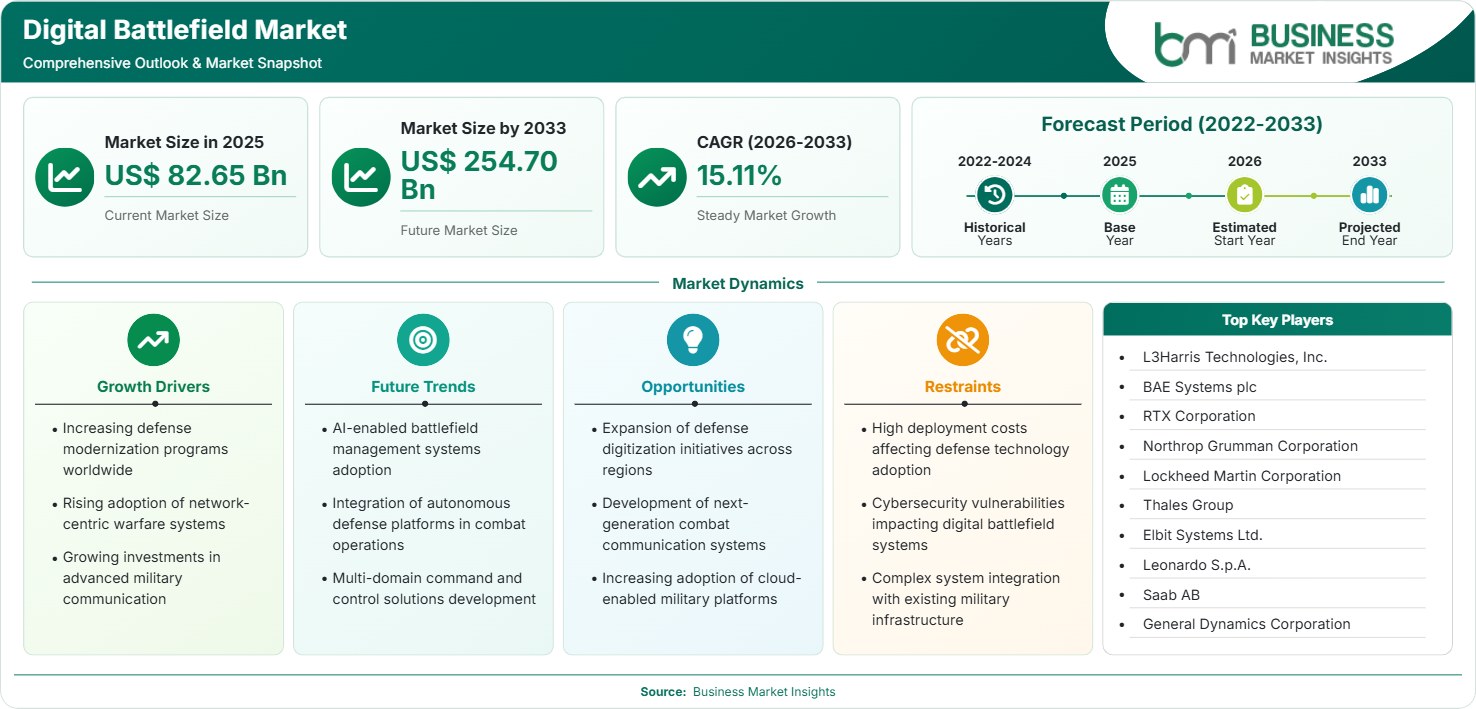
The Digital Battlefield Market size was valued at US$ 82.65 billion in 2025 and is projected to reach US$ 254.7 billion by 2033, registering a CAGR of 15.11% during 2026–2033. The market is experiencing significant growth driven by increasing defense modernization programs, rising adoption of network-centric warfare, and growing investments in military communication systems. Digital battlefield solutions are transforming modern defense operations by enabling real-time intelligence sharing, enhanced situational awareness, secure communication, and coordinated decision-making across land, naval, air, and space domains.

Report Coverage
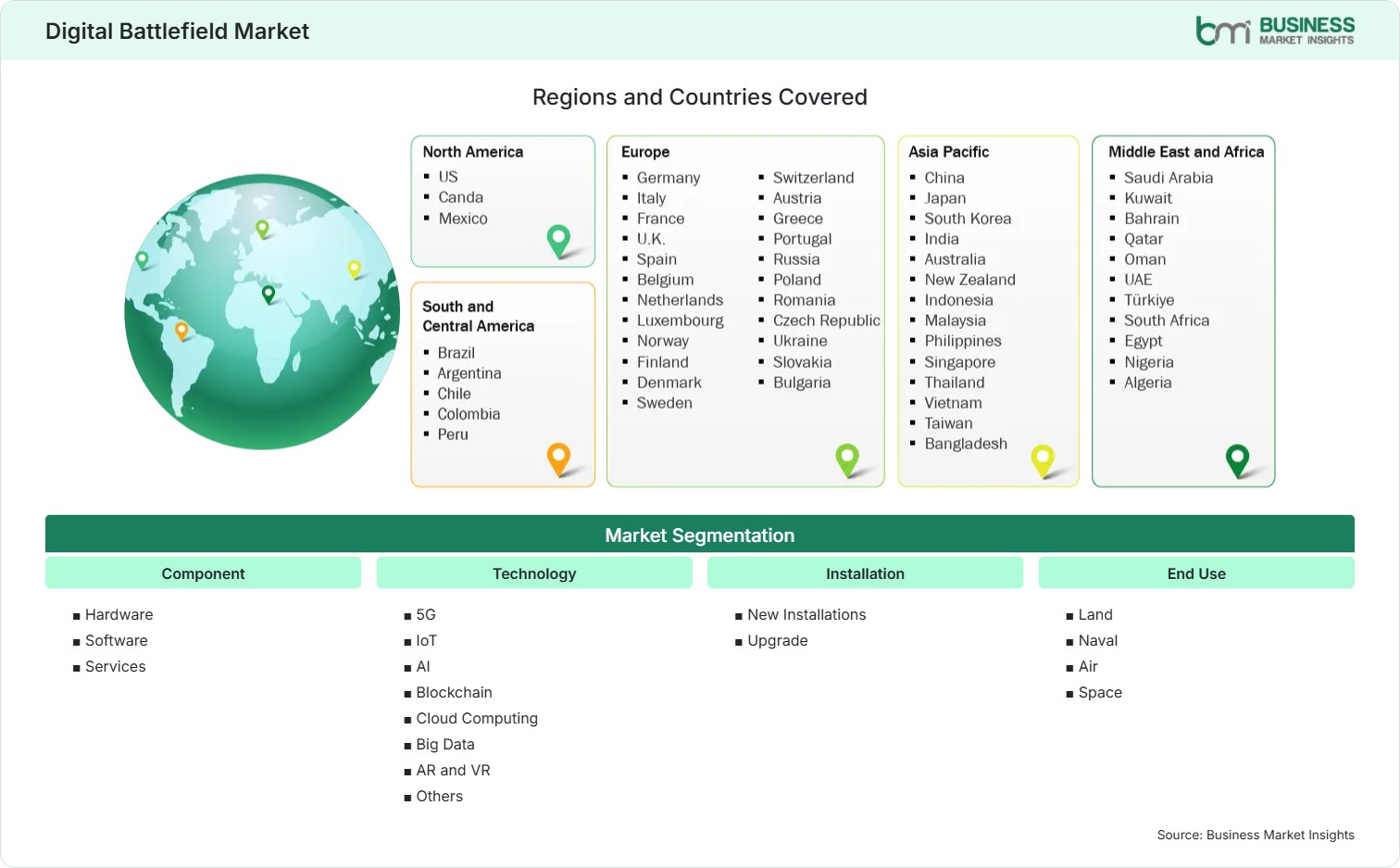
  • Component: Hardware, Software, Services
  • Technology: 5G, IoT, AI, Blockchain, Cloud Computing, Big Data, AR and VR, Others
  • Installation: New Installations, Upgrade
  • End Use: Land, Naval, Air, Space
US$ 82.65 Bn Market size in 2025
US$ 254.70 Bn Market Size by 2033
15.11% CAGR, 2026 - 2033
2026-2033 Forecast Period

AI Overview

Digital Battlefield Market Summary

  • North America Region: North America accounted for 34%–37% of global revenue in 2025 and is projected to register a CAGR of 14.7%–15.2% during 2026–2033. The region maintains a leading market position due to strong defense budgets, advanced military technology capabilities, and continuous investments in next-generation communication and battlefield management systems. The United States contributes approximately 85%–88% of regional revenue and is expected to register a CAGR of 14.8%–15.3% owing to extensive defense modernization initiatives, military AI adoption, and network-centric warfare development.
  • Fastest Growing Region: Asia Pacific represented 25%–28% of global revenue in 2025 and is projected to register the highest CAGR of 16.0%–16.5% during the forecast period. Increasing defense expenditure, modernization of military infrastructure, regional security concerns, and growing adoption of advanced communication technologies continue driving regional market expansion.
  • Leading Segment: Hardware accounted for 42%–45% of market revenue in 2025 and is projected to register a CAGR of 14.8%–15.3% during the assessment period owing to increasing deployment of communication equipment, sensors, surveillance systems, networking infrastructure, and battlefield hardware solutions.
  • High Growth Segment: AI technology is projected to witness significant growth, expanding at a CAGR of 18.0%–18.5% during 2026–2033 due to increasing adoption of artificial intelligence for intelligence analysis, autonomous decision support, predictive operations, and real-time battlefield management.
  • Key Market Opportunity: Expansion of defense digitization initiatives, development of next-generation combat communication systems, and increasing adoption of cloud-enabled military platforms continue creating significant growth opportunities.
  • Major Market Players: L3Harris Technologies, Inc., BAE Systems plc, RTX Corporation, Northrop Grumman Corporation, Lockheed Martin Corporation, Thales Group, Elbit Systems Ltd., Leonardo S.p.A., Saab AB, General Dynamics Corporation.
Strategic Insights

Digital Battlefield Market: Strategic Insights

Digital Battlefield Market Strategic Framework
FREE PDF
Request your free sample
Request free sample
Stakeholder View

Key Takeaways

  • The market continues benefiting from increasing defense modernization programs, rising adoption of network-centric warfare, growing military communication investments, and rapid integration of advanced digital technologies.
  • The strongest Digital Battlefield Market Growth opportunities continue emerging from defense digitization initiatives, AI-enabled military systems, cloud-based defense platforms, advanced communication networks, and multi-domain warfare solutions.
  • Hardware remains the dominant component segment owing to increasing deployment of battlefield communication equipment, sensors, surveillance systems, and defense networking infrastructure.
  • Asia Pacific is projected to witness the fastest growth owing to increasing defense expenditure, military modernization programs, regional security concerns, and adoption of advanced defense technologies.
  • Defense organizations are increasingly investing in AI, IoT, 5G connectivity, cloud computing, big data analytics, and autonomous systems to enhance battlefield intelligence and operational efficiency.
  • Companies focusing on secure communication platforms, interoperable defense systems, AI-enabled solutions, and next-generation military technologies are expected to strengthen their competitive positioning.
Geographic Outlook

Digital Battlefield Market Regional Highlights

North America Digital Battlefield Market

North America accounted for 34%–37% of global revenue in 2025 and is projected to register a CAGR of 14.7%–15.2% during 2026–2033. The region continues maintaining a leading position due to strong defense spending, advanced military technology infrastructure, and continuous investments in digital warfare capabilities. The Digital Battlefield Market Share remains significant as defense agencies increasingly adopt AI-enabled command systems, secure communication networks, cloud-based military platforms, and advanced battlefield intelligence solutions.

  • The United States remains the largest regional market owing to extensive defense modernization programs, high military expenditure, and strong investments in next-generation combat technologies.
  • Canada continues supporting regional growth through investments in defense communication systems, surveillance capabilities, and military digital transformation initiatives.
  • Increasing adoption of network-centric warfare strategies continues accelerating demand for connected battlefield platforms and interoperable defense systems.
  • Government investments in artificial intelligence, cybersecurity, satellite communication, and advanced military networks continue strengthening regional market development.

US Digital Battlefield Market

The United States accounted for approximately 85%–88% of North American revenue in 2025 and is projected to register a CAGR of 14.8%–15.3% during the forecast period. Strong defense modernization initiatives, increasing adoption of advanced military technologies, and growing demand for integrated battlefield management systems continue driving domestic market growth.

  • The U.S. Department of Defense continues investing in digital command and control systems, artificial intelligence, autonomous defense technologies, and secure communication networks.
  • Growing adoption of multi-domain operations is increasing demand for connected platforms capable of integrating land, naval, air, and space-based defense assets in digital battlefield market.
  • Expansion of military cloud infrastructure and data analytics capabilities continues improving real-time intelligence processing and decision-making.
  • Increasing focus on cybersecurity and resilient communication networks is encouraging investments in advanced defense technologies.

Europe Digital Battlefield Market

Europe represented 22%–25% of global revenue in 2025 and is expected to expand at a CAGR of 14.5%–15.0% during 2026–2033. The region continues benefiting from increasing defense modernization programs, rising security concerns, and investments in advanced military communication systems. Germany remains the largest regional market, while Poland is projected to register the fastest growth with a CAGR of 15.8%–16.3% owing to increasing defense spending, military modernization, and adoption of advanced battlefield technologies.

  • Germany continues leading regional demand through investments in military digitalization, secure communication platforms, and defense technology upgrades.
  • Poland continues witnessing strong growth due to increased defense investments, modernization of armed forces, and expansion of military infrastructure.
  • France continues supporting digital battlefield market expansion through development of advanced defense systems, aerospace capabilities, and military communication technologies.
  • European defense initiatives continue encouraging collaboration among governments and defense technology providers for integrated digital battlefield solutions.
  • Increasing adoption of AI, cybersecurity solutions, and cloud-enabled military platforms continues strengthening regional capabilities.

Asia Pacific Digital Battlefield Market

Asia Pacific accounted for 25%–28% of global revenue in 2025 and is projected to register the highest CAGR of 16.0%–16.5% during the forecast period. Increasing defense expenditure, geopolitical tensions, military modernization programs, and adoption of advanced digital technologies continue driving regional market expansion. China remains the leading regional market, while India is projected to register the fastest growth with a CAGR of 16.5%–17.0% owing to defense digitization initiatives, indigenous military technology development, and modernization of communication systems.

  • China continues dominating regional demand through large-scale defense investments, advanced military networking systems, and development of AI-enabled defense platforms.
  • India continues witnessing strong digital battlefield market growth through defense modernization programs, digital military initiatives, and increasing focus on indigenous defense technology development.
  • Japan continues supporting regional demand through investments in advanced surveillance systems, cybersecurity, and integrated defense communication networks.
  • South Korea continues contributing through military technology advancements, smart defense systems, and next-generation communication solutions.
  • Growing adoption of autonomous systems, unmanned platforms, and battlefield analytics continues creating new regional growth opportunities.

Rest of World Digital Battlefield Market

The Rest of World accounted for 10%–12% of global revenue in 2025 and is projected to register a CAGR of 14.8%–15.3% during 2026–2033. Latin America, the Middle East, and Africa continue strengthening market growth through increasing defense investments, security modernization initiatives, and adoption of advanced military communication technologies.

Growing focus on border security, surveillance capabilities, military modernization, and digital command infrastructure continues creating new opportunities for digital battlefield solution providers across emerging markets.

  • Saudi Arabia continues supporting regional demand through defense modernization programs, advanced surveillance investments, and military technology acquisition.
  • United Arab Emirates continues strengthening market growth through adoption of AI-enabled defense systems, advanced communication networks, and smart military technologies.
  • Brazil continues contributing through military modernization initiatives and investments in defense communication infrastructure.
  • South Africa continues supporting demand through defense technology upgrades and modernization of military capabilities.
  • Increasing adoption of secure communication systems, cloud-enabled defense platforms, and advanced battlefield technologies continues supporting long-term market expansion across emerging regions.
Global Market Geography
FREE PDF
Request your free sample
Request free sample
Segment Analysis

Digital Battlefield Market Segmentation

Component

The Component segment accounted for 42%–45% of market revenue in 2025 and is projected to register a CAGR of 14.8%–15.3% during the forecast period. Increasing adoption of advanced battlefield infrastructure, secure communication networks, and integrated military technologies continues supporting market expansion. The Digital Battlefield Market Trends indicate growing demand for connected defense hardware, software-driven command systems, and specialized services that enable real-time intelligence sharing and operational coordination.

  • Hardware: Hardware remains the dominant segment owing to increasing deployment of military communication equipment, sensors, surveillance systems, networking devices, battlefield computers, and advanced defense platforms. Rising demand for modernized military infrastructure continues encouraging defense organizations to invest in next-generation hardware solutions.
  • Software: Software continues witnessing significant growth through increasing adoption of artificial intelligence platforms, command and control systems, battlefield management software, analytics solutions, and cybersecurity applications. Software platforms enable improved data processing, mission planning, and real-time decision support.
  • Services: Services continue gaining importance through increasing demand for system integration, maintenance, cybersecurity support, training, consulting, and lifecycle management solutions. Defense organizations are increasingly partnering with technology providers to ensure effective deployment and operation of complex digital battlefield systems.

Technology

The Technology segment continues expanding as military organizations increasingly integrate advanced digital solutions to improve battlefield intelligence, communication efficiency, and operational effectiveness. The Digital Battlefield Market Scope continues broadening through adoption of emerging technologies across land, naval, air, and space defense operations.

  • 5G: 5G technology is gaining adoption due to its ability to provide high-speed, low-latency communication required for connected military platforms, autonomous systems, real-time data transmission, and advanced battlefield coordination.
  • IoT: IoT enables interconnected military equipment, sensors, vehicles, and communication systems, improving situational awareness, asset tracking, and operational efficiency across defense environments.
  • AI: AI represents one of the fastest-growing technology segments due to increasing utilization in intelligence analysis, autonomous systems, predictive maintenance, threat detection, and battlefield decision support.
  • Blockchain: Blockchain technology is being explored for secure military communications, data integrity, supply chain management, and authentication of sensitive defense information.
  • Cloud Computing: Cloud Computing continues gaining adoption as defense organizations increasingly utilize secure cloud platforms for data storage, analytics, collaboration, and scalable military operations.
  • Big Data: Big Data technologies support advanced intelligence processing by analyzing large volumes of battlefield information from sensors, surveillance systems, and communication networks.
  • AR and VR: AR and VR technologies are increasingly used for military training, simulation, mission planning, and enhanced battlefield visualization capabilities.
  • Others: Other technologies including robotics, autonomous systems, edge computing, and advanced analytics continue contributing to digital battlefield transformation.

Installation

The Installation segment represented 58%–61% of total market revenue in 2025 and is expected to expand at a CAGR of 14.9%–15.4% throughout the assessment period. Increasing military modernization programs and replacement of legacy defense infrastructure continue supporting demand across both new deployments and system upgrades.

  • New Installations: New Installations remain a major segment owing to increasing development of advanced military bases, next-generation communication networks, autonomous defense platforms, and integrated battlefield systems.
  • Upgrade: Upgrade activities continue witnessing strong growth as defense organizations modernize existing military infrastructure with AI capabilities, secure communication technologies, advanced sensors, and cloud-enabled platforms.

End Use

The End Use segment continues expanding as defense agencies increasingly adopt digital battlefield solutions across multiple operational domains. The growing requirement for coordinated multi-domain warfare capabilities is driving investments across land, naval, air, and space defense systems.

  • Land: Land-based applications represent a significant segment due to increasing deployment of battlefield communication systems, armored vehicle networking, soldier modernization programs, surveillance technologies, and command platforms.
  • Naval: Naval applications continue expanding through adoption of advanced maritime communication systems, vessel networking technologies, underwater surveillance solutions, and integrated naval combat systems.
  • Air: Air-based applications are gaining momentum through increasing deployment of advanced aircraft communication networks, unmanned aerial systems, aerospace intelligence platforms, and digital mission management technologies.
  • Space: Space applications continue witnessing growth due to increasing investments in military satellites, space-based communication systems, surveillance capabilities, and secure data transmission infrastructure.
Market Forces

Digital Battlefield Market Dynamics

Key Market Drivers

Increasing defense modernization programs worldwide

The defense establishments across the world are stepping up efforts to modernize their forces using digital technologies to upgrade their capabilities. The government agencies are working on development of connected defense environment, Artificial Intelligence driven platform, secure communication system, autonomous system, and command and control system integration.

Rising adoption of network-centric warfare systems

The rising popularity of network-centric warfare systems has led to the need for digital battlefield technologies that will provide smooth communication, data exchange, and coordination of forces. Connected defense solutions can offer better situational awareness and coordinated operations on land, maritime, and aerospace fronts.

Growing investments in advanced military communication

Advancements in the construction of military communication infrastructure are contributing towards the adoption of technology for the digital battlefield. Military organizations have started using various tools such as secure communication systems, satellite communications, 5G connectivity, and encryption tools for ensuring communication and effective operations during missions.

Key Market Opportunities

Expansion of defense digitization initiatives across regions

The expansion of defense digitization initiatives across regions is creating significant growth opportunities for digital battlefield solution providers. Governments are focusing on transforming traditional military operations through connected defense ecosystems, automated command systems, intelligent surveillance platforms, and advanced analytics solutions to strengthen battlefield preparedness and operational capabilities.

Development of next-generation combat communication systems

The development of next-generation combat communication systems is creating new opportunities as defense organizations seek faster, secure, and interoperable communication solutions. Advanced technologies integrating artificial intelligence, 5G networks, satellite communication, and cloud platforms are enabling improved coordination between military personnel, vehicles, and defense systems.

Increasing adoption of cloud-enabled military platforms

Increasing adoption of cloud-enabled military platforms is supporting improved data management, mission planning, collaboration, and intelligence processing. Secure cloud-based defense solutions provide scalable infrastructure for managing large volumes of battlefield data while enabling real-time analytics, faster decision-making, and enhanced operational efficiency.

Market Restraints and Challenges

High deployment costs affecting defense technology adoption

Factor: Digital warfare solutions demand significant spending on state-of-the-art hardware, communications infrastructure, artificial intelligence systems, cloud computing systems, sensors, cybersecurity systems, and military hardware. Large expenses incurred in researching, developing, deploying, integrating, and maintaining sophisticated military technologies may pose financial problems to defense organizations, especially nations whose military budgets are restricted.

Impact: Significant expenditure involved in deploying digital warfare solutions will make the adoption of digital warfare solutions slow among defense organizations, especially those in emerging defense markets. Defense organizations have been able to overcome this factor by implementing solutions in phases, government funding, technology partnerships, and optimizing investments through scalable digital defense systems.

Cybersecurity vulnerabilities impacting digital battlefield systems

Factor: The growing digitalization of military activities poses cyber security threats, such as cyber-attacks, data breaches, disruption of communication channels, and hacking of confidential defense information. Digital battlefields depend on network connectivity, cloud computing services, use of artificial intelligence, and data transfer technologies.

Impact: The cybersecurity threats might have an impact on the mission effectiveness, operational security, and efficiency of the connected defense systems. Military and defense organizations are implementing new advanced encryption systems, zero trust cybersecurity approaches, threat intelligence, and cyber resilient architecture to prevent cyber-attacks.

Company Analysis

Competitive Landscape

Competition within the digital battlefield industry is driven by technological innovation, defense contracts, cybersecurity capabilities, system integration expertise, advanced communication solutions, and research investments. The Digital Battlefield Market Analysis indicates that leading defense companies are focusing on AI-enabled warfare solutions, secure communication networks, cloud-based military platforms, autonomous systems, and multi-domain operational technologies to strengthen their market positions.

Company Name

Overview

Products and Services relevant to this market

L3Harris Technologies, Inc.

Global defense technology company specializing in communication systems and mission-critical solutions.

Tactical communication systems, battlefield networking solutions, secure communications, intelligence systems, and defense electronics.

BAE Systems plc

Leading defense and aerospace company providing advanced military technologies.

Digital battlefield systems, electronic warfare solutions, command and control systems, cybersecurity solutions, and military communication technologies.

RTX Corporation

Global aerospace and defense company developing advanced military technologies.

Integrated defense systems, secure communication platforms, sensors, missile systems, and battlefield intelligence solutions.

Northrop Grumman Corporation

Defense technology company focused on advanced military systems and autonomous solutions.

Command and control systems, cyber solutions, unmanned systems, surveillance technologies, and digital battlefield platforms.

Lockheed Martin Corporation

Global defense contractor providing advanced military technologies and integrated defense solutions.

Network-centric warfare systems, military communication platforms, AI-enabled defense technologies, and integrated combat systems.

Thales Group

International technology company serving defense, aerospace, and security industries.

Military communication systems, cybersecurity solutions, battlefield management systems, and digital defense platforms.

Elbit Systems Ltd.

Defense technology provider specializing in land, air, and naval systems.

Command and control systems, unmanned systems, electronic warfare solutions, battlefield intelligence, and defense electronics.

Leonardo S.p.A.

Aerospace and defense company providing advanced military technologies.

Defense electronics, communication systems, surveillance solutions, aerospace technologies, and digital mission systems.

Saab AB

Swedish defense and security company focused on advanced military solutions.

Tactical communication systems, battlefield management solutions, surveillance technologies, and defense digital platforms.

General Dynamics Corporation

Global defense company providing military platforms and information systems.

Combat systems, defense communication networks, command systems, cybersecurity solutions, and mission support technologies.

Trust & Transparency

Research Methodology

The market analysis combines proprietary research with secondary data from government agencies, company disclosures, regulatory filings, industry databases and expert interviews. Market estimates are validated through data triangulation, cross-market benchmarking and analyst review.

View Full Research Methodology

Questions Answered

Frequently Asked Questions

How do market forecasts support strategic planning?

Digital Battlefield Market Forecasts help defense organizations, technology providers, military equipment manufacturers, investors, and government agencies evaluate future demand, identify growth opportunities, optimize technology investments, and support long-term defense modernization strategies.

What does the market report include?

The Digital Battlefield Market Report provides comprehensive insights covering market size, competitive landscape, segmentation analysis, regional outlook, industry trends, investment opportunities, competitive benchmarking, and future growth prospects.

What factors are driving market expansion?

Increasing defense modernization programs, rising adoption of network-centric warfare, growing investments in military communication systems, and integration of advanced digital technologies continue driving market growth.

Which technology segment is expected to witness significant growth?

AI is expected to witness strong growth due to increasing adoption in intelligence analysis, autonomous defense systems, predictive operations, threat detection, and battlefield decision support.

Which component dominates the market?

Hardware represents the leading component segment owing to increasing deployment of communication equipment, sensors, surveillance systems, networking infrastructure, and advanced military platforms.

Access the Full Digital Battlefield Market Report

Get segment-level forecasts, regional estimates, competitive benchmarking, company profiles and downloadable Excel datasets.

Access the full Digital Battlefield Market Report
350 pages PDF & Excel | 2026-08-07