
Digital Transformation Market Outlook: Size, Share, Trends, Growth Analysis, Competitive Landscape & Forecast, 2026-2033

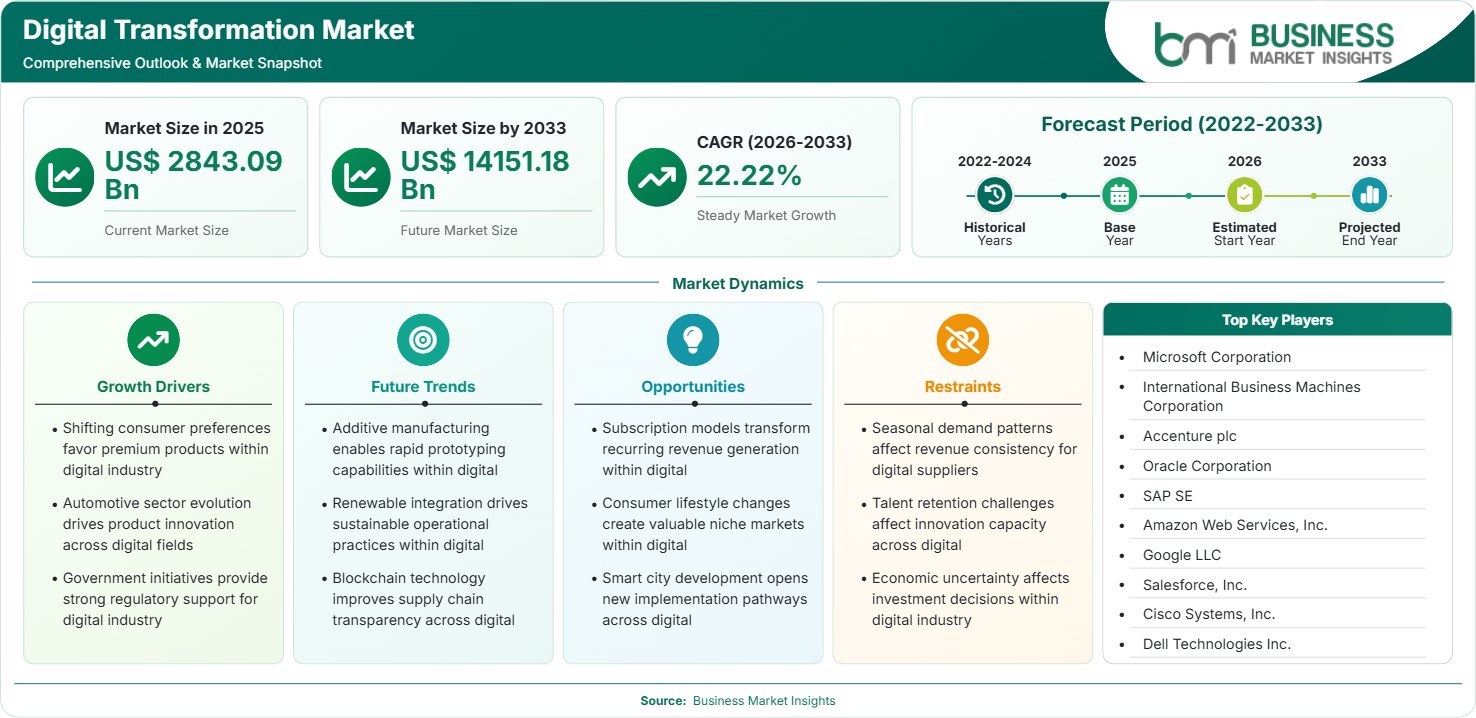
The Digital Transformation Market size was valued at US$ 2843.09 Billion in 2025 and is projected to reach US$ 14151.18 Billion by 2033, growing at a CAGR of 22.22% during 2026–2033. Key drivers include enterprise AI integration, cloud modernization, cybersecurity investments, industrial automation, connected ecosystems, and data-driven operating models. Major opportunities stem from generative AI deployment, industry cloud platforms, digital public infrastructure, and intelligent process automation.

Report Coverage
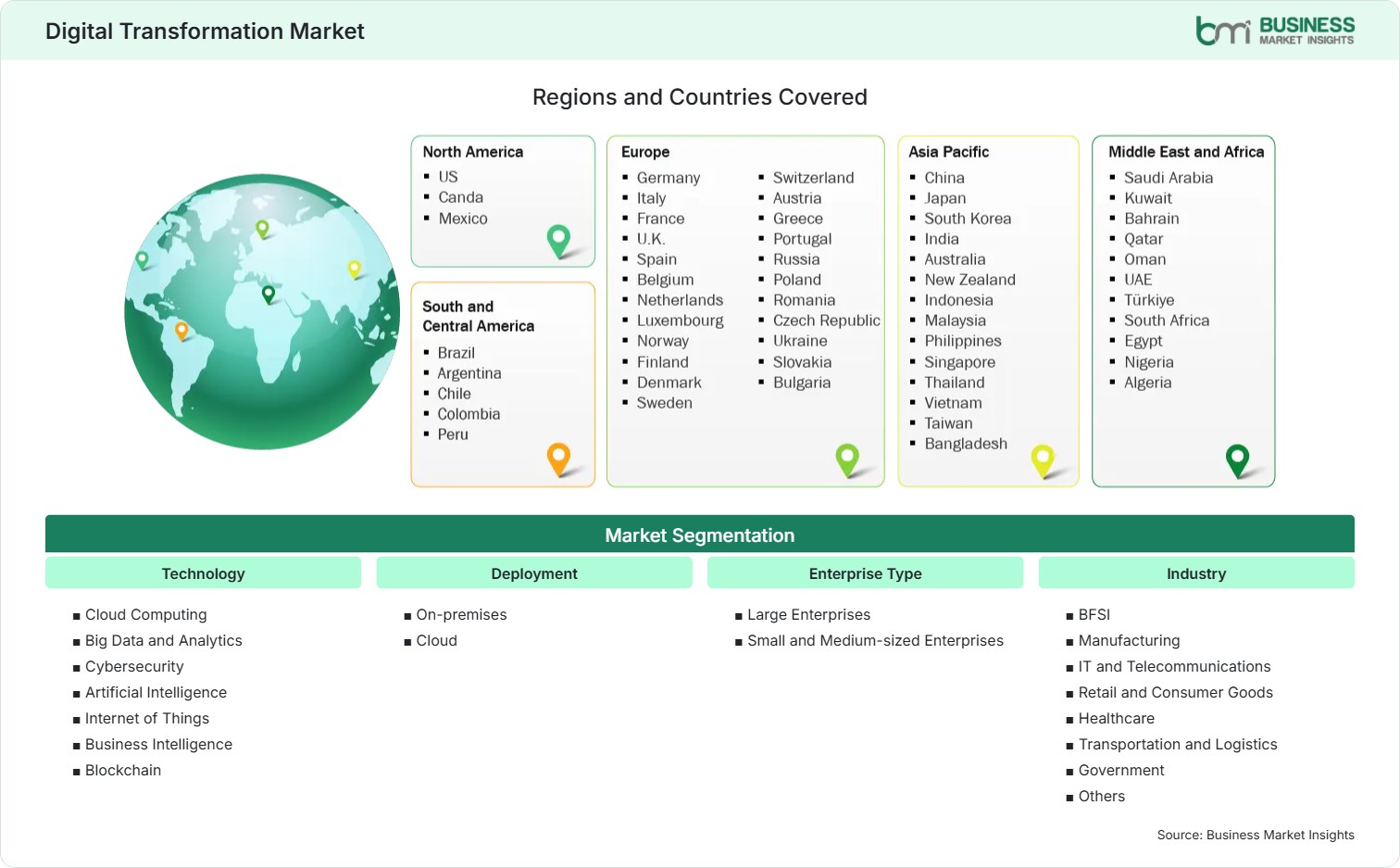
  • Technology: Cloud Computing, Big Data and Analytics, Cybersecurity, Artificial Intelligence , Internet of Things , Business Intelligence, Blockchain
  • Deployment: On-premises, Cloud
  • Enterprise Type: Large Enterprises, Small and Medium-sized Enterprises
  • Industry: BFSI, Manufacturing, IT and Telecommunications, Retail and Consumer Goods, Healthcare, Transportation and Logistics, Government, Others
US$ 2843.09 Bn Market size in 2025
US$ 14151.18 Bn Market Size by 2033
22.22% CAGR, 2026 - 2033
2026-2033 Forecast Period

AI Overview

Digital Transformation Market Summary

  • North America Region: Holds a market share of 35%–38% in 2025, growing with a CAGR of 20%–22% during 2026–2033, supported by accelerated enterprise AI adoption, hyperscale cloud investments, cybersecurity modernization initiatives, digital workplace transformation, and strong public-private innovation ecosystems driving sustained technology spending. Brief U.S. analysis: Strong enterprise technology spending, AI platform deployment, and cloud migration programs support a CAGR of 20%–22% through 2033.
  • Fastest Growing Region: Asia Pacific holds a market share of 27%–30% in 2025, expanding at a CAGR of 24%–26% during 2026–2033, fueled by industrial digitization, smart manufacturing, government digitalization programs, rising startup activity, expanding cloud infrastructure, and increasing enterprise technology investments.
  • Leading Segment: Cloud Computing holds a market share of 24%–27% in 2025 and advances at a CAGR of 22%–24% through 2033, supported by hybrid infrastructure strategies, workload modernization, flexible scalability, operational efficiency improvements, and enterprise application transformation initiatives.
  • High Growth Segment: Artificial Intelligence (AI) holds a market share of 16%–19% in 2025 and grows at a CAGR of 28%–30% through 2033, driven by generative AI deployment, predictive analytics adoption, intelligent automation requirements, and evolving data monetization strategies.
  • Key Market Opportunity: Enterprises increasingly combine AI, IoT, analytics, and cloud-native platforms to create autonomous operations, enabling measurable productivity gains, stronger resilience, improved customer experiences, and scalable digital business models.
  • Major Market Players: Microsoft Corporation, International Business Machines Corporation, Accenture plc, Oracle Corporation, SAP SE, Amazon Web Services, Inc., Google LLC, Salesforce, Inc., Cisco Systems, Inc., Dell Technologies Inc.
Strategic Insights

Digital Transformation Market: Strategic Insights

Digital Transformation Market Strategic Framework
FREE PDF
Request your free sample
Request free sample
Stakeholder View

Key Takeaways

  • The ecosystem increasingly integrates cloud providers, software vendors, cybersecurity firms, consulting partners, systems integrators, and telecom operators, creating interconnected value chains supporting end-to-end enterprise modernization.
  • AI-powered automation, intelligent analytics, industry clouds, and digital process orchestration represent the highest-value opportunities due to measurable productivity improvements and increasing demand for scalable digital operations.
  • R&D priorities are shifting toward generative AI, digital twins, autonomous enterprise systems, explainable AI governance, and low-code development platforms that accelerate modernization cycles.
  • Asia Pacific offers one of the strongest investment cases, supported by enterprise digitization, government technology initiatives, large mobile populations, expanding cloud infrastructure, and manufacturing sector modernization.
  • Strategic acquisitions increasingly focus on AI-native providers, cybersecurity specialists, data platform developers, and cloud consulting firms as organizations expand portfolio capabilities.
  • Industry-specific transformation platforms tailored for healthcare, banking, retail, and logistics are generating stronger adoption rates than generalized enterprise technology deployments.
Geographic Outlook

Digital Transformation Market Regional Highlights

North America Digital Transformation Market

North America accounts for 35%–38% of the Digital Transformation Market share in 2025 and is projected to grow at a CAGR of 20%-22% through 2033. Heavy adoption of the enterprise cloud, AI adoption, and cybersecurity spending further support regional dominance. Huge tech budget allocations in BFSI, healthcare, and telecom drive automation spending. Federal initiatives for digital transformation, along with growth in hyperscale data centers, are boosting innovation. The region has a strong digital environment, high enterprise software penetration, advanced networks, and a tech consultancy sector.

  • Cloud migration remains a strategic priority as enterprises modernize legacy infrastructure and support hybrid work environments.
  • Generative AI deployments are expanding rapidly across customer service, software development, and enterprise knowledge management functions.
  • Cybersecurity investment growth is reinforced by increasingly complex compliance requirements and rising ransomware risks.
  • Manufacturing companies leverage digital twins, predictive maintenance, and industrial IoT platforms to improve operational performance.
  • Venture capital activity continues supporting emerging software, analytics, and automation technology providers.

US Digital Transformation Market

The United States represents 75%–78% of the regional market and advances at a CAGR of 20%–22%. Enterprise technology spending remains among the highest globally, supported by widespread AI adoption and cloud transformation strategies. Financial institutions and healthcare networks accelerate digital platform investments. Innovation clusters across California, Texas, Massachusetts, and Washington contribute to technology commercialization and large-scale deployment activity. Advanced digital infrastructure and strong software ecosystems sustain robust demand.

  • AI-driven productivity platforms are becoming core components of enterprise operational strategies.
  • Banking institutions continue modernizing digital customer engagement and risk management frameworks.
  • Healthcare providers increasingly deploy cloud-enabled analytics and interoperable digital health platforms.
  • Federal agencies accelerate modernization projects focused on cybersecurity resilience and service delivery.

Europe Digital Transformation Market

Europe holds 24%–27% market share in 2025 and expands at a CAGR of 21%–23%. Germany leads adoption through industrial digitalization initiatives, while the United Kingdom demonstrates strong cloud modernization activity. High-growth markets include Poland and Spain, supported by digital economy programs. Regulatory frameworks focused on data privacy, digital sovereignty, and AI governance encourage structured technology investments. Manufacturing, automotive, and financial services sectors remain significant adopters of advanced transformation platforms across the region.

  • Industrial automation programs strengthen demand for connected manufacturing technologies.
  • Digital sovereignty initiatives stimulate regional cloud and cybersecurity investments.
  • Banks increasingly integrate analytics platforms to enhance compliance and customer intelligence.
  • Smart city projects expand demand for IoT-enabled operational infrastructure.
  • Sustainability goals encourage deployment of energy-efficient digital architectures.

Asia Pacific Digital Transformation Market

The Asia-Pacific region holds a 27%-30% share and witnesses the highest CAGR of 24%-26%. China remains the largest market, and India stands out for its highest growth potential. The presence of government initiatives towards digitalization, growing usage of enterprise clouds, and increasing investments in AI help drive regional growth. Programs on manufacturing automation in China, Japan, South Korea, and the rest of Southeast Asia speed up the adoption of intelligent solutions. Strong startup ecosystems and expanding digital infrastructure reinforce long-term competitiveness and innovation capacity.

  • India benefits from expanding digital public infrastructure and enterprise software adoption.
  • China continues investing heavily in AI, smart manufacturing, and industrial internet development.
  • Southeast Asia attracts increasing cloud infrastructure and data center investments.
  • Retail digitization accelerates omnichannel commerce and customer analytics adoption.
  • Telecommunications operators leverage 5G deployment to expand digital service ecosystems.

Rest of World Digital Transformation Market

Rest of World accounts for 10% to 12% of worldwide revenues and is growing at a compound annual growth rate of 22% to 24% through 2033. There is robust momentum in South & Central America, driven by efforts toward banking and retail digitalization. Brazil is the biggest market here, whereas Colombia is showing accelerated technology adoption. Digital government programs and smart cities, along with cloud investments, are contributing to growth in the Middle East and Africa. Saudi Arabia and the UAE lead regional modernization efforts, creating substantial opportunities for enterprise transformation.

  • Digital banking expansion drives growing demand for cloud and analytics technologies.
  • Smart city investments accelerate adoption of connected operational platforms.
  • Public sector modernization strengthens regional technology procurement activity.
  • Cloud ecosystem development encourages local enterprise digitization programs.
  • Logistics and transportation sectors increasingly adopt automation and predictive analytics tools.
Global Market Geography
FREE PDF
Request your free sample
Request free sample
Segment Analysis

Digital Transformation Market Segmentation

Technology

Technology emerges as the biggest slice, with a market share of 38%–41% in 2025 and 23%–25% CAGR. The scope of the Digital Transformation Market in the technology industry continues to expand through the integration of cloud computing, AI, cybersecurity, analytics, and blockchain solutions to drive transformation and modernization.

  • Cloud Computing: Enables scalable infrastructure modernization, application migration, and flexible workload management while supporting agile operating models and enterprise-wide digital acceleration.
  • Big Data and Analytics: Supports real-time insights, predictive decision-making, and performance optimization across customer engagement, operations, and risk management functions.
  • Cybersecurity: Strengthens enterprise resilience through advanced threat detection, identity management, governance frameworks, and compliance-centered digital transformation programs.
  • Artificial Intelligence (AI): Accelerates intelligent automation, predictive analytics, conversational interfaces, and autonomous decision support across business functions.
  • Internet of Things (IoT): Connects assets, devices, and infrastructure to enhance visibility, automation, and operational efficiency across industries.
  • Business Intelligence: Enhances performance monitoring and executive decision-making through centralized reporting, visualization, and data-driven management capabilities.
  • Blockchain: Improves transaction transparency, trust, traceability, and digital asset management across distributed enterprise networks.

Deployment

Deployment Models capture 27% - 30% market share by 2025 and witness a CAGR of 21% - 23%. Organizations maintain a balance among security, flexibility, and compliance requirements through hybrid model architectures. According to the Digital Transformation Market Trends, there is an emerging trend towards cloud-oriented deployment models.

  • On-premises: Remains relevant for organizations requiring strict control over sensitive data, mission-critical applications, and regulatory compliance requirements.
  • Cloud: Supports rapid scalability, lower infrastructure complexity, enhanced collaboration, and accelerated adoption of advanced digital technologies.

Enterprise Type

Enterprise-type segmentation accounts for 18%–21% of market share and grows at a CAGR of 22%–24%. Large enterprises continue to dominate adoption, whereas small and medium enterprises adopt via subscription, which supports the platforms' affordability and implementation flexibility.

  • Large Enterprises: Drive significant spending on enterprise-wide modernization programs, complex integrations, and advanced technology deployment.
  • Small and Medium-sized Enterprises: Adopt cloud services, automation platforms, and digital customer engagement tools to improve competitiveness.

Industry

Industry-based applications have a market share of 31%–34% in 2025 and will expand at 22%–24% CAGR. Sector-specific transformation needs influence unique application practices and technology adoption methods.

  • BFSI: Focuses on digital banking, fraud analytics, customer personalization, compliance automation, and cybersecurity modernization.
  • Manufacturing: Utilizes smart factories, digital twins, industrial IoT, and predictive maintenance to improve productivity.
  • IT and Telecommunications: Advances service delivery through cloud-native platforms, network automation, and AI-enabled customer support.
  • Retail and Consumer Goods: Enhances omnichannel engagement, inventory optimization, and personalized consumer experiences through analytics.
  • Healthcare: Supports telehealth, electronic records interoperability, predictive analytics, and patient-centered digital services.
  • Transportation and Logistics: Improves fleet visibility, route optimization, predictive maintenance, and supply chain intelligence.
  • Government: Modernizes public services, digital identity initiatives, cybersecurity frameworks, and citizen engagement platforms.
Market Forces

Digital Transformation Market Dynamics

Key Market Drivers

Enterprise AI Adoption Accelerating Process Modernization

Enterprises are increasingly adopting AI-based automation solutions to enhance workflow efficiency, accelerate decision-making, and reduce operational expenses. Based on observations of leading tech vendors, enterprise AI adoption is increasing across customer support, analytics, software engineering, and operations management. The growth of the digital transformation market is increasingly tied to enterprises' adoption of machine learning and generative AI capabilities. With data becoming increasingly abundant and real-time insights required more than ever, adoption is being further enabled. AI solutions have become critical as corporations strive to improve productivity and distinguish themselves through their operations. In light of this, as companies focus on increasing productivity and competitive differentiation, AI systems are becoming vital components of modernization across the banking, health care, manufacturing, retail, and government sectors.

Cloud Infrastructure Modernization Across Industries

Cloud computing is an integral part of the digital transformation process for enterprises. Legacy applications are migrated to scalable cloud environments to improve resilience, collaboration, and agility. Cloud services across industries can be used to develop solutions for specific industries, thereby increasing implementation speed and minimizing customization. The use of multi-cloud and hybrid cloud strategies is gaining popularity among businesses to improve performance, regulatory compliance, and risk management. According to Digital Transformation Market trends, there is a growing need for infrastructure due to its opportunities for rapid innovation and operational model transformation. Cloud platforms also enable the deployment of AI and analytics, and enable workforce collaboration around the world.

Expansion of Connected Ecosystems and IoT Networks

The proliferation of connected devices, industrial sensors, and intelligent infrastructure generates new digital capabilities across industries. Manufacturing companies leverage industrial IoT technologies to monitor assets and improve maintenance efficiency. Transportation networks use connected systems to improve visibility in logistics and increase efficiency. The healthcare industry is increasingly using connected healthcare devices and remote monitoring technologies. With the increasing importance of real-time operational intelligence, IoT networks form the base for automation and analytics. The increase in investment in connectivity technologies, alongside advances in edge computing capabilities, makes IoT network adoption easier for all sorts of organizations.

Key Market Opportunities

Generative AI Integration Across Enterprise Functions

There are considerable business opportunities for software companies, consultants, and enterprises in adopting generative AI technology. The use of advanced models enables content creation, software engineering, customer engagement, and knowledge management. Enterprises are beginning to make budget provisions towards experimentation and deployments. According to Digital Transformation Market Forecasts, there is a growing need for enterprise-level governance, security, and integration capabilities to ensure successful deployment. Software companies offering vertical industry solutions through AI can derive greater value from specialized use cases. There is long-term potential for process automation and new revenue streams.

Industry-Specific Digital Platforms and Ecosystems

Vertical digital platforms have significant growth potential because companies are focusing on delivering results rather than just rolling out technology. Financial institutions need custom compliance automation and risk intelligence platforms. Hospitals need interoperable digital ecosystems to provide patient-centered services. Manufacturers want connected operations with industrial analytics capabilities. Vertical solutions improve implementation efficiency and meet the requirements of regulators and businesses. Increasing demand for vertical platforms can be seen as transformation programs become more advanced. Providers of integrated cloud, AI, analytics, and cybersecurity products will see more procurement opportunities and longer customer relationships.

Digital Government and Smart Infrastructure Programs

Governments around the world continue to invest in areas such as digital public services, smart cities, and national digitization programs. All of these provide many opportunities for cloud providers, cybersecurity firms, analytics providers, and systems integrators. Investment is growing in digital identities, citizen services portals, transportation management platforms, and connected infrastructure solutions. Modernizing the public sector not only helps drive digital ecosystems but also improves infrastructure preparedness and technology adoption. Long-term programs in the Middle East, Asia-Pacific, and Europe are anticipated to drive sustained demand.

Market Restraints and Challenges

Data Privacy and Regulatory Complexity

Factor: Expanding global data protection requirements increase compliance complexity for organizations operating across multiple jurisdictions. Impact: Enterprises face higher implementation costs, delayed deployment timelines, and increased governance obligations. Regulations concerning data residency, privacy management, cybersecurity, and AI accountability require substantial investment in compliance frameworks. Organizations must balance innovation objectives with legal obligations while maintaining operational efficiency. Regulatory fragmentation can complicate cloud adoption strategies and cross-border data utilization. Technology suppliers increasingly need embedded governance capabilities to help customers manage risk and satisfy evolving compliance requirements throughout transformation initiatives.

Talent Shortages and Legacy System Integration Constraints

Factor: Demand for cloud architects, AI engineers, cybersecurity specialists, and data scientists continues exceeding workforce availability. Impact: Skills shortages and integration difficulties slow modernization programs and increase project costs. Many organizations must maintain legacy infrastructures while simultaneously deploying advanced digital technologies. Complex integration environments create operational risks and implementation delays. Shortages of specialized expertise can restrict technology utilization and reduce expected transformation outcomes. Enterprises increasingly invest in workforce reskilling, managed services, and automation solutions to address capability gaps and accelerate modernization roadmaps.

Company Analysis

Competitive Landscape

The Digital Transformation Market analysis reflects a competitive environment characterized by cloud platform providers, enterprise software developers, consulting firms, and digital infrastructure specialists.

Company Name

Overview

Products and Services relevant to this market

Microsoft Corporation

Global technology leader with extensive cloud, AI, and enterprise productivity ecosystems supporting transformation initiatives.

Azure, Microsoft 365, Dynamics 365, Power Platform, AI and cybersecurity solutions.

International Business Machines Corporation

Enterprise technology and consulting provider focused on hybrid cloud, AI, and modernization services.

WatsonX, hybrid cloud platforms, consulting services, automation and analytics solutions.

Accenture plc

Global professional services company supporting enterprise reinvention and digital transformation projects.

Cloud migration, AI services, cybersecurity, managed services, industry consulting.

Oracle Corporation

Enterprise software and cloud provider serving large organizations across industries.

Oracle Cloud Infrastructure, ERP, analytics, database, and AI solutions.

SAP SE

Leading enterprise application software provider supporting operational digitization.

SAP S/4HANA, business process automation, analytics, cloud ERP platforms.

Amazon Web Services, Inc.

Major cloud infrastructure provider enabling scalable digital operations.

Compute, storage, analytics, AI, IoT, and cloud modernization services.

Google LLC

Technology company delivering cloud, AI, analytics, and productivity solutions.

Google Cloud, AI platforms, data analytics, machine learning services.

Salesforce, Inc.

Customer relationship technology provider focused on digital engagement.

CRM platforms, automation tools, analytics, AI-enabled customer solutions.

Cisco Systems, Inc.

Networking and cybersecurity specialist supporting digital infrastructure modernization.

Enterprise networking, collaboration tools, security platforms, observability solutions.

Dell Technologies Inc.

Infrastructure and services company supporting hybrid IT environments.

Servers, storage, edge solutions, cloud infrastructure, digital workplace services.

Trust & Transparency

Research Methodology

The market analysis combines proprietary research with secondary data from government agencies, company disclosures, regulatory filings, industry databases and expert interviews. Market estimates are validated through data triangulation, cross-market benchmarking and analyst review.

View Full Research Methodology

Questions Answered

Frequently Asked Questions

What does this Digital Transformation Market Report help stakeholders evaluate?

The report helps stakeholders assess technology adoption patterns, competitive positioning, investment opportunities, regional demand dynamics, enterprise spending priorities, and future innovation pathways.

What factors make Asia Pacific the fastest-growing region?

Government digitization initiatives, expanding cloud infrastructure, manufacturing modernization programs, startup ecosystem growth, and increasing enterprise technology investments accelerate regional expansion.

How do SMEs benefit from transformation initiatives?

SMEs gain access to scalable cloud services, subscription-based software, automation capabilities, and analytics tools without requiring substantial upfront infrastructure investments.

Which technology category generates the largest revenue contribution?

Cloud computing remains the largest revenue-generating technology category because it serves as the foundational infrastructure for AI, analytics, cybersecurity, and application modernization initiatives.

What industries are adopting digital transformation most rapidly?

BFSI, manufacturing, healthcare, retail, and telecommunications sectors are leading adoption due to automation requirements, compliance needs, customer experience priorities, and increasing demand for real-time operational intelligence.

Access the Full Digital Transformation Market Report

Get segment-level forecasts, regional estimates, competitive benchmarking, company profiles and downloadable Excel datasets.

Access the full Digital Transformation Market Report
350 pages PDF & Excel | 2026-09-11
Similar Research

Related Market Reports