
Digital Thread Market Outlook: Size, Share, Trends, Growth Analysis, Competitive Landscape & Forecast, 2026-2033

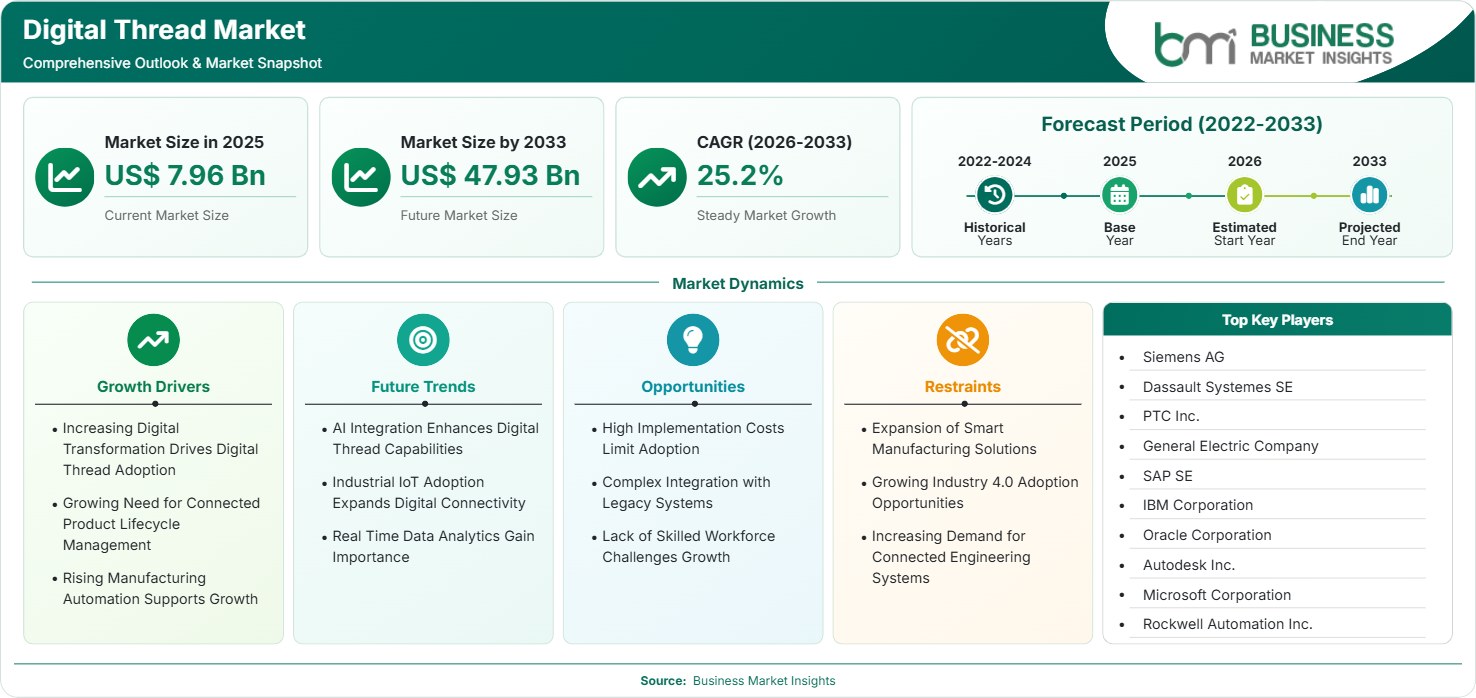
The Digital Thread Market size was valued at US$ 7.96 billion in 2025 and is projected to reach US$ 47.93 billion by 2033, growing at a CAGR of 25.2% during 2026–2033, driven by Industry 4.0 adoption, connected manufacturing initiatives, lifecycle data integration, automation expansion, and increasing demand for real-time engineering intelligence.

Report Coverage
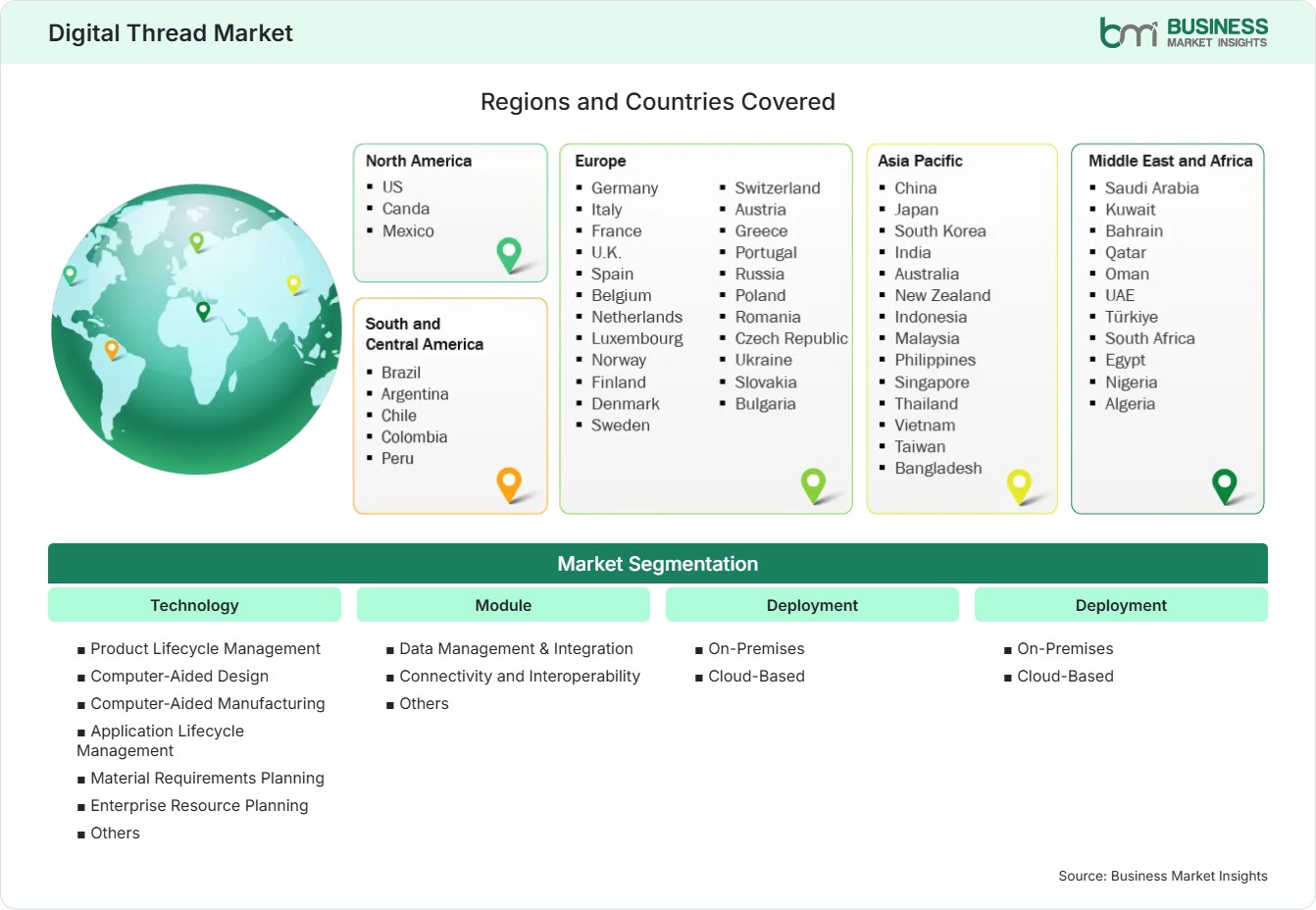
  • Technology: Product Lifecycle Management, Computer-Aided Design, Computer-Aided Manufacturing, Application Lifecycle Management, Material Requirements Planning, Enterprise Resource Planning, Others
  • Module: Data Management & Integration, Connectivity and Interoperability, Others
  • Deployment: On-Premises, Cloud-Based
  • Deployment: On-Premises, Cloud-Based
US$ 7.96 Bn Market size in 2025
US$ 47.93 Bn Market Size by 2033
25.2% CAGR, 2026 - 2033
2026-2033 Forecast Period

01 AI Overview

Digital Thread Market Summary

  • North America Region: North America holds market share of 34%–37% in 2025, growing with a CAGR of 24%–26% influenced by advanced manufacturing ecosystems, industrial digitalization, cloud adoption, and investments in connected engineering platforms. The US market demonstrates strong growth with a CAGR of 24%–26% from 2026–2033 supported by smart factory initiatives, enterprise software adoption, and automation investments.
  • Fastest Growing Region: Asia Pacific holds market share of 28%–31% in 2025, growing with a CAGR of 27%–29% supported by manufacturing modernization, Industry 4.0 investments, industrial automation expansion, and increasing adoption of digital engineering solutions.
  • Leading Segment: Product Lifecycle Management (PLM) holds market share of 32%–35% in 2025, growing with a CAGR of 25%–27% influenced by demand for lifecycle visibility, collaborative engineering, product innovation, and connected design-to-production workflows.
  • High Growth Segment: Cloud-Based deployment holds market share of 40%–43% in 2025, growing with a CAGR of 28%–30% driven by scalability, remote collaboration, reduced infrastructure requirements, and increasing enterprise migration toward cloud platforms.
  • Key Market Opportunity: Opportunities are concentrated in smart manufacturing, Industry 4.0 implementation, connected engineering systems, cloud platforms, industrial analytics, and integrated product lifecycle management solutions.
  • Major Market Players: Siemens AG, Dassault Systèmes SE, PTC Inc., General Electric Company, SAP SE, IBM Corporation, Oracle Corporation, Autodesk Inc., Microsoft Corporation, Rockwell Automation Inc.
02 Strategic Insights

Digital Thread Market: Strategic Insights

Digital Thread Market Strategic Framework
FREE PDF
Request your free sample
Request free sample
03 Stakeholder View

Key Takeaways

  • Industrial value chains are shifting toward connected ecosystems where product data flows continuously across design, manufacturing, operations, and service functions.
  • Manufacturing industries present strong growth opportunities as companies invest in smart factory platforms, automation technologies, and integrated engineering solutions.
  • Innovation is focusing on cloud-native architectures, artificial intelligence integration, digital twins, and advanced analytics capabilities to improve lifecycle intelligence.
  • Asia Pacific provides significant investment opportunities due to expanding manufacturing capacity, industrial modernization programs, and increasing adoption of Industry 4.0 technologies.
  • Technology providers are strengthening market positions through strategic partnerships, software portfolio expansion, acquisitions, and development of integrated digital platforms.
  • Enterprise adoption is increasingly influenced by interoperability, cybersecurity capabilities, scalability, and the ability to integrate existing industrial systems.
04 Geographic Outlook

Digital Thread Market Regional Highlights

North America Digital Thread Market

North America accounts for a 34%–37% share in 2025 with a CAGR of 24%–26% during 2026–2033. The region benefits from advanced manufacturing infrastructure, strong software adoption, industrial automation investments, and enterprise digital transformation initiatives. The Digital Thread Market share in North America is supported by aerospace, automotive, and industrial sectors adopting connected lifecycle management solutions to improve efficiency and innovation.

  • United States and Canada are expanding digital manufacturing adoption through automation and enterprise software investments.
  • Manufacturers are integrating lifecycle management platforms to improve engineering collaboration and operational visibility.
  • Cloud-based industrial solutions are gaining adoption across large and mid-sized enterprises.
  • Aerospace and automotive industries are driving demand for connected product development environments.

US Digital Thread Market

The US holds a 29%–32% share in 2025 with a CAGR of 24%–26% from 2026–2033. The market is supported by advanced industrial capabilities, strong technology infrastructure, and increasing adoption of digital manufacturing strategies. The Digital Thread Market growth in the US is influenced by demand for connected engineering platforms, automation technologies, and enterprise data integration solutions.

  • Manufacturing companies are investing in digital transformation initiatives to improve productivity and innovation.
  • Aerospace and defense sectors are adopting connected lifecycle management platforms extensively.
  • Cloud adoption is supporting scalable deployment of industrial software solutions.
  • Technology providers are expanding partnerships to support enterprise digitalization programs.

Europe Digital Thread Market

Europe represents a 25%–28% share in 2025 with a CAGR of 24%–26% between 2026–2033. The region benefits from strong industrial automation capabilities, sustainability initiatives, and Industry 4.0 strategies. Germany, France, and the United Kingdom are leading markets, while Italy and the Netherlands are demonstrating growth through the adoption of advanced manufacturing and investments in digital engineering.

  • Germany is accelerating smart factory adoption through industrial automation and digital transformation programs.
  • France is expanding connected manufacturing initiatives across automotive and aerospace sectors.
  • United Kingdom companies are investing in cloud-based engineering and lifecycle management solutions.
  • European manufacturers are prioritizing interoperability and industrial data integration.
  • Government-supported Industry 4.0 initiatives are encouraging enterprise technology adoption.

Asia Pacific Digital Thread Market

The Asia Pacific region represents a market share of 28%-31% in 2025 and shows a CAGR of 27%-29% from 2026 to 2033. It is witnessing fast-paced growth owing to development in the manufacturing sector, automation in industry, and government-backed digitalization efforts. China, Japan, South Korea, and India have been driving adoption through their smart manufacturing solutions.

  • China is expanding digital manufacturing capabilities through industrial automation and smart factory investments.
  • Japan is adopting advanced engineering platforms to improve manufacturing efficiency and product innovation.
  • India is increasing Industry 4.0 adoption through manufacturing modernization initiatives.
  • South Korea is integrating connected systems across electronics and industrial production.
  • Regional manufacturers are investing in cloud-based industrial solutions and analytics platforms.

Rest of World Digital Thread Market

Rest of World accounts for a 10%–13% share in 2025 with a CAGR of 23%–25% from 2026–2033. South America and Middle East and Africa markets are developing through industrial modernization, infrastructure investments, and digital transformation initiatives. Brazil, Saudi Arabia, and the United Arab Emirates represent emerging opportunities due to increasing technology adoption and manufacturing development.

  • Brazil is improving industrial digitalization through manufacturing technology investments and automation adoption.
  • Middle Eastern economies are supporting digital transformation through industrial diversification programs.
  • Saudi Arabia is investing in advanced manufacturing technologies under economic development initiatives.
  • United Arab Emirates organizations are adopting connected industrial solutions.
  • Regional enterprises are exploring cloud platforms to improve operational efficiency.
Global Market Geography
FREE PDF
Request your free sample
Request free sample
05 Segment Analysis

Digital Thread Market Segmentation

Technology

The technology segment encompasses the underlying software and technological innovations that support the connected lifecycle of product management, engineering collaboration, manufacturing processes, and enterprise data management. This segment contributed to a considerable market share in 2025 and is expected to expand at a CAGR of 25%–27% from 2026 to 2034. Growth in the digital transformation of industries, smart manufacturing projects, and the need for real-time product information are driving adoption rates.

  • Product Lifecycle Management (PLM): PLM solutions enable centralized product data management, lifecycle visibility, engineering collaboration, and improved coordination across design, production, and service processes.
  • Computer-Aided Design (CAD): CAD platforms support digital product development through advanced modeling, simulation capabilities, design optimization, and improved engineering workflow efficiency.
  • Computer-Aided Manufacturing (CAM): CAM technologies connect digital designs with manufacturing processes, improving production accuracy, automation, and operational efficiency across industrial environments.
  • Application Lifecycle Management (ALM): ALM solutions manage software development processes, system requirements, and product evolution across connected engineering ecosystems.
  • Material Requirements Planning (MRP): MRP systems support production planning, inventory optimization, and resource coordination through integrated manufacturing data management.
  • Enterprise Resource Planning (ERP): ERP platforms connect business operations, financial processes, supply chain activities, and enterprise data to improve organizational visibility.

Module

The module segment focuses on capabilities required for data connectivity, system integration, and interoperability across industrial environments. The segment represented strong adoption in 2025 and is expected to expand at a CAGR of 24%–26% between 2026–2034. Increasing complexity of manufacturing ecosystems and demand for seamless data exchange are driving investments in digital integration platforms. The Digital Thread Market scope continues expanding as enterprises seek unified operational intelligence and connected workflows.

  • Data Management & Integration: Data management and integration solutions enable information consolidation, lifecycle data accessibility, and seamless communication between engineering and operational systems.
  • Connectivity and Interoperability: Connectivity solutions support integration among multiple platforms, devices, and industrial systems, enabling continuous data flow across enterprise environments.

Deployment

The deployment segment category assesses the deployment models organizations use to implement digital thread solutions in their industrial operations. The deployment category had a major market share in 2025 and is expected to register a CAGR of 25% to 28% from 2026–2034. Organizations have chosen deployment models depending on security considerations, scalability, complexity, and other factors.

  • On-Premises: On-premises deployment provides organizations with greater control over data management, security policies, customization capabilities, and internal system integration.
  • Cloud-Based: Cloud-based deployment is gaining adoption through scalability, flexible infrastructure, remote accessibility, lower maintenance requirements, and support for enterprise digital transformation initiatives.

End-User

The end-user segment includes industries adopting digital thread technologies to improve product development, manufacturing efficiency, and operational performance. The segment accounted for substantial adoption in 2025 and is expected to grow at a CAGR of 25%–27% between 2026–2034. Increasing automation, connected production environments, and demand for lifecycle optimization are strengthening adoption across multiple industries.

  • Automotive: Automotive manufacturers are adopting digital thread solutions to improve vehicle development, manufacturing coordination, supply chain visibility, and connected production processes.
  • Energy and Utilities: Energy and utility companies are using digital platforms to optimize asset management, improve operational efficiency, and support infrastructure modernization.
  • Consumer Electronics: Consumer electronics manufacturers leverage digital thread technologies to accelerate product innovation, manage complex designs, and improve production processes.
  • Industrial: Industrial companies are adopting connected engineering solutions to enhance manufacturing efficiency, equipment monitoring, and operational decision-making.
  • Medical Devices and Pharmaceuticals: Medical device and pharmaceutical companies use digital thread platforms to support compliance, product traceability, and controlled manufacturing processes.
06 Market Forces

Digital Thread Market Dynamics

Key Market Drivers

Increasing Digital Transformation Drives Digital Thread Adoption

The increasing digitization of transformation is expected to be a driving force behind the Digital Thread Market growth, due to the growing adoption of digitization to modernize organizations through connected platforms, automation, and a digitized data environment. Organizations are focusing on using digital technologies to improve their efficiency and make better decisions by minimizing operational inefficiencies. With the growing adoption of cloud computing, industry analytics, and artificial intelligence, there is a rising demand for solutions that can connect product information throughout its lifecycle. Organizations are shifting from disconnected systems to a single ecosystem for digital collaboration across departments such as engineering, manufacturing, and services.

Growing Need for Connected Product Lifecycle Management

The increasing requirement for connected lifecycle management of products is driving adoption, as there is a need for better visibility across all processes, from design and development to manufacturing and maintenance. Today's products involve sophisticated engineering activities and therefore require consistent access to data throughout the product's life cycle. The digital thread solutions ensure that the organization remains consistent in its actions and avoids communication gaps and misalignment across departments. The Digital Thread Market Trends show a growing shift towards platform solutions that integrate product, simulation, manufacturing, and operational data.

Rising Manufacturing Automation Supports Growth

The increase in manufacturing automation contributes to growth as various industries implement connected systems, robots, and smart production technologies that require data integration. Automation systems produce large amounts of data that need to be managed to achieve optimal performance. The digital thread platform allows companies to link engineering to manufacturing output. Smart factories are now using digital technology to monitor processes, conduct predictions, and optimize processes. The convergence of automation and connected data technologies is driving the emergence of digital thread requirements in the manufacturing industry.

Key Market Opportunities

Expansion of Smart Manufacturing Solutions

Increased growth in the market for smart manufacturing solutions presents opportunities as more industries adopt interconnected factories, automation technologies, and intelligent production facilities. Businesses are making digital investments to adopt a platform that integrates information across engineering, manufacturing, and operations to enhance their productivity and flexibility. There are growing demands for smart manufacturing solutions driven by Industry 4.0 approaches. The Digital Thread Market Forecasts reveal significant opportunities driven by manufacturing modernization, adoption of industrial analytics, and connected assets management. Solution providers building scalable platforms with strong integration capabilities will benefit from increased enterprise investment. The expansion of smart manufacturing ecosystems will drive persistent demand for digital thread solutions.

Growing Industry 4.0 Adoption Opportunities

Opportunities in terms of adopting Industry 4.0 are becoming abundant as companies are focusing on automation, connectivity, and intelligent operations. Advanced technologies such as Industrial IoT, Artificial Intelligence, and Cloud Computing are being used by companies to strengthen their competitive position. Digital threads support this strategy by enabling the seamless exchange of information between systems. The adoption of such technologies by companies in the automotive, electronics, aerospace, and industrial sectors has created a need for digital platforms. Those firms that can provide interoperable solutions across different industrial settings are set to benefit from the growing opportunities.

Increasing Demand for Connected Engineering Systems

There is an emerging trend toward greater connectivity among engineering systems as businesses seek to increase cooperation among engineering departments, suppliers, and factories. Engineering complex products requires platforms that can provide accurate data throughout the design and manufacture of products. The emergence of digital threads will lead to increased innovation, improved quality control, and better lifecycle management. Businesses are investing in connected engineering systems to shorten development cycles and improve product performance. Simulation, digital twins, and cloud-based collaboration tools have improved the adoption trends.

Market Restraints and Challenges

High Implementation Costs Limit Adoption

Factor: High implementation costs associated with software licensing, infrastructure upgrades, system customization, and workforce training create challenges for digital thread adoption. Impact: Elevated investment requirements can limit adoption among small and medium-sized enterprises with restricted technology budgets. Organizations must evaluate long-term benefits against initial deployment expenses while managing integration complexity. The need for specialized expertise and continuous platform maintenance can further increase operational costs. Companies are addressing these challenges through cloud-based models, scalable solutions, and phased implementation strategies. However, cost considerations remain a significant factor influencing adoption decisions across industries pursuing digital transformation.

Complex Integration with Legacy Systems

Factor: Complex integration with legacy systems creates challenges due to outdated infrastructure, incompatible data formats, and limited interoperability across existing enterprise platforms. Impact: Integration problems can lead to implementation delays, add complexity to projects, and limit the capabilities of digital thread applications. Many organizations use a variety of systems that require customization for integration. Integration technologies are being developed by technology firms to overcome such challenges. The adoption of this technology requires successful data migration, system compatibility, and cybersecurity management. Legacy systems pose a major challenge for organizations moving towards integrated digital ecosystems.

07 Company Analysis

Competitive Landscape

The competitive environment includes industrial software providers, enterprise technology companies, and automation specialists developing connected lifecycle management solutions. The Digital Thread Market analysis highlights competition around product lifecycle platforms, industrial data integration, cloud deployment capabilities, and smart manufacturing technologies. Leading companies are strengthening their market presence through software innovation, strategic partnerships, acquisitions, and development of integrated digital transformation platforms for industrial customers.

Company Name

Overview

Products and Services relevant to this market

Siemens AG

Global technology company providing industrial automation and digital transformation solutions.

Digital thread platforms, PLM software, industrial automation solutions, digital twin technologies, and manufacturing software.

Dassault Systèmes SE

Software company specializing in 3D design, simulation, and lifecycle management solutions.

PLM platforms, CAD solutions, simulation software, digital manufacturing tools, and collaborative engineering systems.

PTC Inc.

Technology company focused on industrial software and connected product solutions.

PLM, CAD, IoT platforms, augmented reality solutions, and product lifecycle management technologies.

General Electric Company

Industrial technology company providing digital solutions for industrial operations.

Industrial software, asset management platforms, analytics solutions, and digital transformation technologies.

SAP SE

Enterprise software provider supporting business process integration and digital operations.

ERP platforms, supply chain solutions, enterprise data management, and industrial integration tools.

IBM Corporation

Technology company offering enterprise software, cloud, and artificial intelligence solutions.

Cloud platforms, AI solutions, data management, analytics, and digital engineering technologies.

Oracle Corporation

Enterprise technology provider offering cloud and business software solutions.

Cloud infrastructure, ERP solutions, database technologies, and enterprise data integration platforms.

Autodesk Inc.

Design software company serving engineering, manufacturing, and construction industries.

CAD software, manufacturing design tools, simulation solutions, and engineering collaboration platforms.

Microsoft Corporation

Technology company providing cloud computing and enterprise digital solutions.

Cloud platforms, industrial IoT solutions, data analytics, collaboration tools, and AI technologies.

Rockwell Automation Inc.

Industrial automation company providing manufacturing and digital transformation solutions.

Industrial automation systems, manufacturing software, analytics platforms, and connected factory solutions.

08 Industry Activity

Recent Developments

July 2026

Siemens AG announced a collaboration with FuelCell Energy, Inc. to explore scalable fuel cell power solutions for distributed energy systems. Under the memorandum of understanding, Siemens will provide electrical balance of plant (EBOP) systems and support engineering, integration, and delivery of fuel cell-based energy solutions.

June 2026

Rockwell Automation Inc. launched FactoryTalk Orchestration software at Automate 2026, a new solution designed to connect automated equipment with plant and enterprise systems by coordinating end-to-end material flow and production processes. The solution aims to improve manufacturing efficiency, enhance operational visibility, and enable seamless coordination across production environments.

June 2026

PTC Inc. introduced a new wave of AI-powered product innovations across its Intelligent Product Lifecycle portfolio, including PTC Orbit, PTC Jetstream AI platform, new AI agents, integrations, and enhancements across CAD, PLM, ALM, and SLM solutions. These innovations aim to enhance product development, streamline lifecycle management, and support AI-driven decision-making across engineering and manufacturing workflows.

April 2026

SAP SE announced an integrated approach with Uhlmann Group to combine digital production environments, open data ecosystems, and SAP Business AI within manufacturing operations. The collaboration aims to improve operational efficiency, data connectivity, and AI-driven decision-making across manufacturing processes.

10 Trust & Transparency

Research Methodology

The market analysis combines proprietary research with secondary data from government agencies, company disclosures, regulatory filings, industry databases and expert interviews. Market estimates are validated through data triangulation, cross-market benchmarking and analyst review.

View Full Research Methodology

11 Questions Answered

Frequently Asked Questions

How does the Digital Thread Market Report support strategic planning?

The report provides insights into technology trends, competitive strategies, regional opportunities, market segmentation, and digital transformation developments supporting business decisions.

What challenges affect digital thread implementation?

High implementation costs, legacy system integration difficulties, cybersecurity requirements, and organizational complexity can influence adoption timelines and investment decisions.

How does digital thread technology improve manufacturing operations?

Digital thread technology connects product data across design, engineering, production, and service stages, enabling better collaboration, faster decision-making, and improved operational performance.

Which industries are adopting digital thread solutions?

Automotive, aerospace, industrial manufacturing, consumer electronics, energy, utilities, and medical device sectors are adopting digital thread technologies to improve lifecycle visibility and operational efficiency.

What factors are driving Digital Thread Market growth?

Growth is driven by increasing digital transformation initiatives, Industry 4.0 adoption, manufacturing automation, connected lifecycle management requirements, and demand for integrated enterprise data environments.

Access the Full Digital Thread Market Report

Get segment-level forecasts, regional estimates, competitive benchmarking, company profiles and downloadable Excel datasets.

Access the full Digital Thread Market Report
350 pages PDF & Excel | 2026-07-30