Market Summary
Executive Summary and Global Market Analysis
Machine-to-machine communication refers to the automated exchange of information between connected devices without direct human intervention. These systems enable equipment, sensors, gateways, and networked assets to transmit operational data across digital infrastructures, supporting monitoring, control, and intelligent decision-making across industrial and commercial environments.
Organizations are increasingly integrating connected assets into operational workflows to improve visibility, automate routine functions, and optimize resource utilization. Expanding digital transformation initiatives across transportation, financial services, telecommunications, and retail environments continue to strengthen the role of machine-to-machine communication in supporting real-time operational intelligence.
Market expansion is influenced by broad deployment across multiple connectivity architectures and service models. Managed services remain important for enterprises seeking centralized oversight of device ecosystems, while professional services support deployment planning, integration, and lifecycle management. Connectivity options continue to diversify according to coverage requirements, bandwidth needs, and infrastructure availability.
Technological advancement is reshaping communication frameworks through edge processing, intelligent device management, and enhanced network interoperability. Integration with cloud environments, artificial intelligence applications, and advanced analytics platforms enables organizations to derive actionable insights from connected endpoints. Improvements in low-power communication standards further support efficient long-term device operation.
Segment Analysis
Machine to Machine Market Segmentation
The market encompasses diverse service models, connectivity technologies, and industry-specific deployment requirements.
By Type
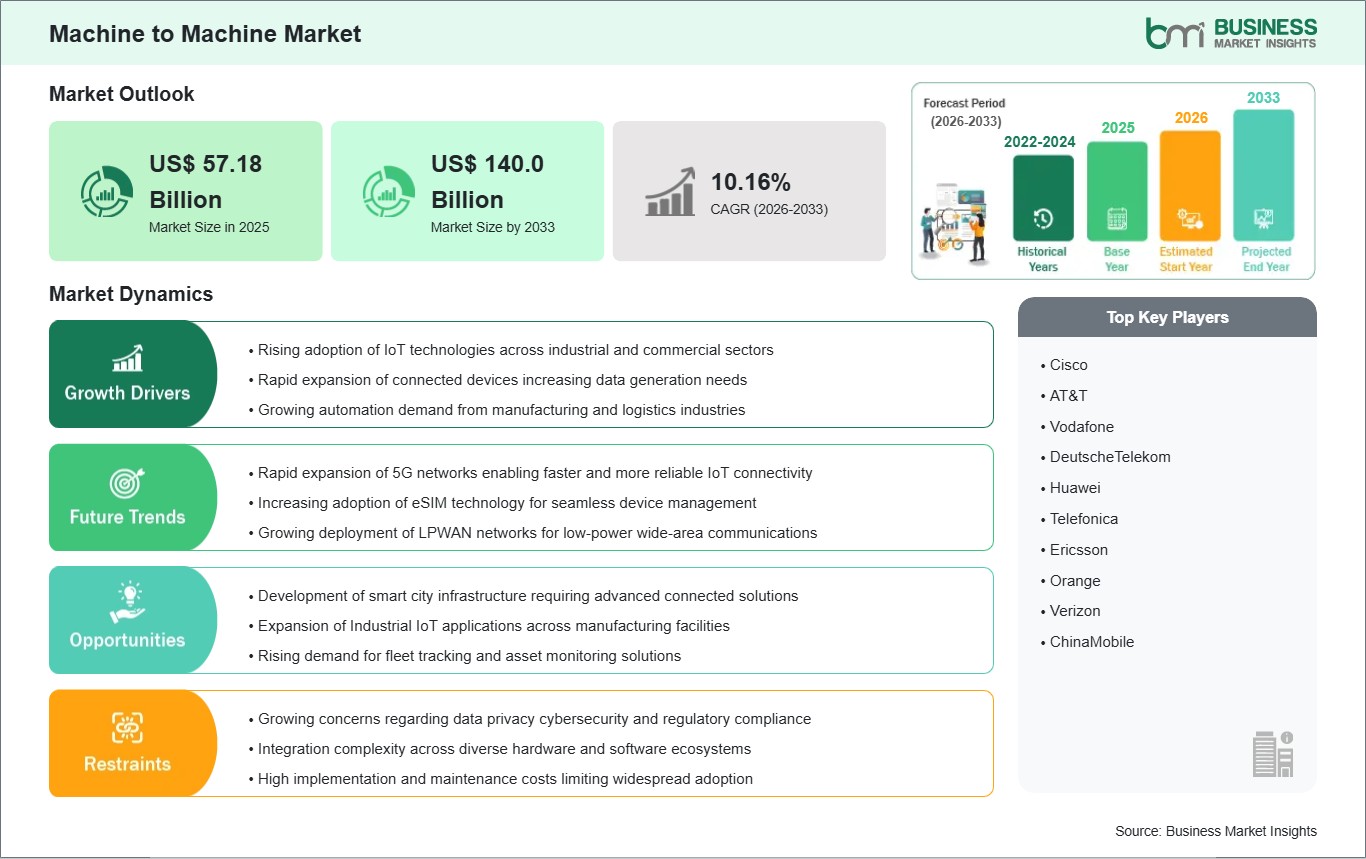
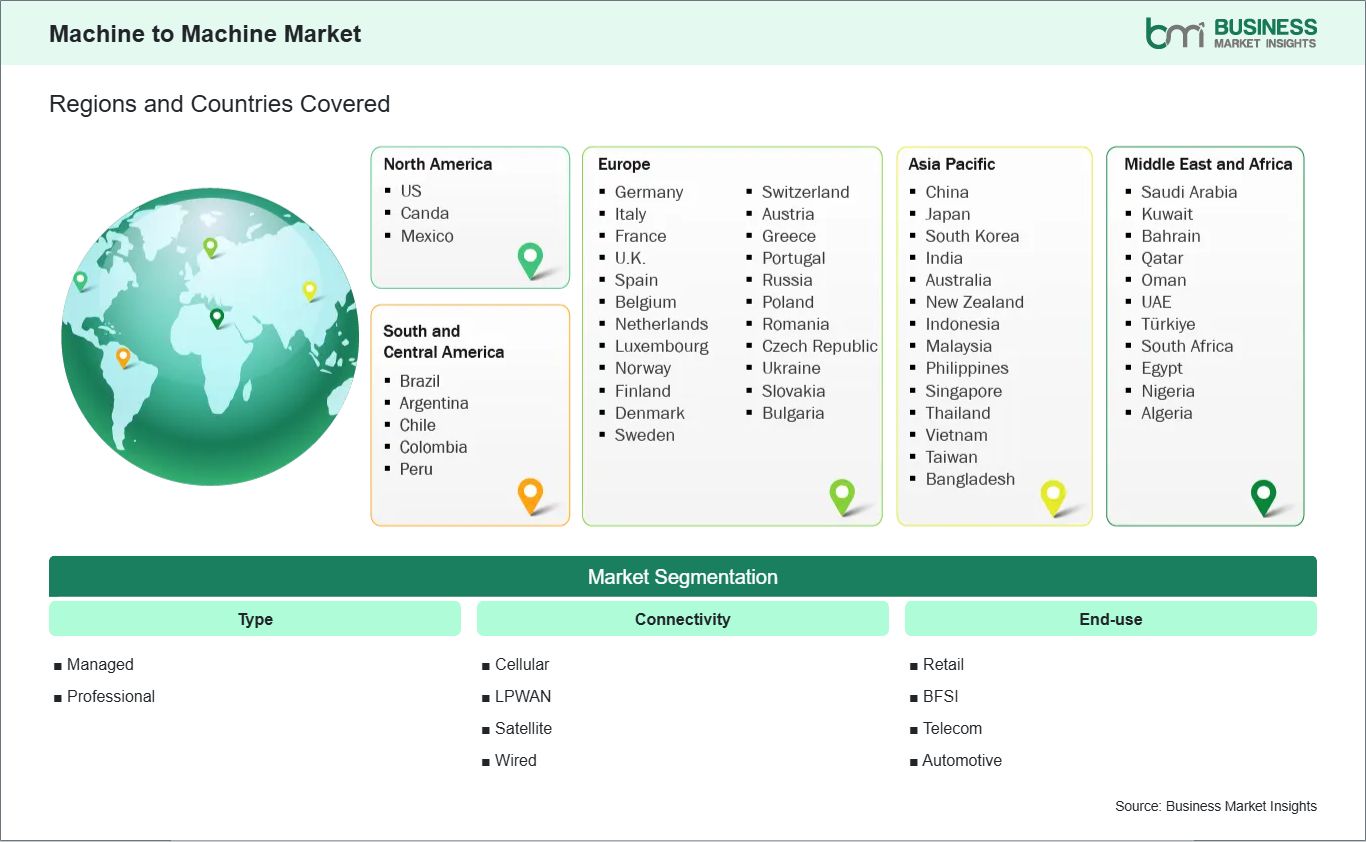
- Managed - Preferred for centralized monitoring, maintenance, and lifecycle administration.
- Professional - Supports integration planning, deployment consulting, and system optimization.
By Connectivity
- Cellular - Enables broad-area connectivity with established mobile network infrastructure.
- LPWAN - Supports low-power communications across distributed device networks.
- Satellite - Facilitates connectivity in remote and geographically challenging locations.
- Wired - Delivers stable communication for fixed industrial environments.
By End-use
- Retail - Enhances inventory visibility and connected store operations.
- BFSI - Supports secure transaction monitoring and asset connectivity.
- Telecom - Enables network performance tracking and infrastructure management.
- Automotive - Facilitates connected vehicle communication and telematics functions
Market Forces
Machine to Machine Market Drivers and Opportunities
Expansion of Connected Industrial Infrastructure
Industrial facilities continue incorporating intelligent equipment capable of autonomous communication and operational reporting. Organizations increasingly seek continuous asset visibility, predictive maintenance capabilities, and process optimization tools. Machine-to-machine frameworks support these requirements by enabling uninterrupted data exchange across production, logistics, and utility environments.
As operational complexity rises, enterprises require communication systems that improve responsiveness and reduce manual intervention. Connected infrastructure enables efficient monitoring of dispersed assets while supporting informed decision-making. This environment reinforces the relevance of machine-to-machine solutions within modernization strategies across multiple industries.
Emergence of Intelligent Device Ecosystems
The evolution of connected ecosystems is creating opportunities for advanced machine-to-machine deployments. Intelligent sensors, embedded computing technologies, and cloud-integrated platforms are expanding communication possibilities across commercial and industrial environments. These innovations support more sophisticated automation and data management capabilities.
Future development is likely to emphasize interoperability, scalable architectures, and intelligent orchestration across connected assets. Expanding ecosystem collaboration between network providers, platform developers, and enterprise users may accelerate deployment opportunities. Such developments can enhance operational efficiency while unlocking new business models based on connected-device intelligence.
Size and Share Analysis
Machine to Machine Market Size and Share Analysis
The Machine to Machine Market was valued at US$ 57.18 Billion in 2025 and projected to reach US$ 140.0 Billion by 2033, advancing at a CAGR of 10.16% from 2026 to 2033. This trajectory reflects expanding integration of connected devices across enterprise operations, industrial automation frameworks, and digitally enabled service environments.
Managed service offerings maintain a significant position within the market as organizations prioritize operational continuity, centralized oversight, and streamlined device administration. Connectivity solutions continue evolving to accommodate distinct performance requirements across different deployment scenarios.
End-use demand remains strongly influenced by telecommunications, automotive, retail, and financial service applications. These sectors increasingly rely on automated communication frameworks to support asset visibility, transaction integrity, operational efficiency, and intelligent service delivery.
Report Coverage
Machine to Machine Market Report Coverage and Deliverables
The "Machine to Machine Market Size and Forecast (2022-2033)" report provides a detailed analysis of the market covering below areas:
- Market size and forecast at global, regional, and country levels for all market segments covered under the scope
- Market trends, as well as drivers, restraints, and opportunities
- Market analysis covering key trends, global and regional framework, major players, regulations, and recent developments
- Industry landscape and competition analysis covering market concentration, heat map analysis, prominent players, and recent developments for the market
- Detailed company profiles, including SWOT analysis
Geographic Insights
Machine to Machine Market Geographic Insights
The Machine to Machine market shows diverse regional adoption patterns influenced by digital infrastructure maturity, connectivity investments, industrial automation priorities, and enterprise modernization strategies. Market participants continue expanding service capabilities to address varying regulatory frameworks, operational requirements, and technology readiness levels across global economies.
North America demonstrates strong implementation activity supported by advanced communication networks and broad enterprise digitization efforts. Organizations across transportation, financial services, utilities, and industrial sectors increasingly integrate connected-device architectures into operational workflows. Continued emphasis on automation and data-driven management strengthens regional demand for machine-to-machine solutions.
Asia Pacific exhibits substantial momentum due to large-scale industrial development, expanding telecommunications infrastructure, and accelerating smart-city initiatives. Enterprises throughout manufacturing, logistics, automotive, and consumer-focused sectors continue deploying connected technologies to improve efficiency and service delivery. Regional innovation ecosystems further encourage integration of intelligent communication frameworks.
Europe maintains steady progress through industrial modernization programs, connected mobility initiatives, and emphasis on operational sustainability. Emerging markets across the Middle East, Africa, and South America are also strengthening connectivity ecosystems through infrastructure investments and digital transformation projects. These developments contribute to broader utilization of machine-to-machine technologies across diverse economic environments.
Industry Activity
Recent Developments
The Machine to Machine market is evaluated by gathering qualitative and quantitative data post primary and secondary research, which includes important corporate publications, association data, and databases. Recent developments and news in the market include:
- In March 2025, Nokia significantly expanded its industrial IoT capabilities by launching six new Industry 4.0 applications on its MX Industrial Edge (MXIE) platform. These solutions strengthen machine-to-machine (M2M) communication by deploying AI-based video analytics, machine control, and localized security directly on-site for manufacturing and critical infrastructure.
- In October 2025, D-Link Corporation has announced the launch of its latest 4G/5G Machine-to-Machine (M2M) portfolio, designed to connect and manage distributed devices across smart buildings, transportation, telematics, and industrial automation environments.
Trust & Transparency
Research Methodology
The market analysis combines proprietary research with secondary data from government agencies, company disclosures, regulatory filings, industry databases and expert interviews. Market estimates are validated through data triangulation, cross-market benchmarking and analyst
review.
View Full Research Methodology
Key Sources Referred:
Industry market intelligence reportsGovernment digital transformation publicationsTelecommunications and connectivity studiesIndustrial IoT adoption assessmentsCompany WebsitesCompany Annual ReportsCompany Investor Presentations