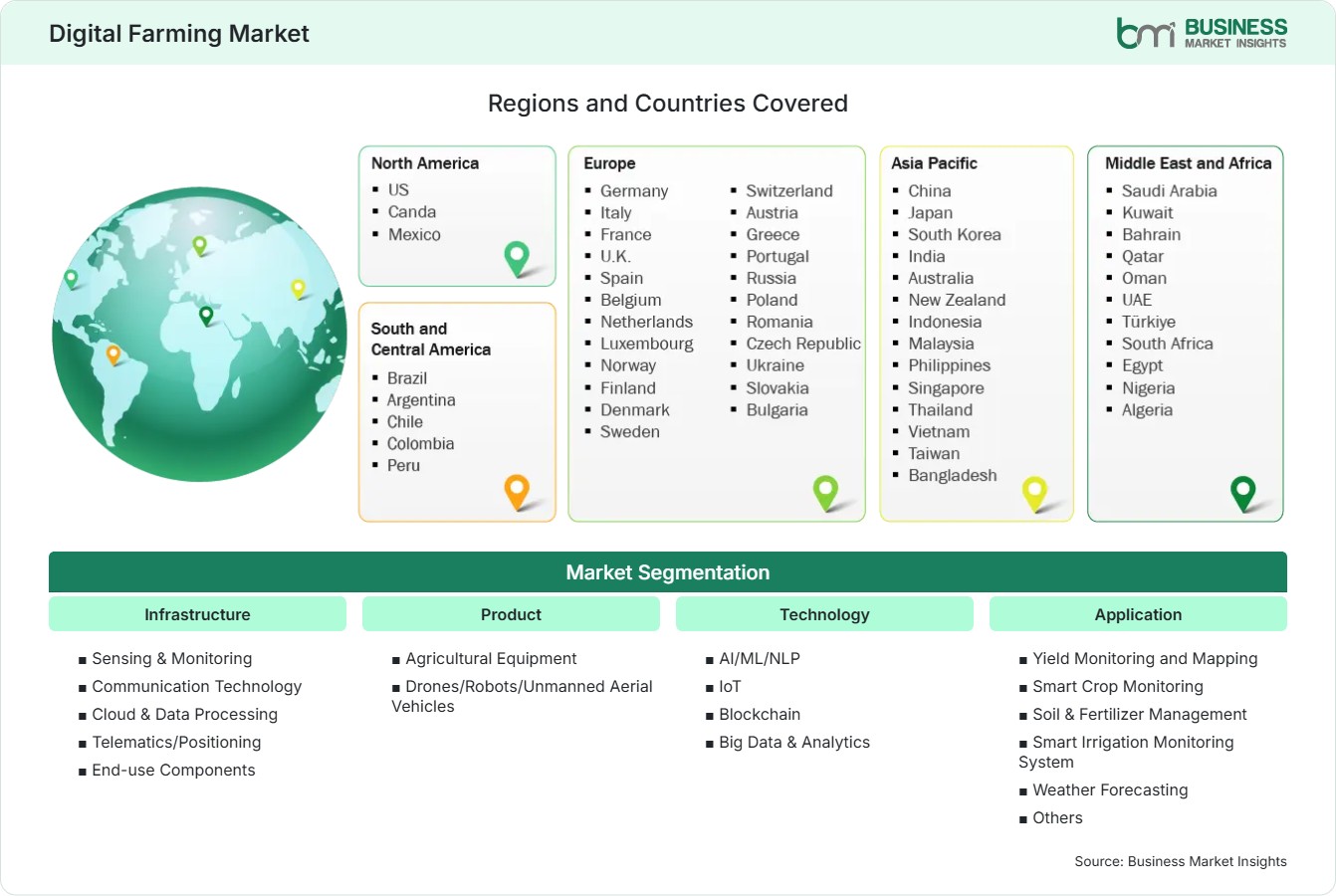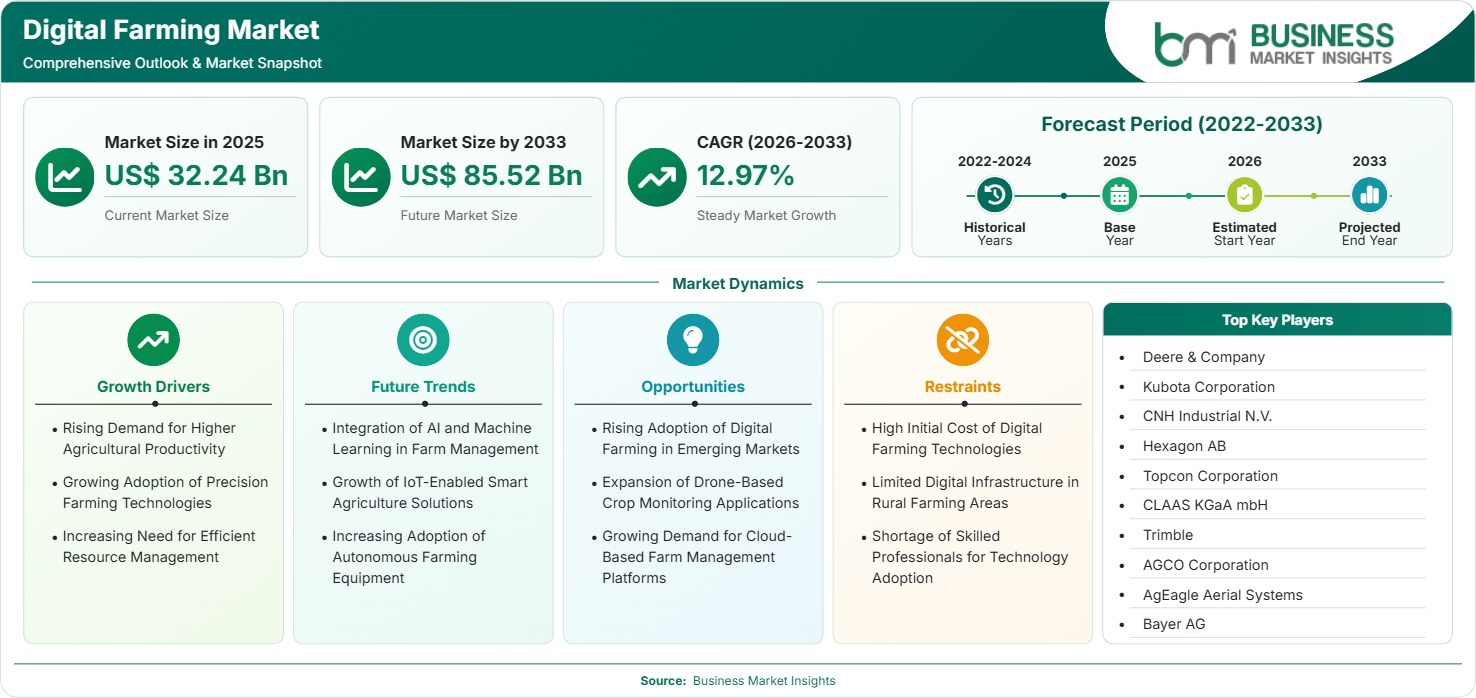
Digital Farming Market Regional Highlights
North America Digital Farming Market
North America accounts for 34%–37% Digital Farming Market share in 2025 and is projected to grow at a CAGR of 12.4%–13.1% through 2033. The region benefits from advanced farming practices, extensive agricultural mechanization, and strong adoption of precision farming technologies.
- Farmers continue investing in connected technologies to improve productivity and operational planning.
- Precision agriculture platforms are gaining wider adoption across large-scale farming operations.
- Agricultural equipment manufacturers continue integrating digital capabilities into machinery.
- Data analytics solutions are helping improve crop management and resource allocation.
- Smart irrigation technologies are supporting more efficient water management practices.
- Ongoing investments in agricultural innovation continue supporting market expansion.
US Digital Farming Market
The United States contributes approximately 88%–92% of North American revenue and is expected to register a CAGR of 12.6%–13.3% through 2033. The country remains the largest digital farming market due to high technology adoption and extensive commercial farming activities.
- Commercial farms are increasingly utilizing precision agriculture technologies to improve efficiency.
- Connected farm equipment is becoming a standard component of modern agricultural operations.
- Producers are deploying sensing and monitoring systems to enhance field visibility.
- The use of agricultural drones continues expanding across crop management applications.
- Data-driven farming practices are improving operational decision-making.
- Agricultural technology investments remain supportive of long-term industry development.
Europe Digital Farming Market
Europe represents 23%–26% of global revenue in 2025 and is anticipated to expand at a CAGR of 12.7%–13.4% through 2033. Increasing focus on sustainable agriculture and precision farming continues supporting regional growth.
- Germany continues leading regional demand through strong adoption of advanced agricultural technologies.
- Poland is among the fastest-growing markets and is estimated to register a CAGR of 13.6%–14.3% during the forecast period.
- Farmers are increasingly adopting digital tools to optimize crop performance.
- Precision nutrient management practices continue supporting technology deployment.
- Smart farming initiatives are improving agricultural resource efficiency.
- Agricultural modernization programs remain favorable for market growth.
Asia Pacific Digital Farming Market
Asia Pacific accounts for 28%–31% of global revenue in 2025 and is expected to achieve the fastest CAGR of 13.8%–14.5% through 2033. Growing food demand, expanding agricultural modernization efforts, and increasing technology adoption continue supporting strong regional growth.
- China remains the largest regional market due to large-scale investments in agricultural modernization.
- India is projected to achieve approximately 14.7%–15.4% CAGR, supported by increasing adoption of smart farming technologies.
- Governments continue promoting digital agriculture initiatives to improve productivity.
- Farmers are increasingly utilizing monitoring systems and connected devices in field operations.
- Adoption of agricultural drones is expanding across crop management applications.
- Growing awareness regarding precision agriculture continues supporting market expansion.
Rest of World Digital Farming Market
Rest of World accounts for 8%–11% of global revenue in 2025 and is projected to expand at a CAGR of 11.5%–12.2% through 2033. Increasing focus on agricultural productivity and rising adoption of modern farming technologies continue supporting market development.
- Brazil continues generating demand through expansion of precision agriculture practices.
- The UAE is witnessing growing interest in smart agriculture and resource-efficient farming technologies.
- Saudi Arabia is expected to achieve approximately 12.4%–13.1% CAGR through 2033, supported by investments in agricultural modernization.
- Digital monitoring tools are helping improve farm management capabilities.
- Governments are encouraging the adoption of advanced agricultural technologies.
- Long-term food security initiatives remain supportive of market growth.