
Digital Badge Market Outlook: Size, Share, Trends, Growth Analysis, Competitive Landscape & Forecast, 2026-2033

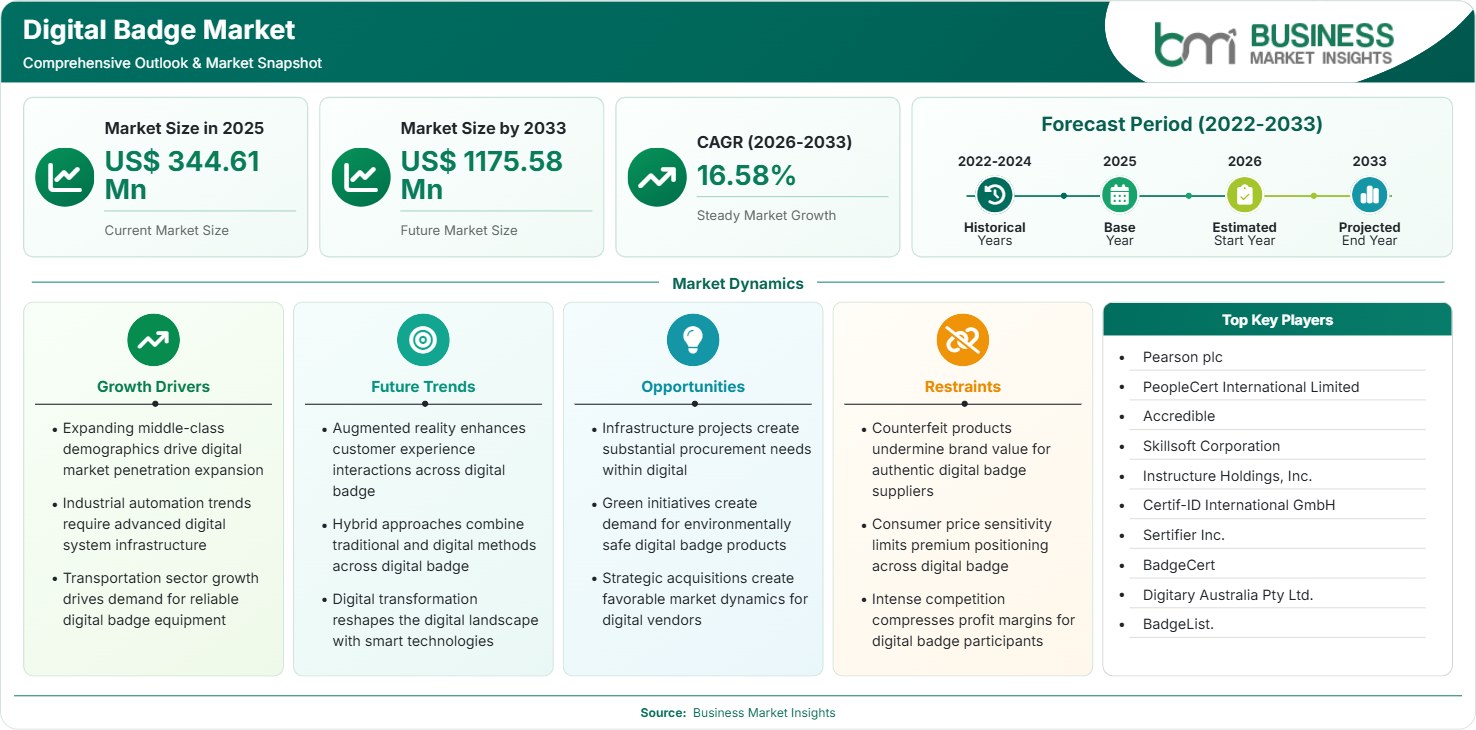
The Digital Badge Market size was valued at US$ 344.61 Million in 2025 and is projected to reach US$ 1175.58 Million by 2033, growing at a CAGR of 16.58% during 2026–2033, driven by digital credential adoption, workforce upskilling initiatives, online learning expansion, competency-based hiring practices, blockchain-enabled verification, and increasing demand for portable, verifiable achievements across education and employment ecosystems.

Report Coverage
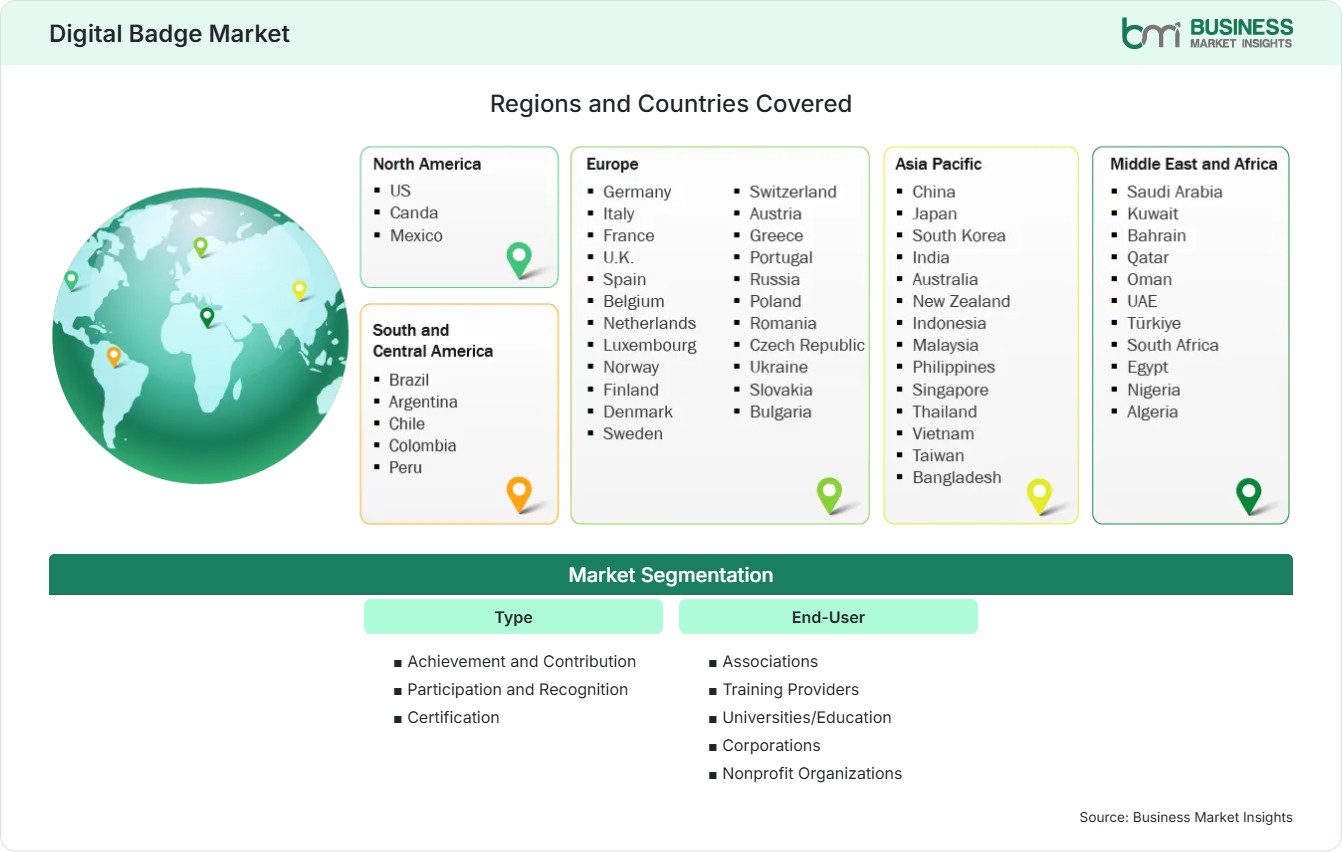
  • Type: Achievement and Contribution, Participation and Recognition, Certification
  • End-User: Associations, Training Providers, Universities/Education, Corporations, Nonprofit Organizations
US$ 344.61 Mn Market size in 2025
US$ 1175.58 Mn Market Size by 2033
16.58% CAGR, 2026 - 2033
2026-2033 Forecast Period

AI Overview

Digital Badge Market Summary

  • North America Region: North America holds a market share of 38%–41% in 2025, growing with a CAGR of 15.5%–16.5% during 2026–2033. Demand is supported by mature edtech ecosystems, enterprise learning investments, credential transparency requirements, skills-based recruitment practices, digital workforce transformation initiatives, and increasing integration of verifiable credentials across institutions globally. The U.S. represents the dominant regional contributor, supported by large certification ecosystems and a CAGR of 15.8%–16.8%.
  • Fastest Growing Region: Asia Pacific accounts for 24%–27% share in 2025 and advances at a CAGR of 18.5%–19.8% during 2026–2033. Rapid digital education adoption, government-supported workforce development programs, expanding online certification platforms, technology-enabled assessment models, and increasing demand for employability credentials continue accelerating market expansion.
  • Leading Segment: Certification represents 42%–45% share in 2025 and expands at a CAGR of 16.0%–17.0% during 2026–2033. Growing acceptance of micro-credentials, professional certification programs, regulated industry compliance requirements, and employer preference for validated competencies strengthen segment leadership across multiple sectors.
  • High Growth Segment: Corporations hold 29%–32% share in 2025 and grow at a CAGR of 18.0%–19.0% during 2026–2033. Corporate learning transformation, workforce reskilling initiatives, skills tracking requirements, employee engagement programs, and competency-based talent management strategies support strong adoption momentum worldwide.
  • Key Market Opportunity: Expanding interoperability standards for verifiable credentials create opportunities for educational institutions, enterprises, and certification providers to establish globally recognized digital achievement ecosystems that improve learner mobility and hiring efficiency.
  • Major Market Players: Pearson plc, PeopleCert International Limited, Accredible, Skillsoft Corporation, Instructure Holdings, Inc., Certif-ID International GmbH, Sertifier Inc., BadgeCert, Digitary Australia Pty Ltd., and BadgeList.
Strategic Insights

Digital Badge Market: Strategic Insights

Digital Badge Market Strategic Framework
FREE PDF
Request your free sample
Request free sample
Stakeholder View

Key Takeaways

  • The value chain is increasingly shifting toward integrated credential ecosystems where learning platforms, assessment providers, certification organizations, and employers collaborate to validate and recognize competencies through interoperable digital frameworks.
  • Corporate workforce development programs present the strongest commercial opportunity as organizations seek scalable methods to track employee skills, certifications, compliance training, and professional development achievements.
  • Innovation is centered on blockchain-backed verification, decentralized identity technologies, artificial intelligence-driven skills mapping, and real-time credential authentication capabilities that enhance trust and portability.
  • Asia Pacific offers an attractive investment environment due to expanding online education participation, government-backed skilling initiatives, and rising demand for workforce readiness credentials across developing economies.
  • Strategic acquisitions and partnerships are increasingly focused on combining credential management platforms with learning management systems to create end-to-end talent development ecosystems.
  • The growing shift toward skills-based hiring is reducing reliance on traditional degree-centric evaluation models, increasing the importance of verifiable digital achievements within recruitment processes.
Geographic Outlook

Digital Badge Market Regional Highlights

North America Digital Badge Market

North America accounts for approximately 38%–41% of revenue in 2025 and is projected to expand at a CAGR of 15.5%–16.5% through 2033. Regional leadership stems from advanced learning technology infrastructure, widespread adoption of skills-based hiring, and significant investments in workforce development. Universities, certification bodies, and corporations continue integrating verifiable credentials into talent management systems. The Digital Badge Market share remains highest in this region due to strong participation from educational institutions and enterprise learning providers supporting digital credential ecosystems.

  • Enterprise learning departments increasingly deploy credential frameworks to validate employee competencies, improve workforce visibility, and align talent development initiatives with evolving organizational objectives and compliance requirements.
  • Strong adoption of cloud-based learning management systems enables seamless issuance, storage, and verification of credentials while supporting integration with recruitment and talent management platforms.
  • Professional certification organizations continue expanding digital credential offerings to strengthen learner engagement, credential visibility, and long-term value creation for members and employers.
  • Regulatory emphasis on workforce readiness and measurable learning outcomes supports growing implementation of competency-based education and credential verification initiatives.
  • Higher education institutions increasingly use digital achievements to document granular skills acquisition, helping learners demonstrate competencies beyond traditional academic transcripts.

US Digital Badge Market

The United States represents approximately 74%–78% of North American Digital Badge Market demand and records a CAGR of 15.8%–16.8% during 2026–2033. Strong technology adoption, mature certification ecosystems, and expanding skills-first recruitment strategies drive continued growth. Major employers increasingly recognize digital credentials as reliable indicators of workforce capabilities and professional development achievements. Extensive participation from universities, technology firms, and professional associations reinforces regional market leadership.

  • Large enterprises are integrating credential analytics into talent management strategies to identify skill gaps, optimize training investments, and improve workforce planning outcomes.
  • Online education providers continue expanding micro-credential portfolios, creating new pathways for learners seeking flexible and career-focused competency development opportunities.
  • Growing demand for verified technical skills in cybersecurity, cloud computing, artificial intelligence, and data analytics strengthens credential adoption across industries.
  • Industry associations increasingly leverage digital achievements to improve member engagement, certification renewal rates, and professional recognition programs.

Europe Digital Badge Market

Europe captures approximately 27%–30% Digital Badge Market share in 2025 and advances at a CAGR of 15.8%–16.8% through 2033. Regional growth is supported by digital education strategies, workforce mobility initiatives, and increasing emphasis on lifelong learning. The United Kingdom remains the leading contributor, while Germany demonstrates strong expansion driven by vocational training modernization. Harmonized credential frameworks and cross-border recognition initiatives encourage broader adoption among institutions and employers.

  • European skills frameworks promote standardized competency recognition, supporting interoperability across educational institutions, employers, and certification providers throughout the region.
  • The United Kingdom remains a leading market due to established certification ecosystems, strong edtech adoption, and active participation from professional development organizations.
  • Germany records one of the strongest growth trajectories, supported by Industry 4.0 workforce requirements and modernization of vocational education programs.
  • Universities increasingly integrate digital credentials into academic records to improve employability outcomes and support lifelong learning initiatives.
  • Employer demand for transparent competency validation continues encouraging adoption across manufacturing, technology, healthcare, and professional services sectors.

Asia Pacific Digital Badge Market

Asia Pacific represents 24%–27% of global Digital Badge Market revenue in 2025 and is forecast to grow at a CAGR of 18.5%–19.8% through 2033. Rapid digital transformation, increasing internet penetration, and government-supported workforce development initiatives are key growth catalysts. China leads regional adoption through large-scale digital learning investments, while India emerges as the fastest-growing national market. Expanding online education participation and enterprise upskilling programs continue strengthening regional demand.

  • Government-led skilling programs encourage adoption of verifiable credentials to improve workforce readiness and support labor market competitiveness.
  • China remains the largest regional contributor due to extensive digital education infrastructure and strong participation from technology-enabled learning providers.
  • India exhibits the highest growth momentum as enterprises, universities, and certification organizations accelerate implementation of digital credentialing solutions.
  • Rising enrollment in online courses and professional certification programs creates sustained demand for portable and verifiable achievement records.
  • Technology companies increasingly collaborate with educational institutions to establish industry-aligned skills validation frameworks supporting employability outcomes.

Rest of World Digital Badge Market

The Rest of World region accounts for approximately 8%–11% Digital Badge Market share in 2025 and is expected to grow at a CAGR of 16.5%–17.5% through 2033. Adoption is expanding across South & Central America and the Middle East & Africa as governments prioritize workforce modernization and digital education access.

Countries including Brazil and the United Arab Emirates are emerging as key markets due to investments in digital learning ecosystems, national skills programs, and technology-enabled credential verification frameworks supporting economic diversification objectives.

  • Brazil continues leading adoption within South & Central America through expanding online education participation and increased emphasis on workforce certification initiatives.
  • The United Arab Emirates demonstrates strong momentum through national digital transformation strategies and investments in advanced education technologies.
  • Growing youth populations and rising internet connectivity support broader acceptance of digital learning and credential recognition systems.
  • International development programs increasingly emphasize measurable skills outcomes, encouraging implementation of digital achievement frameworks.
  • Partnerships among governments, universities, and technology vendors are strengthening credential infrastructure and improving workforce mobility across emerging economies.
Global Market Geography
FREE PDF
Request your free sample
Request free sample
Segment Analysis

Digital Badge Market Segmentation

Type

The Type segment represents the core credential issuance framework within the market. In 2025, Certification accounts for the largest share of approximately 42%–45%, while the segment is expected to advance at a CAGR of 16.0%–17.0% through 2033. Increasing acceptance of skills-based hiring, competency validation requirements, and digital credential portability continue driving adoption. The Digital Badge Market scope is expanding as institutions and employers seek trusted mechanisms to verify individual achievements across diverse learning environments.

  • Achievement and Contribution: Organizations use these credentials to recognize project participation, leadership initiatives, innovation contributions, and community engagement activities. Growing focus on employee engagement and learner motivation supports broader implementation across academic and corporate environments.
  • Participation and Recognition: These badges are widely adopted for workshops, conferences, webinars, training programs, and professional development activities. Increased virtual learning participation and event digitization continue strengthening demand for recognition-based credentialing solutions.
  • Certification: Professional certifications remain the most influential category due to employer trust, regulatory compliance requirements, industry-recognized qualifications, and increasing demand for verifiable competencies across technology, healthcare, finance, and manufacturing sectors.

End-User

The End-User segment reflects diverse adoption patterns across educational, professional, and nonprofit ecosystems. Corporations account for approximately 29%–32% of market demand in 2025 and are projected to expand at a CAGR of 18.0%–19.0% through 2033. Digital Badge Market trends indicate rising integration of credentialing platforms into talent management, learning management, and workforce development systems. Enterprises increasingly use digital credentials to monitor skills progression, improve training effectiveness, and support employee retention strategies.

  • Associations: Professional associations utilize digital credentials to recognize member achievements, continuing education milestones, and specialized expertise while strengthening engagement, certification renewal rates, and industry recognition.
  • Training Providers: Commercial and vocational training organizations deploy digital badges to validate course completion, practical competencies, and professional readiness, improving learner outcomes and enhancing employer confidence.
  • Universities/Education: Academic institutions increasingly issue credentials documenting specific skills, project achievements, and co-curricular accomplishments, enabling students to demonstrate competencies beyond conventional degree transcripts.
  • Corporations: Employers use digital credentials to support workforce development, compliance tracking, leadership development programs, and internal mobility initiatives while enhancing visibility into employee capabilities.
  • Nonprofit Organizations: Nonprofits adopt digital badges for volunteer recognition, skills development initiatives, workforce inclusion programs, and community engagement activities designed to improve participant outcomes and impact measurement.
Market Forces

Digital Badge Market Dynamics

Key Market Drivers

Expansion of Skills-Based Hiring and Workforce Credentialing

The corporate sector is increasingly recognizing skills over traditional qualification measures in sectors including technology, health care, finance, manufacturing, and professional services. Corporate companies have started focusing on validating skills in order to combat the challenges of skill shortage and dynamic labor market needs. Digital certificates act as proof of skills and enhance recruitment and evaluation processes. Digital Badge Market growth is strongly influenced by enterprise demand for transparent skill verification frameworks. With increasing competition within labor markets, firms are focusing on developing systems whereby the results of learning processes are linked to workforce needs in terms of credentials, which creates the need for digital badges.

Growth of Online Learning and Micro-Credential Ecosystems

The global expansion of online education continues generating significant demand for verifiable achievement recognition systems. Modular learning courses are now being offered in universities and other certification and training centers. The need for portable credentials which are proof of particular competencies gained from short-form educational programs is on the rise among learners. Global organizations which advocate for lifelong learning and workplace flexibility help to push for the use of credentials. Digital systems which can issue, manage, and verify achievements are critical infrastructure pieces. With educational organizations embracing digital delivery channels, the need for secure credentials keeps rising.

Advancements in Credential Verification Technologies

Technological innovation is transforming digital credential management through blockchain integration, decentralized identity frameworks, artificial intelligence, and cloud-native architectures. Such technologies will help raise the reliability of credentials, reduce possible fraud and make integration between various educational institutions, certification agencies and the employers much easier. The greater attention being paid to the reliable digital identity has pushed many organizations to invest more into their verification mechanisms. Now there is much more use of the digital credentials that allow automating the process of validation making the work of hiring managers and administrative staff easier.

Key Market Opportunities

Development of Global Interoperable Credential Networks

One key opportunity is in building credential ecosystems that have international recognition and allow seamless mobility and participation of learners in the workforce. Educational organizations, employers, and certifying agencies need an ecosystem that allows their credentials to be interoperable and verifiable regardless of jurisdiction. Digital Badge Market Forecasts indicate there is substantial scope for solutions that help recognize competencies across borders. The technology suppliers who have the capability to provide standardized verification tools, credential exchange solutions, and digital identity services can capitalize on this. It will not only enable mobility of workers but also generate monetization opportunities within the entire credentialing value chain.

Corporate Reskilling and Internal Talent Mobility Programs

Organizations are investing heavily in workforce transformation initiatives to address technological disruption and evolving business requirements. Digital credentials provide a realistic method for recording the development process of employees and managing competencies. Larger firms are looking for platforms that can help to connect learning outcomes with the objectives of workforce planning. Credential-driven talent management helps organizations to better recognize skills gaps and career advancement possibilities. Companies offering credentialing systems in tandem with performance management, human capital management, and learning ecosystems can reap benefits from the rising demand by large enterprises.

Emergence of Digital Public Infrastructure for Credentials

Governments and educational authorities are increasingly exploring digital public infrastructure initiatives that incorporate verifiable credentials into national skills frameworks. The objectives of such systems include enhanced workplace transparency, lifelong learning, and increased efficiency of the labor market. The national digital identity strategy creates an enabling environment for mass use of credentials. Providers of technology solutions who want to implement the systems in the public sector can realize great potential for growth. Integrating such systems with employment, education, and professional licensing systems could result in scalable platforms for millions of credentials holders.

Market Restraints and Challenges

Lack of Universal Credential Standards Across Platforms

Factor: Credential ecosystems continue to operate across multiple technology platforms, standards frameworks, and verification methodologies. Impact: Fragments limit interoperability and present problems for employers, students, and educational institutions trying to verify credentials obtained through various systems. Inefficiency and credential portability become difficult due to the non-uniformity of data structures and authentication protocols. There are extra integration costs incurred in connecting fragmented systems. While industry associations are still pushing for standardization, the lack of universally agreed standards is a major hurdle in its way. Overcoming interoperability issues would be critical in ensuring that credentials are maximally utilized.

Employer Awareness and Credential Recognition Gaps

Factor: Many employers remain unfamiliar with the full capabilities and value proposition of digital credentials, particularly outside technology-intensive industries. Impact: The lack of awareness may decrease adoption rates even though the education sector has participated significantly in the process. There are some organizations that still depend largely on conventional qualifications and certificates in their recruitment and promotion processes. The lack of consistency reduces the value of credentials among the learners and the institutions offering them. There is a need for all market players to put in efforts to create awareness of the benefits of digital credentials.

Company Analysis

Competitive Landscape

The competitive environment remains highly dynamic as vendors focus on credential interoperability, blockchain-enabled verification, enterprise learning integration, and digital identity capabilities. The Digital Badge Market analysis highlights increasing competition among credentialing specialists, learning technology providers, and certification platform developers seeking to strengthen ecosystem partnerships and global credential recognition.

Company Name

Overview

Products and Services relevant to this market

Pearson plc

Global education company providing assessment, certification, and workforce learning solutions across academic and professional markets.

Digital credentials, certification programs, learner assessment platforms, workforce skills validation, and education technology services.

PeopleCert International Limited

International certification organization serving professional and language certification markets through technology-enabled assessment solutions.

Digital certificates, credential verification tools, professional certifications, examination platforms, and candidate management services.

Accredible

Leading credential technology provider focused on secure issuance, management, and verification of digital achievements.

Digital badges, blockchain-backed credentials, certificate management, verification services, and credential analytics platforms.

Skillsoft Corporation

Enterprise learning and workforce development provider supporting organizations through digital learning ecosystems.

Skills credentials, learning pathways, compliance training, workforce development tools, and achievement recognition solutions.

Instructure Holdings, Inc.

Educational technology company known for learning management systems and credential integration capabilities.

Learning management platforms, digital badges, competency tracking, learner engagement tools, and credential management solutions.

Certif-ID International GmbH

Credential verification specialist supporting secure authentication and trust-based digital credential ecosystems.

Identity verification, credential authentication, fraud prevention solutions, and secure digital certification technologies.

Sertifier Inc.

Credential technology company focused on scalable digital certification and achievement recognition platforms.

Digital badges, certificate issuance, verification infrastructure, analytics dashboards, and credential distribution services.

BadgeCert

Provider of secure credential management systems serving educational institutions and professional organizations.

Digital credential platforms, blockchain verification, certification management, learner records, and credential sharing capabilities.

Digitary Australia Pty Ltd.

Specialist in academic credential management and trusted digital document verification technologies.

Academic records management, digital credentials, document verification, learner identity services, and transcript solutions.

BadgeList

Digital achievement recognition platform supporting educational and workforce development applications.

Badge issuance, achievement tracking, learner engagement tools, competency recognition, and credential display services.

Trust & Transparency

Research Methodology

The market analysis combines proprietary research with secondary data from government agencies, company disclosures, regulatory filings, industry databases and expert interviews. Market estimates are validated through data triangulation, cross-market benchmarking and analyst review.

View Full Research Methodology

Questions Answered

Frequently Asked Questions

Why is the Digital Badge Market Report important for strategic planning?

The Digital Badge Market Report helps stakeholders evaluate technology adoption patterns, investment opportunities, competitive positioning, regulatory developments, and emerging credentialing models that influence long-term business decisions.

How is blockchain influencing credential management?

Blockchain technology strengthens credential security by creating tamper-resistant records that improve authenticity, transparency, and trust. It also supports decentralized verification processes that reduce fraud and administrative complexity.

Which end-user segment offers the strongest growth potential?

Corporations present the strongest growth opportunity due to increasing investments in workforce transformation, talent development, compliance management, leadership training, and competency-based career progression initiatives.

How do digital badges differ from traditional certificates?

Digital badges contain verifiable metadata detailing skills, achievements, issuer information, and completion criteria. Unlike static certificates, they can be authenticated online and integrated into professional networking, recruitment, and talent management systems.

What factors are accelerating adoption of digital badges across industries?

Growing demand for skills-based hiring, online learning expansion, workforce reskilling programs, and credential verification requirements are driving adoption. Organizations increasingly value portable, verifiable evidence of competencies that can be shared across educational and professional ecosystems.

Access the Full Digital Badge Market Report

Get segment-level forecasts, regional estimates, competitive benchmarking, company profiles and downloadable Excel datasets.

Access the full Digital Badge Market Report
350 pages PDF & Excel | 2026-08-28
Similar Research

Related Market Reports