
Device-as-a-Service Market Outlook: Size, Share, Trends, Growth Analysis, Competitive Landscape & Forecast, 2026-2033

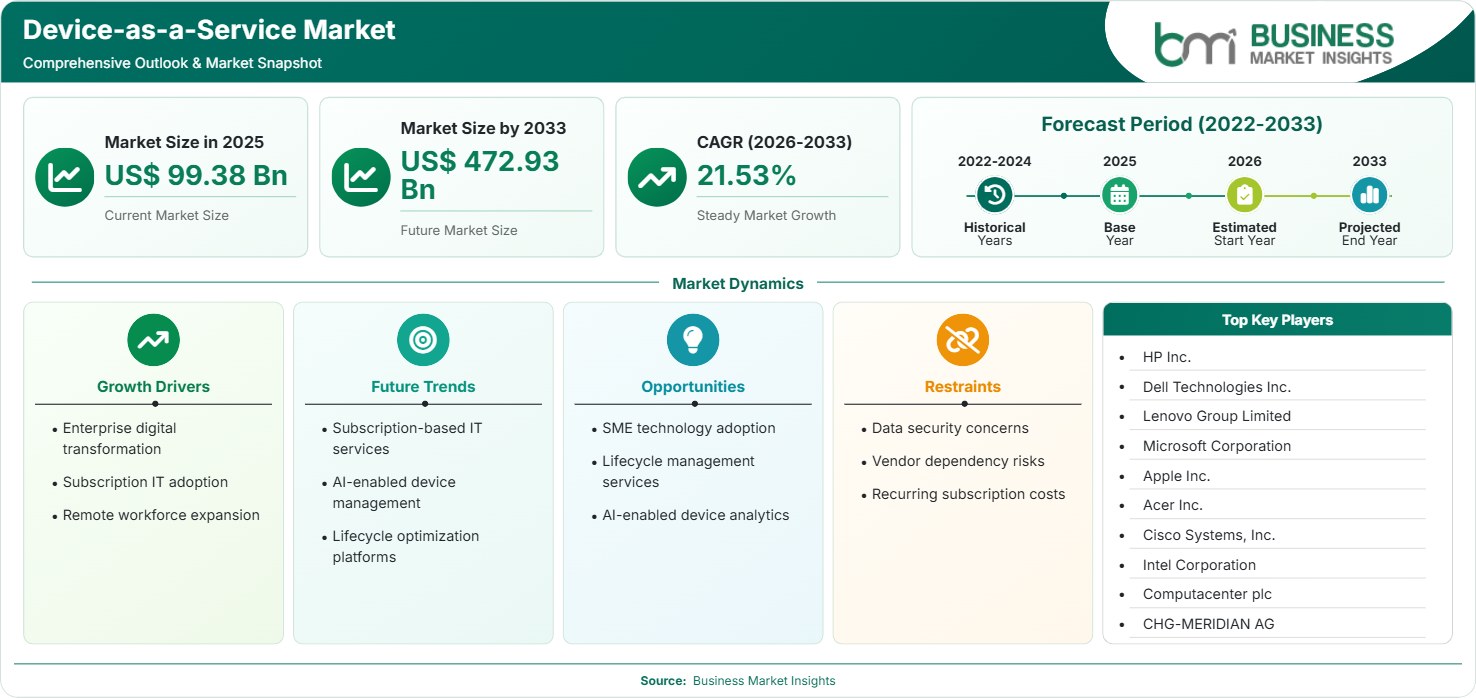
The Device-as-a-Service Market size was valued at US$ 99.38 billion in 2025 and is projected to reach US$ 472.93 billion by 2033, growing at a CAGR of 21.53% during 2026–2033. Growth is driven by enterprise digital transformation, subscription-based IT adoption, and remote workforce expansion, while opportunities are emerging through SME technology adoption, lifecycle management services, and AI-enabled device analytics.

Report Coverage
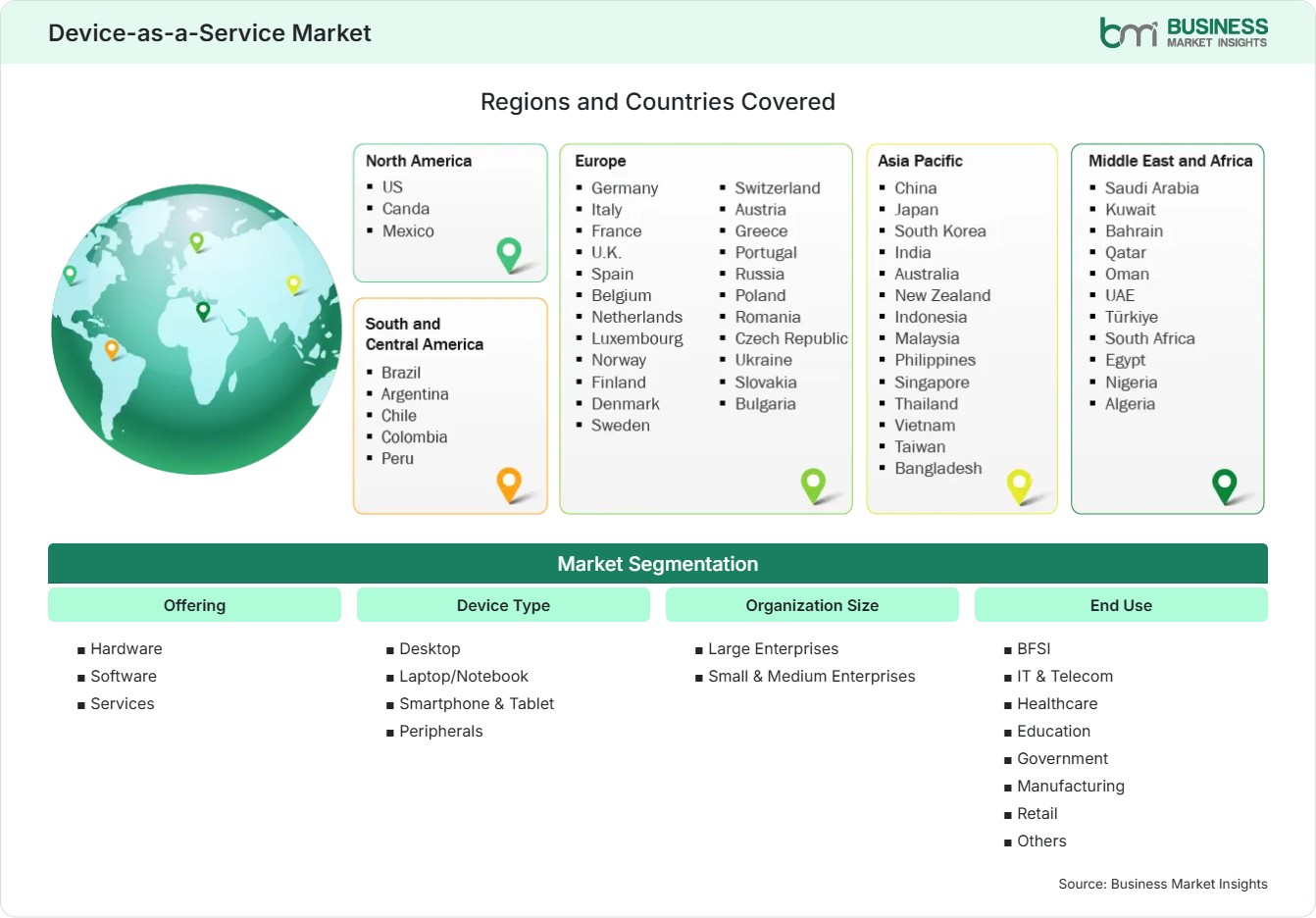
  • Offering: Hardware, Software, Services
  • Device Type: Desktop, Laptop/Notebook, Smartphone & Tablet, Peripherals
  • Organization Size: Large Enterprises, Small & Medium Enterprises
  • End Use: BFSI, IT & Telecom, Healthcare, Education, Government, Manufacturing, Retail, Others
US$ 99.38 Bn Market size in 2025
US$ 472.93 Bn Market Size by 2033
21.53% CAGR, 2026 - 2033
2026-2033 Forecast Period

01 AI Overview

Device-as-a-Service Market Summary

  • North America Region: North America accounts for approximately 38%–42% device-as-a-service market share in 2025 and is projected to grow at a 20.5%–21.5% CAGR during 2026–2033. Growth is supported by enterprise cloud adoption, workplace modernization, subscription IT models, and strong demand for managed device lifecycle solutions. The U.S. market benefits from advanced enterprise technology adoption and is estimated to grow at approximately 20.8%–21.8% CAGR.
  • Fastest Growing Region: Asia Pacific represents around 22%–26% of the global market in 2025 and is expected to expand at 22.5%–23.5% CAGR through 2033. Digital transformation initiatives, expanding enterprise mobility, increasing SME technology adoption, and rising demand for flexible IT procurement models are accelerating regional growth.
  • Leading Segment: Hardware holds approximately 52%–56% market share in 2025 and is expected to grow at a 20.5%–21.5% CAGR. Enterprise demand for managed laptops, desktops, mobile devices, and workplace equipment replacement cycles is supporting hardware subscription adoption.
  • High Growth Segment: Services represent approximately 20%–24% market share in 2025 and are projected to grow at 23.0%–24.0% CAGR. Increasing demand for device management, maintenance, analytics, security support, and lifecycle optimization is driving service adoption.
  • Key Market Opportunity: AI-powered device monitoring, predictive maintenance, automated lifecycle management, and expanding SME adoption are creating opportunities for providers to deliver scalable technology solutions with improved operational efficiency.
  • Major Market Players: HP Inc., Dell Technologies Inc., Lenovo Group Limited, Microsoft Corporation, Apple Inc., Acer Inc., Cisco Systems, Inc., Intel Corporation, Computacenter plc, and CHG-MERIDIAN AG.
02 Strategic Insights

Device-as-a-Service Market: Strategic Insights

Device-as-a-Service Market Strategic Framework
FREE PDF
Request your free sample
Request free sample
03 Stakeholder View

Key Takeaways

  • Subscription-based IT procurement is reshaping enterprise hardware strategies by enabling predictable spending, simplified asset management, and flexible technology scaling.
  • Managed device lifecycle services provide strong growth opportunities as enterprises seek support for deployment, maintenance, upgrades, and secure asset disposal.
  • Artificial intelligence and analytics are improving device performance monitoring, predictive maintenance, security management, and operational visibility across enterprise environments in the device-as-a-service market.
  • Asia Pacific offers strong expansion potential due to rapid digitalization, growing SME technology adoption, and increasing enterprise mobility requirements.
  • Market participants are strengthening competitive positions through integrated hardware, software, financing, and lifecycle management offerings.
  • Growing concerns around device security and vendor dependency are encouraging providers to enhance cybersecurity capabilities and develop flexible service models.
04 Geographic Outlook

Device-as-a-Service Market Regional Highlights

North America Device-as-a-Service Market

North America accounted for approximately 38%–42% of the global market in 2025 and is projected to grow at a 20.5%–21.5% CAGR during 2026–2033. The region maintains market leadership due to strong enterprise technology adoption, widespread subscription-based procurement models, and increasing demand for managed workplace solutions. The Device-as-a-Service Market share is supported by digital transformation initiatives, hybrid work adoption, and investments in secure enterprise device management platforms.

  • The United States represents the largest regional contributor due to high enterprise IT spending, advanced cloud adoption, and strong demand for managed device solutions.
  • Organizations are increasingly outsourcing hardware lifecycle activities to improve operational efficiency and reduce internal IT management requirements.
  • Large enterprises are adopting subscription-based device models to improve workforce flexibility and simplify technology refresh cycles.
  • Security-focused device management solutions are gaining importance as enterprises manage distributed employees and endpoint vulnerabilities.

US Device-as-a-Service Market

The United States represented approximately 33%–37% of global Device-as-a-Service Market revenue in 2025 and is expected to expand at a 20.8%–21.8% CAGR through 2033. The country remains a major market due to high enterprise digitalization, widespread remote work adoption, and strong presence of technology providers. Demand is increasing across large enterprises and SMEs as organizations seek flexible IT procurement models, improved device security, and simplified lifecycle management solutions.

  • Enterprises are increasingly adopting device subscription models to optimize IT budgets and improve technology deployment efficiency.
  • Growing hybrid work environments are increasing demand for managed laptops, desktops, mobile devices, and endpoint services.
  • Technology providers are expanding service capabilities through automation, analytics, and integrated security management solutions.

Europe Device-as-a-Service Market

Europe accounted for approximately 27%–31% of the global market in 2025 and is expected to grow at a 20.0%–21.0% CAGR between 2026 and 2033. Germany, the United Kingdom, France, and the Netherlands are major contributors due to enterprise modernization initiatives and increasing adoption of circular IT models. Germany is estimated to grow at 20.2%–21.2% CAGR, while the United Kingdom is expected to expand at 20.0%–21.0% CAGR due to increasing demand for managed workplace services.

  • European enterprises are adopting device subscription models to improve asset utilization and support sustainable technology management practices.
  • Germany remains a key market due to strong industrial digitization and enterprise investment in modern IT infrastructure.
  • Organizations are prioritizing secure device management solutions to address increasing cybersecurity requirements across distributed workplaces.
  • Circular economy initiatives are encouraging businesses to adopt lifecycle management services and responsible device disposal practices.

Asia Pacific Device-as-a-Service Market

Asia Pacific accounted for approximately 22%–26% of the global Device-as-a-Service Market in 2025 and represents the fastest-growing region with a projected 22.5%–23.5% CAGR during 2026–2033. China, India, Japan, South Korea, Singapore, and Australia are driving regional expansion through digital transformation, enterprise mobility adoption, and increasing technology investments. China is projected to grow at 22.8%–23.8% CAGR, while India is expected to expand at 23.5%–24.5% CAGR due to rapid SME digitization.

  • Enterprises across Asia Pacific are adopting flexible technology procurement models to improve access to advanced computing devices.
  • India is becoming a high-growth market due to expanding IT services, startup ecosystems, and increasing SME technology adoption.
  • Businesses are investing in managed workplace solutions to support remote and hybrid workforce requirements.
  • Cloud adoption and digital transformation initiatives are increasing demand for integrated device management services.
  • Regional technology providers are developing affordable subscription models to address growing enterprise demand.

Rest of World Device-as-a-Service Market

Latin America, the Middle East, and Africa collectively represented approximately 5%–8% of the global market in 2025 and are forecast to grow at a 21.0%–22.0% CAGR between 2026 and 2033. Brazil, Mexico, UAE, Saudi Arabia, and South Africa are emerging markets due to increasing digital adoption, enterprise modernization, and demand for flexible IT solutions. The Device-as-a-Service Market trends in these regions are influenced by technology accessibility requirements, workforce mobility, and growing investments in digital infrastructure.

  • Latin American businesses are adopting managed device solutions to modernize workplace technology while controlling capital expenditure requirements.
  • Brazil and Mexico are witnessing increasing demand for subscription-based IT models across enterprises and growing businesses.
  • Middle Eastern organizations are investing in digital transformation programs that support adoption of managed workplace technologies.
  • Saudi Arabia and UAE are expanding enterprise technology investments through national digital transformation initiatives.
  • African businesses are exploring device subscription models to improve access to computing infrastructure and managed support services.
Global Market Geography
FREE PDF
Request your free sample
Request free sample
05 Segment Analysis

Device-as-a-Service Market Segmentation

Offering

Offering segmentation represents the foundation of the market ecosystem, accounting for approximately 85%–88% of global revenue in 2025 and expanding at a 21.0%–21.8% CAGR between 2026 and 2034. Enterprises are increasingly adopting bundled solutions combining hardware procurement, software management, and professional services to simplify IT operations. The shift from ownership-based models toward subscription-based technology consumption is encouraging providers to develop integrated offerings that improve device utilization, security, and lifecycle management efficiency.

  • Hardware: Hardware remains the leading offering category due to enterprise demand for managed laptops, desktops, smartphones, and peripherals under flexible subscription-based procurement models.
  • Software: Software adoption is increasing through device management platforms, security applications, analytics tools, and automation solutions that improve visibility and control over enterprise technology assets.
  • Services: Services are experiencing strong adoption due to increasing demand for deployment support, maintenance, lifecycle management, device monitoring, and technology optimization capabilities.

Device Type

Device Type segmentation accounted for approximately 75%–79% of market demand in 2025 and is projected to grow at a 21.2%–22.0% CAGR through 2034. Growing workforce mobility, remote operations, and enterprise digitization are increasing demand for managed computing devices. Organizations are adopting device subscription models across multiple categories to improve employee productivity, strengthen security, and simplify technology refresh cycles.

  • Desktop: Desktop devices continue supporting enterprise environments requiring fixed workstations, centralized management, and reliable computing infrastructure across offices and operational facilities.
  • Laptop/Notebook: Laptops represent a major adoption category due to remote work expansion, workforce mobility requirements, and demand for flexible enterprise computing solutions.
  • Smartphone & Tablet: Smartphones and tablets are gaining importance as businesses expand mobile workforce capabilities and require secure access to applications and digital resources.
  • Peripherals: Peripherals including monitors, docking stations, printers, and accessories are increasingly bundled into managed device solutions to provide complete workplace technology packages.

Organization Size

Organization Size segmentation accounted for approximately 68%–72% of market demand in 2025 and is expected to grow at a 21.3%–22.0% CAGR during 2026–2034. Large enterprises remain major adopters due to complex IT environments and workforce scale, while SMEs are increasingly adopting subscription-based models to access advanced technology without significant upfront investments. Providers are developing flexible service packages to address requirements across different business sizes during device-as-a-service market forecasts.

  • Large Enterprises: Large enterprises represent significant demand due to extensive device fleets, complex management requirements, security needs, and preference for outsourced technology lifecycle services.
  • Small & Medium Enterprises: SMEs are adopting device-as-a-service models to reduce capital expenditure, access enterprise-grade technology, and overcome limitations in internal IT resources.

End Use

End Use segmentation accounted for approximately 80%–84% of the global market in 2025 and is forecast to grow at a 21.5%–22.3% CAGR through 2034. Organizations across industries are adopting managed device solutions to support digital transformation, workforce mobility, and operational efficiency. Industry-specific requirements such as security, compliance, remote accessibility, and asset management are influencing adoption patterns across major sectors, supporting device-as-a-service market growth.

  • BFSI: Financial institutions are adopting managed device solutions to improve endpoint security, compliance management, and secure employee access to digital banking infrastructure.
  • IT & Telecom: IT and telecom companies represent major users due to large technology environments, distributed teams, and continuous demand for updated computing infrastructure.
  • Healthcare: Healthcare organizations are adopting managed devices to support digital healthcare systems, secure patient information, and enable efficient clinical workflows.
  • Education: Educational institutions are increasingly using managed device models to provide scalable access to computing resources for students, faculty, and administrative operations.
  • Government: Government organizations are adopting device management services to modernize public infrastructure, improve cybersecurity, and optimize technology asset management.
  • Manufacturing: Manufacturers are implementing managed devices to support connected operations, digital workflows, and workforce productivity across production environments.
  • Retail: Retail companies are adopting managed device solutions for point-of-sale systems, workforce mobility, inventory management, and customer experience improvement.
  • Others: Other industries are adopting managed device services to improve operational flexibility, access to technology, and efficiency in lifecycle management.
06 Market Forces

Device-as-a-Service Market Dynamics

Key Market Drivers

Enterprise Digital Transformation Acceleration

Enterprise digital transformation initiatives are driving organizations toward flexible technology consumption models that reduce infrastructure complexity and improve operational agility. Businesses are replacing traditional device ownership approaches with subscription-based models that combine hardware, software, security, and lifecycle services. The Device-as-a-Service Market growth is supported by increasing adoption across industries seeking predictable IT expenditure, simplified asset management, and faster technology deployment. Enterprises are prioritizing managed device platforms to support cloud-based applications, distributed teams, and evolving workplace requirements. The transition toward digital-first operations is encouraging organizations to outsource device management activities while focusing internal resources on strategic technology initiatives and business innovation.

Expansion of Subscription-Based IT Adoption

The growing preference for subscription-based technology models is accelerating the adoption of device-as-a-service solutions among enterprises of different sizes. Organizations are increasingly shifting from upfront hardware purchases toward operational expenditure models that improve financial flexibility and technology scalability. Subscription approaches enable businesses to access updated devices, maintenance support, security services, and lifecycle management through predictable payment structures. The Device-as-a-Service Market trends are shaped by increasing demand for flexible procurement models, especially among enterprises managing rapidly changing technology requirements. Providers are enhancing bundled offerings that integrate hardware, software, analytics, and support services to deliver comprehensive workplace technology solutions.

Growth of Remote and Hybrid Workforce Models

The rising trend towards remote and hybrid working environments is driving increased demand for managed endpoint solutions to enhance efficiency and security. Companies require reliable laptops, desktops, mobile devices, and accessories that can be centrally managed to support workers across various locations. Managed device service providers help companies in the deployment, protection, management, and monitoring of devices throughout their entire lifecycle. Greater emphasis on mobility, collaboration, and security is driving demand for managed device solutions. Companies are using such services to improve the employee experience, reduce the burden on IT, and enable access to enterprise applications regardless of workplace location.

Key Market Opportunities

Rising SME Technology Adoption

Small and medium enterprises present an excellent area of expansion where companies would be able to gain access to technology infrastructure at an affordable cost. However, there exist certain problems associated with the lack of IT, management, and cybersecurity skills among SMEs. The device-as-a-service business model offers businesses access to high-end devices and other services in the form of a subscription service. The growing digitalization of SMEs in both emerging and advanced countries requires flexible business solutions to capture further market share and capitalize on this trend.

Expansion of Device Lifecycle Management Services

Lifecycle management services are offering many new opportunities as businesses become more interested in comprehensive support for their devices throughout their entire life cycle. Businesses are increasingly turning their attention to optimizing asset use, simplifying operations, and enhancing sustainability through effective device management. Service companies are now developing more options for automated provisioning, monitoring of remotely operated systems, refurbishing, and proper disposal of devices. The focus on the circular economy is causing more companies to implement lifecycle management. Businesses that provide lifecycle management services will be able to better build their relations with customers.

AI-Enabled Device Analytics Integration

The use of artificial intelligence and analytics is creating new possibilities through better monitoring of devices, predictive maintenance, and decision-making. AI platforms can be used to monitor the performance of devices, forecast possible failures, optimize the use of assets, and also offer better security monitoring in an enterprise environment. Companies are beginning to look for intelligent systems that will minimize downtime and increase employee productivity. Providers of the Device-as-a-service offering are combining analytics with their management platforms to offer proactive services and customized advice.

Market Restraints and Challenges

Data Security and Privacy Concerns

Factor: Device-as-a-service models entail centralized management of enterprise devices, user information, and operational data, raising concerns about cybersecurity, data privacy, and unauthorized access. Impact: The security threats could be one reason for the delays in adoption by companies working on sensitive data, especially in the BFSI, healthcare, and government sectors. Companies must have adequate levels of security measures in place, including encryption, authentication, compliance, and data management. The need to continue improving security measures is essential to keep up with the emerging threats.

Vendor Dependency and Service Flexibility Risks

Factor: Organizations adopting device-as-a-service models may become dependent on specific vendors for hardware availability, software compatibility, maintenance support, and lifecycle management. Impact: Excessive reliance on vendors can lead to inflexibility, difficulty switching providers, and risks if service-level expectations cannot be consistently met. Transparent contracts, compatibility, and flexible service agreements are required for companies to minimize problems caused by vendor dependency. To tackle such issues, providers are increasing support for multiple devices, integrating platforms, and providing flexible service structures.

07 Company Analysis

Competitive Landscape

The Device-as-a-Service Market analysis highlights a competitive environment shaped by global hardware manufacturers, technology providers, IT service companies, and lifecycle management specialists. Market participants are expanding subscription-based device portfolios by integrating hardware, software, financing, analytics, security, and support services. Companies are focusing on improving device lifecycle efficiency, strengthening enterprise partnerships, and developing AI-enabled management platforms to address the increasing demand for flexible workplace technology solutions.

Company Name

Overview

Products and Services relevant to this market

HP Inc.

Global technology company providing computing devices and enterprise workplace solutions.

Device-as-a-service solutions, laptops, desktops, peripherals, lifecycle management, and enterprise support services.

Dell Technologies Inc.

Technology provider specializing in enterprise computing infrastructure and managed device solutions.

Managed devices, PCs, laptops, endpoint solutions, lifecycle services, and IT asset management offerings.

Lenovo Group Limited

Global hardware manufacturer delivering enterprise computing and workplace technology solutions.

Device subscription solutions, laptops, desktops, tablets, accessories, and managed lifecycle services.

Microsoft Corporation

Software and cloud technology company supporting enterprise device management ecosystems.

Endpoint management software, security solutions, cloud services, and workplace productivity platforms.

Apple Inc.

Technology company providing premium computing and mobile devices for enterprise users.

Mac devices, iPhone, iPad, device management integration, and enterprise support services.

Acer Inc.

Computing device manufacturer offering products for business and institutional users.

Business laptops, desktops, monitors, enterprise devices, and workplace technology solutions.

Cisco Systems, Inc.

Networking and technology company supporting connected enterprise environments.

Device connectivity solutions, security platforms, collaboration tools, and managed workplace technologies.

Intel Corporation

Semiconductor company providing processors and technologies supporting enterprise devices.

Enterprise processors, hardware technologies, security features, and computing platforms.

Computacenter plc

IT services provider delivering technology infrastructure and lifecycle management services.

Device deployment, managed workplace services, IT asset management, and enterprise support solutions.

CHG-MERIDIAN AG

Technology leasing and lifecycle management company specializing in managed technology solutions.

Technology leasing, device lifecycle management, asset management, and sustainable IT solutions.

08 Industry Activity

Recent Developments

June 2026

Vodafone Business announced the launch of its new Device-as-a-Service (DaaS) solution, designed to help mid-sized organisations (250 - 1,000 employees) modernise device management, reduce upfront costs and free IT teams to focus on strategic priorities.

May 2026

Lenovo and ServiceNow announced an expanded multi-year strategic partnership to deliver AI-native workflow automation for device lifecycle management by integrating Lenovo's real-time device intelligence with the ServiceNow AI Platform. The solution automates enterprise device lifecycle operations, helping organizations reduce IT support costs by up to 30%.

March 2026

Pepperl+Fuchs and Everphone announced a strategic partnership to offer explosion-protected smartphones and tablets through Everphone's Device-as-a-Service (DaaS) model, enabling industrial and energy companies to access rugged mobile devices with subscription-based lifecycle management, staging, replacement, and centralized device management services.

August 2025

Lenovo Group Limited launched Lenovo TruScale Device as a Service (DaaS) for Sustainability, introducing modular lifecycle management services including certified refurbished devices, asset recovery, carbon impact reporting, and offset services to expand its enterprise Device-as-a-Service portfolio.

10 Trust & Transparency

Research Methodology

The market analysis combines proprietary research with secondary data from government agencies, company disclosures, regulatory filings, industry databases and expert interviews. Market estimates are validated through data triangulation, cross-market benchmarking and analyst review.

View Full Research Methodology

11 Questions Answered

Frequently Asked Questions

How is AI influencing Device-as-a-Service offerings?

AI enables predictive maintenance, device performance monitoring, automated issue detection, security analysis, and improved management of enterprise technology assets.

Why are SMEs adopting Device-as-a-Service solutions?

SMEs are adopting these models to access advanced enterprise technology without large capital investments while gaining access to managed support and maintenance services.

How do businesses benefit from Device-as-a-Service models?

Businesses benefit through predictable costs, reduced IT management workload, access to updated technology, improved device security, and streamlined lifecycle management.

Which device categories are commonly included in Device-as-a-Service models?

In the device-as-a-service market report, common categories include laptops, desktops, smartphones, tablets, peripherals, and associated software and support services required for enterprise workplace operations.

What is driving adoption of Device-as-a-Service solutions?

Enterprise digital transformation, remote workforce expansion, subscription-based IT procurement, and the need for simplified device lifecycle management are major factors accelerating adoption.

Access the Full Device-as-a-Service Market Report

Get segment-level forecasts, regional estimates, competitive benchmarking, company profiles and downloadable Excel datasets.

Access the full Device-as-a-Service Market Report
350 pages PDF & Excel | 2026-07-31