Key Market Drivers
Growing digital product adoption
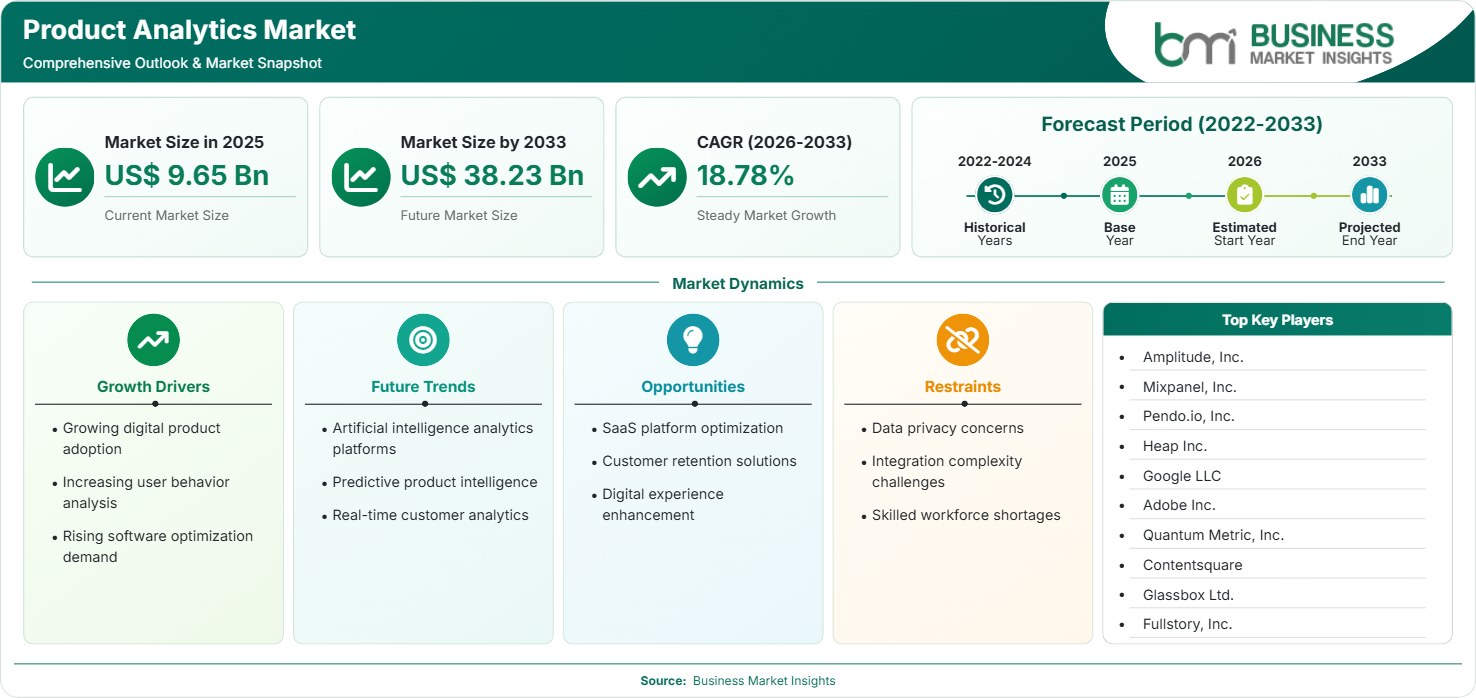
The rise in digitalization in the corporate world has contributed greatly towards a higher need for advanced analytical tools that can help keep track of the performance of their products, engagement with customers, behavior of users, and features usage in their digital products and services. Product analytics has been used by firms developing mobile apps, SaaS, web apps, and digital services to make their products more user-friendly and innovative and to increase customer satisfaction and retention. Advanced product analytics software helps firms make decisions on how to improve their products based on insights gained from the software. The continued investment in cloud computing, artificial intelligence, big data, and digital transformation projects has driven the adoption of advanced product analytics.
Increasing user behavior analysis
The trend towards increasing focus on studying customers' experience in relation to websites, mobile apps, Saas software, and other online platforms to provide an improved user experience is currently on the rise. Behavioral analytics allows businesses to discover usage patterns, track customer journeys, minimize customer churn rate, optimize product features, improve conversion rates, and improve the digital experience in general. Furthermore, using artificial intelligence, machine learning, predictive, and real-time data processing technologies allows for improving user experience analysis by predicting customer behavior, potential risks, and making recommendations to improve the product accordingly.
Rising software optimization demand
Software development is a process that demands real-time tracking of the performance of applications, user engagement, usage of features, and their impact on the effectiveness of the products. Product analytics tools facilitate agility and DevOps approach to development by offering insights on user behavior, application performance, usage of features, and feedback from customers, thus allowing developers to take informed decisions through the development process. This enables enhancing the quality of the product, solving performance problems, reducing risks of development, and prioritizing features for enhancement, as well as faster delivery of the software that meets the needs of the customers. Also, integration with cloud platforms, artificial intelligence, machine learning, and CI/CD allows improving the process even further.
Key Market Opportunities
SaaS platform optimization
The rapid expansion of SaaS applications is creating strong demand for advanced product analytics solutions capable of measuring feature utilization, customer engagement, onboarding performance, user behavior, subscription retention, and overall product performance. Product analytics enables SaaS providers to gain actionable insights into customer journeys, identify feature adoption trends, optimize user experiences, reduce churn, and improve customer satisfaction. Additionally, these platforms support data-driven product development, personalized user engagement, pricing optimization, and continuous feature enhancement, helping SaaS companies increase recurring revenue, maximize customer lifetime value, strengthen customer retention, and maintain a competitive advantage in the rapidly evolving software market.
Customer retention solutions
Businesses are increasingly utilizing predictive analytics, behavioral intelligence, artificial intelligence, and machine learning to identify customer churn risks, personalize engagement strategies, and improve long-term customer retention. Advanced product analytics platforms provide valuable insights into user behavior, customer preferences, feature adoption, and engagement patterns, enabling organizations to deliver highly personalized experiences and targeted recommendations. These data-driven capabilities strengthen customer relationships, improve satisfaction and loyalty, optimize marketing and product strategies, increase customer lifetime value, and support sustainable business growth across digital platforms and subscription-based business models.
Digital experience enhancement
Organizations are increasingly investing in customer journey analytics, product experimentation, A/B testing, feature optimization, and AI-powered recommendation engines, creating significant opportunities reflected in the Product Analytics Market forecast. The integration of real-time analytics with product development workflows enables continuous optimization of websites, mobile applications, SaaS platforms, and enterprise software by providing immediate insights into user behavior, feature performance, and customer preferences. Furthermore, advanced analytics platforms support faster product iterations, data-driven decision-making, personalized user experiences, and continuous innovation, helping organizations improve conversion rates, increase customer retention, accelerate product development, and maintain a competitive advantage in rapidly evolving digital markets.
Market Restraints and Challenges
Data privacy concerns
Factor: Product analytics platforms collect significant volumes of user interaction, behavioral, and application usage data, requiring organizations to comply with evolving privacy regulations such as the General Data Protection Regulation (GDPR), California Consumer Privacy Act (CCPA), and other global data protection frameworks. Ensuring data security, user consent management, data anonymization, and regulatory compliance adds complexity to the deployment and operation of analytics platforms.
Impact: Stringent regulatory requirements increase implementation complexity, compliance costs, and data governance responsibilities while limiting unrestricted access to customer data required for advanced analytics, behavioral modeling, and AI-driven insights. Organizations must invest in robust security measures, privacy management tools, and compliance frameworks, which can extend deployment timelines, increase operational expenses, and create challenges in extracting comprehensive customer insights while maintaining regulatory compliance.
Integration complexity challenges
Factor: Integrating analytics platforms with legacy enterprise systems, multiple cloud environments, CRM platforms, and third-party applications often requires significant technical expertise and infrastructure modernization.
Impact: Complex integration processes can increase deployment timelines, implementation costs, and operational challenges, delaying realization of business value and reducing adoption among organizations with limited technical resources.