Security Analytics Market Regional Highlights
North America Security Analytics Market
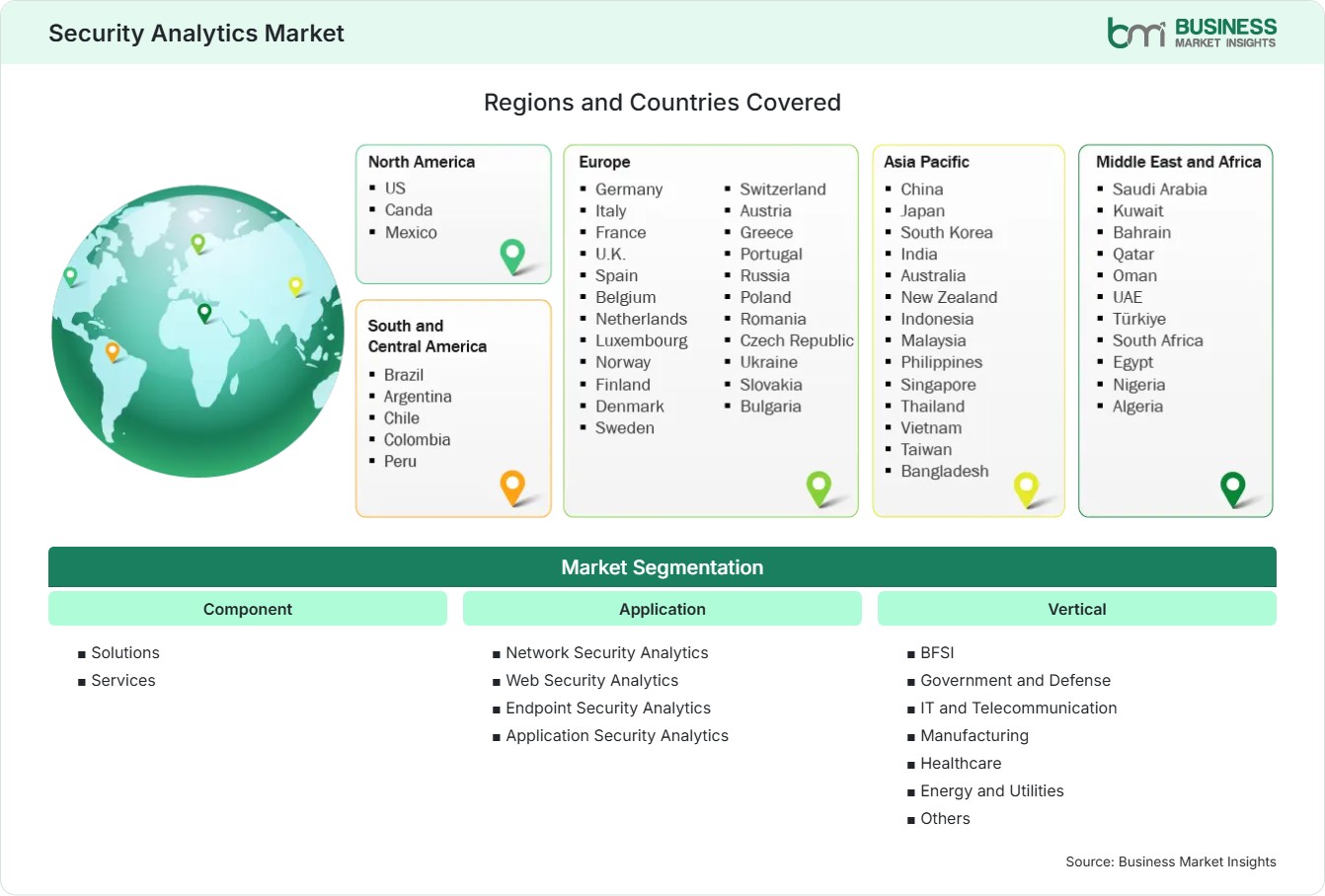
North America represents a 31%–35% share in 2025 and is projected to grow at a 25.5%–26.5% CAGR during 2026–2033. The Security Analytics Market share remains concentrated in the United States, which accounts for 75%–79% of regional demand and expands at a 26.0%–27.0% CAGR. Canada contributes through financial services, government, telecommunications, energy, and healthcare security modernization.
- Enterprise cybersecurity spending remains strong as organizations seek centralized visibility across increasingly distributed networks, endpoints, cloud workloads, applications, identities, and connected devices.
- Financial institutions maintain substantial demand because continuous monitoring, fraud-related analytics, regulatory compliance, and rapid incident investigation are critical to protecting sensitive financial infrastructure.
- Cloud migration is increasing telemetry complexity, strengthening demand for analytics platforms capable of correlating security events across hybrid and multi-cloud environments.
- Security operations modernization is encouraging organizations to combine detection, investigation, threat intelligence, behavioral analytics, and automated response within more integrated architectures.
US Security Analytics Market
The United States Security Analytics Market accounts for 75%–79% of North American demand in 2025 and grows at a 26.0%–27.0% CAGR through 2033. The country benefits from extensive enterprise cloud adoption, high cybersecurity spending, sophisticated threat activity, and strong compliance requirements. Demand is concentrated across BFSI, government, defense, healthcare, technology, telecommunications, energy, and manufacturing.
- Advanced cybersecurity maturity supports adoption of machine learning, behavioral analytics, threat intelligence, automated investigation, and real-time security monitoring across large enterprise environments.
- Regulatory requirements across sensitive industries strengthen demand for continuous security visibility, incident detection, reporting capabilities, data governance, and audit-ready monitoring.
- Cloud and hybrid infrastructure expansion increases demand for analytics capable of correlating security events across distributed workloads, users, applications, and endpoints.
Europe Security Analytics Market
Europe Security Analytics Market accounts for a 20%–24% share in 2025 and expands at a 24.2%–25.4% CAGR during 2026–2033. Germany, the United Kingdom, France, and the Netherlands remain leading markets because of strong enterprise technology adoption, financial services activity, industrial digitalization, and cybersecurity requirements. Poland represents a high-growth market with a 26.0%–27.2% CAGR as digital infrastructure expands.
- Germany maintains strong demand through industrial digitalization, manufacturing security requirements, financial services, and increasingly complex connected enterprise environments.
- The United Kingdom supports adoption through financial services, government modernization, cloud migration, telecommunications, and advanced cybersecurity operations requiring continuous threat visibility.
- France and the Netherlands benefit from expanding cloud infrastructure, digital services, critical infrastructure protection, and enterprise security modernization.
- Regulatory requirements are encouraging organizations to improve monitoring, event correlation, risk identification, incident response, and security governance across sensitive environments.
Asia Pacific Security Analytics Market
Asia Pacific Security Analytics Market represents a 25%–29% share in 2025 and expands at a 28.8%–30.0% CAGR through 2033, making it the fastest-growing region. China, Japan, India, South Korea, Singapore, and Australia provide substantial demand. India records a 31.0%–32.5% CAGR as digital payments, cloud adoption, enterprise modernization, and cybersecurity investment expand. China remains a major market because of extensive digital infrastructure and enterprise technology deployment.
- China supports substantial demand through large-scale digital infrastructure, cloud deployment, telecommunications, manufacturing, financial technology, and enterprise security modernization.
- India provides strong expansion opportunities as digital payments, cloud services, connected enterprises, and cybersecurity requirements increase across public and private organizations.
- Japan and South Korea benefit from advanced technology adoption, industrial connectivity, financial services digitization, and increasing requirements for sophisticated threat detection.
- Southeast Asian markets are expanding as cloud adoption, digital banking, e-commerce, telecommunications, and connected infrastructure increase security monitoring requirements.
Rest of World Security Analytics Market
Rest of World represents a 14%–18% share in 2025 and expands at a 23.0%–24.5% CAGR during 2026–2033. South and Central America are supported by financial digitization, cloud adoption, telecommunications, and increasing cyber risks. Brazil and Mexico are leading markets, while Brazil records a 25.0%–26.2% CAGR. Saudi Arabia and the United Arab Emirates remain important demand centers, supported by cybersecurity investment and digital transformation. South and Central American organizations are increasing security analytics deployment as financial services, government systems, telecommunications, and cloud-based business applications expand.
- Brazil provides significant demand through financial services, telecommunications, digital commerce, government technology, and enterprise cloud adoption.
- Mexico benefits from manufacturing, financial services, telecommunications, and digital transformation initiatives that increase the volume of enterprise security data.
- Saudi Arabia and the United Arab Emirates are investing in digital infrastructure and cybersecurity capabilities across government, financial, energy, and smart infrastructure environments.
- African markets provide emerging opportunities as cloud services, mobile financial platforms, digital government systems, and connected enterprise infrastructure expand.