
Physical Security Market Outlook: Size, Share, Trends, Growth Analysis, Competitive Landscape & Forecast, 2022-2033

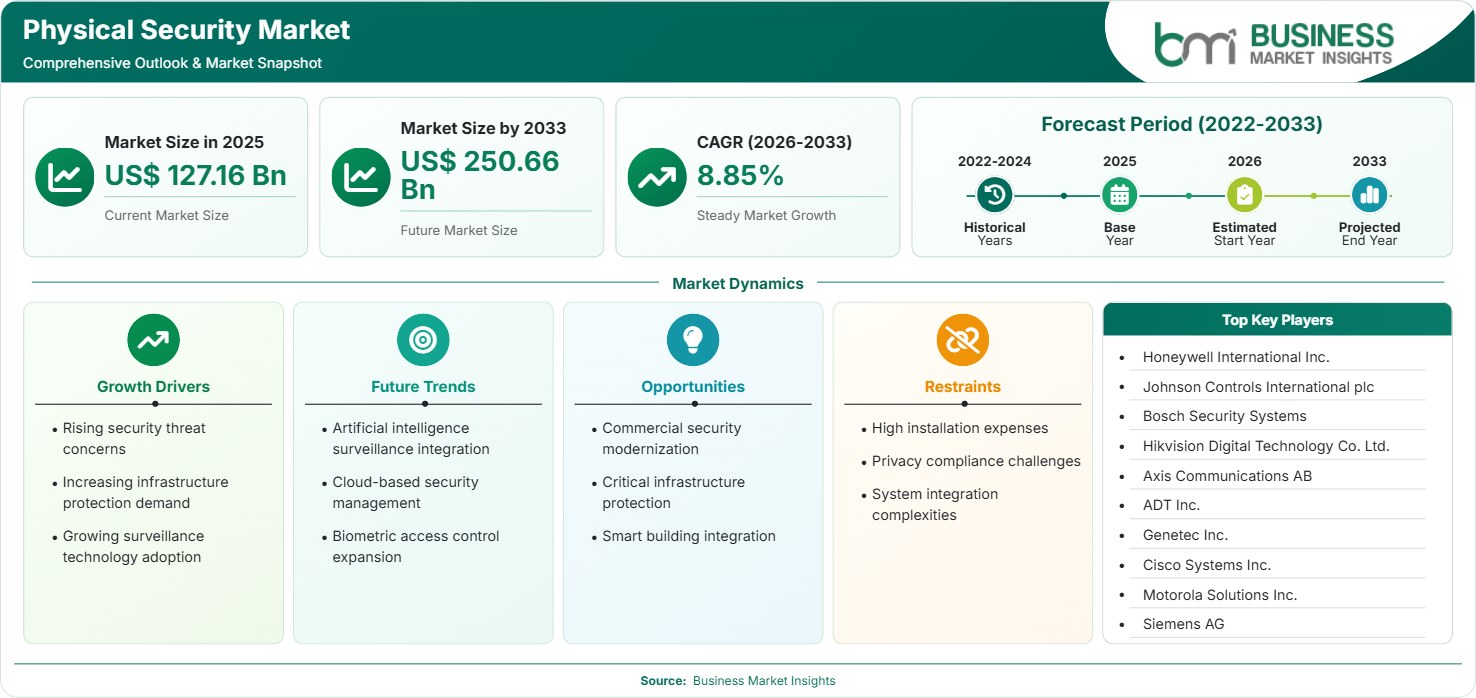
The Physical Security Market size was valued at USD 127.16 Billion in 2025 and is projected to reach USD 250.66 Billion by 2033, growing at a CAGR of 8.85% during 2026–2033. Increasing investments in critical infrastructure protection, AI-powered surveillance systems, and smart building security solutions are accelerating market expansion, while cloud-based security platforms and integrated access control technologies create new opportunities across commercial and government sectors.

Report Coverage
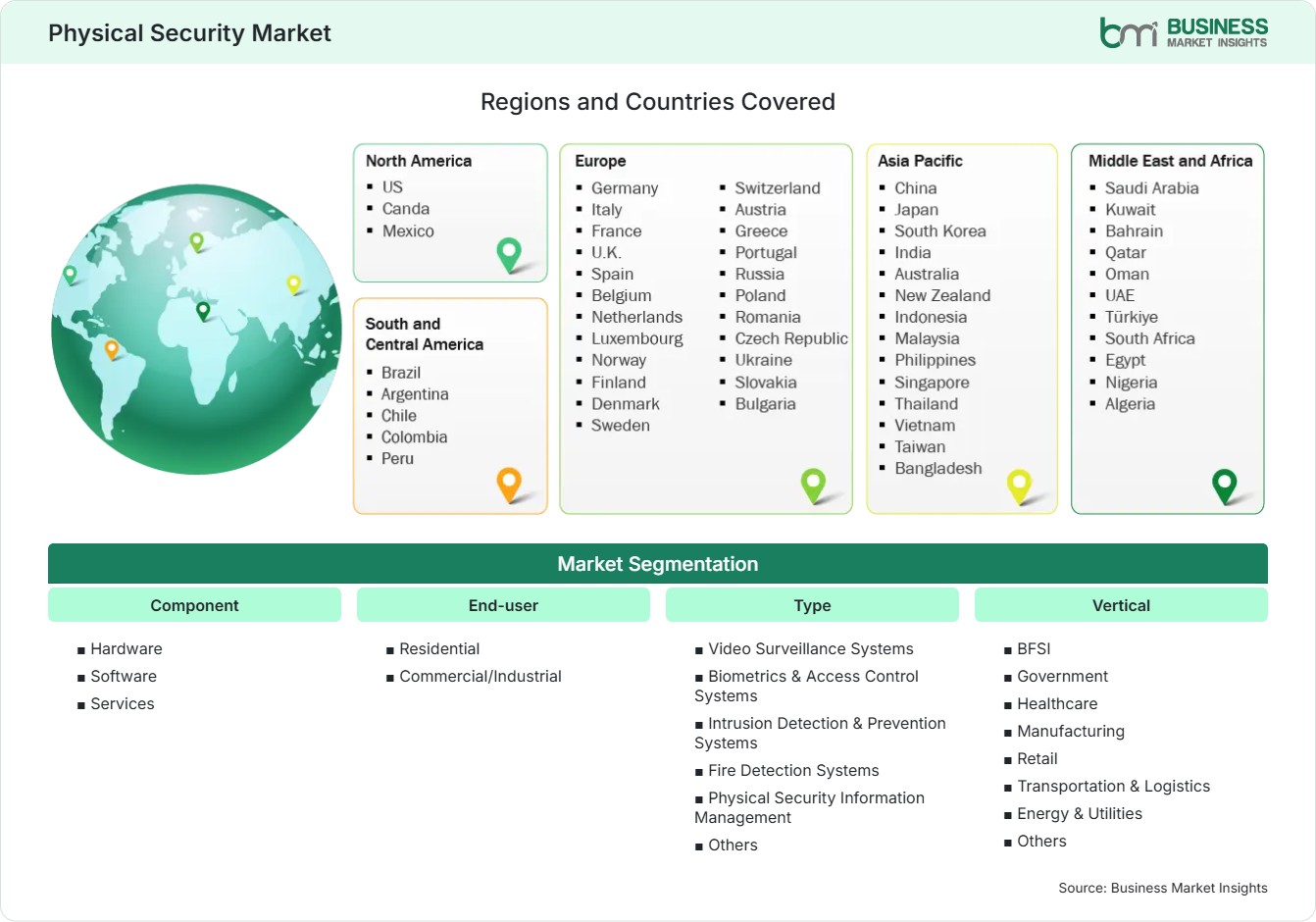
  • Component: Hardware, Software, Services
  • End-user: Residential, Commercial/Industrial
  • Type: Video Surveillance Systems, Biometrics & Access Control Systems, Intrusion Detection & Prevention Systems, Fire Detection Systems, Physical Security Information Management, Others
  • Vertical: BFSI, Government, Healthcare, Manufacturing, Retail, Transportation & Logistics, Energy & Utilities, Others
US$ 127.16 Bn Market size in 2025
US$ 250.66 Bn Market Size by 2033
8.85% CAGR, 2026 - 2033
2026-2033 Forecast Period

01 AI Overview

Physical Security Market Summary

  • North America Region: North America holds 34%–37% market share in 2025, growing with a CAGR of 8.1%–8.6% during 2026–2033, supported by critical infrastructure modernization, enterprise security investments, AI-enabled surveillance adoption, and stringent regulatory compliance. The U.S. market benefits from extensive public safety investments and expands at a CAGR of 8.3%–8.8%.
  • Fastest Growing Region: Asia Pacific accounts for 29%–32% market share in 2025 and is expected to expand at a CAGR of 9.8%–10.3% through 2033, driven by smart city development, rapid urbanization, industrial digitalization, and increasing investments in transportation and public infrastructure security.
  • Leading Segment: Hardware represents 52%–55% market share in 2025 while advancing at a CAGR of 8.5%–9.0%, supported by continuous deployment of surveillance cameras, biometric readers, access control devices, fire detection equipment, and perimeter protection systems.
  • High Growth Segment: Software captures 22%–25% market share in 2025 and records a CAGR of 10.2%–10.7%, fueled by cloud-native security management, AI-based analytics, video intelligence, cybersecurity convergence, and centralized monitoring capabilities.
  • Key Market Opportunity: Growing deployment of unified security platforms integrating artificial intelligence, cloud computing, biometrics, and predictive analytics creates substantial opportunities for vendors delivering scalable, interoperable, and data-driven physical security ecosystems.
  • Major Market Players: Honeywell International Inc., Johnson Controls International plc, Bosch Security Systems, Hikvision Digital Technology Co., Ltd., Axis Communications AB, ADT Inc., Genetec Inc., Cisco Systems, Inc., Motorola Solutions, Inc., and Siemens AG.
02 Strategic Insights

Physical Security Market: Strategic Insights

physical-security-market-market-strategic-framework
FREE PDF
Request your free sample
Request free sample
03 Stakeholder View

Key Takeaways

  • The market ecosystem is increasingly shifting toward integrated security platforms that combine hardware, software, cloud services, and AI-driven analytics, enabling vendors to offer end-to-end solutions instead of standalone surveillance or access control products.
  • The strongest long-term growth opportunities exist in software-centric security management, cloud video surveillance, biometric authentication, and protection of critical infrastructure, particularly across transportation, utilities, healthcare, and government facilities.
  • Artificial intelligence, edge computing, machine learning, and real-time video analytics are transforming security operations by enabling predictive threat detection, automated incident response, facial recognition, and centralized monitoring with improved operational efficiency.
  • Asia Pacific offers the most attractive regional investment opportunity due to rapid urbanization, expanding smart city initiatives, industrial automation, and increasing government expenditure on national security, public infrastructure, and intelligent transportation systems.
  • Strategic acquisitions, technology partnerships, and investments in cloud-native security platforms are reshaping competitive dynamics as vendors seek to strengthen AI capabilities, expand recurring software revenues, and improve interoperability across security ecosystems.
04 Geographic Outlook

Physical Security Market Regional Highlights

North America Physical Security Market

North America accounts for approximately 34%–37% of the global market in 2025 and is projected to expand at a CAGR of 8.1%–8.6% through 2033. The Physical Security market share remains the highest worldwide due to considerable investments in infrastructure security, high-end surveillance equipment, and access control systems. Favorable regulations, company modernizations, and AI proliferation keep stimulating demand on the regional level.

  • Government agencies continue investing in border protection, transportation security, and public safety infrastructure, accelerating deployment of AI-enabled surveillance, biometric identification, and integrated command-and-control systems across federal and municipal facilities.
  • Commercial enterprises increasingly adopt cloud-based video surveillance and intelligent access management platforms to improve operational efficiency, reduce security risks, and enhance compliance with evolving industry regulations.
  • Healthcare providers strengthen physical security infrastructure through advanced monitoring technologies, visitor management systems, and emergency response integration to protect sensitive facilities and critical patient information.

US Physical Security Market

The United States represents 27%–30% of the global market in 2025 and is forecast to register a CAGR of 8.3%–8.8% through 2033. Continuous modernization of critical infrastructure, rising enterprise cybersecurity awareness, and convergence of physical and digital security solutions strengthen domestic demand for intelligent security platforms.

  • Federal investments in transportation, energy infrastructure, and homeland security continue driving procurement of advanced surveillance technologies, integrated command centers, and AI-assisted monitoring systems.
  • Financial institutions increasingly implement biometric authentication, intelligent access control, and real-time surveillance to strengthen fraud prevention and regulatory compliance across branch networks.
  • Educational institutions modernize campus security through cloud-managed surveillance, emergency notification platforms, and centralized access management to improve student and staff safety.

Europe Physical Security Market

Europe contributes approximately 25%–28% of the global market in 2025 while expanding at a CAGR of 8.4%–8.9% through 2033. Regulatory compliance, infrastructure modernization, and growing investments in transportation security continue supporting regional expansion. Germany leads regional adoption, while Poland represents one of the fastest-growing national markets with a CAGR of 9.1%–9.6%.

  • Germany maintains leadership through widespread industrial automation, smart manufacturing investments, and advanced deployment of integrated security management systems across commercial and public sectors.
  • Poland records rapid expansion supported by transportation modernization, logistics infrastructure investments, and increasing adoption of AI-enabled surveillance technologies.
  • The European Union's emphasis on critical infrastructure resilience encourages broader implementation of interoperable access control, video analytics, and emergency management solutions.

Asia Pacific Physical Security Market

Asia Pacific represents 29%–32% of global revenue in 2025 and is anticipated to achieve the fastest expansion at a CAGR of 9.8%–10.3% through 2033. Rapid urbanization, smart city investments, expanding industrialization, and government-backed digital infrastructure initiatives continue accelerating market adoption. China remains the largest regional market, while India records the highest growth with a CAGR of 10.4%–10.9%.

  • China continues investing in intelligent surveillance infrastructure, AI-powered video analytics, and integrated public security systems supporting large-scale urban development projects.
  • India benefits from expanding smart city programs, digital governance initiatives, and rising enterprise investment in commercial and industrial security infrastructure.
  • Manufacturing expansion across Southeast Asia increases demand for access control, worker safety monitoring, and industrial surveillance technologies.

Rest of World Physical Security Market

Rest of World accounts for 9%–11% of the global market in 2025 and is projected to expand at a CAGR of 8.8%–9.3% during the forecast period. South & Central America benefit from growing commercial security investments, while the Middle East & Africa experience increasing demand driven by smart city development, energy infrastructure expansion, and public safety modernization. Brazil leads South & Central America, whereas Saudi Arabia demonstrates the strongest growth at 9.5%–10.0% CAGR.

  • Brazil strengthens enterprise security investments across banking, retail, manufacturing, and transportation sectors, encouraging adoption of integrated surveillance and access management platforms.
  • Saudi Arabia continues expanding smart city projects and critical infrastructure investments under national diversification initiatives, accelerating deployment of advanced security technologies.
  • Energy producers across the Middle East increasingly deploy perimeter protection, intelligent monitoring, and biometric access systems to secure strategic assets.
global-market-geography
FREE PDF
Request your free sample
Request free sample
05 Segment Analysis

Physical Security Market Segmentation

By Component

The Component segment represents the technological foundation of the market, with Hardware accounting for the largest 52%–55% market share in 2025 and expanding at a CAGR of 8.5%–9.0% during 2026–2033. Increasing investments in AI-enabled surveillance equipment, intelligent access control devices, and integrated security infrastructure continue strengthening adoption. The Physical Security Market scope continues expanding as organizations deploy unified hardware, software, and managed security services across critical facilities.

  • Hardware: Includes surveillance cameras, biometric readers, access control devices, fire detection equipment, sensors, and perimeter security systems that remain essential for comprehensive physical protection across commercial and public infrastructure.
  • Software: Encompasses video management systems, AI-powered analytics, security information management platforms, cloud monitoring applications, and centralized command software improving operational visibility and intelligent threat response.
  • Services: Covers consulting, installation, system integration, managed security services, maintenance, technical support, and lifecycle management that enable organizations to maximize operational efficiency and regulatory compliance.

By End-user

The Commercial/Industrial segment dominates end-user demand with an estimated 64%–67% market share in 2025 and is projected to register a CAGR of 9.0%–9.5% through 2033. Enterprises increasingly deploy integrated surveillance, access control, and intelligent monitoring systems to strengthen operational resilience, regulatory compliance, and employee safety while protecting critical business assets.

  • Residential: Smart home adoption, wireless surveillance systems, intelligent door locks, cloud-connected monitoring, and remote mobile access continue increasing demand for affordable and scalable residential security solutions.
  • Commercial/Industrial: Large enterprises, industrial facilities, commercial buildings, warehouses, and institutional campuses invest extensively in integrated security ecosystems supporting asset protection, workforce safety, and centralized security operations.

By Type

Video Surveillance Systems remain the leading product category, accounting for approximately 36%–39% of total revenue in 2025 while expanding at a CAGR of 9.1%–9.6% during the forecast period. Continuous advances in AI-powered analytics, cloud connectivity, edge computing, and intelligent monitoring support strong long-term adoption. The Physical Security Market trends increasingly emphasize integrated platforms capable of combining multiple security technologies into unified operational environments.

  • Video Surveillance Systems: AI-enabled cameras, intelligent monitoring platforms, cloud video storage, and advanced analytics improve threat detection, operational awareness, and forensic investigation capabilities.
  • Biometrics & Access Control Systems: Facial recognition, fingerprint authentication, iris scanning, mobile credentials, and intelligent identity management strengthen secure access across enterprise and government environments.
  • Intrusion Detection and Prevention Systems: Motion sensors, perimeter detection technologies, intelligent alarms, and automated response systems enhance facility protection against unauthorized access and security breaches.
  • Fire Detection Systems: Intelligent smoke detectors, heat sensors, emergency notification technologies, and integrated fire management platforms improve occupant safety and regulatory compliance across facilities.
  • Physical Security Information Management (PSIM): Centralized software platforms integrate multiple security technologies into unified command centers, improving situational awareness, incident management, and operational decision-making.

By Vertical

The BFSI sector represents the largest vertical, contributing approximately 20%–23% of market revenue in 2025 while recording a CAGR of 8.9%–9.4% through 2033. Increasing concerns regarding fraud prevention, branch security, regulatory compliance, and customer protection continue encouraging investments in advanced surveillance, biometric authentication, and integrated physical security platforms.

  • BFSI: Banks and financial institutions deploy intelligent surveillance, biometric verification, secure vault monitoring, and integrated access management to protect assets and customers.
  • Government: National security agencies, municipalities, defense organizations, and public institutions implement advanced surveillance, perimeter protection, and command-and-control systems supporting public safety objectives.
  • Healthcare: Hospitals, laboratories, and medical campuses invest in access management, visitor monitoring, pharmaceutical security, and emergency response technologies protecting patients and sensitive facilities.
  • Manufacturing: Industrial facilities deploy integrated surveillance, worker safety monitoring, perimeter security, and operational intelligence platforms to improve resilience and reduce production risks.
  • Retail: Retailers increasingly implement intelligent video analytics, loss prevention systems, customer behavior monitoring, and centralized security management across multi-store operations.
  • Transportation & Logistics: Airports, ports, railway stations, logistics hubs, and distribution centers adopt integrated surveillance and biometric access technologies to improve operational security and passenger safety.
  • Energy & Utilities: Critical infrastructure operators strengthen perimeter protection, intelligent monitoring, remote surveillance, and emergency management capabilities to safeguard strategic energy assets.
06 Market Forces

Physical Security Market Dynamics

Key Market Drivers

Rising security threat concerns

The rise of geopolitical instability, terrorist threats, organized crime, occupational violence, and unauthorized entry is continuously driving the need for more sophisticated physical security systems. It should be noted that countries are enhancing their efforts in securing critical infrastructure, while businesses are focusing on modernizing security approaches. The UNODC reports that due to urbanization and expansion of critical infrastructure, an enhanced approach to integrated security is necessary.

Increasing infrastructure protection demand

The rapid development of transportation networks, energy infrastructure, health care institutions, data centers, and smart cities is pushing the implementation of integrated security systems. Airports, railways, port authorities, power utilities, and government buildings need multi-tier security systems involving surveillance, intrusion detection, perimeter security, and monitoring solutions. Regulatory bodies in developed and developing countries have raised their physical protection requirements for critical infrastructure, prompting companies to upgrade traditional security systems into integrated security platforms enabling continuous monitoring, alarms, and emergency response.

Growing surveillance technology adoption

The development of artificial intelligence, cloud computing, edge analytics, and high-resolution imaging has greatly increased the efficiency of surveillance systems. Advanced video analytics have made it possible for facial recognition, behavior analysis, object tracking, number plate recognition, and even anomaly detection to be performed more accurately. The Physical Security Markets trends are showing that the customers' demand for cloud-managed surveillance systems has increased because of the benefits they offer. They provide remote access, predictive maintenance, scalability, and seamless integration with cybersecurity solutions.

Key Market Opportunities

Commercial security modernization

The commercial world is increasingly opting to substitute traditional surveillance systems with intelligent AI-based cloud security systems. According to the Physical Security Market Forecasts, organizations are investing more in intelligent video management solutions, biometric access control solutions, and centralized monitoring systems that improve their efficiencies and work in hybrid workspaces.

Critical infrastructure protection

There is huge investment in protecting energy plants, transport facilities, communication systems, water systems, and governmental establishments from the increasing security threats. Such investment results in growing prospects for command center solutions, perimeter security systems, smart surveillance solutions, and automated incident management solutions.

Smart building integration

The quick adaptation of smart commercial buildings brings new possibilities for building physical security system integration with building automation systems, HVAC control, lighting, occupancy sensing, and energy management systems. This way, unified building management helps improve efficiency and allows centralized monitoring, predictive maintenance, and automated responses to emergencies.

Market Restraints and Challenges

High installation expenses

Factor: Enterprise-grade surveillance infrastructure, biometric authentication systems, network upgrades, command centers, and integrated software platforms require substantial capital investment alongside installation, configuration, and employee training costs. Impact: Small and medium-sized enterprises frequently delay modernization projects due to budget constraints, extending replacement cycles for legacy equipment. High upfront expenditures also increase procurement complexity for organizations managing geographically distributed facilities, slowing adoption despite long-term operational benefits and improved security performance.

Privacy compliance challenges

Factor: Expanding deployment of facial recognition, biometric authentication, AI-powered analytics, and continuous video monitoring increases regulatory scrutiny regarding personal data collection, storage, and processing under frameworks such as GDPR and similar privacy regulations. Impact: Organizations must invest in governance policies, cybersecurity controls, encryption technologies, compliance audits, and transparent data management practices. These additional requirements increase implementation complexity, extend deployment timelines, and elevate operational costs for both solution providers and end users operating across multiple jurisdictions.

07 Company Analysis

Competitive Landscape

The market competition is driven by the ongoing innovations in AI, cloud security management, surveillance system integrations, and physical protection via cybersecurity solutions. As per the Physical Security Market analysis, major players in the industry have gained competitive advantage due to their investments in acquisitions, software development, AI-based analytics, and holistic security ecosystem combining video surveillance, access control, intrusion detection, and command & control functions.

Company Name

Overview (15–20 words)

Products and Services Relevant to this Market (15–20 words)

Honeywell International Inc.

Global industrial technology company delivering integrated building technologies and enterprise-grade security solutions across diverse industries.

Video surveillance, access control, intrusion detection, fire safety systems, integrated security platforms, and building management solutions.

Johnson Controls International plc

Multinational provider of smart buildings, building automation, and comprehensive physical security technologies.

Access control systems, surveillance platforms, fire detection, integrated security software, and managed security services.

Bosch Security Systems

Leading manufacturer of intelligent security and communication technologies for commercial and industrial environments.

AI-enabled surveillance cameras, intrusion detection, fire alarms, video management software, and integrated security systems.

Hikvision Digital Technology Co., Ltd.

Global provider of AI-powered video surveillance and intelligent security technologies for multiple vertical industries.

Network cameras, video analytics, biometric access control, intelligent monitoring, and cloud-based security management platforms.

Axis Communications AB

Pioneer in network video technology delivering intelligent surveillance and access control solutions worldwide.

IP cameras, network audio, video analytics, access control devices, and centralized monitoring software.

ADT Inc.

Major security service provider specializing in monitored residential and commercial protection solutions.

Alarm monitoring, video surveillance, smart security systems, intrusion detection, and managed security services.

Genetec Inc.

Software-focused security company offering unified security management and cloud-native operational platforms.

Physical Security Information Management, video management software, access control, cloud security, and analytics platforms.

Cisco Systems, Inc.

Global networking technology company integrating secure connectivity with enterprise physical security infrastructure.

Secure networking, IoT connectivity, surveillance networking solutions, cybersecurity integration, and cloud infrastructure.

Motorola Solutions, Inc.

Public safety technology provider delivering mission-critical communications and intelligent security platforms.

Video surveillance, command center software, AI analytics, access control, emergency communications, and incident management solutions.

Siemens AG

Global industrial technology leader delivering integrated building security and infrastructure management solutions.

Building security systems, fire safety technologies, access management, surveillance solutions, and integrated building automation.

08 Industry Activity

Recent Developments

March 2026

Motorola Solutions, Inc. completed the acquisition of Theatro Labs, Inc., expanding its AI-powered enterprise security portfolio with voice-controlled communication and workflow solutions for frontline workers across retail, hospitality, healthcare, and manufacturing sectors.

February 2026

Axis Communications AB expanded its network security portfolio with a new generation of AI-powered network cameras featuring edge-based analytics, deep learning capabilities, and enhanced cybersecurity to improve real-time surveillance and threat detection across commercial and industrial facilities.

October 2025

Genetec Inc. introduced the latest version of Security Center, enhancing unified physical security operations with AI-assisted incident management, cloud connectivity, and advanced video analytics for enterprise and critical infrastructure applications.

April 2025

Honeywell International Inc. launched the Honeywell Digital Security Suite, integrating AI-enabled video analytics, cloud-based access control, and cybersecurity capabilities to strengthen enterprise physical security and building management solutions.

10 Trust & Transparency

Research Methodology

The market analysis combines proprietary research with secondary data from government agencies, company disclosures, regulatory filings, industry databases and expert interviews. Market estimates are validated through data triangulation, cross-market benchmarking and analyst review.

View Full Research Methodology

11 Questions Answered

Frequently Asked Questions

What future opportunities are expected to shape the market?

Emerging opportunities include AI-driven video analytics, cloud-based security management, smart building integration, unified Physical Security Information Management (PSIM) platforms, intelligent biometric authentication, and protection solutions for critical infrastructure and digital industrial facilities.

Which companies are included in the Market Report?

The Physical Security Market Report includes Honeywell International Inc., Johnson Controls International plc, Bosch Security Systems, Hikvision Digital Technology Co., Ltd., Axis Communications AB, ADT Inc., Genetec Inc., Cisco Systems, Inc., Motorola Solutions, Inc., and Siemens AG.

Which region is expected to grow the fastest during the forecast period?

Asia Pacific is anticipated to register the fastest growth with a CAGR of 9.8%–10.3% between 2026 and 2033. Growth is supported by rapid urbanization, government investments in smart cities, expanding transportation infrastructure, and increasing enterprise adoption of intelligent security technologies.

Which component holds the largest share in the market?

The Hardware segment leads the market with an estimated 52%–55% share in 2025. Continued deployment of surveillance cameras, biometric readers, fire detection equipment, intrusion sensors, and access control devices supports its dominant position across multiple end-user industries.

What are the major factors driving the Physical Security Market?

The industry is being powered by higher investments in critical infrastructure protection, greater use of AI-based surveillance systems, more applications of smart cities concepts, higher demand for biometric access control technologies, tougher security regulations, and the convergence of physical and cyber security systems.

Access the Full Physical Security Market Report

Get segment-level forecasts, regional estimates, competitive benchmarking, company profiles and downloadable Excel datasets.

Access the full Physical Security Market Report
350 pages PDF & Excel | 2026-07-30