
Mobile Security Market Outlook: Size, Share, Trends, Growth Analysis, Competitive Landscape & Forecast, 2026-2033

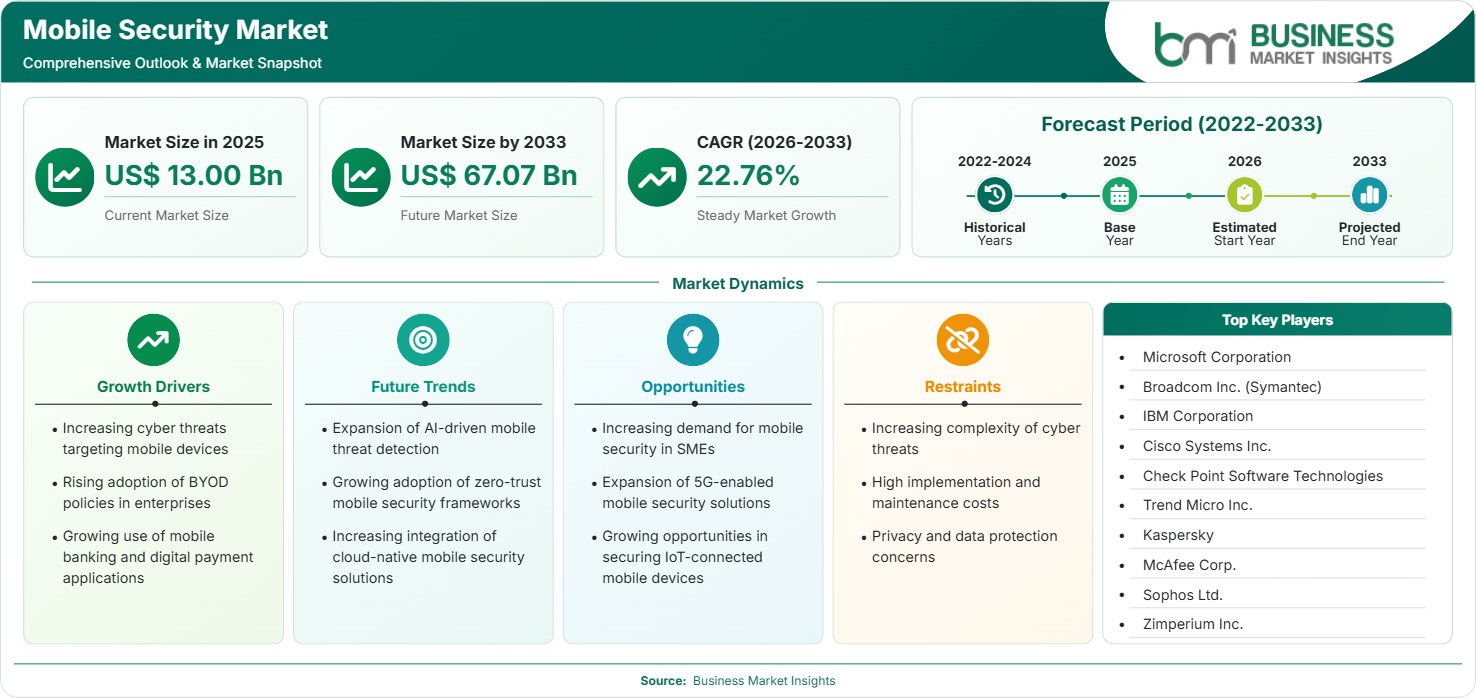
The Mobile Security Market size was valued at US$ 13.00 Billion in 2025 and is projected to reach US$ 67.07 Billion by 2033, growing at a CAGR of 22.76% during 2026–2033. Increasing cyber threats targeting mobile devices, rising adoption of bring-your-own-device (BYOD) policies, growing mobile banking usage, and expansion of digital payment applications are driving market growth.

Report Coverage
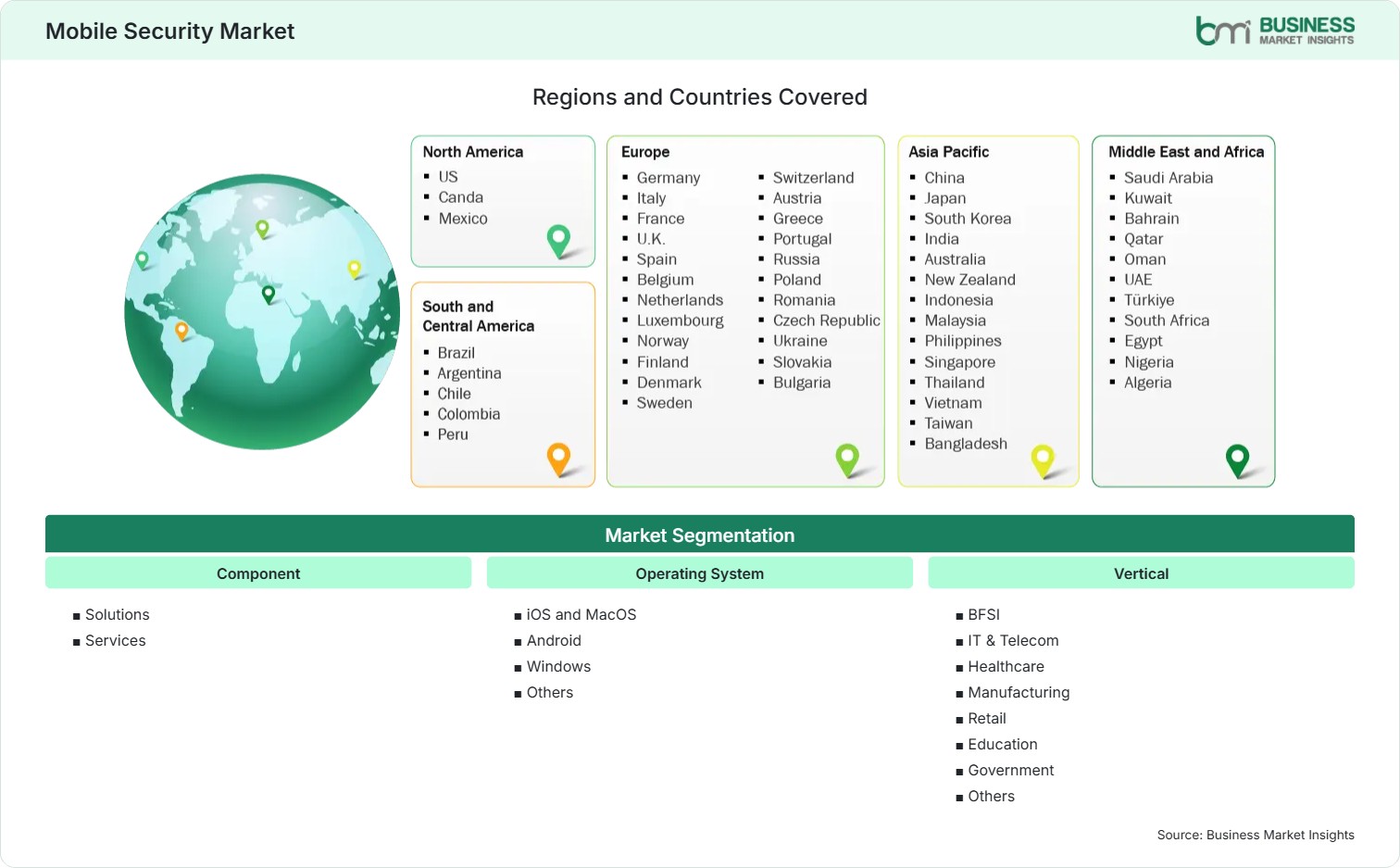
  • Component: Solutions, Services
  • Operating System: iOS and MacOS, Android, Windows, Others
  • Vertical: BFSI, IT & Telecom, Healthcare, Manufacturing, Retail, Education, Government, Others
US$ 13.00 Bn Market size in 2025
US$ 67.07 Bn Market Size by 2033
22.76% CAGR, 2026 - 2033
2026-2033 Forecast Period

AI Overview

Mobile Security Market Summary

  • North America Region: North America accounts for 39%–42% share in 2025 and is projected to expand at a 21.8%–22.5% CAGR during 2026–2033. Growth is supported by advanced cybersecurity infrastructure, increasing enterprise mobility adoption, strong presence of security vendors, and rising investments in data protection solutions. The U.S. represents the largest regional market due to widespread smartphone adoption, increasing cyber risks, and high enterprise security spending, growing at a 22.0%–22.7% CAGR.
  • Fastest Growing Region: Asia Pacific holds 25%–28% share in 2025 and is expected to grow at a 23.5%–24.5% CAGR through 2033, driven by rapid digital transformation, increasing smartphone penetration, expanding fintech adoption, and growing cybersecurity awareness among enterprises.
  • Leading Segment: Solutions Component accounts for 63%–66% share in 2025 and is projected to grow at a 22.3%–22.9% CAGR, supported by increasing demand for mobile threat protection, application security, identity management, and endpoint security solutions.
  • High Growth Segment: Healthcare Vertical accounts for 11%–14% share in 2025 and is projected to grow at a 24.5%–25.5% CAGR, driven by increasing digitization of healthcare systems, protection of patient data, and rising mobile access to healthcare applications.
  • Key Market Opportunity: Increasing demand from SMEs, expansion of 5G-enabled security solutions, and protection of IoT-connected mobile devices are creating significant growth opportunities.
  • Major Market Players: Microsoft Corporation, Broadcom Inc. (Symantec), IBM Corporation, Cisco Systems Inc., Check Point Software Technologies, Trend Micro Inc., Kaspersky, McAfee Corp., Sophos Ltd., and Zimperium Inc.
Strategic Insights

Mobile Security Market: Strategic Insights

Mobile Security Market Strategic Framework
FREE PDF
Request your free sample
Request free sample
Stakeholder View

Key Takeaways

  • The mobile security value chain is evolving through collaboration between cybersecurity providers, enterprises, telecom operators, cloud service providers, and device manufacturers.
  • Mobile security solutions and healthcare applications represent major growth opportunities due to increasing data protection requirements and digital transformation.
  • Innovation is focused on AI-based threat detection, zero-trust security frameworks, mobile application protection, and cloud-based security platforms.
  • Asia Pacific provides strong investment opportunities due to rapid smartphone adoption, expanding digital payments, and increasing cybersecurity awareness.
  • Companies are strengthening competitive positions through advanced security technologies, strategic partnerships, acquisitions, and expansion into emerging markets.
  • Data privacy regulations, enterprise mobility trends, and increasing cyberattack complexity are becoming key factors influencing mobile security investments.
Geographic Outlook

Mobile Security Market Regional Highlights

North America Mobile Security Market

North America accounted for 39%–42% share in 2025 and is projected to grow at a 21.8%–22.5% CAGR during 2026–2033. The region maintains a leading position due to advanced cybersecurity infrastructure, high enterprise adoption of mobile security platforms, increasing cyber threats, and strong presence of major security technology providers. Organizations across BFSI, healthcare, government, and IT sectors are investing heavily in mobile security solutions to protect sensitive information and ensure regulatory compliance.

  • The U.S. represents the largest contributor due to high smartphone penetration, increasing enterprise mobility adoption, and rising cybersecurity investments.
  • Growing adoption of cloud-based applications and remote work environments is increasing demand for mobile threat detection and secure access solutions.
  • Enterprises are implementing zero-trust security frameworks and advanced authentication technologies to protect mobile endpoints.
  • Increasing cyberattacks targeting mobile applications, financial data, and corporate information are encouraging organizations to strengthen security infrastructure.

US Mobile Security Market

The U.S. represents 86%–89% of the North American market in 2025 and is projected to expand at a 22.0%–22.7% CAGR during 2026–2033. Growth is supported by increasing enterprise digital transformation, high adoption of mobile applications, expanding BYOD policies, and rising cybersecurity spending across industries. The country has strong demand for advanced mobile security platforms due to increasing ransomware, phishing, malware, and data breach incidents targeting mobile devices in Mobile Security Market.

  • BFSI organizations are increasing investments in mobile security due to rising digital banking usage and mobile payment adoption.
  • Healthcare providers are adopting security solutions to protect patient information accessed through mobile applications.
  • Large enterprises are deploying mobile device management and endpoint security solutions to secure employee-owned and company-owned devices.
  • Growing regulatory requirements related to data protection are encouraging organizations to implement stronger mobile security measures.

Europe Mobile Security Market

Europe accounted for 23%–26% share in 2025 and is projected to register a 22.1%–22.8% CAGR during 2026–2033. The market is expanding due to increasing cybersecurity awareness, strict data protection regulations, growing digital banking adoption, and rising enterprise mobility requirements. Countries including Germany, the United Kingdom, France, and the Netherlands are contributing significantly to regional Mobile Security market growth.

  • Germany is witnessing increased adoption of mobile security solutions due to strong industrial digitalization and enterprise cybersecurity requirements.
  • The United Kingdom is expanding through growth in fintech applications, digital payments, and mobile-based business services.
  • France is increasing investments in cybersecurity technologies to protect government, enterprise, and consumer mobile ecosystems.
  • European organizations are focusing on compliance with data protection regulations, encouraging adoption of advanced security platforms.
  • Rising demand for secure mobile access solutions is supporting growth across healthcare, financial services, and government sectors.

Asia Pacific Mobile Security Market

Asia Pacific accounted for 25%–28% share in 2025 and is projected to grow at a 23.5%–24.5% CAGR during 2026–2033, making it the fastest-growing region. Growth is supported by rapid smartphone adoption, expanding digital payment ecosystems, increasing internet penetration, and rising awareness regarding cybersecurity threats. China, India, Japan, South Korea, and Southeast Asian countries are key contributors to regional expansion in Mobile Security Market forecasts.

  • China is expanding due to widespread mobile usage, increasing digital financial services, and growing enterprise cybersecurity investments.
  • India represents a high-growth market due to rapid fintech expansion, digital transformation initiatives, and increasing smartphone adoption.
  • Japan is witnessing demand for advanced mobile security solutions due to enterprise digitalization and increasing cyber risk concerns.
  • South Korea is supporting market growth through advanced mobile infrastructure, 5G adoption, and technology-driven industries.
  • Southeast Asian countries are creating opportunities due to expanding online services, mobile commerce, and increasing cybersecurity requirements.

Rest of World Mobile Security Market

The Rest of World accounted for 5%–8% share in 2025 and is projected to grow at a 20.8%–21.6% CAGR during 2026–2033. Growth is supported by increasing smartphone adoption, expanding digital services, rising cybersecurity awareness, and growing enterprise technology investments across Latin America, the Middle East, and Africa in Mobile Security Market.

  • Brazil is experiencing growth due to increasing digital banking adoption and rising demand for protection against mobile cyber threats.
  • Mexico is expanding through increased enterprise mobility adoption and growing awareness of cybersecurity solutions.
  • Middle Eastern countries are investing in mobile security as governments and businesses accelerate digital transformation programs.
  • South Africa is witnessing increased demand for cybersecurity solutions due to expanding mobile connectivity and digital services.
  • Growing adoption of cloud platforms and mobile applications across developing economies is creating new opportunities for security providers.
Global Market Geography
FREE PDF
Request your free sample
Request free sample
Segment Analysis

Mobile Security Market Segmentation

Component

The component segment is driven by increasing enterprise demand for comprehensive mobile protection solutions, managed security services, and advanced threat detection capabilities. Solutions represent the leading category, accounting for 63%–66% share in 2025 and projected to grow at a 22.3%–22.9% CAGR during 2026–2033. Growth is supported by rising cyber threats, increasing adoption of mobile applications, and growing enterprise requirements for endpoint protection, identity management, and application security in Mobile Security market.

  • Solutions: Mobile security solutions dominate due to increasing demand for mobile threat defense, secure application platforms, device management, authentication solutions, and data protection technologies. Organizations are deploying integrated security platforms to safeguard mobile devices against malware, phishing, unauthorized access, and data breaches.
  • Services: Mobile security services are gaining adoption as organizations seek specialized expertise, continuous monitoring, threat intelligence, consulting, and managed security support. Small and medium-sized enterprises are increasingly adopting security services due to limited internal cybersecurity capabilities.

Operating System

The operating system segment is influenced by increasing mobile device adoption across consumer and enterprise environments. Android represents the leading category, accounting for 58%–61% share in 2025 and projected to grow at a 23.0%–23.7% CAGR during 2026–2033. Growth is supported by widespread global adoption, open ecosystem characteristics, and increasing enterprise use of Android-based devices.

  • iOS and MacOS: Apple operating systems are witnessing strong demand for mobile security solutions due to increasing enterprise adoption of iPhones, iPads, and Mac devices. Organizations are focusing on securing corporate applications, user identities, and sensitive data across Apple ecosystems.
  • Android: Android dominates due to its large global user base, extensive device availability, and growing adoption across emerging markets. Increasing malware threats targeting Android devices are encouraging users and enterprises to adopt advanced mobile security solutions.
  • Windows: Windows-based mobile security requirements continue due to enterprise usage of laptops, tablets, and hybrid devices. Organizations are implementing security solutions to protect business data across connected Windows environments.

Vertical

The vertical segment is expanding due to increasing digital transformation, growing mobile application usage, and rising cybersecurity requirements across industries. BFSI represents the leading category, accounting for 22%–25% share in 2025 and projected to grow at a 22.5%–23.2% CAGR during 2026–2033. Growth is supported by increasing mobile banking adoption, digital payment expansion, and the need to secure sensitive financial information.

  • BFSI: Financial institutions are major adopters of mobile security solutions due to rising online banking usage, mobile payments, and increasing risks associated with fraud, phishing, and unauthorized transactions.
  • IT & Telecom: The IT and telecom sector is adopting advanced mobile security solutions to protect large-scale networks, enterprise applications, and customer data. Increasing connectivity and cloud adoption are supporting demand.
  • Healthcare: Healthcare is a high-growth segment due to increasing use of mobile healthcare applications, electronic health records, and remote healthcare services. Protecting patient information and meeting compliance requirements are key drivers.
  • Manufacturing: Manufacturing companies are adopting mobile security solutions as connected devices, industrial applications, and digital operations increase cybersecurity requirements.
  • Retail: Retail organizations are investing in mobile security due to increasing mobile commerce, digital payments, and customer data protection needs.
  • Education: Educational institutions are adopting mobile security solutions to protect online learning platforms, student information, and connected devices.
  • Government: Government agencies are increasing investments in mobile security to protect confidential information, public services, and digital infrastructure.
Market Forces

Mobile Security Market Dynamics

Key Market Drivers

Increasing Cyber Threats Targeting Mobile Devices

The rising frequency and complexity of cyberattacks targeting mobile devices is a major factor driving the growth of the market. Mobile devices are increasingly used for accessing business applications, financial platforms, cloud services, and sensitive organizational data, making them attractive targets for cybercriminals. Threats such as malware, phishing attacks, spyware, ransomware, and unauthorized access attempts are increasing the need for advanced mobile protection solutions. Enterprises are adopting mobile threat defense platforms, endpoint security solutions, and real-time monitoring technologies to protect mobile ecosystems. These factors are supporting market growth as organizations prioritize data protection and secure digital access. Emerging Mobile Security Market trends include AI-powered threat detection, zero-trust security models, and cloud-based mobile security solutions.

Rising Adoption of BYOD Policies in Enterprises

Increasing adoption of bring-your-own-device (BYOD) policies across enterprises is creating strong demand for mobile security solutions. Organizations are allowing employees to use personal smartphones and tablets for accessing corporate applications, improving flexibility and productivity. However, BYOD environments create security challenges related to unauthorized access, data leakage, device vulnerabilities, and compliance risks. Enterprises are implementing mobile device management, identity authentication, encryption, and application security solutions to secure employee devices. The expansion of remote and hybrid work models is further accelerating BYOD adoption, increasing the requirement for comprehensive mobile security frameworks that protect both corporate and personal devices.

Growing Use of Mobile Banking and Digital Payment Applications

The rapid expansion of mobile banking and digital payment applications is increasing demand for advanced mobile security solutions. Consumers and businesses are increasingly using smartphones for financial transactions, digital wallets, and online payments, creating greater risks related to fraud, identity theft, and unauthorized access. Financial institutions are investing in biometric authentication, transaction monitoring, encryption technologies, and mobile application security to protect users and financial data. Growing fintech adoption and increasing digital payment penetration across emerging economies are further supporting market expansion. The need to secure financial applications against evolving cyber threats is expected to remain a key growth driver.

Key Market Opportunities

Increasing Demand for Mobile Security in SMEs

The increasing need for cybersecurity protection among small and medium-sized enterprises (SMEs) represents a significant growth opportunity for mobile security providers. SMEs are increasingly adopting mobile applications, cloud platforms, and remote working models but often lack dedicated cybersecurity resources. Rising awareness regarding data breaches and cyber risks is encouraging SMEs to invest in affordable and scalable mobile security solutions. Security vendors are developing cloud-based platforms, subscription models, and managed security services to address SME requirements. As digital transformation continues among smaller businesses, demand for accessible mobile security technologies is expected to increase.

Expansion of 5G-Enabled Mobile Security Solutions

The expansion of 5G networks is creating new opportunities for mobile security providers by increasing the need for advanced protection across high-speed connected environments. 5G enables faster data transmission, increased device connectivity, and improved support for emerging technologies such as edge computing and IoT applications. However, increased connectivity also introduces new security challenges, requiring advanced threat detection, network protection, and device authentication solutions. Companies are developing security platforms designed specifically for 5G ecosystems to address evolving vulnerabilities. Growing 5G deployment across industries is expected to create demand for next-generation mobile security solutions.

Growing Opportunities in Securing IoT-Connected Mobile Devices

Increasing adoption of IoT-connected devices linked with mobile applications is creating new opportunities for mobile security solutions. Smartphones are increasingly used as control interfaces for smart home devices, wearable technologies, connected vehicles, and industrial IoT systems. Protecting communication channels, device identities, and connected applications has become essential as IoT ecosystems expand. Security providers are developing integrated solutions that combine mobile protection with IoT security capabilities. Growing demand for connected devices across consumer and enterprise environments is expected to support innovation and expansion in the mobile security market.

Market Restraints and Challenges

Increasing Complexity of Cyber Threats

Factor: Increasing sophistication and complexity of cyber threats create challenges for mobile security providers and organizations. Impact: Attackers are continuously developing advanced malware, social engineering techniques, and zero-day exploits that can bypass traditional security measures. Organizations require continuous updates, advanced analytics, and proactive threat intelligence to address evolving risks. The increasing complexity of mobile ecosystems, cloud applications, and connected devices makes security management more challenging. Companies must invest heavily in research, technology development, and skilled cybersecurity professionals to maintain effective protection against emerging threats.

High Implementation and Maintenance Costs

Factor: High costs associated with implementing and maintaining advanced mobile security solutions can restrict adoption, especially among smaller organizations. Impact: Expenses related to security software, infrastructure upgrades, professional services, employee training, and continuous system maintenance can create financial challenges. Enterprises require regular updates and monitoring to ensure protection against new threats, increasing operational costs. SMEs may face difficulties adopting advanced security platforms due to budget limitations. Security providers are addressing this challenge through cloud-based solutions, flexible pricing models, and managed security services to improve accessibility and reduce deployment complexity.

Company Analysis

Competitive Landscape

The Mobile Security Market analysis highlights increasing competition among global cybersecurity providers focusing on mobile threat protection, endpoint security, identity management, application security, and cloud-based security solutions. Leading companies are investing in artificial intelligence-based threat detection, zero-trust security frameworks, enterprise mobility management, and advanced authentication technologies to address increasing cyber risks across smartphones, tablets, and connected mobile devices.

Company Name

Overview

Products and Services Relevant to this Market

Microsoft Corporation

Technology company providing cybersecurity solutions integrated with enterprise platforms and cloud environments.

Mobile threat protection, identity security, endpoint protection, device management, and enterprise security solutions.

Broadcom Inc. (Symantec)

Cybersecurity provider offering enterprise security technologies through its Symantec portfolio.

Mobile threat defense, endpoint security, data protection, and enterprise cybersecurity solutions.

IBM Corporation

Global technology company providing cybersecurity platforms, consulting, and security intelligence solutions.

Mobile application security, identity management, threat intelligence, and managed security services.

Cisco Systems Inc.

Networking and cybersecurity company offering solutions for enterprise connectivity and protection.

Mobile device security, secure access solutions, network security, and threat detection technologies.

Check Point Software Technologies

Cybersecurity company specializing in advanced threat prevention and network security solutions.

Mobile threat prevention, application security, cloud security, and enterprise protection platforms.

Trend Micro Inc.

Cybersecurity company focused on threat intelligence and digital protection solutions.

Mobile security, endpoint protection, malware detection, and cybersecurity platforms.

Kaspersky

Cybersecurity provider offering security solutions for consumers and enterprises.

Mobile antivirus, threat detection, privacy protection, and device security solutions.

McAfee Corp.

Security technology company providing consumer and enterprise digital protection solutions.

Mobile security applications, identity protection, privacy solutions, and cybersecurity services.

Sophos Ltd.

Cybersecurity company providing endpoint, network, and managed security solutions.

Mobile threat protection, endpoint security, encryption, and managed cybersecurity services.

Zimperium Inc.

Mobile security company specializing in mobile application and device protection.

Mobile threat defense, application security testing, and enterprise mobile security solutions.

Trust & Transparency

Research Methodology

The market analysis combines proprietary research with secondary data from government agencies, company disclosures, regulatory filings, industry databases and expert interviews. Market estimates are validated through data triangulation, cross-market benchmarking and analyst review.

View Full Research Methodology

Questions Answered

Frequently Asked Questions

What challenges affect the mobile security industry?

Increasing cyber threat complexity, high implementation costs, maintenance requirements, and evolving security risks remain key challenges affecting market growth.

Which industry represents a major opportunity for mobile security providers?

Healthcare represents a major growth opportunity due to increasing digital healthcare adoption, mobile applications, and the need to protect sensitive patient information.

Why is mobile security becoming important for enterprises?

Mobile security is becoming important due to increased use of smartphones for business operations, remote work, cloud applications, and access to sensitive organizational data.

Which component segment dominates the Mobile Security Market share?

Solutions dominate due to increasing enterprise demand for mobile threat protection, application security, identity management, and endpoint security technologies.

What factors are driving growth in the Mobile Security Market report?

Growth is driven by increasing cyber threats targeting mobile devices, rising BYOD adoption, growing mobile banking usage, and increasing demand for secure digital applications.

Access the Full Mobile Security Market Report

Get segment-level forecasts, regional estimates, competitive benchmarking, company profiles and downloadable Excel datasets.

Access the full Mobile Security Market Report
350 pages PDF & Excel | 2026-08-06