
Mobile Advertising Market Outlook: Size, Share, Trends, Growth Analysis, Competitive Landscape & Forecast, 2026-2033

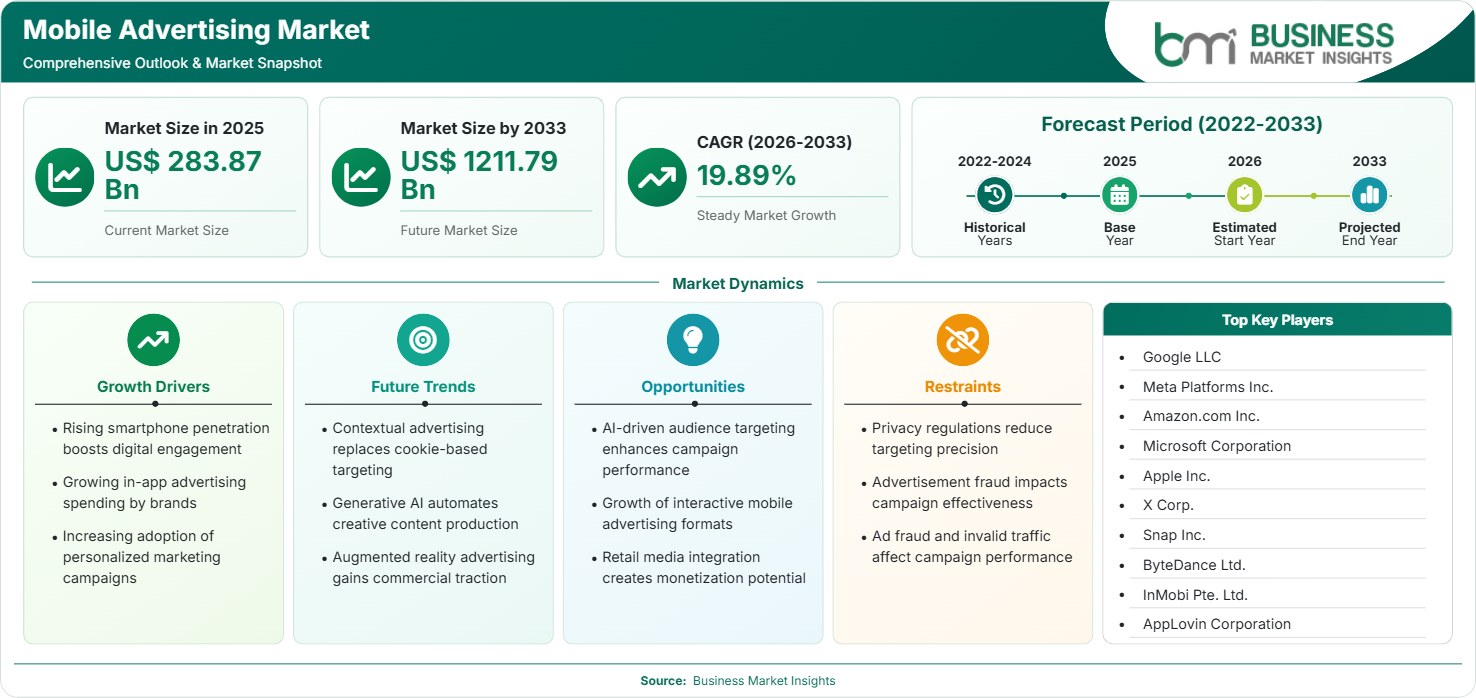
The Mobile Advertising Market size was valued at US$ 283.87 billion in 2025 and is projected to reach US$ 1,211.79 billion by 2033, growing at a CAGR of 19.89% during 2026–2033. Rising smartphone penetration, increasing in-app advertising investments, and widespread adoption of personalized marketing strategies continue accelerating digital advertising expenditure across industries.

Report Coverage
  • Vertical: Retail & E-commerce, Media & Entertainment, Healthcare, BFSI, Education, Travel & Tourism, Automotive, Others
US$ 283.87 Bn Market size in 2025
US$ 1211.79 Bn Market Size by 2033
19.89% CAGR, 2026 - 2033
2026-2033 Forecast Period

01 AI Overview

Mobile Advertising Market Summary

  • North America Region: North America accounts for 34%–37% market share in 2025 and is projected to expand at a CAGR of 18.8%–19.4% during 2026–2033. Strong digital advertising expenditure, mature mobile commerce ecosystems, and AI-powered campaign optimization continue supporting market expansion. The U.S. remains the largest contributor with a CAGR of 18.9%–19.5%, driven by advanced advertising technology adoption and high smartphone engagement.
  • Fastest Growing Region: Asia Pacific represents 30%–33% market share in 2025 and is expected to register a CAGR of 21.2%–21.9%, supported by expanding smartphone adoption, rising internet accessibility, rapid digital commerce growth, and increasing investments in mobile-first advertising strategies.
  • Leading Segment: Search accounts for 36%–39% market share in 2025 and is anticipated to grow at a CAGR of 19.4%–20.0%, supported by strong advertiser demand for intent-based marketing and measurable campaign performance.
  • High Growth Segment: Retail & E-commerce captures 27%–30% market share in 2025 and is projected to record a CAGR of 21.5%–22.2%, driven by expanding online shopping, personalized promotions, and mobile commerce adoption.
  • Key Market Opportunity: AI-powered campaign optimization, retail media expansion, and immersive advertising experiences continue creating significant revenue opportunities for digital advertising platforms and technology providers.
  • Major Market Players: Google LLC, Meta Platforms, Inc., Amazon.com, Inc., Microsoft Corporation, Apple Inc., X Corp., Snap Inc., ByteDance Ltd., InMobi Pte. Ltd., and AppLovin Corporation.
02 Strategic Insights

Mobile Advertising Market: Strategic Insights

Mobile Advertising Market Strategic Framework
FREE PDF
Request your free sample
Request free sample
03 Stakeholder View

Key Takeaways

  • AI-powered advertising platforms are improving audience segmentation, campaign optimization, and return on advertising spend through real-time data analysis and predictive marketing capabilities.
  • Retail and e-commerce companies remain the largest advertising spenders as mobile shopping continues expanding across developed and emerging digital economies.
  • Privacy-focused advertising technologies and first-party data strategies are becoming strategic priorities following changes in third-party cookie policies and mobile tracking frameworks.
  • Asia Pacific offers the strongest long-term investment opportunity due to rapid smartphone adoption, digital payment growth, expanding online retail ecosystems, and increasing advertiser expenditure.
  • Programmatic advertising continues reshaping media buying by enabling automated campaign execution, audience targeting, and real-time performance optimization across multiple mobile platforms.
  • Partnerships among advertising technology providers, publishers, retailers, and telecommunications companies are strengthening monetization opportunities across the mobile advertising value chain.
04 Geographic Outlook

Mobile Advertising Market Regional Highlights

North America Mobile Advertising Market

North America accounts for 34%–37% Mobile Advertising Market share in 2025 and is expected to register a CAGR of 18.8%–19.4% during 2026–2033. Strong digital infrastructure, widespread smartphone usage, and mature advertising technology ecosystems continue supporting regional leadership. Major advertisers increasingly invest in AI-driven campaign management, first-party data strategies, and omnichannel marketing solutions that improve campaign efficiency and measurable customer engagement.

  • AI-powered advertising platforms continue improving audience targeting, campaign optimization, and marketing return on investment.
  • Mobile commerce expansion strengthens advertiser demand for performance-based digital marketing solutions.
  • Privacy regulations encourage wider adoption of contextual advertising and first-party data strategies.
  • Connected television and mobile integration create additional cross-platform advertising opportunities.

US Mobile Advertising Market

The United States contributes 84%–87% of North American revenue and is projected to expand at a CAGR of 18.9%–19.5% through 2026–2033. High digital advertising expenditure, continuous innovation in advertising technology, and strong mobile commerce activity continue supporting sustained market leadership.

  • Major technology companies continue expanding AI-powered advertising platforms for enterprise marketers.
  • Mobile video advertising records strong adoption across entertainment, retail, and gaming industries.
  • Digital retailers increasingly integrate retail media advertising into mobile shopping applications.
  • Advanced measurement tools improve campaign transparency and advertising performance evaluation.

Europe Mobile Advertising Market

Europe represents 24%–27% market share in 2025 and is projected to grow at a CAGR of 18.2%–18.8% during the forecast period. Digital transformation, expanding online retail, and increasing investments in privacy-compliant advertising technologies continue supporting market development. Germany remains the leading regional market, while Spain records the fastest growth through rising digital media consumption and mobile commerce expansion.

  • GDPR compliance accelerates investment in privacy-first advertising technologies.
  • Mobile shopping applications continue increasing advertiser demand across retail sectors.
  • Video-based advertising formats strengthen user engagement and campaign effectiveness.
  • Programmatic advertising adoption continues expanding among regional enterprises.

Asia Pacific Mobile Advertising Market

Asia Pacific holds 30%–33% market share in 2025 and is projected to record the fastest 21.2%–21.9% CAGR through 2026–2033. Expanding smartphone ownership, affordable mobile internet services, growing social commerce, and rapid digitalization continue driving regional demand. China leads overall revenue generation, while India records the fastest growth through increasing digital advertising investments and expanding online consumer engagement.

  • Rising smartphone penetration continues expanding mobile advertising audiences across emerging economies.
  • Social commerce platforms increasingly integrate personalized advertising and AI-powered recommendations.
  • Mobile gaming and short-video platforms generate substantial advertiser demand.
  • Digital payment adoption strengthens mobile commerce and performance marketing opportunities.

Rest of World Mobile Advertising Market

The Rest of World region accounts for 8%–11% market share in 2025 and is projected to expand at a CAGR of 19.1%–19.7% during 2026–2033. Increasing internet connectivity, smartphone adoption, and digital business transformation continue supporting advertising investments across Latin America, the Middle East, and Africa.

  • Brazil remains the leading Latin American market supported by expanding mobile commerce and social media usage.
  • GCC countries continue investing in digital transformation and mobile-first consumer engagement strategies.
  • Regional brands increasingly adopt programmatic advertising to improve campaign efficiency.
  • Growing internet accessibility expands opportunities for advertisers targeting emerging digital consumers.
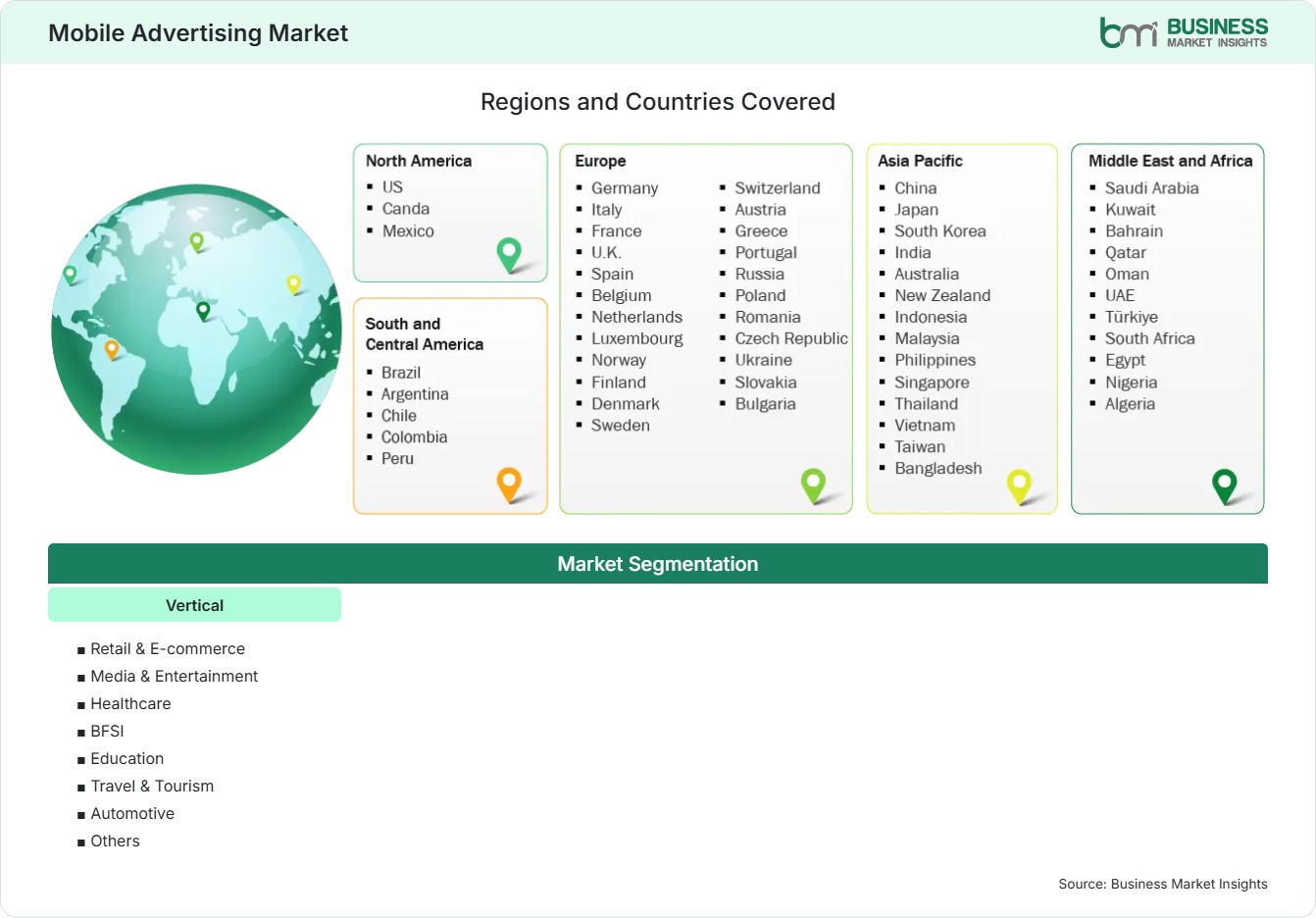
Global Market Geography
FREE PDF
Request your free sample
Request free sample
05 Segment Analysis

Mobile Advertising Market Segmentation

Format Type

The format type segment forms the foundation of mobile advertising strategies as brands increasingly diversify campaigns across search engines, mobile applications, social platforms, and streaming services. It accounted for 36%–39% market share in 2025 and is projected to register a CAGR of 19.4%–20.0% during 2026–2033. Advancements in AI-based optimization, programmatic advertising, and consumer analytics continue expanding the Mobile Advertising Market scope, enabling advertisers to deliver more personalized and measurable campaigns across digital ecosystems.

  • Search: Leads the segment because advertisers prioritize intent-based marketing, high conversion rates, measurable performance, and keyword-driven campaigns that efficiently capture consumers actively searching for products and services.
  • Display: Remains widely adopted across websites and mobile applications, enabling businesses to increase brand visibility through banners, rich media advertisements, and interactive creative formats targeting specific audience segments.
  • Digital Video: Records strong growth as short-form videos, live streaming, and mobile entertainment platforms continue attracting higher user engagement, encouraging advertisers to allocate larger budgets toward immersive visual advertising experiences.
  • Others: Includes native advertising, rewarded advertisements, in-app promotional formats, and emerging interactive experiences that improve customer engagement while supporting higher campaign effectiveness across mobile platforms.

Vertical

The vertical segment reflects diverse advertising demand across industries investing in digital customer acquisition and mobile engagement. It represented 27%–30% market share in 2025 and is anticipated to expand at a CAGR of 21.5%–22.2% during 2026–2033. Current Mobile Advertising Market trends indicate increasing investment in AI-powered audience targeting, retail media networks, personalized campaigns, and omnichannel marketing strategies across consumer-facing industries.

  • Retail & E-commerce: Represents the largest revenue contributor as online retailers utilize mobile advertising to drive customer acquisition, personalized recommendations, product discovery, and higher conversion across shopping applications.
  • Media & Entertainment: Invests heavily in mobile campaigns to promote streaming services, gaming applications, music platforms, and digital content through interactive and video-based advertising formats.
  • Healthcare: Increasingly adopts mobile advertising to improve patient engagement, health awareness campaigns, telehealth promotion, and digital healthcare service visibility while complying with privacy regulations.
  • BFSI: Financial institutions leverage personalized mobile advertising to promote banking services, insurance products, digital wallets, investment platforms, and customer acquisition campaigns.
  • Education: Educational institutions and online learning platforms increasingly utilize mobile advertising to attract students, promote digital courses, and improve enrollment through targeted marketing campaigns.
  • Travel & Tourism: Travel companies employ location-based mobile advertising, personalized offers, and seasonal promotional campaigns to increase bookings and strengthen customer engagement across digital platforms.
  • Automotive: Vehicle manufacturers and dealerships use mobile advertising to promote new vehicle launches, financing offers, dealership engagement, and personalized customer experiences supported by data-driven campaign strategies.
  • Others: Includes telecommunications, consumer goods, real estate, government organizations, and technology providers that increasingly invest in mobile-first advertising to strengthen digital visibility and customer engagement.
06 Market Forces

Mobile Advertising Market Dynamics

Key Market Drivers

Rising smartphone penetration boosts digital engagement

The growing global adoption of smartphones continues to expand the addressable audience for mobile advertising across developed and emerging economies. According to GSMA, more users of mobile internet keep joining the fold as the affordability of smartphones and fast connectivity increases. Customers use significant amounts of time on mobile apps, social networks, online streaming and mobile shopping, thus pushing the marketers to develop mobile marketing campaigns. Companies allocate more money into mobile marketing campaigns that have good tracking options, targeting and optimization. These developments continue supporting Mobile Advertising Market growth, enabling brands to strengthen customer engagement and improve campaign effectiveness across multiple digital touchpoints.

Growing in-app advertising spending by brands

The rapid expansion of mobile applications across entertainment, gaming, finance, retail, and social networking has created significant opportunities for advertisers to reach highly engaged audiences. In-app advertising ensures that promotional messages are targeted without interrupting the user experience, in addition to providing analytics of the campaign and measurement of conversions. Increasingly, developers are using advertising for generating income from free apps, resulting in more innovative ad types like rewarded video and playable ads. Brands continue increasing investments in mobile applications because they provide higher engagement rates, improved audience segmentation, and stronger return on advertising expenditure compared with many traditional digital channels.

Increasing adoption of personalized marketing campaigns

Businesses increasingly rely on artificial intelligence, machine learning, and advanced consumer analytics to deliver highly personalized advertising experiences. First-party data, behavioral insights, location intelligence, and contextual targeting allow advertisers to deliver appropriate marketing material to enhance customer engagement and conversion rate. The marketing automation software uses predictive analytics and dynamic creative optimization to constantly improve the performance of the marketing campaign. Privacy laws have reshaped the digital marketing landscape, prompting businesses to enhance their data strategies. These technological developments continue influencing Mobile Advertising Market trends, encouraging widespread adoption of personalized and data-driven advertising strategies across industries.

Key Market Opportunities

AI-driven audience targeting enhances campaign performance

Artificial intelligence is transforming digital advertising by improving audience segmentation, bid optimization, campaign automation, and performance measurement. These algorithms make use of vast amounts of data related to the consumer's behavior, search patterns, and purchase behavior in order to target advertising campaigns to mobile devices. Predictive analytics are now becoming more popular among advertisers for maximizing the effectiveness of marketing campaigns. Mobile Advertising Market Forecasts indicate that continued advancements in generative AI, machine learning, and real-time decision-making technologies will create substantial opportunities for advertising technology providers, publishers, and enterprise marketers seeking higher campaign effectiveness.

Growth of interactive mobile advertising formats

Consumer expectations are shifting toward engaging digital experiences that encourage direct interaction with advertisements. Interactive ads, AR experiences, interactive videos, shoppable ads, and gamification campaigns are enabling companies to increase customer participation and enhance their brand recognition. Such types of advertising are delivering more effective results through increased participation rates and valuable behavioral insights for advertisers. As mobile devices become increasingly powerful and network connectivity improves, advertisers are expected to expand investments in immersive advertising experiences across multiple consumer applications.

Retail media integration creates monetization potential

Retail media networks have emerged as one of the fastest-growing digital advertising channels, enabling retailers to monetize their digital ecosystems while providing brands with direct access to high-intent consumers. Mobile commerce apps are increasingly incorporating sponsored listings, customized recommendations, and advertisements within the consumer purchase experience. Retailers derive the benefit of using first-party consumer data, which makes for more precise advertising and measurement of campaigns. The growth of digital commerce ecosystems is likely to promote collaboration among retailers, advertisers, and advertising technology companies while generating fresh revenue streams from mobile commerce.

Market Restraints and Challenges

Privacy regulations reduce targeting precision

Digital advertising continues facing increasing regulatory scrutiny regarding consumer privacy, personal data collection, and user consent requirements. Factor: Regulations such as GDPR, evolving mobile operating system privacy policies, and restrictions on third-party tracking reduce advertisers' access to user-level behavioral data. Impact: Campaign targeting accuracy, audience measurement, and attribution capabilities become more complex, requiring businesses to invest in privacy-compliant technologies, first-party data strategies, and contextual advertising solutions while maintaining advertising effectiveness.

Ad fraud and invalid traffic affect campaign performance

The increasing sophistication of digital advertising ecosystems has also led to higher levels of ad fraud, including bot-generated traffic, click fraud, impression manipulation, and fraudulent application installs. Factor: Invalid traffic consumes advertising budgets without delivering genuine consumer engagement or measurable business outcomes. Impact: Reduced campaign efficiency, inaccurate performance reporting, and lower advertiser confidence encourage companies to invest in advanced fraud detection platforms, AI-powered verification technologies, and transparent programmatic advertising systems to protect marketing investments and maintain campaign credibility.

07 Company Analysis

Competitive Landscape

The competitive environment is characterized by continuous innovation in artificial intelligence, programmatic advertising, privacy-focused targeting, and omnichannel campaign management. Mobile Advertising Market analysis indicates that leading companies are investing in AI-powered advertising platforms, retail media ecosystems, advanced analytics, and first-party data capabilities to strengthen advertiser performance and improve customer engagement. Strategic partnerships, acquisitions, and cloud-based advertising technologies continue shaping competition across global digital advertising ecosystems.

Company Name

Overview

Products and Services Relevant to this Market

Google LLC

Global digital advertising leader providing search, display, video, and mobile advertising technologies through an extensive ecosystem of consumer platforms.

Google Ads, AdMob, Display & Video 360, Google Analytics, AI-powered campaign optimization, and mobile advertising solutions.

Meta Platforms, Inc.

Operates one of the world's largest mobile advertising ecosystems across social media and messaging platforms.

Facebook Ads, Instagram Ads, Audience Network, AI-driven advertising tools, Reels advertising, and campaign measurement solutions.

Amazon.com, Inc.

Expanding digital advertising provider leveraging retail media and first-party shopping data for targeted marketing campaigns.

Amazon Ads, Sponsored Products, Sponsored Brands, Amazon DSP, retail media advertising, and mobile commerce marketing solutions.

Microsoft Corporation

Provides enterprise advertising technologies supported by search, AI, and cloud-based marketing capabilities.

Microsoft Advertising, Bing Ads, audience intelligence, AI campaign optimization, and omnichannel advertising solutions.

Apple Inc.

Develops privacy-focused advertising solutions integrated across its mobile ecosystem and digital services.

Apple Search Ads, App Store advertising, SKAdNetwork, privacy-centric measurement tools, and mobile advertising technologies.

X Corp.

Social media platform offering real-time mobile advertising and audience engagement solutions for businesses worldwide.

Promoted Posts, video advertising, performance marketing, brand campaigns, and mobile audience targeting solutions.

Snap Inc.

Focuses on augmented reality, visual communication, and mobile-first advertising experiences targeting younger audiences.

Snap Ads, AR advertising, Story Ads, Collection Ads, Dynamic Ads, and campaign analytics tools.

ByteDance Ltd.

Global technology company operating leading short-form video platforms with AI-powered advertising capabilities.

TikTok Ads Manager, in-feed video advertising, branded content, performance marketing, and creator-based advertising solutions.

InMobi Pte. Ltd.

Independent mobile advertising technology company specializing in programmatic and AI-powered advertising platforms.

InMobi Exchange, demand-side platform, audience targeting, mobile monetization, and programmatic advertising services.

AppLovin Corporation

Mobile advertising technology company supporting app developers and advertisers through AI-driven monetization platforms.

AppDiscovery, MAX mediation platform, mobile app monetization, performance advertising, and AI-powered campaign optimization.

10 Trust & Transparency

Research Methodology

The market analysis combines proprietary research with secondary data from government agencies, company disclosures, regulatory filings, industry databases and expert interviews. Market estimates are validated through data triangulation, cross-market benchmarking and analyst review.

View Full Research Methodology

11 Questions Answered

Frequently Asked Questions

What does the Mobile Advertising Market Report include?

The Market Report provides comprehensive insights into market dynamics, competitive landscape, segmentation, regional analysis, technological developments, investment opportunities, emerging consumer behavior, and long-term industry forecasts.

Which region is expected to experience the fastest growth?

Asia Pacific is projected to register the highest growth due to expanding smartphone adoption, increasing mobile commerce, rising internet penetration, growing social media engagement, and strong digital advertising investments.

Why is AI becoming important in mobile advertising?

Artificial intelligence improves campaign optimization, audience segmentation, bid management, creative generation, and predictive analytics, enabling advertisers to deliver highly personalized experiences while maximizing marketing efficiency.

Which advertising format holds the largest market share?

Search advertising remains the leading format because it captures high-intent consumers, delivers measurable campaign performance, supports keyword-based targeting, and provides strong return on advertising investment.

What factors are driving the Mobile Advertising Market?

The market is driven by rising smartphone penetration, increasing mobile internet usage, expanding in-app advertising investments, AI-powered audience targeting, and growing demand for personalized digital marketing strategies across multiple industries.

Access the Full Mobile Advertising Market Report

Get segment-level forecasts, regional estimates, competitive benchmarking, company profiles and downloadable Excel datasets.

Access the full Mobile Advertising Market Report
350 pages PDF & Excel | 2026-08-17