
Mobile Device Management Market Outlook: Size, Share, Trends, Growth Analysis, Competitive Landscape & Forecast, 2026-2033

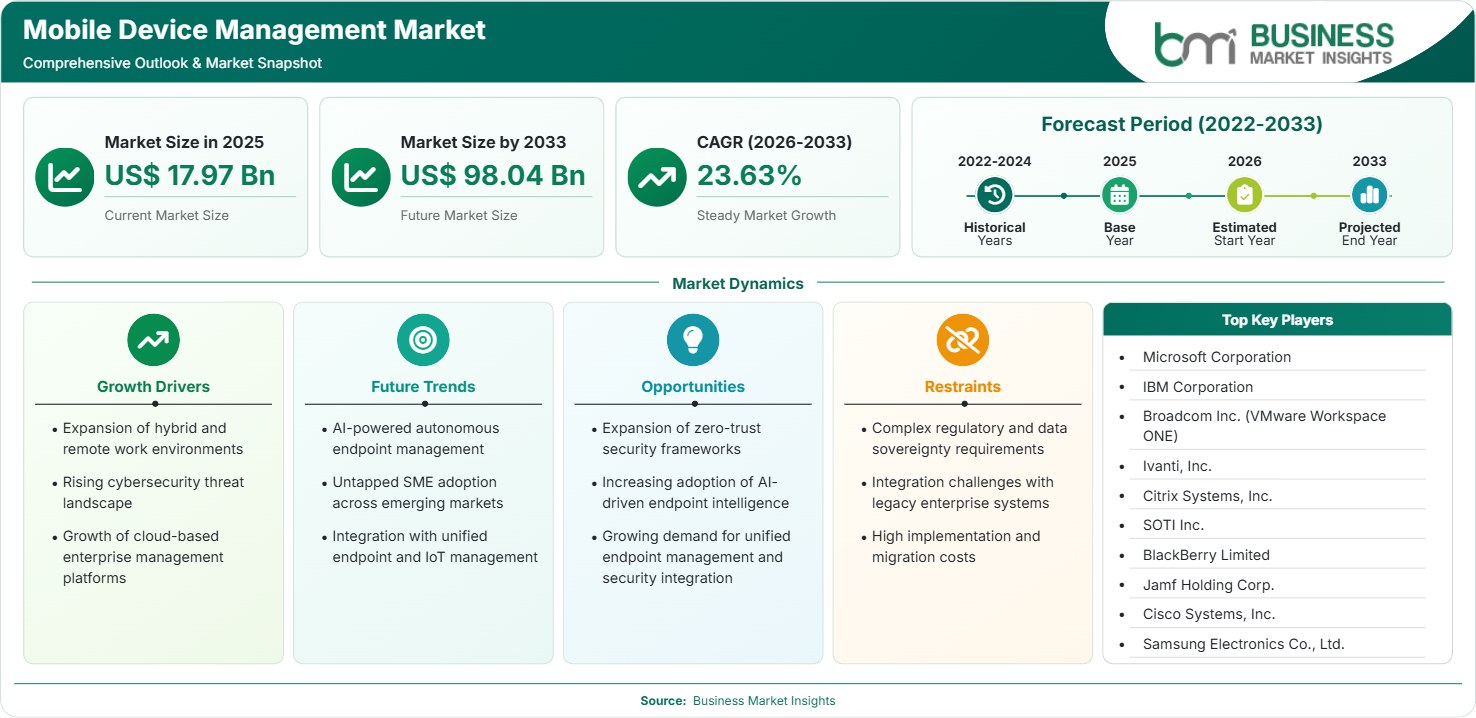
The Mobile Device Management Market size was valued at US$ 17.97 Billion in 2025 and is projected to reach US$ 98.04 Billion by 2033, growing at a CAGR of 23.63% during 2026–2033. Rising enterprise mobility adoption, zero-trust security initiatives, BYOD expansion, cloud-native endpoint management, AI-driven automation, and stricter compliance requirements continue creating substantial opportunities across global enterprises.

Report Coverage
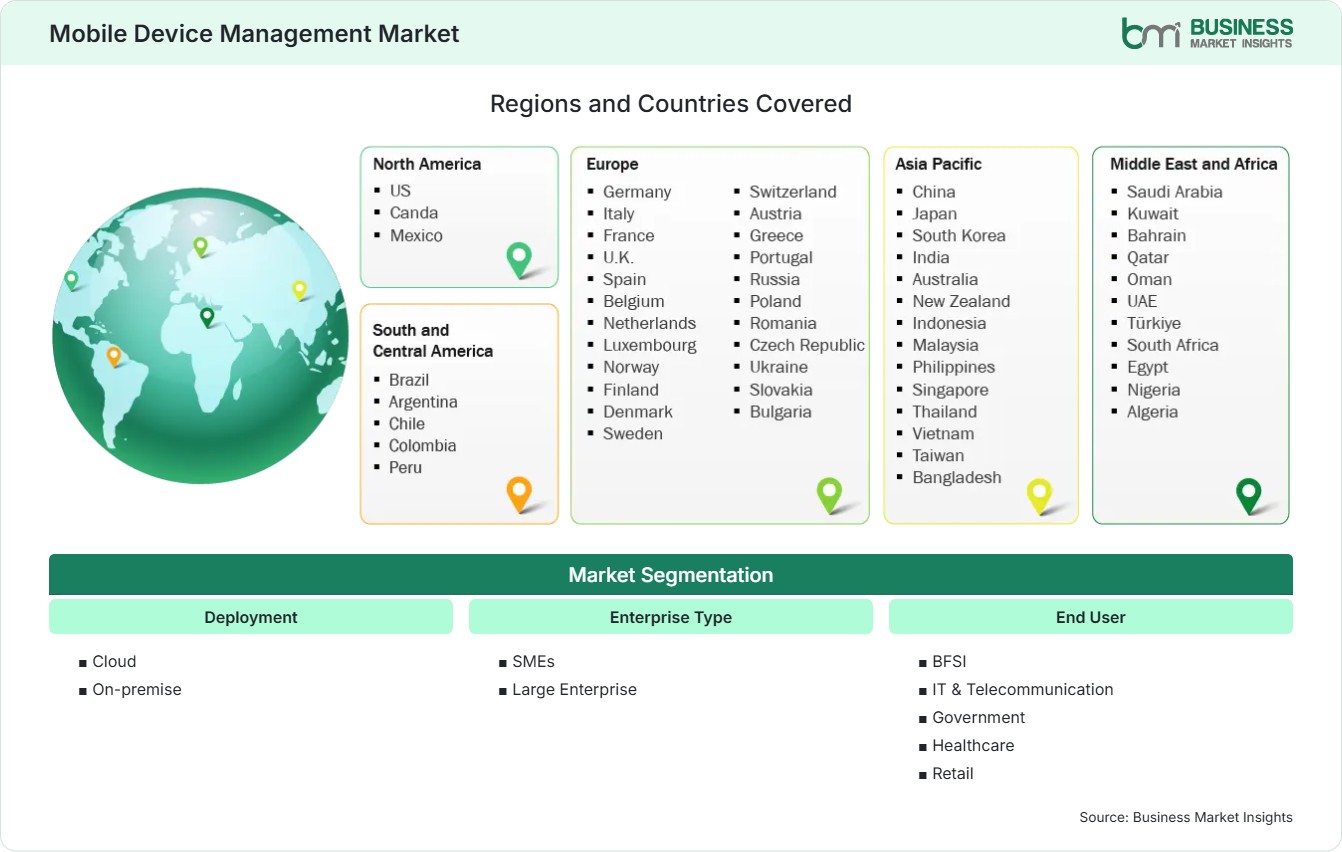
  • Deployment: Cloud, On-premise
  • Enterprise Type: SMEs, Large Enterprise
  • End User: BFSI, IT & Telecommunication, Government, Healthcare, Retail
US$ 17.97 Bn Market size in 2025
US$ 98.04 Bn Market Size by 2033
23.63% CAGR, 2026 - 2033
2026-2033 Forecast Period

01 AI Overview

Mobile Device Management Market Summary

  • North America Region: North America holds market share of 36%–39% in 2025, growing with a CAGR of 21%–23%. Demand is driven by zero-trust security adoption, advanced enterprise mobility programs, regulated industry compliance, cloud-based endpoint administration, remote workforce expansion, and identity-centric security modernization initiatives. US market remains dominant, supported by mature cybersecurity investments and enterprise mobility spending, advancing at approximately 21%–23% CAGR.
  • Fastest Growing Region: Asia Pacific holds market share of 24%–27% in 2025, growing with a CAGR of 26%–28%. Digital transformation, smartphone-driven workplaces, government digitization programs, expanding cloud adoption, and increasing cybersecurity spending across enterprises continue accelerating regional deployment and modernization activities.
  • Leading Segment: Cloud holds market share of 67%–70% in 2025 and advances with a CAGR of 24%–26%. Enterprises prioritize scalability, centralized administration, lower infrastructure requirements, faster deployment cycles, integrated security frameworks, and remote device visibility across distributed workforces.
  • High Growth Segment: SMEs hold market share of 34%–37% in 2025 and expand with a CAGR of 25%–27%. Affordable subscription models, growing cyber threats, compliance requirements, simplified deployment, and cloud accessibility encourage stronger adoption among resource-constrained organizations globally.
  • Key Market Opportunity: AI-enabled endpoint intelligence is creating opportunities for predictive threat detection, autonomous policy enforcement, device lifecycle optimization, compliance automation, and real-time remediation across increasingly complex enterprise mobility environments worldwide.
  • Major Market Players: Microsoft Corporation, IBM Corporation, Broadcom Inc. (VMware Workspace ONE), Ivanti, Inc., Citrix Systems, Inc., SOTI Inc., BlackBerry Limited, Jamf Holding Corp., Cisco Systems, Inc., Samsung Electronics Co., Ltd.
02 Strategic Insights

Mobile Device Management Market: Strategic Insights

Mobile Device Management Market Strategic Framework
FREE PDF
Request your free sample
Request free sample
03 Stakeholder View

Key Takeaways

  • The ecosystem is evolving from device-centric management toward unified endpoint orchestration, integrating identity, application, and security management across distributed enterprise environments.
  • Small and medium-sized enterprises present one of the strongest commercial opportunities as subscription-based deployment models reduce implementation barriers while improving cybersecurity resilience.
  • Artificial intelligence is becoming a defining innovation area, supporting predictive analytics, risk scoring, anomaly detection, automated remediation, and contextual policy enforcement.
  • Asia Pacific presents a compelling investment destination due to enterprise digitization, expanding mobile workforces, cloud migration initiatives, and rising regulatory attention toward cybersecurity.
  • Competitive activity increasingly focuses on platform consolidation, security portfolio expansion, endpoint visibility enhancement, and strategic acquisitions linking device management with broader cybersecurity capabilities.
  • Industry verticals handling sensitive customer data, particularly healthcare, BFSI, and government sectors, are expected to remain premium spending categories through the forecast period.
04 Geographic Outlook

Mobile Device Management Market Regional Highlights

North America Mobile Device Management Market

North America accounts for 36%–39% Mobile Device Management Market share in 2025 and is projected to register a CAGR of 21%–23% through 2033. The region benefits from mature cloud infrastructure, stringent data protection requirements, extensive hybrid work adoption, and strong cybersecurity budgets. Enterprises increasingly implement unified endpoint security strategies integrating identity management, endpoint protection, and device governance. Financial institutions, healthcare organizations, and government agencies continue driving advanced deployments while prioritizing compliance and remote operational resilience.

  • Zero-trust architecture adoption accelerates demand for unified device compliance monitoring and identity-aware access management.
  • Financial institutions expand mobile workforce management initiatives to strengthen regulatory compliance and data protection.
  • Cybersecurity spending remains among the highest globally, supporting continuous platform modernization and integration.
  • Cloud-native management ecosystems increasingly replace legacy on-premise deployment structures across enterprises.
  • Managed security service providers enhance accessibility for mid-market organizations seeking enterprise-grade capabilities.

US Mobile Device Management Market

The United States represents approximately 79%–82% of North American share and advances at a CAGR of 21%–23%. Strong enterprise software spending, expanding regulatory oversight, and rapid adoption of AI-powered security tools support continued growth. Large businesses increasingly standardize endpoint governance practices across remote and hybrid workforces. Federal cybersecurity initiatives and widespread cloud adoption contribute to strong demand across public and private sectors.

  • Fortune 500 enterprises continue consolidating endpoint management and cybersecurity platforms.
  • Healthcare providers prioritize secure mobility solutions supporting telehealth and patient data protection.
  • Government agencies strengthen mobile endpoint visibility through modernization programs.
  • Increasing ransomware threats encourage automation and proactive compliance monitoring.

Europe Mobile Device Management Market

Europe captures 27%–30% share in 2025 and is forecast to grow at 22%–24% CAGR. GDPR compliance requirements, growing digital workplace investments, and expanded cloud adoption underpin regional expansion. Germany remains the largest market, while Poland and Spain demonstrate faster adoption rates. Enterprises are focusing on secure cross-border workforce mobility and stronger endpoint governance practices. Increased investment in cybersecurity infrastructure creates favorable conditions for advanced platform deployments.

  • Germany leads regional revenue generation with strong enterprise software adoption.
  • Poland exhibits high-growth potential with CAGR approaching regional upper ranges.
  • GDPR compliance encourages centralized policy management and reporting capabilities.
  • Manufacturing companies increasingly connect mobile endpoints with operational workflows.
  • Public-sector digitalization initiatives expand demand for secure device administration.

Asia Pacific Mobile Device Management Market

Asia Pacific accounts for 24%–27% share in 2025 and records the fastest CAGR of 26%–28%. Rapid digital transformation, growing smartphone penetration, and large-scale cloud migration efforts support expansion. China, Japan, and India dominate regional demand, while Southeast Asian economies deliver strong growth momentum. Organizations increasingly deploy mobility solutions to manage distributed workforces, enhance employee productivity, and address escalating cybersecurity threats associated with mobile-first operations.

  • India benefits from enterprise digitization and expanding software-as-a-service adoption.
  • China remains a major revenue contributor due to extensive enterprise mobility deployment.
  • ASEAN economies experience accelerated adoption across banking and retail industries.
  • Telecom-led digital ecosystem development strengthens solution accessibility.
  • Government-backed cybersecurity frameworks support sustained enterprise investments.

Rest of World Mobile Device Management Market

Rest of World contributes 8%–10% Mobile Device Management Market share in 2025 and advances at 23%–25% CAGR. South & Central America benefit from expanding cloud adoption and remote workforce initiatives. Meanwhile, Middle East and Africa markets gain momentum from smart government programs, digital economy strategies, and cybersecurity modernization projects. Brazil and the UAE represent major revenue contributors, while Saudi Arabia demonstrates strong growth potential through large-scale enterprise transformation initiatives.

  • Brazil leads regional demand through expanding enterprise cloud migration projects.
  • UAE organizations increasingly prioritize secure mobility frameworks within digital government programs.
  • Saudi Arabia benefits from Vision-driven technology modernization investments.
  • Banking and telecom sectors remain primary adopters across developing economies.
  • Growing cybersecurity awareness supports broader deployment among medium-sized enterprises.
Global Market Geography
FREE PDF
Request your free sample
Request free sample
05 Segment Analysis

Mobile Device Management Market Segmentation

Deployment

Deployment segment dynamics reflect enterprise preferences for operational flexibility, security, and scalability. Cloud holds 67%–70% share in 2025 and grows at 24%–26% CAGR. The Mobile Device Management Market scope continues expanding as organizations migrate from infrastructure-intensive environments toward subscription-based deployment models that support distributed workforce management and faster policy implementation.

  • Cloud: Enables centralized device administration, automated updates, rapid scalability, lower capital expenditure requirements, and seamless integration with identity management, analytics, and cybersecurity platforms.
  • On-premise: Preferred by highly regulated organizations requiring direct infrastructure control, customized governance frameworks, and strict data residency management across critical operational environments.

Enterprise Type

Large enterprises represent 63%–66% share in 2025, while SMEs emerge as the fastest-growing category with 25%–27% CAGR. Adoption is driven by strengthening cybersecurity requirements, hybrid workforce management needs, and demand for centralized endpoint visibility. Mobile Device Management Market trends increasingly reflect democratized adoption through cloud-based subscription pricing and simplified administration tools.

  • SMEs: Cloud-native deployment accessibility, growing cyber risks, and reduced implementation complexity continue supporting adoption among smaller businesses seeking enterprise-grade management capabilities.
  • Large Enterprise: Strong compliance obligations, multi-location operations, and complex endpoint ecosystems sustain substantial investment in advanced governance and automation capabilities.

End-User

The BFSI segment maintains 21%–24% share in 2025 and advances at 22%–24% CAGR, supported by regulatory compliance and sensitive data protection needs. Healthcare and government sectors also demonstrate strong expansion. The Mobile Device Management Market size continues benefiting from increasing mobile application usage across mission-critical business processes.

  • BFSI: Financial institutions prioritize secure application delivery, compliance monitoring, fraud prevention, and workforce mobility management across customer-facing and internal operations.
  • IT & Telecommunication: Supports extensive device fleets, remote workforce administration, and integrated mobility management across complex digital service environments.
  • Government: Agencies deploy secure access frameworks and policy-driven controls to strengthen endpoint governance and information security.
  • Healthcare: Growing telehealth adoption and electronic health record usage accelerate demand for compliant mobility management solutions.
  • Retail: Omnichannel operations, mobile point-of-sale adoption, and workforce productivity initiatives support implementation across store networks.
06 Market Forces

Mobile Device Management Market Dynamics

Key Market Drivers

Expansion of Hybrid and Remote Work Environments

The emergence of mobile workforces has brought about revolutionary changes to corporate security concerns. There is now a need for centralized management and continuous monitoring of compliance where corporations are managing devices beyond the usual network boundaries. The international literature on labor issues continues to draw attention to the use of flexible working arrangements in the developed world. Mobile Device Management Market growth is thus directly related to organizational needs for visibility, control, and productivity in relation to their widely distributed workforces. Since organizations manage both personal and organizational assets, investment in robust endpoint management solutions keeps rising around the world.

Rising Cybersecurity Threat Landscape

Mobile endpoints represent a growing attack surface for ransomware operators, credential theft campaigns, phishing attacks, and unauthorized access attempts. Globally, cybersecurity organizations are seeing increased attacks against mobile devices within enterprise settings. Businesses are improving their zero-trust frameworks to protect themselves from potential risk exposure while still being agile. Enterprise-level solutions include encryption, remote wipe, threat intelligence, and compliance services. Increased board attention toward cyber resilience helps set priorities for investments in the future. With the increase in regulation, the increasing adoption of endpoint management in security initiatives will keep driving the demand.

Growth of Cloud-Based Enterprise Management Platforms

Using cloud computing infrastructure provides benefits such as scalability, centralized management, and quicker deployment in comparison with traditional computing environments. Business operations are becoming more agile, and at the same time, the task of managing infrastructure is becoming less burdensome. Using cloud computing infrastructure enables quick software updates, AI analysis, remote provisioning, and cross-platform management. Mobile Device Management Market growth is aided greatly by the migration to software-as-a-service platforms, especially in the case of small and medium enterprises. Improvements in cloud security, availability, and certification increase the trust enterprises have in cloud-based endpoint management systems.

Key Market Opportunities

AI-Powered Autonomous Endpoint Management

Artificial Intelligence is offering possibilities that extend beyond the conventional realm of policy management. Companies are looking into areas such as predictive maintenance, issue resolution automation, behavioral risk assessment, and intelligent compliance monitoring through artificial intelligence. An AI platform could detect the anomaly, suggest ways to resolve it, and speed up the process. Integrating these processes into the security operations workflow will deliver even greater business value. Mobile Device Management Market Forecasts emphasize the importance of AI-based features as a differentiating aspect that helps large firms make their purchasing decisions for efficiency and better security results.

Untapped SME Adoption Across Emerging Markets

Many small and medium-sized enterprises remain underserved despite escalating cybersecurity requirements. Low-cost subscription model, streamlined user experience, and provision of managed services are reducing adoption barriers. Developing nations are experiencing a fast pace of transformation into digital businesses driven by smartphones, resulting in a favorable environment for the adoption of mobility management systems. Vendor-extended partnerships to provide localized services will enhance penetration in developing countries. In light of the growing need for compliance and increasing concern about cybersecurity risks, small and medium enterprises are likely to show a higher growth rate than the industry average.

Integration with Unified Endpoint and IoT Management

Enterprise technology ecosystems increasingly extend beyond smartphones and tablets. Connected laptops, rugged devices, wearables, and industrial IoT endpoints require consistent visibility and governance. Companies strive for a unified management ecosystem that can cater to heterogeneous device portfolios. Expansion of vendors into more endpoint categories would help companies with customer retention and adding value to their platforms. Industry 4.0, smart healthcare, field service automation, and connected logistics are some areas of growth. Integrated platforms catering to security, management, analytics, and compliance in heterogeneous endpoint ecosystems will draw strong enterprise spending throughout the forecast period.

Market Restraints and Challenges

Complex Regulatory and Data Sovereignty Requirements

Factor: Requirements relating to data storage, employee privacy, monitoring, and cyber security vary greatly between regulatory authorities. Impact: Vendor complexities, longer deployment times, and higher operational costs are faced by vendors and businesses. Multinationals typically have special needs regarding their regions, reports, and governance structure. Such needs may result in longer implementation periods and difficulties in mobility projects. Legal and compliance reviews lead to additional costs of ownership, especially for firms working in industries that are highly regulated. Regulations enhance the level of security and responsibility, but on the other hand, they generate operational complications.

Integration Challenges with Legacy Enterprise Systems

Factor: Most businesses are still using older applications and security frameworks that are incompatible with newer endpoint management systems. Impact: Integration complexities contribute to increasing project risks, costs of implementation, and resource needs. Companies can face problems in integrating their policies, users' identities, application controls, and reporting in different systems. Longer migration periods can reduce the return on investment and the benefits of modernization. Companies may need special consulting help for migration as well as phasing out their operations to minimize disruptions. Such problems are especially important for large companies and governments.

07 Company Analysis

Competitive Landscape

The Mobile Device Management Market analysis reflects competition centered on unified endpoint management, cloud delivery, security integration, compliance automation, and AI-enabled administration capabilities.

Company Name

Overview

Products and Services relevant to this market

Microsoft Corporation

Global enterprise software leader with extensive endpoint and security ecosystem integration.

Microsoft Intune, Endpoint Manager, compliance management, application protection, device lifecycle administration.

IBM Corporation

Enterprise technology company focused on security, cloud, and digital transformation solutions.

IBM MaaS360, AI-driven endpoint management, compliance monitoring, mobile security services.

Broadcom Inc. (VMware Workspace ONE)

Major provider of digital workspace and endpoint management technologies.

Workspace ONE UEM, identity management, device analytics, application delivery capabilities.

Ivanti, Inc.

Specializes in unified endpoint and IT asset management platforms.

Ivanti Neurons, endpoint security, mobility management, automation and remediation tools.

Citrix Systems, Inc.

Delivers secure digital workspace and application access solutions.

Endpoint governance, secure mobility services, application virtualization and access management.

SOTI Inc.

Focused on enterprise mobility and operational device management.

SOTI MobiControl, remote support, lifecycle management, mobility intelligence solutions.

BlackBerry Limited

Provides security-focused endpoint and mobility management solutions.

BlackBerry UEM, secure communications, policy controls, compliance management.

Jamf Holding Corp.

Leading Apple ecosystem management specialist.

Apple device management, security controls, deployment automation, compliance services.

Cisco Systems, Inc.

Global networking and cybersecurity company supporting enterprise mobility.

Endpoint visibility, secure access controls, network-integrated mobility management solutions.

Samsung Electronics Co., Ltd.

Enterprise mobility provider with hardware-software security integration.

Knox Suite, enterprise enrollment, device security, management and analytics services.

10 Trust & Transparency

Research Methodology

The market analysis combines proprietary research with secondary data from government agencies, company disclosures, regulatory filings, industry databases and expert interviews. Market estimates are validated through data triangulation, cross-market benchmarking and analyst review.

View Full Research Methodology

11 Questions Answered

Frequently Asked Questions

What does this Mobile Device Management Market Report offer stakeholders?

It provides insights into regional performance, competitive positioning, segment opportunities, technology trends, growth drivers, restraints, and strategic developments influencing long-term industry expansion.

How does AI influence endpoint management platforms?

AI enables behavioral analytics, automated remediation, anomaly detection, compliance forecasting, intelligent policy recommendations, and faster incident response, reducing administrative burden while strengthening security outcomes.

Why are cloud deployments gaining preference?

Cloud deployments reduce infrastructure investment, accelerate implementation, improve scalability, enable remote administration, and provide easier integration with security and identity management ecosystems.

Which industry verticals generate the highest demand?

BFSI, healthcare, government, and IT & telecommunications remain leading adopters because they manage sensitive information, large device fleets, strict compliance obligations, and mobile-enabled business processes.

What is driving enterprise adoption of mobile device management solutions?

Organizations are prioritizing secure hybrid work, regulatory compliance, ransomware protection, device visibility, and centralized endpoint control. Cloud-native platforms simplify administration while improving workforce productivity across distributed operating environments.

Access the Full Mobile Device Management Market Report

Get segment-level forecasts, regional estimates, competitive benchmarking, company profiles and downloadable Excel datasets.

Access the full Mobile Device Management Market Report
350 pages PDF & Excel | 2026-08-26