
Cloud IT Service Management Market Outlook: Size, Share, Trends, Growth Analysis, Competitive Landscape & Forecast, 2026-2033

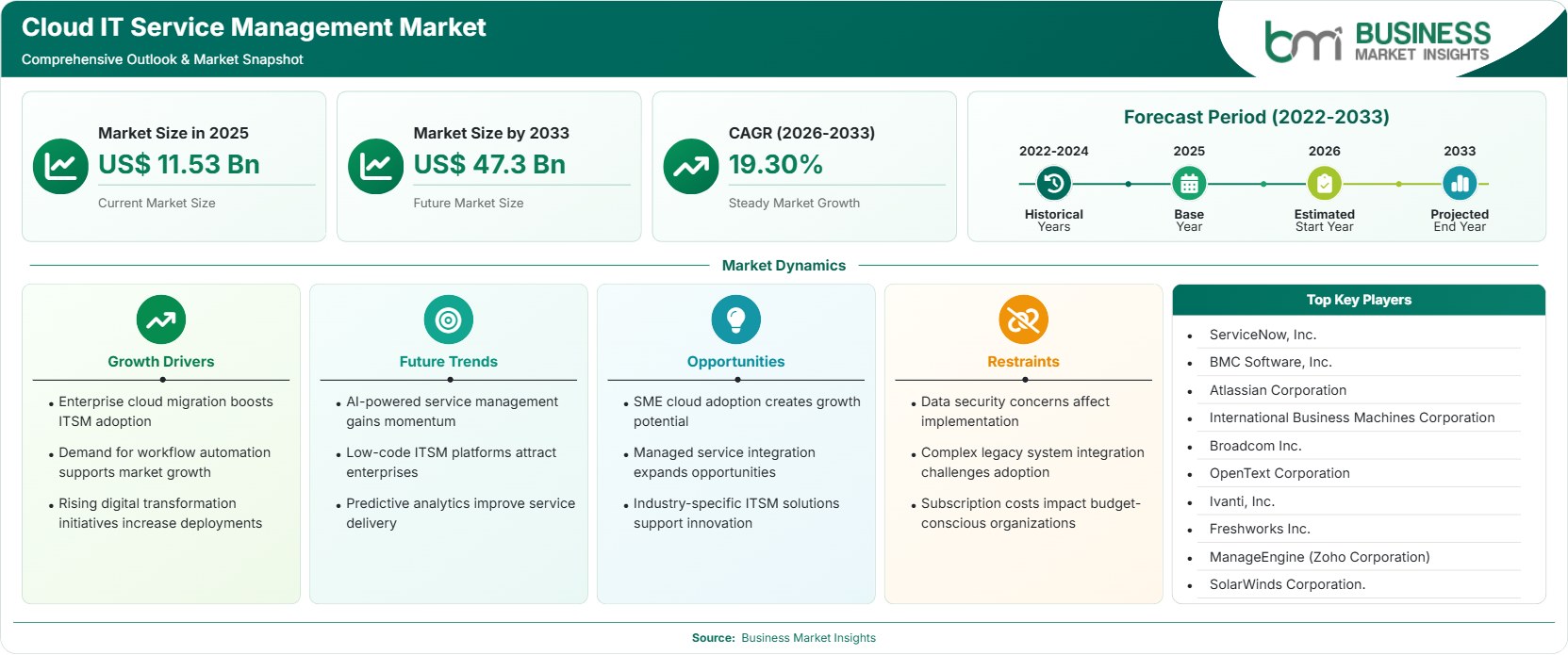
The Cloud IT Service Management Market size was valued at US$ 11.53 Billion in 2025 and is projected to reach US$ 47.3 Billion by 2033, growing at a CAGR of 19.3% during 2026–2033. Growth is supported by enterprise cloud migration, AI-enabled service desks, rising IT complexity, workflow automation demand, and expanding enterprise service management adoption across regulated industries.

Report Coverage
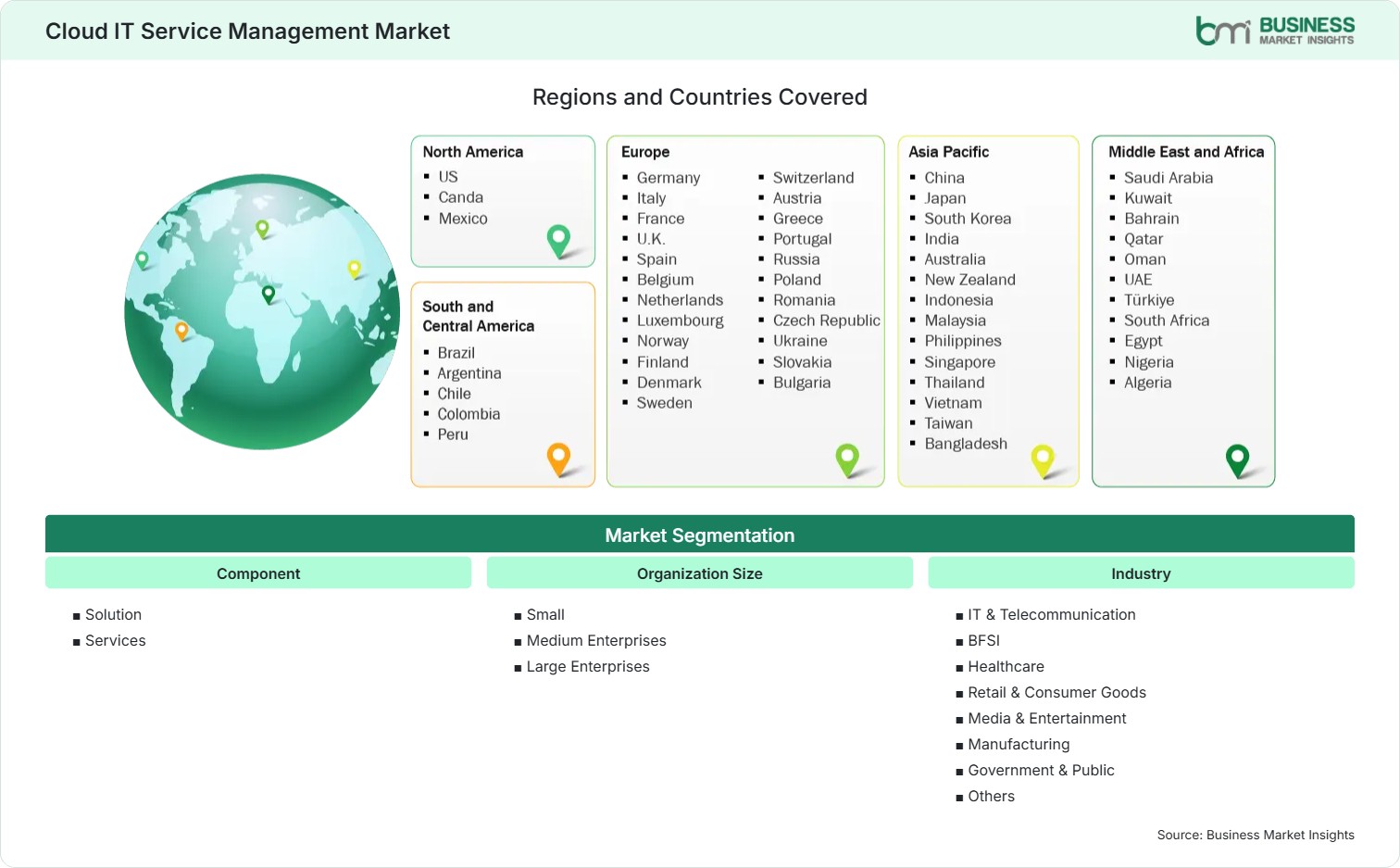
  • Component: Solution, Services
  • Organization Size: Small, Medium Enterprises, Large Enterprises
  • Industry: IT & Telecommunication, BFSI, Healthcare, Retail & Consumer Goods, Media & Entertainment, Manufacturing, Government & Public, Others
US$ 11.53 Bn Market size in 2025
US$ 47.3 Bn Market Size by 2033
19.30% CAGR, 2026 - 2033
2026-2033 Forecast Period

AI Overview

Cloud IT Service Management Market Summary

  • North America Region: North America holds a 40%–44% share in 2025 and is anticipated to grow at a CAGR of 17.5%–19.0% during 2026–2033. Demand is driven by AI-led service automation, hybrid-cloud governance, cybersecurity investments, digital workplace modernization, enterprise workflow orchestration, and expanding SaaS adoption across complex technology environments. US market remains dominant, supported by large enterprise spending and cloud-first strategies, with CAGR estimated at 17.8%–19.3%.
  • Fastest Growing Region: Asia Pacific accounts for 25%–29% share in 2025 and is expected to register a CAGR of 21.0%–23.5% during 2026–2033. Expansion is fueled by digital government initiatives, growing SME cloud adoption, telecom modernization, enterprise automation investments, regional data-center development, and increasing demand for scalable service operations platforms.
  • Leading Segment: The solution segment represents 70%–74% share in 2025 and is projected to grow at a CAGR of 18.5%–20.0% during 2026–2033. Organizations prioritize integrated incident management, change management, knowledge automation, service catalog capabilities, AI-powered ticketing, and operational visibility to improve service quality and productivity.
  • High Growth Segment: SMEs contribute 30%–34% of the Cloud IT Service Management Market share in 2025 and are forecast to expand at a CAGR of 21.5%–24.0% during 2026–2033. Subscription pricing, reduced infrastructure requirements, rapid deployment models, improved scalability, automated workflows, and stronger digital competitiveness continue accelerating adoption among resource-constrained organizations.
  • Key Market Opportunity: Integration of generative AI, predictive analytics, and autonomous remediation into enterprise service platforms enables proactive support models, reduced resolution times, stronger user experiences, and measurable operational efficiency gains.
  • Major Market Players: ServiceNow, Inc.; BMC Software, Inc.; Atlassian Corporation; International Business Machines Corporation; Broadcom Inc.; OpenText Corporation; Ivanti, Inc.; Freshworks Inc.; ManageEngine (Zoho Corporation); SolarWinds Corporation.
Strategic Insights

Cloud IT Service Management Market: Strategic Insights

Cloud IT Service Management Market Strategic Framework
FREE PDF
Request your free sample
Request free sample
Stakeholder View

Key Takeaways

  • The value chain increasingly integrates cloud infrastructure providers, AI software vendors, managed service firms, cybersecurity specialists, and consulting partners to deliver comprehensive digital service operations.
  • SMEs represent one of the strongest long-term opportunities as cloud subscriptions reduce deployment complexity while enabling access to enterprise-grade service management capabilities.
  • Product innovation is shifting toward autonomous operations, generative AI assistants, predictive incident prevention, and workflow orchestration spanning IT, HR, finance, and facilities functions.
  • Asia Pacific offers a compelling investment case due to expanding digital economies, public cloud penetration, and enterprise modernization programs across India, China, Southeast Asia, and Australia.
  • Strategic partnerships between software vendors and observability, cybersecurity, and infrastructure providers are accelerating platform convergence and ecosystem consolidation.
  • Healthcare, BFSI, and government sectors are prioritizing compliance-driven service management architectures that support resilience, traceability, and governance requirements.
Geographic Outlook

Cloud IT Service Management Market Regional Highlights

North America Cloud IT Service Management Market

North America accounts for 40%–44% of global revenue in 2025 and is projected to expand at a CAGR of 17.5%–19.0% through 2033. The region benefits from mature enterprise cloud adoption, strong SaaS spending, and extensive investment in AI-enabled operational automation. Cloud IT Service Management Market share remains highest here due to the presence of leading software vendors, advanced digital transformation programs, and widespread implementation of enterprise service management frameworks across private and public sectors.

  • Large enterprises continue replacing legacy service desks with AI-enabled workflow platforms.
  • Cybersecurity integration with service operations strengthens platform spending.
  • Financial institutions prioritize compliance, auditability, and automated change management.
  • Enterprise adoption of AIOps improves incident prevention and response capabilities.
  • Managed service providers expand cloud-native deployment offerings.

US Cloud IT Service Management Market

The United States contributes 78%–82% of regional revenue and is expected to grow at a CAGR of 17.8%–19.3%. Strong technology sector investment, enterprise software spending, and digital workplace transformation support demand. Federal modernization initiatives and widespread AI adoption strengthen platform deployment across industries. The country remains a key innovation center for cloud-native service management solutions.

  • Fortune 1000 organizations accelerate platform consolidation strategies.
  • Strong venture funding supports automation and AI innovation.
  • Healthcare providers deploy compliant service management environments.
  • Telecom operators advance automated network service workflows.

Europe Cloud IT Service Management Market

Europe accounts for 26%–30% and is expected to grow at a CAGR of 18.0%–20.0%. Initiatives toward digital sovereignty, cloud governance, and enterprise automation drive adoption. The country that earns the most revenue from the region is Germany, whereas Eastern Europe experiences higher growth. The growing trend is to use platforms that offer security, compliance, and optimized services.

  • Germany remains the leading national market with CAGR near 18%–20%.
  • Poland and other emerging markets record faster adoption momentum.
  • GDPR compliance encourages standardized service governance frameworks.
  • Manufacturing firms digitize operational service processes.
  • Public-sector modernization creates new procurement opportunities.

Asia Pacific Cloud IT Service Management Market

Asia Pacific captures 25%–29% share in 2025 and is forecast to register 21.0%–23.5% CAGR through 2033. Rapid Cloud IT Service Management Market growth is supported by enterprise digitization, cloud infrastructure investment, and government-led technology programs. China and Japan contribute significant revenue, while India and Southeast Asia demonstrate stronger growth trajectories due to expanding cloud adoption and SME digitalization initiatives.

  • India records among the fastest regional expansion rates.
  • Telecom digital transformation increases deployment requirements.
  • SMEs adopt subscription-based service management architectures.
  • Regional data-center development enhances cloud accessibility.
  • Government digital programs strengthen enterprise software demand.

Rest of World Cloud IT Service Management Market

Rest of World accounts for 8%–12% share in 2025 and is expected to grow at a CAGR of 18.5%–21.0%.

The South and Central American region benefits from digital banking and enterprise cloud usage. Brazil leads in regional demand, while Mexico has been showing increasing adoption. Growth in the Middle East and Africa is facilitated by smart government initiatives, cloud infrastructure expansion, and diversification programs. Saudi Arabia and UAE are still the key markets, whereas several African economies have adopted cloud-first technologies.

  • Digital government projects generate substantial service platform opportunities.
  • Banking modernization accelerates workflow automation adoption.
  • Regional cloud availability zones enhance data residency compliance.
  • Energy and utilities sectors deploy operational service platforms.
  • Managed service ecosystems expand implementation capabilities.
Global Market Geography
FREE PDF
Request your free sample
Request free sample
Segment Analysis

Cloud IT Service Management Market Segmentation

Component

The solutions segment represents 70%–74% of market share in 2025 and is projected to register a CAGR of 18.5%–20.0%. The scope of the Cloud IT Service Management Market will continue to expand due to the need for workflow integration, automation, intelligent service desk capabilities, and governance capabilities. Services are experiencing high demand in implementation, integration, customization, and management engagements.

  • Solution: Organizations prioritize workflow automation, incident management, change control, and service visibility capabilities to improve operational efficiency and user satisfaction across cloud environments.
  • Services: Growing platform complexity increases demand for consulting, migration, integration, and managed service expertise supporting successful deployment and long-term optimization.

Organization Size

Large enterprises hold a 66%–70% share in 2025, whereas the fast-growing sector is SMEs with 21.5%–24.0% CAGR. The key drivers of adoption include the scalability of cloud solutions, reduced infrastructure costs, and the growing demand for standardization of service management processes across distributed workforces and digital business operations.

  • Small and Medium Enterprises (SMEs): Subscription-based deployment models, rapid implementation, and operational flexibility enable organizations to modernize technology support without extensive capital investments.
  • Large Enterprises: Complex technology ecosystems require advanced automation, governance, analytics, and integration capabilities across multiple business units and geographic operations.

Industry

IT and Telecommunications generate the highest revenue, thanks to the wide range of digital infrastructure they possess. The Cloud IT Service Management Market trends suggest increased adoption across industries to enhance their technology operations.

  • IT & Telecommunications: High technology intensity and network service requirements encourage advanced workflow automation, service assurance, and operational orchestration deployments.
  • BFSI: Regulatory compliance, cybersecurity requirements, and customer experience objectives drive investment in robust service management capabilities.
  • Healthcare: Digital patient services and connected technology environments increase demand for secure, compliant service delivery processes.
  • Retail & Consumer Goods: Omnichannel commerce and customer engagement platforms require scalable support operations and rapid issue resolution capabilities.
  • Media & Entertainment: Cloud-centric content workflows encourage agile service management and collaborative operational environments.
  • Manufacturing: Smart factory initiatives and connected production systems strengthen demand for proactive service governance and automation.
  • Government & Public: Digital citizen services and operational transparency initiatives support sustained adoption of enterprise service management platforms.
Market Forces

Cloud IT Service Management Market Dynamics

Key Market Drivers

Enterprise Cloud Migration and Hybrid IT Expansion

Companies keep migrating their applications and services to the cloud and hybrid cloud environments, complicating management. Market research indicates that the majority of large companies currently use multi-cloud systems, which creates a need for unified governance and processes. The development of the Cloud IT Service Management market depends on ongoing progress, since only cloud-based systems offer capabilities such as scalability, visibility, and automation that are not present in many legacy systems. Modern service management solutions can help minimize operational fragmentation and improve service-level compliance and coordinated incident response.

AI-Driven Service Desk Automation Adoption

AI technology is changing service operations through automated ticket categorization, conversational agents, predictive analytics, and workflow routing. Businesses are looking forward to faster resolution times and a better experience for their employees, which pushes them to adopt automation technologies. The implementation of generative AI helps manage knowledge, enable self-service, and process service requests. Automating redundant tasks while increasing accuracy leads to higher productivity. These changes influence platform expectations, prompting new implementations and upgrades in businesses seeking efficiency gains and service quality improvements.

Rising Demand for Enterprise Service Management

Service management platforms have become increasingly widespread, encompassing departments beyond IT, such as HR, Finance, Procurement, Facilities Management, Customer Support, and others. This strategy, called enterprise service management, increases platform use and delivers greater value to the business. Organizations benefit from standardizing workflows, increasing visibility, and improving governance processes across departments. With the development of digital transformation programs, there is a need to create unified platforms to achieve greater efficiency and governance improvements, and to continue strengthening platform investment priorities across multiple industry verticals.

Key Market Opportunities

Generative AI-Powered Autonomous Operations

Generative AI offers new ways to transition from reactive support to proactive, automated service operations. AI-driven technologies can detect incidents, suggest solutions, create knowledge articles, and even automate remediation actions with little or no human interaction. Companies that focus on developing such solutions have a chance to set their products apart due to increased efficiency and operational intelligence. Cloud IT Service Management Market Forecasts sees the development of autonomous operations as one of the key value propositions. Companies seeking workforce optimization and faster service delivery are likely to prefer technology that offers tangible automation benefits, thereby helping them achieve greater revenue growth in the international marketplace.

Expansion Across Mid-Market Organizations

Many small to medium-sized organizations are in the early stages of maturity of their service management processes; there is huge potential to be exploited. Deployment models for cloud computing reduce barriers to entry through subscription-based pricing and rapid deployment. With small businesses moving rapidly towards digital transformation, there is increased demand for scalable support systems, automation, and governance structures. Those vendors that provide simpler deployment options, industry templates, and managed services stand to benefit from growth opportunities among cost-conscious customers seeking enterprise-grade capabilities without substantial infrastructure investments.

Industry-Specific Service Management Platforms

Solutions designed for sector-specific needs like healthcare, banking, government, and manufacturing create a growing business opportunity. Some sectors may have their own compliance requirements, reporting mechanisms, and workflows. Providers that can offer industry-specific service management solutions will benefit from quicker implementation and faster customer value realization. With more emphasis on operational resiliency and regulatory compliance, demand for vertical-specific solutions is growing. This should provide pricing advantages and greater client interaction.

Market Restraints and Challenges

Complex Integration Requirements Across Legacy Systems

Factor: Many organizations operate fragmented technology estates containing legacy applications, custom workflows, and disconnected databases. Impact: Integration complexity can increase deployment costs, extend implementation timelines, and reduce expected value realization. Service management platforms often require extensive configuration to synchronize data and workflows across existing systems. Enterprises may face resource constraints, process redesign requirements, and interoperability challenges. These factors can delay purchasing decisions and slow implementation momentum, particularly among organizations with highly customized technology environments or limited internal expertise.

Data Security and Regulatory Compliance Concerns

Factor: Sensitive business information, customer records, and operational data increasingly flow through cloud-based service environments. Impact: Security breaches, regulatory violations, or data residency concerns may discourage adoption in highly regulated sectors. Organizations must ensure compliance with regional requirements, strengthen governance controls, and maintain continuous monitoring practices. Meeting these requirements can increase operational expenditure and implementation complexity. Although vendors continue enhancing security capabilities, compliance obligations remain a significant challenge influencing procurement evaluations and deployment strategies.

Company Analysis

Competitive Landscape

Cloud IT Service Management Market analysis indicates competition is centered on AI capabilities, workflow automation, platform extensibility, enterprise integration, and industry-specific service delivery.

Company Name

Overview

Products and Services relevant to this market

ServiceNow, Inc.

Leading enterprise workflow and digital operations provider with strong global ITSM presence.

IT Service Management, IT Operations Management, AI agents, workflow automation, enterprise service management.

BMC Software, Inc.

Enterprise software provider focused on service and operations management solutions.

Helix ITSM, AIOps, service automation, multi-cloud management services.

Atlassian Corporation

Collaboration and service management software vendor serving diverse enterprises.

Jira Service Management, workflow tools, knowledge management, DevOps integration.

International Business Machines Corporation

Technology leader offering hybrid cloud and automation solutions.

IBM Concert, IT automation, observability, enterprise service management capabilities.

Broadcom Inc.

Software and infrastructure technology provider with enterprise management portfolio.

Enterprise service management, automation, operations management solutions.

OpenText Corporation

Information management vendor serving regulated and complex industries.

ITSM software, workflow management, digital operations solutions.

Ivanti, Inc.

Unified IT and security management platform provider.

ITSM, endpoint management, service automation, asset management.

Freshworks Inc.

SaaS company focused on user-friendly enterprise software platforms.

Freshservice, AI-based support, service desk automation, workflow tools.

ManageEngine (Zoho Corporation)

IT management software specialist with a global customer base.

ServiceDesk Plus, IT operations management, asset management tools.

SolarWinds Corporation

IT operations and observability solutions provider.

Service Desk, monitoring, incident management, operational analytics.

Trust & Transparency

Research Methodology

The market analysis combines proprietary research with secondary data from government agencies, company disclosures, regulatory filings, industry databases and expert interviews. Market estimates are validated through data triangulation, cross-market benchmarking and analyst review.

View Full Research Methodology

Questions Answered

Frequently Asked Questions

What information does a Cloud IT Service Management Market Report typically provide?

A Market Report generally includes market sizing, competitive assessment, segmentation analysis, regional outlook, technology trends, growth factors, and strategic opportunities influencing future industry development.

What differentiates modern service management platforms from legacy systems?

Modern platforms offer cloud-native scalability, API-based integration, automation, analytics, AI functionality, and support for enterprise-wide service management beyond traditional IT operations.

How is artificial intelligence influencing platform adoption?

AI improves ticket routing, self-service experiences, incident prediction, workflow automation, and knowledge management, enabling better service quality and greater operational efficiency.

Why are SMEs becoming an important customer segment?

Cloud delivery models reduce upfront costs, simplify deployment, and provide access to advanced automation capabilities that were previously affordable primarily for large enterprises.

Which industries generate the strongest demand for cloud-based service management platforms?

BFSI, IT & telecommunications, healthcare, government, and manufacturing are among the leading adopters because they require operational visibility, governance, compliance support, and efficient incident management across complex digital environments.

Access the Full Cloud IT Service Management Market Report

Get segment-level forecasts, regional estimates, competitive benchmarking, company profiles and downloadable Excel datasets.

Access the full Cloud IT Service Management Market Report
350 pages PDF & Excel | 2026-08-31
Similar Research

Related Market Reports