
Cloud Computing Market Outlook: Size, Share, Trends, Growth Analysis, Competitive Landscape & Forecast, 2026-2033

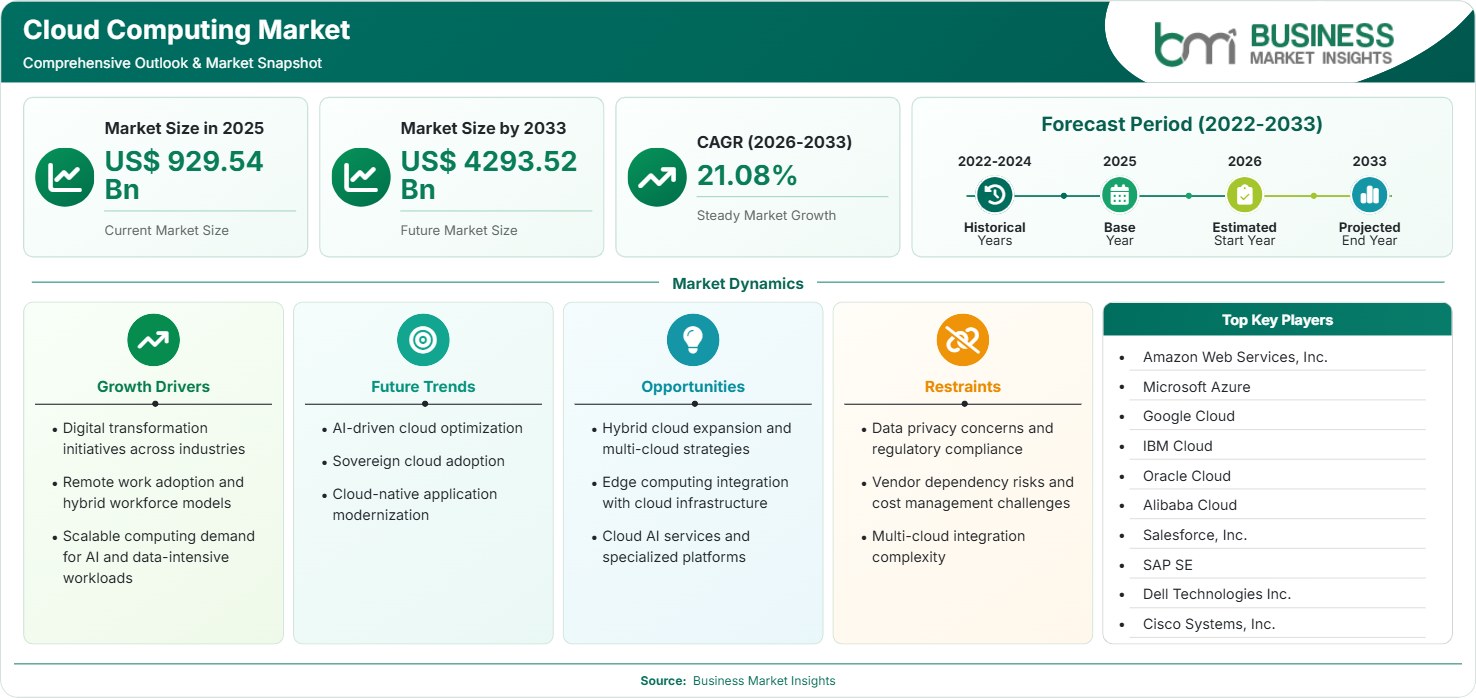
The Cloud Computing Market size was valued at US$ 929.54 billion in 2025 and is projected to reach US$ 4,293.52 billion by 2033, growing at a CAGR of 21.08% during 2026–2033, driven by digital transformation initiatives, remote work adoption, scalable computing demand, hybrid cloud deployment, edge computing integration, and increasing adoption of cloud-based artificial intelligence services across industries.

Report Coverage
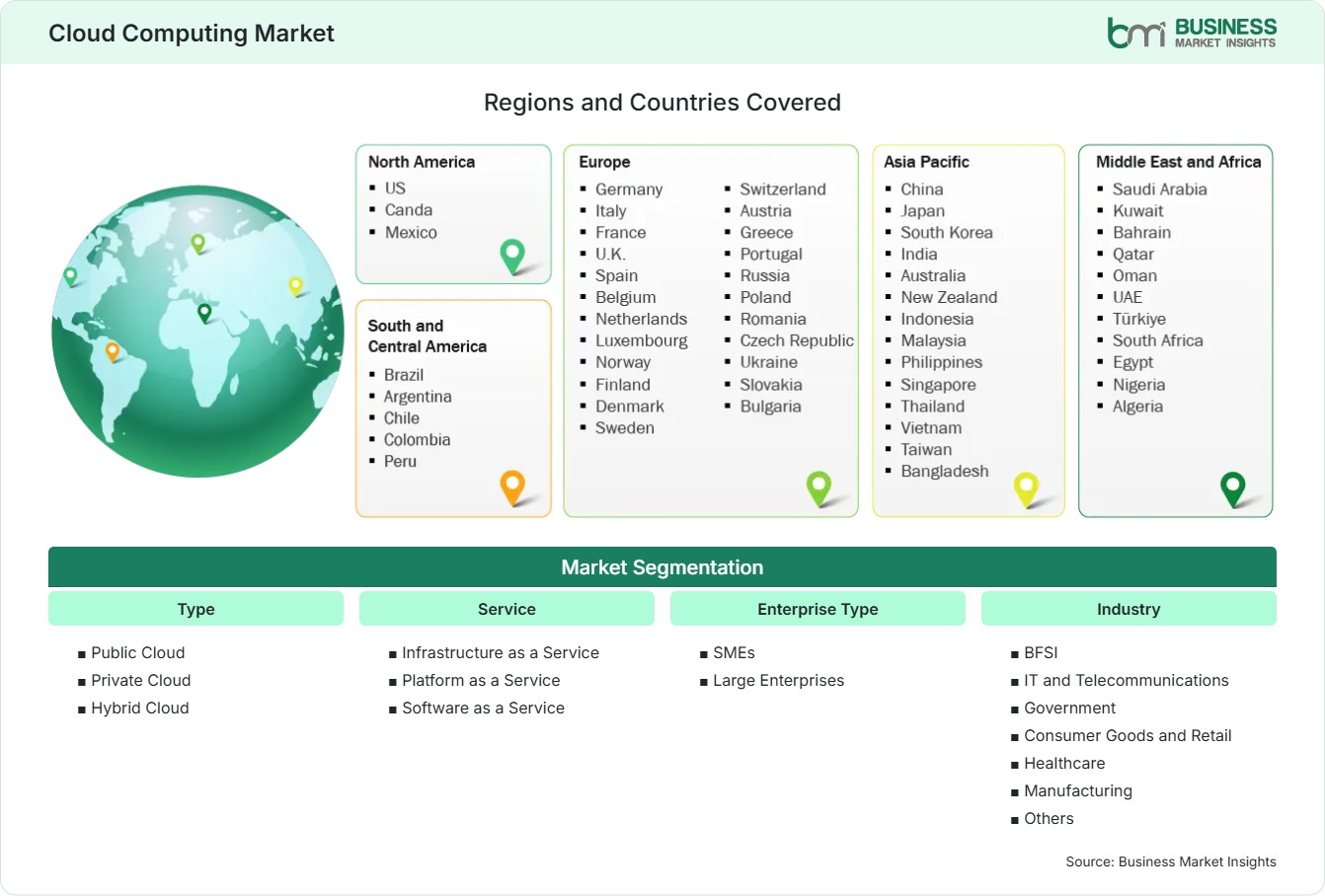
  • Type: Public Cloud, Private Cloud, Hybrid Cloud
  • Service: Infrastructure as a Service, Platform as a Service, Software as a Service
  • Enterprise Type: SMEs, Large Enterprises
  • Industry: BFSI, IT and Telecommunications, Government, Consumer Goods and Retail, Healthcare, Manufacturing, Others
US$ 929.54 Bn Market size in 2025
US$ 4293.52 Bn Market Size by 2033
21.08% CAGR, 2026 - 2033
2026-2033 Forecast Period

AI Overview

Cloud Computing Market Summary

North America Region: North America holds approximately 35%–40% of the market share in 2025 and is projected to grow at a 20.0%–22.0% CAGR during 2026–2033. Regional growth is supported by enterprise cloud migration, advanced IT infrastructure, artificial intelligence adoption, cybersecurity investments, and the strong presence of leading cloud service providers. The United States represents the largest contributor due to widespread enterprise adoption, hyperscale data centers, and technology innovation, growing at approximately 20.5%–22.5% CAGR during the Cloud Computing Market forecast period.

Fastest Growing Region: Asia Pacific represents approximately 28%–33% market share in 2025 and is expected to register a 22.5%–24.5% CAGR during 2026–2033. Growth is supported by increasing digitalization, cloud adoption among SMEs, government technology initiatives, expanding internet connectivity, and investments in data center infrastructure across China, India, Japan, and Southeast Asia.

Leading Segment: Software as a Service (SaaS) accounts for approximately 40%–45% of the Cloud Computing market share in 2025 and is projected to grow at a 21.5%–23.5% CAGR during 2026–2033. Rising enterprise demand for subscription-based software, collaboration platforms, and business automation solutions is driving segment expansion.

High Growth Segment: Hybrid Cloud represents the fastest-growing cloud deployment model due to increasing enterprise preference for flexible infrastructure, workload optimization, regulatory compliance, and integration between private and public cloud environments.

Key Market Opportunity: Expansion of hybrid cloud platforms, edge computing infrastructure, AI-powered cloud services, and industry-specific cloud solutions is creating significant opportunities for technology providers and enterprises.

Major Market Players: Amazon Web Services, Microsoft Azure, Google Cloud, IBM Cloud, Oracle Cloud, Alibaba Cloud, Salesforce, SAP, Dell Technologies, and Cisco Systems.

Strategic Insights

Cloud Computing Market: Strategic Insights

Cloud Computing Market Strategic Framework
FREE PDF
Request your free sample
Request free sample
Stakeholder View

Key Takeaways

  • The cloud ecosystem is evolving from basic infrastructure hosting toward integrated digital platforms combining computing, storage, analytics, cybersecurity, artificial intelligence, and application services.
  • Hybrid cloud adoption presents significant growth opportunities as enterprises seek flexible architectures that balance scalability, regulatory compliance, security requirements, and workload optimization. Industries including BFSI, healthcare, government, and manufacturing are increasingly adopting hybrid models for mission-critical operations.
  • Cloud innovation is shifting toward artificial intelligence integration, edge computing, serverless architectures, and automation-driven services. Technology providers are developing AI-powered cloud platforms that enable predictive analytics, intelligent applications, and faster business decision-making.
  • Asia Pacific offers strong expansion potential due to rapid digitalization, increasing SME cloud adoption, government technology initiatives, and growing data center investments. Countries including China, India, Japan, and Southeast Asian economies are becoming important cloud growth centers.
  • Strategic partnerships, acquisitions, and ecosystem development are shaping market competition as cloud providers collaborate with software companies, enterprises, and infrastructure providers. Companies are strengthening capabilities through industry-specific solutions, cybersecurity offerings, and AI-enabled cloud services.
  • Data sovereignty, cybersecurity, and compliance capabilities are becoming critical factors influencing enterprise cloud decisions. Providers investing in secure infrastructure, regional data centers, and regulatory alignment are better positioned to support long-term enterprise adoption.
Geographic Outlook

Cloud Computing Market Regional Highlights

North America Cloud Computing Market

North America accounted for about 35%–40% of the market share in 2025 and is expected to register a CAGR of 20.0%–22.0% during 2026–2033. This region maintains its dominance owing to superior digital infrastructure, high adoption rates of enterprise cloud computing, robust technology ecosystems, and significant investments by hyperscale cloud providers. The US is the largest country in the region, mainly due to large-scale enterprise migration, AI, cybersecurity, and data center development. Canada is also expanding cloud adoption through digital transformation initiatives.

  • The United States leads regional cloud deployment through enterprise modernization, AI integration, and widespread adoption of hyperscale cloud platforms.
  • Cloud service providers are expanding data center capacity to support increasing demand for scalable enterprise computing solutions.
  • BFSI and healthcare organizations are investing in secure cloud environments to improve operational efficiency and compliance management.
  • Hybrid cloud adoption is increasing as businesses seek flexibility, security, and optimized workload management.

US Cloud Computing Market

The United States represented approximately 32%–36% of the global Cloud Computing Market in 2025 and is expected to grow at a 20.5%–22.5% CAGR during 2026–2033. Market expansion is supported by enterprise digital transformation, strong cloud infrastructure availability, artificial intelligence adoption, and increasing demand for scalable computing resources. The presence of leading cloud providers, advanced technology companies, and large enterprise customers strengthens the country's position. Organizations are increasingly adopting hybrid and multi-cloud strategies.

  • Large enterprises are accelerating cloud migration to improve operational efficiency, scalability, and application modernization.
  • AI-driven cloud services are increasing demand for advanced computing, analytics, and automation capabilities.
  • Government and regulated industries are adopting secure cloud solutions to improve digital service delivery.
  • Data center investments continue expanding to support growing cloud workloads and enterprise applications.

Europe Cloud Computing Market

The Europe region held around 22% to 27% of the Cloud Computing market share in 2025 and is anticipated to witness a 19.5% to 21.5% CAGR between 2026 and 2033. Drivers include digital transformation initiatives, enterprise adoption of cloud computing, investment in cybersecurity, and rising demand for compliance-friendly cloud solutions. Key drivers include Germany, the United Kingdom, France, and Netherlands, owing to their superior IT infrastructure and enterprise technology adoption.

  • Germany is expanding cloud adoption through industrial digitalization and manufacturing technology transformation initiatives.
  • The United Kingdom is increasing cloud usage across financial services, government applications, and enterprise software platforms.
  • France is supporting cloud growth through digital modernization programs and domestic technology investments.
  • European businesses are prioritizing secure and compliant cloud environments due to regulatory requirements.
  • Hybrid cloud models are gaining adoption among enterprises requiring flexibility and data control.

Asia Pacific Cloud Computing Market

Asia Pacific represented approximately 28%–33% of the Cloud Computing market share in 2025 and is projected to achieve the fastest growth with a 22.5%–24.5% CAGR during 2026–2033. Growth is driven by rapid digitalization, expanding internet connectivity, increasing SME adoption, government cloud initiatives, and data center investments. China, India, Japan, and Southeast Asian countries are driving regional expansion through cloud infrastructure development and enterprise technology modernization.

  • China leads regional growth through extensive cloud infrastructure investments and enterprise digital transformation initiatives.
  • India is experiencing strong cloud adoption due to expanding startups, government digital programs, and SME technology modernization.
  • Japan is adopting cloud solutions for enterprise automation, artificial intelligence, and advanced manufacturing applications.
  • Southeast Asian economies are increasing cloud deployment through digital economy development initiatives.
  • Data center expansion is supporting increasing demand for cloud-based applications and services.

Rest of World Cloud Computing Market

The Rest of World region accounted for around 7% to 11% of market share in 2025 and was expected to register a CAGR of 21.0% to 23.5% from 2026 to 2033. The Latin American, MEA, and African regions are slowly embracing cloud computing through digital transformation initiatives, improved connectivity, and investments in enterprise technologies. Examples of countries that are forming their cloud ecosystems include Brazil, Mexico, the UAE, and South Africa, which are developing cloud ecosystems through infrastructure expansion and partnerships with global providers.

  • Brazil is increasing cloud adoption through enterprise modernization and digital transformation across multiple industries.
  • Mexico is expanding cloud infrastructure supported by growing technology investments and business digitization.
  • Middle Eastern countries are investing in cloud platforms to support smart city and government technology initiatives.
  • South Africa is adopting cloud solutions to improve business efficiency and digital service availability.
  • Emerging markets are attracting cloud investments through improved connectivity and increasing demand for scalable computing.
Global Market Geography
FREE PDF
Request your free sample
Request free sample
Segment Analysis

Cloud Computing Market Segmentation

Type<h3>

The type segment is led by Public Cloud, which accounted for approximately 50%–55% market share in 2025 and is projected to grow at a 21.0%–23.0% CAGR during 2026–2033. Public cloud adoption is increasing due to scalability, cost efficiency, flexible resource allocation, and widespread availability of enterprise applications. Hybrid cloud is emerging as the fastest-growing model as organizations seek balanced approaches combining public cloud flexibility with private infrastructure control.

  • Public Cloud: Public cloud services are widely adopted by enterprises due to lower infrastructure costs, scalability, managed services availability, and support for business applications across industries.
  • Private Cloud: Private cloud solutions are preferred by organizations requiring enhanced security, regulatory compliance, customized infrastructure, and greater control over sensitive workloads.
  • Hybrid Cloud: Hybrid cloud adoption is increasing as enterprises combine public and private environments to optimize workloads, improve flexibility, and address security and compliance requirements.

<h3>Service

The service segment is dominated by the Software-as-a-Service (SaaS) offering, which holds a 40%–45% market share in 2025 and is projected to grow at a CAGR of 21.5%–23.5% during 2026–2033. SaaS is favored owing to subscription-based software solutions, the need for collaboration, automation, and ease of IT management. The growth of the IaaS and PaaS segments is also supported by cloud-native application development.

  • Infrastructure as a Service (IaaS): IaaS provides scalable computing, storage, and networking resources that enable enterprises to reduce infrastructure costs and support flexible digital operations.
  • Platform as a Service (PaaS): PaaS solutions support application development by providing cloud-based tools, frameworks, and environments for faster software deployment and innovation.
  • Software as a Service (SaaS): SaaS adoption is increasing through cloud-based business applications, collaboration platforms, customer management tools, and enterprise productivity solutions.

<h3>Enterprise Type<h3>

The enterprise type segment is dominated by Large Enterprises, whose market share stood at about 60%-65% in 2025 and is estimated to grow at a CAGR of 20.0%-22.0% from 2026 to 2033. Cloud solutions are being deployed by large enterprises for overall transformation, data management, applications modernization, and optimization. Small and medium enterprises are increasingly using cloud solutions due to low-cost subscriptions and fewer infrastructural requirements.

  • SMEs: Small and medium enterprises are adopting cloud services to access advanced technology capabilities without significant upfront infrastructure investments.
  • Large Enterprises: Large enterprises are implementing cloud solutions for digital transformation, complex workload management, global operations, and advanced analytics capabilities.

<h3>Industry<h3>

The industrial segment is led by IT and Telecommunications, with approximately 25%–30% market share in 2025 and is forecast to expand at a 21.0%–23.0% CAGR during 2026–2033. The segment is dependent on cloud computing technology to modernize networks, host applications, store and manage data, and provide digital services. Moreover, healthcare, BFSI, manufacturing, and retail industries are also adopting cloud for automation and analytics purposes.

  • BFSI: Financial institutions are adopting cloud solutions for secure banking platforms, analytics, fraud management, digital services, and operational efficiency improvements.
  • IT and Telecommunications: The sector uses cloud platforms for infrastructure modernization, network management, application development, and scalable digital service delivery.
  • Government: Government organizations are deploying cloud solutions to improve public services, data management, cybersecurity, and digital governance initiatives.
  • Consumer Goods and Retail: Retail companies are adopting cloud technologies for e-commerce platforms, customer analytics, inventory optimization, and personalized experiences.
  • Healthcare: Healthcare providers use cloud platforms for electronic health records, medical analytics, telehealth services, and secure data management.
  • Manufacturing: Manufacturers are implementing cloud solutions for industrial automation, supply chain management, predictive analytics, and smart factory operations.
Market Forces

Cloud Computing Market Dynamics

Key Market Drivers

Digital transformation initiatives across industries

Digital Transformation continues to be the primary growth driver for the Cloud Computing Market, as companies across sectors are shifting from rigid internal infrastructure to flexible cloud environments. The BFSI sector, IT and Telecommunications, healthcare, retail, and manufacturing industries have been utilizing cloud computing technologies to upgrade their older technologies to newer ones and to facilitate automation and real-time data access. Companies are moving their critical processes to the cloud due to the rise of SaaS business applications, the prevalence of hybrid workplaces, and the need for secure access for remote-working employees.

Remote work adoption and hybrid workforce models

With the adoption of remote/hybrid working environments on the rise, the use of cloud computing collaboration platforms, cloud computing workspace solutions, and secure cloud computing access solutions has been increasing in the Cloud Computing Market trends. This is because companies are looking to build cloud computing infrastructure that will ensure operational continuity and productivity regardless of the COVID-19 pandemic, and that this change is permanent, as enterprises consider cloud computing critical to their business continuity and workforce mobility.

Scalable computing demand for AI and data-intensive workloads

The rapid advancement of artificial intelligence, machine learning, and data-intensive applications is creating substantial demand for high-performance cloud environments. AI and ML integration is amplifying cloud demand by requiring highly scalable compute, storage, and GPU resources that are impractical to maintain in traditional data centers. Enterprises are deploying AI-driven workloads for fraud detection, customer analytics, supply-chain optimization, healthcare diagnostics, and predictive maintenance, all of which rely heavily on IaaS and PaaS platforms.

Key Market Opportunities

Hybrid cloud expansion and multi-cloud strategies

Hybrid cloud and multi-cloud trends offer substantial growth potential for cloud vendors, as enterprises tend to diversify their architectures for vendor independence, resilience, and better performance. Contemporary management of cloud-based environments, container management, and inter-cloud networking make it simple to run applications in various providers’ clouds, thus fostering adoption. Adoption of the hybrid cloud trend is becoming more common among government bodies, health care providers, and manufacturers whose operations are subject to strict sovereignty and compliance requirements and require certain latency levels. Hybrid cloud enables seamless orchestration of workloads across the internal IT environment and public cloud computing, helping reduce IT costs by up to 25%.

Edge computing integration with cloud infrastructure

Edge computing, coupled with cloud infrastructure, offers significant opportunities for advanced applications requiring extremely low-latency processing, real-time analysis, and bandwidth-intensive connections. With the rollout of 5G networks in North America, Europe, and the Asia-Pacific region, organizations are deploying their latency-critical applications, such as autonomous technologies, smart manufacturing, AR/VR, and IoT analytics, to edge networks to reduce reliance on central data centers and enhance performance, security, and operational efficiency.

Cloud AI services and specialized platforms

Integrating AI capabilities with the cloud is a major area of growth potential, as businesses now need specialized AI services to differentiate. Specialized AI chips, ML platforms, and even managed model training environments are being offered by hyperscalers to cater to the growing adoption of generative AI. Cloud services that cater specifically to various industries, including healthcare, banking, manufacturing, retail, and even governments, are getting popular.

Market Restraints and Challenges

Data privacy concerns and regulatory compliance

Factor: Enterprises face rising risks related to unauthorized access, data breaches, and regulatory non-compliance. Sensitive information in sectors such as BFSI, healthcare, and government requires strict control over data residency, encryption, and identity management. Evolving regulations, including Europe's GDPR, the U.S. CCPA, China's Cybersecurity Law, HIPAA in healthcare, and emerging data-localization requirements across APAC, force organizations to uphold strict compliance standards. Complex multi-cloud and hybrid architectures add further challenges, as each cloud provider uses different security frameworks, increasing the risk of configuration errors and exposure of sensitive data. Impact: These concerns create hesitation among organizations migrating mission-critical workloads to public cloud environments. Ensuring secure API usage, protecting data in transit and at rest, and maintaining continuous monitoring across distributed architectures often strain IT teams. For many enterprises, especially SMEs, the lack of skilled cybersecurity professionals limits their ability to implement robust cloud security frameworks.

Vendor dependency risks and cost management challenges

Factor: Organizations face risks associated with vendor lock-in, dependency on single providers, and cloud cost management. With cloud costs running approximately 17% higher than planned, companies are stepping up efforts to rein in spending. Complex pricing models, data egress fees, and consumption-based billing create challenges for accurate budgeting and cost optimization. Enterprises are increasingly strengthening FinOps teams (59% of organizations) and increasing reliance on managed service providers (60%) to improve cost governance and optimize resource use. These challenges create opportunities for cloud management and optimization service providers but constrain growth among smaller enterprises with limited resources.

Company Analysis

Competitive Landscape

The Cloud Computing Market analysis highlights a competitive environment characterized by global hyperscalers dominating infrastructure services, while specialized providers focus on industry-specific and platform solutions to strengthen market presence.

Company Name

Overview

Products and Services relevant to this market

mazon Web Services

Global leader in cloud infrastructure with comprehensive service portfolio and extensive global availability zones.

IaaS, PaaS, SaaS offerings including compute, storage, databases, AI/ML platforms, and specialized services for enterprise workloads.

Microsoft Azure

Microsoft's cloud platform with strong enterprise integration and hybrid cloud capabilities.

Comprehensive IaaS, PaaS, and SaaS solutions, AI services, DevOps tools, and hybrid cloud management across Windows and Linux environments.

Google Cloud

Google's cloud platform focused on data analytics, AI/ML, and open-source technologies.

IaaS, PaaS services, BigQuery analytics, AI/ML platforms including Vertex AI, Kubernetes, and specialized data processing solutions.

IBM Cloud

IBM's enterprise-focused cloud platform with emphasis on hybrid cloud, AI, and industry solutions.

IaaS, PaaS services, Watson AI platform, hybrid cloud management, and industry-specific solutions for banking, healthcare, and government.

Oracle Cloud

Oracle's cloud platform with strength in enterprise applications and database migration.

IaaS, PaaS, SaaS including Oracle Fusion applications, database services, and enterprise application migration solutions.

Alibaba Cloud

Alibaba Group's cloud platform dominating the Chinese market with a strong presence across Asia Pacific.

IaaS, PaaS, SaaS services including AI/ML platforms, IoT solutions, and specialized offerings for e-commerce and retail.

Salesforce

Global leader in cloud-based CRM and enterprise applications with strong AI integration.

SaaS CRM platform, Einstein AI services, industry-specific cloud solutions, and application development platforms.

SAP

Global leader in enterprise application software with cloud transformation and business solutions.

Cloud ERP, business applications, industry-specific solutions, and integration platforms for enterprise digital transformation.

Dell Technologies

Major enterprise technology provider with infrastructure and multi-cloud solutions.

Cloud infrastructure, multi-cloud management, hybrid cloud solutions, and enterprise storage and compute platforms.

Cisco Systems

Global networking and cloud infrastructure provider with a focus on connectivity and security.

Cloud networking, security, hybrid cloud solutions, application performance management, and multi-cloud connectivity platforms.

Industry Activity

Recent Developments

March 2026

Microsoft Azure announced new Azure AI infrastructure optimized for inference-heavy and reasoning-based workloads, including support for next-generation NVIDIA Vera Rubin NVL72 systems. The company also expanded Microsoft Foundry capabilities to help enterprises build, deploy, and manage AI agents at scale across cloud environments.

September 2025

Google Cloud highlighted expanded deployment of Google Distributed Cloud (GDC), enabling organizations to run cloud and AI workloads at edge locations and on-premises environments while addressing low-latency, data sovereignty, and real-time processing requirements.

February 2025

IBM completed its acquisition of HashiCorp, strengthening its hybrid cloud portfolio with infrastructure automation, security, and cloud-native management capabilities. The acquisition enhances IBM’s ability to support enterprise application modernization and multi-cloud operations.

November 2024

Oracle and Microsoft expanded Oracle Database@Azure capabilities with enhanced integrations for data governance, analytics, security, AI, and networking. The collaboration enables customers to run Oracle database services within Azure environments while leveraging native Azure services through a unified cloud experience.

Trust & Transparency

Research Methodology

The market analysis combines proprietary research with secondary data from government agencies, company disclosures, regulatory filings, industry databases and expert interviews. Market estimates are validated through data triangulation, cross-market benchmarking and analyst review.

View Full Research Methodology

Questions Answered

Frequently Asked Questions

What does this Cloud Computing Market Report cover?

The Market Report provides comprehensive insights into market size, growth trends, segmentation by service model and deployment type, regional analysis, competitive landscape, key industry developments, and future growth opportunities across global markets.

What challenges affect market growth?

Data privacy concerns, cybersecurity risks, regulatory compliance issues, and dependency on internet connectivity remain key challenges affecting cloud adoption.

What are the key product segments?

The key segments include Infrastructure as a Service (IaaS), Platform as a Service (PaaS), and Software as a Service (SaaS). SaaS holds a significant market share due to widespread adoption of cloud-based business applications.

Which region dominates the market?

North America leads the cloud computing market due to the presence of major cloud service providers, advanced IT infrastructure, high enterprise adoption, and significant investments in emerging technologies such as AI, big data analytics, and edge computing.

What is driving demand in this market?

Growing digital transformation initiatives, increasing adoption of artificial intelligence and machine learning, rising demand for scalable IT infrastructure, and the shift toward remote work and hybrid cloud environments are major demand drivers.

Access the Full Cloud Computing Market Report

Get segment-level forecasts, regional estimates, competitive benchmarking, company profiles and downloadable Excel datasets.

Access the full Cloud Computing Market Report
350 pages PDF & Excel | 2026-08-03