
Industrial Cloud Market Outlook: Size, Share, Trends, Growth Analysis, Competitive Landscape & Forecast, 2026-2033

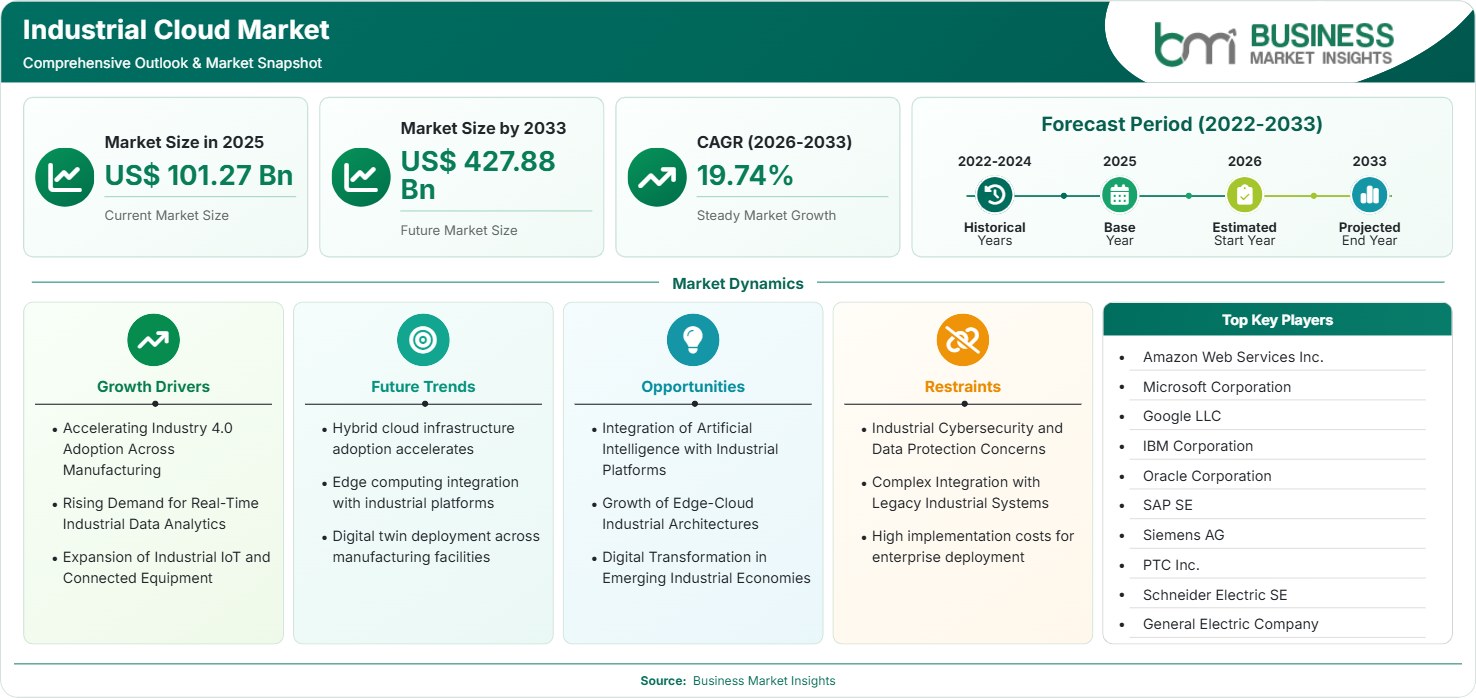
The Industrial Cloud Market size was valued at US$ 101.27 Billion in 2025 and is projected to reach US$ 427.88 Billion by 2033, growing at a CAGR of 19.74% during 2026–2033, driven by industrial digitalization, cloud-based automation, connected operations, artificial intelligence integration, and demand for scalable manufacturing solutions.

Report Coverage
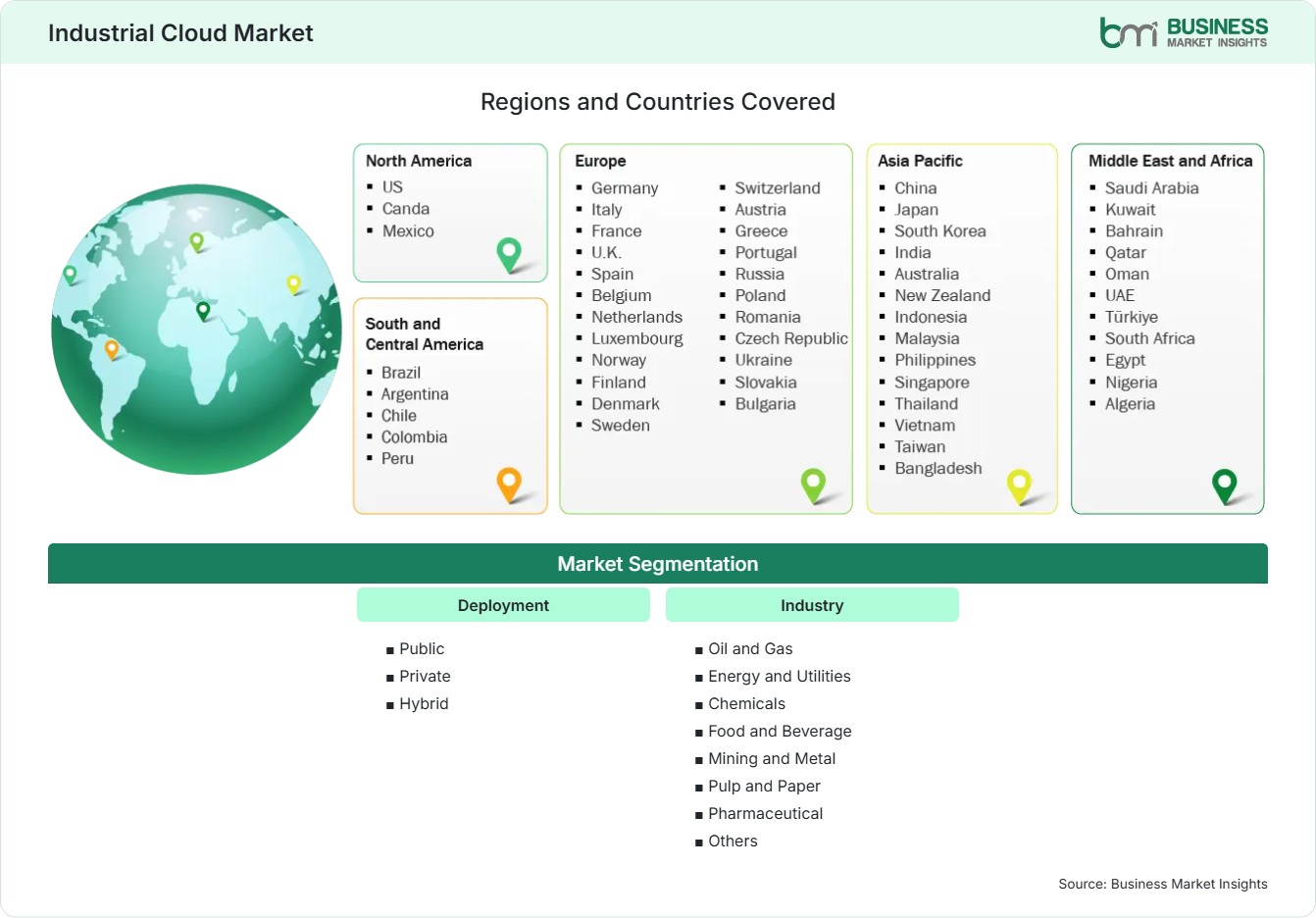
  • Deployment: Public, Private, Hybrid
  • Industry: Oil and Gas, Energy and Utilities, Chemicals, Food and Beverage, Mining and Metal, Pulp and Paper, Pharmaceutical, Others
US$ 101.27 Bn Market size in 2025
US$ 427.88 Bn Market Size by 2033
19.74% CAGR, 2026 - 2033
2026-2033 Forecast Period

AI Overview

Industrial Cloud Market Summary

  • North America Region: North America holds a 32%–36% share in 2025, growing at a CAGR of 18.80%–19.60% during 2026–2033, supported by industrial automation adoption, cloud infrastructure expansion, cybersecurity investments, and smart manufacturing initiatives. The US market demonstrates strong momentum with a CAGR of 19.00%–19.50% from 2026–2033 due to enterprise cloud migration, industrial IoT deployment, and advanced analytics integration.
  • Fastest Growing Region: Asia Pacific accounts for a 28%–32% share in 2025, expanding at a CAGR of 20.50%–21.30% during 2026–2033, supported by manufacturing digital transformation, industrial IoT adoption, government technology initiatives, and increasing investments in connected production ecosystems.
  • Leading Segment: Manufacturing Execution System (MES) represents a 24%–28% share in 2025, growing at a CAGR of 19.40%–20.20% during 2026–2033, driven by real-time production monitoring, operational optimization, data-driven decision-making, and integration with enterprise cloud platforms.
  • High Growth Segment: Hybrid deployment represents a 35%–39% share in 2025, advancing at a CAGR of 21.00%–21.80% during 2026–2033, supported by flexible infrastructure models, security requirements, workload optimization, and industrial enterprise modernization.
  • Key Market Opportunity: Industrial cloud adoption creates opportunities through AI-enabled manufacturing, predictive maintenance, digital twins, edge-cloud integration, and scalable platforms improving productivity, efficiency, asset management, and operational intelligence.
  • Major Market Players: Siemens AG, Schneider Electric SE, Honeywell International Inc., Rockwell Automation, Inc., General Electric Company, Telit, Microsoft Corporation, PTC Inc., Hitachi Data Systems Corporation, Advantech Co., Ltd., IBM Corporation.
Strategic Insights

Industrial Cloud Market: Strategic Insights

Industrial Cloud Market Strategic Framework
FREE PDF
Request your free sample
Request free sample
Stakeholder View

Key Takeaways

  • Industrial cloud ecosystems are evolving from isolated automation environments into integrated digital platforms connecting production assets, enterprise systems, suppliers, and operational intelligence solutions.
  • Manufacturing execution systems, supervisory control platforms, and lifecycle management solutions present strong growth opportunities as industries prioritize real-time monitoring, efficiency improvement, and production optimization.
  • Artificial intelligence, digital twins, edge computing, and advanced analytics are reshaping industrial software development by enabling predictive decision-making and autonomous operational improvements.
  • Asia Pacific provides significant investment potential due to expanding manufacturing capacity, government-led Industry 4.0 programs, and increasing adoption of connected industrial technologies across emerging economies.
  • Strategic partnerships between industrial automation providers, cloud technology companies, and software specialists are increasing as companies seek integrated solutions combining operational expertise with digital capabilities.
Geographic Outlook

Industrial Cloud Market Regional Highlights

North America Industrial Cloud Market

North America accounted for a 32%–36% share in 2025 and is projected to expand at a CAGR of 18.80%–19.60% during 2026–2033. The region benefits from advanced manufacturing infrastructure, cloud adoption maturity, and strong presence of automation technology providers. Industrial Cloud Market share in North America is influenced by increasing investments in smart factories, industrial cybersecurity, and artificial intelligence-enabled operations. The US remains the primary contributor, supported by technology innovation and enterprise digital transformation.

  • The United States continues leading regional adoption through advanced manufacturing initiatives, cloud infrastructure availability, and increasing integration of industrial IoT platforms across sectors.
  • Canada is expanding industrial cloud implementation through automation investments, resource sector modernization, and digital platforms supporting operational efficiency improvements.
  • Large enterprises are prioritizing hybrid cloud architectures to balance scalability, security requirements, and industrial application performance.
  • Industrial automation companies are collaborating with cloud providers to develop sector-specific platforms supporting connected manufacturing environments.

US Industrial Cloud Market

The US represented a 26%–29% share within North America in 2025 and is expected to register a CAGR of 19.00%–19.50% from 2026–2033. The country benefits from strong technology infrastructure, industrial automation capabilities, and widespread enterprise cloud adoption. Industrial Cloud Market share in the US is supported by manufacturing modernization, artificial intelligence implementation, and demand for real-time operational intelligence. Key industries adopting solutions include automotive, aerospace, pharmaceuticals, and energy.

  • Manufacturing companies are increasing cloud investments to improve production visibility, automate workflows, and optimize equipment performance.
  • Technology providers are developing industrial platforms combining cloud computing, edge processing, and analytics capabilities for enterprise applications.
  • Government initiatives supporting domestic manufacturing competitiveness are encouraging adoption of advanced digital production technologies.

Europe Industrial Cloud Market

Europe accounted for a 24%–28% share in 2025 and is estimated to grow at a CAGR of 18.20%–19.00% during 2026–2033. Germany, the United Kingdom, and France are leading contributors due to strong industrial bases and Industry 4.0 adoption. European enterprises are emphasizing sustainable manufacturing, operational efficiency, and secure cloud infrastructure. The region is advancing through digital transformation programs, automation investments, and increasing demand for intelligent production management systems.

  • Germany is strengthening industrial cloud adoption through advanced manufacturing capabilities, automation leadership, and smart factory development.
  • The United Kingdom is increasing cloud implementation across industrial sectors through digital transformation initiatives and technology investments.
  • France is supporting connected manufacturing through industrial modernization programs and enterprise software adoption.
  • European regulations around data protection and industrial cybersecurity are influencing cloud architecture decisions among enterprises.

Asia Pacific Industrial Cloud Market

Asia Pacific held a 28%–32% share in 2025 and is forecast to grow at a CAGR of 20.50%–21.30% between 2026–2033. China, Japan, South Korea, and India are driving regional expansion through manufacturing growth, automation adoption, and government-supported digital initiatives. The Industrial Cloud Market growth in Asia Pacific is supported by increasing investments in smart factories, connected equipment, and industrial analytics. Manufacturing-intensive economies are accelerating cloud transformation.

  • China is expanding industrial cloud adoption through smart manufacturing programs, large-scale industrial digitization, and automation deployment.
  • Japan is integrating cloud platforms with advanced robotics, precision manufacturing, and operational intelligence systems.
  • India is developing industrial digital ecosystems through manufacturing initiatives and increasing technology infrastructure investments.
  • South Korea is advancing connected industrial operations through semiconductor, electronics, and automotive technology innovation.

Rest of World Industrial Cloud Market

Rest of World represented a 8%–12% share in 2025 and is projected to grow at a CAGR of 19.50%–20.30% from 2026–2033. South and Central America are adopting industrial cloud solutions through manufacturing modernization and infrastructure improvement programs. Middle East and Africa markets are investing in digital industrial ecosystems, energy optimization, and technology-driven economic diversification strategies.

  • Brazil is increasing cloud adoption across manufacturing and energy industries through operational modernization programs and digital infrastructure investments.
  • Middle Eastern countries are implementing industrial cloud platforms to improve energy management, automation, and production efficiency.
  • African economies are adopting scalable cloud solutions to support industrial development and technology accessibility.
  • Gulf nations are investing in advanced industrial technologies as part of economic diversification strategies beyond traditional sectors.
Global Market Geography
FREE PDF
Request your free sample
Request free sample
Segment Analysis

Industrial Cloud Market Segmentation

Solution

The Solution segment accounted for a 100% share in 2025 and is projected to register a CAGR of 19.74% during 2026–2033. The segment growth is supported by increasing adoption of industrial software platforms, cloud-based automation, connected production systems, and enterprise digital transformation initiatives. Industrial Cloud Market scope continues expanding as organizations integrate advanced solutions to improve operational visibility, asset performance, and manufacturing intelligence across industries.

  • Supervisory Control and Data Acquisition (SCADA): SCADA solutions enable real-time monitoring, control, and data collection across industrial assets. Cloud integration improves remote accessibility, analytics capabilities, and operational decision-making.
  • Distributed Control System (DCS): DCS platforms support process industries through centralized control, automation management, and improved reliability. Cloud connectivity enhances monitoring capabilities and enables advanced operational optimization.
  • Manufacturing Execution System (MES): MES solutions improve production scheduling, quality management, and workflow visibility. Increasing smart manufacturing adoption is driving integration of MES platforms with cloud-based industrial ecosystems.
  • Human Machine Interface (HMI): HMI solutions enhance operator interaction with industrial equipment through visualization, monitoring, and control capabilities. Cloud-enabled interfaces support remote operations and improved productivity.
  • Product Lifecycle Management (PLM): PLM platforms support product development, engineering collaboration, and lifecycle optimization. Cloud deployment improves accessibility, data management, and collaboration across distributed teams.

Deployment

The Deployment segment is witnessing strong adoption as industries evaluate infrastructure flexibility, security, and operational requirements. Hybrid deployment maintained a leading position with a 35%–39% share in 2025 and is projected to grow at a CAGR of 21.00%–21.80% during 2026–2033. The segment benefits from balanced control, scalability, and integration of existing industrial systems with modern cloud environments.

  • Public: Public cloud deployment supports scalable industrial applications through flexible infrastructure, reduced maintenance requirements, and accessible computing resources for organizations expanding digital capabilities.
  • Private: Private cloud deployment provides enhanced security, customization, and control for industries managing sensitive operational data and requiring dedicated infrastructure environments.
  • Hybrid: Hybrid deployment combines private and public cloud advantages, enabling industrial enterprises to optimize workloads, maintain security standards, and achieve scalable digital transformation.

Industry

The Industry segment demonstrates diversified adoption as manufacturing and process industries implement cloud platforms for automation, analytics, and operational improvement. Industrial Cloud Market trends indicate increasing demand across sectors requiring connected systems, predictive capabilities, and improved resource management. Energy-intensive and production-focused industries are accelerating cloud transformation to enhance efficiency, reliability, and competitiveness.

  • Oil and Gas: Oil and gas companies are adopting industrial cloud platforms for asset monitoring, predictive maintenance, production optimization, and improved operational safety across complex facilities.
  • Energy and Utilities: Energy and utility providers use cloud solutions for grid management, asset analytics, renewable integration, and efficient resource distribution across evolving infrastructure networks.
  • Chemicals: Chemical industries deploy cloud-based systems to improve process control, regulatory compliance, production visibility, and operational efficiency across manufacturing facilities.
  • Food and Beverage: Food and beverage manufacturers utilize cloud platforms for quality monitoring, production tracking, supply chain visibility, and compliance management.
  • Mining and Metal: Mining and metal companies adopt industrial cloud technologies for equipment monitoring, operational analytics, safety improvement, and resource optimization in challenging environments.
  • Pulp and Paper: Pulp and paper industries implement cloud solutions to optimize production processes, improve energy efficiency, monitor equipment performance, and support sustainable manufacturing practices.
  • Pharmaceutical: Pharmaceutical companies leverage industrial cloud platforms for manufacturing control, quality assurance, regulatory compliance, and data-driven production management.
Market Forces

Industrial Cloud Market Dynamics

Key Market Drivers

Accelerating Industry 4.0 Adoption Across Manufacturing

Manufacturing organizations are increasingly adopting connected technologies to improve productivity, reduce downtime, and enhance operational visibility. Growth in the Industrial Cloud Market is driven by the Industry 4.0 movement, rising adoption of industrial Internet of Things and requirements for real-time production insights. As reported by the International Energy Agency, industrial digital solutions are increasingly becoming vital tools for boosting efficiency in the energy-intensive industries. Cloud solutions help companies combine operational data, analytical and automation systems in one environment. The Industrial Cloud Market trends reveal a transition towards intelligent factories that use cloud-based solutions for predictive maintenance and process optimization. These capabilities are helping enterprises improve competitiveness while managing increasingly complex industrial operations.

Rising Demand for Real-Time Industrial Data Analytics

Industrial enterprises are generating larger volumes of operational data from connected machinery, sensors, and automation systems. Cloud-based analytics platforms allow organizations to process information efficiently and identify performance improvements. Companies are using advanced analytics, artificial intelligence, and machine learning to forecast equipment failures, optimize resource utilization, and improve decision-making. Availability of industrial connectivity technologies is prompting organizations to switch from a reactionary approach to predictive maintenance. Cloud-based infrastructures can help leverage scalable computing power for data analysis of complicated datasets in an industrial setting along with collaboration between facilities. This development is leading to increased need for integrated systems that can merge operational technology and enterprise data.

Expansion of Industrial IoT and Connected Equipment

The rapid deployment of industrial IoT devices is increasing demand for cloud platforms capable of managing connected assets and operational networks. The industrial companies are incorporating sensors, edge devices, and automation solutions to enhance their monitoring and operational efficiency. The cloud technology allows the management of assets in a distributed way but also provides remote access to the information in real time. Some industries that have made investments in connected environments include the energy, manufacturing, and utilities industries with the goal of optimizing equipment and minimizing disruptions in operations.

Key Market Opportunities

Integration of Artificial Intelligence with Industrial Platforms

Artificial intelligence integration represents a major opportunity as industries seek autonomous decision-making, predictive capabilities, and improved operational efficiency. AI-driven cloud computing systems may process data, detect trends, and deliver insights useful for improving production. According to Industrial Cloud Market Forecasts, more chances will be created for vendors of technologies that build intelligent solutions for manufacturing, energy, and process industries. Firms that are building AI-based analytical tools, digital twins, and automation technologies will be able to help organizations aiming at achieving better efficiency and decreasing costs. Clouds along with AI will help build industrial environments flexible enough to react to changes in the conditions of operation.

Growth of Edge-Cloud Industrial Architectures

The integration of edge computing with cloud platforms creates opportunities for industries requiring low-latency processing and real-time control. Edge-cloud computing offers the ability to process crucial operational data locally while having cloud computing capabilities to perform analytics on the same data. The edge-cloud architecture is ideal for applications like automated manufacturing, remote monitoring, and intelligent machine management. Companies are adopting hybrid technologies that leverage localized processing in addition to centralizing data. Solution vendors that have offerings in edge and cloud computing will be well positioned to take advantage of the growing demands for responsive industrial solutions.

Digital Transformation in Emerging Industrial Economies

Emerging economies are creating new opportunities through manufacturing expansion, infrastructure development, and government-supported digitalization programs. Nations that are seeking to modernize their industries are using cloud computing to help them increase their efficiency and competitiveness and provide greater access to technology. Industrial companies in developing countries are now relying on cloud computing rather than traditional infrastructure frameworks. The development of intelligent manufacturing zones and other initiatives such as automation and connectivity is providing an opportunity for industrial software vendors.

Market Restraints and Challenges

Industrial Cybersecurity and Data Protection Concerns

Factor: Increasing connectivity between industrial systems and cloud platforms creates cybersecurity risks involving operational technology networks and sensitive production data. Impact: Companies will be reluctant to migrate to cloud technology because of fears of access control, breaches, and disruption in operations. The manufacturing sector needs secure architecture that would help protect its networked environment. Securing a cloud environment in the manufacturing sector becomes complex as firms adopt a variety of devices, applications, and platforms. The need to ensure cybersecurity will always be paramount to foster industry confidence.

Complex Integration with Legacy Industrial Systems

Factor: Many industrial facilities continue operating legacy equipment and traditional control systems that may not easily integrate with modern cloud platforms. Impact: Integration complexity can increase implementation costs, extend deployment timelines, and slow digital transformation initiatives. Enterprises often require customized solutions, specialized expertise, and phased migration strategies to connect existing infrastructure with cloud environments. Compatibility challenges across different industrial technologies can create barriers for organizations seeking rapid modernization. Solution providers must develop flexible architectures that support interoperability between legacy systems and advanced cloud-based industrial applications

Company Analysis

Competitive Landscape

The Industrial Cloud Market analysis highlights a competitive ecosystem driven by industrial automation providers, cloud technology companies, software specialists, and digital transformation solution developers. Companies are focusing on cloud-native industrial platforms, artificial intelligence integration, cybersecurity capabilities, strategic collaborations, and sector-specific solutions to strengthen their positions. Competitive differentiation is increasingly based on scalability, interoperability with industrial systems, real-time analytics capabilities, and the ability to support complex manufacturing and process industry requirements.

Company Name

Overview

Products and Services relevant to this market

Siemens AG

Siemens develops industrial automation and digital transformation solutions supporting connected manufacturing and intelligent infrastructure development.

Provides industrial cloud platforms, automation software, digital twins, industrial IoT solutions, and manufacturing optimization technologies.

Schneider Electric SE

Schneider Electric delivers energy management and automation solutions for industrial enterprises seeking efficiency and sustainability improvements.

Offers cloud-based industrial platforms, automation systems, monitoring solutions, energy management software, and connected infrastructure technologies.

Honeywell International Inc.

Honeywell provides industrial automation and digital solutions across process industries, manufacturing, and critical infrastructure sectors.

Supplies industrial cloud applications, process control systems, analytics platforms, automation technologies, and operational intelligence solutions.

Rockwell Automation, Inc.

Rockwell Automation specializes in industrial automation and digital transformation technologies supporting smart manufacturing environments.

Provides cloud-connected manufacturing platforms, MES solutions, industrial analytics, automation software, and production management systems.

General Electric Company

General Electric develops industrial technology solutions focused on digital operations, asset performance, and industrial intelligence.

Offers industrial cloud platforms, asset monitoring solutions, predictive analytics, and digital transformation services.

Telit Cinterion

Telit Cinterion provides IoT connectivity and edge solutions supporting industrial digital transformation applications.

Delivers IoT modules, connectivity platforms, edge solutions, and cloud integration technologies for industrial environments.

Microsoft Corporation

Microsoft provides cloud computing infrastructure and industrial digital solutions through enterprise cloud platforms.

Offers cloud services, industrial IoT platforms, artificial intelligence solutions, analytics tools, and enterprise application integration.

PTC Inc.

PTC develops industrial software solutions supporting product development, manufacturing, and connected operations.

Provides PLM platforms, IoT solutions, augmented reality technologies, and industrial digital transformation software.

Hitachi Data Systems Corporation

Hitachi Data Systems provides enterprise data solutions supporting industrial information management and digital operations.

Offers data management platforms, analytics solutions, cloud infrastructure services, and industrial information technology solutions.

Advantech Co., Ltd.

Advantech develops industrial computing and IoT technologies for connected industrial applications.

Provides industrial computers, edge devices, IoT platforms, automation solutions, and cloud-enabled industrial systems.

IBM Corporation

IBM delivers enterprise cloud and artificial intelligence technologies supporting industrial transformation initiatives.

Provides hybrid cloud platforms, AI analytics, data management solutions, and industrial automation support technologies.

Trust & Transparency

Research Methodology

The market analysis combines proprietary research with secondary data from government agencies, company disclosures, regulatory filings, industry databases and expert interviews. Market estimates are validated through data triangulation, cross-market benchmarking and analyst review.

View Full Research Methodology

Questions Answered

Frequently Asked Questions

How are companies addressing security challenges in industrial cloud environments?

Companies are implementing advanced cybersecurity frameworks, encryption technologies, identity management systems, and hybrid deployment models to protect industrial data and maintain operational resilience.

Which industries are expected to benefit most from industrial cloud adoption?

Manufacturing, energy, utilities, pharmaceuticals, oil and gas, chemicals, and mining industries are expected to benefit through improved automation, operational visibility, and data-driven decision-making.

What role does artificial intelligence play in Industrial Cloud Market Report development?

The Market Report identifies artificial intelligence as a key technology enabling automated insights, predictive decision-making, anomaly detection, and improved industrial process optimization.

How does cloud computing improve industrial asset management?

Cloud computing enables real-time monitoring, predictive maintenance, remote access, and centralized data analysis, helping industries improve equipment reliability and optimize operational performance.

What factors are accelerating adoption of industrial cloud platforms?

Industrial cloud adoption is accelerating due to smart manufacturing initiatives, increasing industrial IoT deployment, demand for predictive analytics, and the need for scalable infrastructure supporting connected operations.

Access the Full Industrial Cloud Market Report

Get segment-level forecasts, regional estimates, competitive benchmarking, company profiles and downloadable Excel datasets.

Access the full Industrial Cloud Market Report
350 pages PDF & Excel | 2026-08-18
Similar Research

Related Market Reports