
Public Cloud Market Outlook: Size, Share, Trends, Growth Analysis, Competitive Landscape & Forecast, 2026–2033

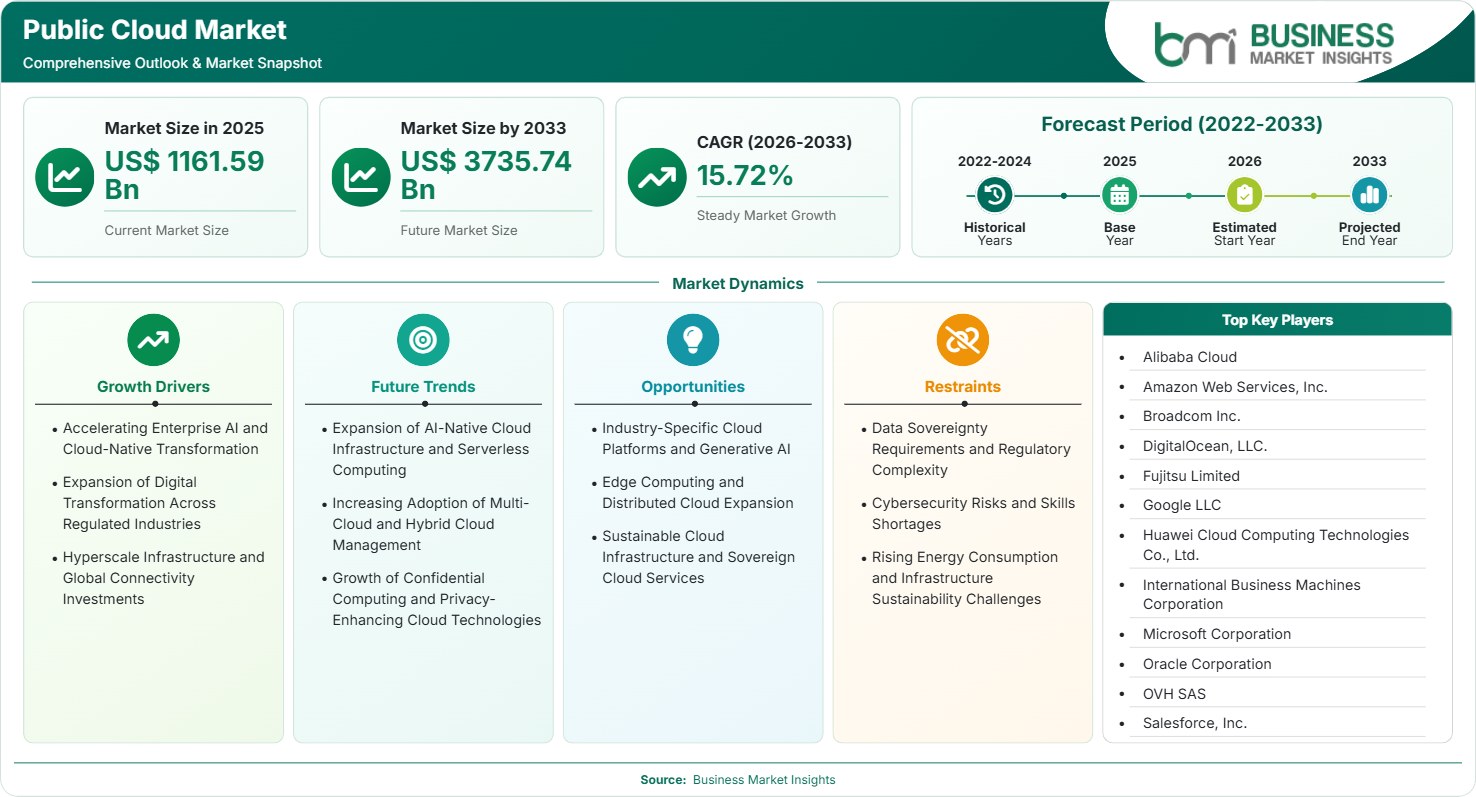
The Public Cloud Market size was valued at US$ 1161.59 Billion in 2025 and is projected to reach US$ 3735.74 Billion by 2033, growing at a CAGR of 15.72% during 2026–2033, driven by enterprise digital transformation, AI adoption, cloud-native modernization, cybersecurity investments, and expanding opportunities across regulated industries and emerging economies.

Report Coverage
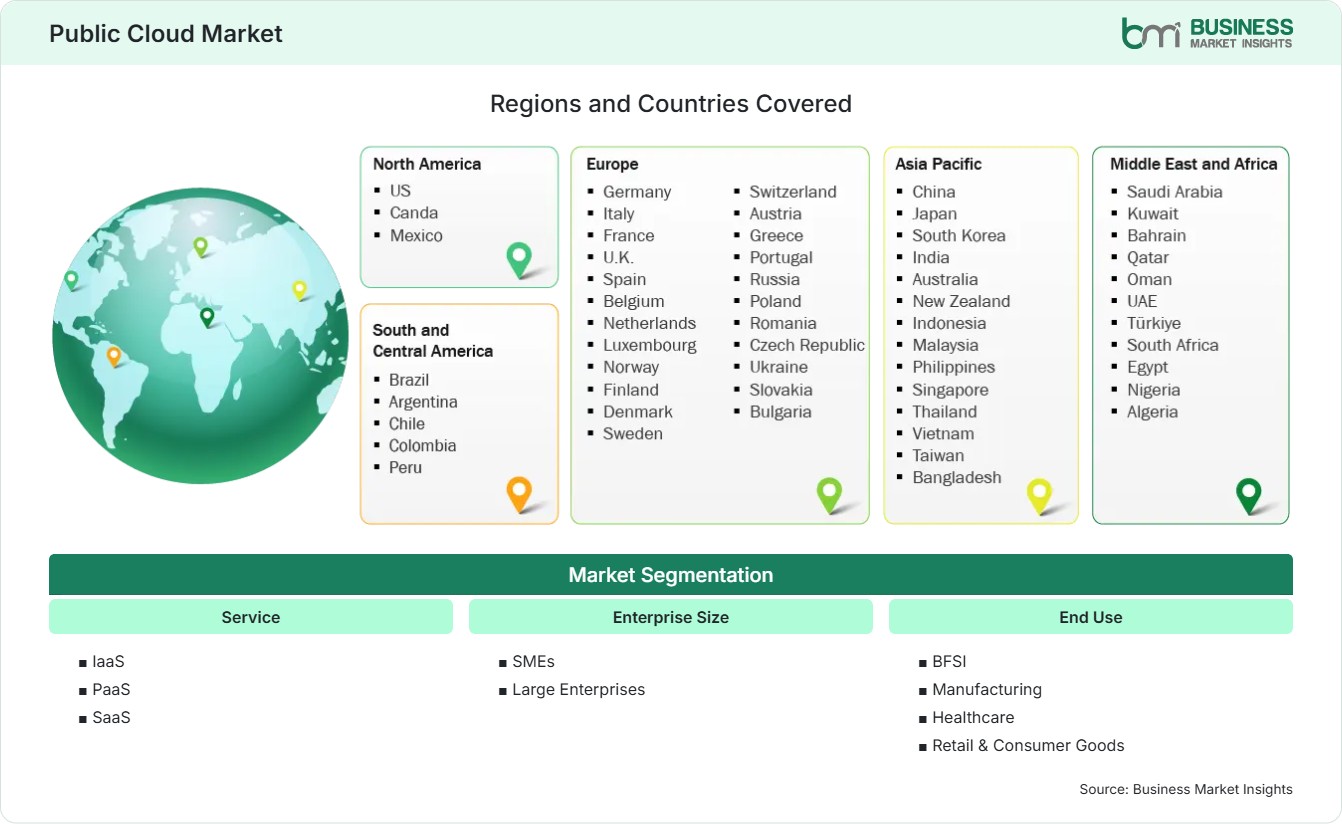
  • Service: IaaS, PaaS, SaaS
  • Enterprise Size: SMEs, Large Enterprises
  • End Use: BFSI, Manufacturing, Healthcare, Retail & Consumer Goods
US$ 1161.59 Bn Market size in 2025
US$ 3735.74 Bn Market Size by 2033
15.72% CAGR, 2026 - 2033
2026-2033 Forecast Period

AI Overview

Public Cloud Market Summary

  • North America Region: North America holds 38%–41% market share in 2025, growing with a 14.5%–15.2% CAGR during 2026–2033, supported by enterprise cloud migration, AI infrastructure investments, cybersecurity spending, and sustained demand for scalable digital services across industries. The U.S. dominates regional demand through extensive hyperscale infrastructure, enterprise software adoption, and AI investments, expanding at a CAGR of 14.8%–15.4% during 2026–2033.
  • Fastest Growing Region: Asia Pacific accounts for 26%–29% market share in 2025 while expanding at a 17.5%–18.3% CAGR during 2026–2033, fueled by digital economy expansion, sovereign cloud investments, SME digitization, AI deployment, fintech innovation, expanding internet penetration, and rising enterprise modernization initiatives.
  • Leading Segment: SaaS represents 47%–50% market share in 2025 and advances at a 15.0%–15.8% CAGR through 2033, supported by subscription software adoption, remote collaboration requirements, continuous feature innovation, and lower deployment complexity across organizations.
  • High Growth Segment: IaaS contributes 28%–31% market share in 2025 while recording a 17.8%–18.6% CAGR during 2026–2033, driven by AI workloads, elastic storage, containerized applications, and demand for scalable digital infrastructure.
  • Key Market Opportunity: Rising generative AI adoption, sovereign cloud initiatives, industry-specific cloud platforms, and secure digital transformation programs create substantial long-term opportunities for cloud infrastructure providers worldwide.
  • Major Market Players: Alibaba Cloud, Amazon Web Services, Inc., Broadcom Inc., DigitalOcean, LLC., Fujitsu Limited, Google LLC, Huawei Cloud Computing Technologies Co., Ltd., International Business Machines Corporation, Microsoft Corporation, Oracle Corporation, OVH SAS, Salesforce, Inc., SAP SE, Tencent Cloud, Vultr.
Strategic Insights

Public Cloud Market: Strategic Insights

Public Cloud Market Strategic Framework
FREE PDF
Request your free sample
Request free sample
Stakeholder View

Key Takeaways

  • The industry value chain is increasingly centered around hyperscale infrastructure providers, semiconductor suppliers, and system integrators working through collaborative cloud ecosystems.
  • Infrastructure-intensive AI applications, financial services modernization, healthcare digitization, and industrial automation present the strongest commercial opportunities.
  • Innovation is shifting from traditional virtualization toward AI-optimized infrastructure, cloud-native application development, and integrated automation for enterprise workload management.
  • Asia Pacific presents one of the strongest long-term investment destinations because expanding digital economies, supportive government initiatives, growing enterprise technology spending.
  • Strategic acquisitions increasingly focus on cybersecurity, observability, AI infrastructure optimization allowing providers to expand integrated service portfolios while strengthening competitive differentiation.
  • Future competitive advantage will depend on balancing infrastructure scalability, regulatory compliance that address evolving customer requirements across highly regulated sectors.
Geographic Outlook

Public Cloud Market Regional Highlights

North America Public Cloud Market

North America accounted for 38%–41% Public Cloud Market share in 2025 and is projected to expand at a 14.5%–15.2% CAGR during 2026–2033. The region benefits from mature hyperscale infrastructure, widespread enterprise cloud adoption, advanced AI implementation, and high investment in cybersecurity.

  • Hyperscale’s keep increasing their regional data center capacity for AI training, high performance computing and enterprise workloads. Renewable energy sourcing and innovative cooling techniques ensure greater reliability, while meeting sustainability expectations of their enterprise clients and regulators.
  • Financial institutions increasingly migrate mission-critical applications to cloud-native environments for better scalability, cybersecurity, and regulatory compliance. Digital banking, fraud analytics, and AI-powered customer engagement continue creating strong enterprise demand for advanced cloud infrastructure services.
  • Healthcare organizations accelerate cloud adoption to support electronic health records, medical imaging, AI diagnostics, and collaborative research. Regulatory compliance frameworks encourage secure infrastructure modernization while enabling scalable healthcare data management across distributed clinical networks.

US Public Cloud Market

The United States public cloud market represented approximately 78%–82% of North American revenue in 2025 while advancing with a 14.8%–15.4% CAGR through 2033. Extensive hyperscale datacenter infrastructure, strong enterprise technology spending, AI innovation, and mature software ecosystems maintain national leadership.

  • Large enterprises increasingly implement multi-cloud architectures to optimize workload distribution, improve resilience, and reduce operational risk. Advanced cloud governance frameworks enhance compliance while supporting business continuity across geographically distributed operations.
  • AI infrastructure investments continue accelerating demand for GPU-enabled cloud services, scalable storage, and high-speed networking. Technology companies collaborate with enterprise customers to deploy generative AI applications supporting productivity and automation.
  • Healthcare providers strengthen secure cloud adoption through AI-assisted diagnostics, remote care platforms, and interoperable patient data management. Regulatory compliance remains central to cloud infrastructure selection and implementation decisions.

Europe Public Cloud Market

Europe captured 24%–27% market share during 2025 and is anticipated to grow at a 14.2%–14.9% CAGR through 2033. Regional demand is supported by strong digital sovereignty initiatives, enterprise modernization, and expanding cloud adoption among regulated industries. Germany remains the leading revenue contributor, while Spain demonstrates one of the fastest growth trajectories with an estimated 15.6%–16.3% CAGR.

  • European enterprises prioritize sovereign cloud deployments to address evolving data governance regulations, improving confidence among organizations operating within financial services, healthcare, and public administration while encouraging long-term cloud infrastructure investments.
  • Germany leads regional adoption through advanced manufacturing, industrial digitalization, and widespread enterprise software implementation. Strong Industry 4.0 initiatives continue expanding demand for scalable cloud computing platforms and intelligent analytics capabilities.
  • Spain records rapid expansion supported by national digital transformation programs, increasing SME technology adoption, and investments in hyperscale infrastructure. Favorable policy initiatives encourage broader enterprise migration toward cloud-native operating environments.

Asia Pacific Public Cloud Market

Asia Pacific held 26%–29% market share in 2025 and is forecast to expand at the fastest 17.5%–18.3% CAGR between 2026 and 2033. Rapid enterprise digitization, expanding AI adoption, growing internet penetration, and supportive government digital economy initiatives drive regional momentum. China remains the largest regional market, while India demonstrates the highest growth with a projected 19.2%–20.0% CAGR. Strong investments in hyperscale infrastructure and cloud-native startups continue accelerating enterprise transformation across multiple industries.

  • China leads regional revenue through large-scale enterprise cloud adoption, digital commerce expansion, AI investments, and extensive domestic hyperscale infrastructure supporting industrial digital transformation and public sector modernization.
  • India experiences exceptional growth driven by expanding startup ecosystems, government digital initiatives, increasing SME cloud adoption, and accelerating enterprise modernization supported by investments from global hyperscale providers.
  • Japan and South Korea strengthen regional innovation through advanced manufacturing, semiconductor ecosystems, AI research, and enterprise automation programs that increasingly depend upon scalable cloud infrastructure and intelligent data management capabilities.
  • Telecommunications operators continue partnering with cloud providers to expand edge computing, 5G-enabled enterprise services, and distributed cloud architectures supporting latency-sensitive industrial and consumer applications across rapidly developing economies.

Rest of World Public Cloud Market

South & Central America and the Middle East & Africa collectively represented 8%–10% market share in 2025 while expanding at a 15.8%–16.6% CAGR through 2033. Brazil remains the leading South American market, whereas Saudi Arabia demonstrates the strongest regional growth with a 17.2%–18.0% CAGR. Expanding connectivity and regulatory reforms further support commercial cloud deployment. Meanwhile, Middle Eastern and African economies increasingly prioritize AI initiatives, smart city investments, and sovereign cloud strategies to diversify economic development while improving digital resilience across public and private sectors.

  • Brazil maintains regional leadership through expanding enterprise cloud migration, financial technology innovation, and increasing investments in digital infrastructure supporting commercial modernization and scalable computing capabilities.
  • Saudi Arabia records the highest regional expansion through Vision 2030 initiatives, hyperscale datacenter investments, AI adoption, and government-led digital transformation programs encouraging enterprise cloud deployment.
  • Financial inclusion initiatives across emerging economies increase cloud adoption among banking institutions, payment providers, and fintech companies requiring secure, scalable digital infrastructure for rapidly growing customer bases.
Global Market Geography
FREE PDF
Request your free sample
Request free sample
Segment Analysis

Public Cloud Market Segmentation

Service

The Service segment accounted for 68%–71% market share in 2025 and is projected to register a 16.2%–16.9% CAGR during 2026–2033. The Public Cloud Market scope continues expanding through growing enterprise dependence on cloud-native platforms, AI-enabled workloads, and subscription-based IT consumption.

  • IaaS: Organizations increasingly adopt Infrastructure as a Service to support AI workloads, disaster recovery, high-performance computing, containerized applications, and flexible storage while minimizing capital expenditure and improving infrastructure scalability.
  • PaaS: Platform as a Service adoption continues expanding among software developers seeking accelerated application development, DevOps automation, integrated analytics, API management, and cloud-native deployment environments supporting continuous innovation.
  • SaaS: Software as a Service remains the dominant delivery model through enterprise productivity platforms, customer relationship management, collaboration software, and industry-specific business applications requiring minimal deployment complexity and predictable subscription pricing.

Enterprise Size

The Enterprise Size segment represented 100% of market demand across customer categories in 2025, with an estimated 15.5%–16.2% CAGR through 2033. The Public Cloud Market trends indicate increasing demand for flexible pricing models, hybrid operating environments, and managed cloud services tailored to diverse operational requirements.

  • SMEs: Small and medium-sized enterprises increasingly leverage public cloud solutions to access enterprise-grade computing, cybersecurity, analytics, and collaboration capabilities without significant infrastructure investments, supporting business expansion and operational agility.
  • Large Enterprises: Large organizations continue investing in multi-cloud environments, AI platforms, data lakes, advanced cybersecurity, and mission-critical workload modernization to improve resilience, compliance, and global operational efficiency across distributed business operations.

End Use

The End Use segment reflects broad industry adoption, with enterprise demand supported by digital transformation, AI deployment, and regulatory modernization. This segment accounted for 100% industry utilization in 2025 and is forecast to expand at a 15.7%–16.4% CAGR during the forecast period.

  • BFSI: Financial institutions utilize public cloud platforms for digital banking, fraud detection, payment processing, regulatory reporting, customer analytics, and AI-driven financial services while strengthening operational resilience and cybersecurity capabilities.
  • Manufacturing: Manufacturers increasingly deploy cloud infrastructure for industrial IoT, predictive maintenance, digital twins, production analytics, supply chain optimization, and intelligent factory automation supporting Industry 4.0 transformation initiatives.
  • Healthcare: Healthcare providers adopt public cloud environments to enable electronic health records, telehealth services, AI-assisted diagnostics, medical imaging, clinical collaboration, and secure patient data management while meeting regulatory compliance requirements.
  • Retail & Consumer Goods: Retail organizations leverage public cloud capabilities for omnichannel commerce, inventory optimization, customer personalization, demand forecasting, marketing analytics, and scalable digital commerce platforms supporting rapidly changing consumer purchasing behavior.
Market Forces

Public Cloud Market Dynamics

Key Market Drivers

Accelerating Enterprise AI and Cloud-Native Transformation

The adoption of artificial intelligence will be an influential driver of growth in the Public Cloud Market, owing to the increasing need for scalable computing, GPU-based infrastructure, and data management, among other requirements. Based on observations by industry players such as the IMF and the OECD, investments in artificial intelligence are rising in sectors such as finance, health care, manufacturing, and retail. Public cloud platforms enable organizations to deploy machine learning models without significant capital expenditure while supporting rapid application development.

Expansion of Digital Transformation Across Regulated Industries

Government agencies and highly regulated sectors are making continued investments in secure infrastructure to bring their public services and business functions up to date with modern technologies. Cloud platforms are used by hospitals in order to store their electronic health records and use artificial intelligence diagnostics tools, while banks depend on cloud systems in order to detect fraud, make payments online, and file reports. Manufacturing companies integrate Industrial IoT, and digital twins into cloud ecosystems to improve operational efficiency.

Hyperscale Infrastructure and Global Connectivity Investments

Increased investments in hyperscale data centers, large fiber-optic networks, and energy-efficient computing facilities improve global access to the cloud. The major companies are working on expanding their regional availability zones, green data centers, and computing facilities driven by AI. Improved network latency, resilient infrastructure, and automated resource allocation enhance customer experience while enabling organizations to scale operations rapidly.

Key Market Opportunities

Industry-Specific Cloud Platforms and Generative AI

According to Public Cloud Market Forecasts, there is significant potential in cloud platforms for sectors such as health care, finance, manufacturing, retail, and government. Businesses today need cloud platforms that offer AI capabilities, ready-to-use solutions that help them comply with regulations easily, and industry analytics. Generative AI services, intelligent automation, and industry-specific large language models are helping to generate revenues for cloud companies that can deliver secure, scalable, and customizable enterprise platforms.

Edge Computing and Distributed Cloud Expansion

The accelerated implementation of 5G technology, automation, autonomy, and connectivity solutions has led to a rise in the demand for distributed cloud systems. Edge computing is designed to process data quicker by placing computing capabilities closer to users and devices and thus lowering latency times while increasing operational speed. Telecommunications firms, manufacturing companies, and smart cities are adopting edge technology and integrating it with their public cloud infrastructures. This trend provides lucrative business prospects for vendors in the industry.

Sustainable Cloud Infrastructure and Sovereign Cloud Services

Environmental sustainability of digital infrastructure is becoming one of the key priorities along with issues of national data sovereignty for governments and multinational companies. Renewable energy-based datacenters, cooling systems, carbon-efficient computing, and regional cloud zones are generating competitive advantages. Companies able to sustain environmentally friendly business practices and comply with the new regulations are likely to increase their customer retention and government partnerships.

Market Restraints and Challenges

Data Sovereignty Requirements and Regulatory Complexity

Factor: The rapidly changing data protection regulations, cross-border data transfer limitations, and compliance issues across industries complicate implementation. Impact: Companies that operate in multiple locations might incur higher costs and face difficulties in implementing the solution due to the increased complexity of selecting cloud providers. The need for governance, security controls, and localization investments is constant and may delay the adoption of such services.

Cybersecurity Risks and Skills Shortages

Factor: Advanced cyber risks, ransomware attacks, misconfigured cloud systems, and lack of qualified personnel in the field of cloud security remain a problem for enterprise implementation. Impact: Enterprises will need to spend a lot of money on identity management, building zero-trust security frameworks, employee training, and monitoring to secure cloud systems. Small enterprises will face challenges in terms of budgets and technical skills in implementing their cloud migration plans.

Company Analysis

Competitive Landscape

Public Cloud Market analysis reveals that the hyperscale vendors are spending large amounts of money on data centers optimized for AI workloads, sovereign clouds, edge computing, and partnerships in order to increase adoption among enterprises. Further, the specialized vendors distinguish themselves with development platforms, regional clouds, managed clouds, and industry-specific regulatory solutions.

Company Name

Overview

Products and Services Relevant to this Market

Alibaba Cloud

Leading Asia-based cloud provider serving enterprises, governments, and digital businesses with scalable infrastructure and AI-enabled cloud platforms across multiple global regions.

Elastic Compute Service, Object Storage Service, AI computing, cloud databases, networking, security, Kubernetes, analytics, and enterprise cloud migration services.

Amazon Web Services, Inc.

World's largest hyperscale cloud provider with an extensive global infrastructure supporting organizations of every size across numerous industry verticals.

Amazon EC2, Amazon S3, AWS Lambda, Amazon RDS, SageMaker, networking, storage, analytics, AI services, and cloud security solutions.

Broadcom Inc.

Enterprise infrastructure software provider strengthening hybrid and multi-cloud capabilities through virtualization, networking, and cloud management technologies.

VMware Cloud Foundation, virtualization software, network infrastructure, cloud automation, workload management, cybersecurity, and enterprise infrastructure software.

DigitalOcean, LLC.

Cloud platform focused on developers, startups, and growing businesses through simplified infrastructure and predictable pricing models.

Virtual machines, managed Kubernetes, object storage, managed databases, application hosting, networking, developer tools, and cloud security services.

Fujitsu Limited

Global technology company delivering digital transformation solutions supported by enterprise cloud integration and managed infrastructure services.

Hybrid cloud solutions, managed cloud services, enterprise consulting, infrastructure modernization, AI integration, cybersecurity, and business application platforms.

Google LLC

Global hyperscale provider combining advanced cloud infrastructure with AI leadership and large-scale data analytics capabilities.

Google Compute Engine, Google Kubernetes Engine, Vertex AI, BigQuery, Cloud Storage, networking, security, and collaboration platforms.

Huawei Cloud Computing Technologies Co., Ltd.

Major cloud provider supporting enterprise digital transformation through AI-enabled infrastructure and regional cloud ecosystem development.

Elastic cloud servers, AI services, databases, networking, cloud security, storage, big data analytics, and industry cloud platforms.

International Business Machines Corporation

Enterprise technology leader specializing in hybrid cloud, AI, automation, and consulting for complex business environments.

IBM Cloud, Red Hat OpenShift, Watson AI, hybrid cloud management, cybersecurity, automation, and consulting services.

Microsoft Corporation

Leading enterprise cloud provider delivering integrated productivity, infrastructure, AI, and developer solutions worldwide.

Microsoft Azure, Microsoft 365, Azure AI, Azure Kubernetes Service, cloud security, databases, analytics, and application development platforms.

Oracle Corporation

Enterprise software and infrastructure provider focused on mission-critical databases and industry cloud solutions.

Oracle Cloud Infrastructure, Autonomous Database, enterprise applications, AI services, analytics, networking, storage, and cloud security.

OVH SAS

European cloud provider emphasizing data sovereignty, open cloud architecture, and sustainable infrastructure operations.

Public cloud instances, hosted private cloud, storage, networking, Kubernetes, managed databases, backup solutions, and cybersecurity services.

Salesforce, Inc.

Customer relationship management leader delivering cloud-based business applications powered by AI and automation capabilities.

Sales Cloud, Service Cloud, Data Cloud, Agentforce AI, analytics, integration tools, workflow automation, and customer engagement platforms.

SAP SE

Enterprise software provider integrating cloud ERP, analytics, and business process management across global organizations.

SAP S/4HANA Cloud, Business Technology Platform, analytics, AI, procurement, finance, supply chain, and human capital management solutions.

Tencent Cloud

Global cloud provider supporting digital entertainment, finance, and enterprise modernization through scalable infrastructure services.

Cloud computing, databases, AI services, content delivery, networking, cloud security, media processing, and industry cloud solutions.

Vultr

Independent cloud infrastructure provider focused on developers and enterprises requiring high-performance global cloud deployment.

Cloud compute, bare metal servers, GPU instances, Kubernetes, storage, networking, databases, AI infrastructure, and edge cloud services.

Trust & Transparency

Research Methodology

The market analysis combines proprietary research with secondary data from government agencies, company disclosures, regulatory filings, industry databases and expert interviews. Market estimates are validated through data triangulation, cross-market benchmarking and analyst review.

View Full Research Methodology

Questions Answered

Frequently Asked Questions

What does this Public Cloud Market Report help stakeholders evaluate?

The report provides strategic insights into market size, competitive positioning, regional opportunities, segmentation trends, and future growth prospects.

How is competition evolving among cloud service providers?

Competition increasingly focuses on AI infrastructure, sovereign cloud capabilities, sustainability, cybersecurity, industry-specific cloud platforms, and global datacenter expansion.

Which industries are expected to generate the strongest future demand?

BFSI, healthcare, manufacturing, and retail & consumer goods are expected to remain the largest demand generators as these sectors increasingly adopt AI, analytics, digital platforms, industrial IoT to improve operational performance.

Which service model currently leads the Public Cloud Market?

Software as a Service (SaaS) remains the leading service model because of its widespread enterprise adoption, subscription-based pricing, simplified deployment, and extensive use in productivity.

What are the primary factors accelerating adoption of the Public Cloud Market?

Enterprise digital transformation, artificial intelligence deployment, cloud-native application development, remote workforce enablement, cybersecurity modernization, and demand for scalable IT infrastructure are the primary growth catalysts.

Access the Full Public Cloud Market Report

Get segment-level forecasts, regional estimates, competitive benchmarking, company profiles and downloadable Excel datasets.

Access the full Public Cloud Market Report
350 pages PDF & Excel | 2026-08-17