
Cloud Storage Market Outlook: Size, Share, Trends, Growth Analysis, Competitive Landscape & Forecast, 2026-2033

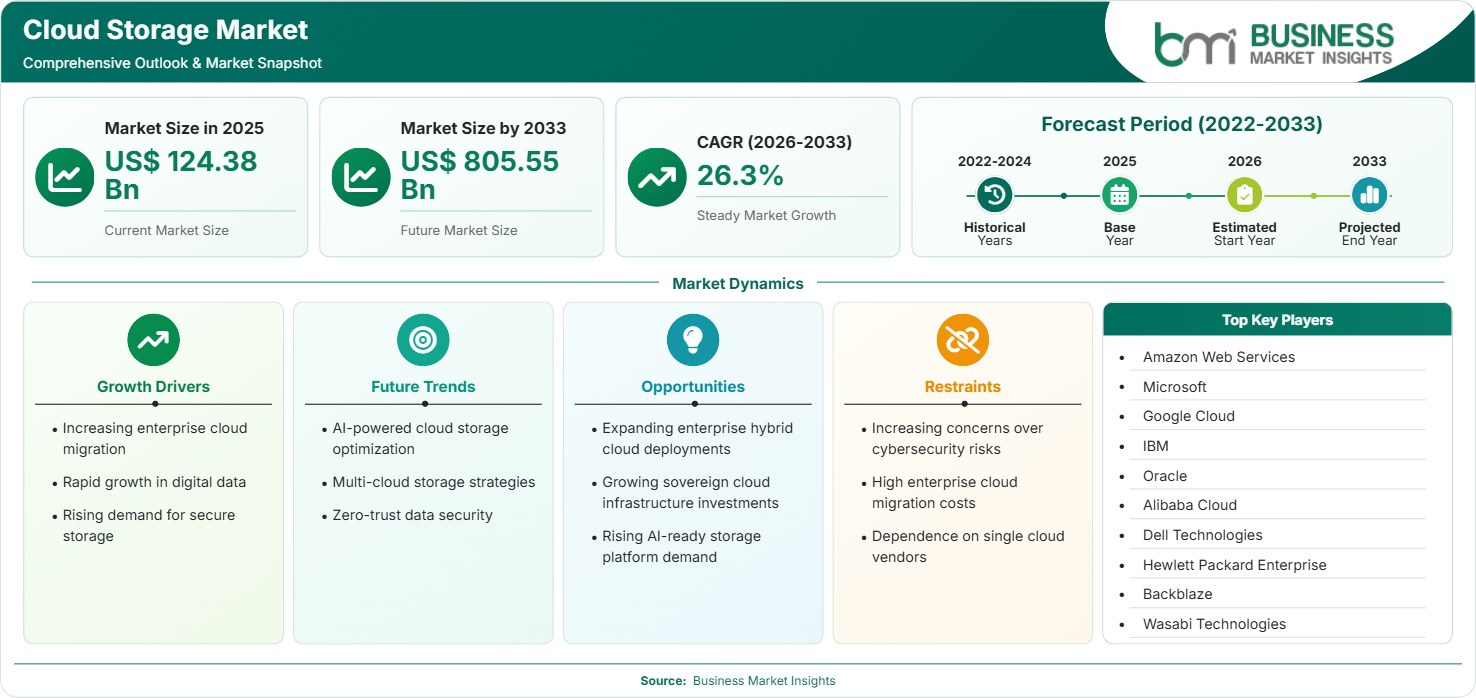
The Cloud Storage Market size was valued at US$ 124.38 Billion in 2025 and is projected to reach US$ 805.55 Billion by 2033, growing at a CAGR of 26.3% during 2026–2033, driven by enterprise cloud migration, exponential digital data generation, secure storage requirements, hybrid cloud adoption, sovereign infrastructure investments, and AI-ready storage platforms.

Report Coverage
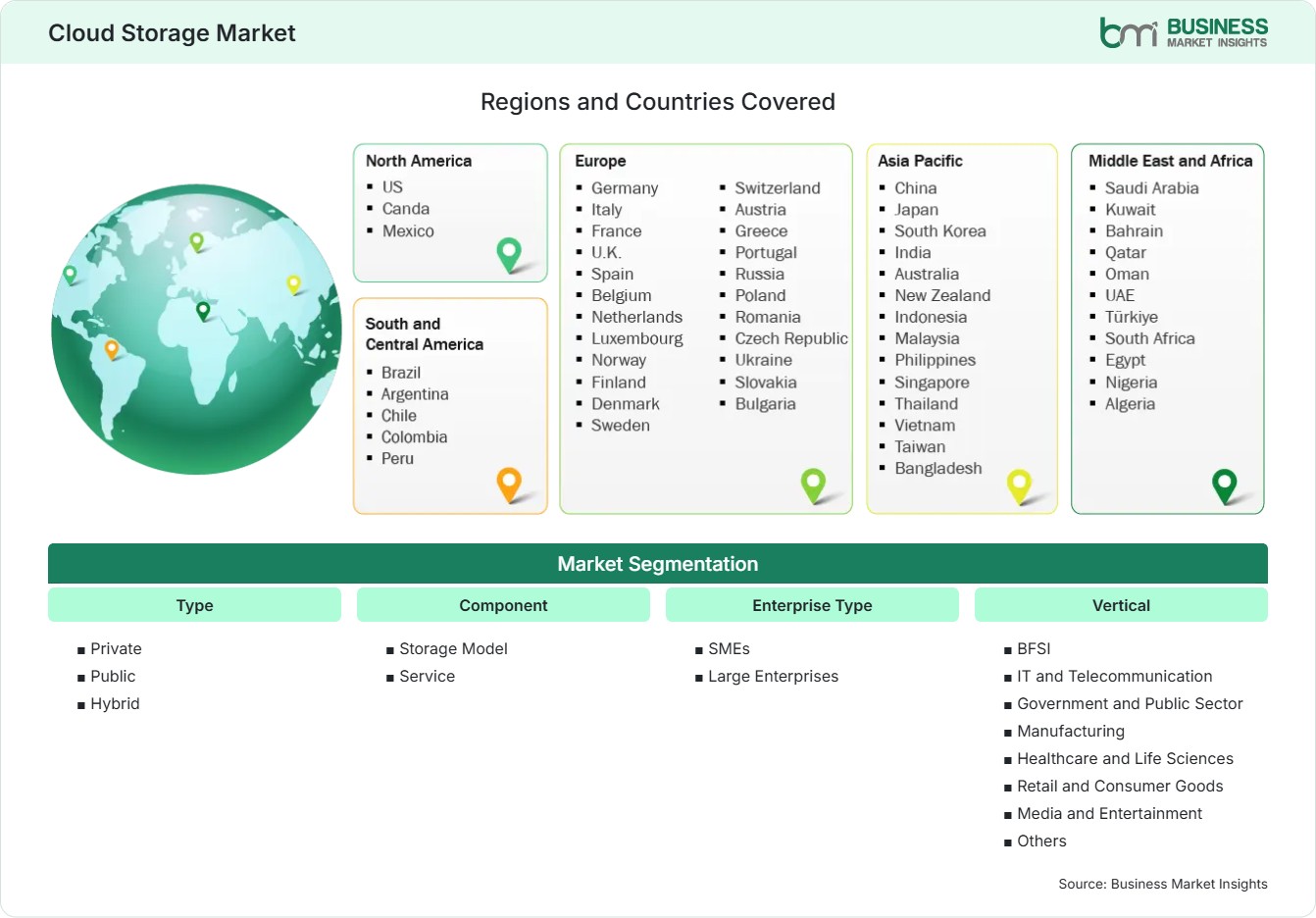
  • Type: Private, Public, Hybrid
  • Component: Storage Model, Service
  • Enterprise Type: SMEs, Large Enterprises
  • Vertical: BFSI, IT and Telecommunication, Government and Public Sector, Manufacturing, Healthcare and Life Sciences, Retail and Consumer Goods, Media and Entertainment, Others
US$ 124.38 Bn Market size in 2025
US$ 805.55 Bn Market Size by 2033
26.3% CAGR, 2026 - 2033
2026-2033 Forecast Period

AI Overview

Cloud Storage Market Summary

  • North America Region: North America holds market share of 39%–42% in 2025, growing with a CAGR of 24%–26% influenced by enterprise cloud adoption, hyperscale infrastructure expansion, cybersecurity investments, and AI workloads. The US market expands with a CAGR of 24%–26% during 2026–2033, supported by strong cloud provider presence, enterprise digital transformation, and advanced data management requirements.
  • Fastest Growing Region: Asia Pacific holds a share range of 25%–28% in 2025, expanding with a CAGR of 29%–31% driven by digital transformation, cloud infrastructure development, increasing data consumption, government cloud initiatives, and enterprise modernization programs.
  • Leading Segment: Public Cloud represents the leading type segment with a share range of 48%–51% in 2025, growing at a CAGR of 27%–29% due to scalability, cost flexibility, hyperscale investments, and increasing adoption among enterprises.
  • High Growth Segment: Hybrid Cloud accounts for a share range of 30%–33% in 2025, expanding at a CAGR of 30%–32% due to data sovereignty requirements, workload flexibility, and enterprise demand for integrated cloud environments.
  • Key Market Opportunity: The market opportunity is concentrated in hybrid cloud deployments, sovereign cloud infrastructure, AI-ready storage platforms, and secure enterprise data management solutions.
  • Major Market Players: Amazon Web Services, Microsoft, Google Cloud, IBM, Oracle, Alibaba Cloud, Dell Technologies, Hewlett Packard Enterprise, Backblaze, Wasabi Technologies.
Strategic Insights

Cloud Storage Market: Strategic Insights

Cloud Storage Market Strategic Framework
FREE PDF
Request your free sample
Request free sample
Stakeholder View

Key Takeaways

  • Cloud storage ecosystems are shifting from basic data backup solutions toward intelligent platforms supporting analytics, artificial intelligence, automation, and enterprise-wide digital operations.
  • Hybrid cloud storage provides significant growth potential as enterprises seek flexibility between public cloud scalability and private infrastructure control.
  • AI-driven workloads are influencing storage innovation, encouraging providers to develop high-performance platforms optimized for large-scale data processing.
  • Asia Pacific represents an attractive investment region due to accelerating digitalization, expanding internet infrastructure, and increasing enterprise cloud adoption.
  • Strategic competition among cloud providers is increasing through infrastructure expansion, cybersecurity enhancement, and industry-specific storage offerings.
  • Sovereign cloud initiatives are creating new opportunities as governments and regulated industries seek localized data management capabilities.
Geographic Outlook

Cloud Storage Market Regional Highlights

North America Cloud Storage Market

North America accounted for a share range of 39%–42% in 2025 and is projected to grow at a CAGR of 24%–26% during 2026–2033. The region maintains leadership due to advanced cloud infrastructure, strong enterprise technology adoption, and the presence of major cloud service providers. The Cloud Storage Market share in North America is supported by increasing enterprise migration, artificial intelligence adoption, cybersecurity requirements, and demand for scalable data management solutions.

  • The United States remains the largest contributor due to strong cloud provider ecosystems, enterprise technology investments, and widespread digital transformation initiatives.
  • Canada is expanding cloud adoption through government modernization programs, business digitalization, and increasing demand for secure data infrastructure.
  • Enterprises across North America are investing in cloud storage platforms to improve operational efficiency, disaster recovery capabilities, and data accessibility.
  • Artificial intelligence workloads are increasing demand for advanced storage systems capable of handling large-scale datasets and complex processing requirements.

US Cloud Storage Market

The United States held a share range of 34%-37% in 2025 and is estimated to grow at a CAGR of 24%-26% between 2026 and 2033. It is still one of the significant hubs owing to cloud infrastructure, technological advancements, and enterprise adoption. Increased volume of data, AI development, demand for cybersecurity, and cloud-based applications deployment will drive market growth.

  • Large enterprises are accelerating cloud migration to improve scalability, flexibility, and operational efficiency across business functions.
  • Technology companies are increasing investment in AI-ready storage platforms to support machine learning and advanced analytics workloads.
  • Government agencies are adopting secure cloud environments to improve data management and modernization capabilities.
  • Healthcare and financial organizations are increasing cloud storage adoption due to growing digital records and compliance requirements.

Europe Cloud Storage Market

Europe held a share range of 25%–28% in 2025 and is projected to grow at a CAGR of 24%–26% during 2026–2033. The region benefits from enterprise digital transformation, regulatory-driven cloud adoption, and increasing demand for secure data management solutions. Germany, the United Kingdom, France, and the Netherlands are key markets. Data sovereignty requirements and cybersecurity regulations are influencing enterprise cloud strategies.

  • Germany supports market growth through industrial digitalization, manufacturing automation, and enterprise cloud adoption.
  • The United Kingdom is expanding cloud infrastructure through technology investments and modernization across financial and public sectors.
  • France is increasing cloud adoption through government digital initiatives and enterprise transformation programs.
  • European organizations are prioritizing secure cloud storage solutions to meet evolving data protection requirements.

Asia Pacific Cloud Storage Market

Asia Pacific accounted for a share range of 25%–28% in 2025 and is expanding at a CAGR of 29%–31% during 2026–2033. The region represents the fastest-growing market due to rapid digital transformation, increasing internet penetration, enterprise modernization, and government-backed cloud infrastructure development. China, India, Japan, South Korea, and Southeast Asian economies are driving adoption through expanding technology ecosystems and increasing demand for scalable data storage. The Cloud Storage Market growth in Asia Pacific is supported by rising digital services, artificial intelligence adoption, and enterprise migration from traditional infrastructure.

  • China is expanding cloud storage adoption through large-scale digital transformation programs, artificial intelligence development, and enterprise cloud infrastructure investments.
  • India is experiencing accelerated cloud adoption due to growing digital businesses, government technology initiatives, and increasing enterprise modernization requirements.
  • Japan and South Korea are supporting cloud expansion through advanced technology ecosystems, manufacturing digitalization, and demand for secure enterprise storage.
  • Southeast Asian countries are emerging as important cloud markets due to increasing data generation, startup growth, and investment in regional data centers.

Rest of World Cloud Storage Market

Rest of World represented a share range of 6%–9% in 2025 and is projected to grow at a CAGR of 26%–28% during 2026–2033. Latin America, the Middle East, and Africa are adopting cloud storage solutions due to increasing digital services, enterprise modernization, and expanding technology infrastructure. Brazil, Mexico, Saudi Arabia, and South Africa are emerging markets supported by cloud investments, public sector digitalization, and growing demand for secure data management platforms.

  • Brazil is increasing cloud storage adoption through enterprise digital transformation and expanding technology service ecosystems.
  • Mexico benefits from cloud infrastructure expansion driven by manufacturing, financial services, and business technology modernization.
  • Middle Eastern countries are investing in sovereign cloud initiatives and regional data centers to support digital economies.
  • African markets are adopting cloud solutions through improved connectivity, technology partnerships, and increasing business digitization.
Global Market Geography
FREE PDF
Request your free sample
Request free sample
Segment Analysis

Cloud Storage Market Segmentation

Type

The type segment is driven by increasing enterprise demand for flexible storage models, improved accessibility, and scalable data management capabilities. Public Cloud represented the leading segment with a share range of 48%–51% in 2025 and a CAGR of 27%–29% between 2026–2033. The Cloud Storage Market scope is expanding as enterprises adopt cloud platforms for cost optimization, operational agility, and advanced application deployment.

  • Private: Private cloud storage solutions provide dedicated infrastructure, enhanced control, and customized security capabilities for organizations with strict compliance requirements.
  • Public: Public cloud storage platforms offer scalability, flexible pricing models, and global accessibility, supporting broad enterprise adoption across industries.
  • Hybrid: Hybrid cloud storage combines public and private environments, enabling organizations to balance security, performance, compliance, and operational flexibility.

Component

The component segment includes storage models and services that support enterprise data management requirements. Storage models provide the underlying infrastructure for data organization, availability, and scalability, while services enable management, security, backup, and optimization capabilities. Increasing enterprise reliance on cloud environments is encouraging demand for comprehensive storage solutions combining infrastructure and service capabilities.

  • Storage Model: Storage models provide scalable data organization frameworks supporting enterprise applications, backup systems, analytics platforms, and digital workloads.
  • Service: Cloud storage services include management, security, optimization, migration, and support capabilities that improve enterprise storage efficiency.

Enterprise Type

The enterprise type segment is growing due to the adoption of cloud storage by companies of varying sizes to increase efficiency, reduce infrastructure costs, and enable digitization. The large enterprise segment accounts for a considerable share of adoption due to high data demands, while small and medium-sized enterprises adopt due to affordability.

  • SMEs: Small and medium enterprises adopt cloud storage to access scalable technology resources without extensive hardware investments or maintenance requirements.
  • Large Enterprises: Large organizations utilize cloud storage for enterprise-wide data management, advanced analytics, security enhancement, and global operational support.

Vertical

The vertical segment is growing, owing to the increasing amounts of data that various industries are generating and need secure, scalable, and easily accessible storage space. The BFSI industry, the health care industry, the IT and telecommunication industry, the manufacturing sector, governments, the retail industry, and the media sector are using cloud storage for their digital transformation. Each industry requires customized solutions that address security, compliance, performance, and data management.

  • BFSI: Financial institutions adopt cloud storage for secure data management, regulatory compliance, analytics, and digital banking operations.
  • IT and Telecommunication: Technology companies use cloud storage to support applications, network operations, customer data, and digital service platforms.
  • Government and Public Sector: Government organizations utilize cloud storage for modernization, citizen services, data management, and secure infrastructure.
  • Manufacturing: Manufacturers adopt cloud storage to support industrial data, automation systems, analytics, and connected production environments.
  • Healthcare and Life Sciences: Healthcare organizations use cloud storage for medical records, research data, imaging systems, and healthcare analytics.
  • Retail and Consumer Goods: Retail companies adopt cloud storage for customer analytics, digital commerce platforms, inventory management, and business intelligence.
  • Media and Entertainment: Media companies utilize cloud storage for large digital assets, content distribution, streaming platforms, and production workflows.
Market Forces

Cloud Storage Market Dynamics

Key Market Drivers

Increasing Enterprise Cloud Migration

Increasing enterprise cloud migration is a major factor accelerating adoption as organizations transition from traditional storage infrastructure toward scalable digital platforms. The Cloud Storage Market growth is supported by businesses seeking improved flexibility, reduced infrastructure complexity, and enhanced operational efficiency. Enterprises are migrating applications, databases, and workloads to cloud environments to support remote operations and digital transformation strategies. Cloud storage technology enables businesses to make their data accessible from various sources while enhancing their disaster recovery, backup, and collaboration capabilities. The shift is taking place especially within sectors that have high amounts of data generated, such as finance, health care, telecommunications, and manufacturing.

Rapid Growth in Digital Data

The fast growth in the production of digital data is leading to a high need for scalable storage architecture across various industries. Companies are generating more data through connected devices, cloud computing applications, artificial intelligence, and digital customer engagements. This makes traditional storage systems inefficient, and companies look towards cloud storage. The Cloud Storage Market trends are influenced by the increasing adoption of analytics, machine learning, Internet of Things platforms, and digital services that require reliable data storage. Cloud storage services are building more efficient systems that can handle larger data sets and provide better accessibility and efficiency. It is anticipated that the growth of digital environments will fuel the demand for more versatile storage facilities.

Rising Demand for Secure Storage

There is a rising concern about cybersecurity issues and more regulations. This will increase the need for secure cloud storage. Organizations are looking into protecting their data through encryption and access management. Providers of cloud services are working to incorporate highly secure technologies such as threat detection and identity management. The financial sector, healthcare institutions, and governments are particularly concerned about secure storage because of their rigorous demands for data protection. Cloud platforms with robust security features that also allow access are preferred by firms. With the evolution of cybersecurity threats, secure cloud storage is rapidly becoming an important criterion in business technology decisions.

Key Market Opportunities

Expanding Enterprise Hybrid Cloud Deployments

The deployment of enterprise hybrid clouds presents a significant opportunity for companies seeking an infrastructure model that offers both private and public cloud capabilities. Companies are moving towards hybrid clouds to run sensitive applications privately while still leveraging cloud-based services. As demand for workload optimization, data sovereignty, and compliance grows, the focus on hybrid cloud solutions is gaining momentum. Cloud storage vendors are offering integrated services that enable ease of movement and management of data across different environments. Some of the industries where hybrid cloud solutions are becoming popular are BFSI, health care, government, and manufacturing, among others.

Growing Sovereign Cloud Infrastructure Investments

Sovereign cloud infrastructure deployments are on the rise due to the need for localized data handling and digital sovereignty. Nations have begun developing regional cloud architectures to maintain control over sensitive information and meet the growing demands of data protection. Cloud storage companies have responded to this development by building data centers and specialized infrastructure. Such an opportunity is especially timely for industries like government, health care, finance, and defense that require data governance. The growing regulatory emphasis on data residency is prompting organizations to consider sovereign clouds alongside their other cloud options. Investments in regional infrastructure, along with secure storage, will create more opportunities for cloud providers.

Rising AI-Ready Storage Platform Demand

The increase in AI technology usage is driving demand for AI-ready storage platforms that can handle high-volume, performance-intensive workloads in the cloud storage market. Storage platforms used by enterprises in their machine learning models need to be able to perform fast data access and processing functions. Cloud service providers are adopting new storage infrastructure to support operations related to AI systems. There is a growing demand for more advanced storage infrastructure due to the proliferation of AI technologies across industries. Companies are setting aside funds for infrastructure in terms of storage, computing, and other related aspects to develop AI technology. This trend creates opportunities for providers offering optimized infrastructure designed for emerging data-intensive applications.

Market Restraints and Challenges

Increasing Cybersecurity Risk Concerns

Factor: Cloud storage environments face increasing cybersecurity threats, including unauthorized access, ransomware attacks, and data breaches affecting sensitive enterprise information. Impact: Security concerns can slow adoption among organizations requiring strict data protection, compliance, and risk management capabilities. Enterprises must invest in advanced security frameworks, encryption technologies, identity management systems, and continuous monitoring to protect cloud-based assets. Although cloud providers offer extensive security features, organizations remain responsible for proper configuration and governance. Industries handling sensitive information, such as healthcare and financial services, often require additional security validation before migration. These challenges can increase implementation complexity and influence enterprise decisions regarding cloud storage adoption.

High Enterprise Cloud Migration Costs

Factor: Enterprise cloud migration requires investment in infrastructure modernization, data transfer, workforce training, and application restructuring. Impact: High migration costs can delay cloud adoption among organizations with limited technology budgets or complex legacy systems. Businesses often face challenges associated with transferring large datasets, redesigning applications, and integrating cloud platforms with existing environments. Migration projects may require specialized expertise and extended implementation periods, increasing overall expenses. Small and medium enterprises may experience greater financial pressure when transitioning from traditional storage systems. Although long-term operational benefits encourage adoption, initial migration investments remain a significant barrier affecting cloud storage deployment decisions.

Company Analysis

Competitive Landscape

The Cloud Storage Market analysis highlights an increasingly competitive ecosystem driven by hyperscale cloud providers, enterprise technology companies, and specialized storage providers. Companies are focusing on infrastructure expansion, cybersecurity enhancement, hybrid cloud capabilities, artificial intelligence integration, and industry-specific storage solutions to strengthen their market position.

Company Name

Overview

Products and Services relevant to this market

Amazon Web Services

Global cloud computing provider offering scalable infrastructure services.

Cloud storage platforms, data management, backup solutions.

Microsoft

Technology company providing enterprise cloud solutions globally.

Azure storage services, hybrid cloud, data management.

Google Cloud

Cloud technology provider focused on enterprise solutions.

Cloud storage, analytics infrastructure, AI-ready storage platforms.

IBM

Enterprise technology company specializing in hybrid cloud solutions.

Cloud storage, data management, hybrid infrastructure services.

Oracle

Technology company offering enterprise cloud infrastructure.

Cloud storage, database solutions, enterprise data services.

Alibaba Cloud

Cloud service provider supporting global digital businesses.

Storage services, cloud infrastructure, enterprise solutions.

Dell Technologies

Technology company providing enterprise infrastructure solutions.

Storage systems, cloud infrastructure, data management solutions.

Hewlett Packard Enterprise

Enterprise technology provider focused on hybrid environments.

Storage platforms, cloud solutions, infrastructure services.

Backblaze

Cloud storage company specializing in simple storage solutions.

Backup storage, cloud data protection, scalable storage services.

Wasabi Technologies

Cloud storage provider focused on affordable data storage.

Object storage, data backup, cloud storage solutions.

Industry Activity

Recent Developments

June 2026

Scality and OVHcloud expanded partnership to deliver a sovereign, cyber-resilient cloud storage platform for AI and enterprise workloads. The solution combines Scality’s S3-compatible object storage technology with OVHcloud infrastructure to provide organizations with secure cloud storage options and greater data control.

March 2026

Worldstream and Cubbit announced a partnership to launch independent sovereign S3 cloud storage services for Dutch enterprises. Worldstream integrated Cubbit’s DS3 Composer software-defined object storage across its Netherlands data centers to provide locally hosted cloud storage capabilities.

February 2026

Synology and Wasabi Technologies announced a strategic partnership integrating Wasabi Hot Cloud Storage with Synology’s ActiveProtect platform. The collaboration enables enterprises to extend backup and data protection workflows to S3-compatible cloud storage through a unified management approach.

March 2025

Google Cloud announced an agreement to acquire Wiz, a cloud security platform, to strengthen Google Cloud’s cybersecurity capabilities and support customers operating across multi-cloud environments. The acquisition supports broader cloud infrastructure protection strategies, including secure cloud data management.

Trust & Transparency

Research Methodology

The market analysis combines proprietary research with secondary data from government agencies, company disclosures, regulatory filings, industry databases and expert interviews. Market estimates are validated through data triangulation, cross-market benchmarking and analyst review.

View Full Research Methodology

Questions Answered

Frequently Asked Questions

How does the market Report support businesses?

The Cloud Storage Market Report provides insights into market trends, competitive strategies, regional opportunities, segmentation analysis, and future investment areas.

What challenges affect cloud storage adoption?

Cybersecurity concerns, migration costs, integration complexity, and regulatory requirements influence enterprise cloud storage adoption decisions.

Why are enterprises investing in hybrid cloud storage?

Enterprises are investing in hybrid cloud storage to balance scalability, compliance, workload flexibility, security, and control over sensitive information.

Which cloud storage type is experiencing strong adoption?

Public and hybrid cloud storage solutions are experiencing strong adoption due to scalability, flexibility, security requirements, and enterprise workload optimization needs.

What factors are driving the Cloud Storage Market forecasts?

The market forecasts are driven by enterprise cloud migration, increasing digital data volumes, secure storage requirements, artificial intelligence workloads, and adoption of hybrid cloud strategies.

Access the Full Cloud Storage Market Report

Get segment-level forecasts, regional estimates, competitive benchmarking, company profiles and downloadable Excel datasets.

Access the full Cloud Storage Market Report
350 pages PDF & Excel | 2026-07-30
Similar Research

Related Market Reports