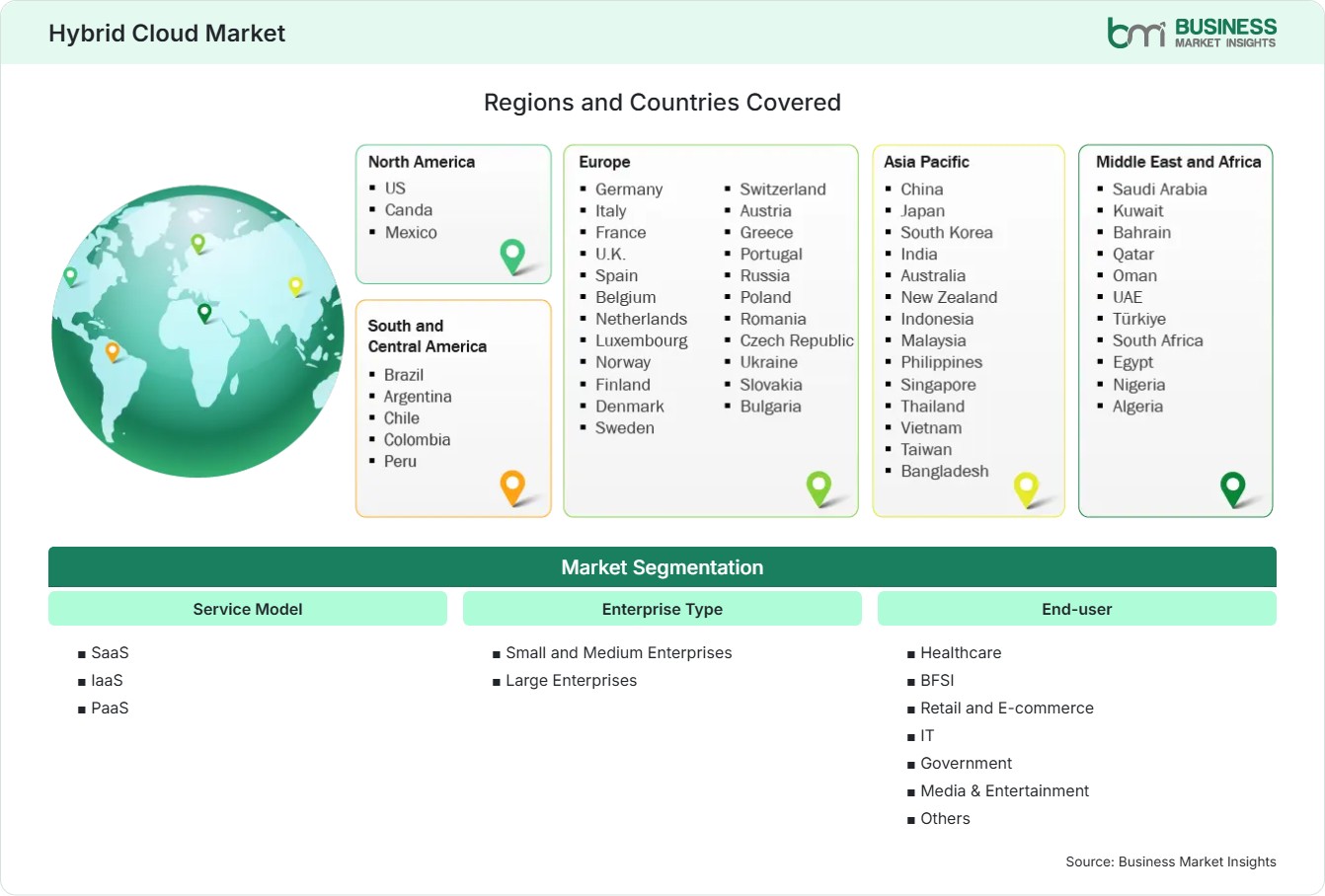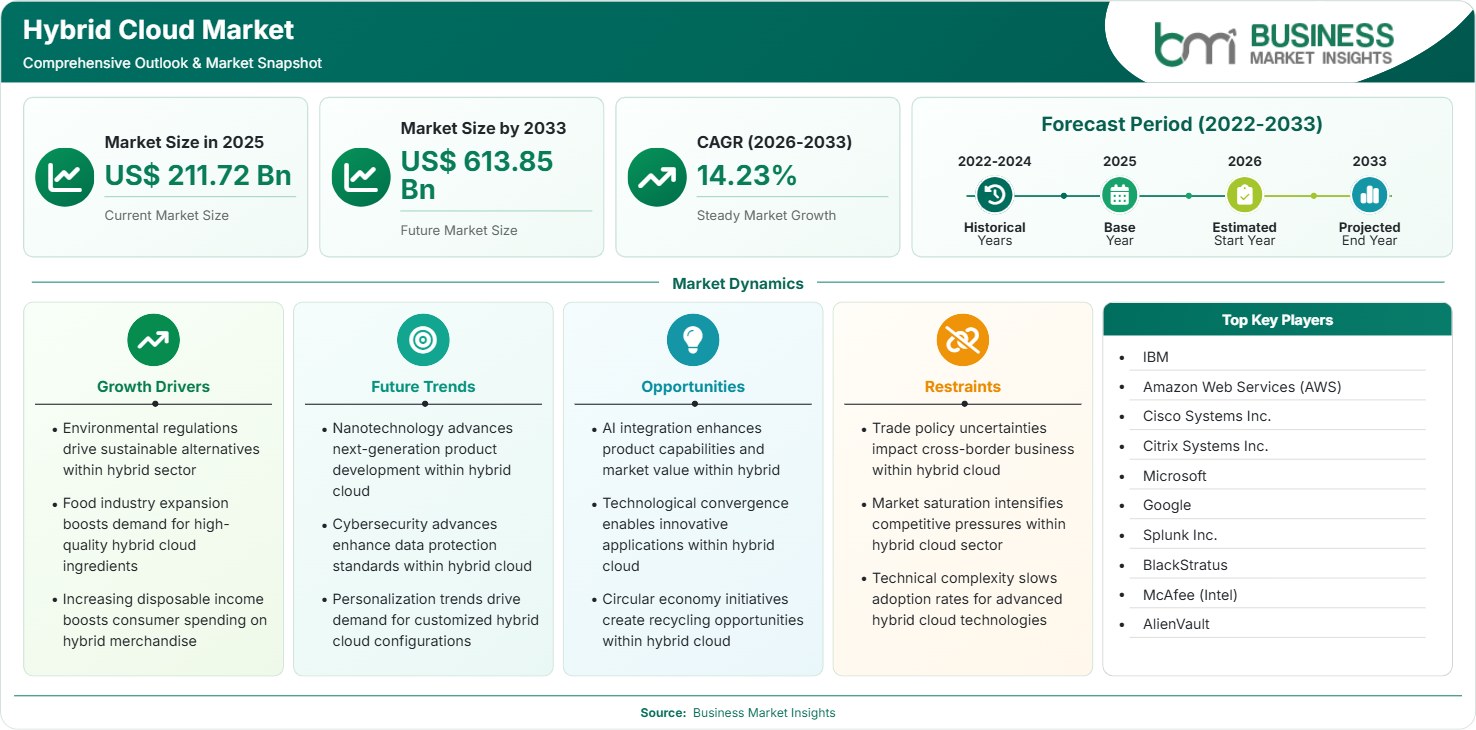
Hybrid Cloud Market Regional Highlights
North America Hybrid Cloud Market
North America accounts for 38%–41% of global revenue in 2025 and is projected to expand at a 13.2%–14.0% CAGR during 2026–2033. Enterprise cloud modernization, advanced AI implementation, robust hyperscale infrastructure, and stringent cybersecurity requirements continue supporting regional leadership. Financial services, healthcare, retail, and government organizations increasingly adopt hybrid architectures to balance workload flexibility with compliance. The region benefits from mature digital ecosystems, high enterprise IT spending, widespread multi-cloud adoption, and continuous innovation by leading cloud providers. The Hybrid Cloud Market share remains highest within this region due to sustained technology investments.
- Enterprises increasingly implement hybrid infrastructure to integrate legacy systems with cloud-native applications, improving operational resilience, reducing latency, and supporting AI-enabled business processes while complying with evolving cybersecurity regulations and industry standards.
- Financial institutions continue migrating mission-critical workloads to hybrid environments, leveraging advanced encryption, disaster recovery capabilities, intelligent automation, and regulatory compliance frameworks to enhance operational efficiency and customer experience across digital banking platforms.
- Healthcare providers accelerate hybrid deployments for electronic health records, telemedicine platforms, AI-assisted diagnostics, and secure patient data management, supported by stronger interoperability standards and expanding investments in digital healthcare infrastructure.
- Government agencies prioritize sovereign cloud initiatives, secure digital services, and resilient infrastructure modernization programs, creating sustained demand for hybrid deployments capable of balancing national security, compliance requirements, and operational scalability.
- Hyperscale cloud providers continue expanding regional data center capacity while strengthening edge computing capabilities, enabling enterprises to optimize application performance, reduce network latency, and improve workload distribution across hybrid environments.
US Hybrid Cloud Market
The United States represents approximately 82%–85% of the North American Hybrid Cloud Market in 2025 and is expected to register a 13.5%–14.2% CAGR through 2026–2033. Large-scale enterprise digital transformation, widespread AI deployment, expanding hyperscale investments, and increasing cybersecurity spending continue supporting market expansion. Strong innovation ecosystems, cloud software development, federal digital modernization initiatives, and enterprise demand for scalable computing infrastructure reinforce the country's leadership across global cloud technologies.
- Fortune 500 organizations increasingly implement AI-enabled hybrid cloud environments to optimize application performance, automate infrastructure management, improve operational resilience, and accelerate enterprise-wide digital transformation initiatives across multiple business functions.
- Federal agencies continue investing in secure cloud modernization through zero-trust architectures, workload portability, and advanced cybersecurity frameworks, strengthening adoption across defense, public administration, and critical national infrastructure.
- Healthcare organizations expand hybrid infrastructure supporting genomic research, medical imaging, telehealth, and real-time analytics while maintaining strict patient privacy requirements and regulatory compliance across distributed healthcare networks.
- Technology companies continue investing in cloud-native software platforms, container orchestration, developer ecosystems, and AI services, reinforcing the country's position as a global innovation hub for enterprise cloud infrastructure.
Europe Hybrid Cloud Market
Europe captures 26%–29% of global Hybrid Cloud Market revenue in 2025 while expanding at a 13.4%–14.3% CAGR during 2026–2033. Regional growth is supported by strong data protection regulations, increasing enterprise digital transformation, sustainability initiatives, and rising investments in sovereign cloud infrastructure. Germany leads regional adoption through advanced manufacturing digitalization, while the United Kingdom demonstrates the fastest expansion with a 14.5%–15.2% CAGR, supported by financial services modernization and expanding cloud technology investments.
- European enterprises increasingly prioritize sovereign cloud strategies to ensure compliance with regional data governance regulations while maintaining operational flexibility through integrated public and private cloud deployments.
- Manufacturing companies accelerate Industry 4.0 initiatives using hybrid infrastructure for predictive maintenance, industrial automation, AI-driven quality management, and secure operational technology integration across production facilities.
- Financial institutions continue investing in resilient cloud architectures supporting digital banking, fraud detection, customer analytics, and regulatory reporting while maintaining stringent compliance with European security requirements.
- Sustainability objectives encourage operators to deploy energy-efficient cloud infrastructure, renewable-powered data centers, and intelligent workload optimization technologies, reducing operational costs while supporting environmental commitments.
- Healthcare organizations increasingly deploy secure hybrid environments supporting medical research, cross-border healthcare collaboration, digital patient records, and AI-enabled clinical decision-making across European healthcare systems.
Asia Pacific Hybrid Cloud Market
Asia Pacific accounts for 25%–28% of global Hybrid Cloud Market revenue in 2025 and is projected to grow at a 16.5%–17.5% CAGR through 2026–2033, making it the fastest-growing regional market. Rapid enterprise digitalization, expanding hyperscale investments, government cloud initiatives, and growing adoption among manufacturing, retail, banking, and telecommunications organizations continue accelerating regional expansion. China maintains regional leadership, while India records the fastest country-level growth with an estimated 18.0%–19.0% CAGR, supported by digital economy initiatives and expanding enterprise cloud adoption.
- Rapid growth in digital commerce encourages retailers to deploy hybrid cloud platforms supporting omnichannel operations, personalized customer experiences, AI-powered demand forecasting, and scalable transaction processing during seasonal demand fluctuations.
- Governments continue investing in digital public infrastructure, smart city initiatives, cloud-first policies, and national AI strategies, creating substantial opportunities for enterprise hybrid infrastructure deployment across public sectors.
- Manufacturing organizations increasingly implement intelligent factories integrating IoT devices, predictive analytics, robotics, and edge computing through hybrid environments that improve productivity while maintaining secure operational control.
- Telecommunications operators strengthen 5G infrastructure by integrating edge computing and hybrid cloud platforms, enabling lower latency, improved network management, and scalable digital service delivery across connected ecosystems.
- Financial technology companies expand cloud adoption to support digital payments, embedded finance, fraud detection, and customer analytics while maintaining secure, compliant, and highly scalable infrastructure.
Rest of World Hybrid Cloud Market
The Rest of World region accounts for 8%–10% of global Hybrid Cloud Market revenue in 2025 and is projected to register a 14.8%–15.6% CAGR through 2026–2033.
South and Central America continue benefiting from expanding enterprise digital transformation, cloud-based financial services, retail modernization, and growing investments in regional data center infrastructure. Brazil remains the largest contributor, while Mexico demonstrates the strongest growth momentum through increasing enterprise technology adoption.
The Middle East and Africa experience accelerating demand as governments promote digital economy strategies, smart city programs, and public cloud investments. Saudi Arabia leads regional investment, while the United Arab Emirates records the fastest expansion with an estimated 16.0%–16.8% CAGR, supported by AI initiatives, hyperscale infrastructure development, and enterprise cloud modernization.
- Banking institutions increasingly modernize legacy infrastructure using hybrid deployments that improve customer experience, strengthen cybersecurity, support digital payment ecosystems, and enhance business continuity across rapidly evolving financial markets.
- Energy companies deploy hybrid cloud solutions supporting asset monitoring, predictive maintenance, remote operations, and industrial analytics while improving operational efficiency across geographically distributed facilities.
- Government digital transformation initiatives continue stimulating demand for secure cloud infrastructure supporting citizen services, education platforms, healthcare systems, and public administration modernization throughout developing economies.
- Telecommunications providers strengthen regional digital infrastructure by expanding data center capacity, edge computing capabilities, and cloud connectivity services, supporting enterprise modernization and broader digital inclusion initiatives.
- International cloud vendors increasingly establish regional partnerships with technology providers and system integrators, accelerating knowledge transfer, localized cloud services, workforce development, and long-term enterprise cloud adoption across emerging economies.