
Cloud ERP Market Outlook: Size, Share, Trends, Growth Analysis, Competitive Landscape & Forecast, 2026-2033

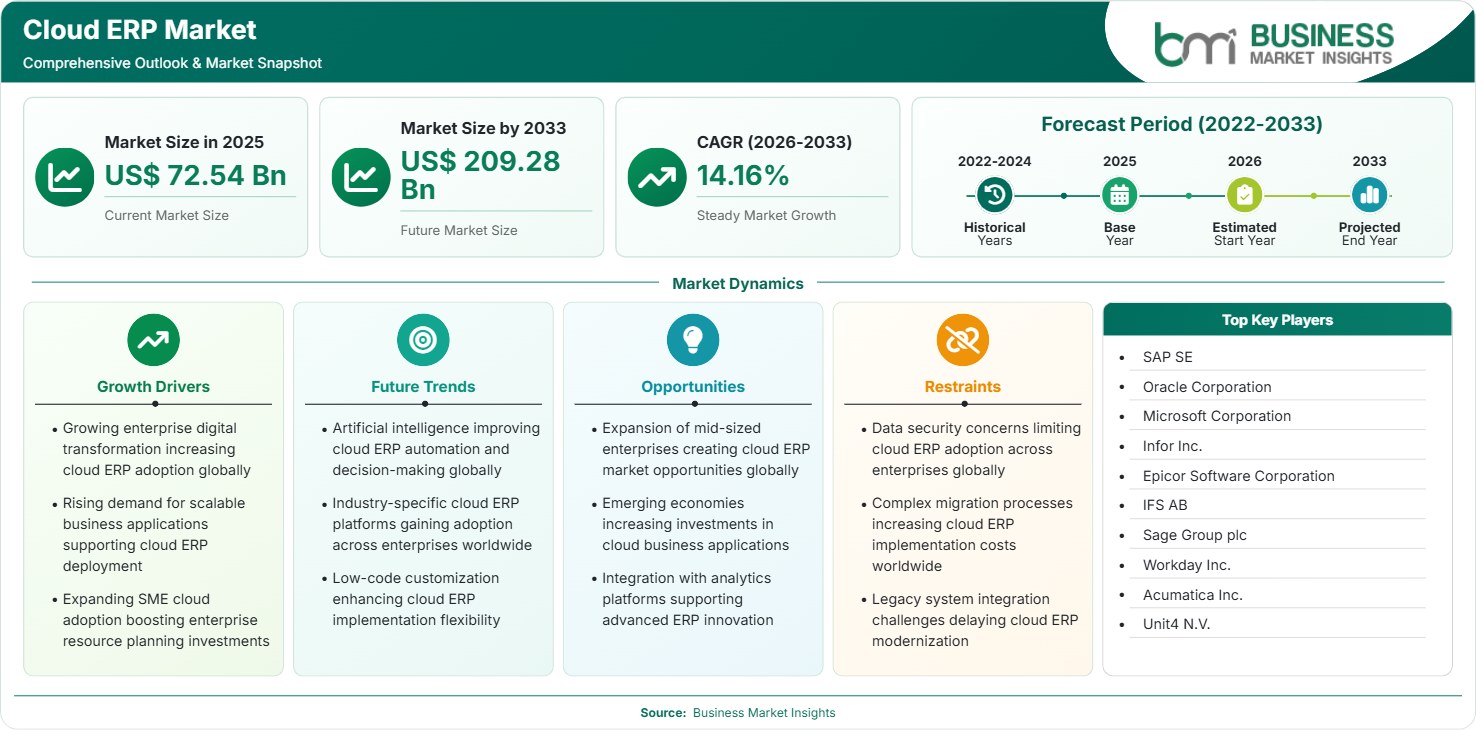
The Cloud ERP Market size was valued at US$ 72.54 billion in 2025 and is projected to reach US$ 209.28 billion by 2033, growing at a CAGR of 14.16% during 2026–2033, driven by enterprise digitization, scalable cloud applications, SME adoption, analytics integration, and business process automation.

Report Coverage
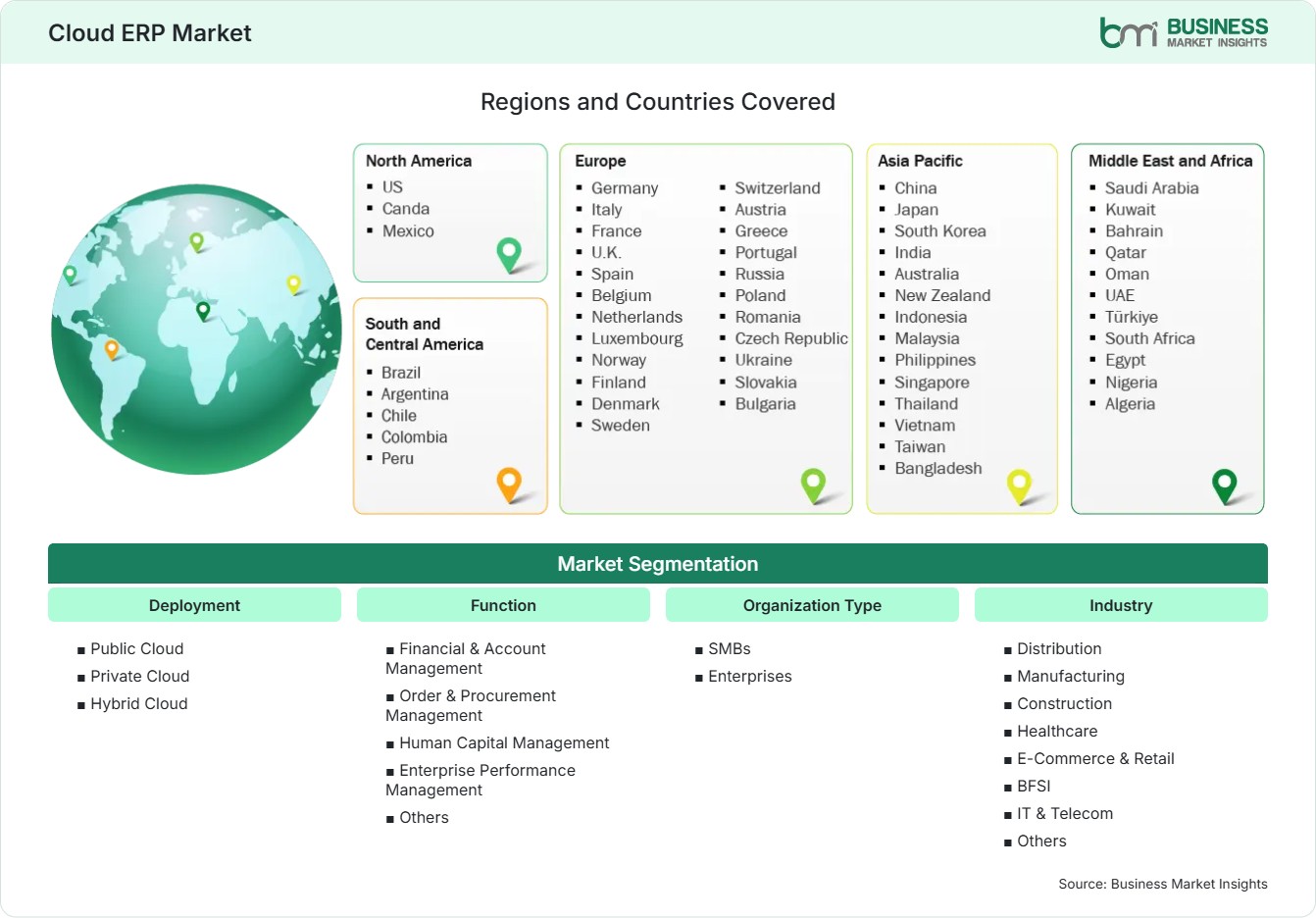
  • Deployment: Public Cloud, Private Cloud, and Hybrid Cloud
  • Function: Financial & Account Management, Order & Procurement Management, Human Capital Management, Enterprise Performance Management, Others
  • Organization Type: SMBs, Enterprises
  • Industry: Distribution, Manufacturing, Construction, Healthcare, E-Commerce & Retail, BFSI, IT & Telecom, Others
US$ 72.54 Bn Market size in 2025
US$ 209.28 Bn Market Size by 2033
14.16% CAGR, 2026 - 2033
2026-2033 Forecast Period

AI Overview

Cloud ERP Market Summary

  • North America Region: North America holds a 36%–39% share in 2025, expanding at a CAGR of 12%–14% during 2026–2033, supported by enterprise modernization, cloud infrastructure maturity, SaaS adoption, and demand for integrated business management platforms. The US market maintains strong adoption with a CAGR of 12.5%–14.5% during 2026–2033 due to large enterprise cloud investments and advanced digital transformation initiatives.
  • Fastest Growing Region: Asia Pacific captures a 25%–28% share in 2025 and grows at a CAGR of 16%–18% during 2026–2033, driven by expanding SMEs, digital government programs, cloud infrastructure investments, and increasing adoption of cloud-based enterprise applications.
  • Leading Segment: Public Cloud accounts for a 45%–48% share in 2025, growing at a CAGR of 14%–16% during 2026–2033, supported by lower deployment costs, faster implementation cycles, subscription-based models, and increasing enterprise preference for scalable solutions during cloud ERP market forecasts.
  • High Growth Segment: Hybrid Cloud records a CAGR of 16%–18% during 2026–2033 with a 25%–28% share in 2025, driven by enterprise requirements for flexible architectures, regulatory compliance, workload optimization, and integration of legacy systems with cloud platforms.
  • Key Market Opportunity: Increasing adoption among mid-sized enterprises, expansion of digital ecosystems, and integration of artificial intelligence and analytics platforms are creating opportunities for cloud ERP providers globally.
  • Major Market Players: SAP SE, Oracle Corporation, Microsoft Corporation, Infor Inc., Epicor Software Corporation, IFS AB, Sage Group plc, Workday Inc., Acumatica Inc., Unit4 N.V.
Strategic Insights

Cloud ERP Market: Strategic Insights

Cloud ERP Market Strategic Framework
FREE PDF
Request your free sample
Request free sample
Stakeholder View

Key Takeaways

  • The market ecosystem is shifting toward subscription-based enterprise software models involving ERP vendors, cloud infrastructure providers, implementation partners, cybersecurity companies, and analytics specialists.
  • Small and medium-sized businesses represent a major growth opportunity as cloud ERP platforms provide affordable access to financial management, operational control, and automation capabilities without extensive infrastructure investments.
  • Artificial intelligence integration is becoming a key innovation focus, enabling predictive analytics, automated workflows, intelligent reporting, and improved enterprise decision-making capabilities.
  • Asia Pacific provides strong expansion potential due to increasing SME digitalization, government cloud initiatives, and growing investments in enterprise technology infrastructure across emerging economies.
  • Strategic partnerships and acquisitions are increasing as ERP vendors expand capabilities in industry-specific solutions, analytics, automation, and cloud-native technologies.
  • Industry-specific ERP solutions are gaining importance as organizations demand customized platforms aligned with sector requirements, regulatory frameworks, and operational workflows.
Geographic Outlook

Cloud ERP Market Regional Highlights

North America Cloud ERP Market

North America accounted for a 36%–39% share of the Cloud ERP Market in 2025 and is projected to grow at a CAGR of 12%–14% during 2026–2033. The region benefits from mature cloud infrastructure, high enterprise technology spending, and widespread SaaS adoption. The United States remains the largest contributor due to strong demand from large enterprises, financial institutions, healthcare organizations, and technology companies. Increasing focus on automation and data-driven operations is strengthening regional adoption.

  • Enterprises are accelerating cloud migration strategies to improve operational agility, reduce infrastructure costs, and enhance business process integration.
  • Strong presence of global ERP providers supports innovation through advanced platforms, industry solutions, and ecosystem partnerships.
  • Increasing cybersecurity investments are improving enterprise confidence in cloud-based business applications.
  • Demand for analytics-enabled ERP platforms is rising among organizations seeking real-time operational insights.

US Cloud ERP Market

The US represented a 30%–33% share of the North American Cloud ERP Market in 2025 and is expected to expand at a CAGR of 12.5%–14.5% during 2026–2033. Large enterprises continue adopting cloud ERP platforms to improve efficiency, automate processes, and support hybrid workforce models. Strong technology infrastructure, enterprise software investments, and digital transformation initiatives are supporting market expansion across industries including BFSI, healthcare, manufacturing, and retail.

  • Large organizations are modernizing legacy ERP environments through cloud migration programs and integrated enterprise platforms.
  • Artificial intelligence and analytics capabilities are increasing demand for advanced ERP solutions across business functions.
  • Cloud subscription models are encouraging adoption among growing businesses seeking flexible technology investments.
  • Industry-specific ERP platforms are gaining traction among regulated sectors requiring customized solutions.

Europe Cloud ERP Market

Europe held a 27%–30% share of the Cloud ERP Market in 2025 and is projected to grow at a CAGR of 13%–15% during 2026–2033. The region is experiencing increasing demand due to enterprise digital transformation, regulatory compliance requirements, and modernization of business systems. Germany, the United Kingdom, France, and Nordic countries are leading adoption, while Eastern European markets are witnessing increasing cloud investments. Data governance and automation requirements are influencing ERP purchasing decisions.

  • European enterprises are adopting cloud ERP solutions to improve compliance, operational efficiency, and cross-border business management.
  • Germany is driving demand through manufacturing digitalization and industrial automation initiatives.
  • The United Kingdom is expanding cloud ERP adoption across financial services, retail, and professional services sectors.
  • France is increasing investments in enterprise software modernization and cloud infrastructure development.
  • Nordic countries are adopting advanced ERP platforms due to strong digital maturity and sustainability-focused business strategies.

Asia Pacific Cloud ERP Market

Asia Pacific accounted for a 25%–28% share of the Cloud ERP Market in 2025 and is anticipated to register a CAGR of 16%–18% during 2026–2033. The region is witnessing rapid adoption due to expanding digital economies, increasing SME technology investments, cloud infrastructure development, and government-led digital transformation initiatives. China, India, Japan, South Korea, and Southeast Asian countries are key contributors. Businesses are adopting cloud ERP platforms to improve scalability, operational visibility, and process automation.

  • China is expanding cloud ERP deployment through enterprise digitalization initiatives, manufacturing transformation programs, and increasing adoption of intelligent business platforms.
  • India is witnessing strong demand from SMEs due to affordable SaaS models, expanding cloud infrastructure, and increasing business automation requirements.
  • Japan and South Korea are adopting cloud ERP solutions to modernize enterprise operations and integrate advanced analytics capabilities.
  • Southeast Asian economies are creating opportunities through digital transformation programs, startup growth, and increasing enterprise software investments.
  • Growing availability of regional cloud service providers is improving accessibility for businesses across developing markets.

Rest of World Cloud ERP Market

Rest of World accounted for a 6%–9% share of the Cloud ERP Market in 2025 and is expected to expand at a CAGR of 11%–13% during 2026–2033. Latin America, the Middle East, and Africa are gradually adopting cloud ERP platforms as organizations focus on operational efficiency, digital modernization, and improved enterprise management capabilities. Increasing cloud infrastructure investments and business application adoption are supporting market development across emerging economies.

  • Brazil and Mexico are increasing cloud ERP adoption through enterprise modernization, digital business initiatives, and growing technology investments.
  • Middle Eastern countries are implementing cloud-based enterprise platforms as part of economic diversification and digital transformation strategies.
  • Gulf nations are adopting advanced ERP solutions to support large-scale infrastructure, construction, and service sector operations.
  • African markets are gradually adopting cloud ERP due to improved connectivity, expanding SMEs, and technology-driven business growth.
  • Growing partnerships between global ERP providers and regional technology companies are improving implementation capabilities.
Global Market Geography
FREE PDF
Request your free sample
Request free sample
Segment Analysis

Cloud ERP Market Segmentation

Deployment

Deployment segmentation reflects enterprise preferences for flexible, scalable, and secure ERP architectures. Public Cloud represented a leading segment with a 45%–48% share in 2025 and is projected to grow at a CAGR of 14%–16% during 2026–2033. Organizations are increasingly adopting cloud-first strategies to reduce infrastructure costs and improve operational flexibility. Cloud ERP Market scope is expanding as businesses prioritize subscription-based platforms and faster deployment models.

  • Public Cloud: Public cloud deployment enables organizations to access scalable ERP platforms with lower infrastructure requirements, faster implementation, and continuous software updates.
  • Private Cloud: Private cloud solutions support enterprises requiring enhanced control, customization, security, and compliance capabilities for specialized business operations.
  • Hybrid Cloud: Hybrid cloud deployment combines private and public environments, allowing organizations to balance flexibility, security requirements, and legacy system integration.

Function

Function segmentation highlights increasing demand for integrated business processes across finance, procurement, workforce management, and performance monitoring. Financial & Account Management represented a major adoption area due to enterprise requirements for accurate reporting and automated financial operations. The segment landscape is influenced by automation, analytics integration, and demand for centralized business management. Cloud ERP Market trends indicate growing preference for comprehensive platforms supporting multiple operational functions.

  • Financial & Account Management: Financial management modules improve accounting automation, reporting accuracy, compliance management, and real-time visibility into organizational performance.
  • Order & Procurement Management: Order and procurement solutions streamline purchasing workflows, supplier management, inventory coordination, and supply chain efficiency.
  • Human Capital Management: Human capital management platforms support workforce planning, employee management, payroll automation, and talent optimization processes.
  • Enterprises Performance Management: Enterprise performance management tools enable strategic planning, budgeting, forecasting, and performance analysis through integrated data systems.
  • Others: Additional functions include project management, customer relationship support, and specialized enterprise workflows across different industries.

Organization Type

Organization type segmentation demonstrates growing adoption among both small businesses and large enterprises. Enterprises accounted for a larger share in 2025 due to complex operational requirements, while SMB adoption is expanding rapidly through affordable cloud subscription models. The Cloud ERP Market scope is increasing as providers develop flexible solutions tailored for different organizational sizes. Digital transformation initiatives are encouraging businesses to modernize legacy systems and improve operational efficiency.

  • SMBs: SMBs are adopting cloud ERP solutions due to lower implementation costs, simplified deployment models, and access to enterprise-grade business management capabilities.
  • Enterprises: Enterprises utilize cloud ERP platforms to manage complex operations, integrate global workflows, improve analytics, and support large-scale digital transformation strategies.

Industry

Industry segmentation reflects broad adoption across sectors requiring integrated business applications and operational visibility. Manufacturing, BFSI, healthcare, retail, and IT services are major adopters due to complex workflows and increasing automation requirements. Industry-specific ERP solutions are gaining momentum as organizations seek customized capabilities. Cloud ERP Market growth demonstrates increasing demand for platforms supporting compliance, analytics, and real-time decision-making.

  • Distribution: Distribution companies adopt cloud ERP to optimize inventory management, logistics coordination, procurement processes, and customer fulfillment operations.
  • Manufacturing: Manufacturers implement ERP platforms to improve production planning, supply chain visibility, quality management, and operational efficiency.
  • Construction: Construction organizations use cloud ERP solutions for project management, resource planning, financial control, and workforce coordination.
  • Healthcare: Healthcare providers adopt ERP systems to manage financial operations, resource allocation, compliance, and administrative processes.
  • E-Commerce & Retail: Retail organizations utilize cloud ERP for inventory optimization, order management, customer operations, and omnichannel business coordination.
  • BFSI: Banking and financial institutions adopt ERP solutions to improve financial reporting, compliance management, and operational automation.
  • IT & Telecom: IT and telecom companies implement cloud ERP platforms for resource management, service operations, and business process optimization.
  • Others: Other industries adopt cloud ERP solutions to improve operational efficiency, automation, and centralized enterprise management.
Market Forces

Cloud ERP Market Dynamics

Key Market Drivers

Growing enterprise digital transformation increasing cloud ERP adoption globally

The rise in enterprise digital transformation due to the adoption of cloud ERP worldwide is fueling the need for contemporary enterprise management platforms where businesses upgrade from traditional software to flexible cloud-based software. Various enterprises in the manufacturing sector, BFSI, healthcare industry, retail, and IT industries are making their moves to automate their workspaces, achieve visibility in real time and integrated workflow. The rise in cloud ERP is driven by more adoption of SaaS approach, remote working, and analytical abilities. The cloud ERP trends point towards intelligent platforms with AI, machine learning, and predictions.

Rising demand for scalable business applications supporting cloud ERP deployment

An increasing need for scalable business applications required for the deployment of cloud ERP systems is increasing the use of such systems by organizations looking for flexible solutions which will grow according to their operational needs. There is a need for business solutions that will be able to handle growing numbers of transactions, different sites, and changes in workflow without requiring large-scale investments in the infrastructure. Cloud ERP systems offer their clients subscription services, regular updates, and enhanced integration options as compared to legacy systems. Increasing need for agility is driving companies to adopt systems that automate, analyze data, and encourage collaboration.

Expanding SME cloud adoption boosting enterprise resource planning investments

The growing SME adoption of cloud services to invest in ERP systems is fueling the need for affordable ERP solutions. SMEs are gradually switching to cloud technologies because of low initial costs, easy installation, and limited dependence on company IT support. Companies are now able to enjoy premium functionalities through a subscription-based pricing model. ERP vendors are designing software that meets the needs of SMEs, such as quick deployment and easy-to-use interfaces. Growing digital knowledge at SMEs is also driving ERP investment efforts.

Key Market Opportunities

Expansion of mid-sized enterprises creating cloud ERP market opportunities globally

Expansion of mid-sized enterprises creating cloud ERP market opportunities globally is generating significant growth potential as businesses require scalable platforms to support expansion. Mid-sized companies are increasingly adopting cloud ERP solutions to improve financial control, automate processes, and enhance operational efficiency without large technology investments. The availability of industry-specific cloud platforms is helping businesses address sector requirements while maintaining flexibility. Providers are focusing on simplified implementation models, integration capabilities, and affordable subscription structures to attract this customer segment.

Emerging economies increasing investments in cloud business applications

Emerging economies increasing investments in cloud business applications are creating expansion opportunities as businesses modernize operations through digital technologies. Developing markets are improving cloud infrastructure, increasing internet accessibility, and supporting enterprise technology adoption through digital transformation programs. Organizations in Asia Pacific, Latin America, and Middle East regions are adopting cloud ERP platforms to enhance productivity, streamline processes, and compete in global markets. Technology providers are expanding regional partnerships and localized solutions to address market-specific requirements. These developments are creating opportunities for ERP vendors to capture demand from growing businesses seeking efficient enterprise management solutions.

Integration with analytics platforms supporting advanced ERP innovation

Integration with analytics platforms supporting advanced ERP innovation is creating opportunities for enhanced business intelligence, predictive insights, and automated decision-making. Organizations are increasingly connecting ERP systems with analytics tools to analyze operational data, identify trends, and improve strategic planning. Artificial intelligence and machine learning capabilities are transforming ERP platforms by enabling forecasting, anomaly detection, and workflow automation. Vendors are investing in integrated ecosystems that combine ERP, analytics, and cloud infrastructure to deliver improved business outcomes.

Market Restraints and Challenges

Data security concerns limiting cloud ERP adoption across enterprises globally

Factor: Data security concerns remain a major challenge as organizations manage sensitive financial, operational, and customer information through cloud-based ERP platforms. Impact: Security issues may affect adoption, especially for sectors where compliance is required and data are managed under regulatory controls. Companies need to analyze security features like cyber security, access control, encryption levels, and compliance before migrating critical applications. The growing threat of cyber-attacks and third-party data management issues necessitate consistent security investments.

Complex migration processes increasing cloud ERP implementation costs worldwide

Factor: Complex migration processes create challenges due to difficulties associated with legacy system integration, data transfer, customization, and employee training. Impact: Implementation complexities may lead to delays in project timelines, additional cost implications, and also delay the benefits that are anticipated from the implementation. Enterprises having custom-designed ERP systems face challenges when migrating into the cloud. The organizations have to handle the disruptions within the operations and at the same time ensure accurate and continuous operations. Service providers are handling these challenges using migration tools, consultation services, and phased implementation processes.

Company Analysis

Competitive Landscape

The Cloud ERP Market analysis highlights a competitive environment driven by global enterprise software providers offering scalable platforms, industry-specific solutions, analytics capabilities, and cloud-native architectures. Leading companies are focusing on artificial intelligence integration, automation, cybersecurity enhancement, and ecosystem expansion to strengthen their market position. Vendors are increasingly developing flexible ERP platforms that support enterprises of different sizes while improving operational efficiency and digital transformation outcomes.

Company Name

Overview

Products and Services relevant to this market

SAP SE

SAP SE is a global enterprise software provider delivering cloud-based business management solutions for organizations worldwide.

Provides SAP S/4HANA Cloud, ERP applications, financial management, supply chain solutions, and intelligent enterprise platforms.

Oracle Corporation

Oracle Corporation develops enterprise cloud technologies supporting business operations, automation, analytics, and application management.

Offers Oracle Fusion Cloud ERP, financial applications, procurement solutions, project management, and enterprise analytics capabilities.

Microsoft Corporation

Microsoft Corporation provides cloud computing and enterprise software solutions supporting digital transformation across industries.

Delivers Microsoft Dynamics 365 ERP solutions, business applications, analytics integration, and cloud-based enterprise management tools.

Infor Inc.

Infor Inc. specializes in industry-specific enterprise software solutions designed for operational efficiency and business automation.

Provides cloud ERP platforms, industry applications, supply chain management, financial solutions, and analytics tools.

Epicor Software Corporation

Epicor Software Corporation develops ERP solutions focused on manufacturing, distribution, retail, and service industries.

Offers Epicor cloud ERP platforms, manufacturing management, financial applications, supply chain, and business intelligence solutions.

IFS AB

IFS AB provides cloud enterprise software supporting asset-intensive industries and service-oriented organizations.

Delivers IFS Cloud ERP, enterprise asset management, project management, manufacturing, and service management solutions.

Sage Group plc

Sage Group plc develops business management software serving small and medium-sized organizations globally.

Provides Sage cloud accounting, financial management, enterprise resource planning, payroll, and business automation solutions.

Workday Inc.

Workday Inc. delivers cloud enterprise applications focused on finance, human resources, and organizational management.

Offers Workday Financial Management, Human Capital Management, planning solutions, and enterprise analytics platforms.

Acumatica Inc.

Acumatica Inc. provides cloud ERP solutions designed for growing businesses requiring flexible business applications.

Supplies Acumatica Cloud ERP, financial management, distribution management, manufacturing, and customer relationship solutions.

Unit4 N.V.

Unit4 N.V. develops enterprise cloud software focused on service organizations, education, and public sector operations.

Provides Unit4 ERP, financial management, human capital solutions, project management, and cloud business applications.

Trust & Transparency

Research Methodology

The market analysis combines proprietary research with secondary data from government agencies, company disclosures, regulatory filings, industry databases and expert interviews. Market estimates are validated through data triangulation, cross-market benchmarking and analyst review.

View Full Research Methodology

Questions Answered

Frequently Asked Questions

What is the future outlook for the Cloud ERP Market Report?

The future outlook is shaped by increasing enterprise digitization, analytics integration, industry-specific platforms, cybersecurity improvements, and expanding adoption across emerging economies seeking efficient business management solutions.

How is artificial intelligence influencing cloud ERP development?

Artificial intelligence is improving cloud ERP through predictive analytics, automated workflows, intelligent forecasting, anomaly detection, and enhanced decision-support capabilities that help businesses optimize operations.

Why are SMEs increasingly investing in cloud ERP platforms?

SMEs are adopting cloud ERP due to affordable subscription models, lower infrastructure requirements, simplified implementation, and access to advanced enterprise capabilities without significant technology investments.

How does cloud ERP differ from traditional ERP systems?

Cloud ERP systems operate through cloud infrastructure, enabling faster deployment, automatic updates, scalability, and reduced hardware requirements. Traditional ERP systems typically require greater internal infrastructure management and customization efforts.

What industries are adopting cloud ERP solutions most actively?

Manufacturing, BFSI, healthcare, retail, distribution, construction, and IT sectors are major adopters due to their need for integrated business processes, automation, financial visibility, and improved operational control.

Access the Full Cloud ERP Market Report

Get segment-level forecasts, regional estimates, competitive benchmarking, company profiles and downloadable Excel datasets.

Access the full Cloud ERP Market Report
350 pages PDF & Excel | 2026-08-31
Similar Research

Related Market Reports