
Commerce Cloud Market Outlook: Size, Share, Trends, Growth Analysis, Competitive Landscape & Forecast, 2026-2033

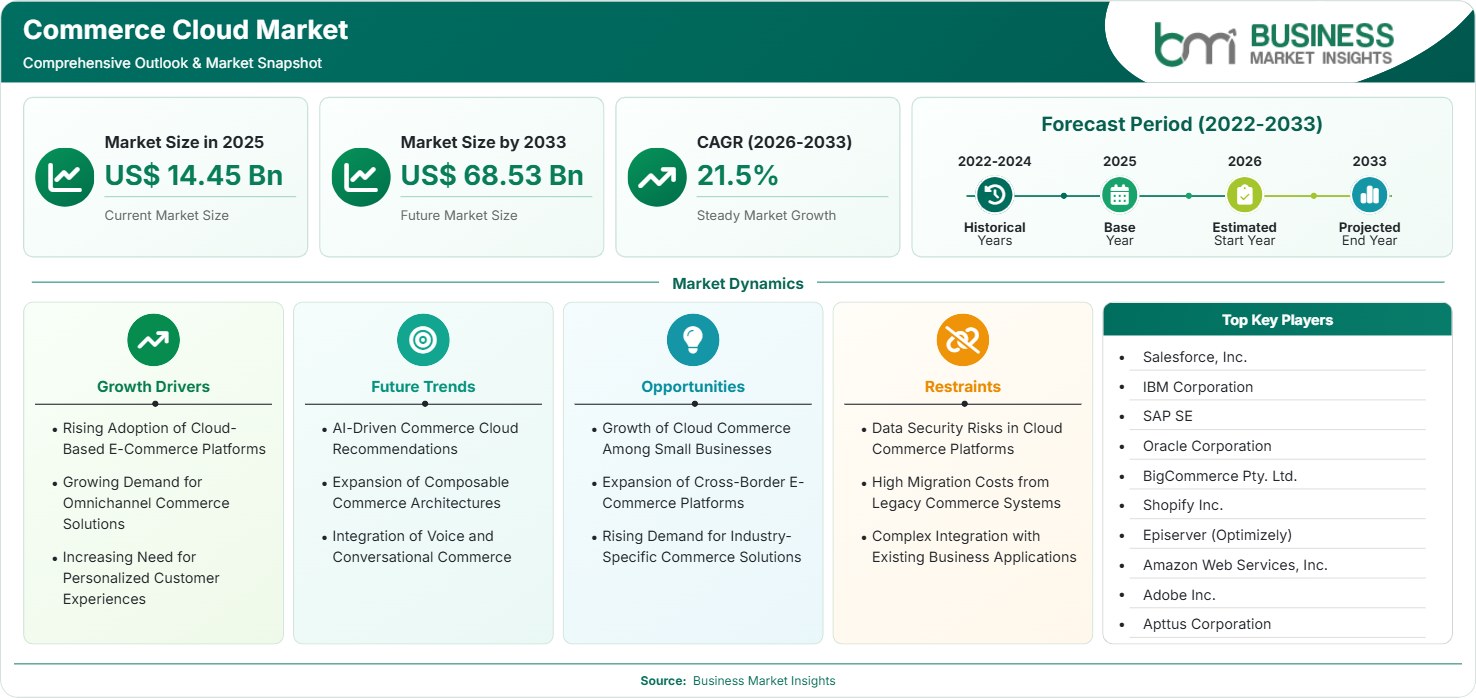
The Commerce Cloud Market size was valued at US$ 14.45 Billion in 2025 and is projected to reach US$ 68.53 Billion by 2033, growing at a CAGR of 21.5% during 2026–2033. Increasing adoption of cloud-based commerce platforms, growing digital retail transformation, and rising demand for scalable omnichannel selling solutions are driving market growth. Businesses are increasingly adopting commerce cloud platforms to improve customer experience, automate operations, and enable personalized shopping experiences.

Report Coverage
  • Component: Platform, Services
  • Enterprise Size: SMEs, Large Enterprises
  • Application: Grocery and Pharmaceuticals, Fashion and Apparel, Travel and Hospitality, Electronics, Furniture and Bookstore, Others
  • End-use: B2B, B2C
US$ 14.45 Bn Market size in 2025
US$ 68.53 Bn Market Size by 2033
21.5% CAGR, 2026 - 2033
2026-2033 Forecast Period

01 AI Overview

Commerce Cloud Market Summary

  • North America Region: North America holds a market share of 36%–39% in 2025 and is projected to grow at a CAGR of 20.8%–21.3% during 2026–2033. Strong presence of technology providers, advanced e-commerce infrastructure, and high enterprise adoption of cloud platforms support regional growth. The US remains the largest regional market, expanding at a CAGR of 21.0%–21.5%.
  • Fastest Growing Region: Asia Pacific accounts for 27%–30% of the market in 2025 and is expected to register the fastest CAGR of 22.5%–23.2% during the forecast period. Increasing digital commerce adoption, expanding online retail ecosystems, and growing SME adoption of cloud solutions are accelerating regional growth.
  • Leading Segment: Enterprise Size – Large Enterprises account for 62%–65% of the commerce cloud market in 2025 and are projected to grow at a CAGR of 20.8%–21.4%. Large businesses continue adopting commerce cloud platforms to manage complex operations, multiple sales channels, and global customer interactions.
  • High Growth Segment: Component – Services accounts for 34%–37% of the market in 2025 while registering a CAGR of 22.5%–23.0%. Growing demand for implementation, integration, consulting, and managed services is accelerating segment growth.
  • Key Market Opportunity: Increasing adoption of artificial intelligence-based commerce solutions, social commerce platforms, and personalized customer engagement technologies is creating significant opportunities.
  • Major Market Players: Salesforce, Inc., IBM Corporation, SAP SE, Oracle Corporation, BigCommerce Pty. Ltd., Shopify Inc., Episerver, Amazon Web Services, Inc., Adobe Inc., and Apttus Corporation.
02 Strategic Insights

Commerce Cloud Market: Strategic Insights

Commerce Cloud Market Strategic Framework
FREE PDF
Request your free sample
Request free sample
03 Stakeholder View

Key Takeaways

  • The commerce cloud market ecosystem includes cloud platform providers, software companies, system integrators, e-commerce solution providers, and digital transformation service companies.
  • Large enterprises represent the largest opportunity due to increasing demand for enterprise-grade commerce platforms supporting global operations.
  • Services are gaining importance as organizations require customization, integration, migration support, and ongoing platform management.
  • Asia Pacific offers significant growth opportunities due to expanding e-commerce markets, increasing internet penetration, and rising SME digital adoption.
  • Integration of artificial intelligence, machine learning, automation, and analytics is becoming a major focus area among commerce cloud providers.
  • Omnichannel commerce, personalized customer experiences, and cloud-native retail solutions are expected to shape future market growth.
04 Geographic Outlook

Commerce Cloud Market Regional Highlights

North America Commerce Cloud Market

North America accounts for 36%–39% of the global market in 2025 and is projected to grow at a CAGR of 20.8%–21.3% during 2026–2033. The Commerce Cloud Market share is supported by strong digital commerce adoption, the presence of leading cloud technology providers, and high enterprise investments in customer experience platforms. Businesses across retail, healthcare, travel, and financial services are increasingly adopting cloud commerce solutions to improve operational efficiency and omnichannel engagement.

  • The United States continues leading regional adoption due to strong e-commerce infrastructure and widespread adoption of enterprise cloud platforms.
  • Enterprises are increasingly integrating artificial intelligence, analytics, and automation capabilities into commerce platforms to deliver personalized customer experiences.
  • Retailers are investing in omnichannel commerce solutions to connect online, mobile, and physical shopping experiences.
  • Cloud migration initiatives among large organizations continue increasing demand for scalable commerce platforms.
  • Strong presence of technology providers supports continuous innovation in commerce cloud capabilities.

US Commerce Cloud Market

The United States represents 31%–34% of the global market in 2025 and is expected to register a CAGR of 21.0%–21.5% through 2033. Strong digital retail growth, enterprise cloud adoption, and increasing demand for personalized customer engagement solutions continue supporting market expansion.

  • Large retailers and enterprises are increasingly adopting cloud commerce platforms to manage complex sales channels and customer interactions.
  • Businesses are integrating AI-driven recommendations, automation tools, and customer analytics into commerce ecosystems.
  • Growing adoption of subscription-based commerce models is creating demand for flexible cloud platforms.
  • Expansion of direct-to-consumer business models is encouraging companies to invest in scalable digital commerce infrastructure.

Europe Commerce Cloud Market

Europe holds 25%–28% of the global market in 2025 and is projected to grow at a CAGR of 20.5%–21.0% during the forecast period. Increasing digital transformation initiatives, strong retail ecosystems, and growing adoption of cloud-based business models support regional growth. The United Kingdom leads the regional market, while Germany records strong growth due to enterprise digitalization.

  • The United Kingdom maintains regional leadership through advanced e-commerce adoption and strong online retail infrastructure.
  • Germany is witnessing increasing adoption of commerce cloud platforms among manufacturers, retailers, and B2B organizations.
  • European businesses are investing in personalized digital experiences to improve customer engagement and retention.
  • Increasing demand for secure and compliant cloud commerce solutions is supporting adoption among regulated industries.
  • Cross-border e-commerce growth continues encouraging businesses to adopt scalable commerce platforms.

Asia Pacific Commerce Cloud Market

Asia Pacific accounts for 27%–30% of the global commerce cloud market in 2025 and is projected to register the fastest CAGR of 22.5%–23.2% during 2026–2033. Expanding e-commerce markets, increasing smartphone adoption, and growing SME digitalization continue driving regional growth. China dominates the regional market, while India records the fastest growth due to rapid digital commerce expansion.

  • China continues leading regional adoption through large-scale e-commerce ecosystems and technology investments.
  • India records strong growth due to increasing online retail adoption, digital payment expansion, and SME cloud migration.
  • Southeast Asian countries are witnessing increasing demand for cloud commerce platforms due to growing digital consumer markets.
  • Japan and South Korea continue investing in advanced commerce technologies and personalized customer engagement platforms.
  • Rising adoption of marketplace models and direct-to-consumer channels is strengthening regional demand.

Rest of World Commerce Cloud Market

The Rest of World accounts for 8%–11% of the global Commerce Cloud Market in 2025 and is projected to grow at a CAGR of 21.5%–22.2% during the forecast period.

South & Central America continues adopting commerce cloud solutions due to increasing online retail activity and digital transformation initiatives. Brazil leads the regional market, while Mexico records strong growth through expanding e-commerce adoption.

The Middle East & Africa continues witnessing increasing demand for digital commerce platforms due to rising internet penetration, growing online shopping adoption, and business modernization initiatives. The United Arab Emirates leads the regional market, while Saudi Arabia records strong growth through digital economy initiatives.

  • Brazil continues expanding cloud commerce adoption through growing online retail and marketplace platforms.
  • Mexico is witnessing increased demand for scalable commerce solutions among retailers and consumer brands.
  • The United Arab Emirates continues investing in digital commerce infrastructure and advanced retail technologies.
  • Saudi Arabia is strengthening adoption through e-commerce growth and broader digital transformation programs.
  • Emerging markets are increasingly adopting commerce cloud platforms to improve customer engagement and expand digital sales channels.
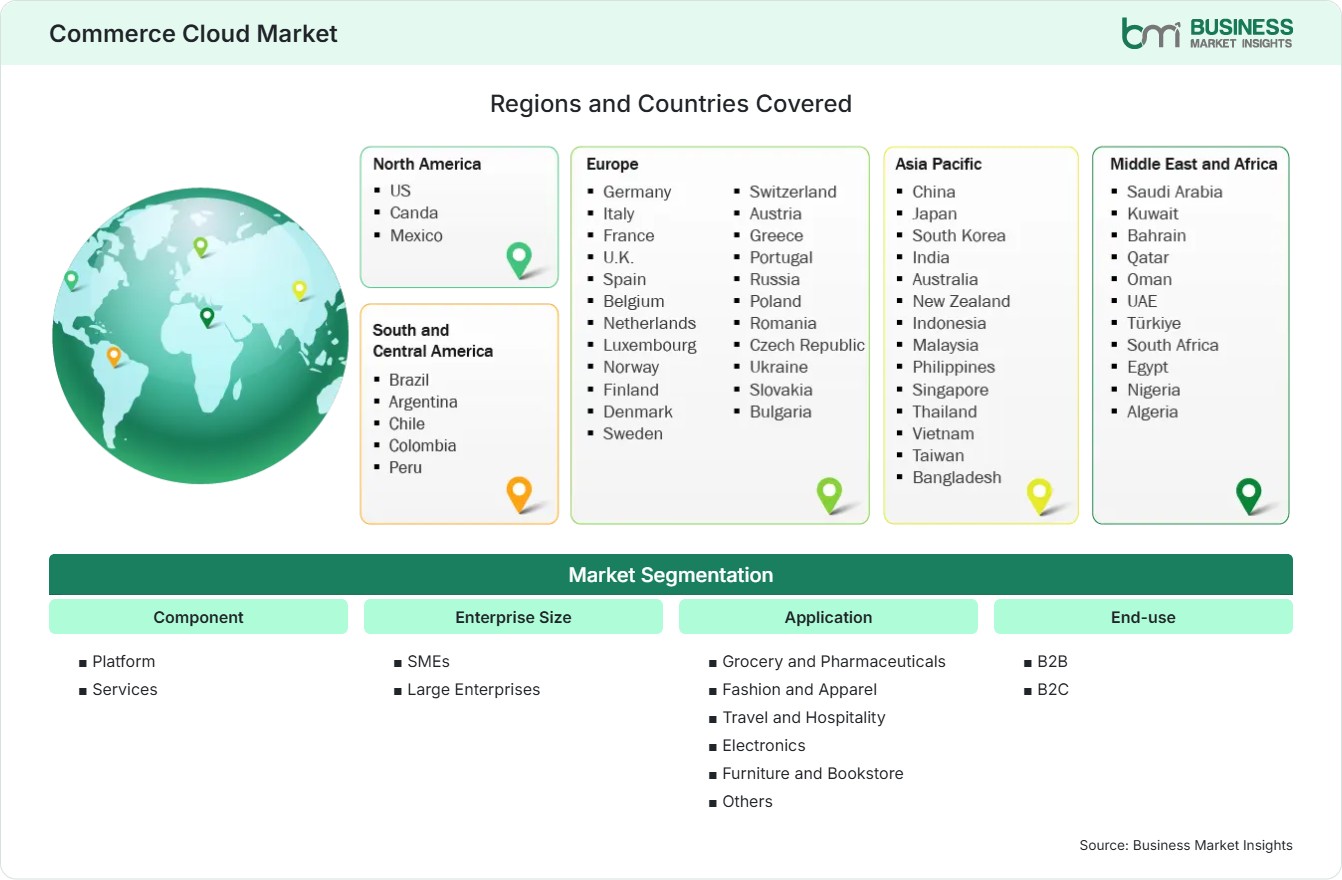
Global Market Geography
FREE PDF
Request your free sample
Request free sample
05 Segment Analysis

Commerce Cloud Market Segmentation

Component

Components define the capabilities of commerce cloud solutions by combining software platforms with supporting implementation and operational services. Platform accounts for 63%–66% of the market in 2025 and is projected to grow at a CAGR of 20.8%–21.3% during 2026–2033. The Commerce Cloud Market scope continues expanding as businesses adopt cloud-native platforms to manage digital storefronts, customer interactions, payments, and sales operations.

  • Platform: Commerce cloud platforms dominate due to increasing adoption of integrated solutions that support product management, order processing, customer engagement, analytics, and omnichannel commerce operations.
  • Services: Services are witnessing strong growth due to rising demand for consulting, implementation, customization, system integration, migration support, and managed services required for successful cloud commerce deployment.

Enterprise Size

Enterprise size influences commerce cloud adoption based on operational complexity, digital maturity, and technology investment capabilities. Large Enterprises account for 62%–65% of the market in 2025 and are projected to grow at a CAGR of 20.8%–21.4% during the forecast period. Increasing digital transformation initiatives continue shaping Commerce Cloud Market trends.

  • SMEs: Small and medium enterprises are increasingly adopting commerce cloud platforms due to lower infrastructure requirements, subscription-based pricing models, and the need to compete through digital channels.
  • Large Enterprises: Large enterprises dominate adoption due to complex commerce operations, global customer bases, multiple sales channels, and demand for scalable platforms supporting extensive digital ecosystems.

Application

Commerce cloud adoption varies across industries based on customer engagement requirements, transaction volumes, and digital transformation priorities. Fashion and Apparel represents a significant market segment due to strong online retail adoption and demand for personalized shopping experiences.

  • Grocery and Pharmaceuticals: Commerce cloud platforms support online ordering, inventory management, customer engagement, and digital fulfillment solutions across grocery and healthcare retail channels.
  • Fashion and Apparel: Fashion brands increasingly utilize commerce cloud solutions for personalized recommendations, flexible storefront management, digital marketplaces, and omnichannel shopping experiences.
  • Travel and Hospitality: Businesses use commerce cloud platforms to manage bookings, customer interactions, loyalty programs, and personalized travel experiences.
  • Electronics: Electronics retailers adopt cloud commerce solutions to manage complex product catalogs, pricing strategies, customer reviews, and online sales channels.
  • Furniture and Bookstore: Commerce cloud platforms support digital catalogs, inventory visibility, online ordering, and customer experience enhancement for furniture and publishing businesses.
  • Others: Other applications include consumer goods, education, automotive, financial services, and industrial commerce operations.

End-use

End-use segmentation reflects the adoption of commerce cloud platforms across business transaction models. B2C accounts for 58%–61% of the market in 2025 due to rapid growth of online retail, direct-to-consumer brands, and personalized digital shopping experiences.

  • B2B: B2B organizations are increasingly adopting commerce cloud platforms to improve digital ordering, automate sales processes, manage partner relationships, and enhance customer self-service capabilities.
  • B2C: B2C adoption dominates due to increasing consumer preference for online shopping, mobile commerce, personalized experiences, and seamless interaction across digital channels.
06 Market Forces

Commerce Cloud Market Dynamics

Key Market Drivers

Rising Adoption of Cloud-Based E-Commerce Platforms

Businesses are increasingly transitioning from traditional on-premise commerce systems to cloud-based e-commerce platforms to improve operational flexibility, scalability, and digital agility. Cloud commerce solutions enable organizations to deploy new features faster, reduce infrastructure management burdens, and streamline online business operations across multiple regions. Retailers, manufacturers, wholesalers, and direct-to-consumer brands are leveraging cloud technologies to support growing online sales and evolving customer expectations. These platforms also offer simplified integration with payment systems, inventory management tools, and customer engagement applications. The Commerce Cloud Market continues to benefit from rising adoption among enterprises seeking cost-effective and scalable solutions that support digital transformation initiatives, accelerate innovation, and enhance overall business performance.

Growing Demand for Omnichannel Commerce Solutions

Customers now expect a seamless experience while shopping on websites, apps, social commerce sites, e-marketplaces, and even physical retail outlets. With the customer journey becoming increasingly complicated, many businesses are using commerce cloud platforms to integrate their operations and offer consistency in terms of their interactions across all sales channels. Such platforms allow businesses to synchronize their inventory, manage orders, monitor customer preferences, and ensure brand consistency throughout the sales cycle. Besides offering omnichannel capabilities to businesses, such platforms make it easier for them to offer additional services, such as in-store pickup and cross-channel return options. The use of such platforms also makes it easier for organizations to understand customer behavior and sales performance.

Increasing Need for Personalized Customer Experiences

Businesses are increasingly investing in advanced commerce cloud capabilities to deliver highly personalized shopping experiences that improve customer engagement and loyalty. Modern commerce platforms leverage artificial intelligence, machine learning, customer data analytics, and behavioral insights to provide personalized product recommendations, targeted promotions, customized content, and dynamic pricing strategies. These capabilities help organizations better understand customer preferences and deliver relevant interactions throughout the purchasing journey. Personalized experiences not only enhance customer satisfaction but also contribute to higher conversion rates and increased revenue opportunities. Furthermore, growing competition in digital commerce is encouraging businesses to differentiate themselves through data-driven customer engagement strategies. As a result, the demand for personalization-focused commerce cloud solutions continues to rise across industries.

Key Market Opportunities

Growth of Cloud Commerce Among Small Businesses

Small and medium-sized enterprises are increasingly adopting cloud commerce platforms to strengthen their digital presence and respond to changing consumer purchasing behaviors. Unlike traditional commerce infrastructure, cloud-based solutions offer simplified deployment, lower upfront investment requirements, automatic software updates, and flexible subscription-based pricing models that are well suited for resource-constrained businesses. These platforms enable SMEs to quickly establish online storefronts, manage inventory, process payments, and engage customers across multiple digital channels without significant IT complexity. In addition, growing internet penetration and rising adoption of digital selling channels are encouraging small businesses to accelerate e-commerce investments. Commerce Cloud Market Forecasts indicate strong growth potential as SMEs continue embracing scalable cloud technologies to enhance operational efficiency, expand customer reach, and support long-term business growth in increasingly competitive digital marketplaces.

Expansion of Cross-Border E-Commerce Platforms

The continued growth of international online commerce is creating substantial opportunities for commerce cloud providers that support global business operations. Companies increasingly seek solutions that enable seamless management of multilingual storefronts, multi-currency pricing, international payment processing, tax compliance, and cross-border order fulfillment. Commerce cloud platforms help businesses simplify the complexities associated with selling products and services across different countries while improving customer experiences through localized content and purchasing options. Rising consumer confidence in online shopping and expanding access to global marketplaces are further driving demand for cross-border commerce capabilities. Additionally, improvements in logistics networks and digital payment technologies are making international transactions more efficient. As global e-commerce activity continues to expand, demand for advanced commerce cloud solutions supporting cross-border operations is expected to increase significantly.

Rising Demand for Industry-Specific Commerce Solutions

Businesses across diverse sectors are increasingly seeking industry-specific commerce platforms tailored to their unique operational requirements, regulatory obligations, and customer engagement needs. Industries such as healthcare, retail, manufacturing, travel, automotive, and business services often require specialized workflows, compliance features, product management capabilities, and customer interaction models that generic commerce platforms may not fully support. Commerce cloud providers are responding by developing customized solutions that address sector-specific challenges while improving operational efficiency and user experience. These platforms often include specialized integrations, automated processes, and industry-focused analytics tools designed to enhance business performance. As organizations place greater emphasis on digital transformation and operational optimization, demand for customized commerce solutions continues to grow, creating new opportunities for cloud commerce providers to deliver differentiated, value-added offerings across multiple industry verticals.

Market Restraints and Challenges

Data Security Risks in Cloud Commerce Platforms

Factor: Commerce cloud platforms store and process sensitive customer information, payment credentials, transaction records, and business data, making them attractive targets for cyberattacks.

Impact: Security concerns can slow cloud commerce adoption among organizations handling confidential information. Businesses often require additional investments in cybersecurity infrastructure, encryption technologies, regulatory compliance, and data protection measures, increasing overall implementation costs and operational complexity.

High Migration Costs from Legacy Commerce Systems

Factor: Migrating from traditional commerce platforms to cloud-based solutions involves significant investments in data migration, application integration, employee training, workflow redesign, and operational adjustments. Organizations with highly customized legacy systems frequently face added technical complexities during the transition process.

Impact: High migration expenses and implementation challenges may delay cloud adoption decisions, particularly among large enterprises with complex IT environments. Extended deployment timelines, potential business disruptions, and integration risks can further increase costs and impact the overall return on investment.

07 Company Analysis

Competitive Landscape

The Commerce Cloud Market analysis is characterized by intense competition among cloud platform providers, enterprise software companies, e-commerce technology providers, and digital transformation solution providers. Companies are focusing on artificial intelligence integration, omnichannel commerce capabilities, personalization tools, cloud scalability, and industry-specific solutions to strengthen their market presence.

Company Name

Overview

Products and Services Relevant to this Market

Salesforce, Inc.

Global cloud software company providing customer relationship management and digital commerce solutions.

Commerce Cloud platform, digital storefront solutions, personalization tools, omnichannel commerce, and customer engagement technologies.

IBM Corporation

Technology company offering cloud computing, artificial intelligence, and enterprise software solutions.

Cloud commerce solutions, AI-powered customer analytics, enterprise integration, automation, and digital transformation services.

SAP SE

Enterprise software provider supporting business operations and digital commerce transformation.

SAP Commerce Cloud, B2B and B2C commerce solutions, customer experience platforms, and enterprise integration tools.

Oracle Corporation

Global technology company providing cloud infrastructure and enterprise applications.

Oracle Commerce solutions, cloud applications, customer experience management, analytics, and enterprise commerce platforms.

BigCommerce Pty. Ltd.

E-commerce platform provider focused on scalable online commerce solutions.

Cloud-based e-commerce platforms, omnichannel selling solutions, marketplace integrations, and digital storefront management.

Shopify Inc.

Commerce platform company supporting businesses in online and omnichannel retail operations.

Cloud commerce platforms, online storefronts, payment solutions, marketplace integrations, and merchant tools.

Episerver (Optimizely)

Digital experience platform provider offering commerce and content management solutions.

Digital commerce platforms, personalization solutions, content management, customer experience optimization, and analytics.

Amazon Web Services, Inc.

Cloud infrastructure provider supporting digital commerce applications and enterprise workloads.

Cloud computing infrastructure, data analytics, AI services, application hosting, and scalable commerce solutions.

Adobe Inc.

Digital experience and marketing technology company supporting customer engagement.

Adobe Commerce, personalization tools, analytics, marketing automation, and omnichannel commerce solutions.

Apttus Corporation

Enterprise software provider specializing in quote-to-cash and commerce solutions.

Configure-price-quote solutions, contract lifecycle management, digital commerce tools, and B2B commerce platforms.

08 Industry Activity

Recent Developments

July 2026

Commercetools launched new modular commerce offerings, enabling enterprises to modernize legacy commerce systems incrementally, adopt composable architecture, and add new capabilities without requiring a full platform reimplementation.

April 2026

Adobe Inc. integrated Adobe Commerce with its Experience Platform, rolling out AI-driven customer journey orchestration, real-time consumer profiles, and unified omni-channel analytics tools to optimize digital shopping conversions.

May 2025

Shopify Inc. launched its Summer ’25 Edition (Horizons), introducing over 150 new features including AI-powered store building, multi-currency local payouts, and a unified POS redesign to streamline global omnichannel selling.

September 2024

Salesforce launched the next-generation Commerce Cloud, unifying B2B, B2C, order management, payments, and AI capabilities on a single platform to deliver connected commerce experiences and accelerate enterprise growth.

10 Trust & Transparency

Research Methodology

The market analysis combines proprietary research with secondary data from government agencies, company disclosures, regulatory filings, industry databases and expert interviews. Market estimates are validated through data triangulation, cross-market benchmarking and analyst review.

View Full Research Methodology

11 Questions Answered

Frequently Asked Questions

What are the major opportunities in the Commerce Cloud Market?

Key opportunities include growth of cloud commerce among small businesses, expansion of cross-border e-commerce platforms, rising demand for industry-specific commerce solutions, and increasing adoption of AI-powered commerce technologies.

Who are the major companies operating in the market?

Major companies include Salesforce, Inc., IBM Corporation, SAP SE, Oracle Corporation, BigCommerce Pty. Ltd., Shopify Inc., Episerver, Amazon Web Services, Inc., Adobe Inc., and Apttus Corporation.

Which region is expected to witness the fastest growth?

Asia Pacific is projected to witness the fastest growth due to expanding e-commerce markets, increasing SME digitalization, rising internet penetration, and growing adoption of cloud technologies.

Which segment dominates the commerce cloud market report?

The Large Enterprises segment dominates due to higher adoption of enterprise-grade commerce platforms supporting complex operations, multiple sales channels, and global customer management.

What is driving the market?

The market is driven by rising adoption of cloud-based e-commerce platforms, growing demand for omnichannel commerce solutions, increasing need for personalized customer experiences, and expansion of digital retail ecosystems.

Access the Full Commerce Cloud Market Report

Get segment-level forecasts, regional estimates, competitive benchmarking, company profiles and downloadable Excel datasets.

Access the full Commerce Cloud Market Report
350 pages PDF & Excel | 2026-07-31