
Automotive E-Commerce Market Outlook: Size, Share, Trends, Growth Analysis, Competitive Landscape & Forecast, 2026-2033

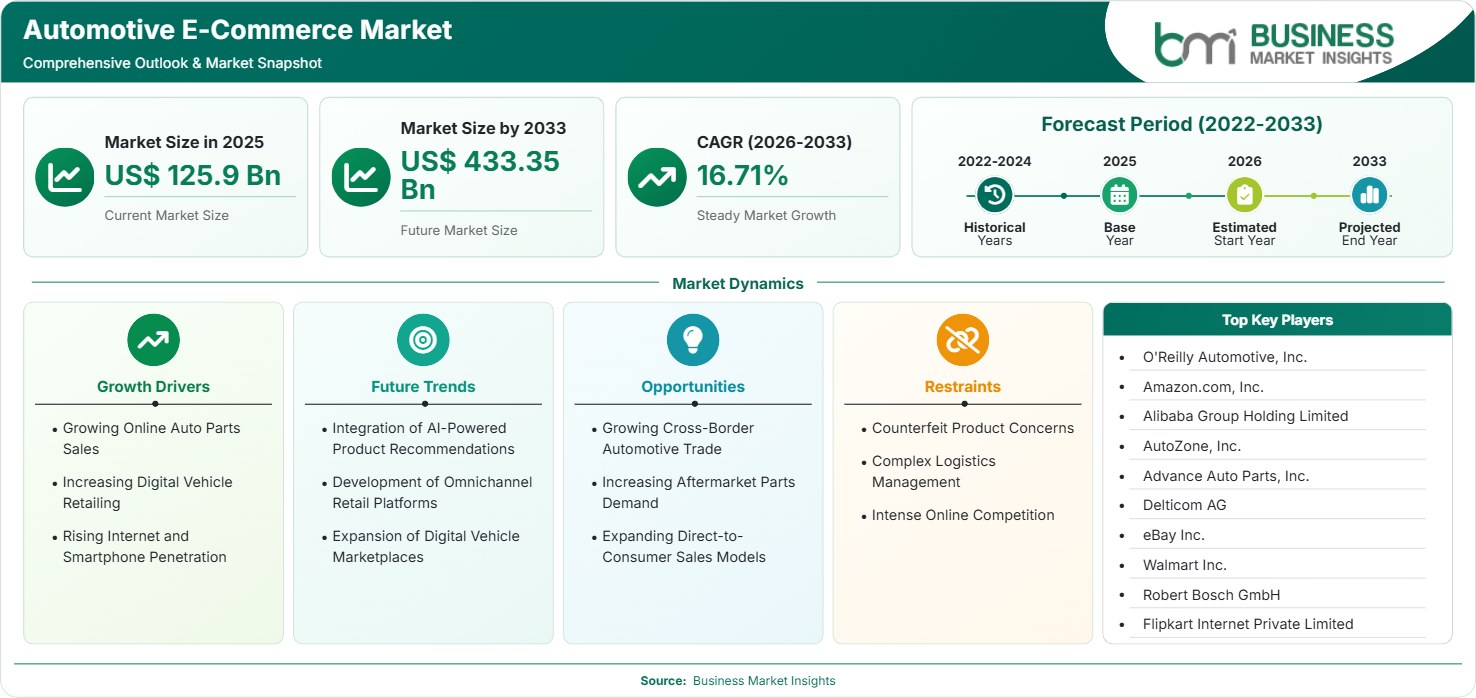
The Automotive E-Commerce Market size was valued at US$ 125.9 Billion in 2025 and is projected to reach US$ 433.35 Billion by 2033, growing at a CAGR of 16.71% during 2026–2033, driven by digital vehicle commerce, expanding aftermarket demand, online spare parts platforms, and direct-to-consumer automotive retail opportunities.

Report Coverage
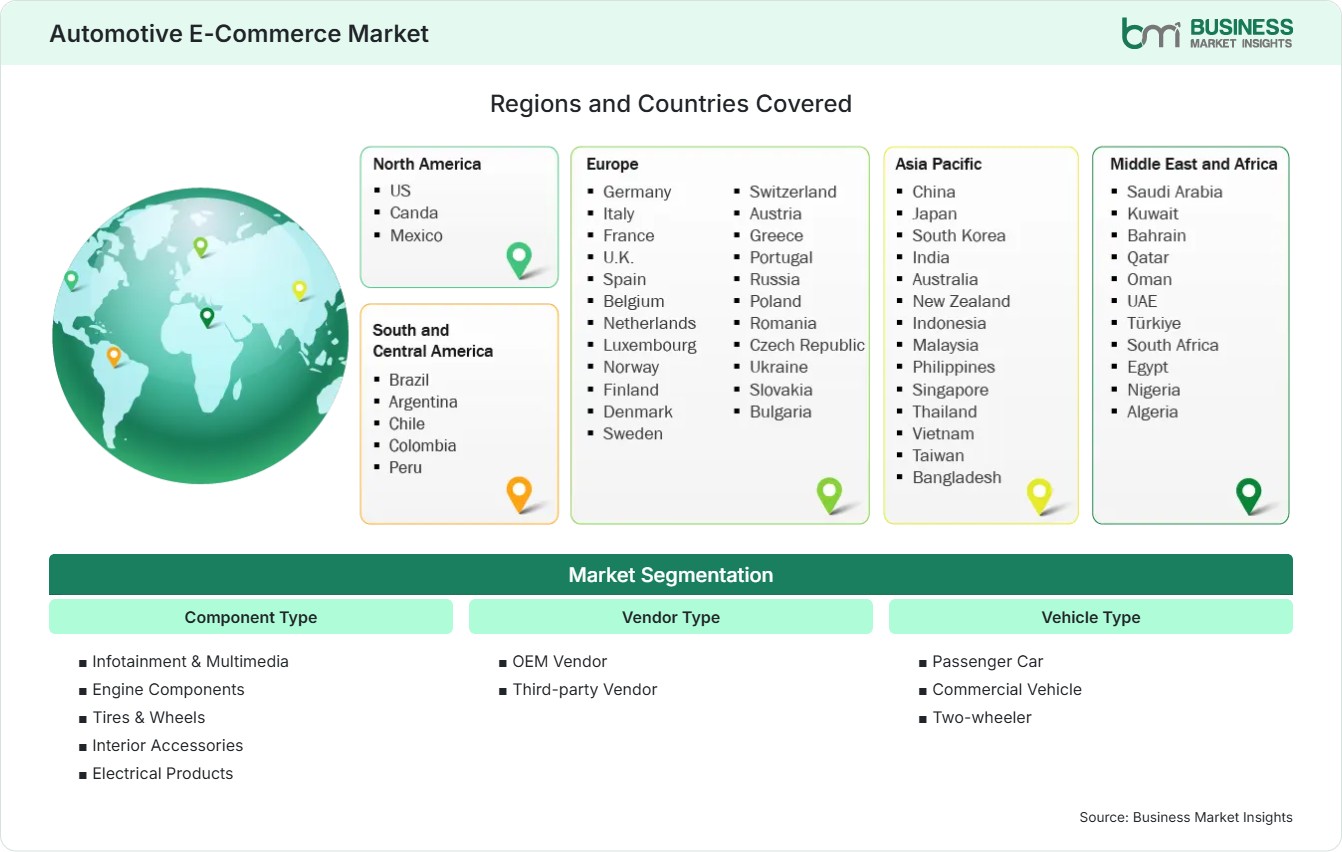
  • Component Type: Infotainment & Multimedia, Engine Components, Tires & Wheels, Interior Accessories, Electrical Products
  • Vendor Type: OEM Vendor, Third-party Vendor
  • Vehicle Type: Passenger Car, Commercial Vehicle, Two-wheeler
US$ 125.9 Bn Market size in 2025
US$ 433.35 Bn Market Size by 2033
16.71% CAGR, 2026 - 2033
2026-2033 Forecast Period

01 AI Overview

Automotive E-Commerce Market Summary

  • North America Region: North America holds a 32%–36% share in 2025, growing with a CAGR of 15.5%–16.5% due to advanced digital retail infrastructure, strong aftermarket ecosystems, and increasing consumer preference for online automotive purchases. The U.S. market analysis shows continued expansion with a CAGR of 15.8%–16.8% from 2026–2033, supported by mature e-commerce adoption and automotive service platforms.
  • Fastest Growing Region: Asia Pacific captures a 28%–32% share in 2025, expanding at a CAGR of 18%–20% through rising vehicle ownership, smartphone adoption, improving logistics networks, and increasing digital payment penetration. Emerging economies are creating opportunities for online automotive parts marketplaces and technology-driven retail models.
  • Leading Segment: Tires & Wheels account for a 24%–28% share in 2025, advancing at a CAGR of 15%–17% due to replacement demand, vehicle maintenance requirements, seasonal tire purchases, and growing availability of online comparison platforms offering wider product selections.
  • High Growth Segment: Electrical Products represent a 16%–20% share in 2025, registering a CAGR of 19%–21% due to increasing vehicle electronics adoption, electric vehicle components, smart accessories, and consumer demand for digitally accessible automotive technologies.
  • Key Market Opportunity: Automotive e-commerce platforms can capture growth through integrated vehicle identification systems, personalized recommendations, digital financing options, and cross-border parts distribution networks connecting consumers with verified suppliers globally.
  • Major Market Players: O'Reilly Automotive, Inc.; Amazon.com, Inc.; Alibaba Group Holding Limited; AutoZone, Inc.; Advance Auto Parts, Inc.; Delticom AG; eBay Inc.; Walmart Inc.; Robert Bosch GmbH; Flipkart Internet Private Limited.
02 Strategic Insights

Automotive E-Commerce Market: Strategic Insights

Automotive E-Commerce Market Strategic Framework
FREE PDF
Request your free sample
Request free sample
03 Stakeholder View

Key Takeaways

  • Automotive e-commerce ecosystems are evolving from simple online product listings into integrated platforms combining inventory management, logistics, vehicle data, financing solutions, and customer engagement tools. Companies with strong digital infrastructure are gaining competitive advantages through improved purchasing experiences.
  • Aftermarket components, accessories, and replacement products represent major growth opportunities as vehicle owners increasingly compare prices, evaluate product specifications, and purchase maintenance items online. Platforms offering compatibility verification and installation support can strengthen customer confidence.
  • Artificial intelligence, predictive analytics, and connected vehicle data are influencing future platform development by enabling personalized recommendations, demand forecasting, and automated inventory optimization. Technology adoption is becoming a key differentiator among online automotive retailers.
  • Asia Pacific provides strong investment potential due to expanding vehicle populations, rising disposable incomes, and rapid digital commerce adoption. Countries including India, China, and Southeast Asian markets are creating opportunities for scalable automotive marketplace models.
  • Strategic partnerships, acquisitions, and technology investments are increasing as traditional automotive retailers collaborate with digital platforms to improve online capabilities, expand product coverage, and strengthen omnichannel customer engagement.
04 Geographic Outlook

Automotive E-Commerce Market Regional Highlights

North America Automotive E-Commerce Market

North America represents a mature digital automotive retail ecosystem with a 32%–36% share in 2025 and CAGR of 15.5%–16.5% during 2026–2033. Strong aftermarket demand, established logistics networks, and high consumer trust in online transactions support regional expansion. The Automotive E-Commerce Market share reflects strong participation from major retailers and technology-enabled platforms. The region benefits from advanced vehicle ownership patterns and increasing demand for convenient maintenance solutions.

  • Online automotive marketplaces are expanding through improved product databases, vehicle compatibility tools, and integrated delivery networks supporting consumer and professional buyers across North America.
  • Digital platforms are increasing aftermarket penetration by offering replacement parts, accessories, and maintenance products with transparent pricing and simplified purchasing processes.
  • Retailers are investing in omnichannel strategies combining physical stores with online platforms to improve customer convenience and service accessibility.
  • Advanced payment solutions, subscription models, and personalized recommendations are improving engagement among digitally active automotive consumers.

US Automotive E-Commerce Market

The U.S. represents the largest contributor within North America, accounting for 70%–75% of regional demand in 2025 with CAGR of 15.8%–16.8% through 2033. The Automotive E-Commerce Market expansion is supported by established aftermarket retailers, high internet penetration, and strong consumer preference for convenient purchasing channels. Online platforms continue improving product availability, fulfillment speed, and customer service capabilities.

  • Large automotive retailers are strengthening digital channels by integrating inventory visibility, online ordering, and store-based fulfillment options.
  • Consumers increasingly purchase replacement components and accessories online due to wider selections, competitive pricing, and access to product reviews.
  • Automotive marketplaces are adopting artificial intelligence tools to improve search accuracy and recommend compatible vehicle products.
  • Growth in electric vehicle adoption is increasing demand for specialized electronic components and digitally available automotive solutions.

Europe Automotive E-Commerce Market

Europe accounts for a 24%–28% share in 2025 and is projected to expand at a CAGR of 14.5%–15.5% during 2026–2033. The region benefits from strong automotive manufacturing capabilities, increasing digital purchasing adoption, and demand for sustainable mobility solutions. Germany, the United Kingdom, France, and Italy remain important markets due to established automotive ecosystems. The Automotive E-Commerce Market share continues developing through improved online catalogs, cross-border trade platforms, and advanced logistics services.

  • Germany demonstrates strong adoption through its advanced automotive industry, high aftermarket activity, and increasing integration of digital platforms connecting suppliers with vehicle owners.
  • The United Kingdom is experiencing rising online automotive purchases due to consumer preference for convenience, competitive pricing, and availability of specialized replacement components.
  • France and Italy are supporting regional expansion through increasing digital retail adoption, growing automotive service networks, and demand for efficient parts procurement.
  • European platforms are emphasizing sustainable logistics, transparent sourcing, and digital tools to improve customer confidence in automotive online transactions.

Asia Pacific Automotive E-Commerce Market

Asia Pacific represents a 28%–32% share in 2025 and is estimated to grow at a CAGR of 18%–20% between 2026–2033. Rapid vehicle ownership growth, expanding internet connectivity, and increasing digital payment adoption are strengthening regional opportunities. China, India, Japan, and Southeast Asian economies are major contributors. The Automotive E-Commerce Market growth in Asia Pacific is supported by large consumer bases, improving logistics infrastructure, and rising demand for affordable automotive products.

  • China maintains strong market momentum through extensive e-commerce ecosystems, automotive manufacturing capacity, and advanced digital payment infrastructure supporting online purchases.
  • India is emerging as a high-growth market due to increasing vehicle ownership, expanding smartphone usage, and growing preference for online automotive parts platforms.
  • Southeast Asian countries are developing digital automotive ecosystems through marketplace expansion, logistics improvements, and increasing consumer access to vehicle maintenance products.
  • Japan and South Korea are adopting specialized online channels focused on advanced vehicle components, accessories, and technology-enabled automotive solutions.

Rest of World Automotive E-Commerce Market

Latin America, Middle East, and Africa collectively represent a 12%–16% share in 2025, expanding at a CAGR of 14%–16% during 2026–2033. Latin American markets are benefiting from increasing internet access, rising vehicle populations, and improving digital commerce infrastructure. Middle Eastern markets are supported by premium vehicle demand, expanding logistics capabilities, and technology investments. The Automotive E-Commerce Market continues developing as regional businesses adopt online procurement models.

  • Brazil and Mexico are supporting growth through expanding automotive aftermarket activities, digital marketplace adoption, and increasing consumer interest in online vehicle accessories.
  • Middle Eastern countries are investing in digital retail infrastructure, enabling faster automotive product delivery and improved customer experiences.
  • African markets are gradually adopting online automotive platforms as mobile commerce penetration and logistics networks continue improving.
  • Regional suppliers are partnering with international marketplaces to increase product availability and strengthen cross-border automotive trade opportunities.
  • Emerging economies are creating opportunities for localized platforms offering affordable components, maintenance products, and vehicle-specific solutions.
Global Market Geography
FREE PDF
Request your free sample
Request free sample
05 Segment Analysis

Automotive E-Commerce Market Segmentation

Component Type

Component Type segmentation demonstrates diverse demand across automotive products, with Tires & Wheels maintaining a leading position due to recurring replacement requirements and consumer purchasing frequency. This segment accounted for a 24%–28% share in 2025 and is expected to expand at a CAGR of 15%–17% between 2026–2033. The Automotive E-Commerce Market scope continues broadening as digital platforms improve product discovery, compatibility checks, and delivery solutions across component categories.

  • Infotainment & Multimedia: Includes entertainment systems, navigation devices, and connected accessories. Demand is increasing through smart vehicle adoption and consumer interest in upgraded digital driving experiences.
  • Engine Components: Covers essential mechanical replacement products supporting vehicle maintenance. Online availability improves access to specialized parts and expands aftermarket purchasing convenience.
  • Tires & Wheels: Represents a major online category due to frequent replacement cycles, extensive product comparisons, seasonal requirements, and simplified ordering processes.
  • Interior Accessories: Includes seat covers, organizers, lighting solutions, and customization products. Consumers increasingly purchase personalized vehicle enhancement products through digital marketplaces.
  • Electrical Products: Covers batteries, electronic components, sensors, and vehicle accessories. Rising vehicle electronics adoption is strengthening demand through specialized online channels.

Vendor Type

Vendor Type segmentation highlights the changing relationship between manufacturers, retailers, and digital marketplaces. Third-party vendors maintain a larger market presence due to broad product availability and marketplace scalability. The segment accounted for a 55%–60% share in 2025 with CAGR between 16%–18% from 2026–2033. The Automotive E-Commerce Market trends indicate increasing collaboration between suppliers and platforms to improve product reach and customer engagement.

  • OEM Vendor: Provides original equipment products with manufacturer-backed quality assurance. OEM participation is increasing through direct digital channels and branded online storefronts.
  • Third-party Vendor: Offers extensive product variety, competitive pricing, and aftermarket solutions. These vendors benefit from marketplace platforms and broader consumer accessibility.

Vehicle Type

Vehicle Type segmentation reflects changing purchasing patterns among passenger vehicles, commercial fleets, and two-wheelers. Passenger cars represent the leading category due to larger consumer ownership volumes and higher accessory demand. This segment held a 60%–65% share in 2025 and is expected to grow at a CAGR of 15%–17% during 2026–2033. Commercial and two-wheeler segments are gaining attention through specialized digital purchasing solutions.

  • Passenger Car: Generates significant demand for replacement parts, accessories, infotainment systems, and maintenance products through consumer-focused online platforms.
  • Commercial Vehicle: Adoption is increasing as fleet operators use digital procurement channels for maintenance components, tires, and operational efficiency products.
  • Two-wheeler: Expanding online demand is supported by rising motorcycle ownership, affordable accessories, and increasing digital purchasing among younger consumers.
06 Market Forces

Automotive E-Commerce Market Dynamics

Key Market Drivers

Growing Online Auto Parts Sales

The sale of automotive components through the internet is growing as customers and repairers want more choices and reasonable prices. The market for Automotive E-Commerce Market growth is driven by rising aftermarket demand and advanced catalog systems that make searching for compatible vehicles easier. Increased availability of spare parts, accessories, and maintenance products is making online buying behavior more common. The trends in market suggest that those platforms focusing on accurate product information, fast delivery, and customer services are getting an edge over others.

Increasing Digital Vehicle Retailing

Digital sales of vehicles are revolutionizing the industry in such a way that customers can do their product research, comparisons, and purchase transactions using online websites. There is now an incorporation of virtual shopping experience, financing facilities, and digital services being offered by automotive firms for better customer engagement. The trend towards an online purchasing process is motivating retailers to establish full-fledged platforms that connect manufacturers, suppliers, and customers.

Rising Internet and Smartphone Penetration

The increased accessibility of the internet and smartphones is widening the reach of automotive eCommerce websites, especially in emerging economies. The usage of mobile shopping applications is allowing customers to search for parts, compare prices, and even make payments easily. Enhanced use of digital payments along with better logistics connectivity is aiding customer and supplier participation. Automotive companies are using the concept of mobile commerce to attract new customers and improve their online sales process.

Key Market Opportunities

Growing Cross-Border Automotive Trade

Cross-border automotive trade is creating new opportunities for online platforms by connecting international suppliers with consumers seeking wider product availability and competitive pricing. The Automotive E-Commerce Market Forecasts reveal an increasing possibility through globalization of marketplaces, advanced customs management systems, and digitized methods of trading. There are investments by companies in international fulfillment systems, localized platforms, and supplier verification systems to ensure that there are effective transactions. The cross-border system enables consumers to acquire specific automotive parts that might not be acquired through domestic means. There are improvements in digitized payment systems and logistics systems, thus enhancing the efficiency of the transactions and wider involvement from all players.

Increasing Aftermarket Parts Demand

Growing vehicle ownership, longer vehicle lifecycles, and increasing maintenance requirements are creating opportunities for online aftermarket parts platforms. Consumers and repair professionals are increasingly using digital channels to source replacement components, accessories, and maintenance products. The e-commerce companies are enhancing customer satisfaction through vehicle recognition services, installation help, and recommendations. The aftermarket industry holds huge opportunities for them as the aging vehicles need constant maintenance and parts replacement. Those companies that offer genuine product verification, efficient logistics, and technical support will be able to create customer loyalty as well as establish themselves in the automobile retail sector.

Expanding Direct-to-Consumer Sales Models

Direct consumer sales models in the automotive industry have become more popular as the manufacturers and suppliers look to build customer connections and improve visibility in the market. Digital storefronts help businesses to have complete control over their brand, gather customer information, and be less dependent on conventional sales channels. More and more automotive components manufacturers are considering direct sales methods in order to sell additional accessories, spare parts, and specialty products. Direct sales models offer ways to increase customer involvement through targeted offers, subscriptions, and digital tools.

Market Restraints and Challenges

Counterfeit Product Concerns

Factor: The increasing availability of unauthorized sellers and imitation automotive components across online platforms creates product authenticity challenges. Impact: Counterfeit concerns can reduce consumer trust, increase safety risks, and negatively affect brand reputation for legitimate manufacturers and retailers. E-commerce sites for automotive parts need better mechanisms for verifying identities, authenticating suppliers and monitoring quality to reduce fraud. There have been investments in blockchain technology, certification schemes and improved controls within marketplaces to increase transparency. Product integrity is crucial as consumers are increasingly reliant on digital channels for automotive and safety products.

Complex Logistics Management

Factor: Automotive products often involve diverse sizes, technical specifications, and storage requirements, creating complex fulfillment challenges. Impact: Inefficient logistics operations can increase delivery costs, extend shipment timelines, and affect customer satisfaction. Automotive e-commerce companies must manage extensive inventories, regional warehouses, supplier coordination, and reverse logistics processes. Large components such as tires, body parts, and specialized equipment require optimized transportation strategies. Businesses are adopting automated inventory systems, regional fulfillment centers, and logistics partnerships to improve operational efficiency. Effective supply chain management remains a critical requirement for scalable digital automotive commerce platforms.

07 Company Analysis

Competitive Landscape

The competitive environment includes online marketplaces, automotive retailers, component manufacturers, and technology-driven commerce platforms. Automotive E-Commerce Market analysis highlights increasing competition around digital customer experience, product authenticity, supply chain efficiency, and integrated marketplace solutions. Companies are focusing on expanding product portfolios, strengthening fulfillment capabilities, and using data-driven technologies to improve online automotive purchasing experiences.

Company Name

Overview

Products and Services relevant to this market

O'Reilly Automotive, Inc.

Automotive aftermarket retailer offering extensive parts, accessories, and maintenance products through physical and digital channels.

Online automotive parts marketplace, replacement components, accessories, repair products, and digital ordering solutions.

Amazon.com, Inc.

Global e-commerce platform providing broad automotive product categories and technology-enabled shopping experiences.

Automotive parts marketplace, vehicle accessories, seller solutions, logistics services, and digital commerce infrastructure.

Alibaba Group Holding Limited

Technology and commerce company operating global online marketplaces connecting automotive suppliers and buyers.

Automotive component marketplaces, supplier networks, cross-border commerce solutions, and digital trading platforms.

AutoZone, Inc.

Leading automotive retailer specializing in aftermarket parts, accessories, and maintenance solutions.

Online parts ordering, replacement components, vehicle accessories, repair products, and customer support services.

Advance Auto Parts, Inc.

Automotive aftermarket provider serving consumers and professional repair customers through integrated retail channels.

Digital automotive marketplace, maintenance parts, accessories, professional repair solutions, and online ordering services.

Delticom AG

European online retailer specializing in automotive products including tires and vehicle-related solutions.

Online tire platforms, automotive accessories, replacement products, and digital purchasing services.

eBay Inc.

Global marketplace platform supporting automotive product transactions between sellers and consumers.

Automotive marketplace services, vehicle parts listings, accessories, seller tools, and digital commerce solutions.

Walmart Inc.

Global retailer expanding automotive products through online and omnichannel commerce platforms.

Automotive accessories, maintenance products, online retail services, and integrated fulfillment solutions.

Robert Bosch GmbH

Global automotive technology supplier providing components and mobility solutions.

Vehicle electronics, automotive parts, diagnostic products, and digital aftermarket solutions.

Flipkart Internet Private Limited

Indian e-commerce platform expanding automotive product availability through digital retail channels.

Automotive accessories, vehicle components, marketplace services, and regional online commerce solutions.

10 Trust & Transparency

Research Methodology

The market analysis combines proprietary research with secondary data from government agencies, company disclosures, regulatory filings, industry databases and expert interviews. Market estimates are validated through data triangulation, cross-market benchmarking and analyst review.

View Full Research Methodology

11 Questions Answered

Frequently Asked Questions

What insights are available through the Automotive E-Commerce Market Report?

The report provides analysis of market dynamics, segmentation, competitive strategies, regional developments, growth opportunities, and emerging trends influencing digital automotive commerce.

What factors influence consumer trust in automotive online purchases?

Product authenticity, accurate specifications, secure payments, reliable delivery, and customer reviews are key factors influencing purchasing confidence among online automotive buyers.

How are manufacturers benefiting from direct online sales channels?

Direct digital channels allow manufacturers to strengthen customer relationships, collect market insights, improve brand visibility, and reduce dependence on traditional distribution networks.

What role do aftermarket parts play in online automotive sales?

Aftermarket components represent a major opportunity because vehicle owners increasingly seek affordable replacement products, maintenance solutions, and accessories through digital platforms offering wider selections.

How is technology improving automotive e-commerce platforms?

Artificial intelligence, vehicle identification systems, and advanced analytics are improving product recommendations, inventory management, and customer purchasing experiences. These technologies help platforms provide more accurate component matching and reduce purchase errors.

Access the Full Automotive E-Commerce Market Report

Get segment-level forecasts, regional estimates, competitive benchmarking, company profiles and downloadable Excel datasets.

Access the full Automotive E-Commerce Market Report
350 pages PDF & Excel | 2026-08-18