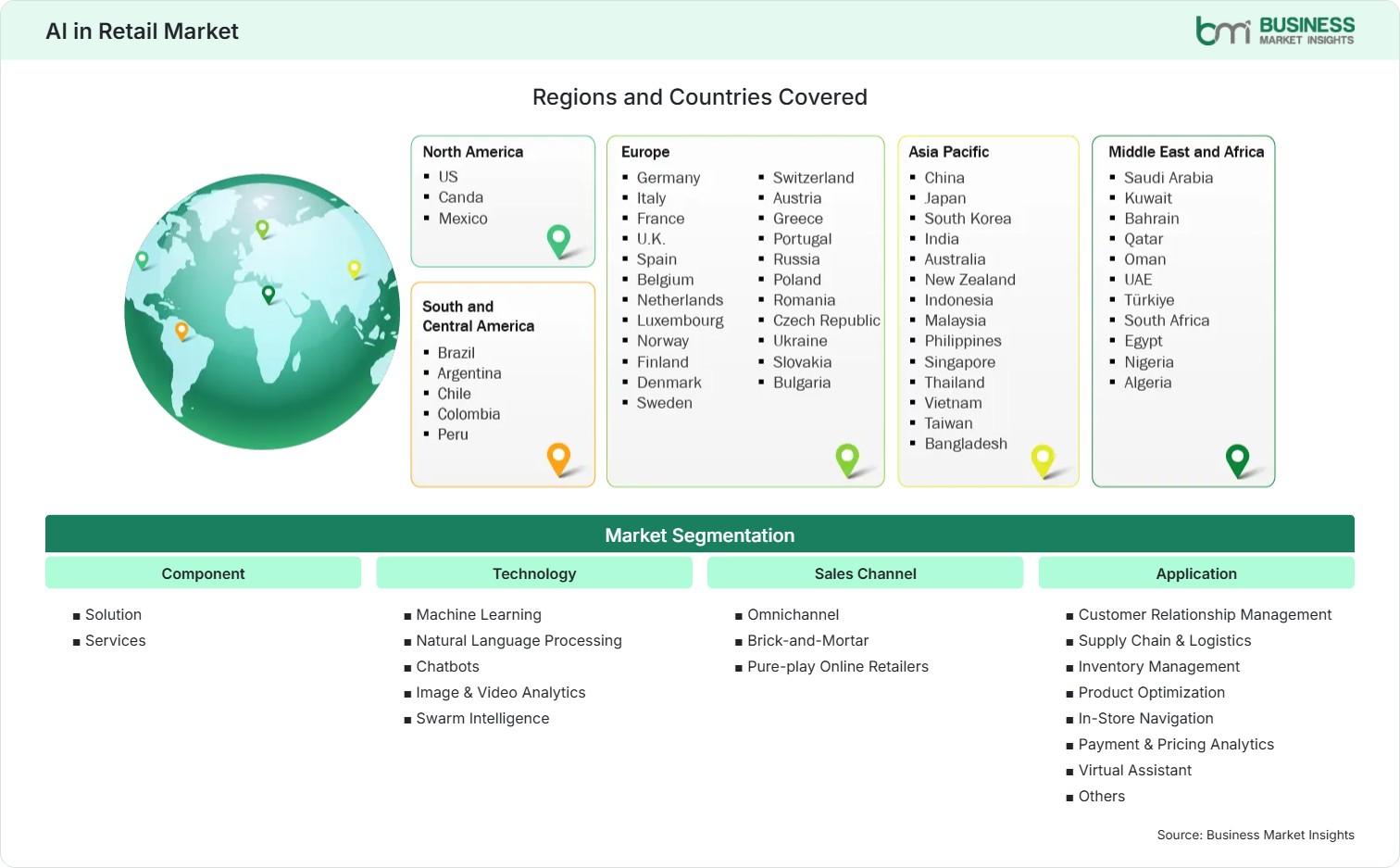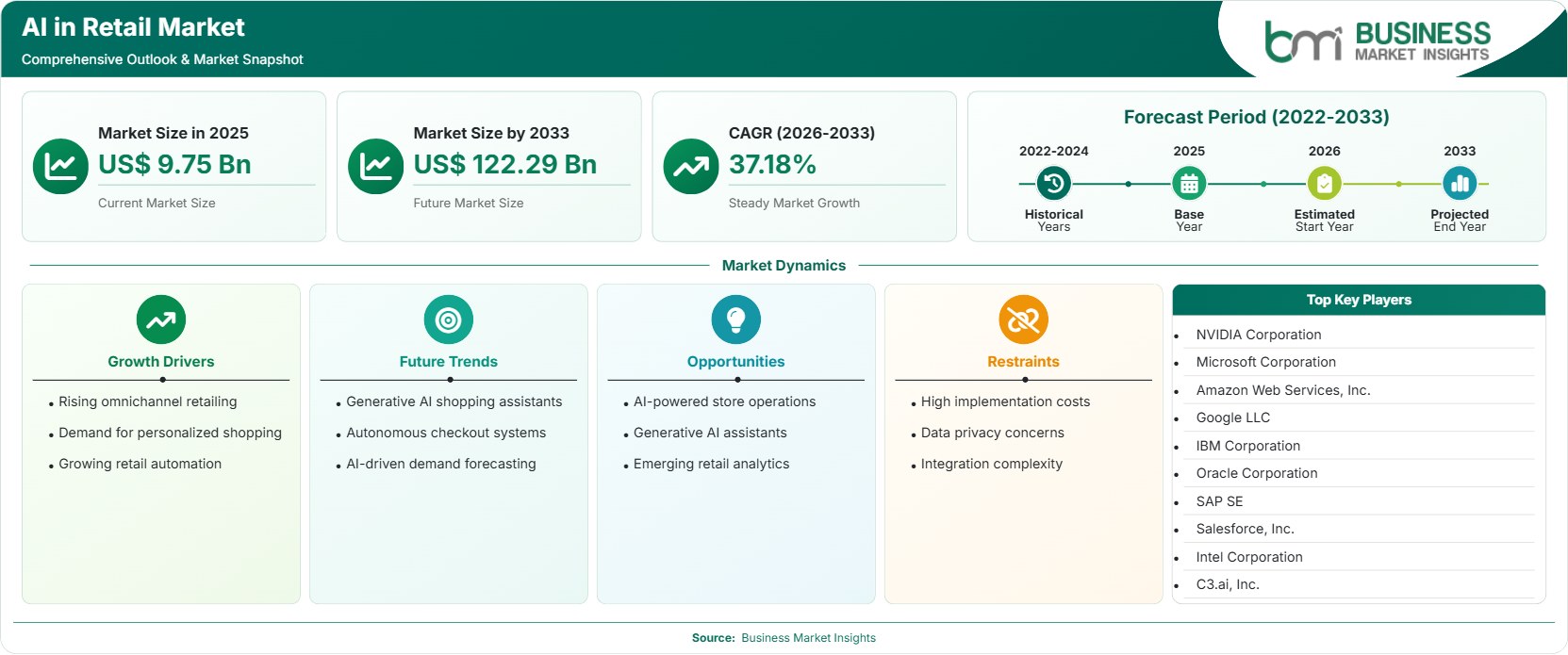
AI in Retail Market Regional Highlights
North America AI in Retail Market
North America accounts for approximately 39%–42% of the global market in 2025 and is projected to expand at a CAGR of 35.8%–36.6% during 2026–2033. The region benefits from advanced cloud infrastructure, widespread AI adoption among large retailers, strong technology ecosystems, and high consumer acceptance of digital commerce. AI in Retail Market share remains the largest globally due to substantial investments in intelligent retail technologies, automation, and customer experience optimization.
- Large retailers increasingly deploy artificial intelligence for personalized product recommendations, demand forecasting, dynamic pricing, fraud detection, and customer service automation to improve profitability and consumer engagement.
- Cloud computing providers continue expanding AI infrastructure, enabling retailers to implement scalable analytics, computer vision, and generative AI applications with lower deployment complexity.
- Omnichannel commerce strategies continue driving investments in inventory visibility, fulfillment optimization, and intelligent supply chain management to support seamless shopping experiences.
- Computer vision technologies are increasingly adopted across autonomous checkout, shelf monitoring, loss prevention, and in-store customer behavior analytics.
- Continuous innovation in generative AI and retail analytics strengthens enterprise adoption across grocery, fashion, electronics, and specialty retail segments.
US AI in Retail Market
The United States represents approximately 33%–36% of the global market in 2025 and is expected to register a CAGR of 36.2%–37.0% through 2033. Strong investments by retailers, leading cloud technology companies, and AI software providers continue supporting rapid commercialization of intelligent retail solutions.
- Enterprise retailers increasingly integrate AI into customer relationship management, inventory planning, digital marketing, and pricing optimization to improve operational efficiency and customer retention.
- Expansion of autonomous stores, cashier-less checkout technologies, and AI-enabled logistics networks continues accelerating technology adoption across retail formats.
- Growing investments in generative AI assistants improve personalized shopping, customer support automation, and product discovery across online and physical retail channels.
- Strong venture capital investment and innovation ecosystems continue supporting AI startups developing specialized retail automation solutions.
Europe AI in Retail Market
Europe accounts for approximately 26%–29% of the global market in 2025 and is forecast to expand at a CAGR of 36.4%–37.2% during 2026–2033. Retail digitalization, increasing AI adoption, and supportive regulatory frameworks continue strengthening regional market development. The United Kingdom leads regional adoption, while Germany records the fastest growth among major European economies with a CAGR of 37.1%–37.8%.
- Retailers increasingly invest in AI-powered merchandising, demand forecasting, and customer analytics to enhance competitiveness in highly digital consumer markets.
- European supermarkets and fashion retailers continue expanding AI applications across supply chain optimization, warehouse automation, and personalized promotions.
- Growing investments in responsible AI, cybersecurity, and privacy-compliant analytics support broader adoption across enterprise retail organizations.
- Intelligent pricing algorithms and predictive inventory planning continue improving product availability while minimizing stockouts and excess inventory.
- Expansion of cloud-based retail platforms accelerates implementation of AI-enabled business intelligence and customer engagement solutions.
Asia Pacific AI in Retail Market
Asia Pacific represents approximately 24%–27% of the global market in 2025 and is expected to register the fastest CAGR of 39.8%–40.7% through 2033. Rapid expansion of e-commerce, digital payments, smartphone penetration, and smart retail initiatives continues supporting exceptional regional growth. China leads regional revenue generation, while India records the highest growth with a CAGR of 41.2%–42.0%.
- Large digital commerce platforms increasingly deploy artificial intelligence for customer recommendations, logistics optimization, fraud detection, and personalized marketing.
- Retail modernization initiatives encourage adoption of AI-enabled inventory management, demand forecasting, and intelligent supply chain solutions across organized retail.
- Expansion of smart stores utilizing computer vision, facial recognition, and autonomous checkout technologies continues transforming customer shopping experiences.
- Government initiatives promoting artificial intelligence innovation and digital transformation create favorable conditions for enterprise AI adoption.
- Rising investments by retailers and cloud providers continue strengthening regional AI infrastructure and analytics capabilities.
Rest of World AI in Retail Market
The Rest of World region accounts for approximately 7%–9% of global revenue in 2025 and is projected to expand at a CAGR of 36.8%–37.6% during the forecast period. Digital commerce expansion, increasing cloud adoption, and retail modernization continue supporting AI in Retail market growth across Latin America, the Middle East, and Africa.
Brazil leads regional AI adoption in retail by expanding e-commerce and digital payment ecosystems, while the United Arab Emirates and Saudi Arabia continue to invest in smart retail technologies and AI-enabled customer experiences.
- Brazil records the fastest regional growth with a CAGR of 37.5%–38.2%, supported by expanding organized retail and digital transformation initiatives.
- Gulf countries increasingly invest in AI-powered shopping experiences, intelligent malls, autonomous checkout systems, and omnichannel retail platforms.
- Cloud infrastructure expansion enables retailers across emerging markets to deploy advanced AI analytics without significant on-premises investments.
- Consumer demand for personalized shopping experiences continues encouraging retailers to invest in AI-driven recommendation engines and conversational commerce platforms.
- AI-powered fraud detection, payment analytics, and customer engagement solutions continue gaining traction across financial and retail ecosystems.