
Security Market Outlook: Size, Share, Trends, Growth Analysis, Competitive Landscape & Forecast, 2022-2033

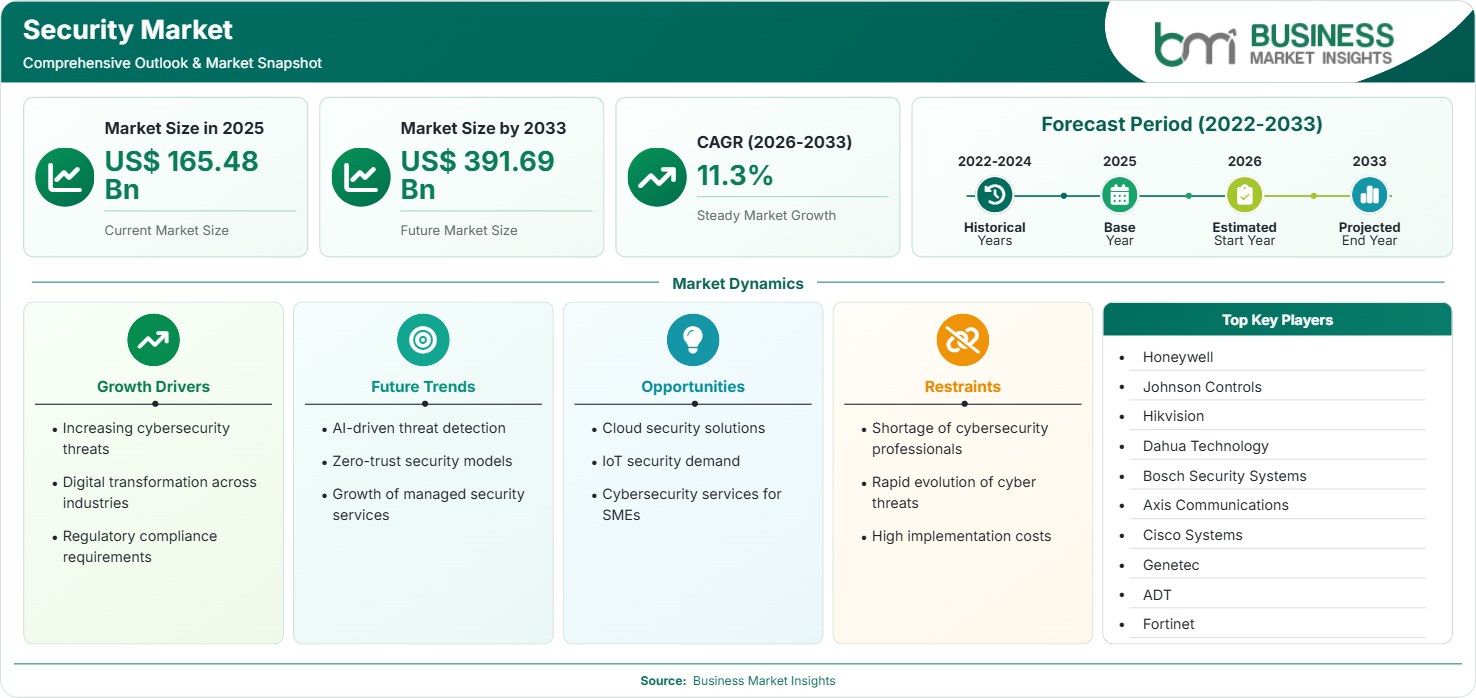
The Security Market was valued at US$ 165.48 Billion in 2025 and is projected to reach US$ 391.69 Billion by 2033, growing at a CAGR of 11.3% during 2026–2033. Growth is driven by rising cybersecurity threats, rapid digital transformation, and stricter regulatory compliance requirements. Additional opportunities are emerging from cloud security adoption, expanding IoT protection, and increasing cybersecurity service demand among small and medium enterprises seeking stronger digital resilience.

Report Coverage
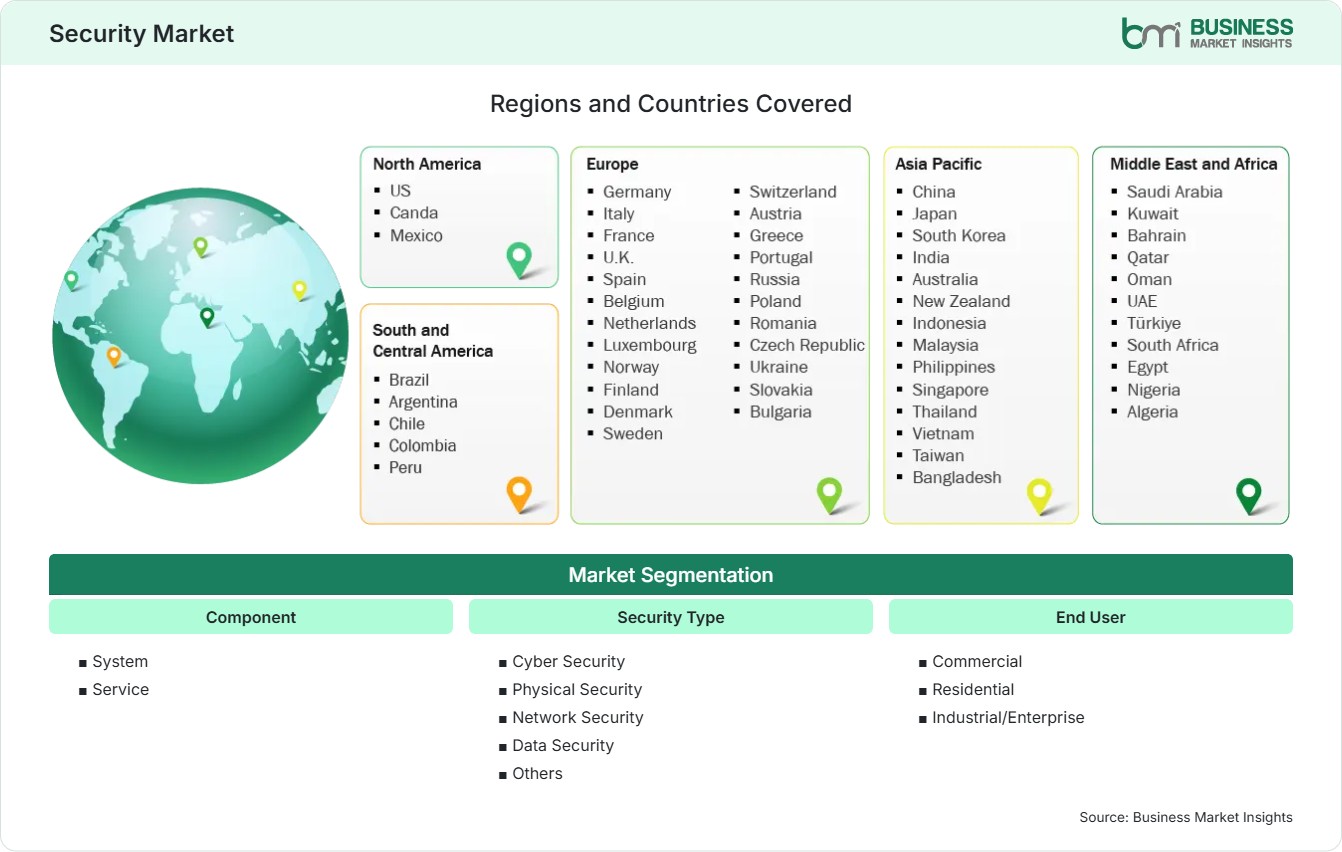
  • Component: System, Service
  • Security Type: Cyber Security, Physical Security, Network Security, Data Security, Others
  • End User: Commercial, Residential, Industrial/Enterprise
US$ 165.48 Bn Market size in 2025
US$ 391.69 Bn Market Size by 2033
11.3% CAGR, 2026 - 2033
2026-2033 Forecast Period

AI Overview

Security Market Summary

  • North America Region: North America accounted for 36%–39% market share in 2025 and is projected to grow at a CAGR of 10.8%–11.3% during 2026–2033. Strong cybersecurity investments, advanced technology adoption, regulatory enforcement, and demand for integrated physical and digital security continue supporting regional growth. The United States is expected to register a CAGR of 11.0%–11.5%.
  • Fastest Growing Region: Asia Pacific represented 25%–28% market share in 2025 and is forecast to record the fastest CAGR of 12.5%–13.0% through 2033. Rapid digitalization, smart city development, expanding internet access, and increasing enterprise cybersecurity spending continue driving regional demand.
  • Leading Segment: Cyber Security accounted for 38%–41% market share in 2025 and is projected to grow at a CAGR of 12.0%–12.5%. Rising ransomware attacks, cloud migration, stronger data protection requirements, and enterprise digital transformation continue supporting adoption.
  • High Growth Segment: Managed Security Services represented 22%–25% market share in 2025 and is expected to expand at a CAGR of 13.2%–13.8%. Increasing security complexity, cybersecurity talent shortages, and growing reliance on outsourced threat monitoring continue accelerating growth.
  • Key Market Opportunity: Expanding adoption of cloud security platforms, IoT protection solutions, and cybersecurity services for SMEs is creating significant opportunities for providers delivering scalable, automated, and integrated security technologies.
  • Major Market Players: Honeywell International Inc., Johnson Controls International plc, Hangzhou Hikvision Digital Technology Co., Ltd., Zhejiang Dahua Technology Co., Ltd., Bosch Security Systems, Axis Communications AB, Cisco Systems, Inc., Genetec Inc., ADT Inc., Fortinet, Inc.
Strategic Insights

Security Market: Strategic Insights

Security Market Strategic Framework
FREE PDF
Request your free sample
Request free sample
Stakeholder View

Key Takeaways

  • The security ecosystem is shifting toward integrated platforms combining cybersecurity, physical security, surveillance, access management, and analytics. Vendors offering unified solutions are strengthening their competitive position by addressing broader enterprise security needs.
  • Cybersecurity services, cloud security platforms, and managed security solutions represent major growth opportunities as organizations increasingly outsource threat monitoring and protection due to rising attack complexity and limited internal expertise.
  • Artificial intelligence, machine learning, behavioral analytics, and automation are transforming security operations by improving threat detection, accelerating incident response, and strengthening predictive risk management.
  • Asia Pacific offers significant investment opportunities driven by digital transformation, smart city development, expanding IoT ecosystems, and increasing cybersecurity spending across emerging economies.
  • Strategic acquisitions, technology partnerships, and platform integrations continue reshaping competition as providers expand capabilities across cyber defense, cloud security, physical monitoring, and enterprise risk management.
  • Increasing compliance requirements related to data protection, critical infrastructure security, and industry regulations are encouraging organizations to invest in advanced security technologies and professional security services.
Geographic Outlook

Security Market Regional Highlights

North America Security Market

North America accounted for approximately 36%–39% of the global Security Market share in 2025 and is projected to grow at a CAGR of 10.8%–11.3% during 2026–2033. Growth is supported by advanced cybersecurity infrastructure, high enterprise technology adoption, strict regulations, and increasing investments in integrated cyber and physical security solutions.

  • The United States leads regional demand due to strong cybersecurity spending and widespread cloud security adoption.
  • Financial institutions continue investing in protection against fraud, ransomware, and regulatory risks.
  • Healthcare providers are strengthening cybersecurity to secure patient data and connected medical devices.
  • Smart building projects are increasing demand for surveillance and access control systems.
  • Managed security services are gaining popularity as organizations address cybersecurity skill shortages.

US Security Market

The United States represented approximately 31%–34% of the global market in 2025 and is expected to expand at a CAGR of 11.0%–11.5% through 2033. Emerging Security Market trends, such as Strong cybersecurity investments, cloud adoption, and digital transformation, continue supporting market growth.

  • Federal cybersecurity initiatives are encouraging stronger cyber defense capabilities.
  • AI-powered security platforms are improving threat detection and response.
  • Growing IoT deployment is increasing demand for network and endpoint security.
  • Cloud migration continues driving adoption of identity management and cloud security solutions.

Europe Security Market

Europe accounted for approximately 27%–30% of global revenue in 2025 and is projected to grow at a CAGR of 10.5%–11.0% during the Security Market Forecasts. Increasing cybersecurity regulations and digital transformation continue supporting market expansion.

  • Germany leads regional adoption through strong industrial cybersecurity demand, regulatory compliance requirements, and enterprise investments in integrated protection systems, with a projected CAGR of 10.4%–10.9%.
  • The Netherlands is expected to demonstrate strong growth with a CAGR of 11.5%–12.0%, supported by data center expansion, digital services, and increasing cybersecurity requirements.
  • European businesses are adopting advanced security technologies to comply with data protection regulations and strengthen resilience against cyber threats.
  • Industrial companies are investing in cybersecurity solutions to protect connected manufacturing systems, operational technology networks, and critical production infrastructure.
  • Increasing smart city initiatives across European countries are driving adoption of surveillance, access control, and intelligent security management platforms.

Asia Pacific Security Market

The Asia-Pacific region constituted around 25% - 28% share of the worldwide Security Market in 2025 and is projected to register the highest CAGR of 12.5% - 13.0% up to 2033. The ongoing digitalization process, smart infrastructures, and growing investments in cybersecurity continue being the factors fueling the segment's growth. China accounts for the leading market, whereas India is forecast to show the fastest growth.

  • China leads regional demand through large-scale smart city deployments, enterprise cybersecurity investments, surveillance infrastructure development, and digital government initiatives, with a projected CAGR of 12.3%–12.8%.
  • India is expected to achieve the fastest regional growth with a CAGR of 13.5%–14.0%, supported by expanding digital services, cybersecurity awareness, cloud adoption, and enterprise technology investments.
  • Southeast Asian economies are increasing security investments as businesses adopt digital platforms, connected devices, and cloud-based applications requiring advanced protection.
  • Manufacturing industries across Asia Pacific are deploying cybersecurity and physical security solutions to protect automated facilities and connected industrial systems.
  • Government initiatives focused on digital infrastructure, smart cities, and cyber resilience continue creating opportunities for security technology providers.

Rest of World Security Market

The Rest of World region accounted for approximately 7%–10% of global revenue in 2025 and is projected to grow at a CAGR of 11.5%–12.0% during 2026–2033. Demand is rising due to digital transformation, cloud adoption, and growing cybersecurity awareness.

Brazil remains the leading Security Market in South & Central America, while the UAE is the fastest-growing market in the Middle East.

  • Brazil continues expanding security adoption through financial technology growth, enterprise digitalization, and increasing demand for cybersecurity services, with a projected CAGR of 11.4%–11.9%.
  • The United Arab Emirates is expected to record strong growth with a CAGR of 12.2%–12.7%, supported by smart city programs, digital infrastructure investments, and cybersecurity modernization.
  • Telecommunications companies are strengthening security capabilities to protect expanding networks, connected devices, and digital communication platforms.
  • Oil and gas companies are increasing investments in cybersecurity and physical protection systems to secure critical infrastructure and operational assets.
  • Government digital transformation initiatives are creating new opportunities for security providers offering scalable cybersecurity and surveillance solutions.
Global Market Geography
FREE PDF
Request your free sample
Request free sample
Segment Analysis

Security Market Segmentation

Component

The component segment represents the foundation of security deployments, covering hardware-based protection systems and professional services required for installation, management, and optimization. The segment accounted for approximately 55%–58% market share in 2025 and is projected to grow at a CAGR of 10.9%–11.4% between 2026–2033.

  • System: Security systems are gaining adoption due to increasing demand for surveillance, intrusion detection, alarm management, and access control technologies across commercial buildings, industrial facilities, and critical infrastructure.
  • Alarm & Notification Systems: Adoption is increasing as organizations prioritize real-time threat alerts, emergency response coordination, fire detection integration, and improved incident management across various operational environments.
  • Intrusion Detection Systems: Demand is rising due to increasing security risks, unauthorized access concerns, and the need for automated monitoring solutions protecting residential, commercial, and industrial properties.
  • Video Surveillance Systems: Growth is supported by artificial intelligence-based analytics, smart cameras, facial recognition capabilities, and increasing deployment across public spaces, enterprises, and infrastructure projects.
  • Barrier Systems: These solutions are increasingly used for perimeter protection, access restriction, and critical facility security, particularly across transportation, government, and industrial applications.
  • Service: Security services are expanding as organizations seek specialized expertise for system deployment, monitoring, risk evaluation, maintenance, and continuous security improvement.
  • System Integration & Consulting: Demand is increasing as enterprises require customized security architectures, technology integration, and professional guidance for complex security environments.
  • Risk Assessment & Analysis: Adoption is growing due to increasing compliance requirements, cybersecurity threats, and organizational need for proactive vulnerability identification and security planning.
  • Managed Security Services: Growth is driven by rising cyber threats, limited internal security expertise, and increasing demand for outsourced monitoring, threat detection, and incident response capabilities.
  • Maintenance & Support: Organizations are investing in ongoing support services to ensure security system reliability, software updates, operational continuity, and long-term performance optimization.

Security Type

The security type segment is expanding as organizations require comprehensive protection against physical threats, cyberattacks, and data vulnerabilities. The segment accounted for approximately 48%–51% of the Security market share in 2025 and is projected to grow at a CAGR of 11.2%–11.7% during 2026–2033. Increasing digital transformation, connected infrastructure deployment, and regulatory compliance requirements are strengthening demand for advanced security solutions across industries.

  • Cyber Security: Represents the largest category due to increasing ransomware attacks, cloud adoption, digital transformation, and enterprise demand for advanced threat detection and protection platforms.
  • Physical Security: Adoption continues rising due to increasing infrastructure investments, smart building development, surveillance requirements, and demand for access control and perimeter protection technologies.
  • Network Security: Growth is supported by expanding enterprise networks, remote work adoption, connected devices, and increasing need to protect communication infrastructure from unauthorized access.
  • Data Security: Demand is increasing due to rising data privacy concerns, regulatory requirements, cloud storage adoption, and the need to protect sensitive organizational and customer information.
  • Others (Hybrid Security): Hybrid security solutions are gaining importance as organizations combine physical and digital protection strategies for comprehensive risk management and improved operational visibility.

End User

The end-user segment continues expanding as businesses, households, and industrial organizations increase investments in security technologies. The segment accounted for approximately 52%–55% market share in 2025 and is expected to grow at a CAGR of 11.0%–11.5% during 2026–2033. Growing awareness of security risks, infrastructure modernization, and compliance requirements are driving adoption across diverse user groups.

  • Commercial: Commercial users are increasing security investments for offices, retail facilities, financial institutions, and public spaces requiring surveillance, cybersecurity, and access management solutions.
  • Residential: Residential adoption is growing through smart home technologies, connected security devices, video monitoring systems, and increasing consumer awareness regarding personal and property protection.
  • Industrial/Enterprise: Industrial organizations are adopting advanced security systems to protect critical infrastructure, manufacturing operations, operational technology networks, and sensitive business information from evolving threats.
Market Forces

Security Market Dynamics

Key Market Drivers

Increasing cybersecurity threats

The growing frequency and sophistication of cyberattacks continue to drive demand across the Security Market. Organizations are strengthening investments in advanced cybersecurity platforms, endpoint protection, identity management, and threat intelligence solutions to defend against ransomware, phishing, data breaches, and other evolving attack methods. As businesses expand their digital operations, protecting sensitive information and maintaining business continuity have become top priorities. Security vendors are increasingly integrating artificial intelligence, behavioral analytics, and automation into their solutions to improve threat detection accuracy, accelerate incident response, and reduce operational risks.

Digital transformation across industries

Rapid digital transformation across sectors such as banking, healthcare, manufacturing, retail, and government is significantly increasing demand for integrated security solutions. Organizations adopting cloud computing, IoT technologies, automation, and digital business platforms require comprehensive protection for applications, networks, devices, and critical infrastructure. Hybrid work environments and distributed IT architectures have expanded the attack surface, making centralized security management more challenging. Businesses are therefore investing in unified security platforms that combine cybersecurity, surveillance, identity management, and analytics to provide end-to-end protection. Security providers continue developing scalable and cloud-native solutions that enable organizations to secure digital operations while maintaining regulatory compliance and operational efficiency.

Regulatory compliance requirements

Rapid digital transformation across sectors such as banking, healthcare, manufacturing, retail, and government is significantly increasing demand for integrated security solutions. Organizations adopting cloud computing, IoT technologies, automation, and digital business platforms require comprehensive protection for applications, networks, devices, and critical infrastructure. Hybrid work environments and distributed IT architectures have expanded the attack surface, making centralized security management more challenging. Businesses are therefore investing in unified security platforms that combine cybersecurity, surveillance, identity management, and analytics to provide end-to-end protection. Security providers continue developing scalable and cloud-native solutions that enable organizations to secure digital operations while maintaining regulatory compliance and operational efficiency.

Key Market Opportunities

Cloud security solutions

The rapid migration of enterprise workloads to cloud environments is creating strong opportunities for cloud security providers. Businesses require advanced solutions to protect applications, data, identities, and infrastructure across public, private, and hybrid cloud platforms. Increasing adoption of cloud-native applications, remote operations, and distributed computing environments is driving demand for security solutions offering continuous monitoring and automated protection. Cloud security platforms incorporating artificial intelligence, threat analytics, and identity management capabilities are becoming increasingly important for enterprises managing complex digital ecosystems.

IoT security demand

The expansion of connected devices across smart buildings, industrial facilities, healthcare systems, and consumer applications is creating significant demand for IoT security solutions. Increasing numbers of connected endpoints are expanding potential attack surfaces, requiring advanced authentication, device monitoring, and network protection technologies. Organizations are investing in security platforms capable of identifying vulnerabilities, managing connected assets, and preventing unauthorized access. Industrial IoT adoption is particularly increasing demand for specialized security solutions that protect operational technology environments and critical infrastructure.

Cybersecurity services for SMEs

Small and medium enterprises are increasingly adopting cybersecurity services due to rising cyber threats and limited internal security expertise. Many SMEs lack dedicated security teams and require affordable managed solutions for monitoring, vulnerability assessment, endpoint protection, and incident response. Service providers are developing customized cybersecurity packages designed to address the budget limitations and operational requirements of smaller organizations. Growing digital adoption among SMEs, including cloud applications, online payments, and remote collaboration tools, is increasing exposure to cyber risks.

Market Restraints and Challenges

Shortage of cybersecurity professionals

Factor: The increasing complexity of cyber threats requires skilled professionals with expertise in threat analysis, incident response, cloud security, and advanced security technologies. However, organizations across industries continue facing difficulties in recruiting and retaining qualified cybersecurity specialists due to a limited global talent pool and rapidly changing technology requirements.

Impact: The shortage of cybersecurity professionals can delay security implementation, increase dependence on external service providers, and raise operational costs for enterprises. Small and medium businesses are particularly affected because limited budgets restrict their ability to build dedicated security teams, creating challenges in maintaining continuous threat monitoring and effective risk management capabilities.

Rapid evolution of cyber threats

Factor: Cyber threats are continuously evolving through advanced attack techniques, artificial intelligence-enabled attacks, ransomware innovations, and increasingly sophisticated social engineering methods. Attackers frequently modify tactics to bypass traditional security controls, requiring organizations to continuously upgrade technologies, processes, and expertise.

Impact: The rapid pace of threat evolution increases security complexity, raises investment requirements, and creates challenges for organizations attempting to maintain effective defense mechanisms. Enterprises must continuously adopt updated security solutions, conduct vulnerability assessments, and improve incident response capabilities, which can increase operational expenses and create implementation challenges across resource-constrained organizations.

Company Analysis

Competitive Landscape

The competitive environment is shaped by global cybersecurity providers, physical security technology manufacturers, and integrated security solution companies focusing on threat prevention, surveillance, access control, and enterprise protection. The security market analysis highlights increasing competition around artificial intelligence-based security platforms, cloud protection solutions, managed services, and integrated security ecosystems designed to address evolving cyber and physical risks.

Company Name

Overview

Products and Services Relevant to this Market

Honeywell International Inc.

Global technology company providing automation, security, and building management solutions across industries.

Video surveillance, access control, intrusion detection, alarm systems, building security solutions, and integrated platforms.

Johnson Controls International plc

Multinational provider of building technologies, security systems, and facility management solutions.

Access control systems, video surveillance, fire security, intrusion detection, and smart building security solutions.

Hangzhou Hikvision Digital Technology Co., Ltd.

Security technology company specializing in video surveillance and intelligent monitoring solutions.

AI cameras, video surveillance systems, access control, alarm products, and security management platforms.

Zhejiang Dahua Technology Co., Ltd.

Global provider of intelligent security products and video-based monitoring technologies.

Surveillance cameras, video analytics, access control, alarms, and integrated security systems.

Bosch Security Systems

Security technology provider delivering solutions for commercial and industrial protection applications.

Video surveillance, intrusion detection, communication systems, access control, and security management solutions.

Axis Communications AB

Network technology company focused on connected security and surveillance solutions.

Network cameras, video analytics, access control, surveillance software, and security ecosystem solutions.

Cisco Systems, Inc.

Technology company providing networking, cybersecurity, and digital infrastructure solutions worldwide.

Network security, cloud security, threat intelligence, identity management, and cybersecurity platforms.

Genetec Inc.

Security software company specializing in unified security management platforms.

Video management systems, access control, license management, analytics, and security integration solutions.

ADT Inc.

Security services provider offering monitoring and protection solutions for homes and businesses.

Alarm systems, video security, smart security solutions, monitoring services, and access management.

Fortinet, Inc.

Cybersecurity company delivering network protection and enterprise security platforms.

Firewalls, secure networking, endpoint security, cloud security, threat intelligence, and managed security solutions.

Industry Activity

Recent Developments

April 2025

Fortinet, Inc. announced FortiOS 7.6 enhancements, introducing new artificial intelligence and security automation capabilities across the Fortinet Security Fabric to improve threat detection, response efficiency, and enterprise cyber protection.

March 2025

Cisco Systems, Inc. announced enhancements to its Cisco Security platform, including expanded AI-powered security capabilities designed to improve threat detection, security operations, and protection across hybrid cloud environments.

October 2024

Axis Communications AB announced new network camera and video surveillance solutions incorporating advanced analytics, cybersecurity features, and intelligent monitoring capabilities for commercial and infrastructure applications.

June 2024

Johnson Controls International plc announced enhancements to its OpenBlue digital building platform, supporting integrated building management, security, and operational efficiency solutions for commercial facilities.

Trust & Transparency

Research Methodology

The market analysis combines proprietary research with secondary data from government agencies, company disclosures, regulatory filings, industry databases and expert interviews. Market estimates are validated through data triangulation, cross-market benchmarking and analyst review.

View Full Research Methodology

Questions Answered

Frequently Asked Questions

What does the Security Market Report provide?

The report provides insights into market size, regional trends, competitive landscape, component analysis, security technology adoption, end-user demand, growth opportunities, challenges, and strategic developments influencing future market direction.

How are SMEs contributing to market expansion?

SMEs are increasing adoption of managed cybersecurity services because they require affordable protection solutions, automated monitoring, and external expertise to address security risks without maintaining large internal security teams.

Which security segment is experiencing strong growth?

Cybersecurity is experiencing strong growth due to increasing ransomware attacks, enterprise digitalization, cloud adoption, data protection requirements, and the need for advanced threat detection and response capabilities.

Why are cloud security solutions becoming important?

Cloud security solutions are becoming important because organizations are migrating workloads to cloud platforms and require protection for applications, data, identities, and infrastructure across hybrid and multi-cloud environments.

What factors are increasing demand in the security market?

Increasing cyber threats, digital transformation, connected device adoption, regulatory compliance requirements, and rising demand for integrated physical and cybersecurity solutions are driving organizations to strengthen their security infrastructure across industries.

Access the Full Security Market Report

Get segment-level forecasts, regional estimates, competitive benchmarking, company profiles and downloadable Excel datasets.

Access the full Security Market Report
350 pages PDF & Excel | 2026-07-31
Similar Research

Related Market Reports