
Network Security Market Outlook: Size, Share, Trends, Growth Analysis, Competitive Landscape & Forecast, 2026-2033

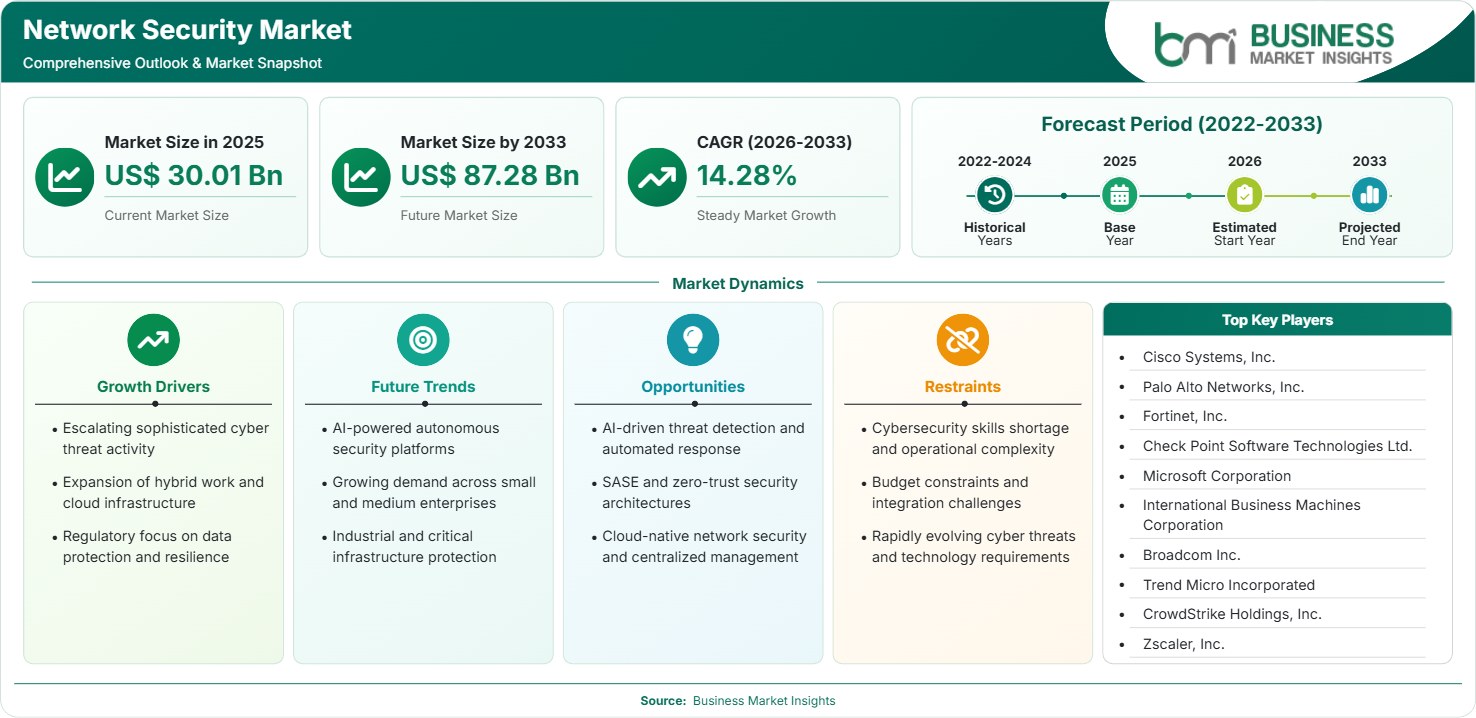
The Network Security Market size was valued at US$ 30.01 Billion in 2025 and is projected to reach US$ 87.28 Billion by 2033, growing at a CAGR of 14.28% during 2026–2033, driven by zero-trust adoption, cloud migration, AI-enabled threat detection, regulatory compliance requirements, and expanding protection needs across distributed enterprise networks and critical infrastructure.

Report Coverage
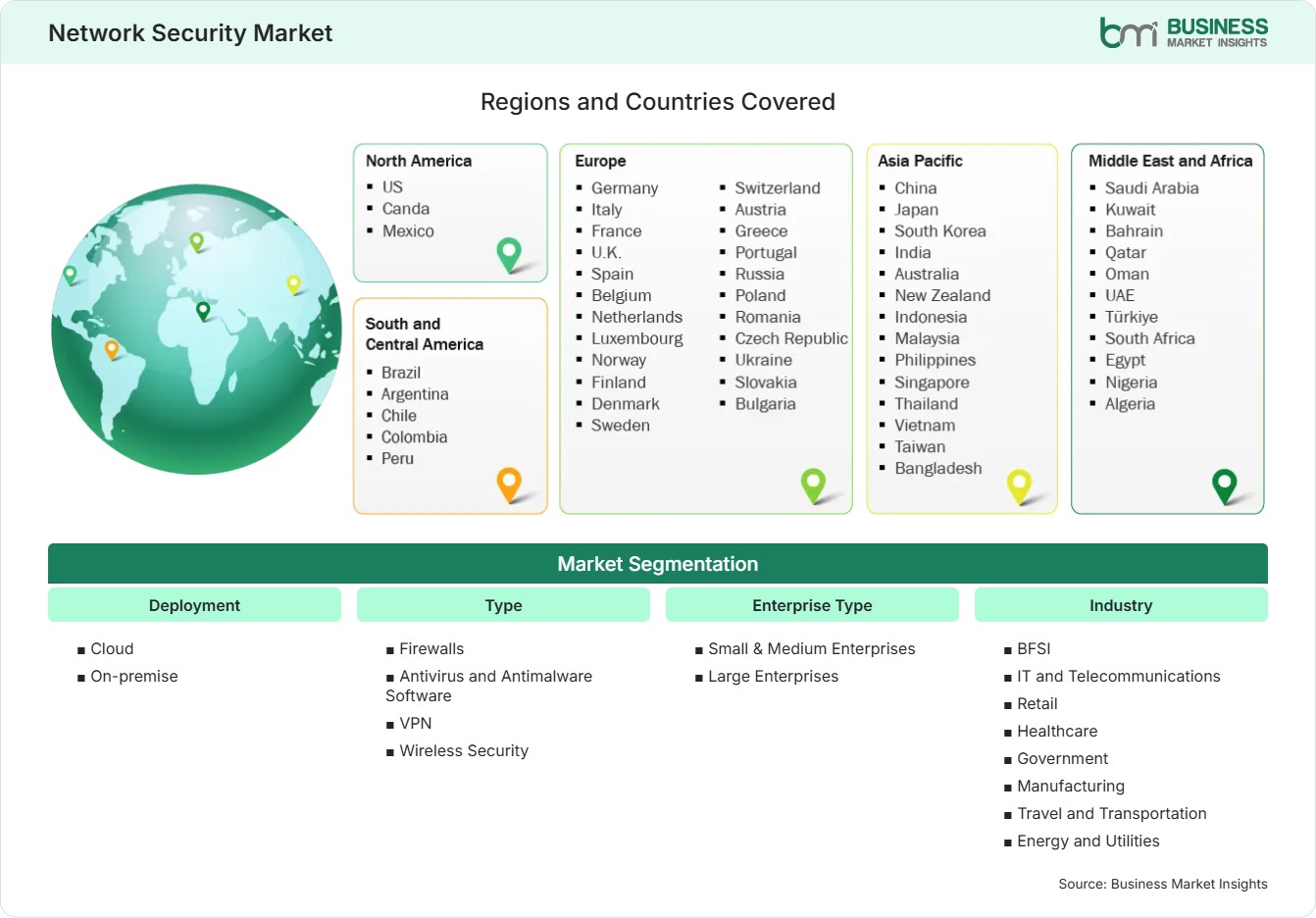
  • Deployment: Cloud, On-premise
  • Type: Firewalls, Antivirus and Antimalware Software, VPN, Wireless Security
  • Enterprise Type: Small & Medium Enterprises, Large Enterprises
  • Industry: BFSI, IT and Telecommunications, Retail, Healthcare, Government, Manufacturing, Travel and Transportation, Energy and Utilities
US$ 30.01 Bn Market size in 2025
US$ 87.28 Bn Market Size by 2033
14.28% CAGR, 2026 - 2033
2026-2033 Forecast Period

AI Overview

Network Security Market Summary

  • North America Region: North America holds a market share of 39%–42% in 2025, growing at a CAGR of 12.8%–13.6% during 2026–2033. Growth is driven by cybersecurity spending, cloud adoption, critical infrastructure protection, AI-powered monitoring, regulatory mandates, security modernization programs, and rising enterprise demand for integrated cyber defense architectures globally. US market benefits from strong vendor presence and federal cybersecurity initiatives, advancing at a CAGR of 13.0%–13.8%.
  • Fastest Growing Region: Asia Pacific holds a market share of 25%–28% in 2025, growing at a CAGR of 16.2%–17.1% during 2026–2033. Key drivers include digitalization, 5G deployment, industrial connectivity, data localization policies, increasing cyberattacks, cloud expansion, government investment programs, and enterprise technology modernization across emerging economies.
  • Leading Segment: Firewalls account for 31%–34% share in 2025 and are expected to grow at a CAGR of 13.2%–14.0%. Demand remains supported by perimeter security requirements, secure branch networking, hybrid workplace protection, advanced inspection capabilities, and increasing deployment of next-generation firewall platforms.
  • High Growth Segment: Cloud deployment represents 44%–47% share in 2025 and is projected to expand at a CAGR of 17.0%–18.0%. Adoption accelerates through multi-cloud environments, scalable protection models, subscription pricing advantages, centralized management frameworks, and expanding secure access service edge deployments worldwide.
  • Key Market Opportunity: Enterprises increasingly integrate AI, SASE, and zero-trust frameworks into unified platforms, creating substantial opportunities for vendors delivering automated protection, visibility, analytics, compliance management, and cloud-native security capabilities.
  • Major Market Players: Cisco Systems, Inc.; Palo Alto Networks, Inc.; Fortinet, Inc.; Check Point Software Technologies Ltd.; Microsoft Corporation; International Business Machines Corporation; Broadcom Inc.; Trend Micro Incorporated; CrowdStrike Holdings, Inc.; Zscaler, Inc.
Strategic Insights

Network Security Market: Strategic Insights

Network Security Market Strategic Framework
FREE PDF
Request your free sample
Request free sample
Stakeholder View

Key Takeaways

  • The value chain is increasingly shifting from standalone security products toward integrated platforms combining firewall management, cloud protection, identity controls, analytics, and managed security services.
  • Cloud deployment and SME adoption present the strongest expansion potential as organizations prioritize scalable cybersecurity solutions with lower infrastructure management requirements.
  • Product innovation is moving toward AI-driven threat intelligence, automated incident response, SASE architectures, and zero-trust frameworks capable of securing distributed work environments.
  • Asia Pacific offers a compelling investment proposition due to rapid digitalization, telecommunications expansion, industrial automation projects, and government-backed cybersecurity initiatives.
  • Strategic acquisitions continue reshaping competition as technology providers acquire cloud monitoring, threat exposure management, and AI security specialists to expand platform capabilities.
  • Healthcare, BFSI, and manufacturing sectors are emerging as major demand centers because cyberattacks increasingly target sensitive operational and customer data.
Geographic Outlook

Network Security Market Regional Highlights

North America Network Security Market

North America accounted for approximately 39%–42% Network Security Market share in 2025 and is projected to expand at a CAGR of 12.8%–13.6% through 2033. Strong cybersecurity budgets, advanced cloud adoption, widespread digital transformation, and stringent compliance frameworks support demand. Large enterprises continue investing in SASE, zero-trust, and AI-driven protection technologies. Federal cybersecurity programs and critical infrastructure modernization initiatives further strengthen spending across government, healthcare, banking, and telecommunications environments.

  • Large enterprises increasingly consolidate vendors to reduce complexity while improving visibility across hybrid cloud and on-premise environments.
  • Banking institutions are investing in advanced threat detection and identity-based security architectures to combat sophisticated cyberattacks.
  • Critical infrastructure operators prioritize operational technology protection and network segmentation to reduce exposure to disruptive attacks.
  • Security service providers expand managed offerings as organizations address ongoing cybersecurity skills shortages.

US Network Security Market

The United States represented approximately 82%–86% of North American revenue in 2025 and is forecast to grow at a CAGR of 13.0%–13.8%. The demand is still driven by enterprise digitization, defense modernization efforts, cloud ecosystem growth, and ransomware attacks. The technology leadership, cyber security innovations, and massive investments from the private sector keep the nation as the key market contributor in the region.

  • Federal cybersecurity mandates encourage modernization of security infrastructure across government agencies and contractors.
  • Energy and utility operators strengthen network monitoring capabilities to secure evolving critical infrastructure systems.
  • Healthcare organizations increase investment to comply with privacy requirements and address growing attack frequency.
  • Telecommunications providers deploy advanced security controls supporting 5G and edge computing networks.

Europe Network Security Market

Europe held 24%–27% share in 2025 and is projected to record a CAGR of 13.0%–14.0%. Regional growth is driven by obligations to comply with GDPR regulations, implementation of cloud technology, and needs for industrial cyber security. Germany continues to be the top country, while Eastern Europe shows faster growth rates. Growing investments in cyber resilience and digital sovereignty initiatives ensure steady demand for services.

  • Germany leads regional adoption through industrial automation investments and manufacturing cybersecurity modernization.
  • The United Kingdom demonstrates strong implementation of cloud-native security and managed detection services.
  • France expands national cybersecurity capabilities supporting public sector digitalization strategies.
  • Poland and Romania emerge as higher-growth markets with increasing enterprise cybersecurity investments.
  • Regulatory frameworks continue encouraging security upgrades across financial and healthcare institutions.

Asia Pacific Network Security Market

Asia Pacific accounted for 25%–28% Network Security Market share in 2025 and is expected to achieve the fastest CAGR of 16.2%–17.1% through 2033. Factors such as fast digitization, rising internet access, industrial connections schemes, and heightened cybersecurity risks are some of the reasons for high demands. Among other nations, China is considered the biggest market while India and Southeast Asian countries are notable in terms of growth potential.

  • Enterprises increasingly deploy cloud security solutions to support scalable digital transformation programs.
  • India records strong growth driven by fintech expansion, digital services, and cybersecurity policy development.
  • Japan continues investing in advanced threat intelligence and critical infrastructure protection capabilities.
  • Southeast Asia experiences increasing demand from telecommunications, manufacturing, and e-commerce sectors.
  • Regional governments strengthen cyber resilience through investment programs and compliance requirements.

Rest of World Network Security Market

Rest of World represented 8%–10% Network Security Market share in 2025 and is expected to grow at a CAGR of 14.5%–15.5%. South and Central America benefit from digital banking growth and enterprise cloud migration initiatives. The Middle East and Africa continue expanding cybersecurity investments linked to smart city projects, energy infrastructure modernization, and public sector digital transformation strategies. Saudi Arabia, UAE, and Brazil remain important contributors.

  • Brazil leads regional spending through banking sector cybersecurity modernization initiatives.
  • Mexico benefits from manufacturing digitalization and increasing enterprise connectivity requirements.
  • Saudi Arabia accelerates investment under national digital transformation and cyber resilience strategies.
  • UAE supports demand through smart city and critical infrastructure protection programs.
  • Energy sector expansion drives security deployment across industrial operations and utilities networks.
Global Market Geography
FREE PDF
Request your free sample
Request free sample
Segment Analysis

Network Security Market Segmentation

Deployment

Deployment segment reflects evolving enterprise preferences across cloud and traditional environments. The segment accounted for nearly 100% market allocation, with cloud contributing the larger proportion. Network Security Market scope continues expanding as organizations pursue operational agility. Cloud deployment held 44%–47% share in 2025 and records the fastest CAGR of 17.0%–18.0%, while on-premise solutions remain important for regulated environments requiring direct infrastructure control.

  • Cloud: Supports centralized management, faster deployment cycles, scalable protection models, and stronger integration with remote access, multi-cloud environments, and subscription-based security operations.
  • On-premise: Preferred by organizations requiring extensive customization, local data control, compliance assurance, and protection of highly sensitive operational and business information assets.

Type

The type segment remains highly diversified as enterprises implement layered cybersecurity defenses. Firewalls retained the largest revenue contribution with 31%–34% share in 2025 and CAGR of 13.2%–14.0%. Network Security Market trends indicate rising adoption of AI-enhanced threat detection, secure access frameworks, and integrated policy management capabilities across enterprise network environments.

  • Firewalls: Continue serving as foundational security controls, providing traffic inspection, segmentation, threat prevention, and visibility across distributed network architectures.
  • Antivirus and Antimalware Software: Focuses on endpoint protection, behavioral analytics, ransomware defense, and automated malware detection for enterprise assets.
  • VPN: Enables secure remote connectivity through encrypted communications supporting hybrid workforces and geographically dispersed operations.
  • Wireless Security: Addresses risks arising from mobile connectivity, wireless infrastructure expansion, and growing enterprise reliance on connected devices.

Enterprise Type

Demand differs according to organizational scale, security maturity, and budget structures. Large enterprises presently account for the majority of spending with 58%–61% share in 2025, while SMEs are projected to expand faster at 15.5%–16.5% CAGR as affordable cloud-native solutions become increasingly accessible across sectors.

  • Small & Medium Enterprises (SMEs): Adoption accelerates through managed services, cost-efficient subscriptions, and growing awareness regarding cyber risk exposure.
  • Large Enterprises: Continue investing in integrated security architectures, security operations centers, and advanced threat intelligence programs.

Industry

Industry adoption patterns reflect digital maturity, regulatory requirements, and cyber risk exposure. BFSI remains the leading vertical with 20%–23% share in 2025, while healthcare demonstrates one of the highest growth trajectories through 2033 due to growing protection needs for sensitive data and connected environments.

  • BFSI: Prioritizes fraud prevention, compliance management, customer data protection, and operational resilience.
  • IT and Telecommunications: Invests heavily in securing cloud infrastructure, networks, and customer-facing digital platforms.
  • Retail: Focuses on payment security, omnichannel operations, and customer information protection.
  • Healthcare: Expands investment to protect electronic records, connected devices, and clinical systems.
  • Government: Strengthens cyber resilience programs protecting citizen data and public infrastructure.
  • Manufacturing: Deploys operational technology security for connected production environments.
  • Travel and Transportation: Improves security across digital platforms, mobility systems, and passenger information networks.
  • Energy and Utilities: Enhances infrastructure protection and operational continuity across critical assets.
Market Forces

Network Security Market Dynamics

Key Market Drivers

Escalating Sophisticated Cyber Threat Activity

Organizations face increasingly complex ransomware campaigns, phishing attacks, and advanced persistent threats targeting critical systems. Threat actors use automation and AI methodologies, which help to increase both the frequency and complexity of attacks. In order to cope with the situation, companies are using sophisticated security monitoring and analytics systems along with threat intelligence. The priorities for security investments are shifting towards prevention, detection, and reaction. This shift is additionally stimulated by regulatory requirements and executive management’s awareness. Due to the expansion of attack surfaces via cloud technologies and IoT, new security frameworks become critical.

Expansion of Hybrid Work and Cloud Infrastructure

The transition toward hybrid workforces and cloud-centric operations has fundamentally altered network architecture requirements. Employees connect to applications from many different locations, using various devices, thus raising the risk levels. Companies are now adopting the use of VPNs, SASE, Identity Governance, and cloud-native security to protect their networks. As more organizations move their applications outside their traditional perimeters, continuous monitoring and enforcement become essential. The adoption of software-as-a-service solutions is another factor that raises the need for security platforms.

Regulatory Focus on Data Protection and Resilience

Governments worldwide continue strengthening cybersecurity and privacy requirements. Financial firms, hospitals, utility companies, and government departments are under increasing pressure to provide assurances about their security controls and reporting procedures. Compliance pressures lead to the development of security monitoring tools, encryption, access control, and audit capabilities. Cyber resilience is now seen as a governance problem, rather than one of IT operations. Companies with security systems that can document and report on compliance and risk management benefit from this trend.

Key Market Opportunities

AI-Powered Autonomous Security Platforms

Artificial intelligence is creating opportunities for vendors to transform traditional security management approaches. Automated detection, response, prioritization, and remediation capabilities help security teams address growing alert volumes and staffing shortages. Organizations require analytics and monitoring that help increase efficiency. Those vendors who are looking to develop explainable AI, threat intelligence, and automation can distinguish themselves from other providers. Network Security Market Forecasts increasingly take into account the desire to create a smart platform that would decrease response time and increase accuracy. Investments in the automation of cyber security technologies are forecast to bring great profits.

Growing Demand Across Small and Medium Enterprises

SMEs represent a substantial underpenetrated opportunity. Smaller companies used limited security solutions earlier because of budget and resource constraints. Cloud delivery approaches allow access to sophisticated protection technologies without substantial infrastructure costs. Managed security services, pay-for-service model, and easy management make solutions more accessible. Increased awareness about cyber threat and high security standards of customers push companies to choose such solutions. Vendors creating affordable solutions for SMEs may increase market opportunities and improve cybersecurity readiness of economic ecosystems.

Industrial and Critical Infrastructure Protection

Industrial connectivity and operational technology modernization create attractive growth opportunities. A manufacturing facility, utilities, a transportation system, and an energy provider need to have special security solutions that can protect a highly sophisticated environment of operations. With the increasing use of connectivity and automation, there is a need for greater security. Vendors with integrated capabilities of IT/OT security will be able to take advantage of that demand. Critical infrastructure resilience programs in many countries will increase market opportunities even more.

Market Restraints and Challenges

Cybersecurity Skills Shortage and Operational Complexity

Factor: Persistent shortages of skilled cybersecurity professionals limit organizational ability to manage increasingly sophisticated security environments. Enterprises often operate multiple tools across networks, endpoints, cloud resources, and applications. Impact: Inexperience is likely to affect the reaction time of responding to any issues, increase mistakes in setting up, and lower the efficacy of any implemented solutions. Alert fatigue and inefficiencies are common problems that security teams often encounter when dealing with a massive amount of threat data. Small companies tend to have more difficulty because of budget constraints.

Budget Constraints and Integration Challenges

Factor: Many organizations struggle to justify extensive cybersecurity investments while balancing competing technology priorities. Legacy infrastructure frequently creates compatibility issues during modernization initiatives. Impact: Procurement processes tend to take longer, integration becomes more complicated, and there are cases of project delay. There might be a need for more consulting, customization, and costs involved in operations. Companies that look for integrated security systems encounter high transition costs. These are some of the obstacles that may prevent a quick implementation, especially for medium-sized companies.

Company Analysis

Competitive Landscape

Network Security Market analysis indicates competition is centered on platform integration, cloud security expansion, AI-powered threat detection, and managed security capabilities.

Company Name

Overview

Products and Services relevant to this market

Cisco Systems, Inc.

Global networking and cybersecurity provider serving enterprises, governments, and service providers worldwide.

Firewalls, secure access solutions, network analytics, zero-trust platforms, and security management services.

Palo Alto Networks, Inc.

Cybersecurity specialist focused on integrated platform-based protection architectures.

Next-generation firewalls, cloud security, SASE, threat intelligence, and security operations solutions.

Fortinet, Inc.

Security vendor known for high-performance network protection technologies.

FortiGate firewalls, secure networking, SD-WAN security, cloud protection, and analytics platforms.

Check Point Software Technologies Ltd.

Enterprise cybersecurity provider emphasizing threat prevention and unified management.

Firewalls, cloud security, endpoint protection, threat intelligence, and exposure management solutions.

Microsoft Corporation

Technology leader integrating cybersecurity across cloud and enterprise environments.

Security monitoring, identity protection, cloud security, threat intelligence, and access management.

International Business Machines Corporation

Enterprise technology company offering cybersecurity consulting and security software.

Managed security, threat detection, governance tools, and security operations capabilities.

Broadcom Inc.

Advanced technology company with enterprise security software portfolio.

Enterprise security management, protection platforms, and infrastructure security solutions.

Trend Micro Incorporated

Cybersecurity specialist with strong enterprise and cloud security presence.

Network defense, cloud workload protection, threat intelligence, and risk management solutions.

CrowdStrike Holdings, Inc.

Cloud-native cybersecurity provider leveraging AI and threat intelligence.

Endpoint protection, threat hunting, security operations, and cloud security platforms.

Zscaler, Inc.

Security company focused on cloud-delivered secure access architectures.

Zero-trust access, secure web gateways, cloud security, and SASE capabilities.

Trust & Transparency

Research Methodology

The market analysis combines proprietary research with secondary data from government agencies, company disclosures, regulatory filings, industry databases and expert interviews. Market estimates are validated through data triangulation, cross-market benchmarking and analyst review.

View Full Research Methodology

Questions Answered

Frequently Asked Questions

What does this Network Security Market Report help stakeholders evaluate?

The study helps stakeholders assess competitive positioning, regional opportunities, technology evolution, demand trends, investment priorities, growth segments, and strategic decision-making considerations through 2033.

Which region offers the strongest future growth potential?

Asia Pacific presents the most attractive expansion opportunity due to rapid digitalization, growing cloud adoption, increasing cyber awareness, and supportive government cybersecurity programs.

Why is cloud deployment growing faster than on-premise deployment?

Cloud deployment offers scalability, centralized administration, rapid implementation, flexible subscription models, and easier integration across distributed enterprise environments, making it attractive for modern organizations.

Which industry generates the highest demand?

BFSI remains a leading adopter due to stringent compliance requirements, high-value digital transactions, sensitive customer data management, and the need for resilient operational security frameworks.

What is driving demand for advanced network security solutions?

Cyberattacks targeting cloud infrastructure, remote work environments, connected devices, and critical infrastructure are increasing. Organizations require stronger visibility, threat detection, compliance capabilities, and automated response mechanisms to reduce cyber risk.

Access the Full Network Security Market Report

Get segment-level forecasts, regional estimates, competitive benchmarking, company profiles and downloadable Excel datasets.

Access the full Network Security Market Report
350 pages PDF & Excel | 2026-08-31