
Security Solutions Market Outlook: Size, Share, Trends, Growth Analysis, Competitive Landscape & Forecast, 2026-2033

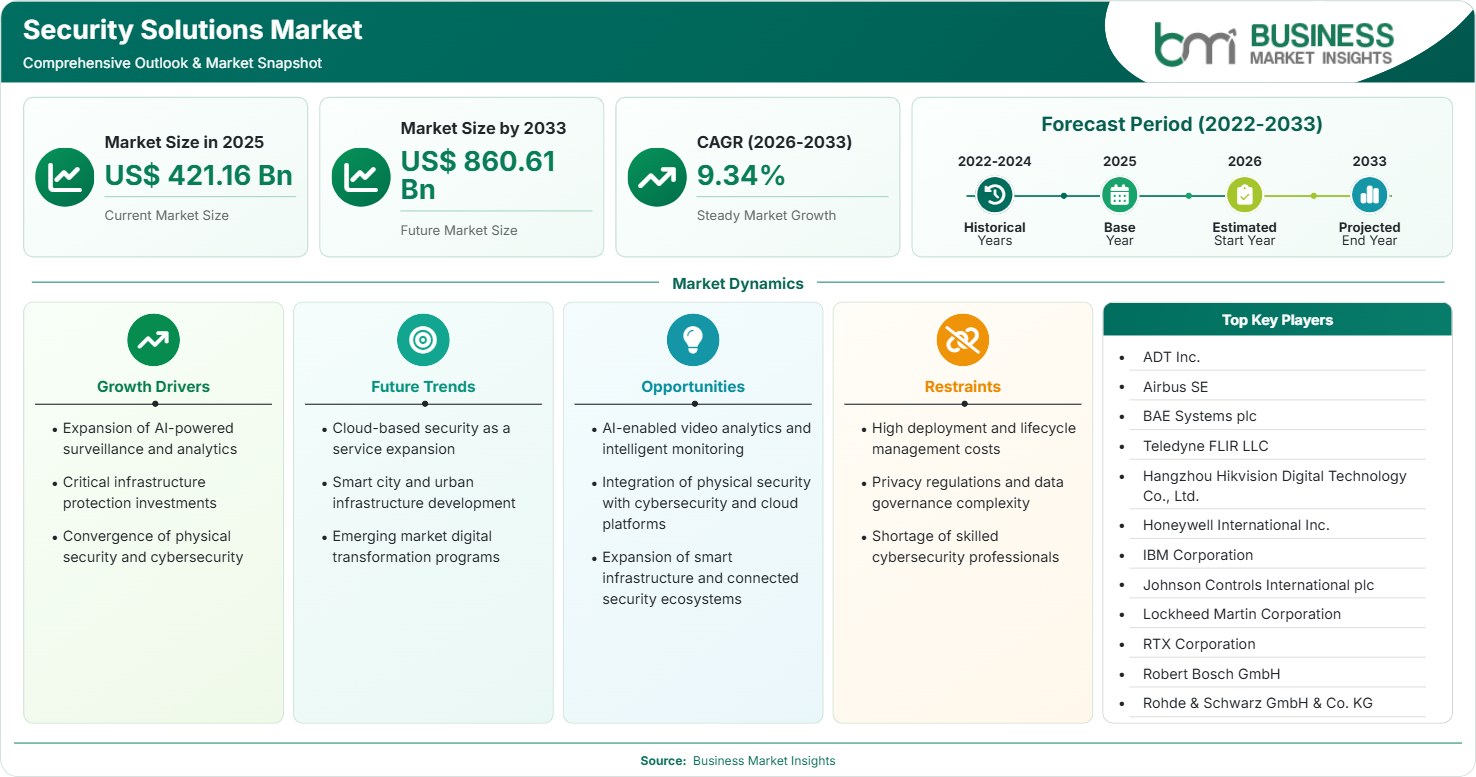
The Security Solutions Market size was valued at US$ 421.16 Billion in 2025 and is projected to reach US$ 860.61 Billion by 2033, growing at a CAGR of 9.34% during 2026–2033. Rising adoption of AI-enabled surveillance, cloud-based monitoring, critical infrastructure protection, and integrated physical-cybersecurity platforms is creating significant opportunities across commercial, government, and industrial environments.

Report Coverage
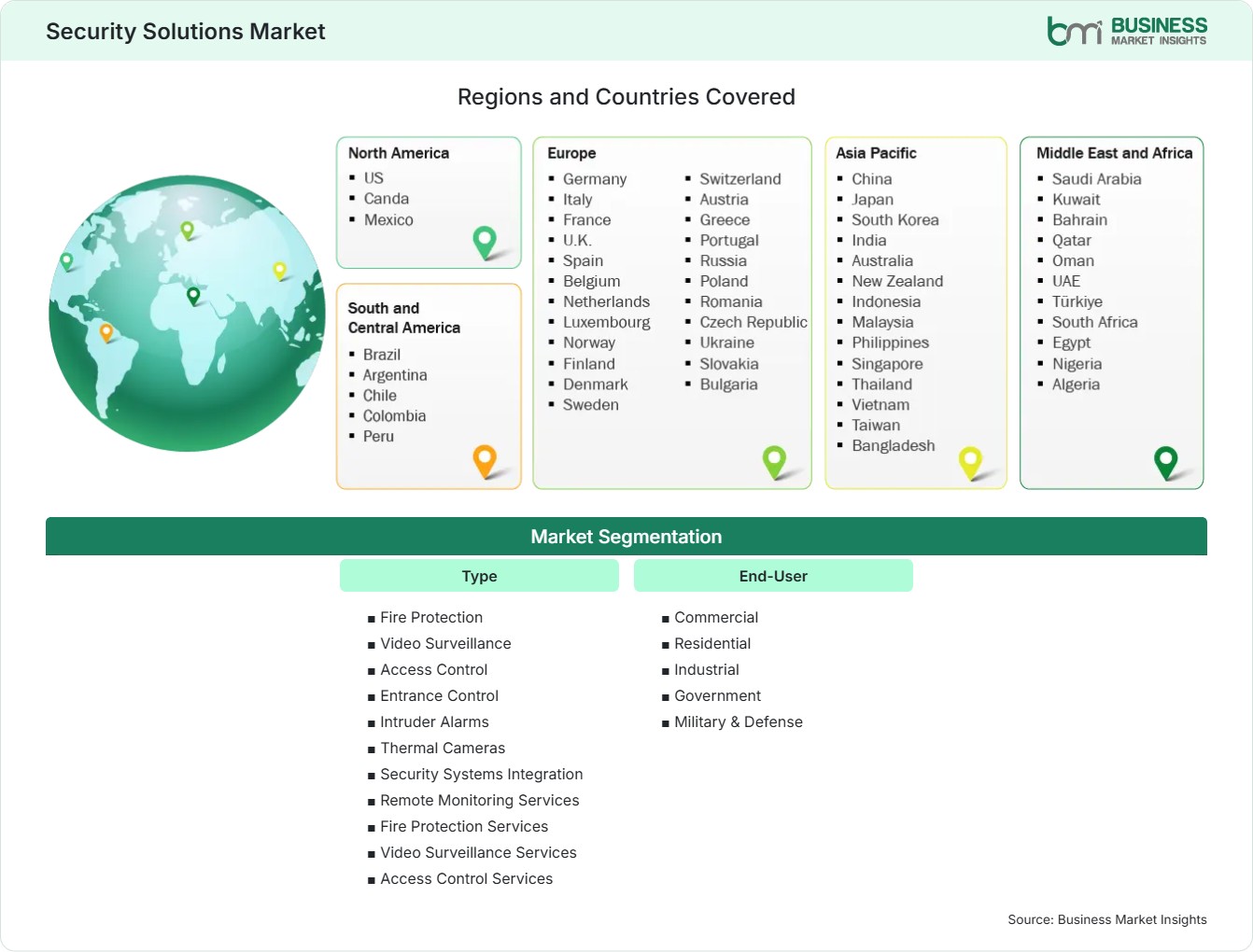
  • Type: Fire Protection, Video Surveillance, Access Control, Entrance Control, Intruder Alarms, Thermal Cameras, Security Systems Integration, Remote Monitoring Services, Fire Protection Services, Video Surveillance Services, Access Control Services
  • End-User: Commercial, Residential, Industrial, Government, Military & Defense
US$ 421.16 Bn Market size in 2025
US$ 860.61 Bn Market Size by 2033
9.34% CAGR, 2026 - 2033
2026-2033 Forecast Period

AI Overview

Security Solutions Market Summary

  • North America Region: North America holds a market share of 34%–37% in 2025, growing with a CAGR of 8.5%–9.0% during 2026–2033. Strong investments in critical infrastructure protection, AI surveillance deployment, cloud-enabled monitoring, and regulatory compliance requirements continue to support technology modernization and service expansion opportunities across sectors. The U.S. market benefits from extensive enterprise digitization, smart infrastructure spending, and increasing deployment of integrated security ecosystems, advancing at a CAGR of 8.7%–9.2%.
  • Fastest Growing Region: Asia Pacific accounts for 25%–28% share in 2025 and is projected to expand at a CAGR of 10.8%–11.5% through 2033. Rapid urbanization, smart city investments, transportation modernization, industrial automation, and growing public safety programs continue creating substantial deployment opportunities for advanced security technologies.
  • Leading Segment: Video Surveillance represents 27%–31% of total revenue in 2025 and is expected to grow at a CAGR of 9.5%–10.2%. Increasing use of AI analytics, edge processing, cloud storage, behavioral recognition, and real-time threat detection enhances adoption across commercial and public environments.
  • High Growth Segment: Remote Monitoring Services hold 11%–14% market share in 2025 and are forecast to expand at a CAGR of 11.8%–12.6%. Growing demand for centralized operations centers, predictive alert management, subscription-based monitoring, and workforce optimization continues accelerating enterprise adoption globally.
  • Key Market Opportunity: Expanding convergence between physical security, cybersecurity, AI analytics, and cloud management platforms enables unified threat intelligence, operational efficiency improvements, proactive risk mitigation, and recurring service-based revenue opportunities for solution providers.
  • Major Market Players: ADT Inc., Airbus SE, BAE Systems plc, Teledyne FLIR LLC, Hangzhou Hikvision Digital Technology Co., Ltd., Honeywell International Inc., IBM Corporation, Johnson Controls International plc, Lockheed Martin Corporation, RTX Corporation, Robert Bosch GmbH, Rohde & Schwarz GmbH & Co. KG, Thales S.A., and Carrier Global Corporation.
Strategic Insights

Security Solutions Market: Strategic Insights

Security Solutions Market Strategic Framework
FREE PDF
Request your free sample
Request free sample
Stakeholder View

Key Takeaways

  • The industry is transitioning from hardware-centric deployments toward integrated ecosystems combining software platforms, AI analytics, cloud management, monitoring services, and cybersecurity controls, increasing recurring revenue opportunities across the value chain.
  • Remote monitoring services, AI-powered video analytics, and unified security management platforms present the strongest medium-term expansion potential due to increasing enterprise demand for operational efficiency and centralized visibility.
  • Innovation is increasingly focused on edge intelligence, generative AI-assisted threat recognition, predictive maintenance, digital twins, and multi-sensor integration capable of transforming surveillance systems into real-time decision-support platforms.
  • Asia Pacific offers one of the most compelling investment opportunities due to rapid urbanization, transportation modernization, smart city development, and expanding public safety spending programs.
  • Strategic acquisitions increasingly target software developers, AI analytics providers, cloud platform specialists, and cybersecurity firms as companies seek integrated offerings spanning physical and digital protection.
  • Growing convergence between operational technology, information technology, and physical security systems is creating opportunities for vendors capable of delivering interoperable, scalable, and compliance-focused solutions.
Geographic Outlook

Security Solutions Market Regional Highlights

North America Security Solutions Market

North America maintains leadership due to extensive deployment across critical infrastructure, commercial facilities, transportation hubs, defense installations, and smart buildings. The region accounts for approximately 34%–37% of global Security Solutions Market revenue in 2025 and is projected to expand at a CAGR of 8.5%–9.0% through 2033. Strong technology spending, mature enterprise security frameworks, cloud adoption, and increasing convergence between physical and cyber protection systems continue supporting market expansion. The region also benefits from extensive managed security services adoption and AI-driven monitoring investments.

  • Enterprises increasingly deploy unified platforms integrating video, access control, alarms, and analytics into centralized command environments that improve situational awareness and operational efficiency.
  • Federal infrastructure modernization initiatives continue supporting demand for intelligent surveillance, perimeter protection, and critical asset monitoring technologies.
  • AI-enabled video analytics adoption is accelerating across logistics facilities, educational campuses, healthcare institutions, and transportation networks.
  • Organizations increasingly prioritize cybersecurity integration within physical protection architectures to reduce vulnerabilities across connected environments.

US Security Solutions Market

The United States contributes approximately 74%–78% of the regional Security Solutions Market share and is projected to expand at a CAGR of 8.7%–9.2% through 2033. Enterprise digitization, defense spending, smart infrastructure development, and cloud-based security adoption continue supporting growth. Increasing regulatory scrutiny around data protection and operational resilience is driving modernization of legacy systems across public and private sectors. Strong demand for AI-enhanced analytics, mobile credentials, and integrated monitoring solutions further strengthens market prospects.

  • Critical infrastructure operators increasingly adopt AI-driven monitoring systems capable of identifying anomalies and improving incident response times.
  • Commercial real estate owners continue investing in integrated building management and access control platforms.
  • Defense and homeland security spending support deployment of advanced surveillance, thermal imaging, and perimeter detection solutions.
  • Adoption of cloud-native monitoring architectures continues expanding across distributed enterprise environments.

Europe Security Solutions Market

Europe represents approximately 26%–29% of the global Security Solutions Market revenue in 2025 and is expected to grow at a CAGR of 8.8%–9.5% during the forecast period. Regulatory emphasis on privacy, infrastructure security, and cyber resilience encourages investments in compliant technologies. Germany remains the largest regional market, while Eastern European countries and selected Nordic markets demonstrate faster expansion rates between 9.5% and 10.5%. Industrial automation, transportation modernization, and public safety initiatives continue driving adoption across the region.

  • GDPR compliance requirements influence purchasing decisions, increasing demand for privacy-focused surveillance technologies.
  • Industrial facilities increasingly deploy integrated access control and video analytics systems to protect automated operations.
  • Transportation infrastructure projects support investment in intelligent monitoring and emergency response capabilities.
  • Software-centric security architectures are gaining preference over standalone hardware deployments.

Asia Pacific Security Solutions Market

Asia Pacific accounts for 25%–28% of the Security Solutions Market revenue in 2025 and is expected to register the fastest CAGR of 10.8%–11.5% through 2033. China remains the largest contributor, while India and Southeast Asian countries represent high-growth markets with CAGR ranges between 11.5% and 12.5%. Smart city initiatives, transportation expansion, industrial digitalization, and public safety investments continue accelerating deployment of advanced surveillance and access management technologies.

  • Governments increasingly integrate AI-powered surveillance into urban safety and transportation management initiatives.
  • Manufacturing facilities adopt intelligent monitoring systems to support automation and operational continuity.
  • Rapid infrastructure development drives demand for perimeter protection, access control, and fire safety systems.
  • Local technology providers are expanding AI-enabled video analytics and cloud monitoring capabilities to address evolving requirements.

Rest of World Security Solutions Market

Rest of World accounts for approximately 10%–13% of global revenue in 2025 and is forecast to grow at a CAGR of 9.2%–10.0% through 2033. The Middle East benefits from substantial investments in critical infrastructure, airports, and smart city developments. South and Central America are witnessing increasing adoption across commercial facilities, transportation networks, and public safety applications. Saudi Arabia and the UAE remain leading regional markets, while Brazil demonstrates strong growth potential.

  • Mega infrastructure projects continue supporting demand for integrated monitoring and access management technologies.
  • Public safety modernization programs encourage deployment of advanced surveillance systems across urban environments.
  • Energy facilities increasingly invest in thermal imaging and perimeter protection technologies.
  • Cloud-based monitoring services gain traction among organizations seeking scalable and cost-efficient security operations.
Global Market Geography
FREE PDF
Request your free sample
Request free sample
Segment Analysis

Security Solutions Market Segmentation

Type

The Type segment accounted for approximately 68%–72% of total revenue in 2025 and is expected to expand at a CAGR of 9.2%–9.8% through the forecast period. The Security Solutions Market scope continues expanding as organizations prioritize integrated protection strategies combining hardware, software, and managed services. Increasing demand for AI-powered surveillance, cloud-connected systems, and recurring service models is reshaping purchasing behavior while creating long-term revenue opportunities across multiple end-user industries.

  • Fire Protection: Adoption is increasing across commercial buildings, industrial facilities, healthcare institutions, and transportation hubs as organizations seek faster incident detection, compliance support, and business continuity protection.
  • Video Surveillance: AI-enabled analytics, facial recognition capabilities, cloud storage integration, and real-time monitoring functionality continue driving demand across public safety, retail, transportation, and enterprise applications.
  • Access Control: Organizations increasingly deploy biometric authentication, mobile credentials, and cloud-managed identity solutions to improve security, operational efficiency, and regulatory compliance across distributed facilities.
  • Entrance Control: Smart gates, turnstiles, visitor management systems, and automated screening technologies are gaining traction in commercial buildings, airports, educational campuses, and critical infrastructure environments.
  • Intruder Alarms: Enhanced sensor accuracy, wireless deployment capabilities, and integration with centralized command systems are supporting broader adoption across residential and commercial environments.
  • Thermal Cameras: Growing deployment in perimeter monitoring, critical infrastructure protection, industrial facilities, and defense applications supports demand for advanced thermal imaging technologies.
  • Security Systems Integration: Organizations increasingly require unified platforms capable of consolidating surveillance, alarms, access control, and analytics into centralized operational environments.
  • Remote Monitoring Services: Subscription-based monitoring models improve operational visibility, incident response efficiency, and cost optimization for enterprises managing geographically dispersed assets.
  • Fire Protection Services: Inspection, maintenance, compliance auditing, and managed fire safety programs continue generating stable recurring revenue opportunities for service providers.
  • Video Surveillance Services: Managed video monitoring, analytics support, and cloud storage management services are becoming increasingly attractive for organizations seeking operational efficiency.
  • Access Control Services: Lifecycle management, credential administration, technical support, and policy management services help organizations optimize security infrastructure performance.

End-User

The Commercial segment remains the largest contributor within end-user categories, representing approximately 29%–33% of revenue in 2025 and advancing at a CAGR of 9.1%–9.7%. Security Solutions Market trends indicate increasing deployment of integrated platforms across offices, retail environments, hospitality facilities, and mixed-use developments. Growing emphasis on operational efficiency, regulatory compliance, and customer safety continues encouraging investments in intelligent surveillance, access control, and monitoring technologies.

  • Commercial: Enterprises increasingly prioritize unified security architectures capable of supporting employee safety, asset protection, compliance requirements, and operational efficiency across complex facilities.
  • Residential: Smart home adoption, connected security devices, cloud monitoring services, and mobile-based management platforms continue supporting strong demand among residential consumers.
  • Industrial: Manufacturing facilities, logistics centers, utilities, and energy operations deploy advanced monitoring technologies to protect assets, support automation, and reduce operational risks.
  • Government: Public-sector agencies invest in surveillance, access control, emergency response systems, and critical infrastructure protection to strengthen security resilience and citizen safety.
  • Military & Defense: Rising geopolitical tensions and modernization initiatives continue driving investment in thermal imaging, perimeter protection, command systems, and advanced surveillance technologies.
Market Forces

Security Solutions Market Dynamics

Key Market Drivers

Expansion of AI-Powered Surveillance and Analytics

AI is changing the field of security through automatic threat detection, behavioral analysis, object identification, and predictive monitoring. Companies are beginning to adopt AI-driven technology to increase efficiency during incident response and reduce costs associated with manual monitoring. Industry research has shown that with the help of AI, there will be higher chances of accurate detection as well as lower chances of false positives. Edge computing is becoming increasingly popular and allows for real-time analysis without large amounts of bandwidth. With the need for increased visibility and proactive risk management in various companies and industries, the market for intelligent surveillance is rapidly growing. This technological evolution remains a major contributor to Security Solutions Market growth.

Critical Infrastructure Protection Investments

Investments in critical infrastructure security have been increased due to the rising fears about operational interruptions, cyber-physical threats, and dangers to public safety. More sophisticated solutions are being called for in energy plants, transport systems, utility systems, airfields, and communication systems due to the need for security, access control, perimeter security, and event response measures. The regulatory focus on resilience and risk management further drives modernization efforts. Infrastructure projects across North America, Europe, Asia Pacific, and the Middle East maintain a high demand for integrated security systems. With increased interconnectivity of critical infrastructure assets, organizations are increasingly looking at security architectures to meet their security needs.

Convergence of Physical Security and Cybersecurity

Connected security devices create a number of operational benefits but also pose cybersecurity threats. Businesses are becoming aware of the need for integrated security approaches that will be able to address physical as well as digital threats. The use of a platform that combines surveillance, access control, monitoring, and threat intelligence helps to have better visibility over operations. Security Solutions Market growth is further supported by increasing demand for interoperable solutions that reduce risk exposure while improving compliance with evolving regulatory and industry standards. This convergence trend is reshaping investment priorities across enterprise security programs.

Key Market Opportunities

Cloud-Based Security as a Service Expansion

Cloud-native security platforms are creating significant opportunities for vendors transitioning from product-centric business models toward recurring service revenues. Subscription models that reduce capital expenditure and improve scalability are becoming increasingly common in organizations. The ability to manage remotely, gain insight from a single location, conduct automatic software updates, and perform analysis all increase the value proposition. Small and medium-sized enterprises make up a very lucrative customer base. Security Solutions Market Forecasts indicate that the adoption of managed services and cloud-based monitoring solutions will experience further growth during the forecast period in the quest for efficiency and transformation.

Smart City and Urban Infrastructure Development

Governments worldwide continue investing in smart transportation, intelligent traffic management, public safety platforms, and connected urban infrastructure. Such initiatives would necessitate the widespread use of surveillance cameras, analytics applications, access control systems, emergency response technology, and command centers. With increasing population in urban areas, the significance of effective security management and situational awareness solutions increases. Solution providers that can bring together different technologies in a scalable solution will be able to take advantage of the initiative. There is also an opportunity beyond hardware solutions in analytics, monitoring services, and data management solutions.

Emerging Market Digital Transformation Programs

Rapid industrialization, infrastructure development, and economic growth across emerging markets continue to generate substantial opportunities for advanced protection technologies. Enterprises have become more inclined towards using technology for the purpose of automation and management. There is an increasing need for governments to invest in transportation infrastructure, public safety, and such facilities that require a security infrastructure. Increased concerns about operational risks and regulations provide another rationale behind this trend. Those vendors who can provide such scalable solutions at reasonable costs, keeping in view local conditions, can benefit from increased demand. Future prospects for growth are especially bright in South Asia, Southeast Asia, Latin America, and some Middle Eastern countries.

Market Restraints and Challenges

High Deployment and Lifecycle Management Costs

Factor: Complex surveillance systems, command platforms, analytics packages, and monitoring services are generally very costly to purchase and to maintain.

Impact: Financial constraints will lead to delayed decision-making in implementation issues, especially by smaller and mid-sized enterprises. Integration difficulties, training needs, and technological improvements are some of the elements that raise ownership costs. Companies still operate with old technologies since new software requires large investments to be installed. Even though cloud computing reduces investment costs, lifecycle management costs are one of the key factors impacting adoption rates.

Privacy Regulations and Data Governance Complexity

Factor: More facial recognition, biometrics authentication, behavior analysis, and surveillance systems become problematic in terms of privacy and regulations.

Impact: Compliance requirements may lead to greater implementation difficulty, longer implementation timeframes, and higher costs. Compliance requirements include dealing with data retention, international data transfer, cybersecurity, and consent needs. Different legal regulations in different jurisdictions add to the complexity of multinational deployment. Technology providers need to modify their technologies and procedures in order to comply with changing legal requirements. This may lead to reduced adoption rates of advanced analytical capabilities despite increasing demand.

Company Analysis

Competitive Landscape

Security Solutions Market analysis indicates increasing competition among global technology providers, defense contractors, building automation companies, and specialized security vendors focused on integrated solutions, AI-enabled monitoring, cloud platforms, and managed services.

Company Name

Overview

Products and Services Relevant to this Market

ADT Inc.

Major provider of monitored security services with strong residential and commercial customer base across North America.

Intrusion detection, remote monitoring, smart security systems, video surveillance, and managed protection services.

Airbus SE

Global aerospace and defense company with advanced security and critical infrastructure protection capabilities.

Border security systems, surveillance solutions, command platforms, and integrated security technologies.

BAE Systems plc

Leading defense and technology company serving government and critical infrastructure markets worldwide.

Surveillance systems, intelligence platforms, security analytics, and defense-focused protection solutions.

Teledyne FLIR LLC

Specialist in thermal imaging and sensing technologies supporting security and surveillance applications.

Thermal cameras, imaging systems, perimeter monitoring, and advanced detection technologies.

Hangzhou Hikvision Digital Technology Co., Ltd.

Global supplier of video surveillance products and intelligent security solutions.

Network cameras, video management software, analytics, and integrated surveillance platforms.

Honeywell International Inc.

Diversified industrial technology company with extensive building and security portfolio.

Access control, fire protection, video surveillance, and integrated building security systems.

IBM Corporation

Enterprise technology provider emphasizing AI, analytics, and security management capabilities.

AI analytics, security software, monitoring platforms, and operational intelligence solutions.

Johnson Controls International plc

Building technology company offering integrated safety and security solutions globally.

Access control, fire protection, surveillance systems, and facility management platforms.

Lockheed Martin Corporation

Defense contractor with expertise in surveillance, intelligence, and mission-critical security systems.

Surveillance technologies, command systems, detection solutions, and defense security applications.

RTX Corporation

Aerospace and defense leader supporting government and critical infrastructure security requirements.

Advanced sensing technologies, monitoring systems, and integrated security solutions.

Robert Bosch GmbH

Industrial technology provider with strong presence in security and surveillance markets.

Video systems, intrusion detection, access management, and intelligent monitoring technologies.

Rohde & Schwarz GmbH & Co. KG

Communications and security specialist serving government and critical infrastructure sectors.

Surveillance platforms, secure communications, and monitoring technologies.

Thales S.A.

Global technology provider focused on defense, aerospace, and digital security markets.

Identity management, surveillance solutions, cybersecurity integration, and command systems.

Carrier Global Corporation

Provider of building technologies and safety systems serving commercial and industrial markets.

Fire safety, monitoring solutions, access management, and integrated building protection systems.

Trust & Transparency

Research Methodology

The market analysis combines proprietary research with secondary data from government agencies, company disclosures, regulatory filings, industry databases and expert interviews. Market estimates are validated through data triangulation, cross-market benchmarking and analyst review.

View Full Research Methodology

Questions Answered

Frequently Asked Questions

How can a Security Solutions Market Report support strategic planning?

A Security Solutions Market Report helps stakeholders evaluate competitive positioning, technology adoption trends, investment priorities, regional opportunities, regulatory influences, and long-term demand patterns across end-user industries.

Why are remote monitoring services growing rapidly?

Organizations prefer centralized monitoring models that improve scalability, operational visibility, and cost efficiency. Subscription-based services also provide predictable expenditures and access to specialized expertise.

How is artificial intelligence influencing industry development?

AI improves threat detection, video analytics, predictive monitoring, behavioral recognition, and operational efficiency. These capabilities help organizations identify risks faster while reducing dependence on manual monitoring processes.

Which end-user sector offers the strongest long-term opportunities?

Commercial facilities continue generating substantial demand, while government, industrial, and critical infrastructure applications provide attractive long-term opportunities due to increasing modernization and resilience requirements.

What is driving adoption of integrated security platforms?

Organizations increasingly seek unified visibility across surveillance, access control, alarms, analytics, and cybersecurity systems. Integrated platforms improve operational efficiency, reduce response times, and support centralized management of complex security environments.

Access the Full Security Solutions Market Report

Get segment-level forecasts, regional estimates, competitive benchmarking, company profiles and downloadable Excel datasets.

Access the full Security Solutions Market Report
350 pages PDF & Excel | 2026-09-02