
Cloud Security Market Outlook: Size, Share, Trends, Growth Analysis, Competitive Landscape & Forecast, 2026-2033

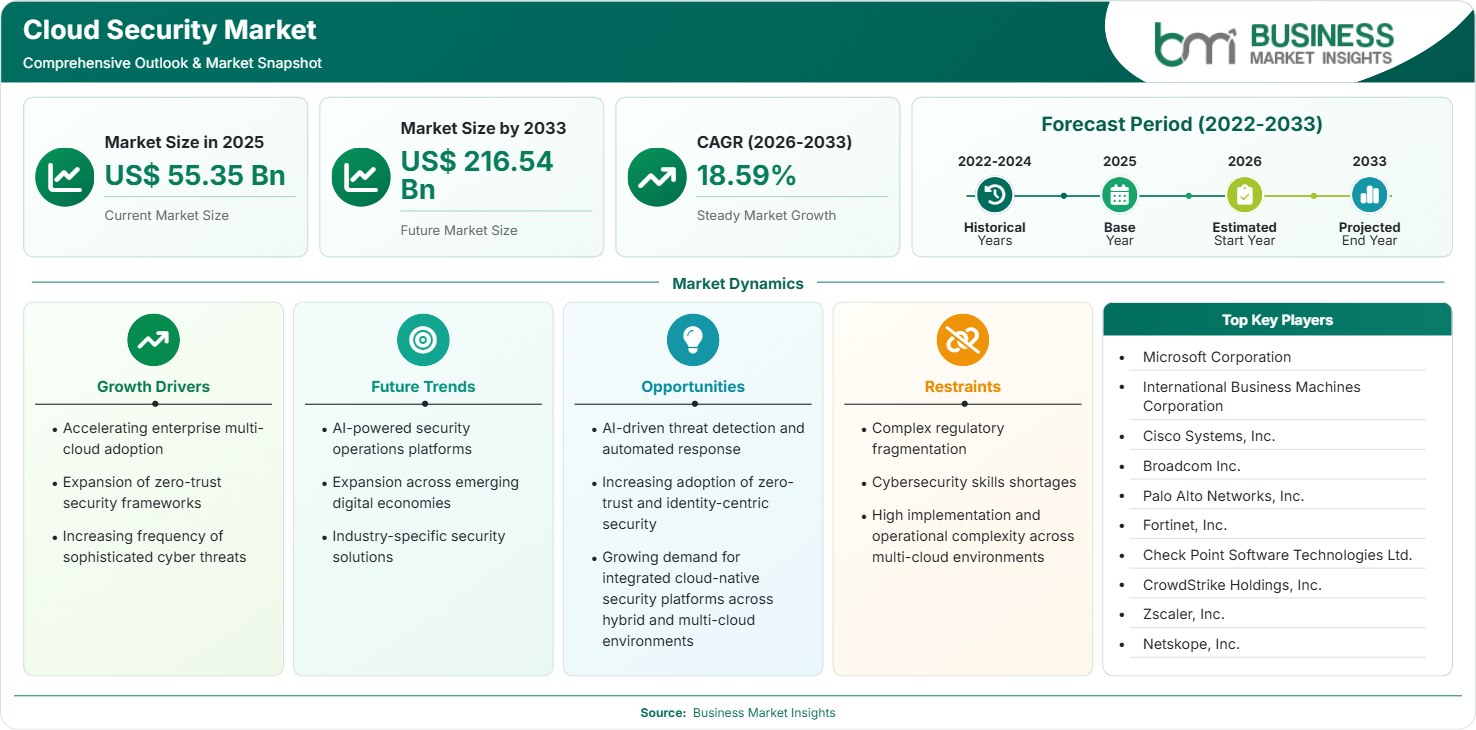
The Cloud Security Market size was valued at US$ 55.35 billion in 2025 and is projected to reach US$ 216.54 billion by 2033, growing at a CAGR of 18.59% during 2026–2033. Rising multi-cloud adoption, zero-trust implementation, AI-driven threat detection, regulatory compliance requirements, and expanding remote-work ecosystems continue creating substantial opportunities across enterprise and public-sector environments.

Report Coverage
  • Security Type: Identity and Access Management, Data Loss Prevention, Security Information and Event Management, Business Continuity and Disaster Recovery
  • Enterprise Size: Large Enterprises, Small, Medium-Sized Enterprises
  • End-User: IT and Telecommunication, Banking, Finance, Security and Insurance, Healthcare and Life Sciences, Manufacturing, Retail, Government, Energy and Utilities
US$ 55.35 Bn Market size in 2025
US$ 216.54 Bn Market Size by 2033
18.59% CAGR, 2026 - 2033
2026-2033 Forecast Period

AI Overview

Cloud Security Market Summary

  • North America Region: North America holds a market share of 36%–39% in 2025, growing with a CAGR of 17.5%–18.5% during 2026–2033, driven by zero-trust investments, stringent compliance mandates, cloud migration, ransomware resilience programs, AI-enabled monitoring solutions, critical infrastructure protection, managed services expansion, digital transformation momentum, and enterprise cybersecurity modernization initiatives. US market benefits from mature cybersecurity spending and federal cloud programs, advancing at 17.8%–18.8%.
  • Fastest Growing Region: Asia Pacific holds a market share of 25%–28% in 2025, growing with a CAGR of 20.5%–21.5% during 2026–2033, supported by digitalization, hyperscale data center construction, fintech expansion, sovereign cloud initiatives, cybersecurity regulations, enterprise cloud adoption, manufacturing modernization, rising cyber threats, and growing technology investments.
  • Leading Segment: Identity and Access Management (IAM) holds a market share of 28%–31% in 2025, growing with a CAGR of 18.5%–19.5% during 2026–2033, supported by workforce mobility, zero-trust frameworks, privileged access control, cloud-native authentication, compliance requirements, identity governance demand, and hybrid work security priorities.
  • High Growth Segment: Small and Medium-Sized Enterprises (SMEs) holds a market share of 24%–27% in 2025, growing with a CAGR of 20.5%–21.5% during 2026–2033, driven by subscription-based security adoption, managed security offerings, affordable cloud deployment, ransomware protection needs, regulatory expectations, digital commerce growth, and simplified security platforms.
  • Key Market Opportunity: Increasing integration of AI-powered security analytics with cloud-native application protection platforms enables predictive threat detection, automated response workflows, compliance optimization, operational efficiency improvements, and scalable enterprise risk management capabilities.
  • Major Market Players: Microsoft Corporation, International Business Machines Corporation, Cisco Systems, Inc., Broadcom Inc., Palo Alto Networks, Inc., Fortinet, Inc., Check Point Software Technologies Ltd., CrowdStrike Holdings, Inc., Zscaler, Inc., Netskope, Inc.
Strategic Insights

Cloud Security Market: Strategic Insights

Cloud Security Market Strategic Framework
FREE PDF
Request your free sample
Request free sample
Stakeholder View

Key Takeaways

  • The ecosystem is shifting toward integrated platforms combining identity security, data protection, workload monitoring, analytics, and automated response capabilities across hybrid and multi-cloud environments.
  • SME-focused managed security offerings represent a significant expansion avenue as organizations seek enterprise-grade protection without maintaining large internal cybersecurity teams.
  • AI-driven behavioral analytics and autonomous threat remediation are reshaping product development priorities and reducing incident response timelines.
  • Asia Pacific presents a compelling investment destination due to accelerating cloud adoption, digital banking growth, data center expansion, and regulatory modernization.
  • Strategic acquisitions continue strengthening platform portfolios as vendors seek cloud-native application protection, identity governance, and security operations capabilities.
  • Industry-specific solutions for healthcare, BFSI, and government sectors are gaining prominence due to compliance requirements and elevated cyber-risk exposure.
Geographic Outlook

Cloud Security Market Regional Highlights

North America Cloud Security Market

North America accounts for 36%–39% of global revenue in 2025 and is projected to expand at a CAGR of 17.5%–18.5% through 2033. The region benefits from extensive cloud penetration, mature cybersecurity spending, and widespread adoption of zero-trust frameworks. Cloud Security Market share remains highest across large enterprises and regulated industries. Growth is supported by increasing ransomware defense investments, federal cybersecurity directives, hybrid work environments, and advanced security operations capabilities deployed across public and private sector organizations.

  • Strong adoption of AI-enabled threat detection platforms improves security visibility and accelerates incident response across enterprise cloud environments.
  • Financial institutions continue prioritizing identity governance, data encryption, and operational resilience programs to strengthen cyber-risk management.
  • Federal cybersecurity initiatives support modernization of cloud infrastructure and security architectures across government agencies.
  • Managed security service providers expand offerings to address talent shortages and growing threat complexity.

US Cloud Security Market

The United States represents 82%–85% of regional revenue and advances at a CAGR of 17.8%–18.8% through 2033. High cloud spending, sophisticated security requirements, and strong vendor presence support market expansion. Enterprise investment focuses on workload protection, secure access service edge architectures, and cybersecurity automation. Demand remains particularly strong across financial services, healthcare, technology, and public-sector organizations managing sensitive data assets and critical digital operations.

  • Significant spending on zero-trust strategies increases adoption of advanced identity and access management technologies.
  • Healthcare organizations deploy cloud protection tools to meet privacy and security obligations.
  • Technology companies accelerate deployment of cloud-native application protection platforms.
  • Cybersecurity workforce shortages encourage broader use of managed and automated services.

Europe Cloud Security Market

Europe captures 28%–31% market share in 2025 and records a CAGR of 17.8%–18.8% during the forecast period. Strict privacy regulations, digital sovereignty initiatives, and rising cyber incidents support adoption. Germany and the United Kingdom remain leading markets, while Poland and Spain demonstrate stronger growth trajectories exceeding regional averages. Organizations increasingly deploy integrated solutions combining compliance management, identity controls, and cloud workload protection across public, private, and hybrid cloud infrastructures.

  • GDPR-driven compliance requirements continue stimulating investments in governance and security monitoring platforms.
  • Financial institutions strengthen protection measures for digital banking ecosystems and cross-border transactions.
  • Sovereign cloud initiatives encourage deployment of regionally compliant security frameworks.
  • Manufacturing organizations expand operational technology and Cloud Security convergence strategies.

Asia Pacific Cloud Security Market

Asia Pacific holds 25%–28% revenue share in 2025 and is expected to achieve a CAGR of 20.5%–21.5%, making it the fastest-growing regional market. China, Japan, and India lead adoption, while Indonesia and Vietnam exhibit accelerated expansion. Rising cloud infrastructure investment, growing digital commerce activity, and stronger cybersecurity regulations support demand. Enterprises increasingly adopt cloud-native application security, identity protection, and advanced threat analytics to secure rapidly expanding digital ecosystems.

  • Hyperscale data center development strengthens demand for scalable cloud protection technologies.
  • Fintech and digital banking expansion drive advanced authentication and fraud prevention investments.
  • Government cybersecurity initiatives encourage modernization of enterprise security capabilities.
  • Manufacturing digitalization increases requirements for workload and application protection.
  • Rising cyber threats accelerate adoption of AI-supported monitoring and response platforms.

Rest of World Cloud Security Market

Rest of World represents 8%–10% of revenue and grows at a CAGR of 18.8%–19.8% through 2033. South and Central America benefit from expanding cloud adoption and digital payment ecosystems. The Middle East and Africa gain momentum through smart city projects, government modernization programs, and critical infrastructure investments. Brazil and Saudi Arabia lead regional expenditures, while the UAE demonstrates particularly strong adoption of cloud-native cybersecurity frameworks and managed security services.

  • Digital transformation programs across public services create long-term security deployment opportunities.
  • Energy and utilities sectors invest heavily in cyber resilience and operational continuity strategies.
  • Cloud-first policies stimulate adoption of integrated security architectures and compliance tools.
  • Growing awareness of ransomware risks supports demand for disaster recovery capabilities.
  • Regional technology partnerships improve access to enterprise-grade cybersecurity services.
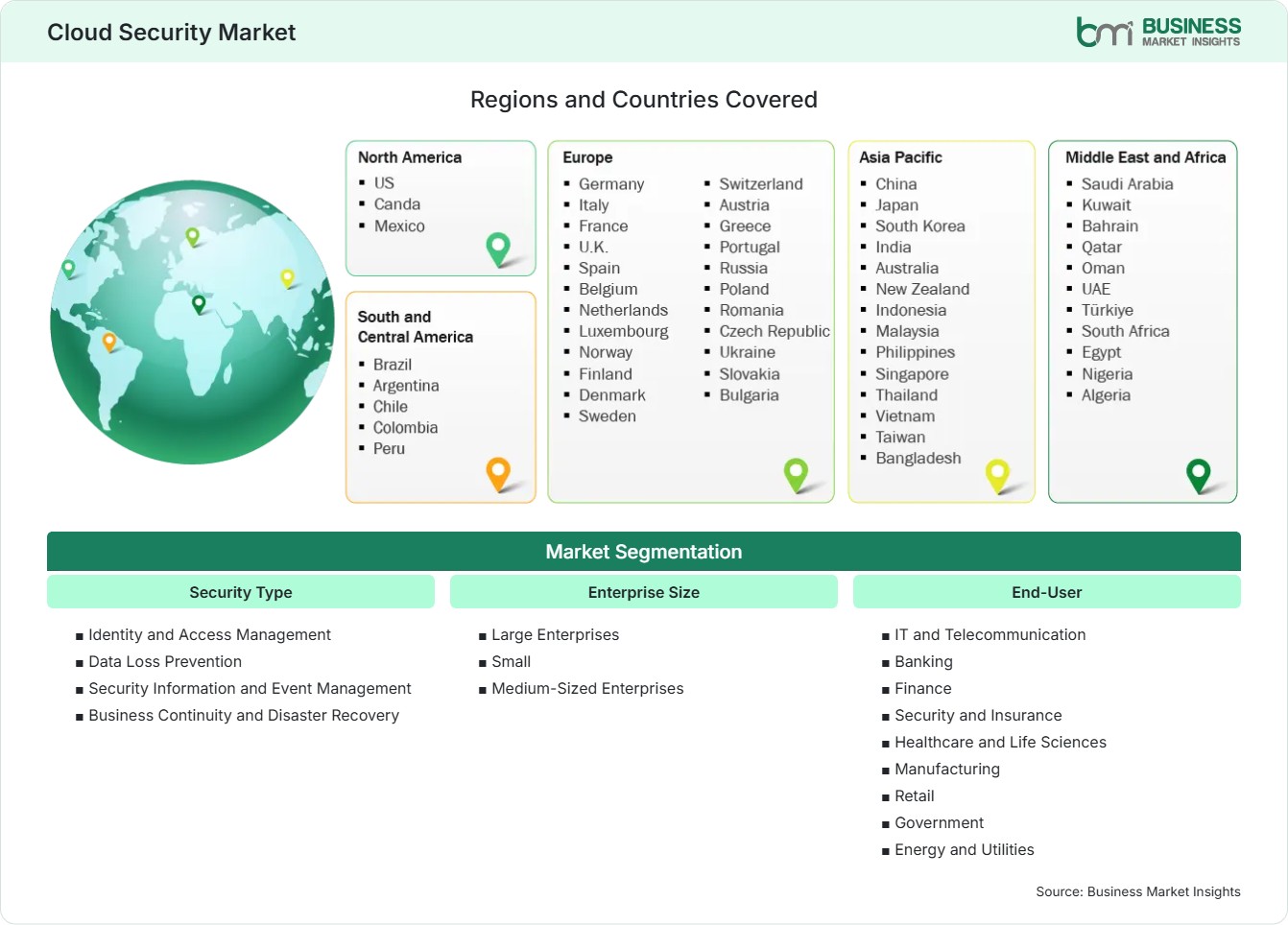
Global Market Geography
FREE PDF
Request your free sample
Request free sample
Segment Analysis

Cloud Security Market Segmentation

Security Type

Security Type accounts for the largest revenue contribution, with Identity and Access Management leading adoption. The segment held approximately 28%–31% market share in 2025 and is expected to expand at a CAGR of 18.5%–19.5%. Cloud Security Market scope continues widening as enterprises seek unified visibility, automated compliance, and stronger protection across multi-cloud deployments.

  • Identity and Access Management (IAM): Supports secure authentication, privileged access controls, and zero-trust strategies across distributed environments while addressing workforce mobility and evolving compliance requirements.
  • Data loss prevention (DLP): Focuses on safeguarding sensitive information through monitoring, classification, and policy enforcement across cloud applications and collaboration environments.
  • Security Information and Event Management (SIEM): Enables centralized monitoring, threat intelligence correlation, and incident investigation capabilities supporting proactive security operations.
  • Business Continuity and Disaster Recovery: Ensures workload resilience, backup protection, and operational continuity during cyberattacks, outages, and infrastructure disruptions.

Enterprise Size

Enterprise size segmentation reveals continued dominance of large organizations, although SME adoption is accelerating faster. Large enterprises account for 63%–66% share in 2025, while SMEs are expected to post a CAGR of 20.5%–21.5% through the forecast period due to increased affordability and managed service availability.

  • Large Enterprises: Invest heavily in integrated security ecosystems covering identity, workload protection, advanced analytics, and compliance management across global operations.
  • Small and Medium-Sized Enterprises (SMEs): Adopt subscription-based platforms and managed security services to strengthen cyber resilience without extensive internal resources.

End-User

The BFSI sector remains a leading contributor with approximately 20%–23% market share in 2025, supported by regulatory obligations and increasing cyber-risk exposure. Cloud Security Market trends across industries indicate rising adoption of cloud-native security controls, automated monitoring, and identity-centric protection strategies.

  • IT and Telecommunication: Requires large-scale protection for cloud infrastructure, digital services, and customer-facing applications.
  • Banking, Finance, Security and Insurance (BFSI): Prioritizes fraud prevention, data protection, access governance, and operational resilience.
  • Healthcare and Life Sciences: Focuses on safeguarding patient records, research assets, and connected healthcare platforms.
  • Manufacturing: Expands security monitoring across industrial systems, connected assets, and digital production environments.
  • Retail: Protects payment ecosystems, customer data, and omnichannel commerce platforms.
  • Government: Implements secure cloud architectures to support digital services and national cybersecurity goals.
  • Energy and Utilities: Strengthens infrastructure resilience and operational security through enhanced monitoring and threat detection.
Market Forces

Cloud Security Market Dynamics

Key Market Drivers

Accelerating Enterprise Multi-Cloud Adoption

Companies are spreading workloads across public, private, and hybrid clouds to enhance flexibility and resilience. With the rising data sizes and application complexities, the need for an enterprise to have a single view of what is going on becomes critical. Surveys in the industry reveal a rise in multi-cloud strategies. Cloud Security Market growth is closely tied to workload migration and expanding digital transformation initiatives. Security architectures that protect data, identities, applications, and workloads across multiple environments have become strategic initiatives. As a result, companies are spending more money on unified solutions that simplify management and enhance their governance and compliance abilities.

Expansion of Zero-Trust Security Frameworks

Zero-trust principles have become foundational across modern cybersecurity programs. Organizations have shifted their focus to validating users, devices, workloads, and applications in real time, rather than perimeter-based controls. This strategy not only enhances identity governance but also ensures that the chances of any kind of unauthorized access are limited to a minimum. The government, as well as regulated industries, is strongly promoting zero-trust architectures. To cope with their distributed workforce and cloud-based processes, the need for authentication and behavioral analytics increases.

Increasing Frequency of Sophisticated Cyber Threats

Incidents associated with ransomware attacks, supply chain attacks, credential theft, and cloud misconfigurations still pose significant threats. Hackers have been seen increasingly exploiting cloud-hosted workloads and mission-critical applications. Organizations react to this threat situation by enhancing their monitoring and automation skills. Cloud Security Market trends demonstrate growing preference for AI-assisted detection technologies capable of analyzing large volumes of telemetry data. Enhanced visibility and faster remediation help organizations reduce exposure while supporting compliance requirements. Escalating threat complexity remains a major force driving demand for advanced cloud-focused cybersecurity investments.

Key Market Opportunities

AI-Powered Security Operations Platforms

AI helps companies enhance their threat prioritization, automate their investigation process, and take quick action. Companies which combine generative AI and machine learning in their Cloud Security operations have an opportunity to gain more operational efficiency. Security professionals need platforms that can lessen their alert fatigue and improve detection precision. Cloud Security Market Forecasts suggest there will be a continued demand for AI-powered cybersecurity products due to companies having talent gaps and increasingly complex infrastructures. There is an increasing array of investment prospects in analytics, autonomous healing, threat intelligence, and predictive risk management tools that are cloud-native.

Expansion Across Emerging Digital Economies

Rapid digitalization in Southeast Asia, the Middle East, Africa, and Latin America creates favorable conditions for Cloud Security deployment. Government cloud programs, an increase in e-commerce transactions, digital banking, and investments in data centers will drive adoption. In the aforementioned markets, many companies are adopting cloud technology for the very first time, providing opportunities for the integration of security platforms. The vendors who provide localized compliance solutions, managed services, and subscription models will be well-positioned to capitalize on the opportunities. Technology modernization projects are continuously improving market attractiveness.

Industry-Specific Security Solutions

Healthcare, financial services, government, and energy organizations face unique compliance requirements and threat profiles. As a result, there is a growing need for security platforms that are specific to the industries and their processes. Providers can differentiate themselves by offering industry-specific threat intelligence, compliance automation, and risk management services. Cloud-based solutions focused on critical infrastructure, healthcare information management, financial transactions, and the public sector are likely to present attractive growth opportunities. This segmentation helps providers improve both customer retention and competitive positioning.

Market Restraints and Challenges

Complex Regulatory Fragmentation

Factor: Organizations operating across multiple jurisdictions face diverse and frequently evolving requirements related to data privacy, cybersecurity reporting, data sovereignty, operational resilience, and cross-border data transfers. Impact: The complexities associated with compliance increase deployment costs, implementation periods, and inefficiencies in operation. The security teams must always be ready to keep changing policies, access controls, and monitoring processes to align with different regional compliance requirements while ensuring adequate levels of protection. Small firms may not have compliance experts, and thus, compliance becomes more difficult. The growth of global cloud computing infrastructure for the organization leads to delays in investments in cloud security.

Cybersecurity Skills Shortages

Factor: Demand for experienced Cloud Security Market professionals continues to exceed available talent across most major markets. Impact: Organizations struggle in addressing challenges related to the management of multi-cloud environments, responding to advanced attacks, and making the best use of their security investments. Lack of skills may result in configuration mistakes, delayed incident response times, and non-optimal usage of advanced security solutions. Such organizations have no choice but to rely on managed security service providers and/or consultants, thereby increasing their costs. This problem becomes even more evident when we talk about small and medium-sized businesses, which usually do not have a separate cybersecurity department.

Company Analysis

Competitive Landscape

Cloud Security Market analysis indicates competition is centered on platform consolidation, AI-enabled detection, zero-trust capabilities, and cloud-native workload protection.

Company Name

Overview

Products and Services relevant to this market

Microsoft Corporation

Global technology leader with extensive cloud infrastructure and cybersecurity portfolio supporting enterprise transformation.

Microsoft Defender for Cloud, Entra ID, Sentinel, security analytics, threat intelligence.

International Business Machines Corporation

Enterprise technology provider focused on security operations, governance, and risk management solutions.

IBM Security, QRadar, identity governance, threat detection, managed security services.

Cisco Systems, Inc.

Networking and cybersecurity vendor delivering secure connectivity and cloud protection technologies.

Secure Access, Umbrella, SecureX, Cloud Security and access management tools.

Broadcom Inc.

Technology company offering enterprise software and infrastructure security capabilities.

Symantec security portfolio, data protection, endpoint and Cloud Security solutions.

Palo Alto Networks, Inc.

Cybersecurity specialist with strong presence in cloud-native and network protection.

Prisma Cloud, Cortex platform, SASE, threat prevention services.

Fortinet, Inc.

Security vendor known for integrated platform architecture and enterprise protection solutions.

FortiGate, FortiSASE, cloud workload security and analytics offerings.

Check Point Software Technologies Ltd.

Cybersecurity company providing advanced threat prevention and compliance capabilities.

CloudGuard, threat intelligence, workload protection and compliance solutions.

CrowdStrike Holdings, Inc.

Cloud-native cybersecurity provider emphasizing AI-driven threat detection and response.

Falcon platform, cloud workload protection, identity threat detection.

Zscaler, Inc.

Security service edge specialist focused on secure access and zero-trust architectures.

Zscaler Internet Access, Private Access, data protection services.

Netskope, Inc.

Cloud Security company delivering SSE, CASB, and data-centric protection capabilities.

Netskope One platform, SASE, cloud access security broker solutions.

Trust & Transparency

Research Methodology

The market analysis combines proprietary research with secondary data from government agencies, company disclosures, regulatory filings, industry databases and expert interviews. Market estimates are validated through data triangulation, cross-market benchmarking and analyst review.

View Full Research Methodology

Questions Answered

Frequently Asked Questions

What does the Cloud Security Market Report indicate about future competition?

Competition is expected to focus on AI-driven analytics, platform consolidation, zero-trust capabilities, industry-specific solutions, and automation that improves operational efficiency and threat response outcomes.

How do managed security services influence adoption among SMEs?

Managed services reduce operational complexity, address cybersecurity talent shortages, and provide enterprise-grade protection at predictable subscription costs, making advanced security more accessible.

What factors make Asia Pacific the fastest-growing regional market?

Rapid digitalization, fintech expansion, government cybersecurity programs, data center construction, and increasing cloud adoption among enterprises collectively accelerate demand across major regional economies.

Why are identity-focused solutions receiving greater investment attention?

Identity has become the primary security perimeter in distributed environments. Strong authentication, privileged access controls, and identity governance significantly reduce risks associated with credential compromise and unauthorized access.

Which industries generate the strongest demand for cloud-based security solutions?

BFSI, healthcare, government, telecommunications, and energy sectors lead adoption because they manage sensitive data, operate critical infrastructure, and face extensive compliance obligations requiring advanced monitoring and access management.

Access the Full Cloud Security Market Report

Get segment-level forecasts, regional estimates, competitive benchmarking, company profiles and downloadable Excel datasets.

Access the full Cloud Security Market Report
350 pages PDF & Excel | 2026-08-27