
Distributed Cloud Market Outlook: Size, Share, Trends, Growth Analysis, Competitive Landscape & Forecast, 2022-2033

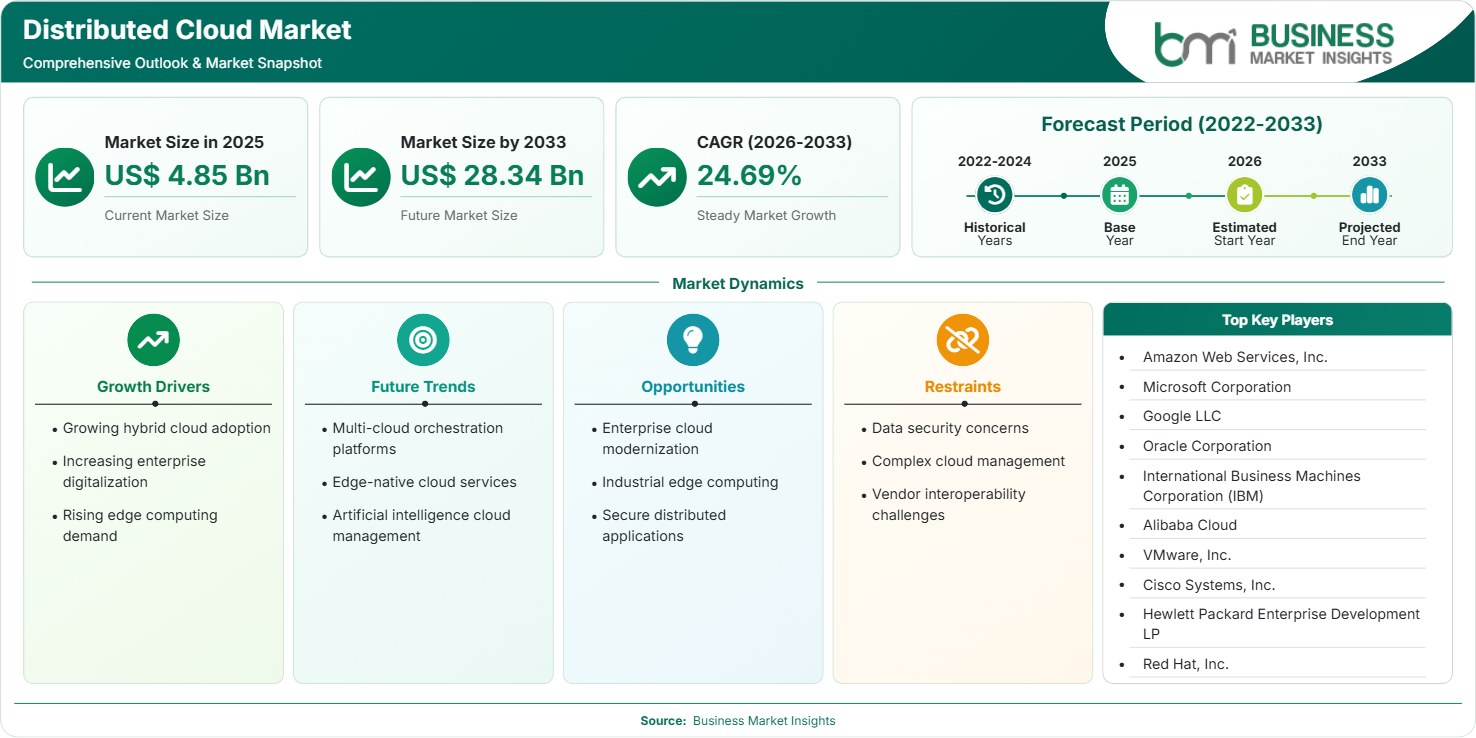
The Distributed Cloud Market size was valued at US$ 4.85 billion in 2025 and is projected to reach US$ 28.34 billion by 2033, growing at a CAGR of 24.69% during 2026–2033. Growing hybrid cloud adoption, increasing enterprise digitalization, and rising edge computing demand are accelerating market expansion. Furthermore, enterprise cloud modernization, industrial edge computing, and secure distributed applications are expected to create substantial long-term growth opportunities for technology providers and cloud service vendors.

Report Coverage
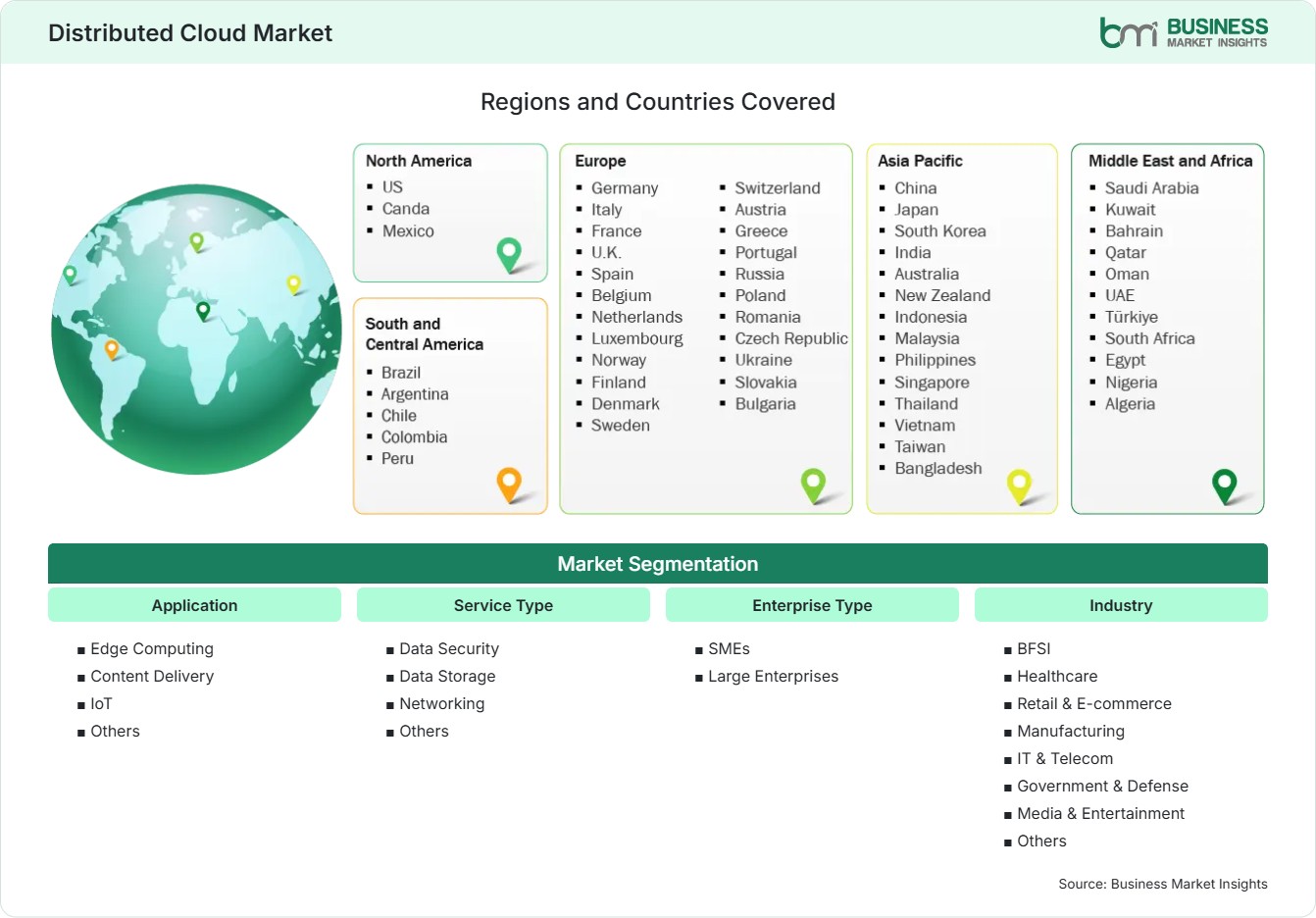
  • Application: Edge Computing, Content Delivery, IoT, Others
  • Service Type: Data Security, Data Storage, Networking, Others
  • Enterprise Type: SMEs, Large Enterprises
  • Industry: BFSI, Healthcare, Retail & E-commerce, Manufacturing, IT & Telecom, Government & Defense, Media & Entertainment, Others
US$ 4.85 Bn Market size in 2025
US$ 28.34 Bn Market Size by 2033
24.69% CAGR, 2026 - 2033
2026-2033 Forecast Period

AI Overview

Distributed Cloud Market Summary

  • North America: North America accounts for 38%–41% of the global market in 2025 and is projected to grow at a CAGR of 24.0%–24.8% through 2033. Strong investments in cloud-native technologies, widespread enterprise cloud adoption, advanced digital infrastructure, and growing demand for low-latency computing continue driving regional market growth. The U.S. market is anticipated to register a CAGR of 24.3%–25.1% during the forecast period.
  • Fastest Growing Region: Asia Pacific holds 27%–30% market share in 2025 and is forecast to register the highest CAGR of 25.8%–26.6% through 2033. Increasing enterprise digital transformation, expanding hyperscale data center investments, rising industrial IoT deployment, and supportive government digitalization initiatives continue strengthening regional market expansion.
  • Leading Segment: Edge Computing represents 35%–38% of the market in 2025 and is projected to expand at a CAGR of 25.2%–26.0% during 2026–2033. Increasing demand for real-time data processing, latency-sensitive applications, AI workloads, and connected devices continues supporting segment leadership.
  • High Growth Segment: Large Enterprises account for 66%–69% market share in 2025 and are expected to register the fastest CAGR of 25.0%–25.8% through 2033. Growing investments in hybrid cloud infrastructure, multi-cloud strategies, distributed data processing, and enterprise digital transformation continue accelerating adoption.
  • Key Market Opportunity: Rising investments in enterprise cloud modernization, industrial edge computing, AI-enabled distributed infrastructure, secure cloud-native applications, and multi-cloud orchestration platforms are creating significant growth opportunities across the distributed cloud ecosystem.
  • Major Market Players: Amazon Web Services Inc., Microsoft Corporation, Google LLC, Oracle Corporation, International Business Machines Corporation (IBM), Alibaba Cloud, VMware Inc., Cisco Systems Inc., Hewlett Packard Enterprise Development LP, and Red Hat Inc.
Strategic Insights

Distributed Cloud Market: Strategic Insights

Distributed Cloud Market Strategic Framework
FREE PDF
Request your free sample
Request free sample
Stakeholder View

Key Takeaways

  • The market ecosystem continues evolving through hyperscale cloud providers, infrastructure vendors, software developers, networking companies, cybersecurity providers, system integrators, managed service providers, and enterprise customers.
  • Edge computing, hybrid cloud deployments, industrial IoT, AI-driven analytics, content delivery, distributed databases, and mission-critical enterprise applications represent the largest commercial opportunities across the distributed cloud ecosystem.
  • Continuous innovation in cloud-native platforms, edge infrastructure, AI-powered automation, container orchestration, distributed security frameworks, and multi-cloud management solutions is significantly improving enterprise scalability, resilience, and operational efficiency.
  • Asia Pacific offers the strongest long-term investment potential due to rapid enterprise digitalization, expanding data center infrastructure, growing cloud adoption among SMEs and large enterprises, increasing industrial automation, and supportive government digital transformation initiatives.
  • Strategic collaborations among cloud service providers, networking vendors, semiconductor companies, cybersecurity firms, and enterprise software developers continue accelerating innovation and commercialization of next-generation distributed cloud solutions.
Geographic Outlook

Distributed Cloud Market Regional Highlights

North America Distributed Cloud Market

North America accounts for 38%–41% of the global market in 2025 and is projected to expand at a CAGR of 24.0%–24.8% through 2033. Strong adoption of hybrid cloud platforms, advanced enterprise IT infrastructure, growing investments in AI-powered cloud services, and expanding edge computing deployments continue supporting regional market growth. The Distributed Cloud Market share remains the largest globally owing to early technology adoption and strong presence of leading cloud service providers.

  • Hybrid cloud adoption accelerates enterprise transformation.
  • Edge computing strengthens low-latency processing.
  • AI-powered cloud platforms improve operational efficiency.
  • Advanced digital infrastructure supports market expansion.

US Distributed Cloud Market

The United States dominates regional revenue and is expected to register a CAGR of 24.3%–25.1% during the forecast period. Increasing enterprise investments in cloud modernization, multi-cloud management, AI workloads, cybersecurity, and distributed application deployment continue supporting sustained Distributed Cloud market expansion.

  • Cloud modernization drives enterprise adoption.
  • AI workloads accelerate infrastructure investments.
  • Multi-cloud strategies improve operational flexibility.

Europe Distributed Cloud Market

Europe represents 24%–27% of the global market in 2025 and is projected to grow at a CAGR of 23.8%–24.6% during 2026–2033. Germany leads regional demand, while the Netherlands records the fastest growth supported by expanding digital infrastructure, increasing enterprise cloud migration, stronger data sovereignty requirements, and rising investments in edge computing platforms.

  • Enterprise cloud migration supports market growth.
  • Germany leads regional cloud investments.
  • Data sovereignty accelerates distributed deployment.
  • Edge infrastructure strengthens digital transformation.

Asia Pacific Distributed Cloud Market

Asia Pacific accounts for 27%–30% of global Distributed Cloud market revenue in 2025 and is expected to register the highest CAGR of 25.8%–26.6% through 2033. China dominates regional demand, while India records the fastest growth owing to rapid digital transformation, expanding hyperscale cloud infrastructure, increasing industrial IoT adoption, growing AI implementation, and government-led digital economy initiatives.

  • Digital transformation accelerates cloud adoption.
  • Industrial IoT expands distributed computing demand.
  • Data center investments strengthen infrastructure.
  • Enterprise AI adoption supports long-term growth.

Rest of World Distributed Cloud Market

The Rest of World region accounts for 6%–8% of the global market in 2025 and is projected to grow at a CAGR of 23.1%–23.9% during the forecast period. Brazil, the UAE, and South Africa continue investing in cloud infrastructure, enterprise digitalization, cybersecurity modernization, and smart city initiatives, creating sustained demand for distributed cloud technologies.

  • Cloud infrastructure investments accelerate adoption.
  • Digital transformation strengthens enterprise demand.
  • Smart city initiatives support edge computing.
  • Cybersecurity modernization drives cloud deployment.
Global Market Geography
FREE PDF
Request your free sample
Request free sample
Segment Analysis

Distributed Cloud Market Segmentation

Application

The Application segment accounted for 35%–38% of the overall market in 2025 and is projected to grow at a CAGR of 25.2%–26.0% during 2026–2033. Growing enterprise demand for real-time computing, increasing deployment of connected devices, expanding AI-driven applications, and rising adoption of latency-sensitive digital services continue driving strong market expansion. Organizations are increasingly implementing distributed cloud architectures to process workloads closer to end users, improve application responsiveness, strengthen data sovereignty, optimize bandwidth utilization, and support mission-critical business operations. Continuous advancements in edge infrastructure, cloud-native development, container orchestration, and intelligent workload management are further accelerating distributed cloud adoption across multiple industries worldwide.

  • Edge Computing: Edge computing represents the largest application segment owing to increasing deployment of real-time analytics, industrial automation, autonomous systems, smart manufacturing, connected healthcare, retail analytics, and low-latency enterprise applications requiring localized data processing.
  • Content Delivery: Content delivery continues to witness strong growth through increasing demand for high-speed media streaming, cloud gaming, digital entertainment, software distribution, and optimized web application performance across geographically distributed users.
  • Internet of Things: IoT applications continue expanding as distributed cloud platforms support connected factories, smart cities, intelligent transportation systems, utility monitoring, healthcare devices, and industrial sensors through scalable and secure edge computing capabilities.
  • Others: Other applications include artificial intelligence workloads, disaster recovery, remote branch computing, telecommunications infrastructure, financial services, and government digital platforms requiring distributed processing environments.

Service Type

The Service Type segment continues expanding as enterprises increasingly require secure, scalable, and resilient cloud services capable of supporting distributed workloads across multiple geographic locations. The Distributed Cloud Market trends indicate rising investments in integrated cloud infrastructure that combines storage, networking, cybersecurity, orchestration, and workload optimization within unified distributed cloud environments.

  • Data Security: Data security represents one of the leading service segments owing to increasing enterprise focus on zero-trust architectures, encryption, identity management, threat detection, compliance management, and secure access across distributed cloud environments.
  • Data Storage: Distributed cloud storage solutions enable scalable, highly available, and geographically distributed data management while improving disaster recovery, backup capabilities, business continuity, and regulatory compliance.
  • Networking: Advanced networking services optimize workload distribution, application connectivity, traffic management, software-defined networking, and low-latency communication across distributed cloud infrastructure.
  • Others: Additional services include cloud orchestration, monitoring, workload automation, infrastructure management, disaster recovery, application optimization, API management, and managed cloud operations.

Enterprise Type

The Enterprise Type segment accounted for 66%–69% of the market in 2025 and is projected to expand steadily through 2033. Growing enterprise digital transformation, increasing hybrid cloud deployments, expanding AI implementation, and rising demand for scalable computing infrastructure continue supporting adoption across organizations of all sizes. Businesses increasingly leverage distributed cloud solutions to improve operational flexibility, optimize application performance, strengthen business continuity, and accelerate innovation.

  • SMEs: Small and medium-sized businesses have been using distributed cloud services to access high-end computing, scale up their infrastructure, reduce costs, work remotely, and undergo digital transformation without making large financial investments.
  • Large Enterprises: Large enterprises constitute the largest market segment due to their heavy investment in multi-cloud solutions, distributed and edge computing, critical applications, global presence, and cloud migration strategies.

Industry

The Industry segment continues its growth through distributed cloud solutions that help companies enhance application performance, resilience, security, and user experience across various industry verticals. Businesses adopt distributed clouds to enable intelligent decision-making, connectivity, regulatory compliance, and real-time business intelligence.

  • BFSI: Financial institutions utilize distributed cloud infrastructure for secure digital banking, payment processing, fraud detection, regulatory compliance, customer analytics, and high-performance financial applications.
  • Healthcare: Healthcare organizations deploy distributed cloud solutions to support electronic health records, medical imaging, connected medical devices, telemedicine, AI diagnostics, and secure patient data management.
  • Retail & E-commerce: Retailers leverage distributed cloud platforms to optimize omnichannel operations, customer analytics, inventory management, personalized shopping experiences, and real-time transaction processing.
  • Manufacturing: Manufacturing companies increasingly implement distributed cloud solutions for industrial IoT, predictive maintenance, robotics, production monitoring, digital twins, and smart factory automation.
  • IT & Telecom: Telecommunications providers utilize distributed cloud infrastructure to support 5G networks, edge computing, network virtualization, cloud-native services, and intelligent traffic management.
  • Government & Defense: Government agencies deploy distributed cloud platforms to strengthen cybersecurity, digital public services, mission-critical communications, secure data management, and national infrastructure modernization.
  • Media & Entertainment: Media companies utilize distributed cloud environments for content streaming, cloud gaming, digital broadcasting, content management, and global content delivery optimization.
  • Others: Other industries include education, logistics, transportation, utilities, energy, hospitality, and professional services adopting distributed cloud technologies to accelerate digital transformation and operational efficiency.
Market Forces

Distributed Cloud Market Dynamics

Key Market Drivers

Growing hybrid cloud adoption

Organizations have begun adopting a hybrid cloud approach, combining public and private clouds with on-premises infrastructure. Distributed cloud ensures that all geographically dispersed resources can be managed efficiently while maintaining regulatory compliance, business continuity, and operational resilience.

Increasing enterprise digitalization

Increasing enterprise digital transformation is driving the need for cloud-based architectures and systems to enable cloud-native application architecture, AI-based computing, remote working, intelligent automation, and data-enabled decision-making. Companies will continue deploying innovative cloud technologies to enhance competitiveness and efficiency.

Rising edge computing demand

This growth has led to a growing need for edge computing solutions, in which information is processed in closer proximity to the source. The distributed cloud solution offers low latency, minimizes bandwidth requirements, and enables real-time business applications across various operational settings.

Key Market Opportunities

Enterprise cloud modernization

Organizations replacing legacy IT infrastructure with cloud-native, containerized, and distributed computing environments present substantial opportunities for cloud service providers, software vendors, and infrastructure technology companies, thereby strengthening the Distributed Cloud market forecasts by delivering scalable, flexible, and efficient modernization solutions.

Industrial edge computing

Growing adoption of Industry 4.0 technologies, connected manufacturing systems, predictive maintenance, robotics, digital twins, and intelligent production environments continues creating significant opportunities for distributed cloud platforms supporting industrial edge computing applications.

Secure distributed applications

Growing demand for secure cloud-native software, zero-trust architecture, distributed cybersecurity, confidential computing, and compliance-driven cloud implementations represents a promising market for providers of advanced distributed application platforms and security services.

Market Restraints and Challenges

Data security concerns

Factor: Distributed cloud environments process and store sensitive enterprise information across multiple geographic locations, creating additional cybersecurity risks related to data breaches, unauthorized access, ransomware attacks, identity management, and regulatory compliance. Impact: Organizations must increase investments in encryption, identity governance, threat monitoring, security automation, and compliance management, raising operational costs and increasing implementation complexity for distributed cloud deployments.

Complex cloud management

Factor: Managing workloads, applications, networking, storage, governance, monitoring, and security across multiple cloud providers, edge environments, and distributed infrastructure introduces significant operational complexity for enterprise IT teams. Impact: Complex cloud management increases administrative overhead, requires highly skilled professionals, complicates workload orchestration, and may slow enterprise cloud adoption despite strong demand for distributed computing capabilities.

Company Analysis

Competitive Landscape

The Distributed Cloud Market analysis is highly competitive and includes major cloud service providers, software companies, network companies, and infrastructure companies that invest heavily in cloud-native services, edge computing, hybrid cloud, and artificial intelligence-based management of cloud infrastructure. The major competitors have been strengthening their market positions through acquisitions, product innovation, the construction of hyperscale data centers, the development of multi-cloud platforms, and collaboration with telecom and enterprise customers. The growing need for secure, low-latency cloud services is driving organizations to build ecosystems that enable enterprise digital transformation.

Company Name

Overview

Products and Services Relevant to this Market

Amazon Web Services Inc.

Global leader in cloud computing and distributed infrastructure services.

AWS Outposts, AWS Local Zones, edge computing services, cloud storage, distributed cloud platforms.

Microsoft Corporation

Leading enterprise cloud provider offering hybrid and distributed cloud solutions.

Microsoft Azure, Azure Arc, Azure Stack, cloud security, edge computing platforms.

Google LLC

Global technology company providing cloud infrastructure and distributed computing services.

Google Distributed Cloud, Google Cloud Platform, Anthos, edge AI solutions, cloud networking.

Oracle Corporation

Enterprise software and cloud infrastructure provider.

Oracle Cloud Infrastructure (OCI), distributed cloud services, database cloud platforms, hybrid cloud solutions.

International Business Machines Corporation (IBM)

Global provider of enterprise cloud, AI, and hybrid cloud technologies.

IBM Hybrid Cloud, Red Hat OpenShift, cloud consulting, distributed application platforms.

Alibaba Cloud

Leading cloud service provider with global distributed infrastructure capabilities.

Edge cloud services, cloud computing platforms, distributed storage, AI cloud solutions.

VMware Inc.

Enterprise virtualization and multi-cloud infrastructure provider.

VMware Cloud Foundation, Tanzu, edge computing, multi-cloud management, virtualization platforms.

Cisco Systems Inc.

Global networking and cloud infrastructure technology company.

Secure networking, edge infrastructure, cloud networking, SD-WAN, cloud security solutions.

Hewlett Packard Enterprise Development LP

Enterprise infrastructure provider focused on hybrid cloud and edge computing.

HPE GreenLake, edge computing platforms, hybrid cloud infrastructure, cloud management services.

Red Hat Inc.

Open-source enterprise software company specializing in hybrid cloud technologies.

Red Hat OpenShift, Kubernetes platforms, cloud-native application development, hybrid cloud management.

Industry Activity

Recent Developments

June 2025

Nokia launched Autonomous Network Fabric, an AI-powered, cloud-native platform that enables operators to automate network operations across public cloud, private cloud, and hybrid cloud environments. The company also expanded its collaboration with Google Cloud to deploy the platform on Google Distributed Cloud.

June 2025

Ericsson announced Ericsson On-Demand, a carrier-grade 5G Core-as-a-Service platform built with Google Cloud, enabling communications service providers to deploy and scale cloud-native core network services through a distributed cloud architecture.

May 2025

Nokia announced that CoreSite selected its IP routing portfolio to build a routing-based network edge solution across 30 data centers, supporting AI workloads and distributed cloud connectivity with low-latency infrastructure.

January 2025

Ericsson announced that Three UK selected its cloud-native 5G Core and Cloud Native Infrastructure solutions to build Europe's largest mobile packet core, running across a distributed data center architecture to improve scalability and low-latency service delivery.

Trust & Transparency

Research Methodology

The market analysis combines proprietary research with secondary data from government agencies, company disclosures, regulatory filings, industry databases and expert interviews. Market estimates are validated through data triangulation, cross-market benchmarking and analyst review.

View Full Research Methodology

Questions Answered

Frequently Asked Questions

What future opportunities are expected in the market?

Major opportunities include enterprise cloud modernization, industrial edge computing, secure distributed applications, AI-enabled cloud infrastructure, multi-cloud orchestration, and next-generation cloud-native application development.

Who are the major companies operating in the Distributed Cloud Market Report?

Leading companies include Amazon Web Services Inc., Microsoft Corporation, Google LLC, Oracle Corporation, International Business Machines Corporation (IBM), Alibaba Cloud, VMware Inc., Cisco Systems Inc., Hewlett Packard Enterprise Development LP, and Red Hat Inc.

Which application holds the largest market share?

Edge Computing dominates the market with a 35%–38% share in 2025 owing to increasing demand for real-time analytics, industrial automation, connected devices, AI processing, and low-latency enterprise applications.

Which region dominates the market?

North America leads the market with a 38%–41% share in 2025, while Asia Pacific is expected to register the fastest growth due to rapid enterprise digital transformation, expanding hyperscale data centers, increasing industrial IoT adoption, and supportive government digitalization initiatives.

What is driving the growth of the Distributed Cloud Market?

The market is driven by growing hybrid cloud adoption, increasing enterprise digitalization, rising edge computing demand, expanding AI workloads, and growing deployment of latency-sensitive applications across industries.

Access the Full Distributed Cloud Market Report

Get segment-level forecasts, regional estimates, competitive benchmarking, company profiles and downloadable Excel datasets.

Access the full Distributed Cloud Market Report
350 pages PDF & Excel | 2026-08-04
Similar Research

Related Market Reports