
Cloud Monitoring Market Outlook: Size, Share, Trends, Growth Analysis, Competitive Landscape & Forecast, 2026-2033

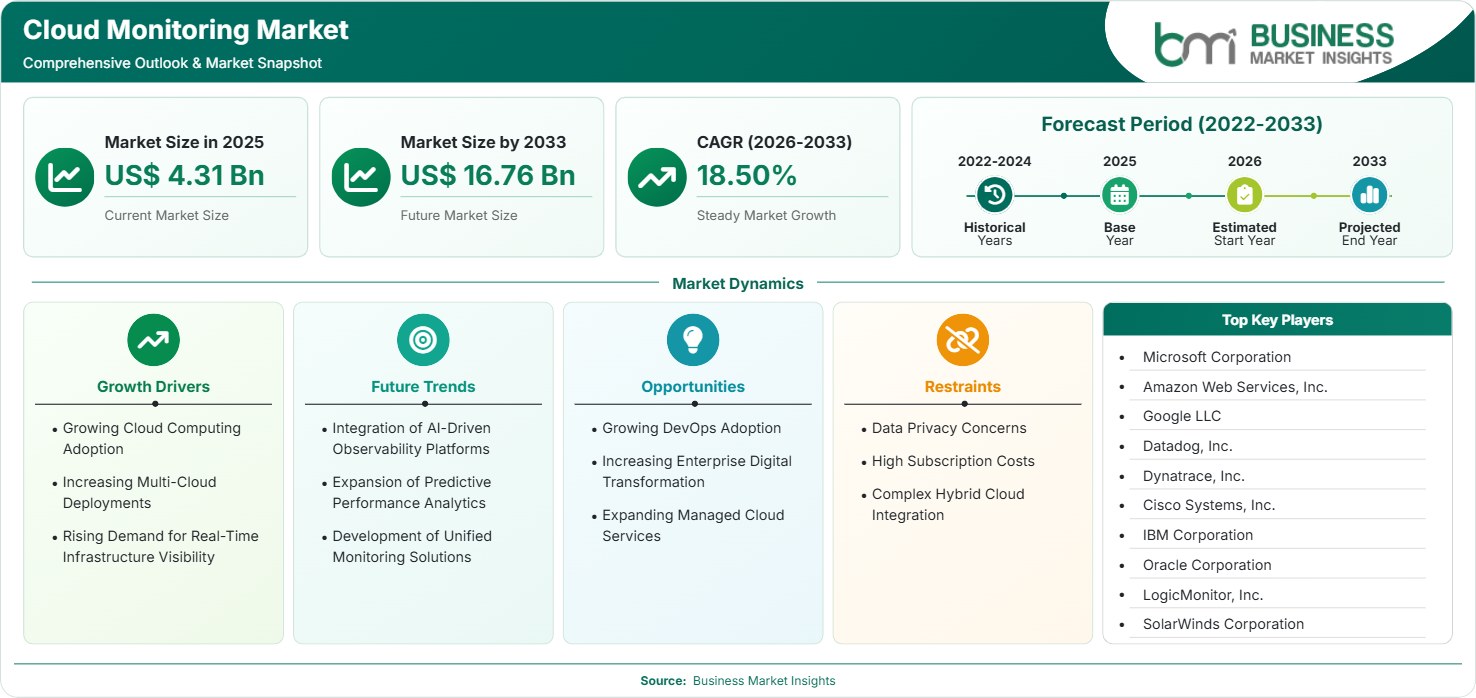
The Cloud Monitoring Market size was valued at US$ 4.31 Billion in 2025 and is projected to reach US$ 16.76 Billion by 2033, growing at a CAGR of 18.50% during 2026–2033. Rising multi-cloud adoption, AI-enabled observability, enterprise digital transformation, expanding DevOps implementation, and increasing demand for real-time infrastructure visibility are creating significant opportunities for intelligent monitoring platforms worldwide.

Report Coverage
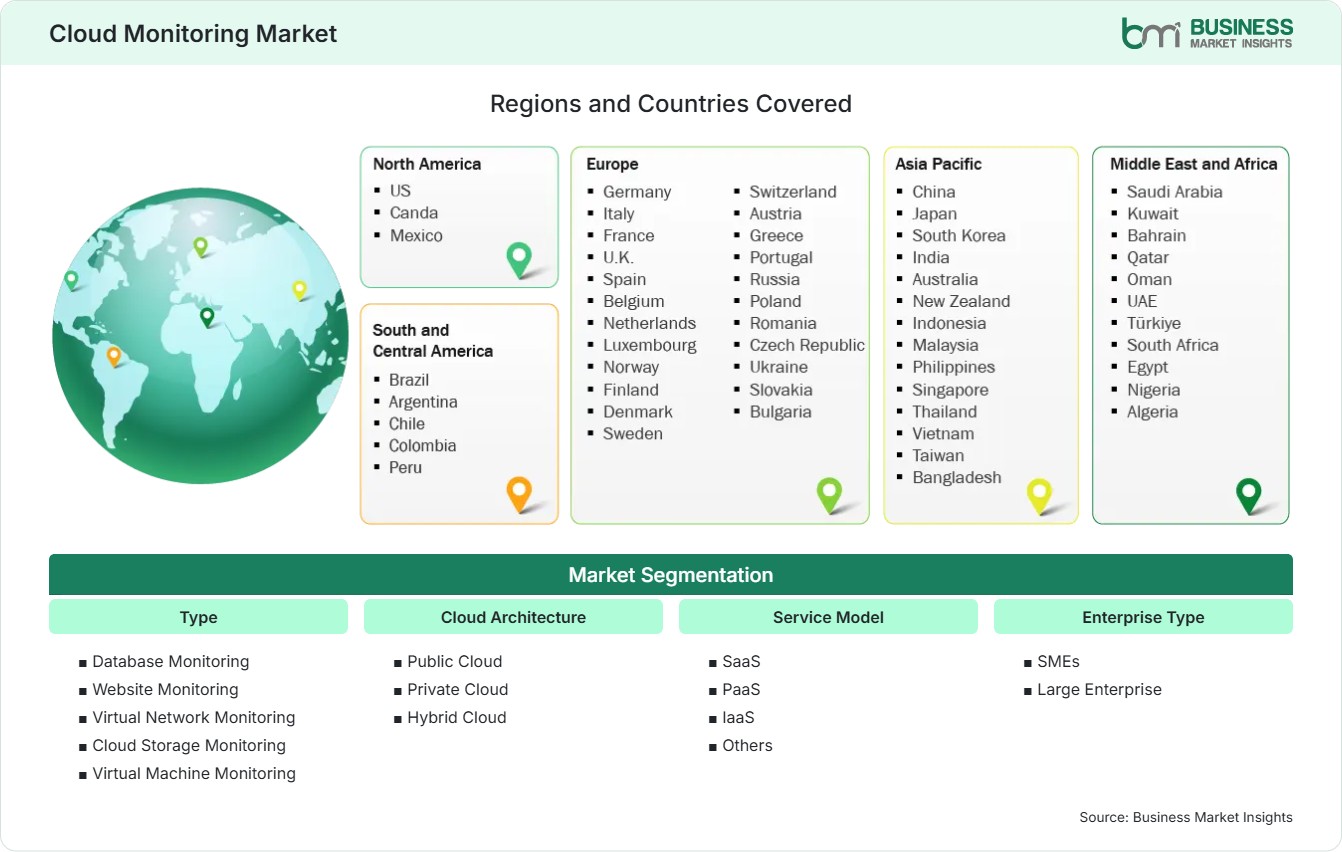
  • Type: Database Monitoring, Website Monitoring, Virtual Network Monitoring, Cloud Storage Monitoring, Virtual Machine Monitoring
  • Cloud Architecture: Public Cloud, Private Cloud, Hybrid Cloud
  • Service Model: SaaS, PaaS, IaaS, Others
  • Enterprise Type: SMEs, Large Enterprise
  • Industry: BFSI, Healthcare, IT & Telecom, Government, Manufacturing, Others
US$ 4.31 Bn Market size in 2025
US$ 16.76 Bn Market Size by 2033
18.50% CAGR, 2026 - 2033
2026-2033 Forecast Period

AI Overview

Cloud Monitoring Market Summary

  • North America Region: North America holds 36%–39% market share in 2025 and is projected to grow at a 17.5%–19.0% CAGR during 2026–2033. Growth is supported by mature cloud ecosystems, enterprise AI adoption, DevSecOps implementation, hyperscale investments, and demand for unified observability across hybrid infrastructures. The U.S. expands at an estimated 18.0%–19.5% CAGR, driven by hyperscale cloud investments and AI-enabled infrastructure monitoring adoption.
  • Fastest Growing Region: Asia Pacific accounts for 24%–27% market share in 2025 and is expected to register the fastest 20.5%–22.5% CAGR through 2033. Government digitalization initiatives, expanding SaaS ecosystems, enterprise cloud migration, hyperscale infrastructure investments, and rapid adoption of cloud-native applications continue accelerating regional demand.
  • Leading Segment: Public Cloud represents 46%–49% share in 2025 and is anticipated to grow at 18.5%–20.0% CAGR. Broad enterprise migration, scalable computing resources, simplified deployment, integrated monitoring capabilities, and cost optimization continue strengthening adoption across organizations of every size.
  • High Growth Segment: Hybrid Cloud captures 28%–31% share in 2025 and is forecast to expand at 21.0%–23.0% CAGR. Organizations increasingly combine public and private infrastructure, creating sustained demand for centralized monitoring, workload visibility, compliance management, and automated operational intelligence.
  • Key Market Opportunity: AI-powered observability platforms integrating predictive analytics, automated remediation, FinOps optimization, cybersecurity monitoring, and unified infrastructure intelligence provide significant long-term opportunities as enterprises modernize increasingly complex hybrid and multi-cloud environments.
  • Major Market Players: Microsoft Corporation, Amazon Web Services, Inc., Google LLC, Datadog, Inc., Dynatrace, Inc., Cisco Systems, Inc., IBM Corporation, Oracle Corporation, LogicMonitor, Inc., and SolarWinds Corporation.
Strategic Insights

Cloud Monitoring Market: Strategic Insights

Cloud Monitoring Market Strategic Framework
FREE PDF
Request your free sample
Request free sample
Stakeholder View

Key Takeaways

  • The market ecosystem is increasingly centered around hyperscale cloud providers, observability software vendors, cybersecurity specialists, managed service providers, and systems integrators collaborating to deliver unified monitoring across increasingly distributed cloud infrastructures.
  • Hybrid cloud deployments and AI-powered observability solutions represent the strongest commercial opportunities because enterprises require centralized monitoring across multiple cloud providers while maintaining compliance, operational efficiency, and infrastructure resilience.
  • Artificial intelligence is transforming monitoring from reactive alerting into predictive infrastructure intelligence capable of detecting anomalies, forecasting failures, automating remediation, optimizing resource utilization, and improving service reliability.
  • Asia Pacific offers the most attractive long-term investment environment owing to expanding hyperscale infrastructure, government-backed digital transformation initiatives, growing SaaS adoption, and rapid enterprise modernization across China, India, Southeast Asia, Japan, and Australia.
  • Strategic acquisitions increasingly focus on observability platforms, AI analytics, cybersecurity integration, and cloud automation capabilities, enabling technology vendors to deliver comprehensive full-stack monitoring solutions supporting complex enterprise cloud ecosystems.
  • Future competitive differentiation will increasingly depend on AI-driven automation, unified observability, FinOps integration, cybersecurity intelligence, and seamless interoperability across public, private, hybrid, edge, and multi-cloud computing environments.
Geographic Outlook

Cloud Monitoring Market Regional Highlights

North America Cloud Monitoring Market

North America accounts for 36%–39% of the market in 2025 and is projected to register a 17.5%–19.0% CAGR during 2026–2033. The region leads due to advanced cloud infrastructure, widespread SaaS adoption, strong AI investments, and mature DevOps practices. Enterprises increasingly implement unified observability platforms to improve application performance, automate incident management, strengthen cybersecurity, and optimize hybrid and multi-cloud environments while meeting stringent regulatory and operational requirements.

  • Enterprises integrate infrastructure, application, network, and security monitoring into unified observability platforms, reducing operational complexity while improving cloud resource utilization and business continuity.
  • BFSI and healthcare organizations invest heavily in AI-powered monitoring to strengthen compliance, ensure service availability, and protect mission-critical workloads across distributed cloud environments.
  • Manufacturing companies increasingly connect Industrial IoT platforms with cloud monitoring tools to support predictive maintenance, operational intelligence, and production optimization.
  • Government agencies continue migrating digital services to secure cloud environments requiring centralized monitoring, automated compliance, and continuous infrastructure visibility.

US Cloud Monitoring Market

The United States represents 74%–78% of the North American market and is expected to expand at an 18.0%–19.5% CAGR through 2033. Continuous investments by hyperscale cloud providers, rapid enterprise AI adoption, expanding DevSecOps implementation, and strong software innovation sustain demand for advanced monitoring platforms capable of supporting complex cloud-native applications and distributed infrastructure.

  • AI-assisted incident management platforms improve operational efficiency through predictive analytics and automated remediation.
  • Federal cybersecurity modernization programs continue encouraging zero-trust architectures supported by continuous cloud observability.
  • Large enterprises integrate monitoring directly into software development pipelines, improving release quality and infrastructure resilience.

Europe Cloud Monitoring Market

Europe captures 25%–28% Cloud Monitoring Market share in 2025 and is forecast to register a 17.8%–19.6% CAGR between 2026 and 2033. Enterprise cloud migration, stringent GDPR compliance, sovereign cloud initiatives, and industrial digitalization continue driving adoption. Germany leads regional implementation, while Nordic countries demonstrate the fastest expansion through advanced cloud-native innovation and enterprise automation.

  • GDPR compliance encourages continuous monitoring, governance, and infrastructure transparency across regulated industries.
  • Industry 4.0 initiatives accelerate deployment of monitoring platforms within advanced manufacturing facilities.
  • Financial institutions modernize hybrid cloud infrastructure requiring real-time monitoring and automated compliance reporting.
  • Sustainability initiatives encourage resource optimization through AI-enabled cloud performance analytics.

Asia Pacific Cloud Monitoring Market

Asia Pacific accounts for 24%–27% of the market in 2025 and is anticipated to record the fastest 20.5%–22.5% CAGR through 2033. China remains the largest contributor, while India records the strongest expansion owing to rapid SaaS adoption, hyperscale data center investments, expanding digital economies, and government-backed digital transformation initiatives.

  • Banking, retail, telecom, and manufacturing sectors increasingly deploy scalable monitoring platforms supporting cloud-native workloads.
  • Hyperscale cloud providers continue expanding regional infrastructure, creating opportunities for advanced observability solutions.
  • Startup ecosystems increasingly adopt Kubernetes and microservices architectures requiring integrated monitoring capabilities.
  • Smart city initiatives strengthen demand for centralized cloud monitoring and cybersecurity analytics.

Rest of World Cloud Monitoring Market

The Rest of World region contributes 10%–13% market share in 2025 while advancing at a 17.0%–18.8% CAGR during the forecast period. South and Central America benefit from increasing enterprise cloud migration, whereas the Middle East and Africa witness growing adoption through smart government initiatives, expanding hyperscale infrastructure, and enterprise cybersecurity investments supporting digital transformation.

  • Brazil and Mexico lead cloud modernization across Latin America through financial services and manufacturing digitalization.
  • Saudi Arabia and the UAE continue investing in sovereign cloud infrastructure and AI-driven government platforms.
  • African enterprises increasingly adopt cloud technologies to improve operational efficiency and digital accessibility.
  • Managed cloud service providers expand regional partnerships, strengthening enterprise access to advanced monitoring platforms.
Global Market Geography
FREE PDF
Request your free sample
Request free sample
Segment Analysis

Cloud Monitoring Market Segmentation

Type

The Type segment accounts for a significant share of the Cloud Monitoring Market, supported by increasing enterprise demand for end-to-end visibility across cloud infrastructure. The segment represents 29%–32% market share in 2025 and is projected to expand at a 19.0%–20.5% CAGR as organizations strengthen observability strategies across cloud-native applications.

  • Database Monitoring: Enables continuous monitoring of database performance, availability, and workload optimization while supporting high-volume transactional environments and enterprise business continuity.
  • Website Monitoring: Improves digital customer experience through continuous uptime tracking, response-time analysis, and automated performance diagnostics across web applications.
  • Virtual Network Monitoring: Supports network visibility, traffic optimization, and security analytics for distributed cloud environments with increasing hybrid connectivity.
  • Cloud Storage Monitoring: Helps organizations optimize storage utilization, availability, compliance, and cost management while protecting enterprise data assets.
  • Virtual Machine Monitoring: Delivers infrastructure health monitoring, workload optimization, resource allocation, and proactive incident detection across virtualized computing environments.

Cloud Architecture

Cloud Architecture remains the largest structural segment because organizations increasingly adopt flexible deployment models balancing scalability, compliance, and operational efficiency. This segment contributes 46%–49% market share in 2025 and is expected to expand at a 19.0%–20.0% CAGR, reflecting the expanding Cloud Monitoring Market scope across hybrid enterprise infrastructures.

  • Public Cloud: Dominates enterprise deployments through scalability, lower infrastructure costs, and integrated monitoring capabilities supporting cloud-native applications.
  • Private Cloud: Maintains strong demand among highly regulated industries requiring enhanced security, governance, and workload control.
  • Hybrid Cloud: Experiences the fastest adoption as organizations combine public scalability with private infrastructure for compliance-sensitive workloads.

Service Model

The Service Model segment continues expanding as enterprises diversify cloud deployment strategies to improve flexibility, scalability, and operational efficiency. The segment represents 31%–34% of the market in 2025 and is projected to grow at a 19.2%–20.8% CAGR through 2033. Increasing adoption of cloud-native applications, containerization, and AI-enabled operations strengthens demand for integrated monitoring across service delivery models.

  • SaaS: Remains the most widely adopted model because organizations require rapid deployment, automatic updates, centralized management, and integrated monitoring without significant infrastructure investments.
  • PaaS: Supports application development, testing, and deployment by providing developers with monitoring tools that improve application performance and resource optimization.
  • IaaS: Gains strong enterprise demand through infrastructure scalability, workload flexibility, and comprehensive visibility across virtual machines, storage, and networking resources.

Enterprise Type

Enterprise Type segmentation reflects varying monitoring requirements based on organizational size and cloud maturity. This segment contributes 33%–36% Cloud Monitoring Market share in 2025 and is expected to register an 18.5%–20.2% CAGR during the forecast period. Growing digital transformation investments encourage businesses to deploy scalable monitoring platforms supporting operational resilience and cybersecurity.

  • SMEs: Adopt cloud monitoring to reduce IT complexity, improve service availability, automate incident response, and optimize cloud spending through subscription-based solutions.
  • Large Enterprise: Leads adoption because complex hybrid infrastructures require advanced observability, AI-powered analytics, compliance management, and centralized operational visibility.

Industry

Industry adoption continues broadening as cloud technologies become essential across business operations. This segment accounts for 35%–38% market share in 2025 and is forecast to expand at a 19.0%–20.7% CAGR through 2033. Increasing digital transformation, cybersecurity priorities, and AI-enabled infrastructure management continue strengthening enterprise investment across multiple verticals.

  • BFSI: Requires continuous monitoring to maintain regulatory compliance, transaction reliability, cybersecurity, and uninterrupted digital banking services.
  • Healthcare: Utilizes monitoring platforms to support electronic health records, connected medical devices, telemedicine applications, and secure patient data management.
  • IT & Telecom: Represents one of the largest adopters because cloud-native applications, virtualization, and 5G infrastructure require continuous observability and automated performance optimization.
  • Government: Implements cloud monitoring to improve digital public services, strengthen cybersecurity, support regulatory compliance, and optimize infrastructure utilization.
  • Manufacturing: Integrates monitoring with Industrial IoT, predictive maintenance, digital twins, and smart factory operations to improve operational efficiency and minimize downtime.
Market Forces

Cloud Monitoring Market Dynamics

Key Market Drivers

Growing Cloud Computing Adoption

Rapid enterprise migration toward public, private, and hybrid cloud environments continues accelerating demand for intelligent monitoring platforms. Organizations increasingly rely on cloud infrastructure for mission-critical workloads, requiring continuous visibility into applications, databases, storage, and networking resources. Cloud Monitoring Market growth indicators on cloud adoption, organizations are increasing their workload in cloud every year, resulting in ongoing need for observability tools that can ensure reliability, diagnose issues automatically, and help in optimization of resources. Monitoring with the assistance of artificial intelligence makes things easier for them.

Increasing Multi-Cloud Deployments

As organizations are more concerned about resilience, vendor lock-in, and workload performance optimization, they move their workloads to multiple cloud providers. The use of multiple clouds brings challenges for management, as different infrastructures, applications, and security mechanisms work on different systems. Hence, companies need to have unified monitoring that can collect telemetry data, detect anomalies, correlate incidents, and automate the resolution of issues. Observability tools help in infrastructure governance and provide the ability to control workloads in public, private, and hybrid cloud environments.

Rising Demand for Real-Time Infrastructure Visibility

Modern businesses need real-time visibility of their infrastructure in order to keep their applications up and running and deliver great digital experience. The AI-driven monitoring tools gather the telemetry data from servers, containers, databases, APIs, and network infrastructure components to provide real-time operational insights. Predictive analytics detects any performance issues before they happen and helps to solve the issues faster. Digitalization of the services in the banking sector, healthcare, manufacturing, retail, and governmental sector drives investment in cloud observability solutions.

Key Market Opportunities

Growing DevOps Adoption

Growing adoption of DevOps and Site Reliability Engineering (SRE) practices is creating strong opportunities for advanced cloud monitoring solutions. Organizations increasingly integrate monitoring into CI/CD pipelines to identify software issues before production deployment, improve release quality, and reduce downtime. Observability solutions that use AI technology automate tasks related to root cause analysis, performance testing, and incidents, providing insight along the way. The Cloud Monitoring Market Forecasts suggest ongoing investments in intelligent monitoring solutions, considering how organizations value fast application delivery, resilience, and cloud-native development.

Increasing Enterprise Digital Transformation

The efforts of banks, healthcare institutions, manufacturers, retailers, and governments to digitally transform their organizations by replacing legacy infrastructures and implementing hybrid clouds and AI business applications create a growing opportunity for cloud monitoring vendors. Cloud monitoring vendors who can deliver services in unified monitoring, cybersecurity analysis, compliance automation, and FinOps will have an advantage as companies spend more on optimizing their digital infrastructures.

Expanding Managed Cloud Services

The fast growth of the managed cloud service provider market presents additional sources of income for monitoring platform providers. Enterprises are increasingly turning to specialized providers who manage their cloud infrastructure and need centralized observability, automation of reporting, optimization of workloads, and predictive analytics. The above trends justify the demand for flexible monitoring platforms that can handle complex client infrastructures while cutting costs and increasing service performance.

Market Restraints and Challenges

Data Privacy Concerns

Factor: Organizations operating across multiple jurisdictions must comply with evolving data privacy regulations governing cloud-hosted information and operational telemetry.

Impact: Compliance requirements increase deployment complexity because monitoring platforms must securely collect, process, store, and analyze infrastructure data without violating regional regulations. Industries including healthcare, banking, and government require enhanced encryption, access controls, audit capabilities, and data residency management, increasing implementation effort while slowing purchasing decisions for organizations operating internationally.

High Subscription Costs

Factor: Advanced observability platforms incorporating AI analytics, automation, security monitoring, and full-stack visibility often require premium subscription models.

Impact: Small and medium-sized enterprises frequently face budget limitations when adopting enterprise-grade monitoring solutions. Additional expenses related to implementation, integration, employee training, and ongoing optimization can extend return-on-investment timelines. Vendors increasingly address this challenge through modular pricing, cloud-native delivery models, and scalable subscription packages that improve affordability while maintaining advanced monitoring capabilities.

Company Analysis

Competitive Landscape

The competitive environment remains highly dynamic as vendors compete through AI innovation, unified observability, cybersecurity integration, automation, and cloud-native infrastructure management. This Cloud Monitoring Market analysis indicates that hyperscale cloud providers and specialized observability vendors continue strengthening their platforms through acquisitions, strategic partnerships, and continuous product innovation.

Company Name

Overview

Products and Services Relevant to this Market

Microsoft Corporation

Global technology leader delivering enterprise cloud infrastructure and AI-enabled digital platforms.

Azure Monitor, Azure Application Insights, Log Analytics, cloud observability, infrastructure monitoring.

Amazon Web Services, Inc.

Leading global cloud infrastructure provider supporting enterprise workloads worldwide.

Amazon CloudWatch, AWS X-Ray, monitoring, logging, observability, cloud performance analytics.

Google LLC

Major cloud platform provider focused on AI-driven infrastructure management.

Google Cloud Operations Suite, Cloud Monitoring, Cloud Logging, observability solutions.

Datadog, Inc.

Specialized observability provider serving cloud-native enterprises globally.

Infrastructure monitoring, APM, log management, security monitoring, AI observability.

Dynatrace, Inc.

AI-powered software intelligence and observability platform provider.

Full-stack monitoring, application performance management, automation, cloud analytics.

Cisco Systems, Inc.

Global networking and enterprise infrastructure technology provider.

AppDynamics, Splunk Observability, network monitoring, cloud performance management.

IBM Corporation

Enterprise technology company supporting hybrid cloud transformation.

IBM Instana Observability, hybrid cloud monitoring, AI operations, automation software.

Oracle Corporation

Enterprise cloud platform and database technology provider.

Oracle Cloud Infrastructure Monitoring, application monitoring, analytics, cloud management.

LogicMonitor, Inc.

SaaS-based infrastructure observability specialist.

Hybrid infrastructure monitoring, cloud observability, AIOps, network performance monitoring.

SolarWinds Corporation

IT operations management and infrastructure monitoring provider.

Hybrid cloud monitoring, server monitoring, database monitoring, observability solutions.

Trust & Transparency

Research Methodology

The market analysis combines proprietary research with secondary data from government agencies, company disclosures, regulatory filings, industry databases and expert interviews. Market estimates are validated through data triangulation, cross-market benchmarking and analyst review.

View Full Research Methodology

Questions Answered

Frequently Asked Questions

What does the Cloud Monitoring Market Report include?

The report provides detailed insights into market size, growth outlook, segmentation, regional analysis, competitive landscape, technology trends, investment opportunities, key drivers, restraints, recent developments, and future industry prospects.

Which region is projected to grow the fastest?

Asia Pacific is forecast to record the fastest growth during the forecast period due to expanding hyperscale investments, government digital transformation programs, growing SaaS adoption, enterprise cloud migration, and increasing technology investments across emerging economies.

Which industry is expected to generate the highest demand?

The IT & Telecom sector is expected to remain the largest adopter owing to extensive cloud-native application deployment, virtualization, hyperscale infrastructure expansion, and continuous requirements for application performance monitoring and operational visibility.

Which deployment architecture dominates the market?

Public cloud remains the leading deployment architecture because it offers scalability, operational flexibility, integrated monitoring services, reduced infrastructure costs, and simplified deployment for organizations across multiple industries.

What is driving the growth of the Cloud Monitoring Market?

Growing enterprise cloud adoption, hybrid and multi-cloud deployments, AI-powered observability, DevOps implementation, digital transformation initiatives, and increasing demand for real-time infrastructure visibility are the primary factors accelerating market expansion.

Access the Full Cloud Monitoring Market Report

Get segment-level forecasts, regional estimates, competitive benchmarking, company profiles and downloadable Excel datasets.

Access the full Cloud Monitoring Market Report
350 pages PDF & Excel | 2026-08-25
Similar Research

Related Market Reports