
Sovereign Cloud Market Outlook: Size, Share, Trends, Growth Analysis, Competitive Landscape & Forecast, 2026-2033

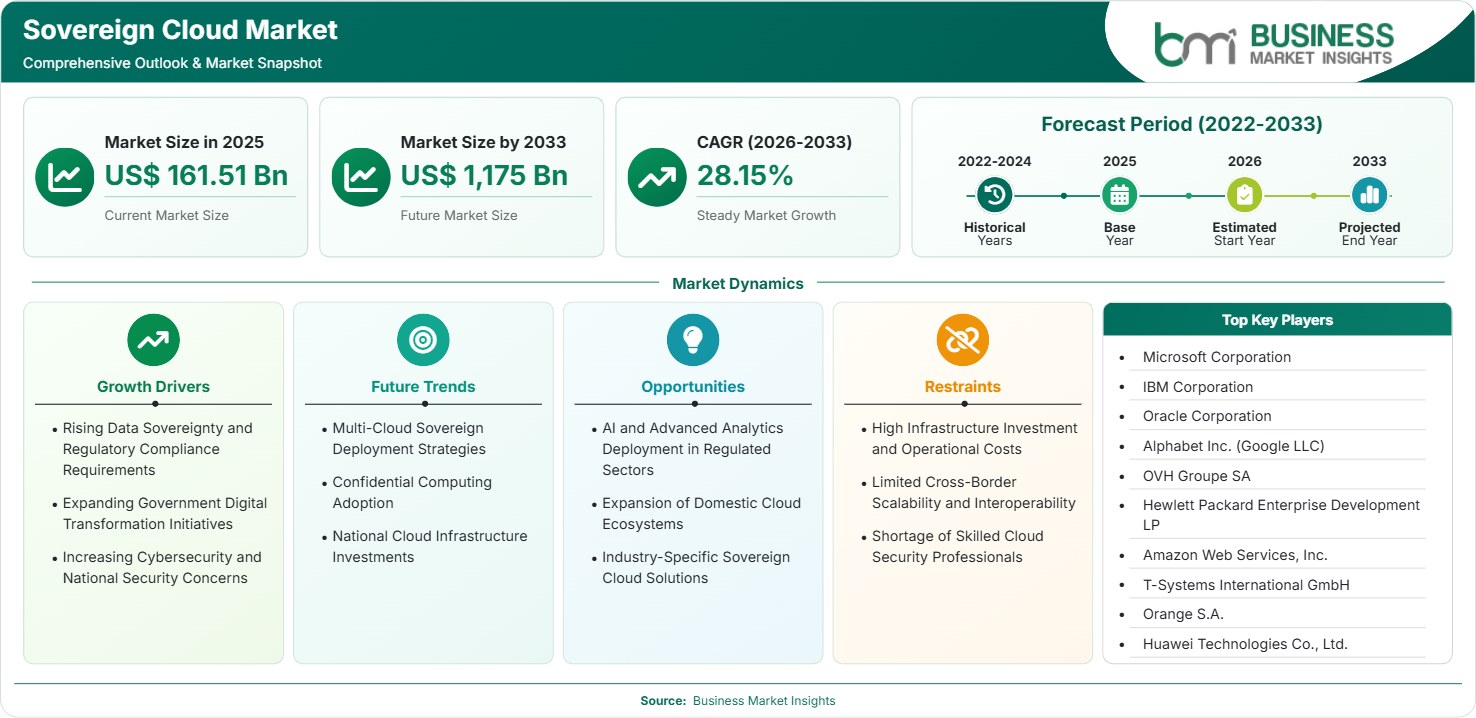
The Sovereign Cloud Market size was valued at US$ 161.51 Billion in 2025 and is projected to reach US$ 1,175 Billion by 2033, growing at a CAGR of 28.15% during 2026–2033. Rising data localization mandates, increasing cybersecurity concerns, expanding digital government initiatives, and accelerating adoption of AI-enabled cloud infrastructure continue creating strong investment opportunities across regulated industries.

Report Coverage
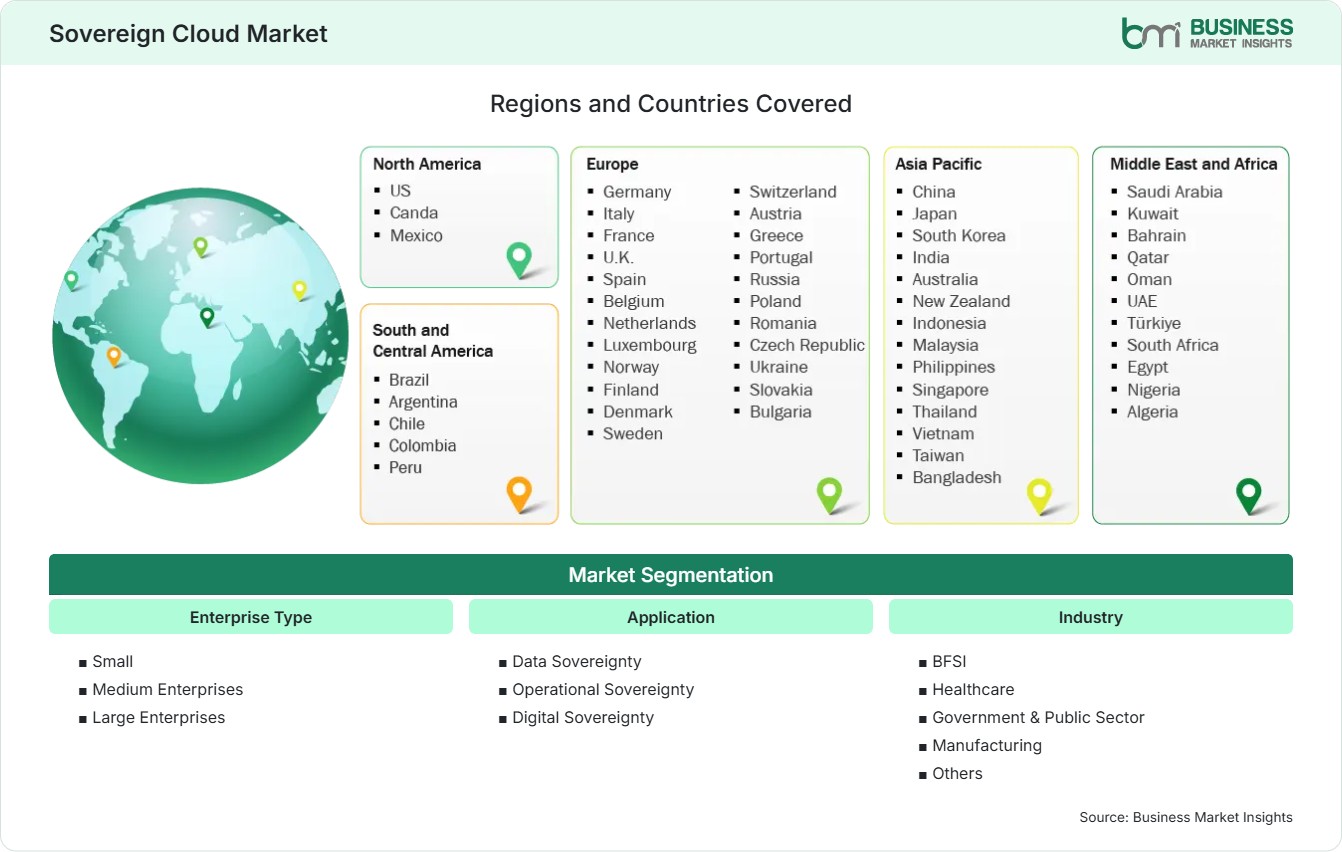
  • Enterprise Type: Small, Medium Enterprises, Large Enterprises
  • Application: Data Sovereignty, Operational Sovereignty, Digital Sovereignty
  • Industry: BFSI, Healthcare, Government & Public Sector, Manufacturing, Others
US$ 161.51 Bn Market size in 2025
US$ 1,175 Bn Market Size by 2033
28.15% CAGR, 2026 - 2033
2026-2033 Forecast Period

AI Overview

Sovereign Cloud Market Summary

  • North America Region: Holds an estimated 38%–41% sovereign cloud market share in 2025 and is projected to expand at a 26.5%–28.0% CAGR during 2026–2033. Growth is supported by federal cybersecurity modernization, Défense cloud investments, regulated industry adoption, and enterprise migration toward jurisdiction-controlled digital infrastructure. The U.S. remains the regional growth engine, supported by federal cloud modernization programs and enterprise compliance spending, advancing at an estimated 26.5%–28.0% CAGR.
  • Fastest Growing Region: Asia Pacific accounts for approximately 23%–26% of global revenue in 2025 and is anticipated to record a 30.5%–32.5% CAGR through 2033. Expanding national cloud strategies, stricter data residency legislation, smart manufacturing initiatives, and sovereign AI investments continue accelerating enterprise deployments.
  • Leading Segment: Large Enterprises represent approximately 66%–69% market share in 2025 while advancing at a 27.5%–29.5% CAGR. Adoption remains strongest among financial institutions, governments, healthcare organizations, and multinational manufacturers managing sensitive workloads under evolving compliance frameworks.
  • High Growth Segment: Digital Sovereignty accounts for approximately 27%–30% of application revenue during 2025 while expanding at a 31.0%–33.0% CAGR. Organizations increasingly prioritize independent digital infrastructure, trusted AI environments, secure identity management, and locally governed cloud ecosystems supporting national resilience.
  • Key Market Opportunity: Growing sovereign AI deployments, confidential computing, regional cloud ecosystems, government procurement modernization, and cross-border digital infrastructure partnerships create substantial opportunities for compliant cloud platforms delivering trusted, jurisdiction-controlled services across highly regulated industries.
  • Major Market Players: Microsoft Corporation, IBM Corporation, Oracle Corporation, Alphabet Inc. (Google LLC), OVH Groupe SA, Hewlett Packard Enterprise Development LP, Amazon Web Services, Inc., T-Systems International GmbH, Orange S.A., Huawei Technologies Co., Ltd.
Strategic Insights

Sovereign Cloud Market: Strategic Insights

Sovereign Cloud Market Strategic Framework
FREE PDF
Request your free sample
Request free sample
Stakeholder View

Key Takeaways

  • Expansion of the cloud ecosystem will rely more and more on collaborations between hyperscalers, telecommunication firms, cybersecurity companies, data center operators, and governmental organizations to provide regulated digital infrastructure.
  • The sectors that offer the most business prospects are regulated sectors such as banks, hospitals, and governmental agencies since compliance regulations drive migration to jurisdictional clouds.
  • Technology innovations are focused on confidential computing, sovereign AI, key management for encryption, identity services, and policy-based automation, which can address complex compliance regulations of the countries.
  • Europe sovereign cloud market offers one of the strongest investment environments through expanding digital sovereignty initiatives, while Asia Pacific provides exceptional long-term demand driven by localization regulations and digital transformation programs.
  • Typical expansion approaches will include strategic acquisitions, regional joint ventures, and sovereign cloud alliances to gain stronger local operations and reliable collaboration with national governments.
  • Differentiation of vendors will be based on governance transparency, operational independence, cybersecurity resilience, compliance automation, and integration with AI-capable digital infrastructure.
Geographic Outlook

Sovereign Cloud Market Regional Highlights

North America Sovereign Cloud Market

North America accounted for approximately 38%–41% share in 2025 and is estimated to expand at a 26.5%–28.0% CAGR during 2026–2033. The region benefits from advanced cloud adoption, government cybersecurity initiatives, and strong enterprise spending across regulated sectors. The United States represents the dominant contributor due to federal modernization programs, defense requirements, and increasing compliance investments from financial institutions. The Sovereign Cloud Market share position remains supported by hyperscaler presence and strong domestic cloud infrastructure capabilities.

  • The budget for cloud modernization in federal organizations is increasing, leading to the expectation of secure clouds, good governance, classified workloads, and compliance-oriented architectures from cloud service providers.
  • Banks and other financial services firms are moving toward the use of controlled clouds due to regulations regarding customer information, operations resilience, and cyber risk management.
  • Technology vendors are investing in regional data centers and sovereign cloud services as a response to increased demands from healthcare, government, and critical infrastructure organizations.
  • Increasing AI governance requirements present an opportunity for confidential computing technologies.

US Sovereign Cloud Market

The United States represented approximately 32%–35% of global Sovereign Cloud Market share in 2025 and is projected to grow at a 26.5%–28.0% CAGR through 2033. Strong federal cloud initiatives, cybersecurity regulations, and enterprise demand for trusted infrastructure continue shaping adoption. The country maintains leadership through major technology providers, extensive data center networks, and significant investments in secure cloud environments. Public sector modernization and regulated industry transformation remain central contributors to national market expansion.

  • Government cloud procurement continues supporting demand for secure platforms designed around federal compliance standards, operational control, and specialized workload requirements.
  • Large enterprises are prioritizing hybrid sovereign architectures to balance innovation speed with strict governance, privacy, and cybersecurity obligations.
  • Cloud providers are developing dedicated U.S.-based solutions to support Défense, financial services, healthcare, and public administration customers requiring enhanced control.

Europe Sovereign Cloud Market

Europe held approximately 27%–30% share in 2025 and is forecast to grow at a 28.5%–30.5% CAGR between 2026 and 2033. Germany, France, and the Netherlands represent leading markets due to strong privacy frameworks, digital sovereignty policies, and enterprise cloud transformation. The region demonstrates strong demand for locally operated infrastructure as organizations prioritize regulatory compliance, cybersecurity resilience, and reduced dependency on external technology ecosystems.

  • Germany continues expanding sovereign infrastructure investments through industrial digitalization, enterprise cloud adoption, and stronger requirements for protected business data environments.
  • France is advancing sovereign cloud capabilities through government-supported digital programs and partnerships between technology providers and domestic infrastructure operators.
  • European financial institutions are adopting compliant cloud solutions to address evolving data governance requirements and operational resilience expectations.
  • Public sector organizations are increasing cloud procurement focused on transparency, jurisdictional control, and secure processing of sensitive information.

Asia Pacific Sovereign Cloud Market

Asia Pacific accounted for approximately 23%–26% in 2025 and is expected to achieve the fastest expansion with a 30.5%–32.5% CAGR during 2026–2033. China, India, Japan, Singapore, and Australia are emerging as major adoption centers due to national digital transformation strategies, cybersecurity regulations, and increasing cloud dependency. The region’s Sovereign Cloud Market growth is driven by government digitization, manufacturing modernization, and expanding enterprise technology investments.

  • China is enhancing its domestic cloud ecosystems by way of localized infrastructure and adoption of digital platforms that are under control.
  • India is experiencing an increase in demand owing to data protection policies, government digital transformation programs, and enterprise migration to cloud services.
  • Japan and Singapore are helping in adoption with the aid of sophisticated technology ecosystems, cybersecurity spending, and robust enterprise cloud programs.
  • Manufacturing organizations in Asia Pacific are adopting sovereign cloud ecosystems for automation and data exchange.

Rest of World Sovereign Cloud Market

South and Central America together contributed approximately 5%–7% share of the Sovereign Cloud Market in 2025 and are projected to grow at a 27.5%–29.5% CAGR through 2033. Brazil and Mexico are emerging markets due to expanding digital government initiatives, financial technology adoption, and data protection regulations.

The Middle East and Africa region represented approximately 4%–6% share in 2025 and is expected to expand at a 29.0%–31.0% CAGR. Gulf countries are investing heavily in digital infrastructure, smart cities, and locally governed cloud ecosystems.

  • Brazil is developing stronger cloud governance frameworks as enterprises seek improved control over financial, healthcare, and government-related information assets.
  • Mexico’s digital transformation initiatives are encouraging organizations to adopt secure cloud environments supporting regulated business operations.
  • Saudi Arabia and the United Arab Emirates are investing in sovereign digital infrastructure aligned with national technology strategies and economic diversification programs.
  • African markets are gradually adopting sovereign cloud capabilities through telecom partnerships, government modernization efforts, and increasing demand for secure digital services.
  • Regional providers are collaborating with global cloud companies to establish localized infrastructure while meeting national compliance and cybersecurity requirements.
Global Market Geography
FREE PDF
Request your free sample
Request free sample
Segment Analysis

Sovereign Cloud Market Segmentation

Enterprise Type

Enterprise Type segmentation demonstrates strong adoption among organizations requiring enhanced governance, regulatory alignment, and operational control over sensitive workloads. Large Enterprises represented approximately 66%–69% share in 2025 and are estimated to grow at a 27.5%–29.5% CAGR during 2026–2033 due to complex compliance needs, multinational operations, and extensive cloud migration programs. The Sovereign Cloud Market scope continues expanding as enterprises prioritize secure infrastructure supporting critical applications, AI workloads, and confidential business processes.

  • Small & Medium Enterprises (SMEs): SMEs are increasingly adopting sovereign cloud solutions through managed services, reducing infrastructure complexity while improving compliance capabilities. Affordable subscription models and regional cloud offerings are supporting broader adoption among smaller organizations.
  • Large Enterprises: Large enterprises drive adoption through complex digital ecosystems requiring dedicated governance, advanced security controls, and regulatory compliance. Their investments focus on hybrid architectures, confidential computing, and jurisdiction-specific cloud environments.

Application

Application-based segmentation highlights increasing demand for cloud environments designed around specific sovereignty requirements. Data Sovereignty remains a major adoption driver as organizations seek control over information storage, processing locations, and regulatory compliance. The Sovereign Cloud Market trends indicate growing enterprise focus on operational independence and digital resilience. Application adoption is supported by cybersecurity concerns, privacy regulations, AI governance requirements, and increasing demand for transparent cloud management frameworks.

  • Data Sovereignty: Organizations prioritize localized data storage, processing control, and compliance mechanisms to address privacy regulations. Financial services, healthcare, and government sectors represent major adopters requiring strict information governance.
  • Operational Sovereignty: Enterprises seek greater control over cloud operations, service availability, and infrastructure management. This application supports business continuity objectives by reducing dependency risks and improving operational transparency.
  • Digital Sovereignty: Digital sovereignty adoption is accelerating as nations and enterprises pursue independent technology capabilities. Investments focus on sovereign AI, trusted platforms, cybersecurity frameworks, and resilient digital ecosystems.

Industry

Industry segmentation reflects increasing reliance on secure cloud infrastructure across regulated and technology-intensive sectors. The Sovereign Cloud Market share is influenced by government mandates, cybersecurity requirements, and digital transformation priorities. Banking, healthcare, government, and manufacturing organizations represent key demand centers because they manage sensitive information and mission-critical operations. Adoption is supported by regulatory evolution, modernization initiatives, and growing requirements for trusted cloud environments.

  • BFSI: Banks and financial institutions are adopting sovereign cloud platforms to strengthen data protection, regulatory compliance, risk management, and secure digital banking operations while supporting innovation through advanced cloud capabilities.
  • Healthcare: Healthcare organizations utilize sovereign cloud infrastructure for protecting patient information, enabling secure analytics, supporting digital health platforms, and maintaining compliance with evolving healthcare data protection standards.
  • Government & Public Sector: Public sector organizations deploy sovereign cloud environments to secure citizen data, improve digital service delivery, and maintain national control over critical information systems.
  • Manufacturing: Manufacturers are integrating sovereign cloud solutions to protect intellectual property, support connected factories, manage industrial data, and improve cybersecurity across increasingly digital production environments.
Market Forces

Sovereign Cloud Market Dynamics

Key Market Drivers

Rising Data Sovereignty and Regulatory Compliance Requirements

As governments and regulated industries increasingly seek for sensitive data to reside within national boundaries, there is a growing need for sovereign cloud platforms. Legal and regulatory requirements related to data localization, privacy, cybersecurity, and infrastructure protection compel businesses to use cloud platforms which are aligned with domestic laws. Sovereign cloud platforms are preferred by government organizations, financial firms, health care organizations, and defense agencies in order to gain more control over sensitive data in accordance with regulations. The increasing threats related to jurisdictional concerns and geopolitical uncertainties compel organizations to invest in sovereign cloud infrastructure.

Expanding Government Digital Transformation Initiatives

Governments across the globe are fast-tracking their digital transformation efforts through modernizing public services, increasing operational efficiencies, and enhancing cybersecurity measures. Sovereign clouds enable governments to have secure infrastructure that supports citizen services, digital identity, tax management, health records, and national security applications with complete regulation. Investments in e-government platforms, smart cities, and digital public infrastructures are fueling demand for sovereign cloud implementations. National cloud policies and public-private partnerships are also contributing to sovereign clouds through encouragement of home-grown cloud ecosystems and trusted services infrastructures.

Increasing Cybersecurity and National Security Concerns

The increase in cyberattacks on governments, critical infrastructures, and regulated sectors is making organizations seek cloud infrastructures that are highly secure and sovereign. Cloud platforms that offer more robust security, encrypted data handling, monitoring, and compliance with national cybersecurity regulations are now sought by organizations. Sovereign cloud platforms minimize exposure to foreign jurisdictional laws and increase resilience against cyber threats and vulnerabilities in the supply chain. Investments in cyber protection, zero trust security frameworks, and secure digital infrastructure have led organizations and governments to adopt sovereign cloud infrastructures that are focused on national security, business continuity, and data governance.

Key Market Opportunities

AI and Advanced Analytics Deployment in Regulated Sectors

The use of artificial intelligence, machine learning, and big data analytics in sectors like government, health care, banking, and defense presents ample opportunities for sovereign cloud vendors. Sovereign clouds provide the possibility to develop secure artificial intelligence models, conduct safe data exchange, and do big data analytics without giving up data sovereignty. The growth of investments in generative artificial intelligence, digital public services, fraud prevention, predictive health care, and defense intelligence is fueling demand for such cloud infrastructure.

Expansion of Domestic Cloud Ecosystems

Countries are increasingly investing in domestic cloud infrastructure to reduce dependence on foreign hyperscale providers and strengthen national digital resilience, creating a favorable Sovereign Cloud Market forecast. Regional cloud operators, managed service providers, data center companies, and cybersecurity vendors are expanding sovereign cloud ecosystems through local partnerships and government procurement programs. Investments in regional data centers, cloud marketplaces, and industry-specific sovereign cloud services enable organizations to adopt compliant digital infrastructure while strengthening domestic technology capabilities, employment generation, and long-term competitiveness across national cloud markets.

Industry-Specific Sovereign Cloud Solutions

There is an increasing demand for customized sovereign cloud computing solutions that cater specifically to healthcare, finance, defense, energy, telecommunications, and critical infrastructure sectors. Sectors-specific solutions incorporate elements of regulation compliance, secure collaboration, workload isolation, encryption, and cybersecurity measures suited to specific sectors. Given that regulated sectors are moving their operations to cloud computing and at the same time adhering to strict governance, vendors who provide customized sovereign clouds along with consulting and security services stand to gain significant revenues from such sectors.

Market Restraints and Challenges

High Infrastructure Investment and Operational Costs

Factor: Implementation of sovereign clouds entails huge capital expenditures on secure data centers, compliance systems, cybersecurity framework, and operation locally across the entire nation.

Impact: High capital and operational costs prevent wider implementation, especially for small businesses and developing countries, which have tight budgets to fund technology solutions. Compliance, redundancy, cybersecurity certification, and staff training result in higher ownership costs. Infrastructure development and compliance costs prevent profitability and increase payback periods for projects.

Limited Cross-Border Scalability and Interoperability

Factor: The different national data residency requirements along with differences in the regulatory environment prevent smooth cross-border cloud operations.

Impact: Enterprises that operate in several nations typically encounter a disjointed cloud architecture along with duplication of systems. In addition to being difficult to standardize because of different national laws, this becomes expensive due to higher integration cost. Cloud service providers need to tailor their offerings according to national laws.

Company Analysis

Competitive Landscape

Sovereign Cloud Market analysis indicates that vendors are competing through localized infrastructure, regulatory certifications, confidential computing capabilities, hybrid cloud integration, and partnerships with governments and regulated industries. Leading providers are expanding sovereign offerings to address requirements related to data residency, operational independence, cybersecurity resilience, and trusted AI deployments.

Company Name

Overview

Products and Services relevant to this market

Microsoft Corporation

Microsoft provides enterprise cloud platforms with strong compliance capabilities and extensive global infrastructure. The company supports regulated organizations requiring controlled cloud environments.

Azure Government, Azure confidential computing, industry-specific cloud solutions, data residency controls, hybrid cloud management, and compliance-focused infrastructure services.

IBM Corporation

IBM delivers hybrid cloud and security-focused solutions designed for regulated industries. Its expertise combines cloud infrastructure with governance and enterprise modernization capabilities.

IBM Cloud for regulated workloads, hybrid cloud platforms, Red Hat OpenShift, confidential computing, cybersecurity services, and compliance management solutions.

Oracle Corporation

Oracle supports organizations requiring secure enterprise cloud environments with strong database capabilities. Its solutions target government, healthcare, and financial services sectors.

Oracle Cloud Infrastructure, dedicated cloud regions, sovereign cloud services, database security, infrastructure governance, and regulated industry cloud solutions.

Alphabet Inc. (Google LLC)

Google Cloud provides advanced infrastructure and AI capabilities while developing sovereignty-focused offerings for organizations requiring enhanced control.

Google Cloud Sovereign Solutions, confidential computing, secure AI infrastructure, data residency controls, and compliance management services.

OVH Groupe SA

OVHcloud specializes in European cloud infrastructure with strong emphasis on data sovereignty and localized hosting capabilities.

OVH cloud sovereign cloud solutions, dedicated infrastructure, hosted private cloud, data protection services, and European compliance-focused platforms.

Hewlett Packard Enterprise Development LP

HPE provides enterprise infrastructure solutions supporting hybrid cloud strategies and secure workload management.

HPE GreenLake, private cloud solutions, edge computing platforms, hybrid cloud infrastructure, and workload governance services.

Amazon Web Services, Inc.

AWS offers extensive cloud infrastructure and specialized solutions supporting government and regulated enterprise requirements globally.

AWS Outposts, AWS European Sovereign Cloud initiatives, GovCloud services, confidential computing, compliance tools, and hybrid infrastructure solutions.

T-Systems International GmbH

T-Systems provides managed cloud services with strong expertise in European regulations and enterprise digital transformation.

Sovereign cloud platforms, managed infrastructure, SAP cloud services, secure hosting, compliance services, and government cloud solutions.

Orange S.A.

Orange delivers telecommunications and cloud services with regional infrastructure capabilities and cybersecurity expertise.

Orange Business cloud services, trusted cloud solutions, cybersecurity platforms, managed infrastructure, and sovereign connectivity services.

Huawei Technologies Co., Ltd.

Huawei provides cloud infrastructure solutions supporting digital transformation across multiple industries and geographic markets.

Huawei Cloud sovereign solutions, enterprise cloud platforms, data governance tools, AI cloud services, and industry cloud applications.

Trust & Transparency

Research Methodology

The market analysis combines proprietary research with secondary data from government agencies, company disclosures, regulatory filings, industry databases and expert interviews. Market estimates are validated through data triangulation, cross-market benchmarking and analyst review.

View Full Research Methodology

Questions Answered

Frequently Asked Questions

How can businesses evaluate sovereign cloud providers?

Businesses should evaluate providers based on compliance certifications, security capabilities, interoperability options, operational transparency, and their ability to support future technologies such as artificial intelligence and confidential computing.

What role does AI play in sovereign cloud adoption?

AI is increasing demand for sovereign cloud environments because organizations require protected infrastructure for sensitive datasets, and regulated AI applications. Sovereign AI solutions are becoming a strategic priority for governments and enterprises.

Which industries are adopting sovereign cloud solutions fastest?

Government, BFSI, healthcare, and manufacturing industries are among the fastest adopters because they manage sensitive information and face strict regulatory obligations.

How does sovereign cloud differ from traditional cloud services?

Sovereign cloud services emphasize jurisdictional control, data residency, operational independence, and compliance alignment. Traditional cloud platforms focus primarily on scalability and availability, while sovereign environments add governance mechanisms for sensitive workloads.

What are driving for for of sovereign cloud market report?

Organizations are adopting sovereign cloud solutions due to increasing regulatory requirements, cybersecurity concerns, and the need for stronger control over sensitive information. Regulated industries are prioritizing cloud environments that provide localized infrastructure, compliance support, and operational transparency.

Access the Full Sovereign Cloud Market Report

Get segment-level forecasts, regional estimates, competitive benchmarking, company profiles and downloadable Excel datasets.

Access the full Sovereign Cloud Market Report
350 pages PDF & Excel | 2026-08-18
Similar Research

Related Market Reports