
Cloud Advertising Market Outlook: Size, Share, Trends, Growth Analysis, Competitive Landscape & Forecast, 2026-2033

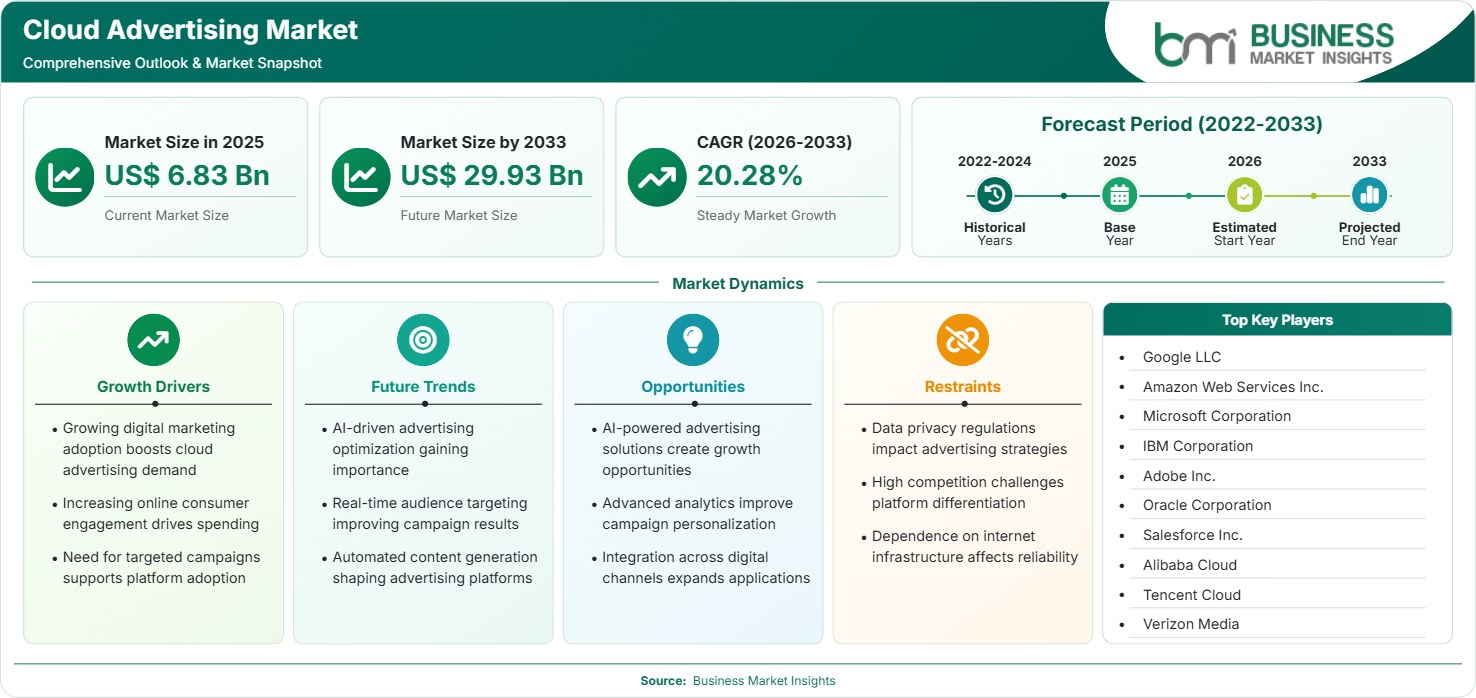
The Cloud Advertising Market size was valued at US$ 6.83 billion in 2025 and is projected to reach US$ 29.93 billion by 2033, growing at a CAGR of 20.28% during 2026–2033. Growing digital marketing adoption, rising online engagement, targeted advertising requirements, and increasing use of cloud-based analytics are expanding opportunities for advertisers and technology providers.

Report Coverage
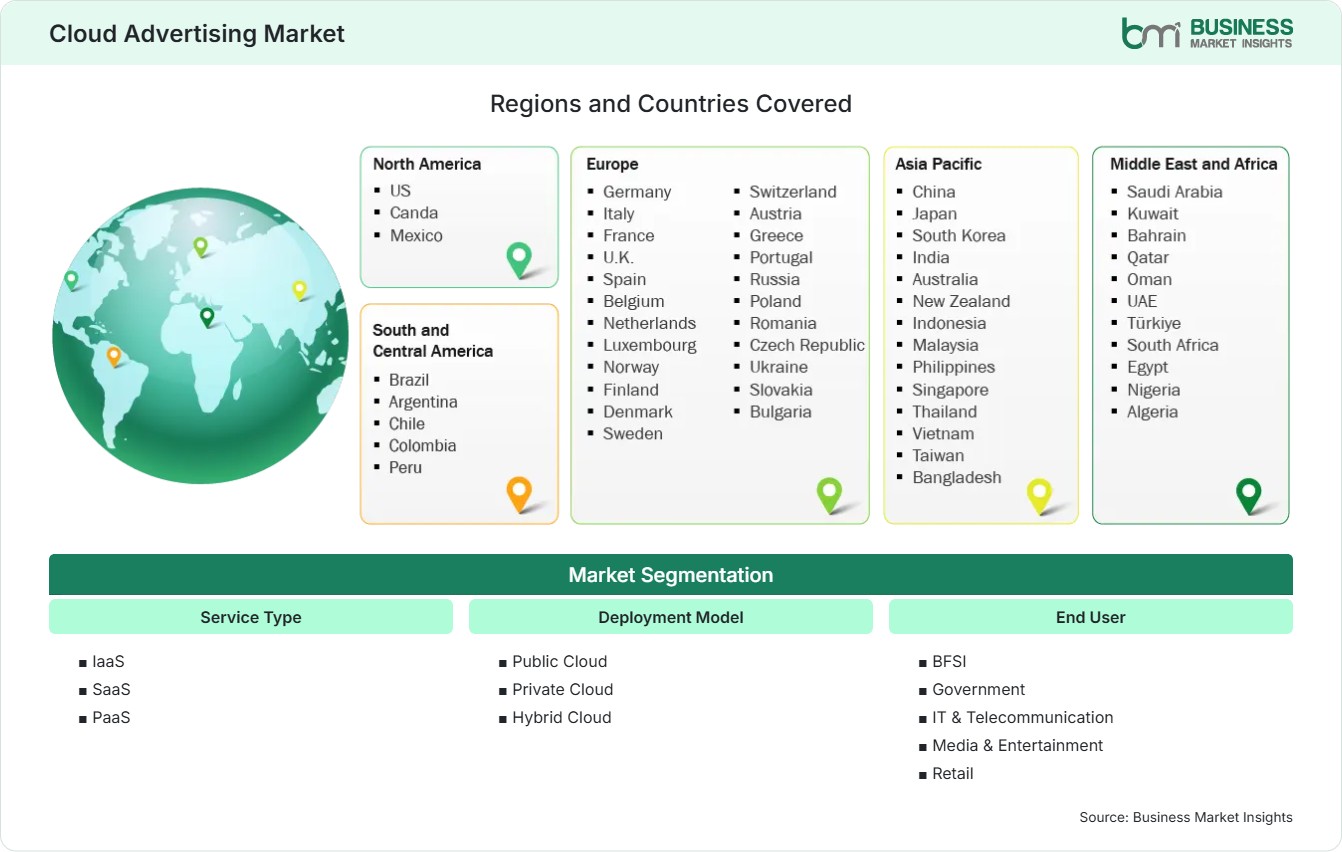
  • Service Type: IaaS, SaaS, PaaS
  • Deployment Model: Public Cloud, Private Cloud, Hybrid Cloud
  • End User: BFSI, Government, IT & Telecommunication, Media & Entertainment, Retail
US$ 6.83 Bn Market size in 2025
US$ 29.93 Bn Market Size by 2033
20.28% CAGR, 2026 - 2033
2026-2033 Forecast Period

AI Overview

Cloud Advertising Market Summary

  • North America Region: North America holds 35%–38% market share in 2025 and is expected to expand at a CAGR of 18.8%–19.8% during 2026–2033. Mature digital advertising infrastructure, high cloud adoption, advanced data analytics, and substantial advertiser spending support regional expansion. The U.S. contributes most regional demand, with a CAGR of 19.0%–20.0%, supported by enterprise cloud migration, programmatic advertising, and sophisticated audience targeting capabilities.
  • Fastest Growing Region: Asia Pacific represents 25%–28% market share in 2025 and is projected to register a CAGR of 22.0%–23.2% during 2026–2033. Rapid digitalization, expanding internet populations, mobile commerce, cloud infrastructure investment, and increasing advertising expenditure across China, India, Southeast Asia, and other emerging economies support strong expansion.
  • Leading Segment: Software as a Service (SaaS) accounts for 48%–52% market share in 2025 and is expected to grow at a CAGR of 20.0%–21.0% during 2026–2033. Scalable subscription models, integrated campaign management, analytics capabilities, and lower infrastructure requirements support broad advertiser adoption.
  • High Growth Segment: Hybrid Cloud captures 24%–28% market share in 2025 and is projected to achieve a CAGR of 21.5%–22.8% during 2026–2033. Flexible workload management, data control, scalability, and integration between private and public environments support adoption among organizations with complex advertising operations.
  • Key Market Opportunity: AI-enabled campaign optimization, advanced analytics, cross-channel audience management, privacy-conscious targeting, and cloud-native advertising infrastructure are creating opportunities to improve personalization, campaign efficiency, measurement, and advertiser returns.
  • Major Market Players: Google LLC, Amazon Web Services, Inc., Microsoft Corporation, IBM Corporation, Adobe Inc., Oracle Corporation, Salesforce, Inc., Alibaba Cloud, Tencent Cloud, and Verizon Media.
Strategic Insights

Cloud Advertising Market: Strategic Insights

Cloud Advertising Market Strategic Framework
FREE PDF
Request your free sample
Request free sample
Stakeholder View

Key Takeaways

  • The value chain is becoming increasingly integrated as cloud infrastructure, advertising platforms, customer data systems, analytics applications, content tools, and commerce technologies converge within connected marketing ecosystems.
  • SaaS-based advertising applications provide strong expansion potential because advertisers can access campaign management, analytics, audience segmentation, and optimization capabilities without maintaining dedicated infrastructure.
  • Cross-channel campaign orchestration is becoming a core competitive differentiator as advertisers seek consistent audience management across search, display, video, social, retail media, connected television, and emerging digital formats.
  • Asia Pacific presents a strong investment case because digital consumer populations, mobile commerce, online media consumption, and cloud infrastructure are expanding simultaneously across several large and rapidly developing advertising markets.
  • Strategic partnerships and platform integrations are increasingly important as technology providers combine advertising, analytics, customer relationship management, cloud infrastructure, and commerce capabilities to strengthen enterprise customer retention.
Geographic Outlook

Cloud Advertising Market Regional Highlights

North America Cloud Advertising Market

North America accounted for 35%–38% Cloud Advertising Market share in 2025 and is expected to grow at a CAGR of 18.8%–19.8% during 2026–2033. Regional demand is supported by mature digital advertising ecosystems, widespread enterprise cloud adoption, strong programmatic activity, and sophisticated analytics capabilities. The United States remains the dominant contributor because large advertisers, agencies, technology companies, and digital platforms operate extensive cloud-based marketing infrastructure. Canada provides additional demand through expanding digital commerce and enterprise technology investment.

  • Large advertisers are increasing cloud utilization to consolidate campaign data, automate performance analysis, and coordinate advertising activity across multiple digital channels.
  • Programmatic advertising infrastructure continues evolving toward more automated bidding, audience management, measurement, and campaign optimization capabilities across major digital formats.
  • Enterprise marketers increasingly connect advertising platforms with customer relationship management and commerce systems to improve audience understanding and conversion measurement.
  • Privacy-conscious data strategies are encouraging investment in first-party data activation, secure analytics environments, contextual targeting, and measurement technologies.

US Cloud Advertising Market

The United States contributes 82%–86% of North American demand and is projected to register a CAGR of 19.0%–20.0% during 2026–2033. The market benefits from a large base of digital advertisers, established cloud infrastructure, sophisticated advertising agencies, and extensive adoption of data-driven marketing. Demand is also supported by widespread use of programmatic advertising, online video, retail media, connected television, and performance-based campaign models.

  • Enterprises are integrating advertising platforms with customer data and analytics applications to create more connected campaign planning and measurement workflows.
  • Retailers and brands are expanding digital advertising programs as commerce platforms generate additional opportunities for audience targeting and measurable promotional activity.
  • Agencies are increasing cloud utilization to manage campaigns across multiple clients, channels, geographies, and advertising formats from centralized technology environments.
  • Advanced analytics and automated optimization are supporting advertisers seeking improved allocation of budgets and more precise measurement of campaign effectiveness.

Europe Cloud Advertising Market

Europe represents 27%–30% Cloud Advertising Market share in 2025 and is anticipated to grow at a CAGR of 18.0%–19.0% during 2026–2033. Germany, the United Kingdom, France, Italy, and Spain represent important regional markets supported by developed digital economies and established enterprise technology ecosystems. The United Kingdom remains a leading advertising technology center, while Germany and France provide substantial enterprise demand. Privacy-focused marketing practices are influencing technology selection across the region.

  • European advertisers are increasingly emphasizing first-party data strategies and privacy-conscious measurement as digital marketing workflows become more data intensive.
  • The United Kingdom provides strong demand through sophisticated advertising agencies, digital publishers, e-commerce businesses, and established technology infrastructure.
  • Germany and France offer opportunities as enterprises modernize marketing technology stacks and connect cloud applications with customer and commerce systems.
  • Cross-channel campaign management is becoming increasingly important as advertisers coordinate search, display, video, social, retail, and other digital formats.

Asia Pacific Cloud Advertising Market

Asia Pacific holds 25%–28% Cloud Advertising Market share in 2025 and is projected to achieve the highest 22.0%–23.2% CAGR during 2026–2033. China, India, Japan, South Korea, Australia, and Southeast Asia represent important demand centers. China provides substantial scale through digital platforms and online commerce, while India offers strong expansion potential because of increasing internet usage, mobile commerce, digital payments, and enterprise cloud adoption.

  • China remains a major regional advertising technology market due to extensive digital commerce, mobile platforms, online video, and sophisticated digital consumer engagement.
  • India provides substantial growth potential as brands increase online advertising investment and businesses adopt cloud technologies to reach rapidly expanding digital audiences.
  • Southeast Asian markets are benefiting from mobile-first consumers, expanding e-commerce ecosystems, social media engagement, and increasing digital advertising participation among businesses.
  • Japan, South Korea, and Australia support advanced cloud advertising adoption through mature digital economies, sophisticated advertisers, and established technology infrastructure.

Rest of World Cloud Advertising Market

The Rest of World region accounts for 8%–11% Cloud Advertising Market share in 2025 and is expected to expand at a CAGR of 19.0%–20.5% during 2026–2033. South America is supported by increasing internet usage, mobile commerce, social media activity, and digital marketing adoption. Brazil represents a leading market, while Mexico provides additional growth through expanding e-commerce and digital business activity.

The Middle East and Africa provide emerging opportunities as enterprises increase digital engagement and cloud adoption. Saudi Arabia, the United Arab Emirates, and South Africa represent important markets as organizations modernize marketing technology and expand online customer acquisition. Growing digital commerce and mobile usage are creating additional advertising opportunities.

  • Brazil provides regional scale through a large digital consumer base, expanding e-commerce activity, and increasing use of online advertising by brands and agencies.
  • Gulf markets are investing in digital transformation, creating demand for cloud-based marketing infrastructure capable of supporting sophisticated customer engagement and campaign measurement.
  • South Africa provides an established digital advertising base and opportunities for cloud platforms serving enterprises, agencies, retailers, and media organizations.
  • Regional technology providers and agencies can expand through localized services, language capabilities, data management expertise, and integrations with regional commerce platforms.
Global Market Geography
FREE PDF
Request your free sample
Request free sample
Segment Analysis

Cloud Advertising Market Segmentation

Service Type

The Service Type segment is influenced by advertiser infrastructure requirements, software accessibility, campaign complexity, and demand for scalable technology. Software as a Service accounted for 48%–52% Cloud Advertising Market share in 2025 and is expected to grow at a CAGR of 20.0%–21.0% during 2026–2033. SaaS adoption benefits from subscription access and integrated marketing functionality.

  • Infrastructure as a Service (IaaS): Provides scalable computing, storage, and infrastructure resources for advertising workloads, supporting organizations that require flexible environments for large-scale data processing and campaign operations.
  • Software as a Service (SaaS): Enables advertisers to access campaign management, analytics, audience tools, and optimization applications through subscription-based platforms without maintaining extensive dedicated infrastructure.
  • Platform as a Service (PaaS): Supports development and deployment of customized advertising applications, integrations, data workflows, and analytics solutions for organizations requiring greater flexibility and control.

Deployment Model

The Deployment Model segment reflects differences in scalability, security, data control, and integration requirements. Public cloud remains attractive for flexible advertising workloads, while private environments address organizations requiring greater control. Hybrid deployment is gaining momentum because enterprises can combine scalable public infrastructure with controlled private environments for selected data and applications.

  • Public Cloud: Provides scalable infrastructure and broad accessibility, enabling advertisers and agencies to deploy campaign applications rapidly while managing variable workloads across multiple markets and channels.
  • Private Cloud: Offers greater organizational control over infrastructure and data environments, supporting enterprises with specialized security, governance, or internal technology requirements.
  • Hybrid Cloud: Combines public and private infrastructure, enabling advertisers to balance scalability, operational flexibility, data control, and integration requirements across complex marketing technology environments.

End User

The End User segment is shaped by digital engagement requirements, advertising intensity, customer data volumes, and organizational investment in marketing technology. IT and Telecommunication and Media & Entertainment remain technology-intensive users, while retail is expanding rapidly through e-commerce and retail media. BFSI and government organizations increasingly use digital channels for customer and citizen engagement.

  • BFSI: Financial institutions use cloud advertising technologies to support customer acquisition, personalized communications, product promotion, and measurable digital campaigns across regulated marketing environments.
  • Government: Government organizations can use cloud-based advertising capabilities for public information campaigns, citizen engagement, digital outreach, and targeted communication across online channels.
  • IT & Telecommunication: Technology and telecommunications companies maintain substantial digital marketing requirements and use cloud platforms to coordinate campaigns, analyze audiences, and manage customer acquisition.
  • Media & Entertainment: Media companies use cloud advertising tools to monetize digital audiences, manage promotional campaigns, analyze engagement, and coordinate advertising across content platforms.
  • Retail: Retailers increasingly use cloud advertising to connect customer data, digital commerce, promotional campaigns, and audience targeting across online and omnichannel environments.
Market Forces

Cloud Advertising Market Dynamics

Key Market Drivers

Growing digital marketing adoption boosts cloud advertising demand

Companies are moving their marketing expenditure from traditional media channels to digital media channels since the latter channels offer measurability, flexibility, and optimization based on performance. This is enabled by cloud technology through scalability in computing, storage, analytics, campaign management, and data integration. The advertisers can increase or decrease the workload as needed without requiring similar physical infrastructure. The agencies also benefit due to coordination of campaigns for multiple clients within multiple markets. This structural migration from traditional marketing workflows toward digital execution is supporting Cloud Advertising Market growth across industries.

Increasing online consumer engagement drives spending

Consumer engagement is increasingly occurring on search engines, social media, digital videos, e-commerce sites, mobile apps, and other connected media. In response, marketers have begun devoting increased time and effort towards digital marketing campaigns which can deliver their messages via multiple touchpoints while providing performance metrics. Cloud computing enables marketers to process large volumes of campaign data while coordinating actions across dispersed geographic areas. This is made possible by the ability to collect all campaign information in one place. These capabilities are contributing to Cloud Advertising Market trends as advertisers prioritize measurable engagement, automated reporting, audience segmentation, and campaign optimization.

Need for targeted campaigns supports platform adoption

Advertisers increasingly require campaign systems capable of identifying relevant audience groups and delivering appropriate messages across digital environments. Targeted campaigns can use first-party information, contextual signals, behavioral insights, geographic characteristics, and engagement data to improve relevance while supporting more efficient budget allocation. Cloud platforms provide the computing capacity and analytical tools required to organize these datasets and support campaign decision-making at scale. Demand for targeting capabilities is encouraging advertising technology providers to strengthen segmentation, measurement, attribution, and optimization functions. The trend also increases the value of integrated platforms that connect advertising with customer data and commerce activity.

Key Market Opportunities

AI-powered advertising solutions create growth opportunities

AI-enabled advertising applications can automate elements of audience segmentation, creative testing, campaign optimization, forecasting, and performance analysis. The technology creates opportunities for advertisers to process larger datasets and identify campaign patterns that may be difficult to manage through manual workflows. Cloud infrastructure provides the scalable computing environment required for these workloads while allowing organizations to integrate models with existing marketing applications. Providers can differentiate by embedding automated recommendations, predictive analytics, dynamic creative capabilities, and real-time campaign optimization into advertising platforms. Cloud Advertising Market Forecasts indicate that technology vendors capable of combining scalable infrastructure with practical marketing applications can capture increasing demand from enterprises seeking greater campaign efficiency.

Advanced analytics improve campaign personalization

Advanced analytics provide advertisers with opportunities to improve audience understanding, campaign attribution, budget allocation, and customer journey analysis. Cloud platforms can consolidate information from multiple digital touchpoints and provide marketers with centralized environments for identifying patterns across campaigns. Improved personalization can help brands develop differentiated messages for audience groups while allowing campaign teams to evaluate performance more systematically. The opportunity extends beyond basic reporting toward predictive modeling, customer segmentation, conversion analysis, and cross-channel measurement. Vendors can strengthen their positions by integrating analytics with advertising execution rather than offering measurement as an isolated function.

Integration across digital channels expands applications

Digital advertising increasingly spans search, display, social media, online video, connected television, retail media, mobile applications, and digital commerce. Managing these channels independently can create fragmented audience data and inconsistent campaign measurement. Cloud-based platforms provide an opportunity to connect campaign planning, audience management, creative assets, analytics, and reporting across multiple environments. Integration can improve operational efficiency by allowing marketers to coordinate campaigns from centralized technology layers while maintaining channel-specific execution capabilities. Vendors can capture additional value by connecting advertising platforms with customer relationship management, commerce, content management, and analytics systems. This broader ecosystem approach can increase platform relevance among enterprise customers and create opportunities for long-term technology partnerships.

Market Restraints and Challenges

Data privacy regulations impact advertising strategies

Factor: Advertising platforms increasingly operate within environments where privacy requirements, consent expectations, data governance rules, and restrictions on personal information influence how audience data can be collected, processed, activated, and measured. Impact: Greater compliance complexity can increase technology costs, constrain certain targeting techniques, and require advertisers to redesign data workflows. Organizations may need stronger consent management, secure data environments, privacy controls, and alternative measurement approaches. These requirements can slow deployment when legacy systems are not designed for evolving governance expectations. Cloud providers and advertising technology companies therefore need architectures capable of supporting privacy-conscious data use without eliminating campaign effectiveness.

High competition challenges platform differentiation

Factor: The cloud advertising ecosystem includes major cloud infrastructure providers, advertising platforms, enterprise software companies, analytics vendors, agencies, and specialized advertising technology providers competing for overlapping customer budgets. Impact: Intense competition can pressure pricing, increase customer acquisition costs, and make it difficult for individual platforms to establish differentiated value propositions. Advertisers can also face technology fragmentation when multiple vendors provide similar campaign management, analytics, targeting, and measurement capabilities. Providers must therefore differentiate through integrations, data capabilities, workflow efficiency, industry specialization, privacy controls, measurable performance, and service quality. Strong ecosystems can help vendors retain customers by embedding advertising functions within broader enterprise technology environments.

Company Analysis

Competitive Landscape

The competitive environment is shaped by cloud infrastructure scale, advertising technology capabilities, analytics, customer data management, enterprise relationships, and cross-channel integration. Cloud Advertising Market Analysis indicates that leading companies are competing through broader marketing ecosystems rather than isolated advertising functions. Large technology providers can combine cloud infrastructure with analytics, customer relationship management, commerce, content, and advertising capabilities, while specialized platforms can differentiate through particular campaign workflows, industry expertise, or regional reach.

Company Name

Overview

Products and Services relevant to this market

Google LLC

Technology company with extensive digital advertising, cloud computing, analytics, and audience engagement capabilities.

Cloud infrastructure, advertising platforms, campaign management, analytics, audience tools, measurement, and digital marketing technologies.

Amazon Web Services, Inc.

Major cloud infrastructure provider supporting scalable enterprise data, analytics, application development, and marketing workloads.

Cloud computing, data storage, analytics, machine learning infrastructure, databases, and services supporting advertising technology deployments.

Microsoft Corporation

Technology company combining cloud infrastructure, enterprise software, data capabilities, and digital advertising technologies.

Cloud services, analytics, marketing applications, data platforms, advertising solutions, and enterprise technology integrations.

IBM Corporation

Enterprise technology provider focused on cloud computing, data management, analytics, automation, and business technology solutions.

Hybrid cloud, analytics, data management, automation, AI-enabled marketing capabilities, and enterprise integration services.

Adobe Inc.

Digital experience technology provider offering integrated tools for content, analytics, customer journeys, and marketing operations.

Marketing automation, campaign management, analytics, customer experience tools, content management, and advertising-related optimization solutions.

Oracle Corporation

Enterprise technology company providing cloud infrastructure, data management, marketing technology, and customer experience applications.

Cloud infrastructure, customer data platforms, marketing applications, analytics, campaign management, and enterprise data services.

Salesforce, Inc.

Customer relationship management company providing cloud-based marketing, customer data, analytics, and engagement technologies.

Marketing automation, customer data platforms, analytics, campaign management, personalization, and customer engagement applications.

Alibaba Cloud

Cloud computing provider serving enterprises with infrastructure, data, analytics, and digital business technologies.

Cloud infrastructure, data analytics, machine learning, databases, digital marketing support, and enterprise application services.

Tencent Cloud

Cloud technology provider with strong capabilities across digital platforms, data, communications, and online consumer ecosystems.

Cloud computing, analytics, data services, digital advertising support, media technologies, and enterprise cloud applications.

Verizon Media

Digital media and advertising technology business associated with large-scale online content, audience engagement, and advertising capabilities.

Digital advertising, audience solutions, media technologies, campaign services, and advertising-related data and analytics capabilities.

Trust & Transparency

Research Methodology

The market analysis combines proprietary research with secondary data from government agencies, company disclosures, regulatory filings, industry databases and expert interviews. Market estimates are validated through data triangulation, cross-market benchmarking and analyst review.

View Full Research Methodology

Questions Answered

Frequently Asked Questions

What does the Cloud Advertising Market Report cover?

The Market Report covers market size, regional performance, segmentation, competitive positioning, technology developments, market drivers, opportunities, restraints, recent developments, and strategic factors influencing adoption through 2033.

Which region offers the strongest growth opportunity?

Asia Pacific offers the strongest expansion opportunity because digital consumer populations, mobile commerce, cloud infrastructure, online media usage, and enterprise digital marketing investment are expanding simultaneously across several major economies.

Why is hybrid cloud gaining importance for advertising workloads?

Hybrid cloud allows organizations to combine public-cloud scalability with greater control over selected private environments. This structure can support flexible campaign processing while helping enterprises address data governance, security, integration, and workload management requirements.

Which service type is expected to maintain a leading position?

Software as a Service is expected to maintain a leading position because subscription-based platforms provide advertisers with accessible campaign management, analytics, audience tools, and optimization capabilities without requiring extensive dedicated infrastructure.

What is driving the Cloud Advertising Market?

The market is being driven by increasing digital marketing adoption, expanding online consumer engagement, growing demand for targeted campaigns, wider cloud infrastructure use, and the need to integrate advertising data across multiple digital channels.

Access the Full Cloud Advertising Market Report

Get segment-level forecasts, regional estimates, competitive benchmarking, company profiles and downloadable Excel datasets.

Access the full Cloud Advertising Market Report
350 pages PDF & Excel | 2026-08-19
Similar Research

Related Market Reports