
Cloud AI Market Outlook: Size, Share, Trends, Growth Analysis, Competitive Landscape & Forecast, 2026-2033

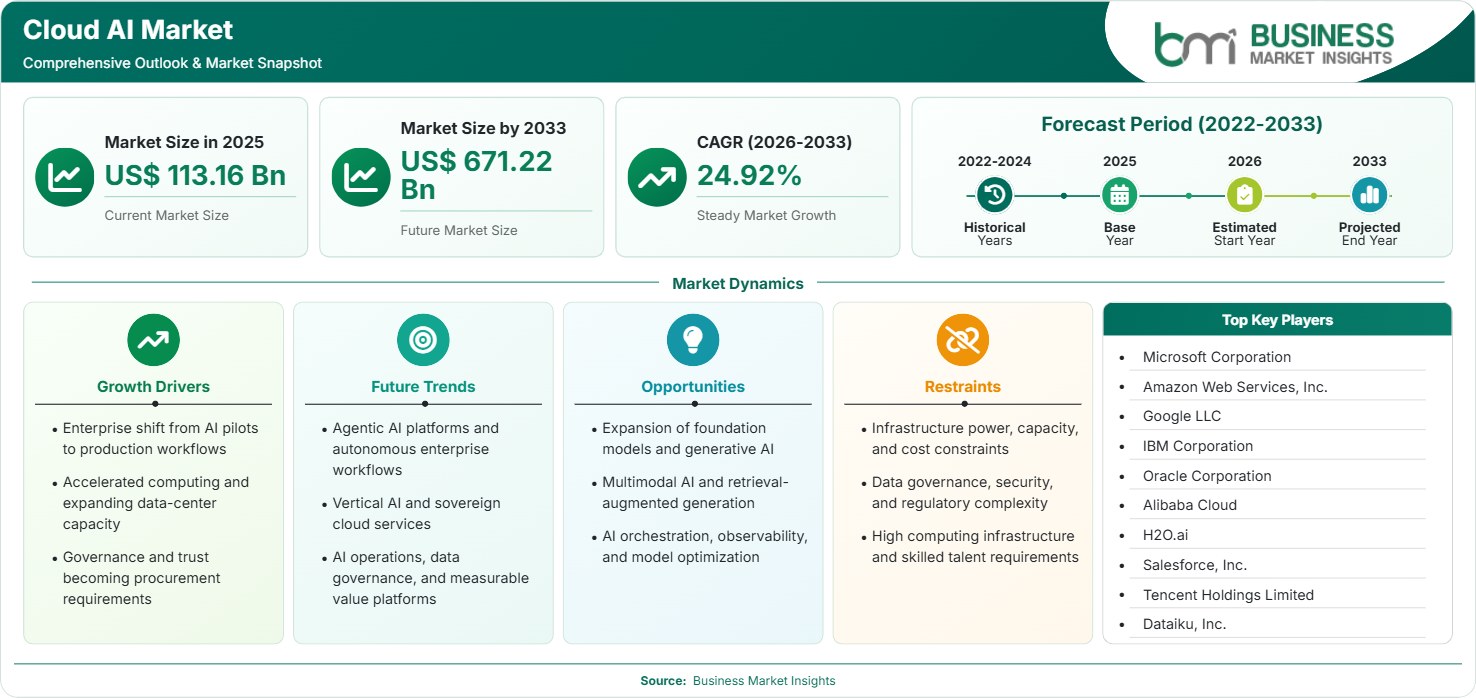
The Cloud AI Market size was valued at US$ 113.16 Billion in 2025 and is projected to reach US$ 671.22 Billion by 2033, growing at a CAGR of 24.92% during 2026–2033, driven by AI workloads, cloud scalability, agentic automation, enterprise data modernization, and demand for governed intelligence.

Report Coverage
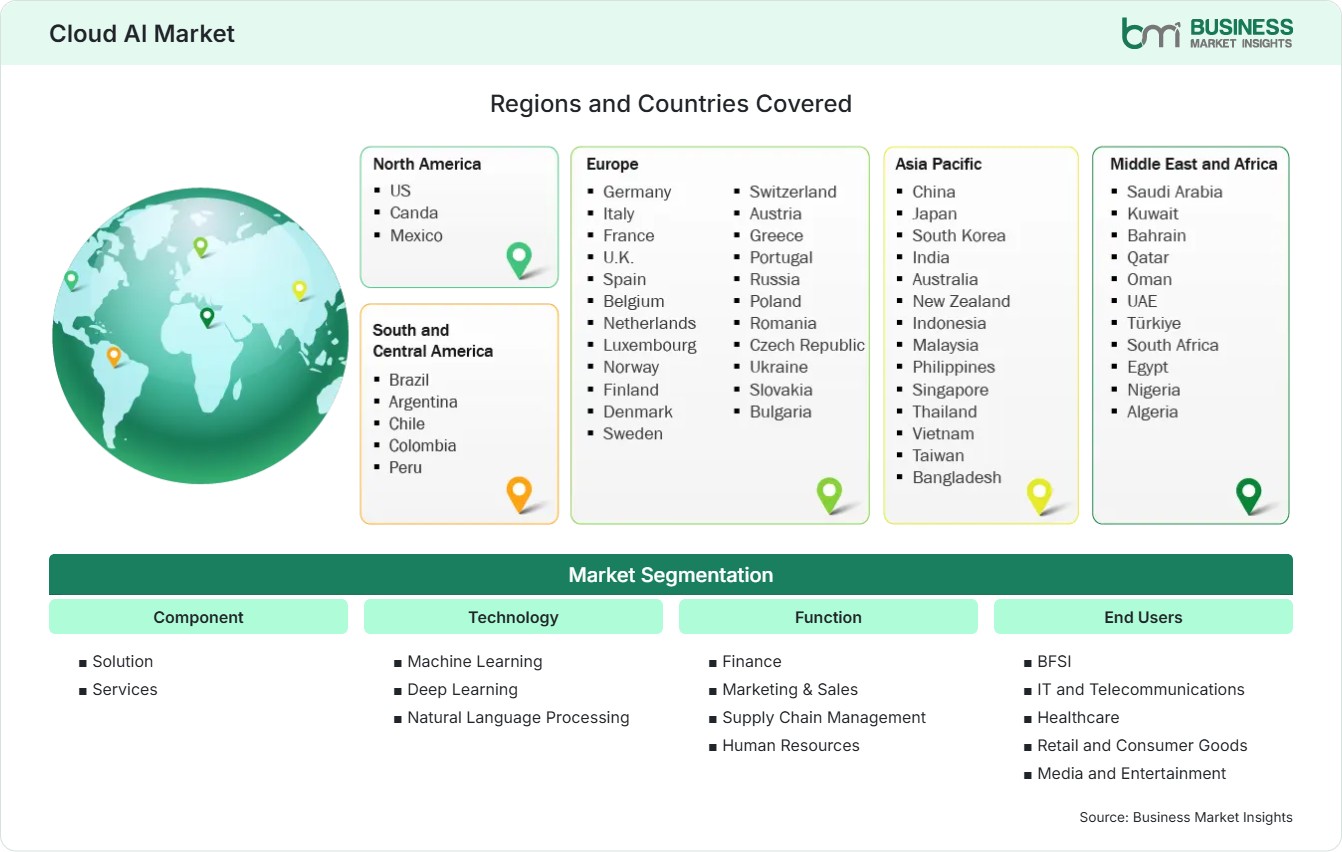
  • Component: Solution, Services
  • Technology: Machine Learning, Deep Learning, Natural Language Processing
  • Function: Finance, Marketing & Sales, Supply Chain Management, Human Resources
  • End Users: BFSI, IT and Telecommunications, Healthcare, Retail and Consumer Goods, Media and Entertainment
US$ 113.16 Bn Market size in 2025
US$ 671.22 Bn Market Size by 2033
24.92% CAGR, 2026 - 2033
2026-2033 Forecast Period

AI Overview

Cloud AI Market Summary

  • North America Region: 34%–38% share in 2025; 23%–26% CAGR during 2026–2033; cloud AI leadership is supported by hyperscaler infrastructure, enterprise software adoption, AI investments, semiconductor access, regulated-sector modernization, and expanding agentic deployments across industries.
    United States adoption remains dominant through hyperscaler capacity, enterprise AI platforms, and agentic workloads, with a 22%–25% CAGR during 2026–2033.
  • Fastest Growing Region: Asia Pacific; 25%–29% Cloud AI Market share in 2025; 27%–30% CAGR during 2026–2033; accelerating digital transformation, expanding data-center capacity, national AI programs, cloud migration, multilingual models, and strong demand from finance, retail, telecommunications, and manufacturing create opportunities.
  • Leading Segment: Solution; 58%–62% share in 2025; 23%–26% CAGR during 2026–2033; integrated platforms, model access, development environments, AI orchestration, governance, data integration, and enterprise deployment capabilities strengthen solution demand.
  • High Growth Segment: Natural Language Processing (NLP); 19%–23% Cloud AI Market share in 2025; 28%–32% CAGR during 2026–2033; conversational AI, intelligent search, document automation, multilingual interfaces, copilots, customer-service agents, and enterprise knowledge applications accelerate cloud-based NLP adoption.
  • Key Market Opportunity: Enterprise adoption is shifting from isolated AI pilots toward governed agentic workflows, creating demand for secure model orchestration, AI observability, vertical solutions, sovereign deployment, and consumption-based services.
  • Major Market Players: Microsoft Corporation, Amazon Web Services, Inc., Google LLC, IBM Corporation, Oracle Corporation, Alibaba Cloud, H2O.ai, Salesforce, Inc., Tencent Holdings Limited, and Dataiku, Inc.
Strategic Insights

Cloud AI Market: Strategic Insights

Cloud AI Market Strategic Framework
FREE PDF
Request your free sample
Request free sample
Stakeholder View

Key Takeaways

  • The ecosystem is consolidating around hyperscale compute, foundation models, data platforms, governance software, specialist AI tools, systems integrators, and industry applications, making interoperability increasingly important for enterprise procurement.
  • The strongest upside is concentrated in solutions supporting agentic workflows, NLP, intelligent automation, enterprise search, customer engagement, decision intelligence, and AI-assisted software development where measurable productivity gains can justify recurring cloud consumption.
  • Innovation is moving toward multimodal reasoning, smaller optimized models, retrieval-augmented generation, agent orchestration, model routing, observability, and privacy-aware deployment, reducing dependence on a single model architecture.
  • Asia Pacific offers a compelling investment case because rapidly expanding cloud capacity, digital commerce, telecommunications modernization, and government-supported AI initiatives are increasing enterprise demand for localized services.
  • Investment priorities increasingly favor platforms capable of converting AI experimentation into governed production. Strategic partnerships, infrastructure alliances, and acquisitions are likely to cluster around agents, data governance, cybersecurity, and specialized industry workflows.
  • Energy availability is becoming a strategic infrastructure variable. The IEA projects electricity used to supply data centers to rise from 460 TWh in 2024 to more than 1,000 TWh in 2030, increasing emphasis on power-efficient computing and resilient infrastructure.
Geographic Outlook

Cloud AI Market Regional Highlights

North America Cloud AI Market

North America is projected to have a market share of 34% to 38% in 2025, with a CAGR of 23% to 26% from 2026 to 2033. North America excels due to a high concentration of hyperscalers, enterprise cloud adoption, advanced semiconductor supply, venture capital, and deployment of agentic applications across technology, finance, healthcare, and retail sectors.

  • Enterprise AI investment is becoming more related to workflow automation, which compels cloud vendors to offer packages for models, data services, security, and orchestration.
  • Expansion of the data center is still an important strategic initiative, as fast computing, training, and inference need more capacity, networking, cooling, and electricity.
  • There is more demand for governance as regulated sectors need auditability, model management, privacy protection, and explainability before scaling up their applications.
  • The United States remains the regional anchor, while Canada strengthens opportunities through public-sector digitization, cloud modernization, research ecosystems, and enterprise AI adoption.

US Cloud AI Market

The US accounts for 75%-80% of North American demand in 2025 and posts a 22%-25% CAGR of the Cloud AI Market during 2026–2033. The reasons behind this are the scale of hyperscalers, strong enterprise software ecosystems, substantial investments in AI, and effective commercialization in high-value industries.

  • Technology companies continue expanding AI infrastructure and managed services, increasing enterprise access to foundation models without requiring organizations to build complete infrastructure internally.
  • Financial institutions, healthcare providers, retailers, and software companies are integrating AI into customer service, fraud analytics, engineering, decision support, and enterprise knowledge workflows.
  • NIST’s continued AI-risk work strengthens demand for governance tooling, testing, monitoring, security controls, and trustworthy deployment practices.

Europe Cloud AI Market

Europe accounts for a 24%–28% share in 2025 and registers a 23%–26% CAGR during 2026–2033. Germany and the United Kingdom lead adoption, while France, the Netherlands, Ireland, and the Nordics provide additional cloud infrastructure and AI investment opportunities.

  • Germany combines industrial automation, manufacturing data, and enterprise modernization, creating demand for production-focused AI and predictive applications.
  • The United Kingdom benefits from strong financial-services adoption, software capabilities, research networks, and demand for regulated AI deployment.
  • France is expanding AI infrastructure and digital sovereignty initiatives, strengthening opportunities for local hosting, secure model services, and government-supported deployments.
  • European healthcare adoption is increasingly linked to governance, workforce readiness, data quality, and affordability, areas highlighted by WHO’s regional assessment.

Asia Pacific Cloud AI Market

The Asia Pacific region contributes 25%-29% to the market in 2025 and experiences the fastest Cloud AI Market CAGR of 27%-30 % from 2026 to 2033. Countries such as China, Japan, South Korea, India, Singapore, and Australia are key demand hubs for the industry.

  • China combines domestic cloud capacity, local model ecosystems, industrial digitization, and large-scale consumer applications, sustaining high AI infrastructure requirements.
  • India is becoming an important growth market through cloud migration, enterprise digitization, multilingual AI, software services, and expanding demand from banking, telecommunications, retail, and public services.
  • Japan emphasizes robotics, advanced manufacturing, healthcare, and enterprise modernization, supporting AI workloads that require reliable cloud infrastructure and data integration.
  • Singapore and Australia provide regional hubs for financial services, government workloads, data governance, and multinational cloud deployments.

Rest of World Cloud AI Market

Rest of World is a 12%-16% stake in 2025 and a 21%-24% CAGR of the Cloud AI Market for 2026-2033. South America and Central America are developing their economies using fintech, telecommunication, e-commerce, and government digitization. Brazil and Mexico are the leading markets for adoption, while Colombia and Chile offer emerging opportunities for enterprises. In the Middle East & Africa, the United Arab Emirates, Saudi Arabia, Israel, and South Africa are major AI investment hubs, backed by national digital policies and cloud region strategies.

  • Brazil is strengthening AI use across financial services, agribusiness, retail, and government, increasing demand for scalable analytics and automation platforms.
  • The United Arab Emirates and Saudi Arabia are prioritizing national AI capabilities, intelligent public services, data centers, and sovereign infrastructure to improve digital competitiveness.
  • Israel contributes specialist AI innovation, cybersecurity capabilities, and enterprise software expertise, supporting demand for advanced cloud-based model and security services.
  • South Africa represents a key regional gateway for financial, telecommunications, and business-service workloads, while cloud adoption expands around major economic centers.
Global Market Geography
FREE PDF
Request your free sample
Request free sample
Segment Analysis

Cloud AI Market Segmentation

Component

The Solution segment is estimated to hold a 58%–62% market share in 2025, with a 23%–26% CAGR from 2026 to 2034, driven by the integration of artificial intelligence platforms, models, orchestration, governance, analysis, and enterprise deployment software. Services play an indispensable role in implementation, modernization, customization, training, and optimization as organizations move from pilots to production.

  • Solution: Integrated platforms simplify model development, deployment, data connection, governance, monitoring, and workflow orchestration, making bundled AI capabilities attractive for enterprises managing diverse cloud workloads.
  • Services: Consulting, integration, managed services, support, and modernization expertise reduce implementation barriers, particularly for regulated organizations lacking specialized AI engineering and governance resources.

Technology

Natural Language Processing (NLP) is expected to experience a CAGR of 28%-32% between 2026 and 2034, but Machine Learning and Deep Learning remain popular among businesses. A cloud-based deployment model will minimize infrastructure complexities and facilitate easy experimentation with different use cases.

  • Machine Learning (ML): Predictive modeling supports forecasting, fraud detection, recommendation, maintenance, and personalization while cloud platforms simplify training, deployment, scaling, and continuous model management.
  • Deep Learning: Advanced neural architectures support computer vision, speech, recommendation, anomaly detection, and complex pattern recognition, benefiting from elastic accelerator infrastructure and managed tooling.
  • Natural Language Processing (NLP): NLP adoption is accelerating through copilots, intelligent search, conversational agents, document processing, summarization, translation, and enterprise knowledge applications requiring scalable model access.

Function

Finance and Marketing & Sales are still valuable functions since measurement, automation, intelligence, forecasting, and decision-making can quickly affect business operations. The use of artificial intelligence in businesses now links functional processes to enterprise data, model governance, and cloud-based orchestration in the Cloud AI Market.

  • Finance: AI supports fraud detection, forecasting, risk analysis, reconciliation, reporting, and finance automation, improving decision cycles and reducing repetitive processing across large transaction environments.
  • Marketing & Sales: Predictive targeting, campaign generation, lead scoring, personalization, and sales copilots improve customer engagement while increasing demand for integrated data and language-model services.
  • Supply Chain Management: AI improves demand forecasting, inventory planning, supplier intelligence, logistics optimization, and disruption monitoring by combining real-time operational data with predictive models.
  • Human Resources: Cloud AI supports talent acquisition, workforce analytics, skills mapping, learning recommendations, and employee assistance, with governance remaining critical for sensitive workforce information.

End-Users

BFSI continues to be a dominant early adopter, as organizations have significant data assets and a strong need for automation across risk management, customer service, and regulatory compliance processes. Sectors such as healthcare, telecom, retail, and media are increasing their use of cloud AI technology as it becomes easier to govern and integrate. The cloud AI market scope is, thus, widening from technical operations to entire business operations.

  • BFSI: Fraud analytics, credit decisioning, customer support, compliance, risk monitoring, and personalized financial services create persistent demand for governed AI infrastructure.
  • IT and Telecommunications: Providers use AI for network optimization, software engineering, customer service, cybersecurity, infrastructure operations, and automated incident management.
  • Healthcare: Clinical documentation, imaging support, patient engagement, research, and administrative automation create opportunity, although privacy, clinical validation, and governance remain central adoption conditions. WHO emphasizes safeguards and equitable implementation.
  • Retail and Consumer Goods: Forecasting, recommendations, inventory optimization, conversational commerce, pricing, and marketing automation increase demand for scalable AI services.
  • Media and Entertainment: Content discovery, personalization, production assistance, advertising optimization, localization, and audience intelligence expand cloud AI workloads across digital platforms.
Market Forces

Cloud AI Market Dynamics

Key Market Drivers

Enterprise Shift From AI Pilots to Production Workflows

The Cloud AI Market growth is increasingly driven by enterprises evolving from experimentation into production use cases with real business results. Enterprises have evolved from isolated chat interfaces to agents, copilots, search, automated workflows, and decisioning, all tied to enterprise data. This increases the requirements for managed models, retrieval capabilities, vector databases, observability, and governance. The 2026 launch of the Google Cloud Gemini Enterprise Agent Platform provides a good example of this trend, as it brings together agent development, deployment, scaling, governance, and optimization all in one place. As deployments become more complex, buyers want platforms that reduce implementation time without sacrificing security and operability.

Accelerated Computing and Expanding Data-Center Capacity

There is an increase in infrastructure needs for computing power, memory, networking, cooling, and electricity due to AI inference and training. According to the IEA, electricity use in global data centers will jump to 1,000 TWh in 2030, up from 460 TWh in 2024. The growth of cloud AI is accompanied by increased infrastructure demands. It benefits companies with existing infrastructure, including accelerators, networking, optimized data, and geographically diverse facilities. Even though the cost of inference per unit decreases as the model's ability increases and more interaction occurs, infrastructure usage increases. Cloud AI Market trends therefore increasingly reflect infrastructure efficiency, workload placement, power availability, model compression, and specialized accelerators as strategic differentiators alongside model quality.

Governance and Trust Becoming Procurement Requirements

AI governance has evolved into a purchasing need as businesses implement systems that affect their financial, healthcare, customer, and operational decisions. The NIST AI Risk Management Framework and the generative AI framework include practices to ensure trustworthiness in the design, implementation, assessment, and management of AI-related risks. The creation of the 2026 critical infrastructure profile is another area of interest that ensures this risk management focuses on high-impact areas. The WHO addresses all those concerns addressed by the AI risk management framework. Buyers will thus begin to consider factors such as model monitoring, data lineage, access control, explainability, testing, security, and human supervision, as well as benchmark performance.

Key Market Opportunities

Agentic AI Platforms and Autonomous Enterprise Workflows

The strongest emerging opportunity is the expansion of AI agents capable of planning, retrieving information, invoking tools, executing workflows, and maintaining context across enterprise systems. This design enables recurring cloud access beyond individual model queries, as the agents can interface with databases, business applications, identity services, monitoring tools, and third-party services. This is evidenced by the 2026 Google Cloud platform launch, which highlights the industry's evolution toward development, governance, and agent operations. Cloud vendors can leverage reusable agent components, a secure execution environment, persistent memory, evaluation systems, and enterprise connectivity to attract more valuable workloads. Consequently, the Cloud AI Market Forecasts will become more dependent on agents than on models, especially as enterprises can quantify their labor savings and faster decision-making cycles.

Vertical AI and Sovereign Cloud Services

Vertical solutions present a promising investment opportunity due to their potential for better context-based performance than horizontal platforms. The financial sector, insurance industry, healthcare, telecommunications sector, manufacturing sector, public sector, and law sector all have unique requirements regarding data handling, workflow integration, terminology, and regulation. The sovereign cloud approach can expand the number of use cases in which government organizations or regulated companies need greater control over data management, access, and infrastructure governance. The current work by the WHO on responsible AI in healthcare underscores the importance of governance alongside technical capabilities. Providers that can combine industry knowledge and cloud infrastructure can acquire premium workloads.

AI Operations, Data Governance, and Measurable Value Platforms

Companies will start requiring solutions that help them understand whether the AI systems they apply are adding real business value to their bottom lines or merely producing outputs. It is an area of opportunity in model observability, evaluation, data quality, agent management, cost optimization, lineage, policy enforcement, and measurement of business impact. For instance, Dataiku’s 2026 platform strategy focuses on agent management, building agents with AI assistance, and reasoning systems to deliver measurable results in enterprise AI. Opportunity areas involve third-party software vendors, systems integrators, cloud services providers, and governance solutions providers. Successful platforms would be those that can correlate technical telemetry with business impact metrics, thus allowing comparison of workloads, control of model costs, detection of failures, and continuous improvement of AI performance.

Market Restraints and Challenges

Infrastructure Power, Capacity, and Cost Constraints

Factor: Rapid AI workload growth increases demand for accelerators, electricity, cooling, networking, and data-center capacity, while infrastructure expansion can face grid constraints, long equipment lead times, and high capital requirements.

Impact: Higher operating costs and constrained capacity can slow deployment, particularly for organizations sensitive to unpredictable consumption. The IEA estimates data-center electricity demand supplied by global power systems could exceed 1,000 TWh in 2030, reinforcing the scale of the infrastructure challenge. Providers must therefore improve utilization, model efficiency, workload scheduling, and power management. Enterprises may also optimize model selection, use smaller specialized models, and combine centralized and distributed inference to control expenditure without sacrificing business performance.

Data Governance, Security, and Regulatory Complexity

Factor: Cloud AI systems process sensitive enterprise information while operating across complex model, data, identity, and application environments.

Impact: Security incidents, compliance failures, inaccurate outputs, or weak accountability can delay deployments and increase total implementation costs. NIST guidance highlights the need to incorporate trustworthiness into AI design, development, deployment, use, and evaluation, while WHO identifies governance, ethics, and responsible implementation as central requirements for healthcare AI. Enterprises may therefore require extensive testing, access controls, human review, audit trails, data residency measures, and model monitoring before production scaling. This raises implementation complexity and can lengthen procurement cycles for high-risk applications.

Company Analysis

Competitive Landscape

The Cloud AI Market analysis indicates a competitive structure combining hyperscale infrastructure providers, enterprise software vendors, AI specialists, and data-management platforms. Competitive differentiation increasingly depends on model breadth, infrastructure economics, governance, developer experience, industry integrations, and the ability to support agentic workloads at production scale.

Company Name

Overview

Products and Services relevant to this market

Microsoft Corporation

Major enterprise cloud and AI provider with broad infrastructure, software, developer, and productivity integration.

Azure AI services, Azure Machine Learning, AI Foundry, Copilot capabilities, cloud infrastructure, model services, security, and enterprise AI tooling.

Amazon Web Services, Inc.

Hyperscale cloud provider offering extensive AI infrastructure, managed machine learning, data, and application services.

Amazon Bedrock, Amazon SageMaker, AI infrastructure, foundation-model access, managed analytics, databases, security, and generative AI services.

Google LLC

Technology leader combining cloud infrastructure, AI research, data platforms, and advanced model capabilities.

Google Cloud AI, Gemini services, Gemini Enterprise Agent Platform, Vertex capabilities, AI infrastructure, data analytics, and developer tooling.

IBM Corporation

Enterprise technology provider focused on governed AI, hybrid cloud, business automation, and specialized enterprise applications.

watsonx.ai, watsonx.data, watsonx.governance, enterprise AI services, hybrid-cloud infrastructure, automation, and consulting.

Oracle Corporation

Cloud and enterprise software company expanding AI across databases, applications, infrastructure, and industry workloads.

Oracle Cloud Infrastructure AI services, AI infrastructure, databases, enterprise applications, generative AI, data platforms, and automation.

Alibaba Cloud

Leading Chinese cloud provider serving domestic and international enterprises with infrastructure, data, and AI services.

PAI, foundation-model services, cloud compute, AI development tools, data platforms, model deployment, and enterprise cloud services.

H2O.ai

Specialist AI platform company focused on machine learning, generative AI, enterprise AI, and responsible deployment.

H2O AI Cloud, Driverless AI, enterprise machine learning, LLM tooling, document intelligence, model management, and AI applications.

Salesforce, Inc.

Enterprise software provider integrating AI agents into customer engagement, sales, service, marketing, and commerce workflows.

Agentforce, Einstein capabilities, Data Cloud, CRM-integrated AI, autonomous agents, analytics, and enterprise workflow automation.

Tencent Holdings Limited

Chinese technology group with cloud, digital services, AI, gaming, communication, and enterprise application capabilities.

Tencent Cloud AI services, computing infrastructure, model capabilities, data platforms, intelligent customer services, and industry solutions.

Dataiku, Inc.

Enterprise AI and data platform specialist focused on governed development, operationalization, collaboration, and AI value realization.

Dataiku platform, AI governance, agent management, collaborative development, machine learning, reasoning systems, and enterprise AI operations.

Trust & Transparency

Research Methodology

The market analysis combines proprietary research with secondary data from government agencies, company disclosures, regulatory filings, industry databases and expert interviews. Market estimates are validated through data triangulation, cross-market benchmarking and analyst review.

View Full Research Methodology

Questions Answered

Frequently Asked Questions

How should buyers evaluate a Cloud AI Market Report?

A useful Market Report should distinguish infrastructure, platform, model, application, and service layers while assessing adoption by region, technology, function, and end-user. Buyers should also examine deployment economics, governance requirements, competitive positioning, use-case maturity, and vendor ecosystem depth.

What role does data governance play in enterprise AI deployment?

Data governance determines whether organizations can deploy AI reliably across sensitive information. Strong lineage, permissions, quality controls, residency policies, model monitoring, auditability, and human oversight help reduce operational and compliance risks while improving confidence in production systems.

Which industries are likely to remain major adopters?

BFSI, IT and telecommunications, healthcare, retail and consumer goods, and media and entertainment are expected to remain important because each has large datasets, repetitive workflows, customer-facing applications, or complex analytical requirements that benefit from scalable AI infrastructure.

How are AI agents changing enterprise cloud requirements?

Agents increase demand for persistent context, workflow orchestration, tool connectivity, identity controls, long-running execution, observability, and governance. This expands AI consumption beyond individual model requests toward interconnected workloads spanning applications, data platforms, and enterprise systems.

What is driving adoption of cloud-based AI services?

Cloud scalability, managed models, easier access to accelerators, integrated data services, and enterprise demand for automation are key adoption factors. Organizations increasingly prefer managed environments that reduce infrastructure complexity while supporting governance, security, observability, and production deployment.

Access the Full Cloud AI Market Report

Get segment-level forecasts, regional estimates, competitive benchmarking, company profiles and downloadable Excel datasets.

Access the full Cloud AI Market Report
350 pages PDF & Excel | 2026-08-31