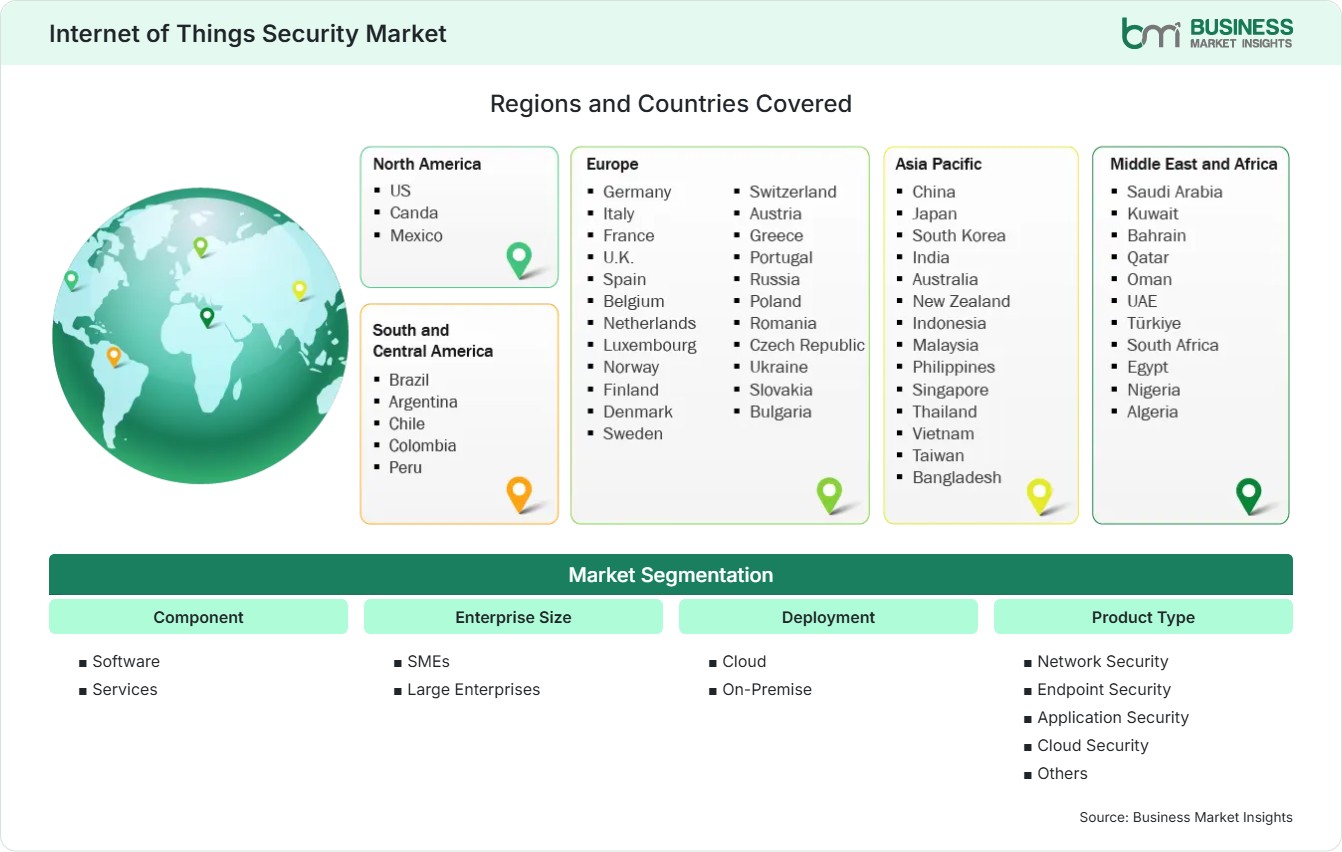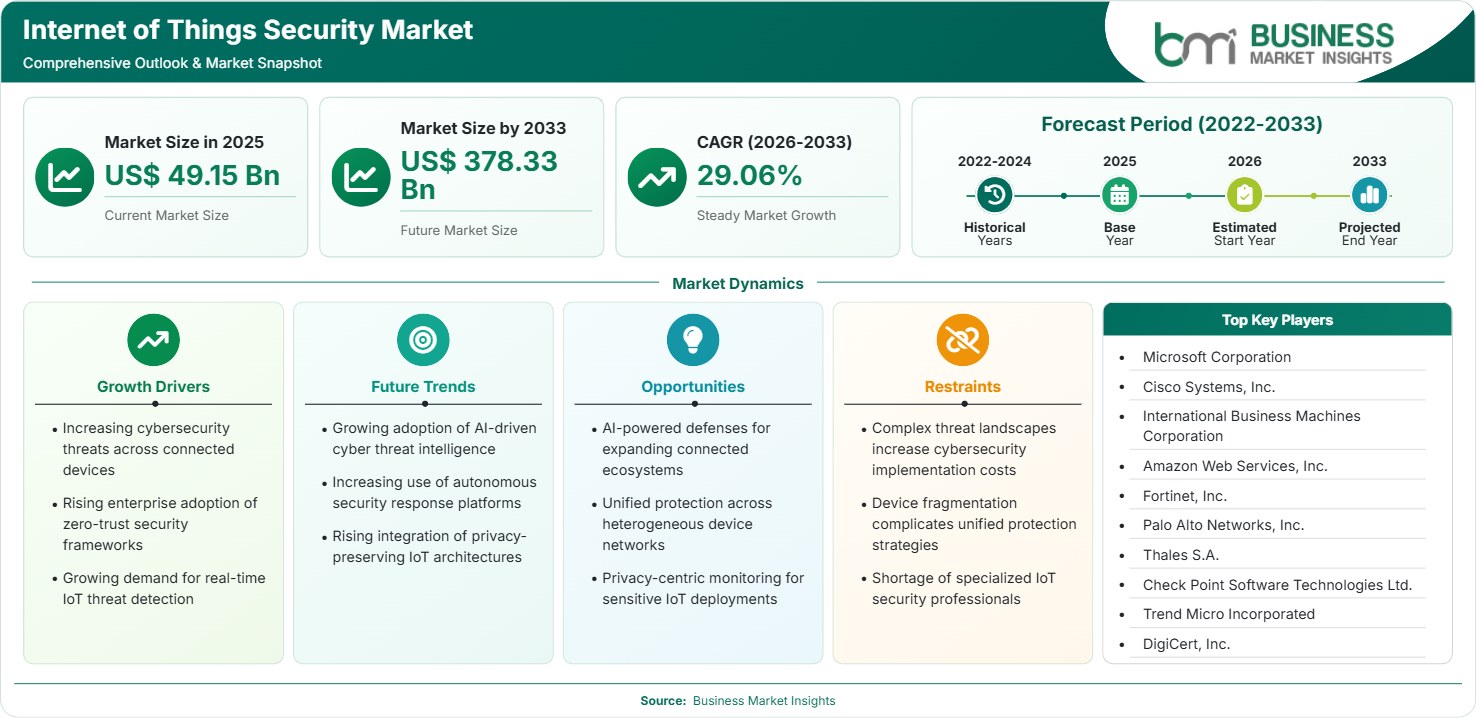
Internet of Things Security Market Regional Highlights
North America Internet of Things Security Market
North America accounted for 36%–39% of global revenue in 2025 and is projected to register a 27%–29% CAGR through 2033. A healthy enterprise cybersecurity budget, early adoption of technologies, and high investments in automation ensure regional dominance. Energy, health care, manufacturing, and logistics verticals are witnessing growth in the deployment of connected infrastructure. The region is blessed with mature cloud ecosystems, cybersecurity regulations, and increased investment in threat intelligence offerings. The Internet of Things Security Market share remains strongest in North America due to extensive digital transformation initiatives and sophisticated security requirements.
- More enterprises are now using zero-trust architectures in order to secure the connected assets in both their IT and operational technology environments, which enhances visibility, policy enforcement, and cyber resilience while also supporting the growing adoption of connected infrastructure.
- Investments in industrial cybersecurity are speeding up as a result of the growing number of ransomware attacks on manufacturing plants, energy infrastructure and transport assets, which is leading to greater use of advanced monitoring and segmentation technologies.
- The federal and industrial cybersecurity standards are still making organizational security requirements more stringent, which in turn leads to continuous demand for identity management, certificate-based authentication, and protection of the device lifecycle.
- Cloud service providers and vendors specialising in cybersecurity are forming more partnerships in order to offer integrated security platforms that can protect highly distributed enterprise device environments.
US Internet of Things Security Market
The US represented approximately 78%–82% of North American revenue in 2025 and is anticipated to advance at a 28%–30% CAGR through 2033. Investments in protection of vital infrastructure, cloud security enhancement, connectivity in industrial environments, and cybersecurity for defense all play an important role in market growth. Companies are increasingly focused on implementing security measures across their device ecosystems to mitigate risks. Manufacturers, the health care industry, the energy sector, and the transport sector are still leading markets when it comes to adoption.
- The number of connected healthcare deployments is leading to a greater demand for devices to be authenticated, for the transmission of data to be encrypted, and for there to be real-time threat monitoring in both hospitals and in remote patient management settings.
- Industrial operators are increasing their expenditure on cybersecurity in order to protect their production assets, reduce operational disruptions, and enhance their visibility within the ever-more interconnected manufacturing ecosystems.
- The deployment of edge computing gives rise to the need for local security monitoring, secure firmware management, and automated threat response capabilities that support a distributed infrastructure.
- The uptake of managed security services is still accelerating within mid-sized companies which are looking for a cost-effective way to obtain expertise in device governance and in carrying out continuous risk assessment.
Europe Internet of Things Security Market
Europe accounted for 25%–28% of global revenue in 2025 and is expected to achieve a 28%–31% CAGR through 2033. Strong regulatory frameworks, digital sovereignty initiatives, and industrial automation investments are increasing cybersecurity requirements across the region. Manufacturing remains a significant demand center, supported by Industry 4.0 implementation strategies. Germany leads regional revenue generation, while Eastern European digital transformation projects and smart infrastructure initiatives contribute to faster expansion. Enterprises continue prioritizing compliance, cyber resilience, and secure connectivity across connected business environments.
- Germany continues to hold on to its leading position by making extensive use of industrial automation and by increasing its investments in the protection of operational technology and in the modernisation of its network security.
- There is strong demand in the United Kingdom for security solutions that are provided over the cloud, this being due to the growing regulatory emphasis on the security of connected products.
- France is enhancing its investments in the security of smart infrastructure, which includes transportation, utilities, and the digital modernization programs of the public sector.
- Poland together with other emerging economies in Europe has a high growth potential, the annual rate of growth reaching between 30% and 33% as digitalisation in the manufacturing sector speeds up.
- Ongoing security certification and digital identity programmes are still affecting the way technology is adopted in both enterprise and government sectors.
Asia Pacific Internet of Things Security Market
Asia Pacific represented 24%–27% of global revenue in 2025 and is projected to expand at a 31%–34% CAGR through 2033, making it the fastest-growing regional market. Rapid industrialization, smart city development, 5G deployment, and digital transformation initiatives continue driving demand. China holds the largest regional position, while India demonstrates the strongest growth momentum. Expanding manufacturing ecosystems and increasing cyberattack frequency are encouraging enterprises to implement comprehensive device protection, access control, and network security strategies across connected operational environments.
- China benefits from extensive industrial automation investments, large connected-device installations, and accelerating deployment of smart manufacturing infrastructure.
- India has one of the highest rates of regional growth as a result of the expansion of its digital infrastructure and the presence of government-supported technology modernization programmes.
- Japan is concentrating on securing advanced manufacturing systems, the deployment of robotics, and the use of connected operational technologies in order to boost industrial productivity.
- The economies of Southeast Asia are increasing their investments in cybersecurity as businesses speed up their adoption of cloud services and move forward with modernisation programmes for their connected logistics.
- Telecommunications operators are increasingly working with cybersecurity companies in order to secure the rapidly growing device ecosystems made possible by 5G networks.
Rest of World Internet of Things Security Market
The Rest of World region accounted for 10%–13% of global revenue in 2025 and is forecast to achieve a 29%–32% CAGR through 2033. South and Central America are experiencing growing demand from financial services, logistics, and industrial sectors adopting connected technologies. Brazil maintains regional leadership while Mexico demonstrates notable expansion. In the Middle East and Africa, smart city projects, digital government initiatives, and critical infrastructure modernization programs are creating significant cybersecurity requirements.
The government's investments in digital transformation are still leading to greater awareness of connected-device security in the areas of energy, utilities, transportation, and healthcare. Nowadays, organizations place a growing emphasis on threat intelligence, asset visibility, and cyber-risk management in order to support the emerging digital ecosystems.
- Brazil continues to be the top market in South America as a result of its growing investments in enterprise connectivity and its initiatives to modernise its cybersecurity.
- Mexico is showing rapid adoption, this being due to its expansion in manufacturing and its efforts to digitise cross-border supply chains.
- The United Arab Emirates is pushing forward with its smart city security initiatives, these requiring advanced technologies for the protection of identity and networks.
- Saudi Arabia keeps increasing spending on cyber resilience, which connects to its goals for economic diversification and digital change.
- South Africa is extending its cybersecurity capabilities in order to back its initiatives relating to connected infrastructure and the adoption of enterprise cloud services.