
Internet of Things in Manufacturing Market Outlook: Size, Share, Trends, Growth Analysis, Competitive Landscape & Forecast, 2026-2033

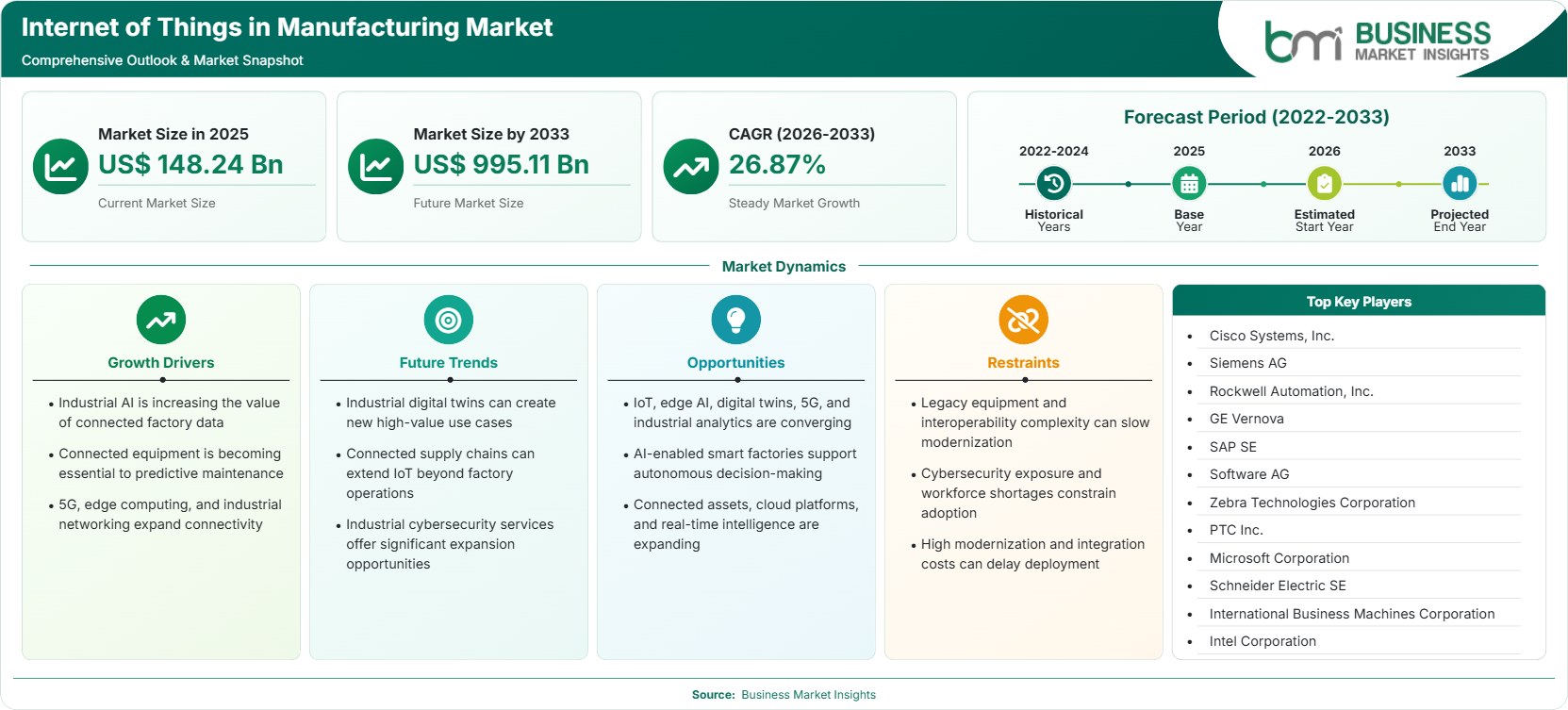
The Internet of Things in Manufacturing Market size was valued at US$ 148.24 Billion in 2025 and is projected to reach US$ 995.11 Billion by 2033, growing at a CAGR of 26.87% during 2026–2033, driven by smart factories, predictive maintenance, edge computing, industrial AI, connected assets, automation, cybersecurity, and real-time operational intelligence.

Report Coverage
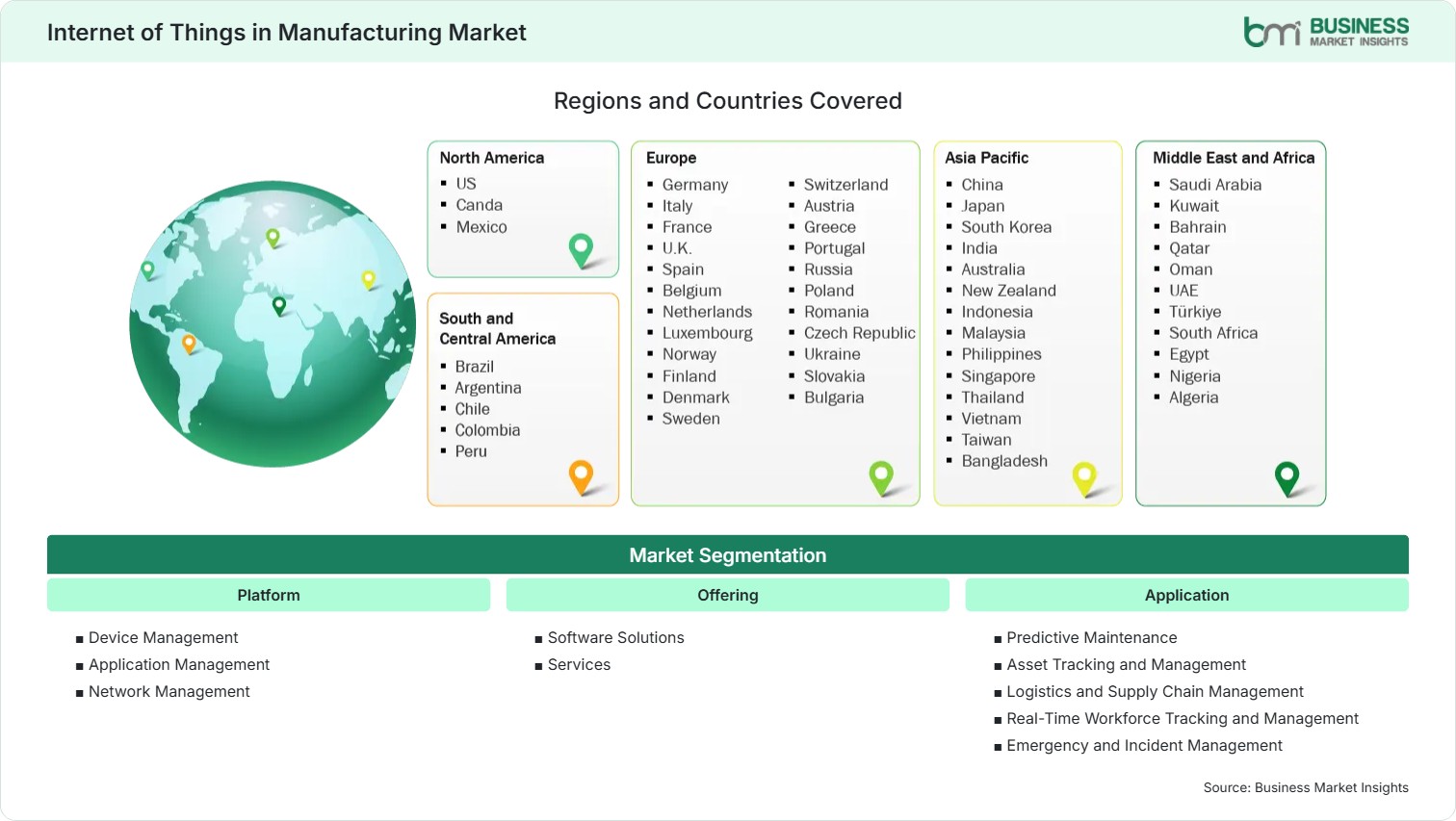
  • Platform: Device Management, Application Management, Network Management
  • Offering: Software Solutions, Services
  • Application: Predictive Maintenance, Asset Tracking and Management, Logistics and Supply Chain Management, Real-Time Workforce Tracking and Management, Emergency and Incident Management
US$ 148.24 Bn Market size in 2025
US$ 995.11 Bn Market Size by 2033
26.87% CAGR, 2026 - 2033
2026-2033 Forecast Period

AI Overview

Internet of Things in Manufacturing Market Summary

  • North America Region: North America holds a modeled 32%–36% share in 2025, growing at a 24%–27% CAGR during 2026–2033, influenced by industrial AI, cloud modernization, reshoring, cybersecurity investment, connected factories, and advanced automation. The US market remains the regional anchor, with a modeled 24%–27% CAGR during 2026–2033, supported by strong IIoT adoption and smart manufacturing investment. Deloitte reports that 46% of surveyed manufacturers already use IIoT solutions, while 27% prioritize IIoT investment.
  • Fastest Growing Region: Asia Pacific holds a modeled 31%–35% share in 2025, expanding at a 29%–32% CAGR during 2026–2033, supported by factory automation, electronics production, semiconductor investments, industrial digitization, government-backed manufacturing programs, and expanding cloud infrastructure.
  • Leading Segment: Platform holds a modeled 38%–42% share in 2025, advancing at a 25%–28% CAGR during 2026–2033, as manufacturers require centralized device, application, and network management to connect heterogeneous production environments and coordinate operational data.
  • High Growth Segment: Software Solutions within Offering holds a modeled 27%–31% share in 2025, advancing at a 29%–32% CAGR during 2026–2033, driven by analytics, AI-enabled optimization, digital twins, cloud applications, cybersecurity, and predictive maintenance deployments.
  • Key Market Opportunity: The strongest opportunity lies in converging IoT, edge AI, digital twins, 5G, and industrial analytics, enabling manufacturers to shift from monitoring assets toward autonomous, closed-loop operational decision-making.
  • Major Market Players: Cisco Systems, Inc.; Siemens AG; Rockwell Automation, Inc.; General Electric Company; SAP SE; Software AG; Zebra Technologies Corporation; PTC Inc.; Microsoft Corporation; Schneider Electric SE; International Business Machines Corporation; Intel Corporation; Honeywell International Inc.; Advantech Co., Ltd.; Robert Bosch GmbH; Amazon Web Services, Inc.; NXP Semiconductors N.V.; Micron Technology, Inc.; Telefonaktiebolaget LM Ericsson; and Litmus Automation Inc.
Strategic Insights

Internet of Things in Manufacturing Market: Strategic Insights

Internet of Things in Manufacturing Market Strategic Framework
FREE PDF
Request your free sample
Request free sample
Stakeholder View

Key Takeaways

  • Value creation is moving toward integrated ecosystems combining sensors, connectivity, edge infrastructure, software, cloud platforms, analytics, cybersecurity, systems integration, and lifecycle services. Vendors able to bridge OT and IT environments can capture broader customer budgets than point-solution providers.
  • Predictive maintenance, asset tracking, logistics visibility, and workforce management offer high-value deployment pathways because they connect measurable operational outcomes directly to connected data. Maintenance and material-management functions also remain comparatively underdeveloped, creating room for targeted deployments.
  • Industrial AI is moving from descriptive dashboards toward systems capable of sensing, reasoning, and acting. Edge processing, machine vision, digital twins, industrial copilots, and agentic workflows are becoming important development priorities as manufacturers seek lower latency and greater autonomy.
  • Asia Pacific offers the strongest expansion case because electronics, automotive, semiconductor, and advanced manufacturing investments create dense environments for connected equipment and software deployment. India's smart manufacturing agenda and China's advanced industrial base strengthen the addressable opportunity.
  • Portfolio realignment is becoming strategically important. PTC completed the sale of its Kepware and ThingWorx businesses to TPG in March 2026, demonstrating how established technology companies are concentrating capital on higher-priority strategic platforms.
  • Cybersecurity, interoperability, lifecycle services, and implementation expertise increasingly determine deployment success. Manufacturers need architectures capable of integrating legacy equipment without disrupting production, making migration capability a competitive differentiator.
Geographic Outlook

Internet of Things in Manufacturing Market Regional Highlights

North America Internet of Things in Manufacturing Market

North America accounted for a modeled 32%–36% share in 2025, with growth of 24%–27% CAGR during 2026–2033. The region benefits from advanced automation, industrial software ecosystems, cloud infrastructure, reshoring initiatives, and cybersecurity spending. The US dominates regional demand, while Canada and Mexico gain from connected automotive, aerospace, electronics, and industrial supply chains. Market share remains supported by strong technology vendor concentration and mature enterprise IT infrastructure. Regional Internet of Things in Manufacturing Market growth is increasingly linked to AI-ready networks and edge processing.

  • Industrial AI: Manufacturers are connecting production networks with AI infrastructure, increasing demand for secure, high-performance networking and edge analytics.
  • Reshoring: New domestic production facilities require connected automation, asset monitoring, digital quality systems, and real-time supply-chain visibility.
  • Cybersecurity: Expanding OT connectivity raises security requirements, increasing demand for segmentation, monitoring, secure remote access, and industrial threat detection.

US Internet of Things in Manufacturing Market

The US represented a modeled 24%–27% Internet of Things in Manufacturing Market share of North America in 2025, with a 25%–28% CAGR during 2026–2033. Large manufacturers are deploying connected equipment alongside cloud, analytics, AI, and automation. Deloitte found 92% of surveyed manufacturers view smart manufacturing as a major competitiveness driver, while 78% allocate more than 20% of improvement budgets toward such initiatives.

  • AI investment: AI, machine learning, and generative AI are becoming embedded into maintenance, inspection, scheduling, and production optimization workflows.
  • Factory modernization: Aging infrastructure creates demand for IoT gateways, sensors, industrial networking, edge computing, and retrofit solutions.
  • Cyber resilience: Connected production assets increase demand for security architectures aligned with industrial cybersecurity standards.

Europe Internet of Things in Manufacturing Market

Europe held a modeled 25%–29% Internet of Things in Manufacturing Market share in 2025, expanding at a 23%–26% CAGR during 2026–2033. Germany remains the regional technology leader, while France, the UK, Italy, and the Netherlands provide additional industrial demand. Germany is modeled at approximately 24%–27% CAGR, while France is positioned around 25%–28% CAGR. Industrial automation, energy efficiency, sustainability, and digital manufacturing strategies support adoption across automotive, machinery, chemicals, and electronics.

  • Germany: Strong automation capabilities and Industry 4.0 expertise support industrial IoT platforms, digital twins, edge applications, and machine connectivity.
  • France: Smart factories and energy-management initiatives encourage connected production and industrial analytics.
  • Sustainability: IoT-based energy monitoring helps manufacturers improve resource efficiency while meeting increasingly demanding environmental objectives.

Asia Pacific Internet of Things in Manufacturing Market

Asia Pacific held a modeled 31%–35% Internet of Things in Manufacturing Market share in 2025, expanding at a 29%–32% CAGR during 2026–2033. China remains the largest manufacturing base, while Japan, South Korea, India, Taiwan, and Southeast Asia contribute strong technology demand. China is modeled at 30%–33% CAGR, while India is positioned at 32%–35% CAGR. Internet of Things in Manufacturing Market trends increasingly reflect electronics, semiconductor, automotive, pharmaceutical, and smart-factory investment.

  • China: Large-scale automation and connected-factory investments create demand for sensors, platforms, robotics, edge systems, and industrial analytics.
  • India: Manufacturing expansion and digital transformation programs are accelerating adoption across automotive, electronics, pharmaceuticals, and food processing.
  • Semiconductors: Fab expansion and electronics manufacturing increase demand for real-time monitoring, predictive maintenance, and environmental control.

Rest of World Internet of Things in Manufacturing Market

Rest of World represented a modeled 6%–10% Internet of Things in Manufacturing Market share in 2025, expanding at a 25%–29% CAGR during 2026–2033. South and Central America benefit from food processing, automotive, mining, and industrial modernization, while the Middle East and Africa gain from diversification, logistics, energy, and advanced manufacturing projects. Brazil is modeled at 25%–28% CAGR, while the UAE and Saudi Arabia are positioned at 27%–30% CAGR as digital industrial programs mature.

  • Latin America: Connected production can improve traceability, equipment utilization, and logistics efficiency across geographically distributed industrial operations.
  • Middle East: Economic diversification is encouraging investment in automated manufacturing, smart logistics, energy management, and industrial digital infrastructure.
  • Africa: Industrial modernization creates opportunities for scalable cloud-connected solutions that avoid extensive legacy IT investment.
Global Market Geography
FREE PDF
Request your free sample
Request free sample
Segment Analysis

Internet of Things in Manufacturing Market Segmentation

Platform

Platform solutions represented a modeled 38%–42% share in 2025 and are projected to expand at 25%–28% CAGR during 2026–2033. Platforms unify device connectivity, applications, networks, analytics, and operational workflows, making them central to large-scale deployments. Internet of Things in Manufacturing Market scope increasingly encompasses centralized management across distributed factories, legacy equipment, edge environments, and enterprise systems.

  • Device Management: Connects, monitors, configures, secures, and updates industrial devices while improving fleet visibility and reducing manual administration across distributed production environments.
  • Application Management: Supports deployment, monitoring, integration, and lifecycle control of IoT applications, enabling manufacturers to scale analytics and operational workflows across multiple plants.
  • Network Management: Provides visibility, configuration, performance monitoring, segmentation, and security for industrial connectivity, supporting reliable communications among machines, sensors, edge devices, and enterprise platforms.

Offering

Offering is divided between software and services, with software solutions representing the faster-growing component at a modeled 29%–32% CAGR during 2026–2033. Internet of Things in Manufacturing Market trends favor software because manufacturers increasingly require scalable analytics, AI, cloud, digital twins, and cybersecurity capabilities.

  • Software Solutions: Enable analytics, visualization, AI, workflow automation, device orchestration, and predictive intelligence, allowing connected production data to support faster operational decisions.
  • Services: Include consulting, integration, implementation, maintenance, managed services, and training that help manufacturers overcome interoperability, cybersecurity, skills, and deployment complexity.

Application

Application demand is distributed across maintenance, asset visibility, logistics, workforce operations, incident response, and other industrial use cases. Predictive maintenance remains strategically important because connected equipment data can support earlier fault identification and reduce unplanned disruption across asset-intensive manufacturing environments.

  • Predictive Maintenance: Uses sensor data, equipment histories, analytics, and AI to identify abnormal conditions, prioritize maintenance actions, and improve equipment availability.
  • Asset Tracking and Management: Provides location, condition, utilization, and lifecycle visibility for machinery, tools, inventory, and high-value production assets.
  • Logistics and Supply Chain Management: Connects materials, shipments, warehouses, production systems, and suppliers to improve traceability, inventory visibility, and fulfillment coordination.
  • Real-Time Workforce Tracking and Management: Uses connected devices and location technologies to improve workforce visibility, task coordination, safety management, and operational responsiveness.
  • Emergency and Incident Management: Combines connected sensors, alerts, analytics, and communications to identify incidents rapidly and coordinate response procedures across manufacturing facilities.
Market Forces

Internet of Things in Manufacturing Market Dynamics

Key Market Drivers

Industrial AI Is Increasing the Value of Connected Factory Data

Industrial AI is changing the economics of connected manufacturing by converting sensor and equipment data into actionable predictions, automated decisions, and adaptive workflows. Market growth is therefore shifting from connectivity alone toward intelligence layered across production systems. Deloitte reports that 29% of surveyed manufacturers use AI or machine learning at facility or network level, while 24% have deployed generative AI at that scale. Another 38% are piloting generative AI. These adoption levels demonstrate that manufacturers are establishing data foundations before expanding advanced automation. Internet of Things in Manufacturing Market trends increasingly favor platforms capable of combining machine data, production context, enterprise information, and AI models. The commercial value is strongest where intelligence directly improves quality, maintenance, scheduling, throughput, and resource utilization.

Connected Equipment Is Becoming Essential to Predictive Maintenance

Predictive maintenance is accelerating IoT adoption because equipment failures directly affect throughput, labor utilization, quality, and delivery performance. Connected sensors can continuously capture vibration, temperature, pressure, energy consumption, and operating conditions, creating datasets suitable for anomaly detection and predictive models. Deloitte found maintenance remains among the functions with substantial maturity gaps, creating additional investment potential. Industrial platforms increasingly combine edge analytics with cloud services so time-sensitive machine decisions can occur locally while broader asset intelligence is aggregated centrally. Internet of Things in Manufacturing Market growth therefore benefits from the transition from scheduled maintenance toward condition-based interventions. Siemens describes Industrial Edge as combining OT and IT connectivity, edge devices, applications, and centralized management, demonstrating how manufacturing architectures are evolving toward scalable connected asset environments.

5G, Edge Computing, and Industrial Networking Expand Connectivity

The convergence of private 5G, industrial Ethernet, Wi-Fi, edge computing, and cloud platforms is expanding the technical foundation for connected factories. Deloitte reports 42% of surveyed manufacturers leverage 5G and 57% use cloud computing at facility or network level. Edge architectures reduce latency and bandwidth requirements by processing operational data closer to machines, while cloud infrastructure supports enterprise-scale analytics. Cisco's 2026 industrial research shows that AI deployments are moving into live operational environments, increasing the need for network readiness, security, and IT/OT collaboration. These developments strengthen Internet of Things in Manufacturing Market trends by enabling mobile robotics, machine vision, remote monitoring, connected workers, and real-time production intelligence.

Key Market Opportunities

Industrial Digital Twins Can Create New High-Value Use Cases

Digital twins provide an opportunity to extend IoT from monitoring into simulation, optimization, and continuous operational improvement. Manufacturers can combine real-time machine data with engineering models, production constraints, asset histories, and AI analytics to test process changes before implementing them physically. Siemens and Microsoft expanded collaboration in March 2025 to integrate Siemens Industrial Edge with Microsoft Azure IoT Operations, supporting IT/OT interoperability and AI- and digital-twin-enabled production. Such architectures can help manufacturers model equipment behavior, optimize production sequences, improve quality, and reduce maintenance uncertainty. The opportunity is especially attractive in automotive, aerospace, electronics, pharmaceuticals, and complex machinery, where downtime and engineering changes have high financial consequences.

Connected Supply Chains Can Extend IoT Beyond the Factory Floor

Manufacturers increasingly need visibility outside the production equipment, offering possibilities for IoT solutions that allow connectivity among the supplier, warehouse, transport means, materials, and manufactured goods. Tracking and logistics applications will be able to offer current information on the location, conditions, stock levels, and fulfillment statuses of these elements. This will help optimize production planning and decrease uncertainties due to disconnected data sources. Infrastructure on the cloud allows scalability of these kinds of solutions, whereas edge computing offers decision-making on-site in cases of limited connectivity. Current Internet of Things in Manufacturing Market trends suggest IoT-enabled traceability can also support product quality investigations, recall management, inventory optimization, and sustainability reporting, expanding the commercial value beyond traditional factory automation.

Industrial Cybersecurity Services Offer a Large Expansion Opportunity

As manufacturing networks become more connected, cybersecurity services are becoming integral to IoT deployment rather than an optional layer. Vendors can capture incremental value through secure device provisioning, identity management, network segmentation, vulnerability monitoring, managed detection, and incident response. Cisco's 2026 industrial research identifies cybersecurity and network readiness as major factors influencing the ability to scale industrial AI. According to the Internet of Things in Manufacturing Market Forecasts, this creates demand for integrated security architectures that protect connected machines without compromising production availability. Manufacturers with aging operational technology environments require specialized services capable of securing legacy equipment while introducing modern cloud and edge infrastructure. The opportunity extends to compliance services, security assessments, zero-trust architectures, remote-access controls, and continuous monitoring, particularly in critical manufacturing environments where production interruption carries substantial costs.

Market Restraints and Challenges

Legacy Equipment and Interoperability Complexity

Factor: Manufacturing plants commonly operate heterogeneous equipment, legacy controllers, proprietary protocols, and aging operational technology that were not designed for cloud or IoT integration.

Impact: Fragmented architectures lead to increased deployment time, costs of integration, security issues, and disruptions in operations. Manufacturers have to rely on gateways, protocol converters, middleware, and custom integration instead of direct integration. Such complications may hamper standardization efforts at multiple sites and complicate return on investment calculations. Outdated legacy equipment is seen by Siemens as a factor blocking transparency, efficiency, and modernization of maintenance processes. Thus, adoption of Internet of Things in Manufacturing Market requires solutions that will be able to integrate existing machines without forcing manufacturers to replace their productive assets.

Cybersecurity Exposure and Skilled Workforce Shortages

Factor: Connecting machines, sensors, cloud platforms, and enterprise systems expands the attack surface while simultaneously increasing demand for specialized IT, OT, data, and cybersecurity personnel.

Impact: A threat to security, talent shortage, and lack of governance can lead to delays in deployment, high operational costs, and make production vulnerable to disruptions. Deloitte discovered that 72% to 74% of manufacturers were experiencing either moderate or serious difficulties with recruiting people for technology-related positions, while 68% had performed cyber risk or cyber maturity assessments in the past year. Thus, manufacturers need not only secure architecture but also the development of their workforce. The Internet of Things in Manufacturing Market adoption might be slowed down due to the lack of knowledge on how to handle connected environments.

Company Analysis

Competitive Landscape

Internet of Things in Manufacturing Market analysis indicates competition is increasingly centered on complete industrial ecosystems rather than individual connected devices. Companies are differentiating through industrial platforms, edge computing, networking, AI, cybersecurity, automation, cloud infrastructure, and integration capabilities.

Company Name

Overview

Products and Services relevant to this market

Cisco Systems, Inc.

Global networking and industrial connectivity provider with strong IT/OT integration capabilities.

Industrial Ethernet, routers, switches, cybersecurity, wireless connectivity, industrial IoT networking, and edge infrastructure.

Siemens AG

Major industrial automation and digitalization provider with extensive smart manufacturing capabilities.

Industrial Edge, automation, digital twins, industrial IoT, analytics, automation software, and connected factory solutions.

Rockwell Automation, Inc.

Industrial automation specialist focused on connected enterprise transformation.

FactoryTalk software, automation systems, industrial networking, analytics, digital services, and connected production technologies.

General Electric Company

Industrial technology company with manufacturing and digital engineering capabilities.

Industrial software, asset performance technologies, analytics, digital solutions, and connected industrial systems.

SAP SE

Enterprise software leader connecting manufacturing operations with business processes.

ERP, supply-chain platforms, manufacturing applications, analytics, asset management, and IoT-enabled enterprise integration.

Software AG

Enterprise integration and industrial data specialist supporting connected operations.

IoT connectivity, integration, APIs, data management, and industrial digital transformation software.

Zebra Technologies Corporation

Enterprise asset visibility and industrial mobility technology provider.

RFID, barcode systems, machine vision, location technologies, mobile computing, asset tracking, and workforce solutions.

PTC Inc.

Industrial software provider known for IoT and product lifecycle technologies.

ThingWorx, industrial connectivity, digital twins, product lifecycle management, and augmented reality.

Microsoft Corporation

Cloud and AI provider supporting industrial data and intelligent manufacturing ecosystems.

Azure IoT, cloud computing, AI, analytics, cybersecurity, edge services, and manufacturing applications.

Schneider Electric SE

Energy management and industrial automation leader with extensive connected-factory deployments.

EcoStruxure, industrial IoT, automation, energy monitoring, asset management, and smart factory platforms.

International Business Machines Corporation

Enterprise technology provider combining AI, cloud, analytics, and industrial transformation.

AI, hybrid cloud, asset management, analytics, automation, and industrial data solutions.

Intel Corporation

Semiconductor and computing technology company enabling edge industrial intelligence.

Edge processors, industrial computing, AI acceleration, connectivity, and edge software technologies.

Honeywell International Inc.

Industrial automation and connected operations provider across process and discrete manufacturing.

Industrial automation, connected assets, cybersecurity, process control, analytics, and asset performance solutions.

Advantech Co., Ltd.

Industrial computing and IoT hardware specialist with broad edge capabilities.

Edge computers, industrial gateways, IoT platforms, embedded systems, and industrial connectivity solutions.

Robert Bosch GmbH

Diversified industrial technology company with strong connected manufacturing expertise.

IoT platforms, sensors, automation, connected equipment, manufacturing software, and industrial AI.

Amazon Web Services, Inc.

Cloud infrastructure provider supporting scalable industrial IoT architectures.

AWS IoT, edge computing, analytics, machine learning, cloud infrastructure, and data services.

NXP Semiconductors N.V.

Semiconductor supplier enabling connected industrial devices and edge intelligence.

Microcontrollers, processors, connectivity chips, secure elements, sensors, and industrial edge technologies.

Micron Technology, Inc.

Memory and storage technology provider supporting data-intensive industrial computing.

Memory, storage, edge computing components, industrial-grade memory, and data infrastructure technologies.

Telefonaktiebolaget LM Ericsson

Connectivity technology provider supporting industrial wireless transformation.

Private 5G, industrial connectivity, wireless networks, edge solutions, and IoT communications.

Litmus Automation Inc.

Industrial IoT software provider focused on machine connectivity and edge data.

Industrial IoT platform, edge computing, device connectivity, data collection, analytics, and application integration.

Trust & Transparency

Research Methodology

The market analysis combines proprietary research with secondary data from government agencies, company disclosures, regulatory filings, industry databases and expert interviews. Market estimates are validated through data triangulation, cross-market benchmarking and analyst review.

View Full Research Methodology

Questions Answered

Frequently Asked Questions

How can manufacturers evaluate an IoT investment?

The Internet of Things in Manufacturing Market Report highlights that Evaluation should connect technology deployment with measurable outcomes such as downtime reduction, throughput, quality improvement, energy savings, inventory accuracy, maintenance costs, safety performance, and workforce productivity rather than device counts alone.

What makes IoT deployment difficult for smaller manufacturers?

Smaller manufacturers often face constrained budgets, limited technical personnel, legacy equipment, and uncertain integration requirements. Cloud services, managed IoT platforms, standardized gateways, and subscription-based models can reduce initial infrastructure and implementation barriers.

How does IoT support sustainable manufacturing?

IoT enables continuous monitoring of energy, water, materials, emissions, and equipment performance. Manufacturers can identify inefficient processes, detect abnormal consumption, optimize operating parameters, and connect sustainability metrics with production decisions.

Why are industrial IoT platforms moving toward AI integration?

AI integration enables connected platforms to move beyond monitoring toward prediction, optimization, and autonomous decision support. This expands value across maintenance, quality, scheduling, energy management, workforce coordination, and supply-chain operations.

What role does edge computing play in manufacturing IoT?

Edge computing processes time-sensitive production data close to machines, reducing latency and bandwidth requirements. It supports rapid anomaly detection, machine control, quality inspection, and local decision-making while cloud infrastructure handles broader analytics and centralized management.

Access the Full Internet of Things in Manufacturing Market Report

Get segment-level forecasts, regional estimates, competitive benchmarking, company profiles and downloadable Excel datasets.

Access the full Internet of Things in Manufacturing Market Report
350 pages PDF & Excel | 2026-09-02