
Internet of Things in Healthcare Market Outlook: Size, Share, Trends, Growth Analysis, Competitive Landscape & Forecast, 2026-2033

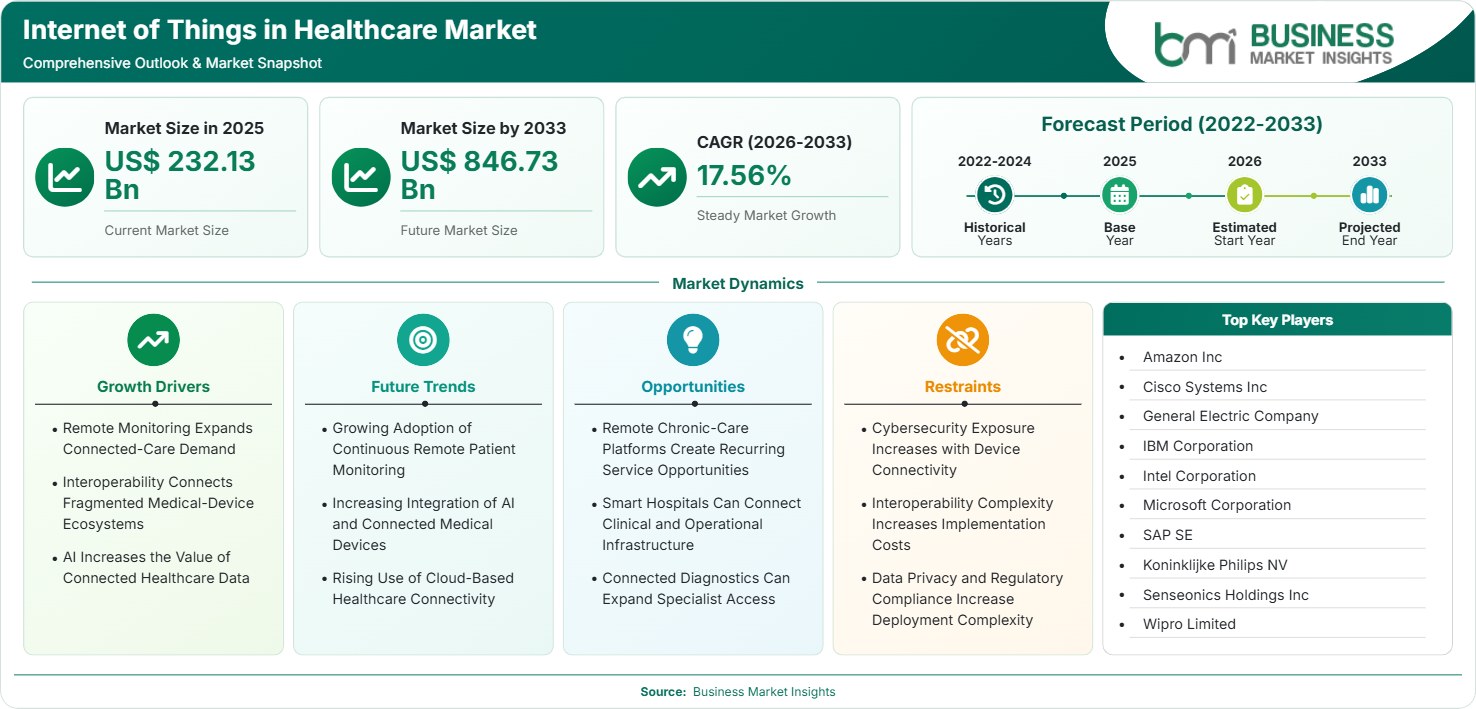
The Internet of Things in Healthcare Market size was valued at US$ 232.13 Billion in 2025 and is projected to reach US$ 846.73 Billion by 2033, growing at a CAGR of 17.56% during 2026–2033, driven by connected medical devices, remote monitoring, telemedicine, cloud platforms, AI analytics, interoperability, smart hospitals, and digital clinical workflows.

Report Coverage
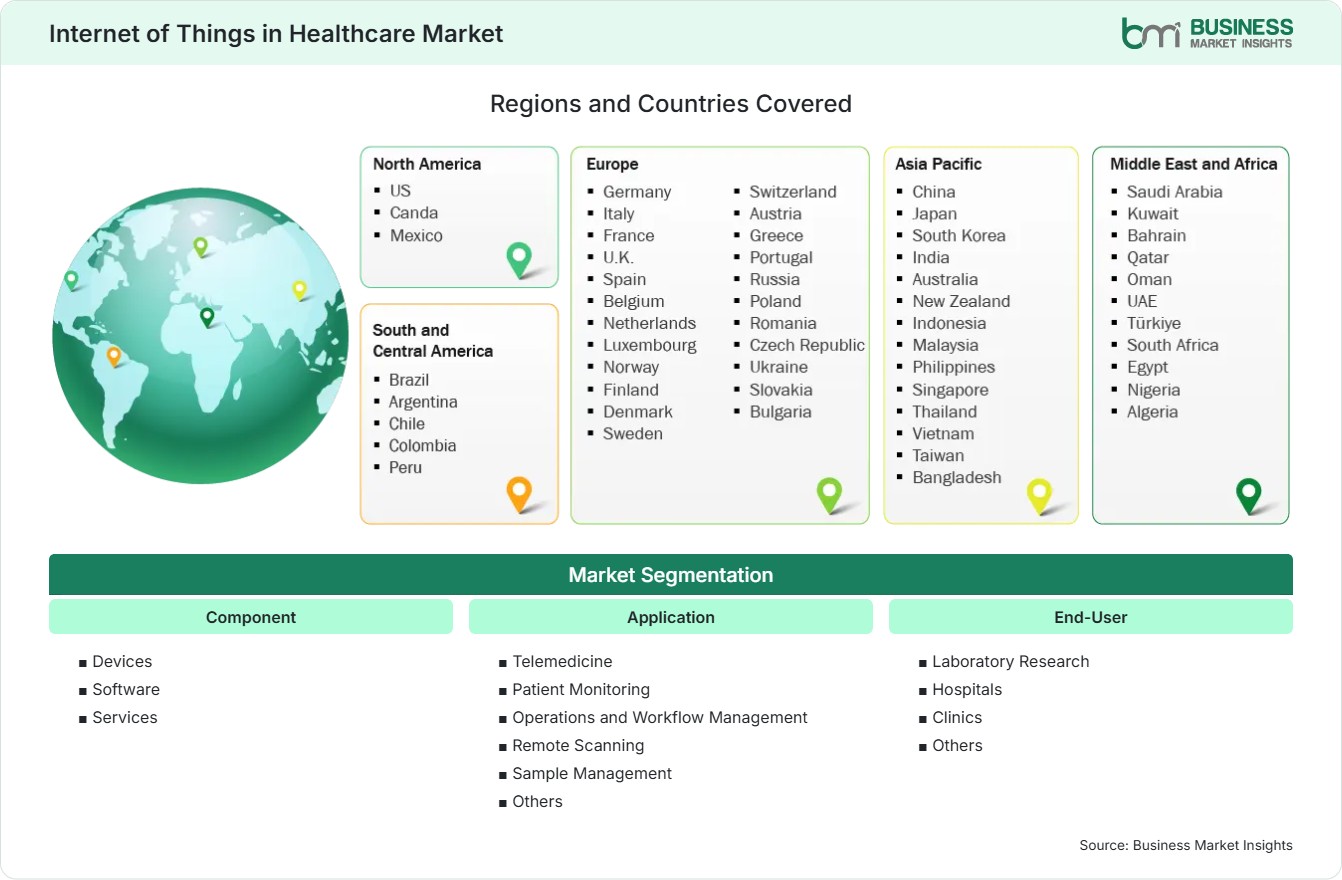
  • Component: Devices, Software, Services
  • Application: Telemedicine, Patient Monitoring, Operations and Workflow Management, Remote Scanning, Sample Management, Others
  • End-User: Laboratory Research, Hospitals, Clinics, Others
US$ 232.13 Bn Market size in 2025
US$ 846.73 Bn Market Size by 2033
17.56% CAGR, 2026 - 2033
2026-2033 Forecast Period

AI Overview

Internet of Things in Healthcare Market Summary

  • North America Region: North America held a 35%–39% share in 2025, growing at a 16.5%–17.5% CAGR during 2026–2033, supported by connected medical devices, remote monitoring, cloud infrastructure, hospital digitization, cybersecurity, interoperability, and technology investment. The US remains the principal contributor because providers increasingly deploy connected monitoring, cloud healthcare platforms, AI analytics, and digitally integrated clinical workflows.
  • Fastest Growing Region: Asia Pacific held a 24%–28% share in 2025, expanding at an 18.4%–19.5% CAGR during 2026–2033, driven by healthcare digitization, expanding hospitals, telemedicine, connected diagnostics, smartphone connectivity, chronic disease management, cloud adoption, and investment in intelligent healthcare infrastructure.
  • Leading Segment: Devices held a 43%–47% share in 2025, advancing at a 16.9%–17.8% CAGR during 2026–2033, supported by connected monitors, wearable sensors, smart medical equipment, implantable technologies, hospital asset tracking, and continuous generation of patient and operational data.
  • High Growth Segment: Remote Scanning held a 9%–13% share in 2025, expanding at a 19.0%–20.0% CAGR during 2026–2033, supported by connected diagnostic equipment, remote image access, cloud workflows, specialist collaboration, distributed healthcare delivery, and faster diagnostic decision-making.
  • Key Market Opportunity: Healthcare providers can create value by integrating connected medical devices with interoperable cloud platforms, AI analytics, remote monitoring, digital workflows, predictive maintenance, and secure longitudinal patient-data environments.
  • Major Market Players: Amazon, Inc.; Cisco Systems, Inc.; General Electric Company; IBM Corporation; Intel Corporation; Microsoft Corporation; SAP SE; Koninklijke Philips N.V.; Senseonics Holdings, Inc.; and Wipro Limited.
Strategic Insights

Internet of Things in Healthcare Market: Strategic Insights

Internet of Things in Healthcare Market Strategic Framework
FREE PDF
Request your free sample
Request free sample
Stakeholder View

Key Takeaways

  • This ecosystem includes the entire chain from sensors to medical device makers, networking companies, cloud providers, software vendors, system integrators, healthcare organizations, cybersecurity providers, and specialized monitoring firms.
  • There are opportunities for patient monitoring, telehealth, connected diagnostics, remote scanning, intelligent hospitals and chronic disease management applications as these use cases are rich in data generation and distribution of health care delivery.
  • Technology platforms evolve from connectivity to edge computing, AI-enabled analytics, alerting, integration, automation of workflows and decision support at the clinical and operational levels.
  • Asia Pacific offers a compelling investment environment because hospital expansion, healthcare digitization, mobile connectivity, telemedicine, chronic disease management, and connected-device adoption are developing simultaneously.
  • Investment capital is being increasingly deployed on medical equipment that is interconnected, cloud-based infrastructure, healthcare cybersecurity, interoperability, telemonitoring, and software that is able to analyze device-generated data.
  • Healthcare institutions are preferring vendors who provide interoperable devices, have industry standards for data and can maintain security rather than just providing interconnected hardware.
Geographic Outlook

Internet of Things in Healthcare Market Regional Highlights

North America Internet of Things in Healthcare Market

North America represented a 35%–39% share in 2025 and is projected to grow at a 16.5%–17.5% CAGR during 2026–2033. The region benefits from sophisticated healthcare infrastructure, high connected-device adoption, established cloud ecosystems, remote monitoring, and substantial technology expenditure. The US provides the largest contribution, while Canada adds opportunities through digital health, remote care, connected diagnostics, and modernization of healthcare information infrastructure. The regional Internet of Things in Healthcare Market share reflects strong provider technology maturity.

  • Healthcare providers are connecting monitoring devices, diagnostic equipment, and clinical systems to improve information availability and reduce manual transfer between departments.
  • Remote patient monitoring is expanding beyond episodic encounters, creating demand for wearable sensors, connected measurement devices, cloud analytics, and clinician dashboards.
  • Cybersecurity remains strategically important because connected medical devices expand endpoints requiring authentication, monitoring, software maintenance, and vulnerability management.
  • Enterprise procurement increasingly favors interoperable platforms supporting heterogeneous devices across hospitals, outpatient facilities, and home-care environments.

US Internet of Things in Healthcare Market

The US represented approximately 30%–34% of global share in 2025 and is projected to grow at a 16.2%–17.3% CAGR during 2026–2033. Demand is supported by remote monitoring, digital health investment, connected medical equipment, cloud adoption, AI-enabled analytics, and hospital workflow modernization. Technology companies and healthcare suppliers are building ecosystems connecting devices, applications, clinical data, and infrastructure.

  • Hospitals are standardizing patient-monitoring networks to improve clinical visibility, device management, cybersecurity, and workflow consistency.
  • Home-based monitoring is creating demand for connected glucose, cardiac, respiratory, blood-pressure, and other chronic-care technologies.
  • Healthcare organizations increasingly require interoperability between medical devices, electronic health records, cloud platforms, analytics, and clinical applications.

Europe Internet of Things in Healthcare Market

Europe represented a 25%–29% share in 2025, expanding at a 16.8%–17.8% CAGR during 2026–2033. Germany, the UK, France, the Netherlands, and Nordic markets remain important because healthcare digitization, connected devices, data governance, and hospital modernization are advancing. Providers increasingly seek interoperable technology architectures that combine monitoring, diagnostics, electronic records, and analytics.

  • Germany provides opportunities in connected hospitals, medical-device interoperability, clinical analytics, and healthcare infrastructure modernization.
  • The UK supports remote monitoring, telemedicine, connected diagnostics, and digital patient-management systems across large healthcare networks.
  • France offers opportunities in smart hospital infrastructure, connected equipment, remote care, and healthcare data platforms.
  • The Netherlands and Nordic countries provide attractive environments for interoperable healthcare technologies and digitally enabled care delivery.

Asia Pacific Internet of Things in Healthcare Market

Asia Pacific represented a 24%–28% share in 2025, with the fastest growth at an 18.4%–19.5% CAGR during 2026–2033. China, Japan, India, South Korea, Australia, and Southeast Asian markets are contributing through healthcare digitization, hospital expansion, telemedicine, connected devices, and cloud adoption. India and China provide substantial opportunities because large patient populations, expanding healthcare infrastructure, rising digital adoption, and demand for affordable remote services create favorable conditions for scalable connected-care technologies.

  • China combines advanced electronics manufacturing with expanding smart hospitals, connected diagnostics, medical wearables, and healthcare data platforms.
  • India provides opportunities in remote monitoring, telemedicine, connected diagnostics, hospital automation, and cost-efficient IoT-enabled healthcare solutions.
  • Japan benefits from aging-population requirements, home healthcare, smart medical equipment, robotics, monitoring technologies, and digitally connected clinical environments.
  • Southeast Asia is developing demand for telemedicine and connected healthcare as mobile connectivity and private healthcare infrastructure expand.

Rest of World Internet of Things in Healthcare Market

Rest of World represented approximately a 10%–14% share in 2025, growing at a 15.5%–17.0% CAGR during 2026–2033. Latin America provides opportunities through telemedicine, remote monitoring, connected diagnostics, hospital digitization, and mobile healthcare platforms. Brazil and Mexico are important markets because of their healthcare scale and expanding technology adoption. Argentina, Colombia, and Chile also offer opportunities for distributed healthcare solutions.

  • Brazil provides opportunities in connected hospitals, telemedicine, remote monitoring, digital diagnostics, and cloud-based healthcare applications.
  • Mexico benefits from private healthcare investment, connected equipment, telemedicine, and technology-enabled clinical workflows.
  • Gulf countries are investing in smart hospitals, advanced diagnostics, connected infrastructure, and digitally enabled patient services.
  • African markets can benefit from remote monitoring and telemedicine where connected technologies help overcome geographic and specialist-access limitations.
Global Market Geography
FREE PDF
Request your free sample
Request free sample
Segment Analysis

Internet of Things in Healthcare Market Segmentation

Component

Devices represented an estimated 43%–47% share in 2025, growing at a 16.9%–17.8% CAGR between 2026 and 2033. Connected monitors, sensors, wearables, smart equipment, and implantable devices provide the data foundation for connected healthcare. The Internet of Things in Healthcare Market scope increasingly covers hardware designed for continuous connectivity, interoperability, remote diagnostics, and intelligent clinical workflows.

  • Devices: Connected monitors, sensors, wearables, implantable systems, smart diagnostic equipment, and hospital devices generate continuous clinical or operational information.
  • Software: Device management, analytics, dashboards, interoperability, cloud connectivity, AI processing, data integration, and applications convert connected-device information into actionable insights.
  • Services: Implementation, integration, consulting, cybersecurity, maintenance, managed connectivity, analytics support, and lifecycle services enable enterprise-scale deployments.

Application

Patient Monitoring represented an estimated 31%–35% share in 2025, expanding at a 17.4%–18.3% CAGR through 2033. Continuous monitoring, chronic-disease management, hospital surveillance, and home-based care support demand for connected technologies. The Internet of Things in Healthcare Market trends increasingly connect patient measurements with cloud analytics, clinical dashboards, alerting systems, and electronic health records.

  • Telemedicine: Connects patients and clinicians remotely through digital consultations, connected devices, data sharing, monitoring, and virtual care workflows.
  • Patient Monitoring: Uses sensors, wearable devices, bedside equipment, and connected measurement technologies to provide continuous or scheduled clinical information.
  • Operations and Workflow Management: Applies connected devices to equipment utilization, staff coordination, inventory tracking, environmental monitoring, and facility operations.
  • Remote Scanning: Connects diagnostic imaging and scanning workflows to remote specialists, cloud systems, and distributed clinical teams.
  • Sample Management: Uses connected identification, tracking, temperature monitoring, and workflow systems to improve laboratory sample visibility and handling.
  • Others: Covers connected healthcare applications involving facilities, logistics, pharmacy operations, rehabilitation, environmental monitoring, and specialized clinical processes.

End-User

Hospitals represented an estimated 48%–52% share in 2025, growing at 16.8%–17.7% CAGR through 2033. Hospitals have extensive device networks, complex workflows, high data volumes, and substantial demand for monitoring and automation. The Internet of Things In Healthcare Market analysis indicates that hospitals will remain central to enterprise-scale deployments as providers consolidate connected infrastructure.

  • Laboratory Research: Uses connected instruments, environmental sensors, sample tracking, equipment monitoring, and data systems to improve research workflows.
  • Hospitals: Deploy connected monitoring, smart equipment, asset tracking, workflow management, remote diagnostics, and patient-data integration across complex care environments.
  • Clinics: Adopt connected devices and telemedicine to improve monitoring, diagnostics, appointment workflows, and access to specialist expertise.
  • Others: Includes home healthcare, ambulatory facilities, pharmacies, rehabilitation centers, long-term care, and specialized healthcare organizations.
Market Forces

Internet of Things in Healthcare Market Dynamics

Key Market Drivers

Remote monitoring expands connected-care demand

Remote monitoring is shifting selected healthcare activities from facility-based encounters toward continuous or scheduled data collection outside conventional clinical environments. Measurements recorded by such interconnected sensors and medical devices can be relayed to healthcare experts to make timely observations and continue disease monitoring. The Internet of Things in Healthcare Market growth is correlated with healthcare systems looking for ways to scale their ability to observe a greater number of patients, while minimizing face-to-face contact. Connected sensors, glucose monitoring devices, cardiac monitoring devices, respiratory monitors, and even home diagnostics devices are expanding the application areas of connected technology in healthcare.

Interoperability connects fragmented medical-device ecosystems

Healthcare organizations rely on diverse medical devices, information systems, diagnostic platforms, and clinical applications across multiple care environments. Fragmented connectivity can result in duplicated interfaces, isolated information, inconsistent data formats, and additional workloads for clinical and information technology teams. Interoperability enables healthcare devices and digital systems to exchange, interpret, and utilize information more effectively across organizational and technological boundaries. The Internet of Things in Healthcare Market trends increasingly emphasize standardized communication, centralized monitoring, cloud integration, and longitudinal access to patient information. As healthcare infrastructure becomes increasingly connected, demand is rising for solutions that can integrate heterogeneous device ecosystems while maintaining reliable and secure data exchange.

AI increases the value of connected healthcare data

Connected healthcare devices generate continuous and high-frequency information that can support predictive analytics, clinical decision support, workflow optimization, and operational planning. AI can handle huge amounts of data generated by devices to recognize patterns, prioritize alerts, help interpret, and gain context for healthcare practitioners. This merger is changing the value proposition of connected healthcare from mere data transfer to intelligence. Healthcare providers can get more value out of their information gathered through connected devices when it is made a part of their clinical workflow instead of being stored in a separate monitoring system. As the connected healthcare eco-systems continue to develop, it is predicted that the integration of sensors, connectivity, data platforms, analytics, and AI will continue to be a key factor behind the demand in the Internet of Things in Healthcare Market.

Key Market Opportunities

Remote chronic-care platforms create recurring service opportunities

Chronic disease management presents a significant opportunity for connected healthcare technologies because remote monitoring can support continuous patient engagement beyond traditional healthcare facilities. Connected devices can collect glucose, cardiac, blood-pressure, respiratory, weight, and activity information and transmit it for remote analysis. Vendor companies can increase their proposition of value to include the offering of subscription-based products along with device management and remote monitoring services. Additionally, healthcare facilities can leverage the power of connected systems to expand their provision of specialist services over wider geographic regions, as well as provide care in between clinical appointments.

Smart hospitals can connect clinical and operational infrastructure

Hospitals provide substantial opportunities to connect clinical devices with operational infrastructure, including beds, infusion systems, asset-tracking solutions, environmental sensors, inventory systems, facility controls, and healthcare information platforms. Smart infrastructure can help visibility in hospitals through enabling tracking and monitoring of equipment locations, usage, maintenance, inventory, and facility management. Suppliers who will be able to manage integration of clinical and operational data with secure governance and reliability of their systems can develop long-lasting partnerships with health institutions. Growth of smart hospital infrastructure thus opens up opportunities for connected technology suppliers at many levels of health care ecosystems.

Connected diagnostics can expand specialist access

Connected diagnostic systems can help distribute specialized healthcare expertise by enabling diagnostic images, measurements, and clinical information to be securely accessed across healthcare networks. Such an approach could help facilities, where diagnostic expertise is located in large hospitals, while the patients seek treatment from geographically distributed centers. The possibility is available in the context of cloud-based diagnostic workflow, remote interpretations, AI-powered diagnosis, connected pathology, and distributed lab services. Vendors can create platforms integrating diagnostic devices, image repositories, clinical record systems, experts, and analytics tools. With healthcare organizations moving towards more integrated service delivery, there will be new possibilities for connected diagnostics within the Internet of Things in Healthcare Market.

Market Restraints and Challenges

Cybersecurity exposure increases with device connectivity

Factor: Connecting medical devices, sensors, cloud systems, hospital networks, and remote endpoints expands the number of assets requiring protection. Impact: An increased attack surface adds complexity in cybersecurity, compliance needs, risk factors, and expenses. The healthcare provider has to deal with issues such as authentication, encryption, access control, updates to software, addressing vulnerabilities, and responding to incidents. The problem is that legacy medical devices can add to security modernization issues since they may not have the necessary features according to contemporary cybersecurity standards.

Interoperability complexity increases implementation costs

Factor: Healthcare environments contain diverse devices, legacy systems, proprietary protocols, electronic health records, imaging platforms, and cloud applications. Impact: Integration will require the use of specific interfaces, middleware, data mapping, testing, validation, and maintenance. Different data formats, lack of metadata, and system incompatibility can decrease the relevance of the data being exchanged. There can also be a need for process adjustments and training of personnel. This can result in increased implementation time and expenses, thus making interoperability a major limitation to fast adoption in the Internet of Things in Healthcare Market.

Company Analysis

Competitive Landscape

The Internet of Things in Healthcare Market analysis shows competition across cloud infrastructure, networking, connected medical equipment, software, analytics, digital platforms, and specialized monitoring technologies.

Company Name

Overview

Products and Services relevant to this market

Amazon, Inc.

Technology company with cloud, AI, connected-device, and healthcare technology capabilities.

AWS cloud infrastructure, IoT services, analytics, machine learning, data management, and healthcare cloud solutions.

Cisco Systems, Inc.

Networking and cybersecurity company supporting connected healthcare infrastructure and device environments.

Healthcare networking, IoT connectivity, security, asset visibility, collaboration, and infrastructure management.

General Electric Company

Healthcare technology provider with extensive patient-monitoring and clinical-device capabilities.

Patient monitoring, device connectivity, clinical systems, diagnostics, data aggregation, and workflow technologies.

IBM Corporation

Enterprise technology provider combining cloud, AI, analytics, and healthcare data capabilities.

Hybrid cloud, AI, analytics, data platforms, cybersecurity, and healthcare technology services.

Intel Corporation

Semiconductor and computing technology provider supporting edge and connected healthcare infrastructure.

Edge computing, processors, AI acceleration, device connectivity, security, and healthcare computing platforms.

Microsoft Corporation

Cloud and software company providing connected healthcare, data, AI, and IoT platforms.

Azure IoT, healthcare data services, AI, cloud infrastructure, interoperability, security, and analytics.

SAP SE

Enterprise software company supporting healthcare operations and data-driven workflows.

Cloud applications, analytics, supply-chain management, enterprise data, and healthcare process solutions.

Koninklijke Philips N.V.

Health technology company focused on connected monitoring, diagnostics, and clinical informatics.

Patient monitoring, device interoperability, connected care, diagnostics, AI-enabled clinical platforms, and informatics.

Senseonics Holdings, Inc.

Medical technology company specializing in long-term implantable continuous glucose monitoring.

Eversense continuous glucose monitoring systems, connected sensors, transmitters, software, and diabetes-management technologies.

Wipro Limited

Technology services company supporting digital transformation and connected healthcare solutions.

IoT integration, cloud, analytics, cybersecurity, digital engineering, healthcare platforms, and managed services.

Trust & Transparency

Research Methodology

The market analysis combines proprietary research with secondary data from government agencies, company disclosures, regulatory filings, industry databases and expert interviews. Market estimates are validated through data triangulation, cross-market benchmarking and analyst review.

View Full Research Methodology

Questions Answered

Frequently Asked Questions

Where can the Internet of Things in Healthcare Market Forecast support business planning?

The market forecast supports regional expansion, technology investment, product planning, partnerships, competitive assessment, and opportunities across patient monitoring, telemedicine, connected diagnostics, and smart healthcare infrastructure.

What does the Internet of Things in Healthcare Market Report cover?

The report covers market size, regional analysis, segmentation, growth drivers, opportunities, restraints, competitive developments, remote monitoring, telemedicine, interoperability, AI, cybersecurity, and smart healthcare technologies.

Why is interoperability becoming strategically important?

Interoperability enables devices and software from different manufacturers to exchange usable information. It reduces data silos, improves workflows, supports longitudinal records, and strengthens analytics and AI applications.

Which application has the strongest commercial potential?

Patient monitoring has strong commercial potential across hospitals, clinics, chronic-care programs, and home healthcare. Remote diagnostics and telemedicine also offer opportunities where distributed specialist access is needed.

What is the primary technology foundation for connected healthcare?

The foundation combines connected medical devices, sensors, reliable networks, cloud or edge computing, interoperability standards, cybersecurity, and analytics. These technologies enable healthcare organizations to collect, transmit, secure, and analyze clinical and operational data.

Access the Full Internet of Things in Healthcare Market Report

Get segment-level forecasts, regional estimates, competitive benchmarking, company profiles and downloadable Excel datasets.

Access the full Internet of Things in Healthcare Market Report
350 pages PDF & Excel | 2026-09-16
Similar Research

Related Market Reports