
Artificial Intelligence In Healthcare Market Outlook: Size, Share, Trends, Growth Analysis, Competitive Landscape & Forecast, 2022-2033

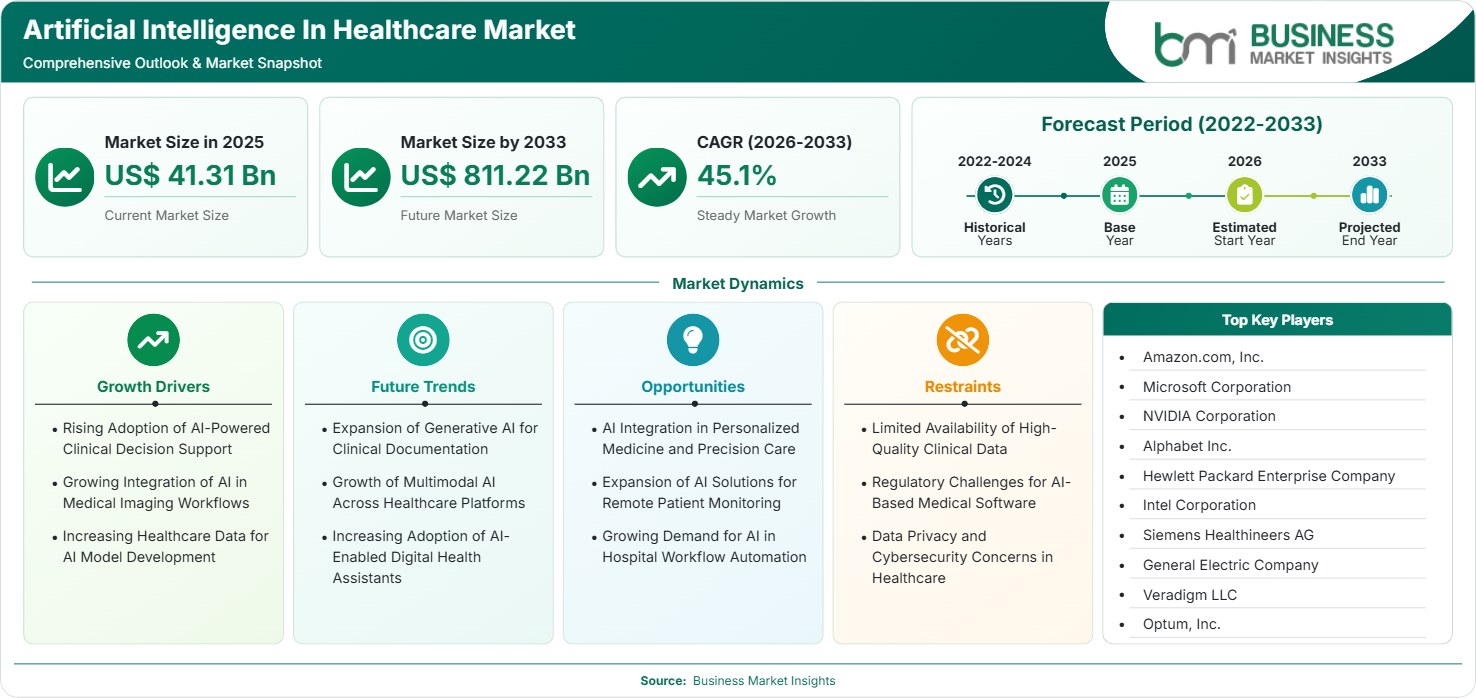
The Artificial Intelligence in Healthcare Market size was valued at US$ 41.31 Billion in 2025 and is projected to reach US$ 811.22 Billion by 2033, growing at a CAGR of 45.09% during 2026–2033. Increasing adoption of AI-driven diagnostics, rising healthcare data volumes, growing demand for workflow automation, and expanding use of predictive analytics are accelerating market growth. Opportunities are emerging from AI-assisted drug discovery, virtual healthcare platforms, precision medicine, and next-generation clinical decision support systems.

Report Coverage
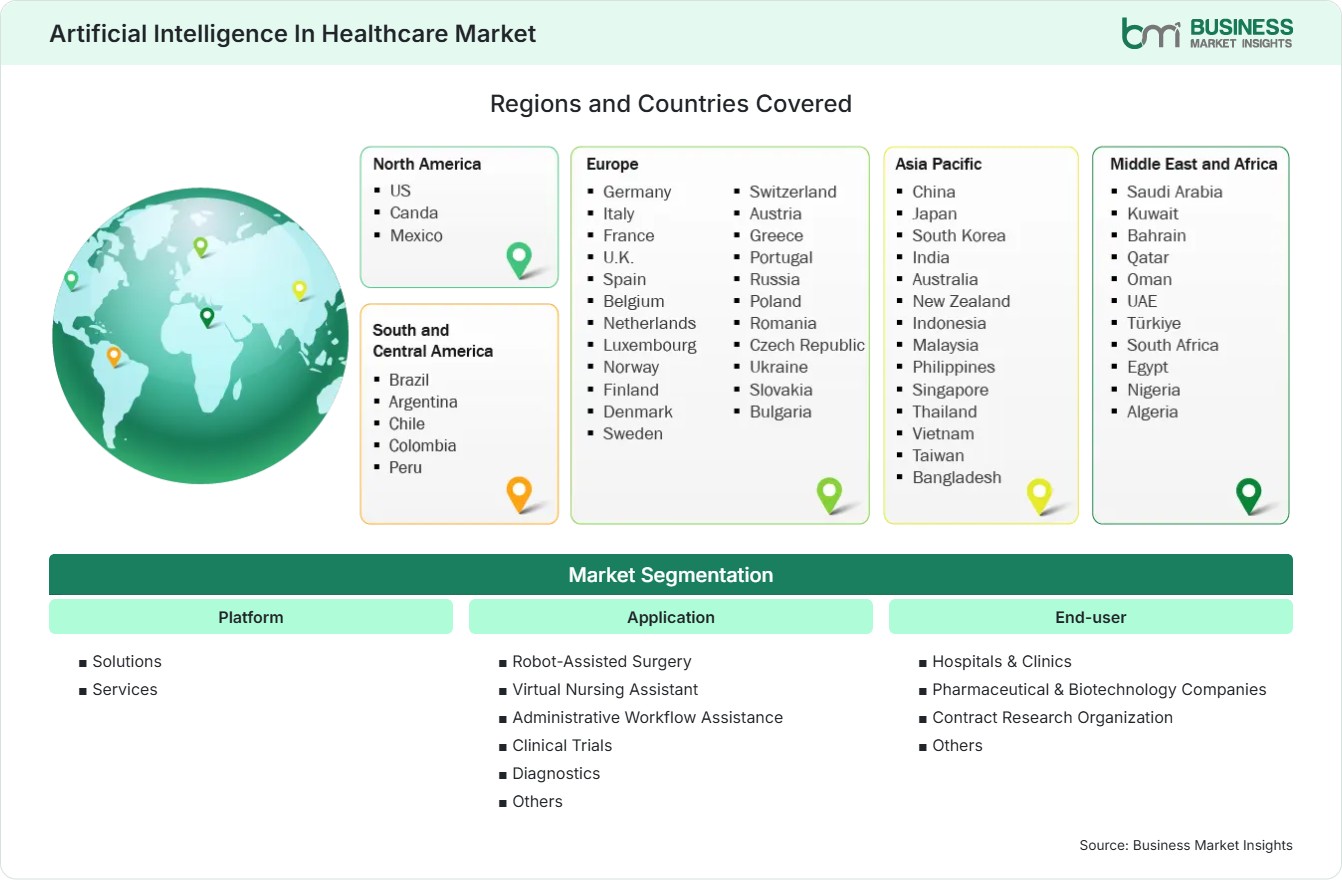
  • Platform: Solutions, Services
  • Application: Robot-Assisted Surgery, Virtual Nursing Assistant, Administrative Workflow Assistance, Clinical Trials, Diagnostics, Others
  • End-user: Hospitals & Clinics, Pharmaceutical & Biotechnology Companies, Contract Research Organization, Others
US$ 41.31 Bn Market size in 2025
US$ 811.22 Bn Market Size by 2033
45.1% CAGR, 2026 - 2033
2026-2033 Forecast Period

01 AI Overview

Artificial Intelligence In Healthcare Market Summary

  • North America Region: North America holds a market share of 41%–44% in 2025 and is projected to grow at a CAGR of 43%–45% during 2026–2033. Strong healthcare IT infrastructure, advanced AI adoption, high healthcare spending, and extensive digital health investments support regional leadership. The US artificial intelligence in healthcare market is expanding at a CAGR of 44%–46% through the forecast period.
  • Fastest Growing Region: Asia Pacific accounts for 22%–25% share in 2025 and is projected to grow at a CAGR of 47%–49% through 2033. Expanding healthcare digitization, government AI initiatives, and growing investments in healthcare technology continue driving regional expansion.
  • Leading Segment: Solutions represent 69%–72% share in 2025 and are expected to grow at a CAGR of 45%–47% through 2033. Hospitals and healthcare providers increasingly deploy AI-driven software platforms to enhance diagnosis, patient management, and operational efficiency.
  • High Growth Segment: Diagnostics holds 23%–26% share in 2025 and is anticipated to grow at a CAGR of 48%–50% during 2026–2033. The growing use of AI-powered imaging analysis, disease detection platforms, and predictive diagnostic tools is accelerating adoption.
  • Key Market Opportunity: Growing adoption of generative AI, precision medicine platforms, clinical decision support tools, and AI-assisted drug discovery technologies is creating significant opportunities throughout the healthcare ecosystem.
  • Major Market Players: Amazon.com, Inc., Microsoft Corporation, NVIDIA Corporation, Alphabet Inc., Hewlett Packard Enterprise Company, Intel Corporation, Siemens Healthineers AG, General Electric Company, Veradigm LLC, Optum, Inc.
02 Strategic Insights

Artificial Intelligence In Healthcare Market: Strategic Insights

artificial-intelligence-in-healthcare-market-market-strategic-framework
FREE PDF
Request your free sample
Request free sample
03 Stakeholder View

Key Takeaways

  • AI-powered healthcare solutions are becoming essential for improving clinical efficiency, reducing administrative burdens, and supporting data-driven patient care decisions.
  • Diagnostics remains the most attractive application opportunity due to increasing adoption of AI-assisted imaging, pathology analysis, and predictive disease detection tools.
  • Generative AI and machine learning models are reshaping healthcare workflows through automated documentation, clinical support, and personalized patient engagement capabilities.
  • Asia Pacific offers substantial expansion opportunities due to aggressive healthcare digitization initiatives, growing healthcare investments, and supportive AI development programs.
  • Strategic collaborations between healthcare providers, technology companies, and pharmaceutical organizations are accelerating AI adoption across the healthcare value chain.
  • Continuous investments in precision medicine, clinical research optimization, and AI-assisted drug development are expected to strengthen long-term market growth and innovation.
  • Artificial intelligence in the healthcare market suggests that generative AI, multimodal AI models, and intelligent clinical decision support systems will see accelerated adoption as healthcare providers prioritize operational efficiency, personalized care, and improved patient outcomes.
04 Geographic Outlook

Artificial Intelligence In Healthcare Market Regional Highlights

North America Artificial Intelligence in Healthcare Market

North America accounted for a 41%–44% share in 2025 and is projected to expand at a CAGR of 43%–45% during 2026–2033. The region benefits from advanced healthcare infrastructure, widespread electronic health record adoption, strong AI investment activity, and a mature digital healthcare ecosystem. The Artificial Intelligence in Healthcare Market share remains concentrated in the US due to significant healthcare technology spending, extensive AI research capabilities, and increasing deployment of clinical decision support platforms.

  • Healthcare providers are accelerating adoption of AI-powered diagnostics, workflow automation, and predictive analytics to improve operational efficiency and patient outcomes.
  • Hospitals are increasingly integrating machine learning tools into radiology, pathology, and clinical decision-making processes to enhance diagnostic accuracy.
  • Growing investments from technology companies and healthcare institutions are driving innovation across AI-enabled healthcare applications.
  • Regulatory support for healthcare digitization and data-driven care models is encouraging wider implementation of artificial intelligence solutions.
  • Rising demand for personalized medicine and value-based healthcare is supporting long-term adoption of advanced AI platforms.

US Artificial Intelligence in Healthcare Market

The US represented a 36%–39% share in 2025 and is estimated to grow at a CAGR of 44%–46% through 2033. Strong digital health infrastructure, extensive healthcare data availability, and growing investments from technology and healthcare companies support market expansion. The Artificial Intelligence in Healthcare Market growth in the US is driven by rapid adoption of AI-assisted diagnostics, virtual healthcare services, administrative automation, and clinical workflow optimization technologies.

  • Healthcare organizations are utilizing AI tools to improve patient engagement, automate documentation, and streamline clinical processes.
  • Expansion of generative AI applications is creating opportunities across medical imaging, patient communication, and healthcare administration.
  • Pharmaceutical companies are leveraging AI platforms to accelerate drug discovery, clinical trial design, and research efficiency.
  • Large healthcare networks continue investing in predictive analytics and population health management solutions.

Europe Artificial Intelligence in Healthcare Market

Europe held a 27%–30% share in 2025 and is expected to grow at a CAGR of 42%–44% from 2026–2033. Germany, the UK, and France represent major Artificial Intelligence in Healthcare markets due to strong healthcare systems, digital health strategies, and increasing AI adoption. Germany is estimated to expand at 43%–45% CAGR, supported by healthcare modernization initiatives and investments in intelligent healthcare technologies.

  • European healthcare providers are increasingly adopting AI-based solutions to address workforce shortages and improve care quality.
  • Germany is strengthening market demand through hospital digitization programs and expanded investment in healthcare innovation.
  • The UK market benefits from strong research capabilities and growing deployment of AI-supported diagnostic systems.
  • France continues supporting AI adoption through digital healthcare initiatives and expanded use of health data analytics.
  • Regulatory frameworks focused on responsible AI deployment are encouraging broader adoption across healthcare environments.

Asia Pacific Artificial Intelligence in Healthcare Market

Asia-Pacific accounted for 22%–25% of the market share in 2025 and is set to witness a CAGR of 47%–49% from 2026 to 2033. China, Japan, India, and South Korea are key countries in this market due to the growing adoption of digital technologies in the healthcare sector, the adoption of artificial intelligence in government healthcare programs, and high investment in healthcare technologies. China's growth rate is 48%–50%, while India's is 49%–51% during the forecast period.

  • Healthcare digital transformation programs are accelerating the deployment of AI-powered diagnostic and clinical support solutions.
  • China is witnessing rapid adoption of medical AI technologies across hospitals, healthcare networks, and research institutions.
  • Japan’s aging population is increasing demand for AI-assisted care delivery, robotics, and predictive healthcare solutions.
  • India is experiencing strong growth due to expanding digital health infrastructure and increasing investments in healthcare innovation.
  • Regional governments continue supporting artificial intelligence development through national healthcare modernization strategies.

Rest of World Artificial Intelligence in Healthcare Market

Rest of World accounted for a 6%–9% share in 2025 and is expected to grow at a CAGR of 41%–43% through 2033. South America, the Middle East, and Africa are witnessing increasing adoption of healthcare AI solutions supported by healthcare modernization efforts, digital transformation initiatives, and growing investments in healthcare technology infrastructure. Brazil, UAE, and Saudi Arabia represent important growth markets.

  • Brazil is expanding adoption of AI-enabled healthcare platforms through investments in digital health and hospital modernization.
  • Middle Eastern countries are investing in smart healthcare infrastructure and AI-supported patient care technologies.
  • Saudi Arabia and UAE are strengthening demand through national healthcare transformation and digital health strategies.
  • Healthcare providers across emerging economies are utilizing AI solutions to improve resource efficiency and access to care.
  • International technology partnerships are supporting deployment of advanced healthcare analytics and diagnostic platforms across developing healthcare systems.
global-market-geography
FREE PDF
Request your free sample
Request free sample
05 Segment Analysis

Artificial Intelligence In Healthcare Market Segmentation

Platform

Platform Segmentation is propelled by greater digitization in healthcare, the growing use of AI-enabled clinical tools, and the need for scalable solutions in healthcare technology. The Solutions segment accounted for 69%-72% of market share in 2025 and is expected to grow at a CAGR of 45%-47% from 2033, driven by widespread deployment across diagnostics, clinical decision support, medical imaging, workflow optimization, and patient engagement applications.

  • Solutions: The leading segment owing to increasing adoption of AI-powered software platforms for diagnostics, predictive analytics, imaging interpretation, clinical decision support, and hospital workflow automation.
  • Services: Experiencing strong growth as healthcare organizations increasingly require consulting, implementation, integration, training, maintenance, and support services for AI deployment and optimization.

Application

The demand for applications is increasing as healthcare organizations use artificial intelligence to deliver improved patient care. Diagnostics accounted for 23%-26% of market share in 2025 and is expected to grow at a CAGR of 48%-50% through 2033, making it the fastest-growing application segment.

  • Robot-Assisted Surgery: Adoption is increasing due to demand for greater surgical precision, minimally invasive procedures, and improved patient recovery outcomes.
  • Virtual Nursing Assistant: Growing utilization is supporting patient engagement, medication adherence, symptom monitoring, and remote care management.
  • Administrative Workflow Assistance: Widely adopted to automate scheduling, billing, documentation, coding, and operational processes to improve efficiency.
  • Clinical Trials: AI is increasingly used for patient recruitment, protocol optimization, trial monitoring, and data analysis to accelerate drug development processes.
  • Diagnostics: The leading high-growth segment driven by increasing use of AI-enabled imaging analysis, disease detection platforms, pathology assessment, and predictive diagnostic tools.
  • Others: Includes drug discovery, personalized medicine, population health management, remote patient monitoring, and healthcare analytics applications.

End-User

End-user adoption is influenced by growing investments in digital healthcare transformation, increasing healthcare data volumes, and the need for improved clinical and operational efficiency. Hospitals & Clinics accounted for 56%–59% share in 2025 and are expected to grow at a CAGR of 44%–46% through 2033.

  • Hospitals & Clinics: The dominant segment due to extensive deployment of AI solutions for diagnostics, clinical decision support, workflow automation, imaging analysis, and patient management.
  • Pharmaceutical & Biotechnology Companies: Increasingly utilizing AI to accelerate drug discovery, optimize research activities, improve target identification, and enhance development efficiency.
  • Contract Research Organization (CRO): Adoption is growing through AI-enabled clinical trial optimization, data analytics, patient recruitment, and research management capabilities.
  • Others: Includes academic research institutions, healthcare payers, diagnostic laboratories, government healthcare agencies, and telehealth providers utilizing AI-driven healthcare technologies.
06 Market Forces

Artificial Intelligence In Healthcare Market Dynamics

Key Market Drivers

Rising Adoption of AI-Powered Clinical Decision Support

Healthcare providers are increasingly deploying AI-powered clinical decision support systems to improve diagnostic accuracy, treatment planning, and patient management. These platforms analyze large volumes of patient information, clinical records, laboratory findings, and medical literature to provide evidence-based recommendations in real time. Artificial Intelligence in Healthcare Market growth is being supported by increasing pressure on healthcare systems to improve care quality while controlling operational costs. Medical professionals are using AI techniques to identify potential risks, make faster decisions, and reduce diagnostic variability. With an increasing number of health organizations embracing data-driven health care delivery strategies, the demand for intelligent decision support technologies continues to expand across hospitals, specialty clinics, and integrated healthcare networks.

Growing Integration of AI in Medical Imaging Workflows

Medical imaging is one of the best-established use cases for artificial intelligence in healthcare. AI systems have become more popular for tasks such as segmentation, abnormality detection, disease classification, and workflow optimization in radiology departments. AI is being used by healthcare facilities to achieve greater efficiency, faster diagnostics, and earlier disease detection. More applications of artificial intelligence in radiology, cardiology, oncology, and pathology are emerging due to increasing volumes of imaging data. The shortage of qualified personnel in imaging is another driving force boosting the adoption of AI analysis systems.

Increasing Healthcare Data for AI Model Development

Healthcare systems generate vast amounts of structured and unstructured data through electronic health records, diagnostic imaging, laboratory systems, wearable devices, genomics platforms, and telehealth services. The emergence of this dynamic data environment serves as the bedrock for developing sophisticated AI models that would help make decisions in the field and in the clinic. Demand for Artificial Intelligence in the Healthcare Market is driven by the increasing availability of healthcare data, enabling more accurate prediction, risk analysis, and personalized treatments. With greater interconnectivity and investments in digital transformation by healthcare companies, AI companies can work with diverse datasets.

Key Market Opportunities

AI Integration in Personalized Medicine and Precision Care

Artificial intelligence is opening up many avenues for personalized medicine by enabling healthcare professionals to develop treatments tailored to individual patient profiles. AI can be used to interpret genomic data, medical history, biomarkers, patient lifestyle, and even treatment response data to determine the most appropriate course of treatment. Artificial Intelligence in Healthcare Market Forecasts indicate strong growth prospects as healthcare organizations seek to provide care on an individualized basis. Numerous pharmaceutical firms, research institutions, and health care facilities are investing heavily in AI-driven precision medicine. The adoption of such technologies can increase treatment efficacy, reduce the incidence of side effects, and optimize the use of healthcare facilities.

Expansion of AI Solutions for Remote Patient Monitoring

The growth of connected healthcare technologies is creating strong opportunities for AI-powered remote patient monitoring solutions. Wearable devices, mobile health applications, biosensors, and telehealth platforms continuously generate patient data that can be analyzed using advanced artificial intelligence algorithms. These monitoring systems allow for real-time observation of a person’s health status, early detection of any deterioration, and subsequent intervention if required. Remote monitoring solutions have been increasingly adopted by medical professionals to manage chronic conditions, increase patient participation, and reduce hospital readmissions. Given the ongoing artificial intelligence in healthcare market trend towards decentralized and home-based care, the demand for AI monitoring solutions is bound to grow further.

Growing Demand for AI in Hospital Workflow Automation

Hospitals are facing increasing pressure to improve efficiency while managing rising patient volumes and workforce constraints. Artificial intelligence technologies are creating opportunities to automate scheduling, documentation, coding, billing, resource allocation, and patient communication processes. AI-enabled automation of work processes can reduce administrative overhead, improve operational efficiency, and help healthcare practitioners focus on patient care. Health organizations have been turning to smart automation platforms as part of their digital transformation efforts. The requirement to streamline operations and cut costs within the healthcare sector will continue to drive significant investments in workflow automation solutions across hospitals and healthcare systems worldwide.

Market Restraints and Challenges

Limited Availability of High-Quality Clinical Data

Factor: Artificial intelligence systems require large volumes of accurate, diverse, and well-structured clinical data to effectively train and validate models. However, healthcare datasets often contain incomplete records, inconsistent formats, fragmented information, and interoperability challenges. Impact: Data quality limitations can reduce model accuracy, limit scalability, and pose challenges to developing reliable AI applications suitable for widespread clinical adoption. Organizations must invest heavily in data standardization, governance frameworks, and interoperability improvements to maximize the value of artificial intelligence solutions. Data availability and quality remain critical factors influencing successful AI implementation across healthcare environments.

Regulatory Challenges for AI-Based Medical Software

Factor: Healthcare artificial intelligence solutions operate within highly regulated environments that require extensive validation, compliance assessments, risk evaluations, and ongoing monitoring. Regulatory authorities continue to develop frameworks for governing AI-based medical software, creating uncertainty about approval pathways and compliance requirements. Impact: Regulatory complexity can lengthen development timelines, increase commercialization costs, and delay the adoption of innovative technologies. Companies must demonstrate transparency, clinical effectiveness, patient safety, and accountability before achieving widespread implementation. Navigating evolving regulatory expectations remains a significant challenge for developers and healthcare organizations deploying advanced artificial intelligence solutions.

07 Company Analysis

Competitive Landscape

The Artificial Intelligence in Healthcare Market analysis is characterized by intense competition among technology providers, healthcare IT companies, cloud computing leaders, medical device manufacturers, and data analytics firms. Market participants are focused on expanding AI capabilities across diagnostics, clinical decision support, medical imaging, hospital operations, drug discovery, and patient engagement platforms. Strategic partnerships between healthcare providers and technology companies are accelerating commercialization of AI-powered healthcare solutions. Investment priorities include generative AI, predictive analytics, large language models, cloud-based healthcare platforms, and precision medicine applications.

Company Name

Overview

Products and Services Relevant to this Market

Amazon.com, Inc.

Global technology company expanding cloud and healthcare AI capabilities.

Healthcare cloud services, AI analytics platforms, machine learning solutions, and healthcare data management tools.

Microsoft Corporation

Leading enterprise technology provider with significant healthcare AI investments.

AI-powered healthcare solutions, clinical workflow tools, cloud infrastructure, and generative AI applications.

NVIDIA Corporation

Major provider of AI computing platforms and accelerated computing technologies.

AI infrastructure, healthcare imaging AI, medical research computing, and deep learning platforms.

Alphabet Inc.

Technology company advancing healthcare AI through research and cloud-based healthcare solutions.

Medical AI platforms, healthcare analytics, diagnostics support tools, and digital health technologies.

Hewlett Packard Enterprise Company

Enterprise technology provider supporting healthcare digital transformation initiatives.

Healthcare data infrastructure, AI computing platforms, and healthcare information management solutions.

Intel Corporation

Semiconductor company enabling AI deployment across healthcare environments.

AI processors, healthcare computing solutions, edge AI infrastructure, and analytics platforms.

Siemens Healthineers AG

Leading healthcare technology company focused on AI-enabled diagnostics.

Medical imaging AI, clinical decision support, diagnostics platforms, and healthcare workflow solutions.

General Electric Company

Healthcare technology provider with strong imaging and analytics capabilities.

AI-enabled imaging systems, diagnostic solutions, and predictive healthcare technologies.

Veradigm LLC

Healthcare data and technology provider supporting clinical intelligence initiatives.

Healthcare analytics, clinical data platforms, decision support technologies, and population health solutions.

Optum, Inc.

Healthcare services and technology company focused on data-driven care delivery.

Healthcare analytics, clinical intelligence platforms, AI-powered operational solutions, and population health management tools.


10 Trust & Transparency

Research Methodology

The market analysis combines proprietary research with secondary data from government agencies, company disclosures, regulatory filings, industry databases and expert interviews. Market estimates are validated through data triangulation, cross-market benchmarking and analyst review.

View Full Research Methodology

11 Questions Answered

Frequently Asked Questions

What opportunities exist for AI healthcare solution providers?

Major opportunities include precision medicine, remote patient monitoring, hospital workflow automation, drug discovery acceleration, clinical decision support systems, and generative AI-enabled healthcare applications.

Why does North America lead the artificial intelligence in healthcare market?

North America maintains leadership due to advanced healthcare infrastructure, strong healthcare IT spending, extensive AI investments, robust research ecosystems, and widespread adoption of digital health technologies.

Which application segment is growing the fastest?

Diagnostics is the fastest-growing application segment as healthcare providers increasingly utilize AI for medical imaging, disease detection, pathology analysis, and predictive diagnostics.

Which platform segment dominates the market?

Solutions dominate the market due to widespread deployment of AI software platforms for diagnostics, clinical support, workflow automation, imaging analysis, and patient management applications.

What is driving growth in the artificial intelligence in healthcare market report?

Growth is driven by increasing healthcare digitization, rising adoption of AI-powered diagnostics, growing healthcare data volumes, workflow automation requirements, and demand for improved clinical decision-making capabilities.

Access the Full Artificial Intelligence In Healthcare Market Report

Get segment-level forecasts, regional estimates, competitive benchmarking, company profiles and downloadable Excel datasets.

Access the full Artificial Intelligence In Healthcare Market Report
350 pages PDF & Excel | 2026-08-03