
Business Intelligence (BI) Market Outlook: Size, Share, Trends, Growth Analysis, Competitive Landscape & Forecast, 2026-2033

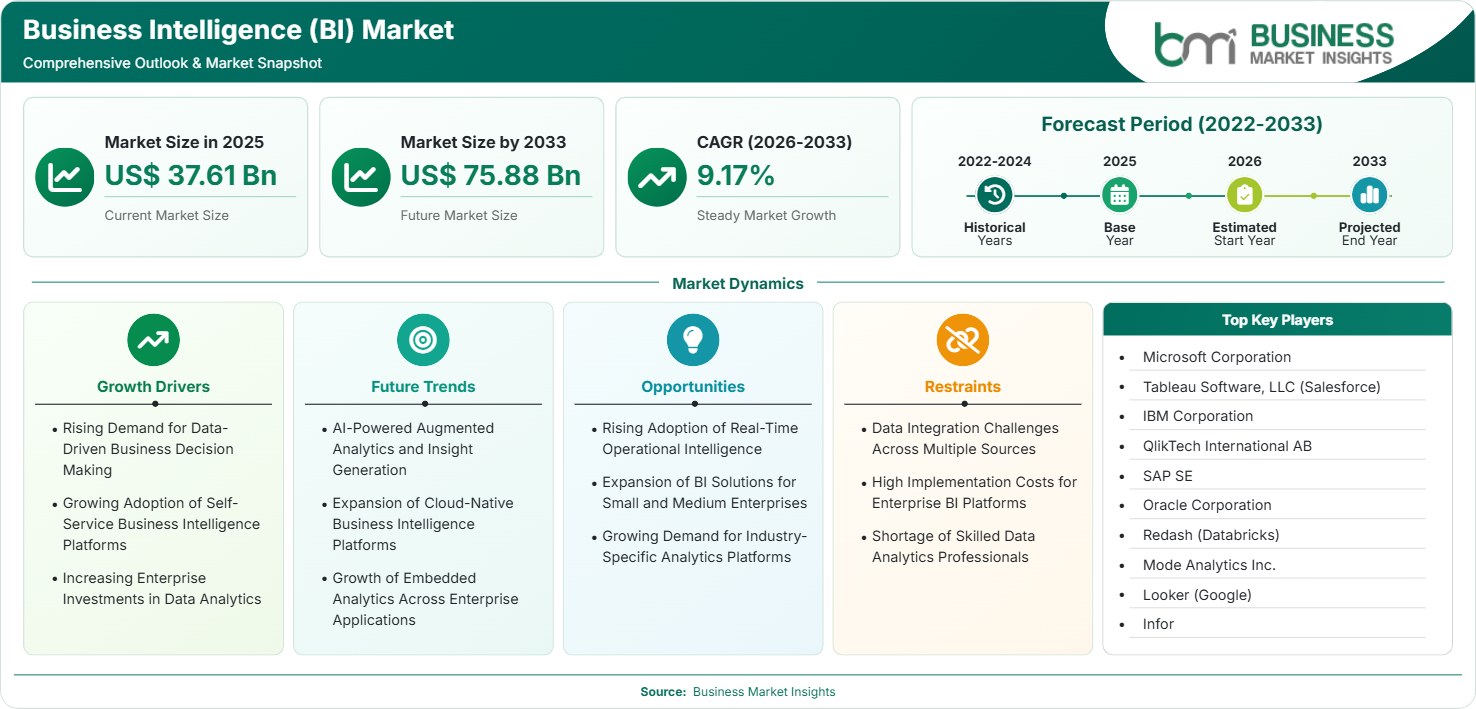
The Business Intelligence (BI) Market size was valued at US$ 37.61 Billion in 2025 and is projected to reach US$ 75.88 Billion by 2033, growing at a CAGR of 9.17% during 2026–2033. Rising enterprise demand for data-driven decision-making, increasing adoption of cloud analytics platforms, growing digital transformation initiatives, and expanding use of advanced reporting and visualization tools are supporting market growth globally.

Report Coverage
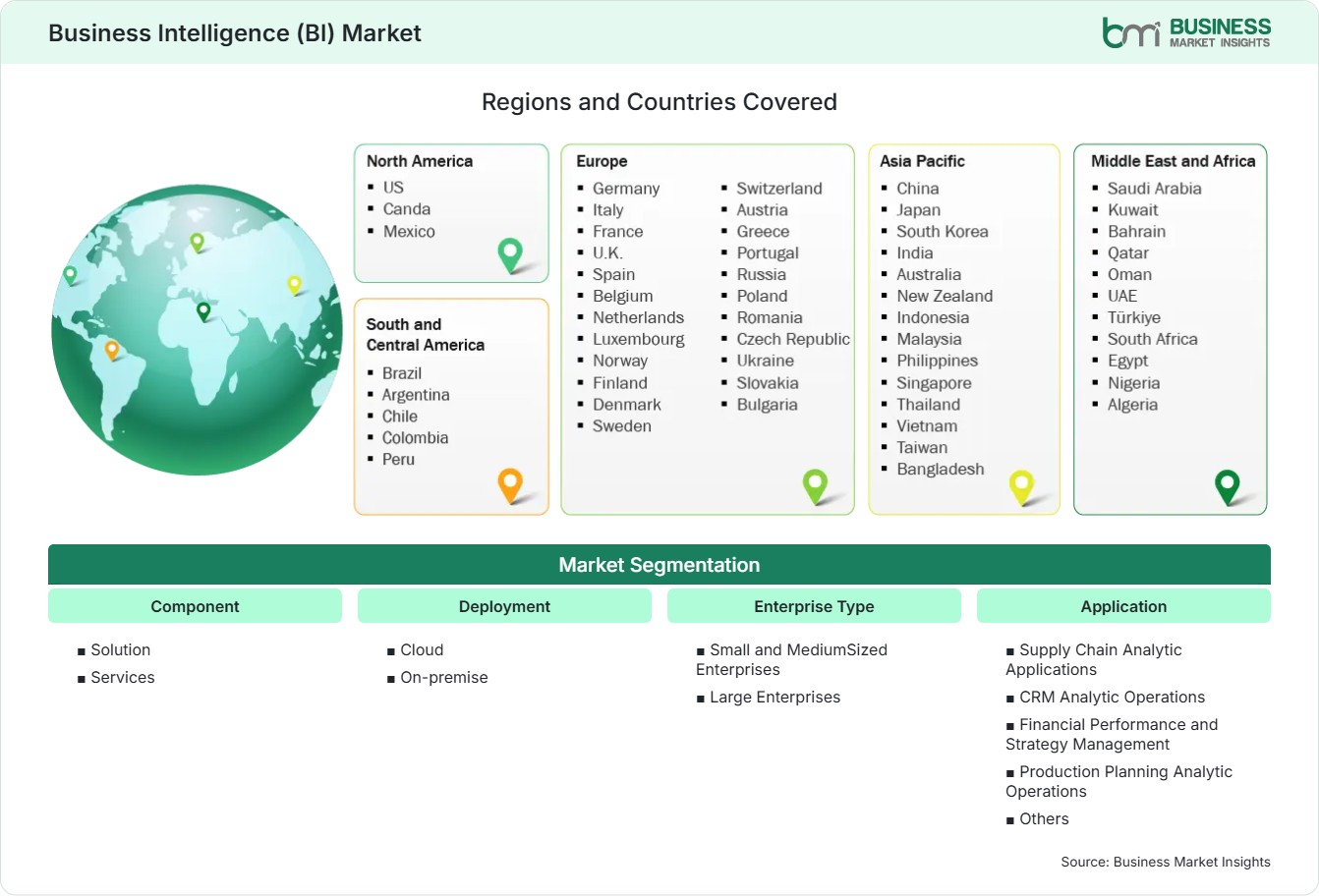
  • Component: Solution, Services
  • Deployment: Cloud, On-premise
  • Enterprise Type: Small and MediumSized Enterprises , Large Enterprises
  • Application: Supply Chain Analytic Applications, CRM Analytic Operations, Financial Performance and Strategy Management, Production Planning Analytic Operations, Others
  • End-use Industry: BFSI, IT and Telecommunication, Retail and Consumer Goods, Manufacturing, Healthcare, others
US$ 37.61 Bn Market size in 2025
US$ 75.88 Bn Market Size by 2033
9.17% CAGR, 2026 - 2033
2026-2033 Forecast Period

AI Overview

Business Intelligence (BI) Market Summary

  • North America Region: North America holds a market share of 36%–39% in 2025, growing with a CAGR of 8.6%–9.2% during 2026–2033. Strong adoption of analytics platforms, mature digital infrastructure, widespread cloud implementation, and high enterprise spending on data intelligence solutions continue supporting regional leadership. The U.S. business intelligence (BI) market is expected to register a CAGR of 8.8%–9.4%.
  • Fastest Growing Region: Asia Pacific accounts for 24%–27% share in 2025 and is projected to grow at a CAGR of 10.4%–11.1% through 2033. Rapid digitalization, growing cloud adoption, increasing data generation, and expanding investments in enterprise analytics continue supporting regional growth.
  • Leading Segment: Solutions represent 64%–67% share in 2025 and are expected to grow at a CAGR of 9.1%–9.8% through 2033. Increasing demand for dashboards, reporting tools, predictive analytics, and self-service analytics solutions continues supporting segment dominance.
  • High Growth Segment: Cloud Deployment accounts for 57%–60% share in 2025 and is forecast to grow at a CAGR of 10.6%–11.3% during 2026–2033. Scalability, lower infrastructure costs, real-time accessibility, and simplified implementation continue accelerating adoption.
  • Key Market Opportunity: Expansion of AI-powered analytics, real-time business intelligence platforms, embedded analytics solutions, and self-service data visualization tools is creating substantial growth opportunities.
  • Major Market Players: Microsoft Corporation, Tableau Software LLC (Salesforce), IBM Corporation, QlikTech International AB, SAP SE, Oracle Corporation, Redash (Databricks), Mode Analytics Inc., Looker (Google), Infor.
Strategic Insights

Business Intelligence (BI) Market: Strategic Insights

Business Intelligence (BI) Market Strategic Framework
FREE PDF
Request your free sample
Request free sample
Stakeholder View

Key Takeaways

  • Business intelligence solutions continue playing a critical role in enterprise decision-making and performance optimization.
  • BI platforms are increasingly integrating artificial intelligence and predictive analytics capabilities.
  • Cloud-based deployments are becoming the preferred implementation model for many organizations.
  • Large enterprises remain the primary adopters of comprehensive analytics and reporting solutions.
  • Supply chain, financial management, and customer analytics applications continue generating strong demand.
  • Asia Pacific presents substantial growth opportunities due to accelerating enterprise digitalization.
Geographic Outlook

Business Intelligence (BI) Market Regional Highlights

North America Business Intelligence (BI) Market

North America accounts for 36%–39% Business Intelligence (BI) Market share in 2025 and is projected to grow at a CAGR of 8.6%–9.2% through 2033. Strong enterprise analytics adoption, increasing investments in AI-powered business intelligence, and growing demand for real-time decision support continue supporting regional leadership.

  • Organizations increasingly utilize BI platforms to support strategic planning, operational optimization, and customer analytics initiatives.
  • Cloud-based analytics solutions continue gaining widespread acceptance among enterprises seeking flexibility and scalability.
  • Financial services organizations remain significant adopters of advanced business intelligence technologies.
  • Growing investments in data governance and enterprise analytics continue supporting market expansion.
  • Integration of predictive analytics with traditional BI tools is improving business decision-making capabilities.
  • Demand for self-service analytics continues increasing across enterprises of various sizes.

US Business Intelligence (BI) Market

The United States contributes approximately 85%–89% of North American revenue and is expected to register a CAGR of 8.8%–9.4% through 2033. Strong technology adoption, extensive digital transformation initiatives, and increasing focus on data-driven operations continue supporting business intelligence (BI) market growth.

  • Enterprises are increasingly deploying advanced analytics tools to enhance operational performance and competitiveness.
  • Cloud analytics adoption continues expanding across industries.
  • Retail, financial services, healthcare, and technology sectors remain major users of BI solutions.
  • AI-enabled business intelligence capabilities continue gaining traction among large enterprises.
  • Organizations increasingly prioritize real-time reporting and data visualization capabilities.

Europe Business Intelligence (BI) Market

Europe represents 25%–28% of global revenue in 2025 and is anticipated to expand at a CAGR of 9.0%–9.7% through 2033. Growing enterprise digitalization, increasing analytics adoption, and rising focus on operational efficiency continue supporting regional growth. Germany remains the leading market while Poland demonstrates stronger growth momentum.

  • Germany continues leading regional adoption through strong industrial and enterprise software ecosystems.
  • Poland is among the fastest-growing markets and is estimated to register a CAGR of 10.0%–10.7% during the forecast period.
  • Organizations increasingly utilize business intelligence platforms to improve productivity and resource utilization.
  • Demand for advanced reporting and forecasting capabilities continues increasing.
  • Growing adoption of cloud-based analytics solutions supports market expansion.
  • AI-enhanced analytics is becoming an important differentiator among solution providers.

Asia Pacific Business Intelligence (BI) Market

Asia Pacific accounts for 24%–27% of global revenue in 2025 and is expected to achieve the fastest CAGR of 10.4%–11.1% through 2033. Rapid digital transformation, increasing enterprise technology spending, and growing adoption of cloud services continue supporting strong regional growth.

  • China remains the largest regional market due to large-scale enterprise digitalization and analytics investments.
  • India is projected to achieve approximately 11.3%–12.0% CAGR, supported by expanding IT infrastructure, cloud adoption, and enterprise modernization initiatives.
  • Businesses increasingly leverage analytics to improve competitiveness and operational efficiency.
  • Growing availability of cloud-based BI platforms is improving accessibility for SMEs.
  • Rising data generation across industries continues driving demand for analytics solutions.
  • Smart business initiatives and digital economy development continue supporting market growth.

Rest of World Business Intelligence (BI) Market

Rest of World accounts for 8%–11% of global revenue in 2025 and is projected to expand at a CAGR of 9.1%–9.8% through 2033. Growing digital transformation efforts, increasing enterprise software adoption, and expanding awareness of analytics-driven decision-making continue supporting market development.

  • Brazil continues generating demand through growing adoption of digital business technologies.
  • The UAE is witnessing increasing investment in enterprise analytics and digital transformation projects.
  • Saudi Arabia is expected to achieve approximately 10.1%–10.8% CAGR through 2033, supported by economic diversification and technology modernization initiatives.
  • Organizations increasingly adopt BI tools to improve business visibility and performance measurement.
  • Growth in cloud infrastructure continues supporting analytics deployments.
  • Data-driven management practices are becoming more widespread across industries.
Global Market Geography
FREE PDF
Request your free sample
Request free sample
Segment Analysis

Business Intelligence (BI) Market Segmentation

Component

The component segment forms the foundation of the business intelligence ecosystem, enabling organizations to collect, process, analyze, visualize, and interpret business data for informed decision-making. The segment accounts for approximately 64%–67% share in 2025 and is projected to grow at a CAGR of 9.3%–10.0% through 2033. The expanding Business Intelligence (BI) Market scope is supported by increasing enterprise data volumes, growing demand for real-time analytics, rising cloud adoption, and the need to improve operational efficiency through data-driven insights.

  • Solution: Solutions represent the dominant segment due to widespread adoption of dashboards, reporting tools, data visualization platforms, predictive analytics systems, and self-service business intelligence applications. Organizations increasingly rely on BI solutions to improve strategic planning and operational performance.
  • Services: Services continue witnessing strong demand as enterprises require consulting, implementation, integration, training, support, and managed services to maximize the value of BI deployments and ensure successful adoption across business functions.

Deployment

Deployment models significantly influence scalability, security, accessibility, and implementation costs associated with business intelligence platforms. This segment accounts for approximately 57%–60% share in 2025 and is expected to register a CAGR of 10.6%–11.3% through 2033. Current Business Intelligence (BI) Market trends indicate accelerating migration toward cloud-based analytics environments.

  • Cloud: Cloud deployment remains the leading segment due to lower infrastructure requirements, scalability, remote accessibility, automatic updates, and ease of integration with enterprise applications and data sources.
  • On-premise: On-premise solutions continue serving organizations requiring greater control over data security, compliance management, and internal IT infrastructure, particularly within highly regulated industries.

Enterprise Type

Enterprise size influences BI adoption strategies, implementation complexity, and analytics investment priorities. This segment accounts for approximately 62%–65% share in 2025 and is projected to grow at a CAGR of 9.0%–9.7% through 2033.

  • Small and Medium-Sized Enterprises (SMEs): SMEs are increasingly adopting affordable and cloud-based BI platforms to improve business visibility, operational efficiency, and competitiveness through analytics-driven decision-making.
  • Large Enterprises: Large enterprises continue dominating the business intelligence (BI) market due to extensive data volumes, complex operations, significant analytics budgets, and strong emphasis on enterprise-wide reporting and performance management capabilities.

Application

Application diversity remains a major factor driving the adoption of business intelligence technologies across organizations seeking operational optimization and strategic insights. This segment accounts for approximately 33%–36% share in 2025 and is projected to expand at a CAGR of 9.5%–10.2% through 2033.

  • Supply Chain Analytic Applications: Organizations increasingly use BI tools to improve inventory visibility, demand forecasting, logistics optimization, supplier management, and operational efficiency.
  • CRM Analytic Operations: Customer analytics solutions help businesses understand behavior patterns, improve retention, personalize services, and enhance customer engagement strategies.
  • Financial Performance and Strategy Management: Financial analytics applications support budgeting, forecasting, profitability analysis, risk management, and strategic planning initiatives.
  • Production Planning Analytic Operations: Manufacturing organizations utilize BI platforms to improve production scheduling, resource allocation, equipment utilization, and quality management.
  • Others: Additional applications include workforce analytics, procurement management, ESG reporting, marketing analytics, and operational performance monitoring.

End-use Industry

End-use industries continue expanding BI adoption as organizations increasingly prioritize data-driven decision-making and digital transformation strategies. This segment accounts for approximately 38%–41% share in 2025 and is forecast to grow at a CAGR of 9.4%–10.1% through 2033.

  • BFSI: Financial institutions utilize BI solutions for risk assessment, fraud detection, performance monitoring, compliance management, and customer analytics.
  • IT and Telecommunication: Technology and telecom companies deploy BI platforms to optimize network performance, improve customer retention, and monitor operational efficiency.
  • Retail and Consumer Goods: Retailers leverage analytics for customer insights, inventory management, sales forecasting, demand planning, and pricing optimization.
  • Manufacturing: Manufacturers use BI systems to improve productivity, monitor operations, optimize supply chains, and reduce operational costs.
  • Healthcare: Healthcare providers employ BI solutions for patient management, operational efficiency, financial reporting, and healthcare analytics.
  • Others: Additional industries include education, government, transportation, hospitality, energy, and professional services.
Market Forces

Business Intelligence (BI) Market Dynamics

Key Market Drivers

Rising Demand for Data-Driven Business Decision Making

Companies within various sectors have begun realizing the importance of information as a resource that can be used to gain an advantage over other organizations. Corporations collect information about their business operations and the interactions between customers and the organization from the different transactions and the use of technology within the organization. The use of business intelligence systems allows companies to convert the data into useful insights that assist in making proper decisions. More and more corporate officers are using business intelligence tools such as dashboard tools to make their decisions.

Growing Adoption of Self-Service Business Intelligence Platforms

Self-service business intelligence tools have become more popular in recent times because companies are looking for ways of giving their staff the freedom to make use of analytical tools without necessarily depending on the IT department. Today, there are many self-service BI tools that have interactive interfaces, drag-and-drop capabilities, and visualizations, which allow users to be able to analyze data on their own. Self-service analytics help in making businesses more agile by providing quicker access to information and resolving any reporting problems.

Increasing Enterprise Investments in Data Analytics

The increasing digital transformation projects are pushing businesses to make additional investments in analytics solutions that would be able to provide operational insights, optimize performance, and enable business intelligence capabilities. Companies have started understanding the need to use data for becoming efficient, spotting opportunities, mitigating risks, and improving the customer experience. Cloud computing, artificial intelligence, data warehousing, and analytics solutions ecosystems investments have been contributing to the adoption of advanced business intelligence solutions. With companies' growing focus on digital innovations and intelligent operations, there will be a consistent demand for business intelligence solutions.

Key Market Opportunities

Rising Adoption of Real-Time Operational Intelligence

The need for real-time operational insights into business operations is becoming more and more necessary for organizations to be able to react rapidly to any changes in the business environment or operational issues. Real-time operational intelligence solutions provide the ability for organizations to analyze key metrics, identify any anomalies, optimize processes, and make instantaneous decisions based on live data. Industries such as manufacturing, retail, logistics, telecom, and finance are among those industries that can benefit the most from this technology.

Expansion of BI Solutions for Small and Medium Enterprises

Small and medium-sized enterprises represent a significant growth opportunity for the BI market. Historically, advanced analytics platforms were often limited to large organizations due to complexity and cost considerations. However, cloud-based BI solutions and subscription-based pricing models are making advanced analytics increasingly accessible to SMEs. These organizations are adopting BI tools to improve business performance, optimize operations, and strengthen competitiveness. As awareness of analytics benefits continues growing among SMEs, demand for scalable and affordable BI solutions is expected to accelerate.

Growing Demand for Industry-Specific Analytics Platforms

Organizations increasingly seek BI solutions tailored to the unique requirements of specific industries. Industry-specific platforms provide prebuilt dashboards, data models, performance metrics, regulatory reporting capabilities, and workflow integrations designed to address sector-specific challenges. Industries such as healthcare, retail, manufacturing, financial services, and telecommunications are increasingly adopting specialized analytics platforms to accelerate deployment and improve outcomes. Long-term Business Intelligence (BI) Market Forecasts remain favorable as solution providers continue developing targeted industry-focused offerings.

Market Restraints and Challenges

Data Integration Challenges Across Multiple Sources

Factor: Modern enterprises operate across numerous systems, applications, databases, cloud environments, and external data sources. Integrating information from diverse and often disconnected platforms can be technically challenging and resource-intensive. Differences in data formats, quality standards, governance policies, and system architectures further complicate integration efforts.

Impact: Data integration challenges can increase implementation timelines, raise deployment costs, and limit the effectiveness of business intelligence initiatives. Organizations must invest in data management, governance, and integration technologies to ensure accurate and reliable analytics outputs.

High Implementation Costs for Enterprise BI Platforms

Factor: Enterprise-grade BI deployments often require significant investments in software licenses, cloud infrastructure, system integration, data management frameworks, employee training, and ongoing maintenance. Complex deployments may also require customization and consulting services to align solutions with organizational requirements.

Impact: High implementation costs can discourage adoption among budget-constrained organizations and delay large-scale analytics projects. Enterprises must carefully evaluate return-on-investment expectations and deployment strategies before making substantial BI investments, potentially slowing adoption in certain market segments.

Company Analysis

Competitive Landscape

The Business Intelligence (BI) Market analysis is characterized by strong competition among enterprise software providers, analytics platform developers, cloud technology vendors, and data visualization specialists. Market participants are focusing on self-service analytics, AI-powered business intelligence, embedded analytics, predictive modeling, and real-time decision support capabilities to strengthen their market positions. The growing importance of data-driven decision-making, enterprise digital transformation initiatives, cloud migration strategies, and increasing demand for advanced reporting tools continue driving innovation across the market. Vendors are increasingly integrating machine learning, natural language querying, and automated analytics features into their BI portfolios to improve user accessibility and business value.

Company Name

Overview

Products and Services relevant to this market

Microsoft Corporation

Global technology company providing cloud, analytics, and enterprise software solutions.

Power BI, business analytics platforms, data visualization tools, cloud analytics services, reporting solutions, and AI-powered business intelligence applications.

Tableau Software, LLC (Salesforce)

Analytics and visualization company focused on self-service business intelligence.

Data visualization platforms, dashboards, reporting tools, self-service analytics solutions, and enterprise business intelligence software.

IBM Corporation

Enterprise technology provider offering analytics, AI, and data management solutions.

Business intelligence platforms, predictive analytics tools, reporting applications, data management solutions, and AI-driven analytics services.

QlikTech International AB

Analytics company specializing in data integration and business intelligence solutions.

Self-service analytics platforms, data visualization tools, enterprise reporting systems, data integration technologies, and business intelligence applications.

SAP SE

Enterprise software company serving business operations, analytics, and digital transformation initiatives.

SAP Analytics Cloud, business intelligence platforms, enterprise reporting tools, performance management solutions, and advanced analytics applications.

Oracle Corporation

Enterprise technology company providing database, analytics, and cloud services.

Oracle Analytics, reporting systems, enterprise intelligence platforms, predictive analytics solutions, and data management technologies.

Redash (Databricks)

Data analytics and visualization platform focused on query-based business intelligence.

Data exploration tools, visualization dashboards, query management platforms, analytics reporting solutions, and collaborative BI applications.

Mode Analytics Inc.

Analytics company providing modern business intelligence and data collaboration solutions.

Business analytics platforms, reporting tools, SQL-based analytics environments, dashboard solutions, and collaborative data analysis capabilities.

Looker (Google)

Cloud-native analytics and business intelligence platform provider.

Business intelligence software, embedded analytics solutions, reporting platforms, data modeling tools, and cloud analytics applications.

Infor

Enterprise software provider serving industry-specific operational and analytics requirements.

Business intelligence platforms, performance management systems, reporting tools, industry analytics solutions, and enterprise data management applications.

Trust & Transparency

Research Methodology

The market analysis combines proprietary research with secondary data from government agencies, company disclosures, regulatory filings, industry databases and expert interviews. Market estimates are validated through data triangulation, cross-market benchmarking and analyst review.

View Full Research Methodology

Questions Answered

Frequently Asked Questions

How is artificial intelligence transforming business intelligence solutions?

Artificial intelligence is enabling automated insights, predictive analytics, natural language queries, anomaly detection, intelligent forecasting, and real-time decision support capabilities, significantly enhancing the value and usability of modern BI platforms.

What does this Business Intelligence (BI) Market Report cover?

This report covers component analysis, deployment assessment, enterprise type evaluation, application segmentation, end-use industry analysis, regional trends, competitive landscape assessment, market dynamics, opportunities, restraints, and growth prospects through 2033.

Why is cloud deployment growing rapidly?

Cloud deployment is expanding because it offers scalability, lower infrastructure costs, remote accessibility, simplified deployment, and seamless integration with enterprise applications and data ecosystems.

Which component segment dominates the market?

Solutions represent the leading segment due to increasing enterprise adoption of dashboards, reporting platforms, visualization tools, predictive analytics software, and self-service business intelligence applications.

What is driving growth in the Business Intelligence (BI) market?

Rising demand for data-driven business decision-making, growing adoption of self-service business intelligence platforms, increasing enterprise investments in analytics solutions, and expanding digital transformation initiatives are major factors driving market growth.

Access the Full Business Intelligence (BI) Market Report

Get segment-level forecasts, regional estimates, competitive benchmarking, company profiles and downloadable Excel datasets.

Access the full Business Intelligence (BI) Market Report
350 pages PDF & Excel | 2026-08-12
Similar Research

Related Market Reports