
Decision Intelligence Market Outlook: Size, Share, Trends, Growth Analysis, Competitive Landscape & Forecast, 2022-2033

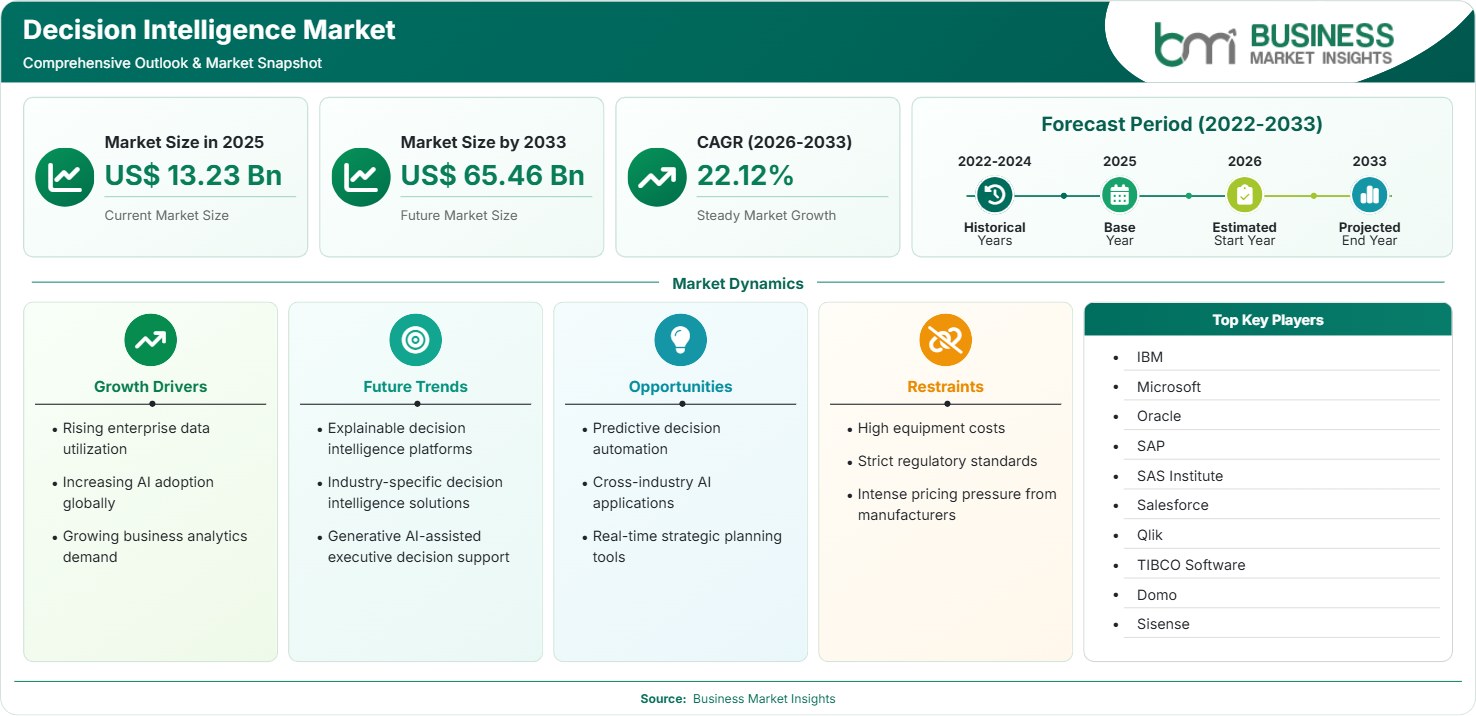
The Decision Intelligence Market size was valued at US$ 13.23 billion in 2025 and is projected to reach US$ 65.46 billion by 2033, growing at a CAGR of 22.12% during 2026–2033. Growing use of enterprise data, increasing adoption of artificial intelligence, and rising need for business analytics are propelling market growth, while decision automation, industry-wide adoption of artificial intelligence, and strategic planning systems offer strong opportunities for future growth.

Report Coverage
  • Application: Decision Support, Decision Augmentation, Decision Automation
  • Enterprise Type: Large Enterprises, Small & Medium Enterprises
  • Industry: IT & Telecommunication, BFSI, Transportation & Logistics, Retail & Ecommerce, Consumer Goods, Construction, Government, Others
US$ 13.23 Bn Market size in 2025
US$ 65.46 Bn Market Size by 2033
22.12% CAGR, 2026 - 2033
2026-2033 Forecast Period

01 AI Overview

Decision Intelligence Market Summary

  • North America Region: North America holds a market share of 38%–41% in 2025 and is projected to expand at a CAGR of 20.8%–21.8% during 2026–2033. Strong enterprise AI investments, mature cloud infrastructure, and widespread adoption of advanced analytics continue supporting market leadership. The U.S. market benefits from rapid enterprise AI deployment and is expected to register a CAGR of 21.0%–22.0% through 2033.
  • Fastest Growing Region: Asia Pacific accounts for 24%–27% of the market in 2025 and is forecast to grow at a CAGR of 24.5%–25.5% during 2026–2033. Accelerating digital transformation, expanding AI investments, government-led digital initiatives, and increasing enterprise modernization create strong opportunities across major regional economies.
  • Leading Segment: Decision Support represents 42%–45% of the market in 2025 and is expected to grow at a CAGR of 21.5%–22.5% through 2033. Organizations increasingly utilize AI-assisted analytics, predictive insights, and business intelligence platforms to improve operational efficiency and strategic decision-making.
  • High Growth Segment: Decision Automation accounts for 26%–29% market share in 2025 while advancing at a CAGR of 24.8%–25.8% between 2026 and 2033. Increasing adoption of autonomous workflows, intelligent process automation, and AI-driven operational decision engines continues accelerating enterprise implementation.
  • Key Market Opportunity: Expanding integration of generative AI, predictive analytics, digital twins, and cloud-native decision platforms enables organizations to automate complex business decisions, improve forecasting accuracy, strengthen operational resilience, and optimize enterprise-wide strategic planning capabilities.
  • Major Market Players: IBM Corporation, Microsoft Corporation, Oracle Corporation, SAP SE, SAS Institute Inc., Salesforce, Inc., QlikTech International AB (Qlik), TIBCO Software Inc., Domo, Inc., and Sisense Ltd.
02 Strategic Insights

Decision Intelligence Market: Strategic Insights

Decision Intelligence Market Strategic Framework
FREE PDF
Request your free sample
Request free sample
03 Stakeholder View

Key Takeaways

  • The market ecosystem is moving towards an integrated AI decision platform, whereby cloud vendors, analytics companies, enterprise software vendors, and consultancies will work together to provide complete decision intelligence services. This value chain will allow organizations to integrate data management, predictive analytics, and decision-making into one digital solution.
  • Automation of decisions is likely to offer the greatest growth potential in the future as organizations become more involved in using AI-based processes to achieve greater efficiency and automate their decision-making.
  • Generative AI, graph analytics, XAI, and machine learning are influencing innovations in products. The vendors are improving their decision intelligence solutions with features such as real-time reasoning, scenario simulation, recommendation, and natural language interface.
  • The Asia-Pacific region provides the best investment opportunity because of digital transformation of businesses, development of cloud computing infrastructure, development of artificial intelligence projects by governments, and growth in the number of analytics platform users.
  • Strategic alliances and mergers continue to influence the competitiveness within the marketplace. Some of the top tech firms have continued to add value to their portfolios through AI platform acquisitions, cloud partnerships, and solution development across various industries.
04 Geographic Outlook

Decision Intelligence Market Regional Highlights

North America Decision Intelligence Market

North America accounted for approximately 38%–41% Decision Intelligence Market share in 2025 and is projected to expand at a CAGR of 20.8%–21.8% during 2026–2033. There is a presence of well-developed cloud infrastructure, high adoption of enterprise AI, developed analytics ecosystem, and investments in digital transformation. Growing deployment of predictive analytics, intelligent automation, and enterprise AI is further driving the growth of the market.

  • Large enterprises increasingly integrate decision intelligence platforms with enterprise resource planning, customer relationship management, and cloud data ecosystems to improve operational efficiency, strategic planning, and business resilience while accelerating AI adoption across mission-critical processes.
  • Strong investments in artificial intelligence, machine learning, and advanced analytics from both private enterprises and government organizations continue strengthening regional technology leadership and expanding enterprise-scale decision automation capabilities.
  • Financial services, healthcare, retail, manufacturing, and telecommunications sectors remain major adopters as organizations increasingly require intelligent decision platforms capable of supporting real-time analytics and predictive business insights.
  • Continuous innovation by leading software vendors and cloud providers accelerates product development through generative AI, explainable AI, and automated decision engines designed to improve enterprise productivity and customer experience.
  • Favorable investment activity, established digital infrastructure, and widespread cloud adoption continue positioning North America as the largest regional market for enterprise decision intelligence solutions.

US Decision Intelligence Market

The United States represented nearly 31%–34% of the global market in 2025 and is expected to register a CAGR of 21.0%–22.0% through 2033. Strong investments in enterprise AI, cloud computing, big data analytics, and intelligent automation continue supporting widespread implementation across large enterprises and rapidly growing technology-driven organizations.

  • Major technology providers continue expanding AI-enabled decision platforms by integrating generative AI, predictive analytics, knowledge graphs, and natural language processing to improve enterprise decision-making and business intelligence capabilities.
  • Financial institutions increasingly deploy decision intelligence solutions to strengthen fraud detection, credit risk assessment, regulatory compliance, customer personalization, and operational efficiency through intelligent automation and predictive analytics.
  • Healthcare organizations leverage AI-powered decision platforms to improve clinical decision support, patient outcome forecasting, resource optimization, and operational planning while enhancing data-driven healthcare delivery.
  • Growing enterprise investments in digital transformation, cybersecurity, cloud migration, and intelligent workflow automation continue creating substantial demand for scalable decision intelligence platforms across diverse industry sectors.

Europe Decision Intelligence Market

Europe held approximately 26%–29% of the global market in 2025 and is forecast to grow at a CAGR of 21.2%–22.2% during 2026–2033. Strong regulatory frameworks for AI governance, increasing digitalization across enterprises, and rising adoption of cloud-based analytics platforms are driving market expansion. Organizations across financial services, manufacturing, and public administration increasingly utilize intelligent decision technologies to improve operational transparency and regulatory compliance.

  • Germany leads regional adoption owing to its advanced industrial digitalization strategy and strong enterprise software ecosystem, recording a CAGR of 21.5%–22.5% through the forecast period.
  • The United Kingdom is the fastest-growing European market with a CAGR of 22.5%–23.5%, supported by rapid AI commercialization, financial technology innovation, and expanding cloud infrastructure investments.
  • France, the Netherlands, and Nordic countries continue increasing investments in AI governance, enterprise analytics, and intelligent automation to strengthen productivity across public and private sector organizations.
  • Compliance with evolving AI regulations encourages organizations to adopt explainable and transparent decision intelligence platforms capable of supporting responsible AI implementation and enterprise risk management.
  • Strategic collaborations among software vendors, research institutions, and cloud providers continue accelerating innovation in intelligent enterprise decision solutions across the European market.

Asia Pacific Decision Intelligence Market

Asia Pacific accounted for approximately 24%–27% of the market in 2025 and is projected to register the fastest CAGR of 24.5%–25.5% during 2026–2033. Rapid enterprise digitalization, expanding cloud infrastructure, increasing AI investments, and supportive government policies continue driving widespread adoption of intelligent decision platforms across major regional economies.

  • China dominates regional revenue through large-scale enterprise AI deployment, cloud platform expansion, and extensive investments in intelligent digital transformation, registering a CAGR of 24.8%–25.8%.
  • India represents the fastest-growing country with a CAGR of 26.5%–27.5%, supported by accelerating enterprise modernization, digital public infrastructure, and increasing adoption of AI-enabled business applications.
  • Japan continues investing in advanced analytics, enterprise AI, and intelligent automation to improve operational efficiency across manufacturing, financial services, and healthcare industries.
  • South Korea and Singapore remain important innovation hubs due to strong cloud adoption, government AI strategies, and expanding enterprise technology investments supporting intelligent decision-making platforms.
  • Growing adoption among small and medium enterprises, together with expanding SaaS deployment models, continues strengthening long-term regional market opportunities.

Rest of World Decision Intelligence Market

The Rest of World region accounted for approximately 7%–9% of the global Decision Intelligence market in 2025 and is expected to expand at a CAGR of 22.0%–23.0% during the forecast period. Increasing cloud adoption, enterprise digitalization, and AI investments are supporting steady market development across South & Central America and the Middle East & Africa.

Growing investments in smart government initiatives, digital financial services, and enterprise modernization continue creating favorable conditions for intelligent decision platform adoption across developing economies.

  • Brazil leads the South & Central American market with a CAGR of 22.3%–23.3%, driven by expanding cloud adoption, financial technology innovation, and enterprise analytics implementation.
  • The United Arab Emirates records the strongest growth across the Middle East with a CAGR of 23.5%–24.5%, supported by national AI strategies and smart government transformation initiatives.
  • Saudi Arabia continues investing in digital economy programs, cloud infrastructure, and artificial intelligence to accelerate enterprise-wide decision intelligence implementation across public and private sectors.
  • South Africa remains the leading African adopter as organizations increasingly modernize enterprise operations through cloud-based analytics, business intelligence, and AI-powered decision support solutions.
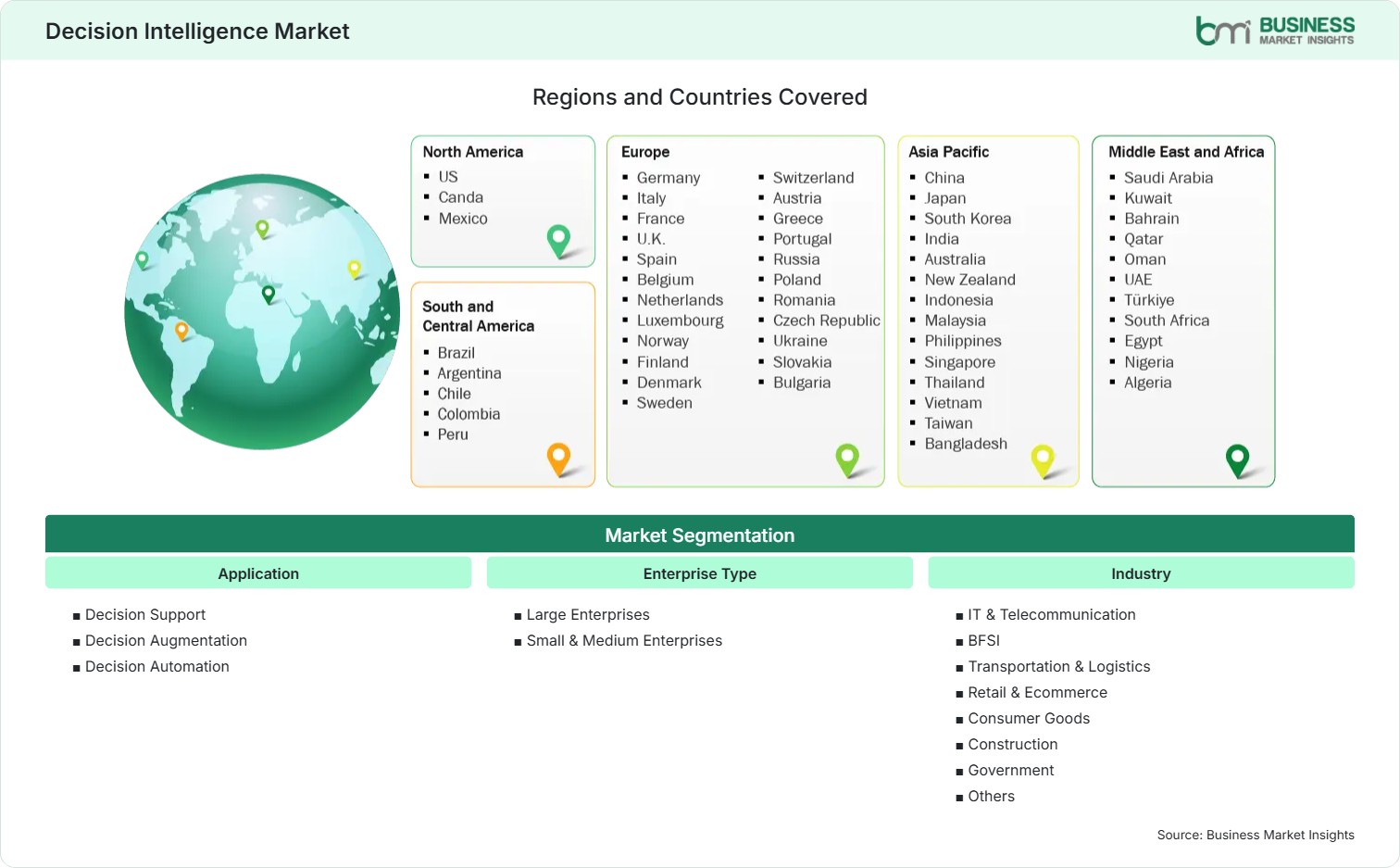
Global Market Geography
FREE PDF
Request your free sample
Request free sample
05 Segment Analysis

Decision Intelligence Market Segmentation

Application

The Application segment accounted for approximately 44%–47% of the market in 2025 and is projected to expand at a CAGR of 22.5%–23.5% during 2026–2033. Enterprises are increasingly adopting decision intelligence solutions to enhance operational efficiency, improve forecasting accuracy, and automate complex business processes. The expanding Decision Intelligence Market scope is encouraging organizations to integrate AI-driven analytics with enterprise decision workflows, enabling faster, data-backed strategic and operational decisions.

  • Decision Support: Organizations leverage AI-powered analytics, visualization tools, and predictive insights to improve executive decision-making, optimize business performance, and strengthen enterprise planning across finance, operations, and customer management.
  • Decision Augmentation: Decision augmentation solutions combine artificial intelligence with human expertise, delivering contextual recommendations and scenario analysis that improve decision quality while maintaining human oversight in critical business functions.
  • Decision Automation: Automated decision platforms execute predefined business rules using AI and machine learning, reducing manual intervention, accelerating operational workflows, and improving consistency across enterprise processes.

Enterprise Type

The Enterprise Type segment represented nearly 52%–55% of the Decision Intelligence market in 2025 and is anticipated to register a CAGR of 21.8%–22.8% through 2033. Increasing investments in cloud computing, enterprise analytics, and AI platforms are driving widespread adoption across organizations of varying sizes. Digital transformation initiatives and demand for intelligent business insights continue strengthening enterprise deployment of decision intelligence technologies.

  • Large Enterprises: Large organizations deploy comprehensive decision intelligence platforms to manage complex business operations, improve strategic planning, optimize supply chains, and support enterprise-wide AI-driven decision-making across multiple business units.
  • Small & Medium Enterprises: SMEs increasingly adopt cloud-based decision intelligence platforms due to lower implementation costs, subscription-based pricing, and improved accessibility to advanced analytics that enhance operational agility and business competitiveness.

Industry

The Industry segment accounted for approximately 48%–51% of the overall market in 2025 and is expected to expand at a CAGR of 22.8%–23.8% during the forecast period. Industry-specific AI models, real-time analytics, and cloud-native decision platforms are enabling organizations to optimize operations, improve customer engagement, and strengthen business resilience. The growing adoption of predictive analytics continues supporting evolving Decision Intelligence Market trends across diverse industry verticals.

  • IT & Telecommunication: Organizations utilize decision intelligence to optimize network performance, improve service delivery, strengthen cybersecurity, and enhance customer experience through predictive analytics and automated operational decisions.
  • BFSI: Financial institutions implement intelligent decision platforms to strengthen fraud detection, automate credit assessment, improve regulatory compliance, optimize risk management, and personalize customer financial services.
  • Transportation & Logistics: Logistics providers deploy AI-driven decision intelligence to optimize route planning, fleet utilization, warehouse operations, inventory management, and real-time supply chain visibility.
  • Retail & Ecommerce: Retailers leverage intelligent analytics to improve demand forecasting, personalize customer experiences, optimize pricing strategies, and enhance inventory planning through data-driven decision-making.
  • Consumer Goods: Consumer goods manufacturers utilize predictive analytics and decision intelligence to improve production planning, demand forecasting, product portfolio management, and supply chain efficiency.
  • Construction: Construction organizations adopt intelligent decision platforms to optimize project scheduling, resource allocation, risk assessment, cost estimation, and digital construction planning across complex infrastructure developments.
  • Government: Government agencies implement decision intelligence solutions to improve public service delivery, policy evaluation, emergency response planning, budget optimization, and evidence-based administrative decision-making.
06 Market Forces

Decision Intelligence Market Dynamics

Key Market Drivers

Rising enterprise data utilization

Organizations are producing an enormous amount of structured and unstructured data from cloud computing, the Internet of Things, enterprise-level applications, and customer-facing activities through digital channels. Decision intelligence technologies make sense of large volumes of data by employing artificial intelligence, machine learning, and analytics. As more enterprises focus on data-driven decision-making and strategy, decision intelligence systems enhance forecast precision, operational efficiency, and executive decision-making. The growth of enterprise data ecosystems is constantly driving the Decision Intelligence Market growth.

Increasing AI adoption globally

The use of artificial intelligence has emerged as a significant technology investment strategy for organizations that want to automate decision-making, improve performance, and deliver better customer experiences. The development of technologies such as generative AI, natural language processing, knowledge graphs, and predictive analytics enables decision intelligence platforms to provide more accurate and explainable recommendations. Financial services, healthcare, retail, manufacturing, and telecom sectors, among others, have begun using AI in their operations.

Growing business analytics demand

The increasing complexity of the business environment has heightened the need for sophisticated analytics to facilitate strategic planning and optimization. Organizations need platforms that offer integrated services, including descriptive, predictive, and prescriptive analytics, as well as AI-based decision-making tools. Real-time dashboards, scenario analysis, and intelligent forecasting not only enhance organizational agility but also help reduce uncertainty. These evolving enterprise requirements continue strengthening Decision Intelligence Market trends, encouraging vendors to develop more scalable, cloud-native, and industry-specific decision intelligence solutions.

Key Market Opportunities

Predictive decision automation

Predictive AI models are creating new opportunities for enterprises to automate routine and complex business decisions with minimal human intervention. Organizations increasingly integrate predictive analytics into finance, customer service, supply chain management, and operations to improve efficiency and reduce response times. The growing adoption of autonomous enterprise workflows supports long-term Decision Intelligence Market Forecasts, encouraging technology providers to expand AI-powered automation capabilities and industry-specific decision engines.

Cross-industry AI applications

Decision intelligence platforms are rapidly expanding beyond conventional analytics for enterprises into healthcare, manufacturing, transport, retail, government, and energy sectors. The use of artificial intelligence models specialized to specific industries will help enhance operational planning, optimize resources, and ensure compliance. The rise in cross-industry use of decision intelligence platforms helps vendors increase their revenue streams.

Real-time strategic planning tools

A growing demand for technologies which are able to process real-time business data and make recommendations arises. The integration of cloud computing, IoT, ERP, and CRM makes it possible to monitor processes and make decisions continuously. Software vendors tend to create interactive dashboards, digital twins, and scenario planning powered by artificial intelligence.

Market Restraints and Challenges

Data privacy challenges

The primary Factor limiting adoption is the increasing complexity of data privacy regulations governing enterprise data usage and artificial intelligence applications. Impact: Organizations must invest significantly in governance frameworks, cybersecurity, compliance monitoring, and responsible AI implementation before deploying decision intelligence solutions. Regulatory requirements increase implementation costs and may delay enterprise adoption, particularly in highly regulated industries such as banking, healthcare, and government.

Integration complexity issues

The key Factor restraining broader market expansion is the technical complexity associated with integrating decision intelligence platforms into legacy enterprise systems. Impact: Organizations frequently encounter challenges related to data silos, incompatible software architectures, inconsistent data quality, and change management requirements. These implementation barriers increase deployment timelines, require specialized technical expertise, and may reduce return on investment during the early stages of enterprise adoption.

07 Company Analysis

Competitive Landscape

The competitive environment is characterized by rapid advancements in artificial intelligence, machine learning, cloud computing, and enterprise analytics. The Decision Intelligence Market analysis indicates that leading software vendors are strengthening their offerings through AI innovation, strategic acquisitions, cloud-native platform development, and industry-specific solutions to help enterprises improve data-driven decision-making and operational efficiency.

Company Name

Overview

Products and Services Relevant to this Market

IBM Corporation

Global technology leader providing enterprise AI, analytics, and cloud solutions for intelligent business decision-making.

IBM watsonx, AI platforms, business analytics, decision intelligence solutions, hybrid cloud services.

Microsoft Corporation

Leading cloud and AI provider delivering enterprise decision intelligence through integrated productivity and analytics platforms.

Microsoft Azure AI, Microsoft Fabric, Power BI, Copilot, enterprise analytics solutions.

Oracle Corporation

Enterprise software company offering cloud-native analytics and AI-driven business decision platforms.

Oracle Cloud Infrastructure, Oracle Analytics Cloud, AI services, enterprise applications.

SAP SE

Global enterprise software provider enabling intelligent business planning through AI-powered analytics and ERP integration.

SAP Business AI, SAP Analytics Cloud, SAP S/4HANA, enterprise planning solutions.

SAS Institute Inc.

Analytics company specializing in AI, machine learning, predictive analytics, and intelligent decision management.

SAS Viya, predictive analytics, decision management, AI and machine learning platforms.

Salesforce, Inc.

CRM and AI software provider integrating intelligent decision capabilities into customer engagement platforms.

Salesforce Einstein AI, Data Cloud, CRM analytics, customer intelligence solutions.

QlikTech International AB (Qlik)

Data integration and analytics company delivering AI-powered business intelligence and decision support.

Qlik Sense, Qlik Cloud Analytics, data integration, AI-assisted analytics.

TIBCO Software Inc.

Enterprise software company providing real-time analytics, integration, and intelligent decision platforms.

TIBCO Spotfire, data integration, event processing, analytics and decision solutions.

Domo, Inc.

Cloud-based business intelligence provider delivering real-time analytics and enterprise decision support.

Domo Business Cloud, AI analytics, dashboards, data visualization, enterprise intelligence.

Sisense Ltd.

Analytics software company offering embedded AI and business intelligence solutions for enterprise decision-making.

Sisense Fusion, embedded analytics, AI-powered dashboards, business intelligence software.

08 Industry Activity

Recent Developments

April 2025

Tata Consultancy Services (TCS) and Vianai Systems, Inc. the companies formed a strategic partnership to integrate Vianai's hila Platform with TCS's AI and analytics services, enabling enterprise leaders to use natural language queries for AI-driven decision intelligence across finance, sales, and supply chain operations.

April 2025

Circuitry.ai the company launched Decision Intelligence Platform 25.1, introducing enhanced AI-powered Service AI Advisor, Parts AI Advisor, and Warranty AI Specialist capabilities to improve operational decision-making, field service efficiency, and predictive maintenance.

February 2025

C3 AI, Inc. and McKinsey QuantumBlack the companies announced a strategic partnership to expand the global deployment of enterprise AI and decision intelligence applications across manufacturing, financial services, energy, and other industries, enhancing data-driven decision-making capabilities.

January 2025

Bamboo Rose, Inc. the company acquired Verteego to launch an AI-powered retail decision intelligence platform, strengthening merchandising, inventory optimization, pricing, and supply chain decision automation capabilities.

10 Trust & Transparency

Research Methodology

The market analysis combines proprietary research with secondary data from government agencies, company disclosures, regulatory filings, industry databases and expert interviews. Market estimates are validated through data triangulation, cross-market benchmarking and analyst review.

View Full Research Methodology

11 Questions Answered

Frequently Asked Questions

Who are the leading companies operating in the market?

Major participants include IBM Corporation, Microsoft Corporation, Oracle Corporation, SAP SE, SAS Institute Inc., Salesforce, Inc., QlikTech International AB, TIBCO Software Inc., Domo, Inc., and Sisense Ltd.

What factors are accelerating market adoption?

Growing enterprise data generation, rapid AI implementation, increasing reliance on predictive analytics, cloud computing expansion, and the need for real-time business intelligence are the primary factors driving widespread adoption of decision intelligence platforms.

Which application segment is expected to lead the Decision Intelligence Market?

Decision Support is expected to remain the leading application because organizations continue prioritizing AI-assisted analytics, predictive insights, and business intelligence capabilities that strengthen executive decision-making and enterprise performance.

Which region dominates the global market?

North America maintains the leading market position due to advanced digital infrastructure, widespread cloud adoption, significant enterprise AI investments, and the presence of major technology providers continuously innovating intelligent decision platforms.

What is the future outlook highlighted in the Decision Intelligence Market Report?

The report highlights that the market is expected to witness strong growth as enterprises increasingly adopt AI-powered analytics, predictive modeling, and intelligent automation to improve strategic planning, operational efficiency, and real-time business decision-making across diverse industry sectors.

Access the Full Decision Intelligence Market Report

Get segment-level forecasts, regional estimates, competitive benchmarking, company profiles and downloadable Excel datasets.

Access the full Decision Intelligence Market Report
350 pages PDF & Excel | 2026-07-28