
Threat Intelligence Market Outlook: Size, Share, Trends, Growth Analysis, Competitive Landscape & Forecast, 2026-2033

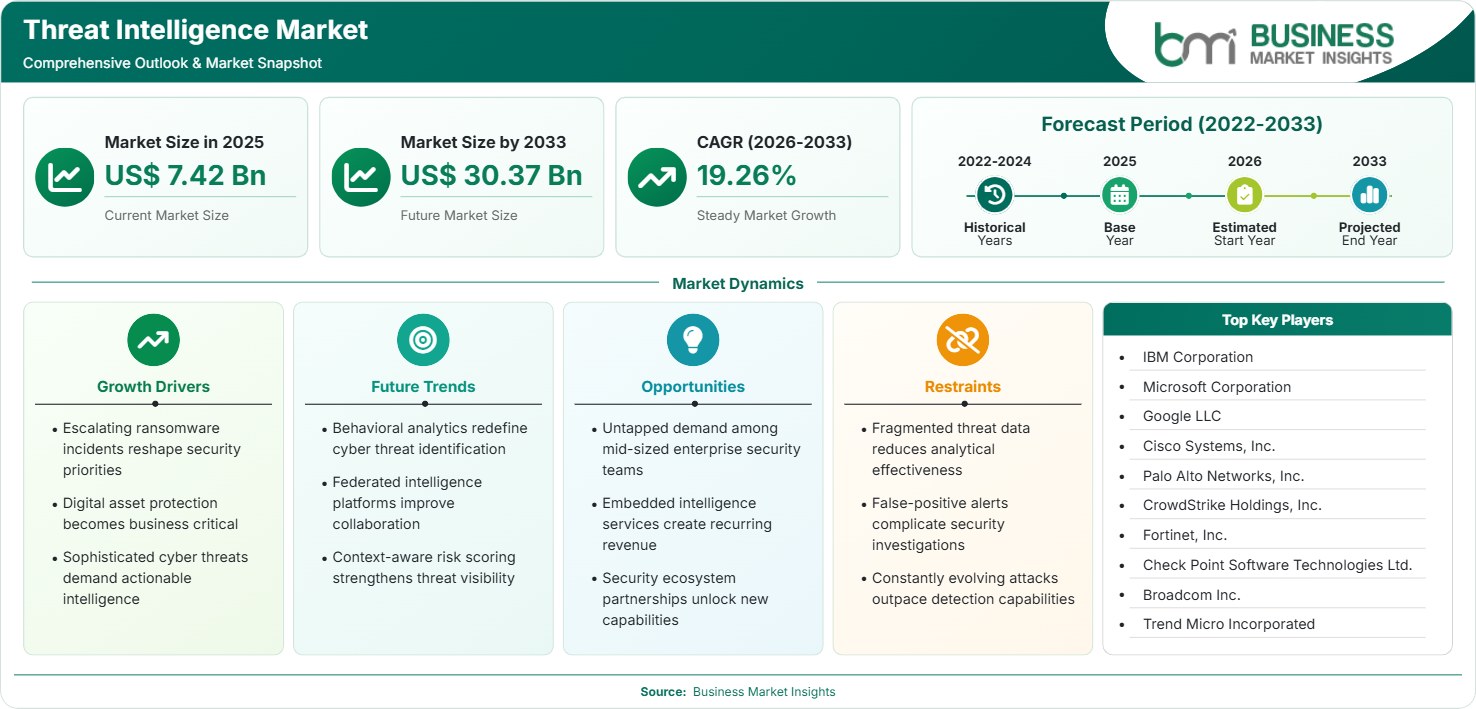
The Threat Intelligence Market size was valued at US$ 7.42 billion in 2025 and is projected to reach US$ 30.37 billion by 2033, growing at a CAGR of 19.26% during 2026–2033. Escalating cyberattacks, growing reliance on digital infrastructure, increasing enterprise security investments, and expanding adoption of proactive threat detection solutions continue driving industry development.

Report Coverage
  • Component: Solutions, Services
  • Type: Strategic, Tactical, Operational
  • Deployment: Cloud, On-Premise
  • Enterprise Type: SMEs, Large Enterprise
  • End-user: BFSI, IT & Telecom, Manufacturing, Healthcare, Energy & Utilities, Retail, Others
US$ 7.42 Bn Market size in 2025
US$ 30.37 Bn Market Size by 2033
19.26% CAGR, 2026 - 2033
2026-2033 Forecast Period

AI Overview

Threat Intelligence Market Summary

  • North America Region: North America holds 37%–40% market share in 2025 and is projected to grow at a CAGR of 18.3%–18.9% during 2026–2033. Strong cybersecurity investments, mature cloud infrastructure, and rising enterprise security spending continue supporting regional expansion. The U.S. remains the dominant market with a CAGR of 18.5%–19.1%, driven by increasing ransomware incidents, AI-powered security platforms, and stringent cybersecurity regulations.
  • Fastest Growing Region: Asia Pacific accounts for 24%–27% market share in 2025 and is expected to register the fastest CAGR of 21.4%–22.1%, supported by rapid digital transformation, cloud adoption, and increasing cybersecurity investments across public and private sectors.
  • Leading Segment: Solutions represent 63%–66% market share in 2025 and are projected to expand at a CAGR of 19.4%–20.0%, driven by enterprise demand for real-time threat visibility, automated detection, and intelligence-driven security operations.
  • High Growth Segment: Cloud deployment captures 54%–57% market share in 2025 and is forecast to grow at a CAGR of 20.3%–21.0%, supported by scalable deployment models, remote workforce security, and cloud-native cybersecurity architectures.
  • Key Market Opportunity: Growing adoption of AI-enabled threat intelligence platforms, managed security services, and collaborative cyber defense ecosystems continues creating long-term opportunities across enterprise cybersecurity environments.
  • Major Market Players: IBM Corporation, Microsoft Corporation, Google LLC, Cisco Systems, Inc., Palo Alto Networks, Inc., CrowdStrike Holdings, Inc., Fortinet, Inc., Check Point Software Technologies Ltd., Broadcom Inc., and Trend Micro Incorporated.
Strategic Insights

Threat Intelligence Market: Strategic Insights

Threat Intelligence Market Strategic Framework
FREE PDF
Request your free sample
Request free sample
Stakeholder View

Key Takeaways

  • Cybersecurity ecosystems are evolving toward intelligence-driven security operations where automated analytics, real-time monitoring, and collaborative threat sharing strengthen enterprise resilience.
  • Cloud-native security platforms and managed threat intelligence services offer significant long-term growth opportunities among organizations modernizing cybersecurity infrastructure.
  • Artificial intelligence, behavioral analytics, and automation continue transforming security operations by reducing response times and improving threat detection accuracy.
  • Asia Pacific presents the strongest investment opportunity due to accelerating enterprise digitalization, expanding cloud adoption, and increasing cybersecurity spending across major economies.
  • Strategic acquisitions, platform integration, and cybersecurity partnerships remain key competitive strategies as vendors expand product portfolios and strengthen global market presence.
  • Regulatory compliance requirements and increasing cyber risk awareness continue encouraging enterprises to invest in proactive threat intelligence capabilities rather than traditional reactive security approaches.
Geographic Outlook

Threat Intelligence Market Regional Highlights

North America Threat Intelligence Market

North America accounts for 37%–40% Threat Intelligence Market share in 2025 and is expected to register a CAGR of 18.3%–18.9% during 2026–2033. Strong cybersecurity regulations, advanced digital infrastructure, widespread cloud adoption, and high enterprise cybersecurity spending continue supporting regional leadership. Organizations increasingly deploy intelligence-driven security platforms to improve threat visibility, automate incident response, and strengthen resilience against sophisticated cyberattacks.

  • Enterprises continue expanding investments in AI-powered security operations centers and threat intelligence platforms.
  • Government cybersecurity initiatives strengthen collaboration between public agencies and private security vendors.
  • Financial institutions increasingly prioritize advanced threat detection to combat ransomware and identity-based attacks.
  • Cloud migration continues accelerating demand for integrated cybersecurity intelligence solutions.

US Threat Intelligence Market

The United States contributes 83%–86% of North American revenue and is projected to expand at a CAGR of 18.5%–19.1% during the forecast period. Rising cybercrime, increasing federal cybersecurity investments, and rapid enterprise cloud adoption continue strengthening long-term market demand.

  • Large enterprises continue integrating AI-driven security analytics into enterprise security operations.
  • Federal cybersecurity modernization programs support investments in advanced cyber defense technologies.
  • Critical infrastructure operators increasingly deploy proactive threat intelligence platforms.
  • Growing cybersecurity talent shortages encourage adoption of automated threat investigation solutions.

Europe Threat Intelligence Market

Europe represents 26%–29% market share in 2025 and is projected to register a CAGR of 18.1%–18.7% through 2026–2033. Strong regulatory frameworks, increasing cybersecurity awareness, and expanding digital infrastructure investments continue driving adoption. Germany leads regional demand, while Poland records the fastest growth due to expanding cybersecurity investment and digital transformation initiatives.

  • GDPR compliance continues encouraging investment in proactive cyber risk management.
  • Financial institutions strengthen security intelligence capabilities against evolving cyber threats.
  • Industrial cybersecurity demand increases alongside Industry 4.0 implementation.
  • Public-private cybersecurity partnerships continue improving regional cyber resilience.

Asia Pacific Threat Intelligence Market

Asia Pacific holds 24%–27% market share in 2025 and is expected to register the fastest 21.4%–22.1% CAGR during the forecast period. Rapid digitalization, expanding cloud infrastructure, increasing internet penetration, and growing cyberattack frequency continue supporting strong regional expansion. China remains the largest market, while India records the fastest growth through rising enterprise cybersecurity investments and digital economy initiatives.

  • Cloud adoption continues increasing enterprise demand for intelligence-driven cybersecurity solutions.
  • Financial services and telecommunications remain major adopters of advanced threat intelligence platforms.
  • Governments continue strengthening national cybersecurity frameworks and digital security investments.
  • Rapid SME digitalization expands demand for scalable cloud-based security services.

Rest of World Threat Intelligence Market

The Rest of World region accounts for 7%–10% market share in 2025 and is projected to expand at a CAGR of 19.0%–19.6% during 2026–2033. Rising cyber risks, expanding digital infrastructure, and increasing enterprise awareness continue supporting adoption across Latin America, the Middle East, and Africa.

  • Brazil leads regional cybersecurity investments driven by expanding financial technology adoption.
  • UAE and Saudi Arabia continue investing heavily in national cybersecurity modernization programs.
  • Growing cloud deployment increases demand for managed threat intelligence services.
  • Critical infrastructure protection remains a major cybersecurity investment priority across emerging economies.
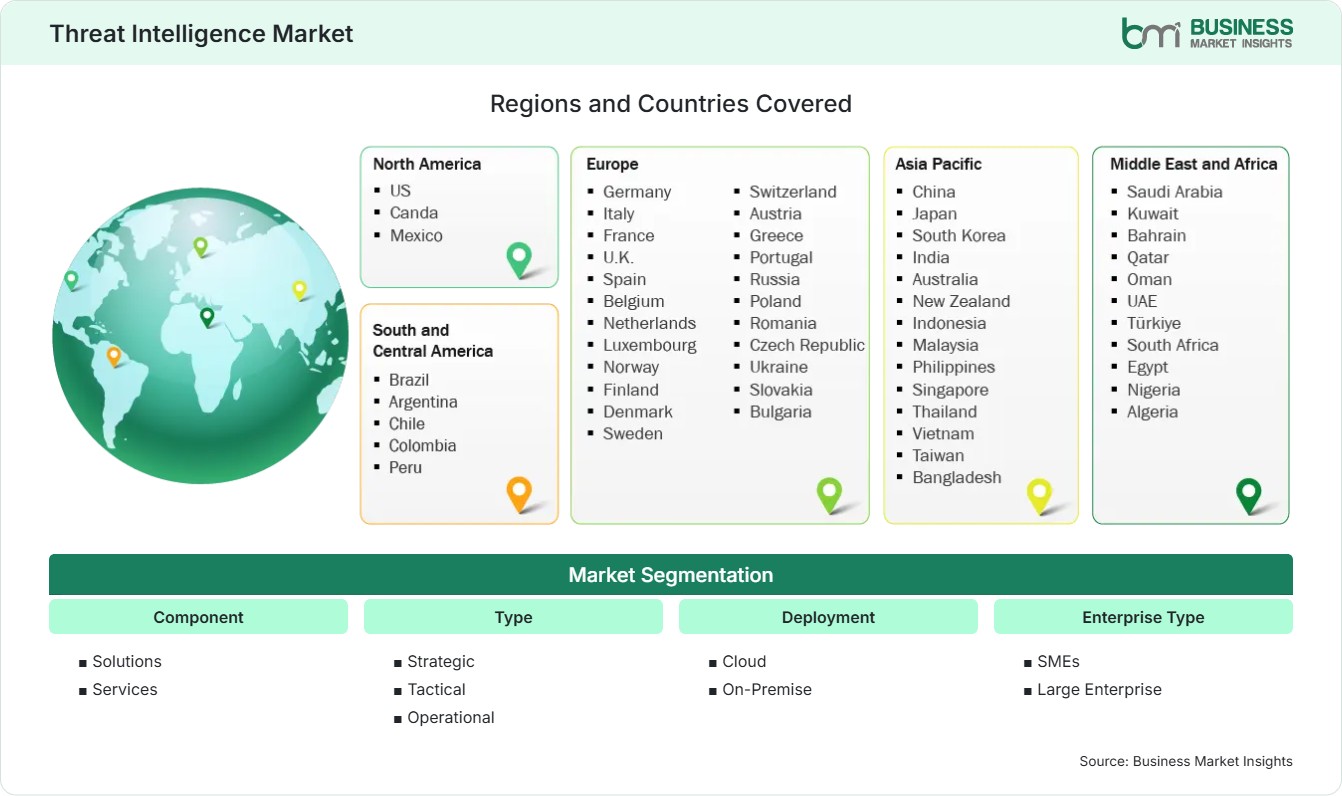
Global Market Geography
FREE PDF
Request your free sample
Request free sample
Segment Analysis

Threat Intelligence Market Segmentation

Component

The component segment forms the foundation of enterprise cybersecurity strategies by combining technology platforms with specialized advisory capabilities. It accounted for 63%–66% market share in 2025 and is expected to grow at a CAGR of 19.4%–20.0% during 2026–2033. Increasing cyberattack complexity, expanding security operations centers, and continuous product innovation continue broadening the Threat Intelligence Market scope across organizations seeking proactive cyber defense and faster incident response.

  • Solutions: Account for the largest share due to widespread adoption of threat detection platforms, intelligence feeds, automated investigation tools, and integrated security analytics that improve cyber resilience.
  • Services: Continue expanding as enterprises increasingly rely on managed security providers, consulting firms, incident response specialists, and threat hunting experts to strengthen cybersecurity capabilities.

Type

Threat intelligence categories enable organizations to prioritize cyber risks based on business objectives, operational needs, and tactical response requirements. This segment continues witnessing steady adoption as enterprises mature their cybersecurity programs and integrate intelligence-driven decision-making into security operations.

  • Strategic: Supports executive-level cybersecurity planning by providing long-term risk assessments, geopolitical threat insights, industry intelligence, and business-focused cyber risk evaluation.
  • Tactical: Focuses on identifying attacker techniques, malware behavior, vulnerabilities, and indicators of compromise that help security teams improve detection and defensive capabilities.
  • Operational: Delivers actionable intelligence on active cyber campaigns, adversary infrastructure, and emerging attack methods, enabling security teams to respond quickly to ongoing incidents.

Deployment

Deployment preferences continue evolving as organizations balance scalability, compliance, operational flexibility, and infrastructure control. This segment represented 54%–57% market share in 2025 and is projected to expand at a CAGR of 20.3%–21.0% through 2026–2033. Current Threat Intelligence Market trends indicate growing enterprise preference for cloud-native security platforms supported by AI-driven automation and real-time analytics.

  • Cloud: Leads deployment adoption by providing scalability, rapid implementation, continuous threat intelligence updates, and simplified integration with modern cloud security ecosystems.
  • On-Premise: Remains important among highly regulated industries requiring complete infrastructure control, enhanced data sovereignty, and compliance with strict cybersecurity policies.

Enterprise Type

Enterprise size significantly influences cybersecurity investment strategies, security staffing, and deployment preferences. Organizations increasingly adopt intelligence-driven cybersecurity solutions to improve visibility, reduce incident response times, and strengthen digital resilience against sophisticated cyber threats.

  • SMEs: Adoption continues increasing as cloud-based subscription models make advanced threat intelligence more affordable while addressing growing ransomware and phishing risks targeting smaller businesses.
  • Large Enterprise: Represents the dominant customer segment due to extensive digital infrastructure, dedicated cybersecurity teams, regulatory obligations, and higher investments in advanced security operations centers.

End-user

End-user demand continues expanding as cyber risks affect every industry undergoing digital transformation. Organizations increasingly invest in intelligence-driven security platforms to protect critical assets, maintain regulatory compliance, and strengthen operational resilience against evolving cyber threats.

  • BFSI: Leads adoption because financial institutions require continuous monitoring against fraud, ransomware, account compromise, and sophisticated financial cyberattacks.
  • IT & Telecom: Continues investing heavily in threat intelligence to secure cloud infrastructure, enterprise networks, communication platforms, and customer data against advanced cyber threats.
  • Manufacturing: Expands adoption through Industry 4.0 implementation, protecting industrial control systems, connected factories, and operational technology environments from cyber intrusions.
  • Healthcare: Demand continues increasing as hospitals and healthcare providers secure electronic health records, connected medical devices, and critical healthcare infrastructure against ransomware attacks.
  • Energy & Utilities: Organizations deploy advanced threat intelligence to safeguard power grids, energy infrastructure, operational technology, and national critical infrastructure assets.
  • Retail: Retailers increasingly utilize intelligence platforms to prevent payment fraud, protect customer information, secure e-commerce platforms, and defend supply chain operations from cyber threats.
Market Forces

Threat Intelligence Market Dynamics

Key Market Drivers

Escalating ransomware incidents reshape security priorities

Ransomware attacks are on the rise, becoming more and more sophisticated and causing greater damage to businesses, which makes it necessary to adopt enhanced cyber security measures for an enterprise that go beyond basic perimeter protection. The businesses have begun to make investments in threat intelligence solutions that can help detect new campaigns, find indicators of compromise and enhance the incident response capabilities. IBM's Cost of a Data Breach report highlights that ransomware continues to be one of the most damaging cyber threats for enterprises around the world. These developments continue accelerating Threat Intelligence Market growth, encouraging wider adoption across both public and private sectors.

Digital asset protection becomes business critical

Modern organizations depend on technology such as digital platforms, cloud software, intellectual property, and business processes that demand constant monitoring to protect against cyber threats. In the current era of digitalization, protecting sensitive business information is a strategic issue, not just an IT concern. Through threat intelligence solutions, security managers can recognize their weaknesses, monitor any activities by the attackers, and manage to address these issues before the attacks take place. Growing demands on cybersecurity governance from regulatory bodies encourage companies to adopt intelligence-led security.

Sophisticated cyber threats demand actionable intelligence

The use of advanced methods of attacks by threat actors is still being seen in the form of fileless malware attacks, phishing attacks, zero-day attacks, and AI-powered cyberattacks. The need for intelligence that can provide visibility on what threat actors are doing, new vulnerabilities, and threat landscapes has become increasingly necessary for organizations. These technological advancements continue shaping Threat Intelligence Market trends, supporting proactive cyber defense strategies across enterprises worldwide.

Key Market Opportunities

Untapped demand among mid-sized enterprise security teams

Small and mid-sized businesses are increasingly becoming lucrative customers of cybersecurity companies because of digital transformation moving from large to small companies. Such businesses are increasingly under threat from cyber attacks yet have limited cybersecurity resources at their disposal. Cloud solutions for cybersecurity, subscription payment models, and managed cybersecurity services are helping this customer segment access advanced cybersecurity solutions. Threat Intelligence Market Forecasts indicate that increasing awareness of ransomware, regulatory compliance, and supply chain security will continue driving adoption among mid-sized enterprises seeking affordable and scalable security capabilities.

Embedded intelligence services create recurring revenue

Cybersecurity vendors are increasingly embedding threat intelligence capabilities into endpoint protection, network security, identity management, and cloud security platforms. This approach allows customers to receive constant intelligence updates without having to set up stand-alone systems but provides vendors with repeatable subscription-based revenues. Managed detection and response services enable vendors to build stronger customer relationships by monitoring and analyzing incidents. This model not only retains customers but also builds the business case for cybersecurity solutions.

Security ecosystem partnerships unlock new capabilities

The strategic relationships between cybersecurity firms, cloud services providers, telecom firms, and managed security services providers keep getting stronger in enhancing the cyber defense capabilities of the enterprise. The exchange of intelligence information, use of integrated APIs, and joint efforts in conducting threat research increase visibility in the highly complex digital environment. The cybersecurity firms are forming technology partnerships to fast track integration of products and exchange of intelligence information.

Market Restraints and Challenges

Fragmented threat data reduces analytical effectiveness

Organizations receive threat intelligence from numerous commercial platforms, government agencies, open-source feeds, and internal monitoring systems, often creating inconsistent or duplicate information. Factor: Fragmented data sources reduce visibility and complicate intelligence correlation across multiple security environments. Impact: Security analysts may experience slower investigations, incomplete threat assessments, and reduced operational efficiency, making it more difficult to prioritize high-risk cyber incidents and respond effectively to sophisticated attacks.

False-positive alerts complicate security investigations

Modern cybersecurity platforms continuously generate alerts from endpoint protection, network monitoring, cloud security, and threat intelligence systems. Factor: Excessive false-positive notifications increase investigation workloads and consume valuable security resources. Impact: Analyst fatigue, delayed response to genuine threats, and inefficient security operations may reduce the overall effectiveness of enterprise cybersecurity programs. Vendors continue investing in artificial intelligence, behavioral analytics, and automated alert prioritization to improve detection accuracy while minimizing unnecessary security investigations.

Company Analysis

Competitive Landscape

The market remains highly competitive as cybersecurity vendors strengthen their platforms through artificial intelligence, automation, cloud-native security capabilities, and integrated threat intelligence services. Threat Intelligence Market analysis shows that leading companies are expanding managed security offerings, strategic acquisitions, and technology partnerships to improve real-time threat visibility and enterprise cyber resilience across global industries.

Company Name

Overview

Products and Services Relevant to this Market

IBM Corporation

Global technology company delivering enterprise cybersecurity, artificial intelligence, cloud computing, and consulting services across multiple industries.

IBM X-Force Threat Intelligence, QRadar SIEM, Managed Security Services, incident response, threat hunting, and cyber risk management solutions.

Microsoft Corporation

Leading cloud and cybersecurity provider integrating advanced threat intelligence across enterprise software and cloud platforms.

Microsoft Defender, Microsoft Sentinel, threat intelligence services, security analytics, cloud security, and identity protection solutions.

Google LLC

Technology company providing cloud security, intelligence-driven cybersecurity, and advanced threat detection capabilities through Google Cloud.

Google Threat Intelligence, Mandiant services, Security Operations platform, cloud security, digital risk protection, and incident response solutions.

Cisco Systems, Inc.

Global networking and cybersecurity company offering integrated security platforms for enterprise network protection and cyber defense.

Cisco SecureX, Cisco XDR, Talos Threat Intelligence, network security, endpoint security, and managed detection services.

Palo Alto Networks, Inc.

Cybersecurity leader delivering AI-powered threat prevention, cloud security, and security operations platforms.

Cortex XSIAM, Unit 42 Threat Intelligence, Prisma Cloud, XDR, SOAR, and managed security services.

CrowdStrike Holdings, Inc.

Cloud-native cybersecurity company specializing in endpoint protection and real-time threat intelligence services.

Falcon platform, Falcon Intelligence, endpoint detection and response, managed threat hunting, and digital risk monitoring.

Fortinet, Inc.

Cybersecurity vendor providing integrated network security, threat intelligence, and enterprise security solutions globally.

FortiGuard Labs, FortiAnalyzer, FortiSIEM, network security appliances, threat intelligence, and security operations tools.

Check Point Software Technologies Ltd.

Global cybersecurity company focused on network security, cloud security, and threat prevention technologies.

ThreatCloud AI, Infinity Platform, network protection, cloud security, endpoint security, and threat intelligence services.

Broadcom Inc.

Technology company delivering enterprise cybersecurity through its Symantec portfolio and integrated security platforms.

Symantec Threat Intelligence, endpoint security, email security, data protection, security analytics, and cyber defense solutions.

Trend Micro Incorporated

Global cybersecurity company specializing in cloud security, threat intelligence, and enterprise risk management solutions.

Trend Vision One, XDR, threat intelligence services, cloud workload protection, email security, and managed detection capabilities.

Trust & Transparency

Research Methodology

The market analysis combines proprietary research with secondary data from government agencies, company disclosures, regulatory filings, industry databases and expert interviews. Market estimates are validated through data triangulation, cross-market benchmarking and analyst review.

View Full Research Methodology

Questions Answered

Frequently Asked Questions

What does the Threat Intelligence Market Report include?

The Market Report provides detailed analysis of market dynamics, technology trends, competitive landscape, regional outlook, segmentation, investment opportunities, cybersecurity developments, and future industry growth prospects.

Which region is expected to experience the fastest growth?

Asia Pacific is projected to record the fastest growth due to rapid digital transformation, increasing cybersecurity investments, expanding cloud infrastructure, and stronger government initiatives supporting cyber resilience.

Why are cloud-based threat intelligence platforms gaining popularity?

Cloud deployment offers scalability, continuous intelligence updates, simplified implementation, lower infrastructure costs, and seamless integration with modern cybersecurity ecosystems, making it attractive for organizations of all sizes.

Which component dominates the market?

Solutions account for the largest market share because organizations increasingly invest in integrated threat intelligence platforms, automated security analytics, and real-time cyber threat detection capabilities.

What factors are driving the Threat Intelligence Market?

Growing ransomware attacks, increasing enterprise digital transformation, stricter cybersecurity regulations, expanding cloud adoption, and rising demand for proactive cyber defense continue accelerating market adoption across industries.

Access the Full Threat Intelligence Market Report

Get segment-level forecasts, regional estimates, competitive benchmarking, company profiles and downloadable Excel datasets.

Access the full Threat Intelligence Market Report
350 pages PDF & Excel | 2026-08-25
Similar Research

Related Market Reports