
Artificial Intelligence Market Outlook: Size, Share, Trends, Growth Analysis, Competitive Landscape & Forecast, 2026-2033

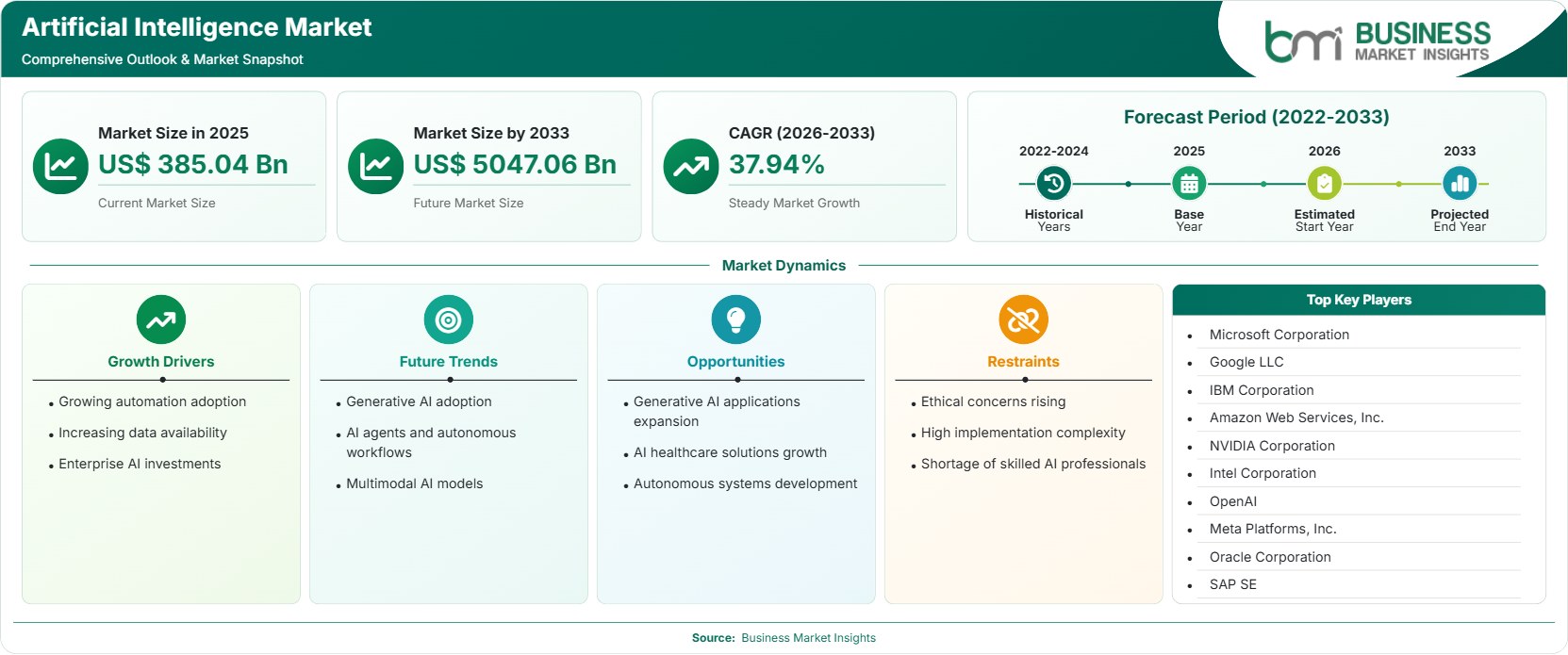
The Artificial Intelligence Market size was valued at US$ 385.04 billion in 2025 and is projected to reach US$ 5,047.06 billion by 2033, growing at a CAGR of 37.94% during 2026–2033, driven by enterprise automation adoption, increasing data availability, accelerated AI investments, generative AI deployment, healthcare AI advancements, autonomous systems development, and growing integration of intelligent technologies across industries.

Report Coverage
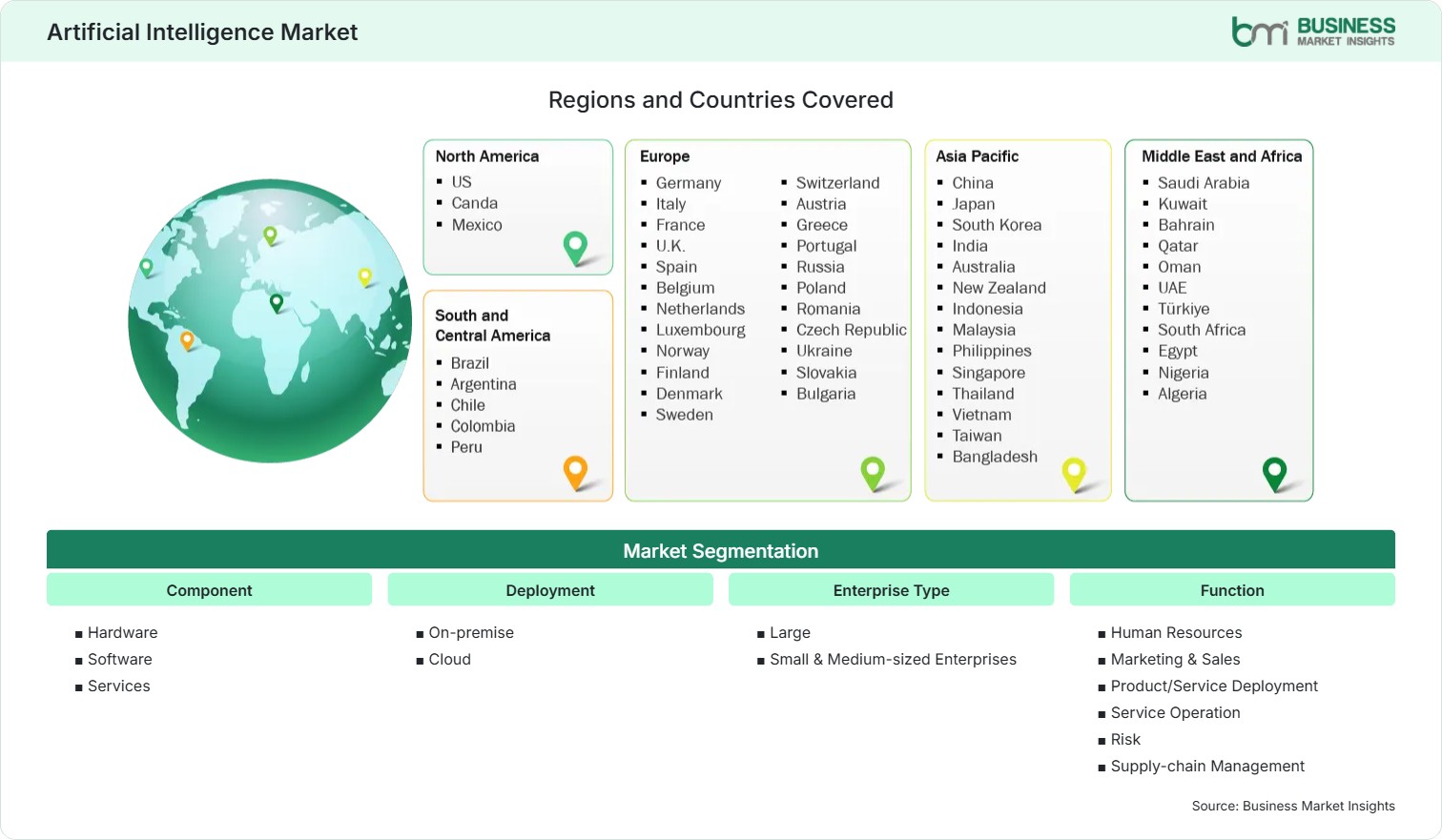
  • Component: Hardware, Software, Services
  • Deployment: On-premise, Cloud
  • Enterprise Type: Large, Small & Medium-sized Enterprises
  • Function: Human Resources, Marketing & Sales, Product/Service Deployment, Service Operation, Risk, Supply-chain Management
  • Technology: Machine Learning, Natural Language Processing, Computer Vision
US$ 385.04 Bn Market size in 2025
US$ 5047.06 Bn Market Size by 2033
37.94% CAGR, 2026 - 2033
2026-2033 Forecast Period

AI Overview

Artificial Intelligence Market Summary

  • North America Region: North America holds approximately 38%–42% market share in 2025 and is projected to grow at a 36.5%–38.5% CAGR during 2026–2033. Regional leadership is supported by strong enterprise AI investments, advanced cloud infrastructure, semiconductor innovation, research capabilities, and early adoption across healthcare, BFSI, automotive, and technology sectors. The United States remains the largest contributor due to major AI companies, high enterprise adoption, and significant research spending, expanding at approximately 37.0%–39.0% CAGR during the forecast period.
  • Fastest Growing Region: Asia Pacific represents approximately 25%–30% market share in 2025 and is expected to register a 39.0%–41.5% CAGR during 2026–2033. Growth is supported by rapid digital transformation, increasing data generation, government AI initiatives, expanding cloud adoption, and rising investments across China, India, Japan, South Korea, and Southeast Asian economies.
  • Leading Segment: Software represents approximately 45%–50% market share in 2025 and is expected to grow at a 38.0%–40.0% CAGR during 2026–2033. Growth is driven by increasing adoption of machine learning platforms, generative AI applications, enterprise automation tools, and AI-powered analytics solutions.
  • High Growth Segment: Generative AI applications represent the fastest-growing opportunity area, supported by expanding enterprise use cases in content creation, software development, customer service automation, healthcare research, and business intelligence applications.
  • Key Market Opportunity: Expansion of generative AI solutions, AI-enabled healthcare applications, autonomous systems, intelligent automation platforms, and industry-specific AI models are creating significant opportunities for technology providers and enterprises.
  • Major Market Players: Microsoft, Google, IBM, Amazon Web Services, NVIDIA, Intel, OpenAI, Meta Platforms, Oracle, and SAP
Strategic Insights

Artificial Intelligence Market: Strategic Insights

Artificial Intelligence Market Strategic Framework
FREE PDF
Request your free sample
Request free sample
Stakeholder View

Key Takeaways

  • The AI value chain is evolving from standalone software solutions toward integrated ecosystems combining semiconductors, cloud infrastructure, AI models, platforms, applications, and specialized services. Companies with capabilities across multiple layers of the AI stack are positioned to capture greater value as enterprise adoption accelerates.
  • Generative AI, healthcare intelligence, and autonomous systems represent high-growth opportunities as organizations seek advanced automation and decision-support capabilities.
  • AI innovation is being shaped by advancements in machine learning algorithms, large language models, computer vision, natural language processing, and specialized AI hardware.
  • Asia Pacific presents a significant expansion opportunity due to rapid digital transformation, increasing data generation, government-backed AI initiatives, and growing enterprise technology adoption.
  • Strategic investments, partnerships, and acquisitions are reshaping the competitive landscape as technology companies expand AI capabilities.
  • Responsible AI implementation is becoming a strategic priority as organizations address ethical considerations, data governance, transparency, and regulatory compliance. Companies that combine technological innovation with reliable governance frameworks are expected to gain stronger enterprise adoption.
Geographic Outlook

Artificial Intelligence Market Regional Highlights

North America Artificial Intelligence Market

North America accounted for approximately 38%–42% market share in 2025 and is projected to grow at a 36.5%–38.5% CAGR during Artificial Intelligence Market Forecasts. The region retains its market leadership owing to the robust technology infrastructure, substantial investments in AI technologies by enterprises, semiconductor technology prowess, and the presence of AI leaders. The United States accounts for the biggest contributor, enabled by cloud computing, generative AI, and research investments.

  • The United States leads regional AI adoption through strong investments in cloud platforms, large language models, and enterprise automation solutions.
  • Technology companies are expanding AI infrastructure through advanced processors, data centers, and scalable computing platforms.
  • Healthcare organizations are increasingly deploying AI solutions for diagnostics, research, and operational efficiency improvements.
  • Enterprise adoption is accelerating through generative AI tools that enhance productivity, customer engagement, and decision-making capabilities.

US Artificial Intelligence Market

The United States represented approximately 34%–37% of the global Artificial Intelligence Market in 2025 and is expected to grow at a 37.0%–39.0% CAGR during 2026–2033. The country remains the largest.

  • Technology companies are accelerating AI development through investments in large language models, computing infrastructure, and advanced AI research.
  • Enterprises are adopting AI automation solutions to improve productivity, optimize operations, and enhance customer experiences.
  • Government and private sector investments are supporting AI innovation, cybersecurity applications, and responsible AI development frameworks.
  • Healthcare providers are integrating AI tools for medical imaging, diagnostics, and personalized treatment approaches.

Europe Artificial Intelligence Market

Europe accounted for approximately 20%–24% of the Artificial Intelligence Market share in 2025 and is expected to register a 35.0%–37.5% CAGR during 2026–2033. Enterprise digital transformation, automation, AI research programs, and usage in manufacturing, automobile, health care, and finance are some factors that contribute to regional growth. Some of the major regions include Germany, the United Kingdom, France, and the Nordic region due to advanced industries and investments in artificial intelligence.

  • Germany is a leading AI market due to industrial automation, manufacturing applications, and integration of intelligent production technologies.
  • The United Kingdom is advancing AI adoption through research institutions, financial services applications, and technology investments.
  • France is supporting AI growth through government initiatives, research funding, and development of national AI capabilities.
  • European manufacturers are deploying AI for predictive maintenance, robotics, and operational optimization.
  • AI governance frameworks are encouraging transparent and responsible technology implementation.

Asia Pacific Artificial Intelligence Market

Asia Pacific represented approximately 25%–30% of the Artificial Intelligence Market share in 2025 and is projected to achieve the fastest growth with a 39.0%–41.5% CAGR during 2026–2033. Growth is driven by rapid digitalization, expanding internet penetration, increasing data generation, government AI strategies, and rising enterprise investments. China, India, Japan, South Korea, and Singapore are emerging as major AI hubs.

  • China is expanding AI capabilities through research investments, industrial applications, and large-scale technology ecosystem development.
  • India is experiencing increasing AI adoption through software services, enterprise automation, and digital transformation initiatives.
  • Japan is integrating AI into robotics, manufacturing, healthcare, and advanced industrial applications.
  • South Korea is investing in AI infrastructure, semiconductor technologies, and intelligent manufacturing solutions.
  • Southeast Asian countries are adopting AI for financial services, retail platforms, and smart city applications.

Rest of World Artificial Intelligence Market

The Rest of World region accounted for approximately 8%–12% market share in 2025 and is projected to grow at a 38.0%–40.5% CAGR during 2026–2033. Latin America, Middle East, and Africa are increasing AI adoption through digital transformation programs, cloud expansion, and industry modernization initiatives. Countries including Brazil, Mexico, Saudi Arabia, and the UAE are investing in AI infrastructure, smart services, and enterprise automation solutions to improve economic competitiveness.

  • Brazil is expanding AI adoption through financial services, agriculture technology, healthcare applications, and digital platforms.
  • Mexico is integrating AI into manufacturing, automotive production, and business automation solutions.
  • Middle Eastern economies are investing in AI infrastructure, smart cities, and government technology initiatives.
  • African markets are adopting AI solutions for financial inclusion, agriculture optimization, and healthcare accessibility.
  • Regional AI growth is supported by increasing cloud availability and international technology partnerships.
Global Market Geography
FREE PDF
Request your free sample
Request free sample
Segment Analysis

Artificial Intelligence Market Segmentation

Component

The component segment represents the foundation of AI adoption, with Software accounting for approximately 45%–50% market share in 2025 and projected to grow at a 38.0%–40.0% CAGR during 2026–2033. Increasing enterprise deployment of machine learning platforms, generative AI applications, analytics solutions, and intelligent automation tools is driving software demand.

  • Hardware: AI hardware demand is increasing due to requirements for advanced processors, GPUs, AI accelerators, and specialized computing infrastructure. Growing adoption of deep learning models and generative AI applications is supporting hardware investments.
  • Software: AI software adoption is accelerating through machine learning platforms, natural language processing tools, computer vision applications, and enterprise AI solutions. Organizations are deploying software platforms to automate processes and improve decision-making.
  • Services: AI services are expanding through consulting, implementation, integration, maintenance, and managed AI solutions. Enterprises require specialized expertise to deploy scalable AI systems and optimize business applications.

Deployment

The deployment segment is increasingly shifting toward cloud-based AI solutions due to scalability, flexibility, and reduced infrastructure requirements. Cloud deployment represents approximately 55%–60% market share in 2025 and is expected to grow at a 39.0%–41.0% CAGR during 2026–2033. Enterprises are adopting cloud AI platforms to access advanced computing resources, accelerate AI development, and integrate intelligent applications across business functions.

  • On-premise: On-premise AI deployment remains important among organizations requiring enhanced control, data security, and compliance management. Large enterprises in regulated industries continue adopting localized AI infrastructure.
  • Cloud: Cloud AI adoption is increasing due to scalable computing, flexible deployment models, and access to advanced AI tools. Cloud platforms enable organizations to develop, train, and deploy AI applications efficiently.

Enterprise Type

The enterprise segment is led by Large Enterprises, which accounted for approximately 65%–70% market share in 2025 due to higher technology budgets, extensive data availability, and greater AI implementation capabilities. Small and medium-sized enterprises are increasingly adopting AI solutions through cloud platforms and affordable AI tools that reduce implementation barriers.

  • Large Enterprises: Large organizations are leading AI adoption through investments in automation, analytics, intelligent workflows, and enterprise-wide AI transformation initiatives across multiple business functions.
  • Small & Medium-sized Enterprises: SMEs are increasingly adopting AI through accessible cloud solutions, automation tools, and industry-specific applications that improve productivity and operational efficiency.

Function

The function segment is expanding as organizations integrate AI across operational and strategic activities. Service Operation and Marketing & Sales represent major adoption areas due to demand for automation, customer insights, and operational optimization. AI implementation across business functions is improving efficiency, reducing costs, and enabling data-driven decisions.

  • Human Resources: AI applications in HR are improving recruitment processes, employee analytics, workforce planning, and talent management through automation and predictive insights.
  • Marketing & Sales: AI adoption is increasing through personalized recommendations, customer analytics, automated campaigns, and predictive sales strategies that enhance customer engagement.
  • Product/Service Deployment: AI supports product development and service optimization through predictive modeling, intelligent design, and improved customer experience management.
  • Service Operation: AI-powered automation is improving operational efficiency through intelligent workflows, virtual assistants, predictive maintenance, and real-time decision support.
  • Risk: Organizations are adopting AI for fraud detection, compliance monitoring, cybersecurity analysis, and predictive risk management across industries.
  • Supply-chain Management: AI enhances supply chain visibility through demand forecasting, inventory optimization, logistics planning, and disruption prediction capabilities.

Technology

The technology segment is dominated by Machine Learning, supported by widespread enterprise adoption across analytics, automation, prediction, and decision-making applications. Machine learning accounted for approximately 40%–45% of the market share in 2025 and is expected to grow at a 38.0%–40.0% CAGR across the Artificial Intelligence Market. Natural language processing and computer vision are expanding through generative AI, conversational systems, and visual intelligence applications.

  • Machine Learning: Machine learning technology enables predictive analytics, automation, recommendation systems, and intelligent decision-making across healthcare, finance, retail, manufacturing, and other industries.
  • Natural Language Processing: NLP adoption is increasing through conversational AI, virtual assistants, language models, document analysis, and generative AI applications improving human-computer interactions.
  • Computer Vision: Computer vision is expanding through applications in healthcare imaging, autonomous vehicles, manufacturing inspection, security systems, and retail analytics.

Industry

The industry segment demonstrates broad AI adoption across multiple sectors, with Healthcare and BFSI emerging as major application areas. AI is improving diagnostics, automation, customer experiences, fraud detection, manufacturing efficiency, and agricultural productivity. Increasing digital transformation initiatives are encouraging organizations across industries to integrate AI capabilities into core operations.

  • Healthcare: AI adoption is increasing through medical imaging, diagnostics, drug discovery, personalized medicine, and healthcare workflow optimization solutions.
  • Automotive: AI is transforming automotive operations through autonomous driving technologies, predictive maintenance, advanced driver assistance systems, and intelligent manufacturing.
  • Retail: Retail companies are deploying AI for recommendation engines, demand forecasting, inventory management, and personalized customer experiences.
  • BFSI: Financial institutions use AI for fraud detection, risk assessment, algorithmic analysis, customer service automation, and compliance management.
  • Manufacturing: AI supports smart manufacturing through predictive maintenance, quality inspection, robotics, and production optimization.
  • Agriculture: AI applications are improving precision farming, crop monitoring, yield prediction, and resource management through data-driven agricultural solutions.
Market Forces

Artificial Intelligence Market Dynamics

Key Market Drivers

Growing automation adoption

Increasing automation adoption across industries is a major driver of the Artificial Intelligence Market as organizations seek to improve operational efficiency, reduce costs, and enhance productivity. Enterprises are integrating AI-powered automation into workflows including customer service, manufacturing, supply chain management, finance operations, and human resources. Intelligent automation enables faster decision-making, predictive insights, and improved resource utilization through machine learning algorithms and advanced analytics.

Increasing data availability

The growing availability of structured and unstructured data is strengthening AI adoption by enabling organizations to develop more accurate models and advanced analytical solutions. Expansion of connected devices, digital platforms, cloud services, and enterprise applications is generating massive volumes of data that support machine learning and artificial intelligence applications. Organizations are leveraging data-driven insights for forecasting, personalization, risk management, and operational optimization.

Enterprise AI investments

Increasing enterprise investments in artificial intelligence technologies are accelerating Artificial Intelligence Market growth through the prioritization of digital transformation and differentiation among businesses. Corporations are allocating budget towards investment in artificial intelligence platforms, cloud technology, computing technologies, and employee skills that will enable integration of intelligent solutions within their business. Big corporations are implementing AI solutions for purposes of automation, analytics, customer interaction, security, and product innovation. Tech vendors are offering industry-tailored AI solutions, generative AI solutions, and enterprise solutions.

Key Market Opportunities

Generative AI applications expansion

The development of use cases around generative AI is a significant opportunity for companies as they explore innovative means of creating content, developing software, engaging customers, and managing knowledge. Large language models and generative AI tools are allowing companies to automate tasks, boost the productivity of employees, and deliver personalized digital experiences. With the continued improvement of the capabilities of generative AI, more companies are likely to incorporate these technologies into their processes and decision-making frameworks.

AI healthcare solutions growth

The increasing use of AI-based health-care applications is bringing many opportunities, including improved diagnostics, drug discovery, personalized treatment, and health-care management. The AI technology helps to process medical information faster and enables advanced imaging and predictive analysis that can be used by clinicians in making decisions. The digitization of health care, medical databases, and the need for effective service delivery are contributing to the process. Emerging Artificial Intelligence Market trends are expected to emerge from advanced diagnostic systems, remote healthcare applications, and AI-assisted research capabilities.

Autonomous systems development

The development of autonomous systems is creating new growth opportunities as AI technologies advance in robotics, vehicles, drones, and industrial automation. Machine learning, computer vision, and sensor technologies are enabling autonomous platforms to operate with improved accuracy and efficiency. Autonomous systems can improve safety, productivity, and operational capabilities across multiple environments. Continued research, improved computing power, and increased investment in AI-enabled machines are expected to accelerate commercialization and expand adoption across industries.

Market Restraints and Challenges

Ethical concerns rising

Factor: Increasing concerns regarding AI ethics, including data privacy, algorithmic bias, transparency, accountability, and responsible technology usage, are influencing AI adoption strategies. Organizations face growing expectations to implement reliable governance frameworks and ensure fair AI outcomes.

Impact: Ethical challenges may increase compliance requirements, slow deployment timelines, and create additional costs for AI development and monitoring. Companies must invest in responsible AI practices, explainable models, and governance systems to maintain user trust and support sustainable adoption.

High implementation complexity

Factor: AI implementation requires significant technical expertise, advanced infrastructure, high-quality data management, and integration with existing enterprise systems. Many organizations face challenges related to skilled workforce availability and technology deployment complexity.

Impact: Implementation difficulties can increase project costs, delay AI adoption, and limit adoption among organizations with limited resources. Enterprises must invest in employee training, scalable infrastructure, and strategic partnerships to overcome technical barriers and achieve successful AI deployment.

Company Analysis

Competitive Landscape

The Artificial Intelligence Market analysis highlights a competitive environment characterized by global leaders focusing on innovation, product differentiation, and strategic partnerships to strengthen market presence.

Company Name

Overview

Products and Services relevant to this market

Microsoft

Global technology company providing cloud computing, enterprise software, and artificial intelligence solutions.

Offers Azure AI services, AI infrastructure, Copilot solutions, machine learning platforms, and generative AI applications through enterprise ecosystems.

Google

Technology company specializing in search, cloud computing, machine learning, and artificial intelligence research.

Provides Google Cloud AI services, Gemini AI models, machine learning tools, AI infrastructure, and enterprise AI solutions.

IBM

Enterprise technology company focused on hybrid cloud, analytics, and artificial intelligence platforms.

Develops Watson AI solutions, machine learning platforms, AI consulting services, and industry-specific artificial intelligence applications.

Amazon Web Services

Cloud computing provider offering scalable infrastructure and AI development capabilities.

Provides Amazon SageMaker, AI services, machine learning tools, cloud computing resources, and generative AI solutions.

NVIDIA

Semiconductor and computing technology company specializing in accelerated computing and AI infrastructure.

Supplies GPUs, AI processors, deep learning platforms, AI computing systems, and software frameworks supporting AI development.

Intel

Semiconductor company developing processors and AI acceleration technologies for computing applications.

Provides AI processors, hardware acceleration solutions, edge AI technologies, and enterprise computing platforms.

OpenAI

Artificial intelligence research organization developing advanced AI models and generative AI technologies.

Offers large language models, generative AI platforms, conversational AI solutions, and AI application development capabilities.

Meta Platforms

Technology company developing AI research, platforms, and intelligent digital solutions.

Provides AI models, machine learning technologies, recommendation systems, and AI research capabilities for digital platforms.

Oracle

Enterprise software and cloud technology company supporting business applications and data management.

Offers Oracle AI services, cloud AI infrastructure, enterprise analytics, machine learning tools, and intelligent applications.

SAP

Enterprise software provider specializing in business applications and digital transformation solutions.

Provides SAP AI capabilities, intelligent enterprise solutions, automation tools, analytics platforms, and AI-powered business applications.

Industry Activity

Recent Developments

February 2026

Microsoft expanded its artificial intelligence ecosystem through continued development of enterprise AI solutions, cloud-based AI capabilities, and productivity-focused generative AI tools. The company focused on improving AI integration across business applications and supporting enterprise adoption of intelligent automation.

November 2025

NVIDIA advanced its AI infrastructure portfolio through developments in accelerated computing platforms, AI processors, and software ecosystems designed to support large-scale artificial intelligence workloads. The company continued to strengthen its role in powering generative and enterprise AI deployments.

June 2025

Google enhanced its artificial intelligence offerings through advancements in AI models, cloud AI services, and enterprise solutions. The company continued to expand its generative AI capabilities and machine learning platforms for businesses across multiple industries.

March 2025

Amazon Web Services expanded its artificial intelligence and cloud capabilities by introducing enhanced AI development tools, infrastructure solutions, and services designed to help organizations build and deploy scalable AI applications.

Trust & Transparency

Research Methodology

The market analysis combines proprietary research with secondary data from government agencies, company disclosures, regulatory filings, industry databases and expert interviews. Market estimates are validated through data triangulation, cross-market benchmarking and analyst review.

View Full Research Methodology

Questions Answered

Frequently Asked Questions

What challenges are covered in the Artificial Intelligence Market report?

Key challenges include ethical concerns, data privacy issues, implementation complexity, infrastructure requirements, and shortage of skilled professionals. Organizations need effective governance frameworks, technical expertise, and responsible AI strategies to overcome adoption barriers.

Which industries are adopting artificial intelligence solutions most actively?

Healthcare, BFSI, automotive, retail, manufacturing, and agriculture are among the leading industries adopting AI technologies.

How is generative AI impacting enterprise adoption?

Generative AI is accelerating enterprise adoption by enabling automated content creation, software development assistance, customer service improvements, and knowledge management.

Which AI technologies are expected to influence future market growth?

Machine learning, natural language processing, computer vision, generative AI, and autonomous systems are expected to shape future growth. These technologies are enabling advanced applications including content generation, predictive analytics, intelligent automation, medical diagnostics, and autonomous operations.

What factors are driving the growth of the Artificial Intelligence Market?

The market is driven by increasing enterprise automation, growing availability of data, rising investments in AI infrastructure, and demand for intelligent decision-making solutions.

Access the Full Artificial Intelligence Market Report

Get segment-level forecasts, regional estimates, competitive benchmarking, company profiles and downloadable Excel datasets.

Access the full Artificial Intelligence Market Report
350 pages PDF & Excel | 2026-09-02
Similar Research

Related Market Reports