
Artificial Intelligence In Cybersecurity Market Outlook: Size, Share, Trends, Growth Analysis, Competitive Landscape & Forecast, 2026-2033

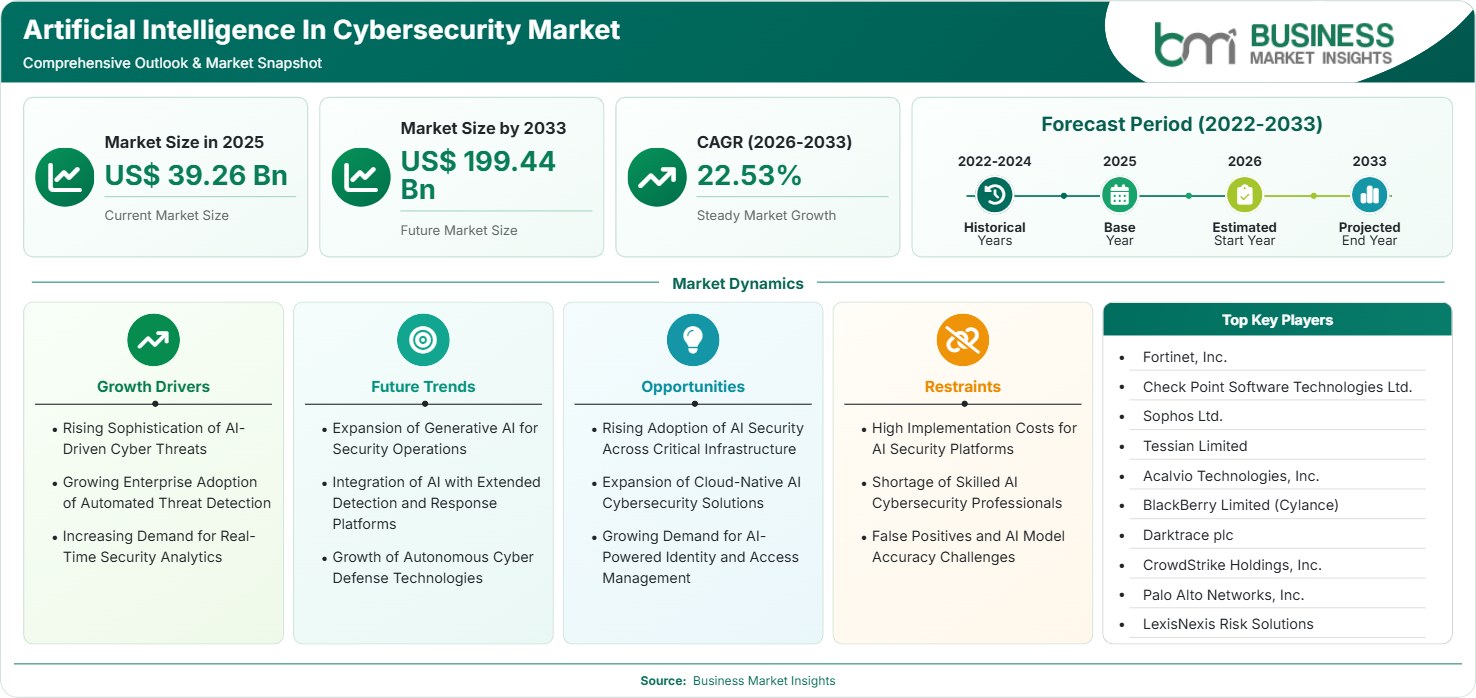
The Artificial Intelligence in Cybersecurity Market size was valued at US$ 39.26 Billion in 2025 and is projected to reach US$ 199.44 Billion by 2033, growing at a CAGR of 22.53% during 2026–2033. Rising cyberattacks, increasing adoption of cloud computing, growing enterprise digital transformation, and expanding demand for automated threat detection continue creating significant opportunities across global cybersecurity ecosystems.

Report Coverage
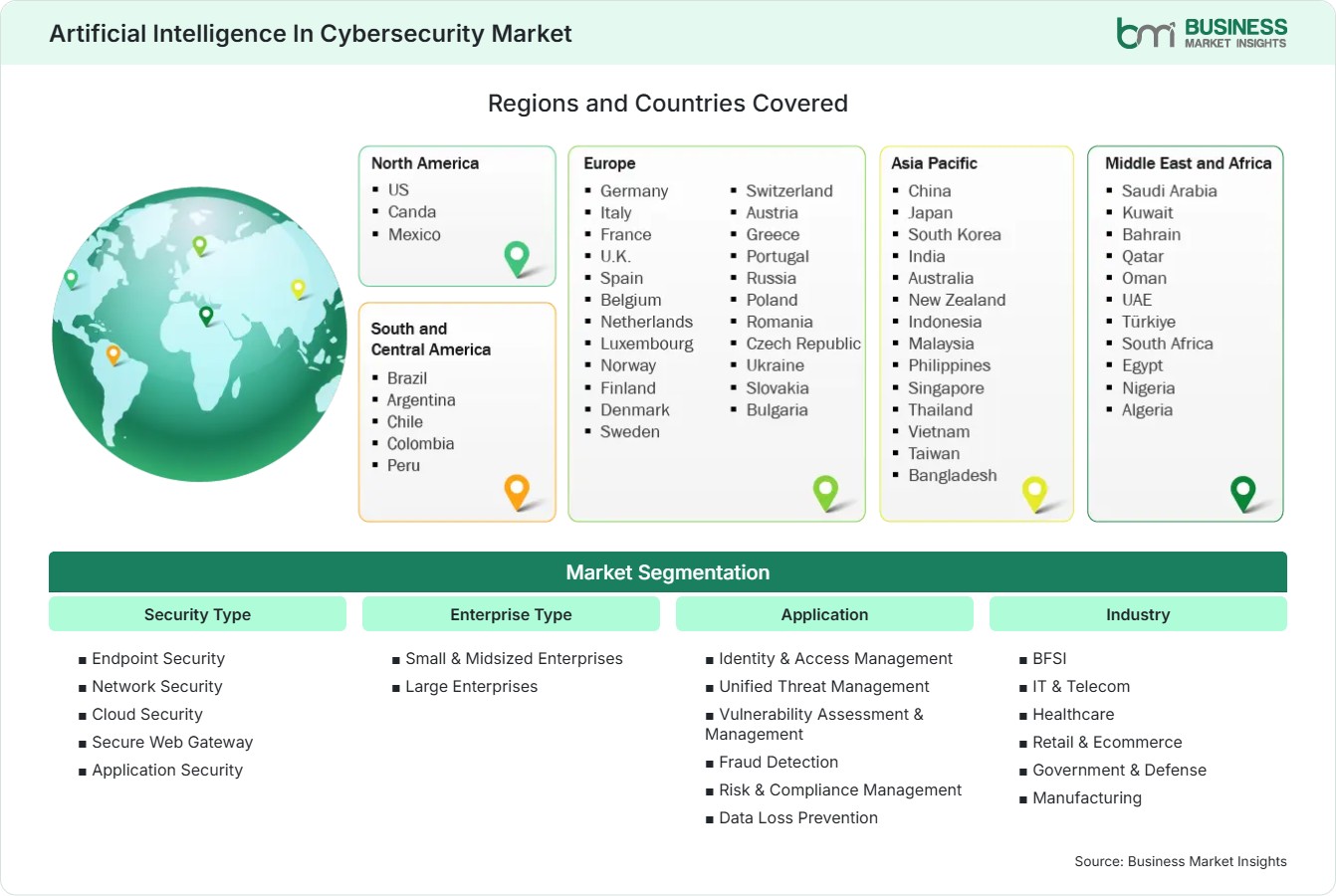
  • Security Type: Endpoint Security, Network Security, Cloud Security, Secure Web Gateway, Application Security
  • Enterprise Type: Small & Midsized Enterprises, Large Enterprises
  • Application: Identity & Access Management, Unified Threat Management, Vulnerability Assessment & Management, Fraud Detection, Risk & Compliance Management, Data Loss Prevention
  • Industry: BFSI, IT & Telecom, Healthcare, Retail & Ecommerce, Government & Defense, Manufacturing
US$ 39.26 Bn Market size in 2025
US$ 199.44 Bn Market Size by 2033
22.53% CAGR, 2026 - 2033
2026-2033 Forecast Period

AI Overview

Artificial Intelligence In Cybersecurity Market Summary

  • North America Region: North America holds 37%–40% artificial intelligence in cybersecurity market share in 2025 and is projected to grow at a CAGR of 21.6%–22.1% during 2026–2033. Strong cybersecurity spending, widespread AI adoption, cloud migration, and strict regulatory compliance continue driving market expansion. The U.S. dominates regional demand through advanced enterprise cybersecurity investments, expanding AI deployment, and increasing ransomware defense initiatives, registering a CAGR of 21.7%–22.2% during the forecast period.
  • Fastest Growing Region: Asia Pacific accounts for 25%–28% market share in 2025 and is expected to expand at a CAGR of 24.1%–24.7%. Rapid digitalization, increasing cloud adoption, expanding enterprise security investments, and growing cyber threat incidents continue accelerating regional growth.
  • Leading Segment: Network Security accounts for 26%–29% market share in 2025 while growing at a CAGR of 22.8%–23.4%. Increasing network complexity, hybrid work environments, and AI-driven threat detection continue supporting segment leadership.
  • High Growth Segment: Cloud Security represents 19%–22% market share in 2025 and is projected to register a CAGR of 24.6%–25.2%. Expanding cloud-native infrastructure and multi-cloud deployments continue accelerating adoption.
  • Key Market Opportunity: Development of autonomous threat detection, AI-powered security operations centers, predictive analytics, and generative AI-based cybersecurity platforms is creating substantial long-term opportunities.
  • Major Market Players: Fortinet, Inc., Check Point Software Technologies Ltd., Sophos Ltd., Tessian Limited, Acalvio Technologies, Inc., Cylance Inc. (BlackBerry), Darktrace Holdings Limited, CrowdStrike Holdings, Inc., Palo Alto Networks, Inc., and LexisNexis Risk Solutions.
Strategic Insights

Artificial Intelligence In Cybersecurity Market: Strategic Insights

Artificial Intelligence In Cybersecurity Market Strategic Framework
FREE PDF
Request your free sample
Request free sample
Stakeholder View

Key Takeaways

  • The cybersecurity ecosystem increasingly integrates AI software providers, cloud platforms, managed security service providers, and enterprise technology vendors.
  • Cloud-native security platforms and AI-driven threat intelligence present the strongest long-term commercial opportunities.
  • Innovation focuses on generative AI, autonomous threat hunting, behavioral analytics, and explainable artificial intelligence for cybersecurity applications.
  • Asia Pacific offers attractive investment opportunities due to rapid enterprise digitalization, expanding cloud infrastructure, and rising cybersecurity spending.
  • Strategic acquisitions and technology partnerships continue strengthening AI cybersecurity portfolios across leading global vendors.
  • Organizations investing in AI-enabled security automation improve operational efficiency while reducing response time against increasingly sophisticated cyber threats.
Geographic Outlook

Artificial Intelligence In Cybersecurity Market Regional Highlights

North America Artificial Intelligence in Cybersecurity Market

North America accounted for approximately 37%–40% of global revenue during 2025 and is projected to expand at a CAGR of 21.6%–22.1% through 2033. Strong enterprise cybersecurity investments, advanced cloud adoption, and regulatory compliance continue supporting market expansion. The Artificial Intelligence in Cybersecurity Market share benefits from increasing deployment of AI-powered security operations, zero-trust architectures, and managed detection platforms.

  • Large enterprises continue expanding AI-powered security operations centers to strengthen real-time threat detection.
  • Federal cybersecurity initiatives encourage wider adoption of intelligent security technologies.
  • Cloud migration increases demand for AI-enabled network and cloud security platforms.
  • Financial institutions remain among the largest adopters of AI cybersecurity solutions.

US Artificial Intelligence in Cybersecurity Market

The United States represents approximately 86%–89% of North American demand and is projected to register a CAGR of 21.7%–22.2% during the forecast period. Strong cybersecurity investments, technology innovation, and increasing enterprise cloud adoption continue supporting long-term growth.

  • Large technology companies continue advancing AI cybersecurity innovation.
  • Rising ransomware incidents increase enterprise security spending.
  • Government agencies strengthen critical infrastructure protection using AI.
  • Financial institutions increasingly deploy AI-powered fraud detection platforms.

Europe Artificial Intelligence in Cybersecurity Market

Europe accounted for approximately 25%–28% of global revenue during 2025 and is expected to grow at a CAGR of 22.0%–22.6% through 2033. Strong GDPR compliance, increasing cybersecurity regulations, and enterprise digital transformation continue supporting regional demand. Germany leads regional adoption, while Poland records the fastest growth.

  • Germany maintains leadership through advanced enterprise cybersecurity deployment.
  • Poland attracts growing cybersecurity investments across enterprise sectors.
  • Increasing digital regulations strengthen demand for AI security solutions.
  • Financial services remain major adopters of AI-enabled cyber defense.

Asia Pacific Artificial Intelligence in Cybersecurity Market

Asia Pacific represented approximately 25%–28% of global revenue during 2025 and is forecast to grow at a CAGR of 24.1%–24.7% through 2033, making it the fastest-growing regional artificial intelligence in cybersecurity market. Expanding digital economies, rising cyber threats, and cloud adoption continue driving demand. China leads regional revenue, while India records the fastest growth.

  • China continues expanding enterprise AI cybersecurity deployments.
  • India records rapid cybersecurity investment supported by digital transformation.
  • Japan and South Korea strengthen AI-enabled cyber resilience initiatives.
  • ASEAN countries increasingly invest in cloud security infrastructure.

Rest of World Artificial Intelligence in Cybersecurity Market

The Rest of World accounted for approximately 8%–10% of global revenue during 2025 and is projected to expand at a CAGR of 22.3%–22.8% through 2033. The Middle East rapidly expands cybersecurity investments while Latin America strengthens digital infrastructure protection. Saudi Arabia leads Middle Eastern growth, whereas Brazil remains the largest Latin American market.

  • Saudi Arabia continues investing in national cybersecurity capabilities.
  • Brazil expands enterprise cybersecurity modernization initiatives.
  • Financial institutions strengthen AI-driven fraud prevention platforms.
  • Government digital transformation programs accelerate cybersecurity adoption.
Global Market Geography
FREE PDF
Request your free sample
Request free sample
Segment Analysis

Artificial Intelligence In Cybersecurity Market Segmentation

Security Type

The Security Type segment accounted for approximately 33%–36% of the market in 2025 and is projected to expand at a CAGR of 22.8%–23.4% during 2026–2033. Increasing cyberattack sophistication, cloud migration, and hybrid work environments continue accelerating deployment of AI-enabled security solutions. The Artificial Intelligence in Cybersecurity Market scope continues expanding as organizations adopt intelligent protection across diverse digital assets.

  • Endpoint Security: AI-powered endpoint security solutions detect malware, ransomware, and abnormal device behavior through behavioral analytics, enabling rapid threat identification and automated response across enterprise endpoints.
  • Network Security: Network security solutions leverage machine learning to analyze traffic patterns, detect anomalies, prevent intrusions, and improve real-time visibility across enterprise and cloud networks.
  • Cloud Security: Cloud security platforms utilize artificial intelligence to secure multi-cloud environments, identify configuration risks, automate compliance monitoring, and mitigate sophisticated cloud-native cyber threats.
  • Secure Web Gateway: AI-enabled secure web gateways inspect web traffic, identify malicious websites, prevent phishing attacks, and enforce secure internet access for distributed workforces.
  • Application Security: Artificial intelligence enhances application security through automated vulnerability detection, runtime threat monitoring, secure code analysis, and continuous application risk assessment.

Enterprise Type

Enterprise adoption continues increasing as organizations strengthen cyber resilience against evolving digital threats. The segment represented approximately 69%–72% of market revenue in 2025 and is expected to register a CAGR of 22.6%–23.1% through the forecast period. The Artificial Intelligence in Cybersecurity Market trends indicate broader deployment among enterprises of all sizes.

  • Small & Mid-sized Enterprises: SMEs increasingly adopt cloud-based AI cybersecurity platforms offering affordable threat detection, automated monitoring, and simplified security management without extensive in-house expertise.
  • Large Enterprises: Large organizations continue leading adoption through significant investments in AI-driven security operations, threat intelligence platforms, and enterprise-wide cyber risk management.

Application

Application diversity continues expanding as AI strengthens multiple cybersecurity functions. This segment accounted for approximately 29%–32% of market revenue during 2025 and is projected to grow at a CAGR of 23.0%–23.5% through 2033.

  • Identity & Access Management: AI enhances authentication, adaptive access control, behavioral verification, and identity risk assessment while reducing unauthorized system access.
  • Unified Threat Management: AI-powered unified threat management platforms consolidate multiple security functions, enabling centralized monitoring, automated response, and improved operational efficiency.
  • Vulnerability Assessment & Management: Artificial intelligence continuously identifies vulnerabilities, prioritizes remediation efforts, and supports proactive cyber risk reduction across enterprise infrastructure.
  • Fraud Detection: AI algorithms detect suspicious transactions, behavioral anomalies, and financial fraud in real time, improving enterprise security and customer protection.
  • Risk & Compliance Management: AI automates regulatory compliance monitoring, risk assessment, audit reporting, and policy enforcement across highly regulated industries.
  • Data Loss Prevention: AI-driven data loss prevention solutions monitor sensitive information, detect unauthorized transfers, and reduce insider threats through intelligent behavioral analysis.

Industry

Industry-specific cybersecurity requirements continue driving adoption of AI-powered security platforms. The segment represented approximately 27%–30% of market revenue in 2025 and is forecast to register a CAGR of 22.7%–23.2% during the forecast period.

  • BFSI: Financial institutions deploy AI cybersecurity solutions for fraud detection, transaction monitoring, identity protection, and regulatory compliance across digital banking environments.
  • IT & Telecom: IT and telecom companies utilize AI to secure cloud infrastructure, communication networks, enterprise applications, and large-scale digital ecosystems.
  • Healthcare: Healthcare organizations implement AI-powered cybersecurity to protect electronic health records, connected medical devices, and sensitive patient information from cyber threats.
  • Retail & E-commerce: Retailers leverage artificial intelligence to prevent payment fraud, secure customer data, monitor digital transactions, and strengthen online commerce security.
  • Government & Defense: Government agencies deploy AI cybersecurity technologies to protect critical infrastructure, classified information, and national digital assets against sophisticated cyberattacks.
  • Manufacturing: Manufacturing companies increasingly adopt AI-enabled security solutions to safeguard industrial control systems, connected production equipment, and smart factory operations.
Market Forces

Artificial Intelligence In Cybersecurity Market Dynamics

Key Market Drivers

Rising Sophistication of AI-Driven Cyber Threats

Cybercriminals increasingly employ artificial intelligence to automate phishing campaigns, generate sophisticated malware, evade traditional detection methods, and exploit digital vulnerabilities more efficiently. As attack complexity grows, organizations require equally intelligent defense mechanisms capable of identifying evolving threats in real time. The Artificial Intelligence in Cybersecurity Market growth continues accelerating because AI-powered security platforms analyze massive volumes of security data, detect behavioral anomalies, and respond automatically before attacks spread. Continuous evolution of ransomware, zero-day exploits, and advanced persistent threats further strengthens enterprise demand for intelligent cybersecurity solutions.

Growing Enterprise Adoption of Automated Threat Detection

Enterprises now utilize automated threat detection systems based on artificial intelligence to increase efficiency in security operations and minimize time spent on analysis and response. Machine learning algorithms constantly analyze user activities, network traffic, endpoints, and clouds to detect anomalies before any harm is done. Automated threat detection technology minimizes false positives, increases the efficiency of analysts, and ensures faster containment of incidents. Companies in the banking, health care, manufacturing, retail, and government industries keep investing in smart cybersecurity solutions due to digital transformation.

Increasing Demand for Real-Time Security Analytics

Modern organizations can generate vast amounts of cybersecurity data from their networks, endpoints, cloud platforms, applications, and other devices connected to their infrastructure. Artificial intelligence helps analyze such large datasets all the time, and companies are able to detect potential threats, assess vulnerabilities, and make cybersecurity-related decisions based on this information. Intelligent security analytics provide better predictive threat intelligence, improve investigations, and increase operational visibility.

Key Market Opportunities

Rising Adoption of AI Security Across Critical Infrastructure

Critical infrastructure sectors including energy, utilities, transportation, healthcare, and financial services increasingly invest in AI-powered cybersecurity to protect essential digital systems from sophisticated attacks. Intelligent monitoring platforms enhance operational resilience by identifying threats before they disrupt critical services. The Artificial Intelligence in Cybersecurity Market Forecasts remain highly favorable as governments strengthen cybersecurity regulations and infrastructure modernization initiatives. Vendors delivering specialized AI security solutions for operational technology and industrial environments are expected to experience significant long-term growth opportunities.

Expansion of Cloud-Native AI Cybersecurity Solutions

The fast uptake of cloud-native applications, containerization and hybrid cloud models generates a high need for artificial intelligence-driven cloud security systems. Such intelligent cloud security solutions can deliver automated workload security, monitoring, anomaly detection, and compliance management in distributed infrastructure. Organizations are favoring cloud-based cybersecurity due to its scalability, management, and constant threat intelligence updates. Cloud-native AI vendors in expansion will be able to take full advantage of this trend.

Growing Demand for AI-Powered Identity and Access Management

Identity and access management continues evolving beyond traditional authentication toward AI-driven behavioral verification, adaptive access policies, and continuous identity monitoring. Artificial intelligence enables organizations to identify compromised accounts, detect unusual login behavior, and dynamically adjust authentication requirements according to user risk profiles. Growing adoption of zero-trust security architectures further strengthens demand for intelligent identity management solutions capable of protecting increasingly distributed digital workforces and cloud environments.

Market Restraints and Challenges

High Implementation Costs for AI Security Platforms

Factor: Deploying enterprise-grade AI cybersecurity platforms requires substantial investments in software licensing, cloud infrastructure, skilled personnel, data integration, and ongoing model optimization.

Impact: High implementation costs can limit adoption among budget-constrained organizations, particularly small and mid-sized enterprises. Many businesses therefore implement AI cybersecurity gradually through cloud-based subscription models, managed security services, and phased deployment strategies that reduce upfront investment while improving long-term cybersecurity capabilities.

Shortage of Skilled AI Cybersecurity Professionals

Factor: Effective deployment and management of AI-powered cybersecurity solutions require professionals with expertise in cybersecurity operations, artificial intelligence, machine learning, and threat intelligence.

Impact: The shortage of qualified cybersecurity specialists increases deployment complexity, extends implementation timelines, and reduces operational effectiveness for many organizations. Enterprises increasingly address this challenge through automation, managed security service providers, workforce training programs, and simplified AI security platforms that reduce dependence on highly specialized technical expertise.

Company Analysis

Competitive Landscape

The Artificial Intelligence in Cybersecurity Market analysis is highly competitive, with leading cybersecurity vendors investing in machine learning, generative AI, behavioral analytics, threat intelligence, and cloud-native security platforms. Companies continue expanding strategic partnerships, acquiring AI startups, and strengthening managed security capabilities to improve automated threat detection and enterprise cyber resilience.

Company Name

Overview

Products and Services Relevant to this Market

Fortinet, Inc.

Fortinet, Inc. is a global cybersecurity company delivering AI-powered network security, threat intelligence, and enterprise security solutions across cloud and hybrid environments.

AI-enabled firewalls, endpoint security, network security, threat intelligence, cloud security, security operations, and managed cybersecurity services.

Check Point Software Technologies Ltd.

Check Point develops advanced cybersecurity solutions protecting enterprise networks, cloud infrastructure, endpoints, and digital workloads using artificial intelligence and automation.

Network security, cloud security, AI threat prevention, endpoint protection, zero trust security, and security management platforms.

Sophos Ltd.

Sophos provides AI-driven cybersecurity solutions focused on endpoint protection, managed detection and response, and cloud security for organizations worldwide.

Endpoint security, managed detection and response, XDR, cloud security, email protection, and AI-powered threat intelligence.

Tessian Limited

Tessian specializes in artificial intelligence-based email security and human risk management solutions that reduce phishing and insider threats.

AI email security, phishing prevention, insider threat protection, behavioral analytics, and intelligent data loss prevention solutions.

Acalvio Technologies, Inc.

Acalvio Technologies develops deception-based cybersecurity platforms powered by artificial intelligence for advanced threat detection and cyber defense.

AI deception technology, threat detection, attack surface management, identity protection, and cyber deception platforms.

Cylance Inc. (BlackBerry)

Cylance develops artificial intelligence-driven endpoint security technologies that predict, prevent, and detect advanced cyber threats before execution.

AI endpoint protection, malware prevention, threat detection, endpoint detection and response, and cybersecurity analytics.

Darktrace Holdings Limited

Darktrace develops self-learning artificial intelligence solutions for autonomous cyber defense across enterprise networks, cloud infrastructure, and industrial environments.

AI threat detection, autonomous response, network security, cloud security, email security, and operational technology protection.

CrowdStrike Holdings, Inc.

CrowdStrike is a leading cloud-native cybersecurity company providing AI-powered endpoint protection and real-time threat intelligence worldwide.

Falcon platform, endpoint security, threat intelligence, identity protection, cloud workload security, and managed detection services.

Palo Alto Networks, Inc.

Palo Alto Networks delivers integrated AI-powered cybersecurity platforms protecting networks, cloud infrastructure, applications, and enterprise users globally.

Network security, Prisma Cloud, Cortex AI security platform, endpoint protection, security operations, and cloud security services.

LexisNexis Risk Solutions

LexisNexis Risk Solutions provides AI-powered identity verification, fraud prevention, digital risk intelligence, and analytics solutions for enterprise customers.

Identity intelligence, fraud detection, risk analytics, compliance management, authentication, and digital identity protection solutions.

Trust & Transparency

Research Methodology

The market analysis combines proprietary research with secondary data from government agencies, company disclosures, regulatory filings, industry databases and expert interviews. Market estimates are validated through data triangulation, cross-market benchmarking and analyst review.

View Full Research Methodology

Questions Answered

Frequently Asked Questions

What does an Artificial Intelligence in Cybersecurity Market Report include?

The market report provides comprehensive insights into market size, segmentation, competitive landscape, technology trends, regional outlook, investment opportunities, regulatory developments, and long-term growth forecasts.

Why is Asia Pacific expected to witness the fastest growth?

Asia Pacific benefits from rapid digital transformation, expanding cloud adoption, increasing cybersecurity investments, government digital initiatives, and growing enterprise awareness of AI-driven cyber risk management.

Which industries are the major adopters of AI cybersecurity solutions?

BFSI, IT & telecom, healthcare, government, manufacturing, and retail organizations are among the largest adopters because they manage sensitive data, critical infrastructure, and highly connected digital environments.

Which security type holds the largest market share?

Network security remains the leading segment due to increasing enterprise network complexity, cloud adoption, hybrid work environments, and growing demand for AI-driven threat detection and automated network protection.

What is artificial intelligence in cybersecurity?

Artificial intelligence in cybersecurity refers to the application of machine learning, deep learning, and intelligent analytics to identify cyber threats, automate incident response, detect anomalies, and strengthen enterprise security operations in real time.

Access the Full Artificial Intelligence In Cybersecurity Market Report

Get segment-level forecasts, regional estimates, competitive benchmarking, company profiles and downloadable Excel datasets.

Access the full Artificial Intelligence In Cybersecurity Market Report
350 pages PDF & Excel | 2026-08-07