
Cybersecurity Mesh Market Outlook: Size, Share, Trends, Growth Analysis, Competitive Landscape & Forecast, 2026-2033

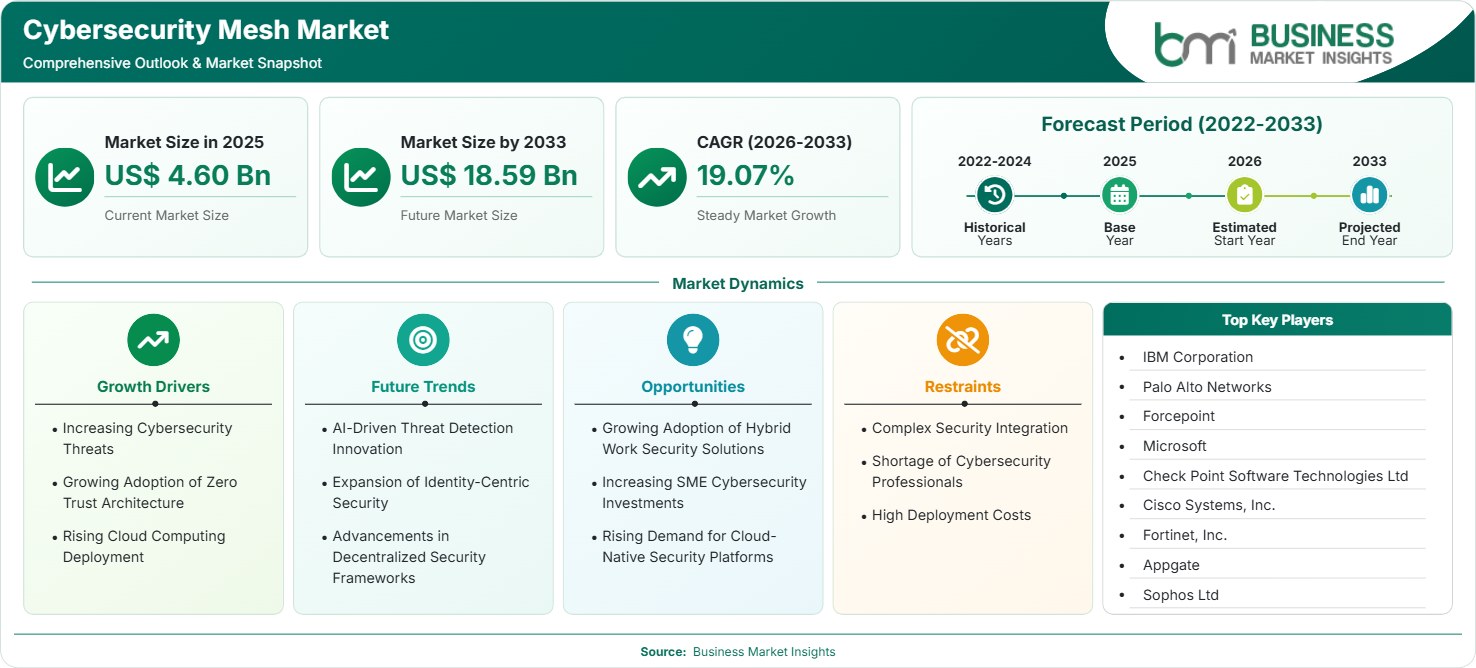
The Cybersecurity Mesh Market size was valued at US$ 4.60 Billion in 2025 and is projected to reach US$ 18.59 Billion by 2033, growing at a CAGR of 19.07% during 2026–2033, driven by rising cyber threats, distributed security architectures, cloud adoption, zero trust frameworks, and increasing demand for scalable enterprise protection solutions.

Report Coverage
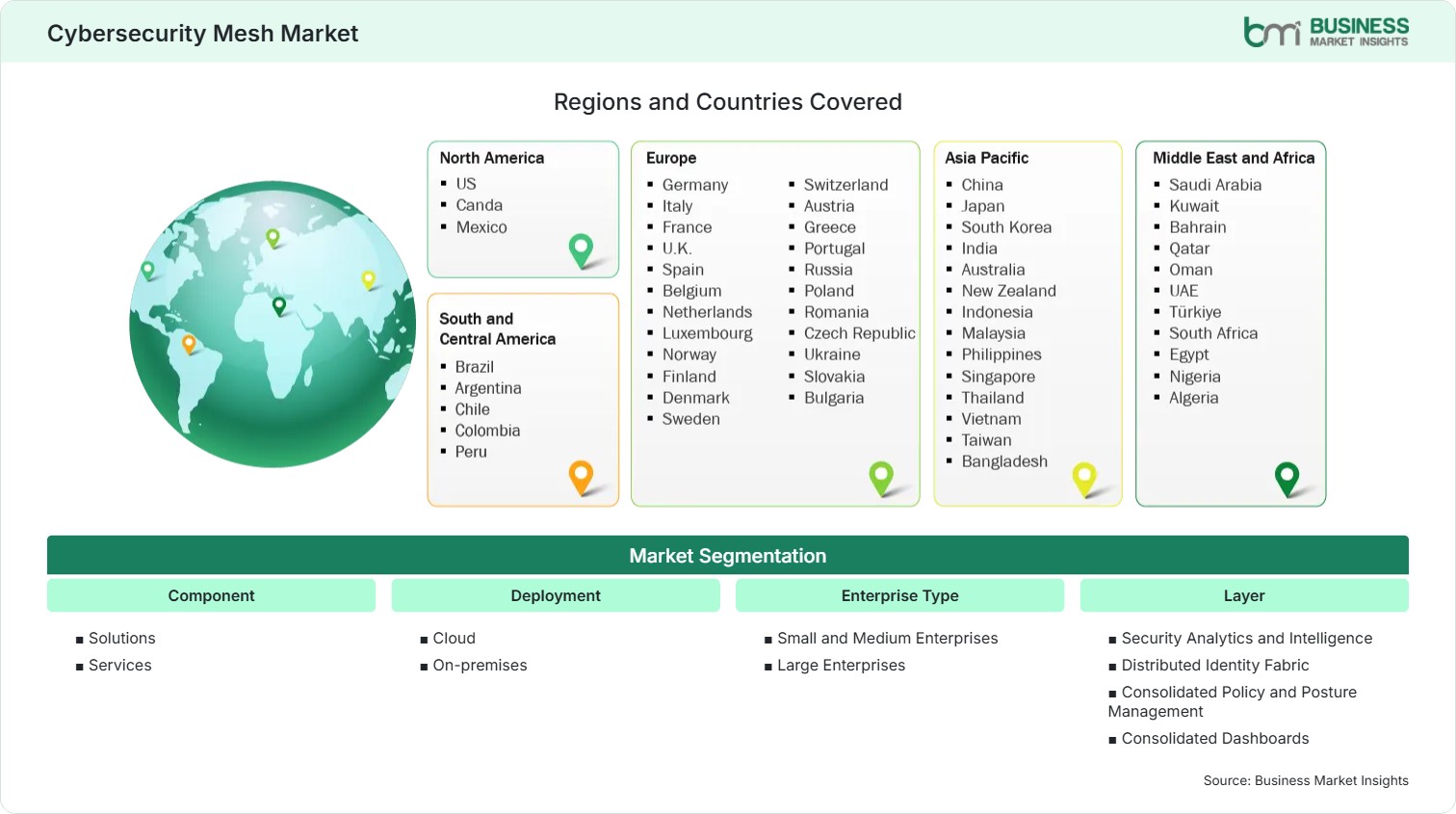
  • Component: Solutions, Services
  • Deployment: Cloud, On-premises
  • Enterprise Type: Small and Medium Enterprises, Large Enterprises
  • Layer: Security Analytics and Intelligence, Distributed Identity Fabric, Consolidated Policy and Posture Management, Consolidated Dashboards
  • Industry: BFSI, Retail & E-commerce, Healthcare, IT & Telecom, Government and Defense, Manufacturing, Others
US$ 4.60 Bn Market size in 2025
US$ 18.59 Bn Market Size by 2033
19.07% CAGR, 2026 - 2033
2026-2033 Forecast Period

AI Overview

Cybersecurity Mesh Market Summary

  • North America Region: North America holds a 38%–42% share in 2025, growing at a CAGR of 18%–20% during 2026–2033, driven by advanced cybersecurity adoption, cloud migration, regulatory compliance, and enterprise security modernization. The US market expands at a CAGR of 18%–19% due to strong investments in zero trust, identity security, and threat intelligence platforms.
  • Fastest Growing Region: Asia Pacific represents a 22%–26% share in 2025, advancing at a CAGR of 21%–23% during 2026–2033, supported by digital transformation, expanding cloud infrastructure, cybersecurity awareness, government initiatives, and increasing enterprise investments across emerging economies.
  • Leading Segment: Solutions maintain a 60%–64% share in 2025, expanding at a CAGR of 18%–20% during 2026–2033, supported by integrated security platforms, identity management, analytics capabilities, automated threat detection, and enterprise demand for unified protection environments.
  • High Growth Segment: Cloud deployment accounts for a 55%–59% share in 2025, growing at a CAGR of 21%–23% during 2026–2033, driven by hybrid workforce models, cloud-native applications, scalable security requirements, and increasing adoption among enterprises.
  • Key Market Opportunity: Increasing adoption of AI-powered security analytics, cloud-native protection platforms, and distributed identity solutions creates opportunities for vendors to deliver adaptive cybersecurity frameworks supporting complex digital ecosystems and evolving enterprise requirements.
  • Major Market Players: IBM Corporation, Palo Alto Networks, Forcepoint, Microsoft Corporation, Check Point Software Technologies Ltd., Cisco Systems, Inc., Fortinet, Inc., Appgate, Sophos Limited.
Strategic Insights

Cybersecurity Mesh Market: Strategic Insights

Cybersecurity Mesh Market Strategic Framework
FREE PDF
Request your free sample
Request free sample
Stakeholder View

Key Takeaways

  • The cybersecurity ecosystem is shifting from traditional perimeter defenses toward interconnected security frameworks integrating identity, analytics, and policy controls across distributed digital environments.
  • Enterprise demand is increasing for cloud-based security solutions, particularly among organizations managing hybrid infrastructure, remote employees, and complex application environments requiring adaptive protection.
  • Artificial intelligence, machine learning, and automated threat detection capabilities are becoming central innovation areas as vendors enhance predictive security analytics and response automation.
  • Asia Pacific presents a strong investment opportunity due to accelerating digital transformation, expanding cloud adoption, and rising cybersecurity requirements across developing economies.
  • Market consolidation is increasing through strategic partnerships, platform integrations, and acquisitions as cybersecurity vendors aim to strengthen end-to-end protection capabilities.
  • Industry collaboration between security providers, cloud companies, and enterprises is creating integrated solutions designed for evolving cyber risk environments.
Geographic Outlook

Cybersecurity Mesh Market Regional Highlights

North America Cybersecurity Mesh Market

North America maintains a 38%–42% share in 2025 and records a CAGR of 18%–20% during 2026–2033. The region benefits from mature cybersecurity infrastructure, strong enterprise technology spending, and regulatory requirements. Cybersecurity Mesh Market share remains dominant due to early adoption among financial institutions, government agencies, and technology companies. The United States and Canada continue supporting innovation through cloud security investments, identity management adoption, and advanced threat detection programs.

  • Enterprises are deploying distributed security frameworks to manage increasing risks from cloud applications, remote access systems, and interconnected digital assets.
  • Government cybersecurity initiatives are encouraging organizations to strengthen identity protection, compliance monitoring, and continuous security assessment capabilities.
  • Large technology companies are investing in integrated security platforms combining analytics, automation, and policy management functions.
  • Financial services and healthcare sectors are accelerating cybersecurity adoption due to strict data protection requirements and rising cyberattack exposure.

US Cybersecurity Mesh Market

The United States accounts for a 32%–36% share of North America in 2025 and expands at a CAGR of 18%–19% during 2026–2033. Strong enterprise adoption, cybersecurity regulations, and technology innovation support market expansion. Organizations across industries are adopting identity-focused security models, cloud protection platforms, and automated defense mechanisms. Cybersecurity Mesh Market growth in the country is reinforced by investments from technology providers and increasing demand for resilient security architectures.

  • Enterprises are prioritizing zero trust security models to protect distributed applications, users, and infrastructure.
  • Federal cybersecurity initiatives are encouraging modernization of outdated security systems across public and private organizations.
  • Technology providers are expanding cloud-native security solutions to support evolving enterprise environments.

Europe Cybersecurity Mesh Market

Europe represents a 26%–30% share in 2025 and grows at a CAGR of 17%–19% during 2026–2033. The region benefits from strict data protection regulations, increasing cyber resilience programs, and enterprise investments in secure digital transformation. Countries including Germany, the United Kingdom, and France are major contributors, while emerging markets in Eastern Europe demonstrate increasing adoption. market share expansion is supported by regulatory compliance requirements and demand for advanced security infrastructure.

  • European organizations are adopting distributed security approaches to address increasing cyber risks across interconnected systems.
  • Germany is strengthening cybersecurity investments through industrial digitalization and manufacturing security initiatives.
  • The United Kingdom is expanding cloud security adoption across financial and government sectors.
  • France is supporting cybersecurity innovation through public-private technology partnerships and digital resilience programs.

Asia Pacific Cybersecurity Mesh Market

Asia Pacific holds a 22%–26% share in 2025 and registers a CAGR of 21%–23% during 2026–2033. The region represents the fastest-growing opportunity due to rapid digital transformation, expanding cloud infrastructure, and increasing cybersecurity awareness. China, India, Japan, and South Korea are leading contributors, with enterprises investing in advanced security platforms. Market growth is supported by government initiatives, digital economy expansion, and rising demand for secure enterprise networks.

  • India is witnessing increased cybersecurity adoption due to expanding digital services, cloud usage, and regulatory developments.
  • China is investing in cybersecurity infrastructure to protect large-scale digital ecosystems and industrial networks.
  • Japan and South Korea are advancing enterprise security modernization through technology innovation.
  • Regional enterprises are adopting integrated security platforms to manage complex digital environments.

Rest of World Cybersecurity Mesh Market

Rest of World represents a 10%–14% share in 2025 and expands at a CAGR of 19%–21% during 2026–2033. South and Central America are experiencing increased cybersecurity investments due to digital banking growth and cloud adoption. Middle Eastern and African countries are strengthening cybersecurity capabilities through smart city initiatives, critical infrastructure protection, and government modernization programs. Cybersecurity Mesh Market share is gradually increasing as organizations improve cyber resilience.

  • Brazil is increasing cybersecurity spending through financial technology expansion and digital transformation initiatives.
  • Middle Eastern countries are adopting advanced security frameworks to protect critical infrastructure and government systems.
  • Africa is witnessing growing demand for affordable cloud-based cybersecurity solutions.
  • Telecommunications providers are strengthening network protection through integrated security technologies.
  • Public sector modernization programs are supporting cybersecurity investments across developing economies.
Global Market Geography
FREE PDF
Request your free sample
Request free sample
Segment Analysis

Cybersecurity Mesh Market Segmentation

Component

The component segment defines the technology foundation of the market, with solutions holding a 60%–64% share in 2025 and expanding at a CAGR of 18%–20% between 2026–2033. Demand is driven by integrated security platforms, identity solutions, analytics capabilities, and enterprise adoption of centralized security frameworks. Services support deployment, consulting, and operational optimization.

  • Solutions: Security platforms enable organizations to implement distributed protection through identity management, threat intelligence, analytics, and policy enforcement capabilities across complex digital environments.
  • Services: Professional and managed services assist enterprises with implementation, monitoring, integration, and optimization of cybersecurity frameworks for evolving technology infrastructures.

Deployment

Deployment segmentation highlights changing enterprise preferences toward flexible security infrastructure. Cloud deployment represents a 55%–59% share in 2025 and grows at a CAGR of 21%–23% between 2026–2033. The Cybersecurity Mesh Market scope expands through scalable cloud-native architectures, while on-premises solutions continue supporting organizations requiring direct control over security environments and sensitive data protection requirements.

  • Cloud: Cloud-based security deployment supports scalability, remote access protection, automated updates, and distributed enterprise environments requiring adaptive cybersecurity capabilities.
  • On-premises: On-premises deployment remains relevant among regulated industries requiring localized infrastructure control, customized security configurations, and strict data governance.

Enterprise Type

Enterprise type segmentation reflects varying cybersecurity requirements across organizations. Large enterprises maintain a 58%–62% share in 2025 due to complex infrastructure, higher cyber risk exposure, and greater technology budgets. Small and medium enterprises are adopting cybersecurity mesh approaches as affordable cloud-based solutions become available, enabling improved protection without extensive internal resources.

  • Small and Medium Enterprises (SMEs): SMEs are increasingly adopting cybersecurity platforms through managed services, subscription models, and simplified security tools supporting digital operations.
  • Large Enterprises: Large organizations deploy comprehensive security frameworks integrating identity, analytics, compliance, and automated response capabilities across global operations.

Layer

Layer-based segmentation demonstrates the increasing complexity of enterprise security requirements. Security Analytics and Intelligence represents the leading layer with a 35%–39% share in 2025, supported by threat detection demand. Consolidated policy management and identity fabric solutions are gaining momentum as enterprises seek unified security control. The market trends indicate continued integration across multiple security layers.

  • Security Analytics and Intelligence: Advanced analytics platforms help organizations detect threats, analyze behavior patterns, and improve proactive cybersecurity decision-making.
  • Distributed Identity Fabric: Identity-focused security solutions provide authentication, access management, and protection across interconnected digital environments.
  • Consolidated Policy and Posture Management: These solutions enable centralized security governance, compliance monitoring, and consistent policy enforcement across enterprise systems.
  • Consolidated Dashboards: Unified dashboards improve visibility by combining security insights, operational monitoring, and risk assessment information.

Industry

Industry segmentation reflects broad adoption across sectors managing sensitive digital assets. BFSI remains a leading industry due to strict compliance requirements and high-value data protection needs. Healthcare, IT and telecom, government, manufacturing, and retail sectors are expanding adoption as cyber threats increase. The market analysis indicates diversified demand across critical industries.

  • BFSI: Financial institutions adopt cybersecurity mesh frameworks to secure transactions, customer data, digital banking platforms, and interconnected financial systems.
  • Retail & E-commerce: Retail organizations implement security solutions to protect customer information, payment systems, and online commerce infrastructure.
  • Healthcare: Healthcare providers deploy advanced cybersecurity platforms to secure patient records, connected devices, and digital healthcare applications.
  • IT & Telecom: Technology companies use cybersecurity mesh solutions to protect networks, cloud services, applications, and communication infrastructure.
  • Government and Defense: Government agencies adopt advanced security frameworks to protect critical infrastructure, sensitive information, and national security systems.
  • Manufacturing: Manufacturers integrate cybersecurity solutions to secure industrial networks, connected equipment, and digital production environments.
Market Forces

Cybersecurity Mesh Market Dynamics

Key Market Drivers

Increasing Cybersecurity Threats

Increasing cyber-attacks, ransomware threats, and advanced methods used to carry out attacks are driving the adoption of distributed security models. Enterprises are now expanding their security beyond conventional perimeter defenses to secure users, applications, and data within different environments. The Cybersecurity Mesh Market growth is driven by the increasing need for adaptive security, monitoring, and automation. As per the assessments made by the industry for the field of cybersecurity, ransomware threats and identity attacks pose significant threats for enterprises. This trend has resulted in increased investment in threat intelligence and identity security solutions.

Growing Adoption of Zero Trust Architecture

Zero Trust is increasingly becoming a driving force for companies that have realized the limitations of the conventional security paradigm. Continuous authentication, least privilege access control, and identity governance are some of the approaches adopted by firms to secure their distributed IT environment. Zero trust concepts can be leveraged in the modernization of cybersecurity infrastructure, thus contributing significantly to the Cybersecurity Mesh Market growth. Government entities and regulatory industries are also adopting zero trust more quickly due to compliance issues and cyber threats. Security vendors are incorporating identity management, analytics, and policy enforcement into one platform solution.

Rising Cloud Computing Deployment

The increasing cloud computing growth has brought the need for more adaptable cybersecurity systems that can be able to safeguard workloads and applications that are distributed. The multi-cloud and hybrid clouds have been embraced by businesses, thereby leading to the creation of demands for more adaptable security systems. The Cybersecurity Mesh market trends represent the rising investments that have been made in cloud-based platforms, security automation, and monitoring tools. Different industries like banking, health care, and IT have been showing an interest in improving their cloud security. The security systems are being improved using artificial intelligence and automated threat responses.

Key Market Opportunities

Growing Adoption of Hybrid Work Security Solutions

Cybersecurity companies will be able to capitalize on hybrid working arrangements as they provide identity-focused and cloud-focused security solutions. The enterprises need security systems that ensure access management and endpoint protection for their employees who work from different locations. The Cybersecurity Mesh Market Forecasts highlight growing interest in the solutions that will be helpful in managing flexible working arrangements. The enterprises are looking for solutions that will include the authentication process, analytics tools, and policy controls in one security system. Companies providing solutions for user behavior analysis, secure remote access, and risk assessment automation will be able to meet this demand.

Increasing SME Cybersecurity Investments

The small and medium enterprises (SMEs) market presents an expanding area of opportunities, owing to the growing availability of cost-effective cybersecurity products. The subscription, managed security services, and cloud-based approach to implementing cybersecurity products have lowered the barriers to entry. Small companies are adopting cybersecurity products as they conduct more activities online and face greater risks of cyberattacks. Security providers have been working on creating easy-to-implement solutions that include automated monitoring, threat detection, and compliance. Through such solutions, SMEs are able to improve their cybersecurity without hiring a large number of cybersecurity professionals.

Rising Demand for Cloud-Native Security Platforms

Security platforms that are cloud-native are generating new opportunities for growth due to modernization of the application environment. Companies need security platforms that can cater to the dynamic nature of cloud computing, container technology, and distributed application development. Companies have been making investments in analytics, automation, and operations for their security platforms. The cloud-native security platforms are scalable as well as able to detect threats quickly. With growing adoption of AI-driven security solutions, the platform is getting better. This generates opportunities for cybersecurity firms to provide complete solutions.

Market Restraints and Challenges

Complex Security Integration

Factor: Complex integration across diverse security systems, legacy infrastructure, and multiple cloud environments creates deployment challenges. Impact: Organizations may experience longer implementation timelines, increased operational complexity, and higher resource requirements when adopting cybersecurity mesh frameworks. Enterprises often manage fragmented security tools from different providers, making interoperability difficult. Integration challenges can limit adoption among organizations lacking specialized technical expertise. Vendors are addressing this issue through unified platforms, automation capabilities, and improved compatibility with existing systems. However, customization requirements and migration complexities remain important considerations for businesses planning cybersecurity modernization initiatives.

Shortage of Cybersecurity Professionals

Factor: Limited availability of skilled cybersecurity professionals affects organizations’ ability to deploy and manage advanced security frameworks effectively. Impact: Talent shortages can delay implementation, increase operational costs, and reduce the effectiveness of cybersecurity investments. Enterprises require specialists capable of managing identity systems, analytics platforms, cloud security, and threat response operations. The growing complexity of cyber environments is increasing demand for experienced professionals. Organizations are responding through managed security services, automation tools, and employee training programs. However, workforce limitations continue creating challenges for enterprises seeking comprehensive cybersecurity capabilities.

Company Analysis

Competitive Landscape

The Cybersecurity Mesh Market analysis highlights a competitive environment shaped by cybersecurity vendors focusing on identity protection, cloud security, threat intelligence, analytics, and integrated security platforms. Leading companies are strengthening portfolios through innovation, partnerships, acquisitions, and platform consolidation to address enterprise demand for scalable and adaptive cybersecurity frameworks.

Company Name

Overview

Products and Services relevant to this market

IBM Corporation

IBM provides enterprise cybersecurity solutions combining artificial intelligence, analytics, cloud security, and risk management capabilities for global organizations.

Offers security analytics, threat intelligence, identity management, incident response, and integrated cybersecurity platforms supporting distributed environments.

Palo Alto Networks

Palo Alto Networks develops advanced cybersecurity technologies focused on cloud protection, network security, and automated threat prevention.

Provides cloud security, zero trust solutions, security operations platforms, and AI-driven threat detection services.

Forcepoint

Forcepoint specializes in data-centric cybersecurity solutions designed to protect users, networks, and sensitive enterprise information.

Delivers secure access solutions, data protection platforms, cloud security services, and behavioral risk monitoring capabilities.

Microsoft Corporation

Microsoft delivers cybersecurity capabilities integrated across cloud, identity, productivity, and enterprise technology ecosystems.

Provides Microsoft Defender, identity protection, security analytics, cloud security tools, and integrated threat intelligence services.

Check Point Software Technologies Ltd.

Check Point develops cybersecurity solutions supporting network, cloud, mobile, and enterprise security requirements.

Offers threat prevention, cloud security, zero trust frameworks, security management platforms, and advanced monitoring solutions.

Cisco Systems, Inc.

Cisco provides networking and cybersecurity technologies supporting secure digital transformation across enterprises.

Delivers identity security, secure access, network protection, threat intelligence, and security operations solutions.

Fortinet, Inc.

Fortinet develops integrated cybersecurity platforms focused on enterprise network protection and secure infrastructure management.

Provides firewalls, secure access solutions, cloud security, threat intelligence, and unified security management platforms.

Appgate

Appgate specializes in zero trust access solutions designed for modern distributed enterprise environments.

Offers software-defined perimeter solutions, secure remote access, identity-based controls, and zero trust security frameworks.

Sophos Limited

Sophos provides cybersecurity solutions focused on endpoint protection, managed security services, and threat response.

Offers endpoint security, managed detection and response, cloud security, ransomware protection, and security monitoring services.

Trust & Transparency

Research Methodology

The market analysis combines proprietary research with secondary data from government agencies, company disclosures, regulatory filings, industry databases and expert interviews. Market estimates are validated through data triangulation, cross-market benchmarking and analyst review.

View Full Research Methodology

Questions Answered

Frequently Asked Questions

What challenges should enterprises consider before implementation?

Organizations should evaluate integration complexity, workforce capabilities, existing infrastructure compatibility, and long-term operational requirements before deploying cybersecurity mesh frameworks.

What technologies are shaping the Cybersecurity Mesh Market Report outlook?

Artificial intelligence, machine learning, automation, cloud-native security, identity management, and advanced analytics are influencing future cybersecurity platform development.

Which industries are adopting cybersecurity mesh solutions rapidly?

Financial services, healthcare, government, telecommunications, manufacturing, and technology sectors are major adopters due to high data sensitivity and increasing cyber risks.

How does cybersecurity mesh differ from traditional security models?

Cybersecurity mesh focuses on distributed protection around identities, applications, and data rather than relying only on network boundaries, enabling flexible security across modern digital environments.

What factors are accelerating adoption of cybersecurity mesh solutions?

Increasing cyber threats, cloud migration, remote work models, and demand for identity-based security frameworks are encouraging organizations to adopt distributed cybersecurity approaches.

Access the Full Cybersecurity Mesh Market Report

Get segment-level forecasts, regional estimates, competitive benchmarking, company profiles and downloadable Excel datasets.

Access the full Cybersecurity Mesh Market Report
350 pages PDF & Excel | 2026-08-06