
Cybersecurity Managed Services Market Outlook: Size, Share, Trends, Growth Analysis, Competitive Landscape & Forecast, 2026-2033

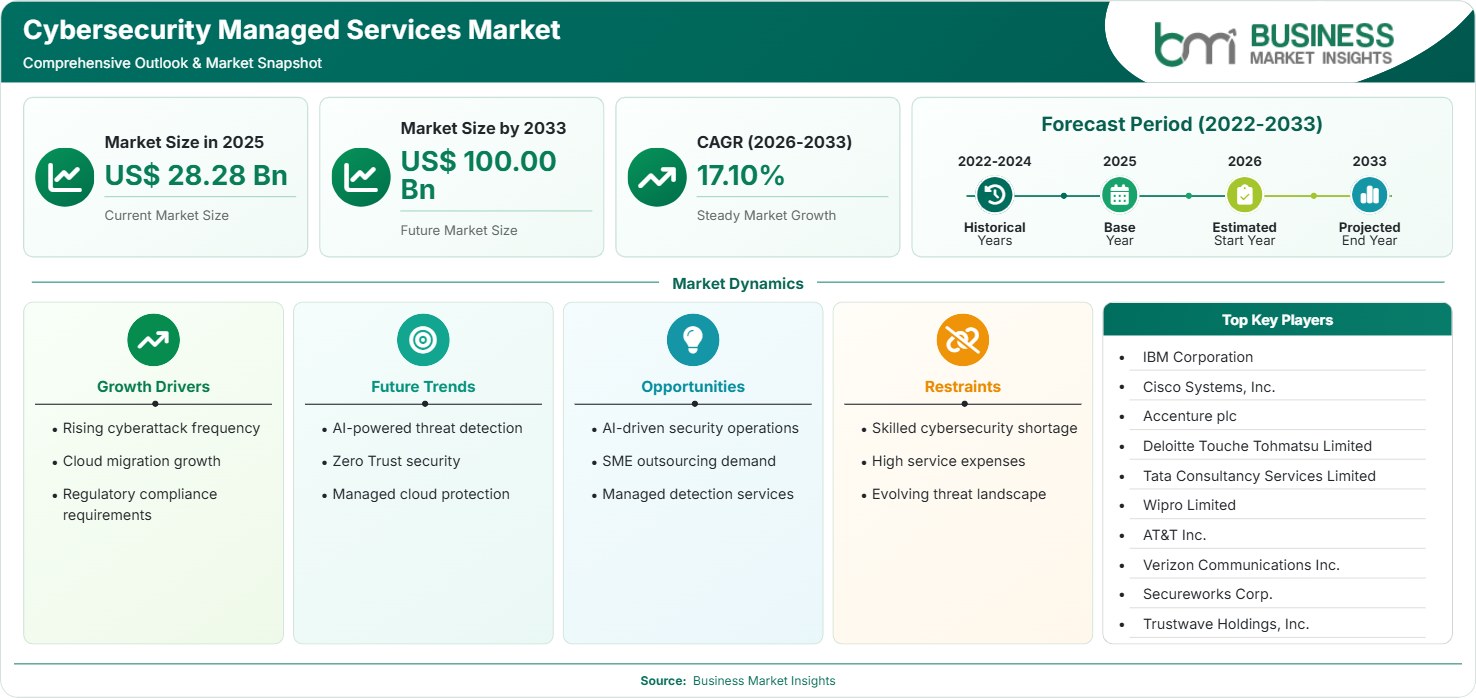
The Cybersecurity Managed Services Market size was valued at US$ 28.28 billion in 2025 and is projected to reach US$ 100.00 billion by 2033, growing at a CAGR of 17.10% during 2026–2033. Growth is driven by rising cyberattack frequency, cloud migration acceleration, and increasing regulatory compliance requirements, while opportunities are expanding through AI-driven security operations, SME outsourcing, and advanced managed detection services.

Report Coverage
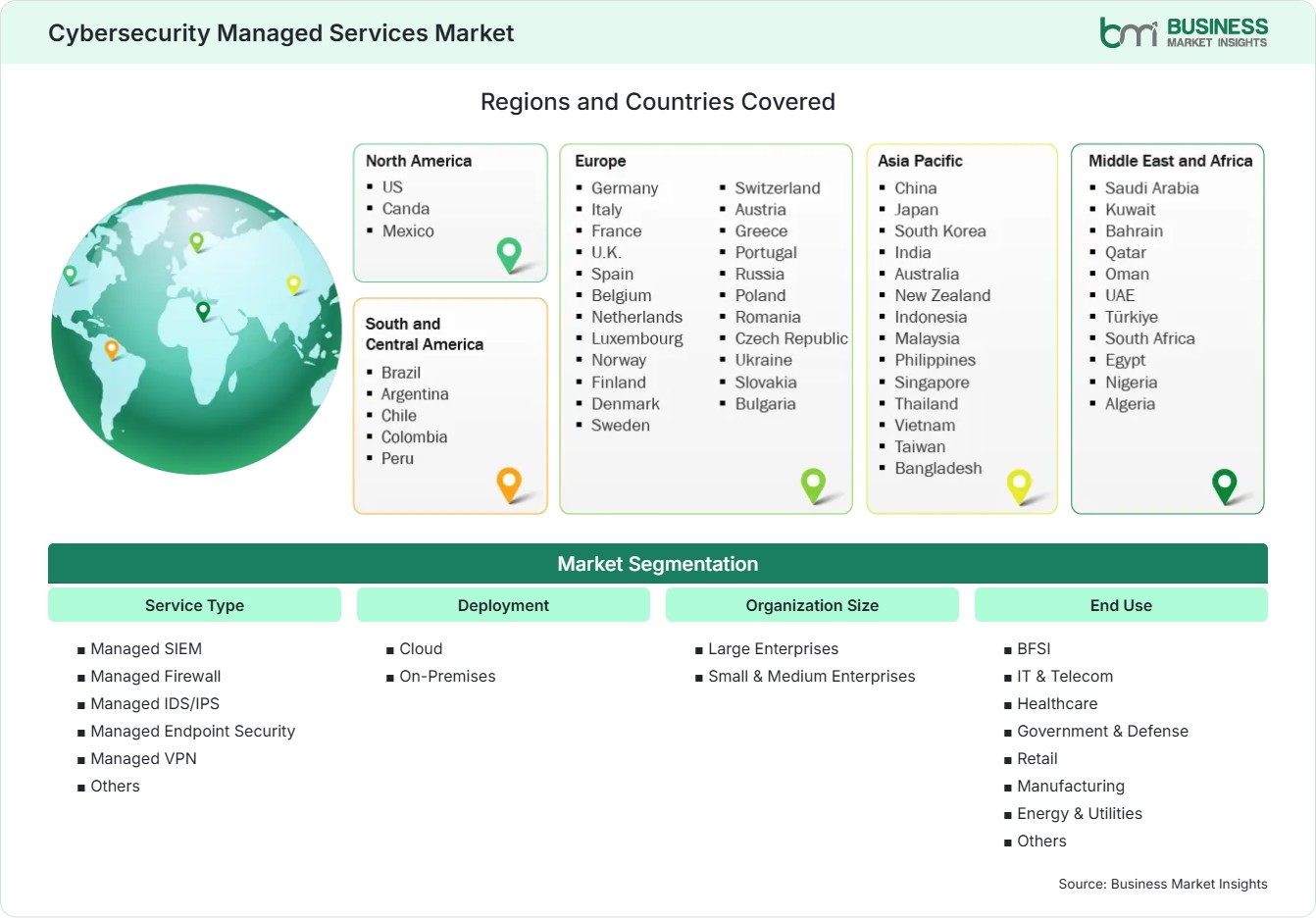
  • Service Type: Managed SIEM, Managed Firewall, Managed IDS/IPS, Managed Endpoint Security, Managed VPN, Others
  • Deployment: Cloud, On-Premises
  • Organization Size: Large Enterprises, Small & Medium Enterprises
  • End Use: BFSI, IT & Telecom, Healthcare, Government & Defense, Retail, Manufacturing, Energy & Utilities, Others
US$ 28.28 Bn Market size in 2025
US$ 100.00 Bn Market Size by 2033
17.10% CAGR, 2026 - 2033
2026-2033 Forecast Period

01 AI Overview

Cybersecurity Managed Services Market Summary

  • North America Region: North America accounts for approximately 36%–40% of the Cybersecurity Managed Services Market share in 2025 and is projected to grow at a 16.5%–17.5% CAGR during 2026–2033. Growth is supported by high cybersecurity spending, advanced cloud adoption, stringent data protection regulations, and increasing enterprise demand for outsourced security operations. The U.S. market benefits from strong managed security provider ecosystems and is estimated to grow at approximately 16.8%–17.8% CAGR.
  • Fastest Growing Region: Asia Pacific represents around 24%–28% of the global market in 2025 and is expected to expand at 18.0%–19.0% CAGR through 2033. Digital transformation, expanding cloud infrastructure, increasing cyber threats, and growing investments in cybersecurity capabilities are accelerating managed security adoption across enterprises.
  • Leading Segment: Managed SIEM holds approximately 28%–32% market share in 2025 and is expected to grow at a 17.0%–18.0% CAGR. Increasing security monitoring requirements, threat intelligence integration, compliance needs, and demand for centralized incident visibility are strengthening adoption among organizations.
  • High Growth Segment: Managed Endpoint Security represents approximately 18%–22% cybersecurity managed services market share in 2025 and is projected to grow at 18.5%–19.5% CAGR. Rising endpoint vulnerabilities, remote workforce expansion, ransomware threats, and advanced detection requirements are driving investment in managed endpoint protection services.
  • Key Market Opportunity: AI-enabled security operations, automated threat detection, outsourced cybersecurity management for SMEs, and managed detection and response services are creating opportunities for providers to deliver scalable protection against evolving cyber risks.
  • Major Market Players: IBM Corporation, Cisco Systems, Inc., Accenture plc, Deloitte Touche Tohmatsu Limited, Tata Consultancy Services Limited, Wipro Limited, AT&T Inc., Verizon Communications Inc., Secureworks Corp., and Trustwave Holdings, Inc.
02 Strategic Insights

Cybersecurity Managed Services Market: Strategic Insights

Cybersecurity Managed Services Market Strategic Framework
FREE PDF
Request your free sample
Request free sample
03 Stakeholder View

Key Takeaways

  • Managed security services are becoming a strategic component of enterprise cybersecurity frameworks as organizations shift from reactive protection models toward continuous monitoring and proactive threat management during cybersecurity managed services market forecasts.
  • Security information and event management, managed detection and response, and endpoint security services represent high-value opportunities due to increasing cyber threat complexity and demand for real-time protection.
  • Artificial intelligence, automation, behavioral analytics, and machine learning technologies are transforming security operations by improving threat identification, reducing response times, and increasing operational efficiency.
  • Asia Pacific provides strong growth potential due to rapid digitalization, expanding cloud adoption, increasing cybersecurity awareness, and growing investments in enterprise security infrastructure.
  • Technology providers and consulting firms are strengthening competitive positions through partnerships, acquisitions, managed security platform development, and expansion of global security operations centers.
  • The shortage of qualified cybersecurity professionals is increasing dependence on external providers capable of delivering specialized expertise, advanced tools, and continuous security management.
04 Geographic Outlook

Cybersecurity Managed Services Market Regional Highlights

North America Cybersecurity Managed Services Market

North America accounted for approximately 36%–40% of the global market in 2025 and is projected to grow at a 16.5%–17.5% CAGR during 2026–2033. The region maintains market leadership due to advanced enterprise cybersecurity adoption, high technology spending, and increasing demand for outsourced security operations. The Cybersecurity Managed Services Market share is strengthened by widespread cloud adoption, regulatory compliance requirements, and the presence of major managed security providers supporting organizations across industries.

  • The United States remains the largest contributor due to high cyber threat exposure, enterprise security investments, and increasing adoption of managed detection and response services.
  • Organizations are expanding security outsourcing strategies to address workforce shortages and improve access to specialized cybersecurity expertise.
  • Financial institutions, healthcare organizations, and government agencies are increasing managed security adoption due to strict data protection requirements.
  • Cloud security services are gaining traction as enterprises transition toward hybrid and multi-cloud environments requiring continuous monitoring capabilities.

US Cybersecurity Managed Services Market

The United States represented approximately 31%–35% of global market revenue in 2025 and is expected to expand at a 16.8%–17.8% CAGR through 2033. The country remains a major cybersecurity innovation hub due to high enterprise technology adoption, increasing ransomware incidents, and strong demand for advanced security operations. The Cybersecurity Managed Services Market growth is supported by government cybersecurity initiatives, cloud transformation programs, and rising investments in AI-enabled security platforms.

  • Enterprises are increasingly adopting managed security providers to strengthen threat detection capabilities and reduce dependence on internal cybersecurity teams.
  • Federal cybersecurity initiatives and industry regulations are encouraging organizations to improve monitoring, incident response, and compliance management.
  • Large technology companies and security providers are expanding security operations centers to deliver advanced managed services.

Europe Cybersecurity Managed Services Market

Europe accounted for approximately 25%–29% of the global cybersecurity managed services market in 2025 and is expected to grow at a 15.8%–16.8% CAGR between 2026 and 2033. Germany, the United Kingdom, France, and the Netherlands are major contributors due to strong enterprise cybersecurity awareness and regulatory requirements. Germany is estimated to grow at 16.0%–17.0% CAGR, while the United Kingdom is expected to expand at 16.2%–17.2% CAGR due to increasing managed security adoption across industries.

  • European organizations are increasing cybersecurity outsourcing due to stricter privacy regulations and growing compliance complexity.
  • GDPR requirements continue influencing investments in managed monitoring, data protection, and security incident management solutions.
  • Financial services and healthcare sectors are adopting managed security platforms to protect sensitive information and improve resilience.
  • Enterprises are investing in cloud security management as hybrid infrastructure adoption continues expanding across the region.

Asia Pacific Cybersecurity Managed Services Market

Asia Pacific accounted for approximately 24%–28% of the global Cybersecurity Managed Services Market in 2025 and represents the fastest-growing region with a projected 18.0%–19.0% CAGR during 2026–2033. China, India, Japan, South Korea, Singapore, and Australia are driving regional expansion through digital transformation, cloud migration, and increasing cybersecurity awareness. China is projected to grow at 18.2%–19.2% CAGR, while India is expected to expand at 19.0%–20.0% CAGR due to rapid enterprise digitization.

  • Increasing cyberattack frequency across emerging economies is encouraging organizations to adopt outsourced security monitoring and response solutions.
  • India is becoming a major managed security services hub due to expanding IT services capabilities and enterprise outsourcing demand.
  • Cloud adoption among businesses is accelerating demand for managed security solutions supporting distributed digital environments.
  • Government cybersecurity initiatives are encouraging organizations to strengthen protection of critical infrastructure and digital services.
  • Small and medium enterprises are increasingly adopting managed security services due to limited internal cybersecurity resources.

Rest of World Cybersecurity Managed Services Market

Latin America, the Middle East, and Africa collectively represented approximately 7%–10% of the global market in 2025 and are forecast to expand at a 16.5%–17.8% CAGR between 2026 and 2033. Brazil, Mexico, the UAE, Saudi Arabia, and South Africa are emerging markets due to increasing digital adoption, cloud infrastructure investments, and cybersecurity modernization initiatives. The Cybersecurity Managed Services Market trends in these regions reflect rising demand for affordable, scalable, and remotely managed security solutions.

  • Latin American organizations are increasing cybersecurity investments due to growing digital banking adoption and rising cybercrime concerns.
  • Middle Eastern countries are investing in cybersecurity capabilities as part of national digital transformation and critical infrastructure protection programs.
  • African enterprises are adopting managed security solutions to address limited cybersecurity expertise and improve digital resilience.
  • Saudi Arabia and the UAE are emerging as regional cybersecurity hubs through government-led technology modernization initiatives.
  • Managed security providers are expanding regional operations through partnerships with telecommunications companies and technology service organizations.
Global Market Geography
FREE PDF
Request your free sample
Request free sample
05 Segment Analysis

Cybersecurity Managed Services Market Segmentation

Service Type

Service Type represents the core segmentation category, accounting for approximately 72%–75% of the global Cybersecurity Managed Services Market share in 2025 and expanding at a 17.0%–17.8% CAGR between 2026 and 2034. Increasing cyber threat complexity, demand for continuous monitoring, and enterprise reliance on specialized security providers are driving adoption across managed SIEM, endpoint protection, firewall management, and detection services.

  • Managed SIEM: Managed SIEM remains the leading service category due to growing demand for centralized security monitoring, threat intelligence integration, compliance reporting, and real-time incident analysis.
  • Managed Firewall: Managed firewall services are gaining adoption as organizations require continuous network protection, policy management, and advanced filtering capabilities across hybrid IT environments.
  • Managed IDS/IPS: Managed intrusion detection and prevention services are expanding due to increasing network threats, sophisticated attack techniques, and demand for proactive security monitoring.
  • Managed Endpoint Security: This segment is experiencing strong growth due to increasing endpoint vulnerabilities, remote work expansion, ransomware threats, and the need for continuous device protection.
  • Managed VPN: Managed VPN services continue supporting secure remote connectivity as organizations operate distributed workforces and require protected access to enterprise resources.
  • Others: Other managed security services include vulnerability management, security consulting, cloud security monitoring, and specialized protection solutions addressing evolving enterprise cybersecurity requirements.

Deployment

Deployment segmentation accounted for approximately 65%–68% of market demand in 2025 and is projected to grow at a 17.5%–18.2% CAGR through 2034. Cloud adoption, hybrid infrastructure expansion, and increasing preference for scalable security solutions are influencing deployment strategies.

  • Cloud: Cloud-based managed security solutions represent the fastest-growing deployment model due to scalability, automated updates, reduced operational complexity, and increasing enterprise migration toward cloud platforms.
  • On-Premises: On-premises managed security services remain important among regulated industries requiring greater infrastructure control, customized security policies, and localized data management capabilities.

Organization Size

Organization Size segmentation reflects increasing cybersecurity requirements across enterprises of different scales. The segment accounted for approximately 60%–63% of market demand in 2025 and is expected to grow at a 17.0%–17.7% CAGR during 2026–2034. While large enterprises continue representing major demand due to complex IT environments, SMEs are increasingly adopting managed services to overcome cybersecurity skill shortages and cost limitations.

  • Large Enterprises: Large organizations maintain strong demand due to extensive digital infrastructure, regulatory obligations, complex security requirements, and the need for continuous enterprise-wide monitoring.
  • Small & Medium Enterprises: SMEs are adopting managed security services to access specialized cybersecurity expertise, improve protection against threats, and reduce the cost burden of maintaining internal security teams.

End Use

End Use segmentation accounted for approximately 78%–81% of the market structure in 2025 and is forecast to grow at a 17.1%–18.0% CAGR through 2034. Rising cybersecurity risks across industries, increasing compliance requirements, and expanding digital transformation initiatives are driving adoption across BFSI, healthcare, government, retail, manufacturing, and energy sectors.

  • BFSI: Financial institutions are major adopters due to high-value data protection needs, fraud prevention requirements, regulatory compliance, and increasing cyberattack risks.
  • IT & Telecom: Technology organizations require managed security services to protect complex networks, cloud infrastructure, customer data, and communication platforms from evolving threats.
  • Healthcare: Healthcare organizations are expanding cybersecurity investments to safeguard patient data, connected medical systems, and digital healthcare platforms against cyber incidents.
  • Government & Defense: Government agencies and defense organizations are adopting managed security solutions to protect critical infrastructure, sensitive information, and national security systems.
  • Retail: Retail businesses are implementing managed cybersecurity services to secure payment systems, customer information, e-commerce platforms, and connected retail technologies.
  • Manufacturing: Manufacturers are adopting managed security solutions to protect industrial networks, operational technology systems, and digitally connected production environments.
  • Energy & Utilities: Energy companies are investing in cybersecurity monitoring to secure critical infrastructure, smart grids, and operational systems from targeted cyber threats.
  • Others: Other industries are adopting managed security services to strengthen digital resilience, improve compliance readiness, and address increasing cybersecurity requirements.
06 Market Forces

Cybersecurity Managed Services Market Dynamics

Key Market Drivers

Increasing Frequency and Sophistication of Cyberattacks

Cyberattack frequency, sophistication, and associated costs have driven the uptake of managed cybersecurity services among firms. Firms are experiencing an increase in sophisticated cyberattacks such as ransomware, phishing, advanced persistent threats, and supply chain attacks, which need constant monitoring and prompt reaction measures. Ransomware and data breaches continue to cause losses for companies in key industries, according to industry cybersecurity analyses. The market size of Cybersecurity Managed Services is increasing due to the need for threat management, incident response, and security analytics.

Accelerating Cloud Migration Across Enterprise Environments

Rapid adoption of cloud computing, hybrid infrastructure, and distributed applications is driving the growing need for security solutions to protect complex digital environments. Businesses adopting workloads on public or private clouds need to monitor their environments continuously, protect identities, detect threats, and manage compliance requirements. Security solutions based in the cloud have become a necessity in light of the increasing number of remote activities and connected applications in businesses. Such trends are influencing the cybersecurity managed services market.

Growing Regulatory Compliance and Data Protection Requirements

Growing levels of cybersecurity regulations and industry compliance standards are driving companies to opt for managed security services. Governments across the globe have implemented strict frameworks to ensure data protection. Frameworks such as GDPR, security standards in specific sectors, and cybersecurity policies from countries have compelled companies to enhance their capabilities in monitoring, reporting, and handling incidents. Managed security firms provide companies with compliance assurance through continuous monitoring, reporting, and security assessment.

Key Market Opportunities

AI-Driven Security Operations and Automated Threat Detection

Artificial Intelligence and machine learning technologies are presenting substantial opportunities for managed cybersecurity vendors through better threat detection, automated responses, and security analysis. Managed security operations centers using AI can process massive amounts of data and detect abnormal behavior patterns as compared to traditional security monitoring techniques. Managed security systems are being developed to incorporate automation, behavioral analysis, and intelligent response mechanisms. The opportunities presented are significant, especially as companies look for fast response and less reliance on manual security procedures.

Increasing SME Demand for Outsourced Cybersecurity Services

The potential of small and medium-sized businesses is very high, as many companies lack an in-house security team or advanced technologies. Managed security services enable SMEs to have enterprise-level capabilities without having to make large investments in their own security infrastructures and workforce. The rising adoption of digital technologies by small businesses increases their vulnerability to cyberattacks, resulting in greater demand for cost-effective security solutions. Providers offering flexible subscription models, automated monitoring, and customized security packages can capture growing SME demand.

Expansion of Managed Detection and Response Services

Managed detection and response services are becoming a major opportunity as organizations require continuous threat hunting, investigation, and automated response capabilities. Unlike legacy security monitoring systems, MDR tools combine analytics, human intelligence, and threat discovery to enhance the effectiveness of cyber defense. With an increasing number of ransomware attacks, a growing remote workforce, and increasingly sophisticated attacks, companies are turning to MDR systems. Cybersecurity Managed Services Market Forecasts indicate strong growth prospects, as companies are increasingly inclined to proactively secure their networks rather than react to security incidents. Companies specializing in expanding MDR through artificial intelligence and other technologies will be able to capitalize on this trend.

Market Restraints and Challenges

Shortage of Skilled Cybersecurity Professionals

Factor: The global shortage of qualified cybersecurity professionals creates challenges for organizations attempting to build and maintain internal security teams with advanced technical capabilities. Impact: Limited availability of skilled experts increases operational pressure, extends threat response timelines, and encourages dependence on external managed security providers. While outsourcing helps address expertise gaps, providers themselves face challenges in recruiting and retaining specialized professionals with knowledge of cloud security, threat intelligence, and incident response.

High Cost of Advanced Managed Security Services

Factor: Advanced managed cybersecurity solutions involving AI platforms, security analytics, threat intelligence, and continuous monitoring require significant technology investments and specialized operational resources. Impact: High service costs can limit adoption among smaller organizations with restricted cybersecurity budgets. Although managed services reduce the need for internal infrastructure and staffing investments, premium solutions may remain challenging for cost-sensitive businesses.

07 Company Analysis

Competitive Landscape

The Cybersecurity Managed Services Market analysis indicates a competitive landscape shaped by global technology companies, consulting firms, telecommunications providers, and specialized cybersecurity vendors. Market participants are strengthening their capabilities through security operations center expansion, AI-enabled threat detection platforms, cloud security services, strategic partnerships, and managed detection and response offerings. Companies are increasingly focusing on automation, integrated security platforms, and industry-specific solutions to address growing enterprise demand for continuous cybersecurity protection.

Company Name

Overview

Products and Services relevant to this market

IBM Corporation

Global technology and consulting company offering enterprise cybersecurity solutions and managed security capabilities.

Managed security services, SIEM, threat intelligence, incident response, cloud security, and security operations solutions.

Cisco Systems, Inc.

Networking and cybersecurity provider delivering integrated security technologies for enterprises worldwide.

Managed security, firewall services, endpoint protection, threat intelligence, network security, and cloud security solutions.

Accenture plc

Global professional services company providing cybersecurity consulting and managed security operations.

Managed detection and response, security transformation, cloud security, identity management, and cyber resilience services.

Deloitte Touche Tohmatsu Limited

Global consulting organization offering cybersecurity advisory and managed protection services.

Security operations, risk management, compliance services, threat monitoring, and incident response solutions.

Tata Consultancy Services Limited

IT services provider delivering cybersecurity services across global enterprise markets.

Managed security services, SOC operations, cloud security, vulnerability management, and compliance solutions.

Wipro Limited

Technology services company providing cybersecurity solutions and managed protection services.

Managed SOC, endpoint security, identity protection, threat intelligence, and cloud security services.

AT&T Inc.

Telecommunications and technology provider offering enterprise cybersecurity services.

Managed security, network protection, threat monitoring, DDoS protection, and security operations solutions.

Verizon Communications Inc.

Communications technology company providing cybersecurity services for enterprises and government organizations.

Managed security services, threat intelligence, incident response, risk assessments, and security monitoring.

Secureworks Corp.

Cybersecurity company specializing in threat intelligence and managed detection services.

Managed detection and response, threat hunting, vulnerability management, and security analytics solutions.

Trustwave Holdings, Inc.

Cybersecurity provider focused on managed security and compliance services.

Managed SIEM, penetration testing, compliance management, database security, and threat detection services.

08 Industry Activity

Recent Developments

June 2026

Wipro expanded its partnership with Palo Alto Networks to deliver AI-driven Managed Detection and Response (MDR) services by integrating the Cortex XSIAM platform with Wipro's CyberShieldSM managed security capabilities. The solution enhances enterprise cyber resilience through AI-powered threat detection, automation, and rapid incident response across Wipro's global Cyber Defense Centers.

May 2026

WatchGuard Technologies, Inc. acquired Perimeters.io and simultaneously launched WatchGuard Cloud Detection and Response (CloudDR). The acquisition enhances WatchGuard's managed security platform with cloud application security, identity threat detection, and automated response capabilities designed specifically for managed service providers (MSPs).

May 2026

Securonix and GRAMAX Cybertech entered a managed security services partnership in India to deliver detection, investigation, and response services for critical and regulated industries. The collaboration strengthens managed detection and response capabilities through GRAMAX's Integrated Cyber Defence Centre powered by the Securonix Unified Defence SIEM platform.

January 2026

LevelBlue acquired Fortra's Alert Logic Managed Detection and Response (MDR) business through a long-term partnership, expanding its global managed security services portfolio with enhanced threat intelligence, telemetry, and cybersecurity capabilities while strengthening its position in the managed detection and response market.

10 Trust & Transparency

Research Methodology

The market analysis combines proprietary research with secondary data from government agencies, company disclosures, regulatory filings, industry databases and expert interviews. Market estimates are validated through data triangulation, cross-market benchmarking and analyst review.

View Full Research Methodology

11 Questions Answered

Frequently Asked Questions

Which industries are major users of managed cybersecurity services?

BFSI, healthcare, government, IT and telecom, retail, manufacturing, and energy sectors are major adopters due to sensitive data protection and compliance requirements.

How is artificial intelligence impacting managed security services?

AI improves threat detection, security analytics, automated response, and incident prioritization, helping managed service providers deliver faster and more efficient cybersecurity protection.

Why are organizations outsourcing cybersecurity operations?

Organizations outsource cybersecurity to access specialized expertise, advanced technologies, continuous monitoring capabilities, and cost-effective protection without maintaining large internal security teams.

Which managed security service segment has strong growth potential?

In the cybersecurity managed services market report, managed detection and response, managed SIEM, and endpoint security services are experiencing strong demand due to increasing threats and enterprise requirements for proactive security monitoring.

What is driving adoption of managed cybersecurity services?

Increasing cyberattack frequency, shortage of cybersecurity professionals, cloud migration, regulatory requirements, and the need for continuous threat monitoring are driving organizations toward managed security solutions.

Access the Full Cybersecurity Managed Services Market Report

Get segment-level forecasts, regional estimates, competitive benchmarking, company profiles and downloadable Excel datasets.

Access the full Cybersecurity Managed Services Market Report
350 pages PDF & Excel | 2026-07-31