
Location Based Services Market Outlook: Size, Share, Trends, Growth Analysis, Competitive Landscape & Forecast, 2026-2033

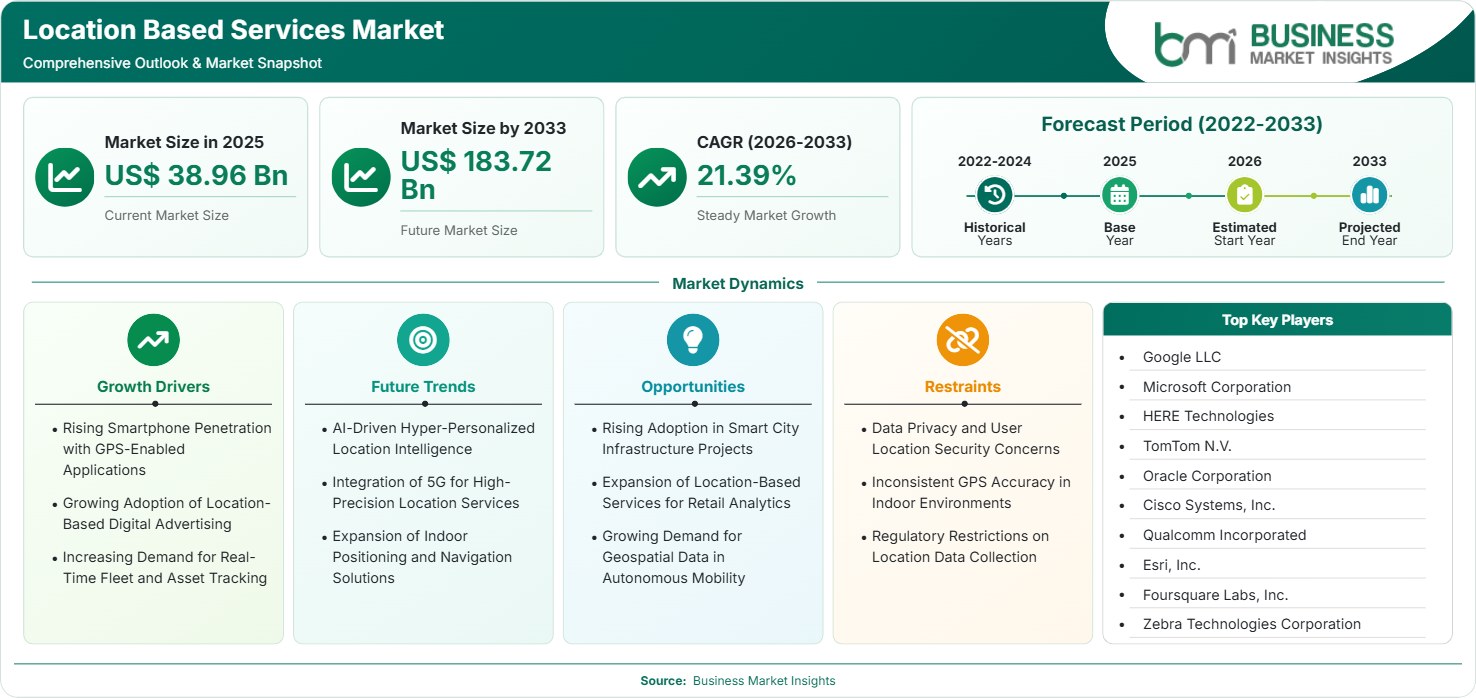
The Location Based Services Market size was valued at US$ 38.96 Billion in 2025 and is projected to reach US$ 183.72 Billion by 2033, growing at a CAGR of 21.39% during 2026–2033. Increasing smartphone penetration, growing deployment of connected devices, rising adoption of geospatial intelligence platforms, and expanding demand for indoor positioning technologies are creating significant growth opportunities across multiple industries.

Report Coverage
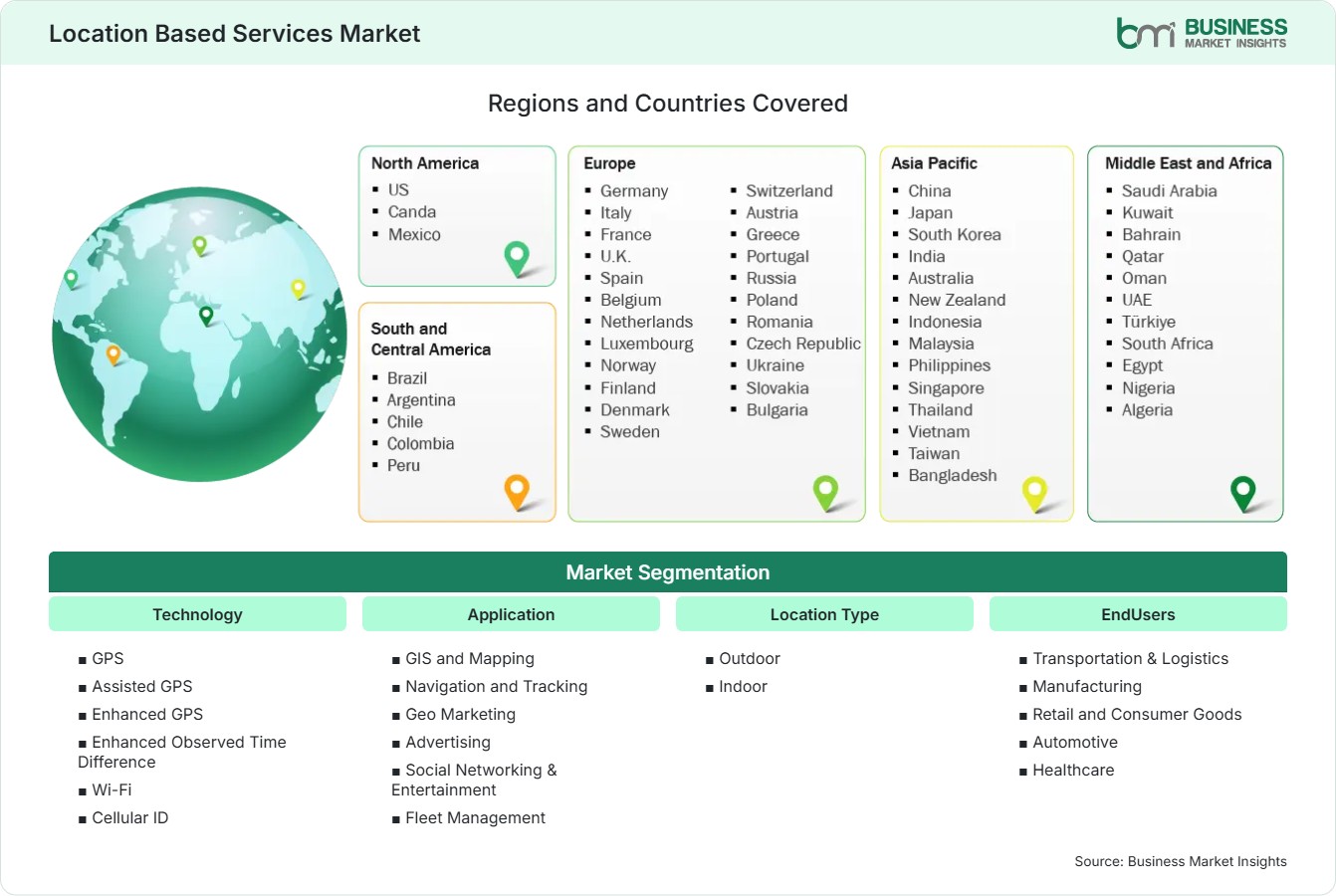
  • Technology: GPS, Assisted GPS, Enhanced GPS, Enhanced Observed Time Difference, Wi-Fi, Cellular ID
  • Application: GIS and Mapping, Navigation and Tracking, Geo Marketing, Advertising, Social Networking & Entertainment, Fleet Management
  • Location Type: Outdoor, Indoor
  • EndUsers: Transportation & Logistics, Manufacturing, Retail and Consumer Goods, Automotive, Healthcare
US$ 38.96 Bn Market size in 2025
US$ 183.72 Bn Market Size by 2033
21.39% CAGR, 2026 - 2033
2026-2033 Forecast Period

AI Overview

Location Based Services Market Summary

  • North America Region: North America holds a location based services market share of 34%–37% in 2025, growing with a CAGR of 19%–21% during 2026–2033. Advanced digital infrastructure, enterprise analytics adoption, connected mobility systems, cloud-based mapping technologies, and fleet digitization continue supporting market expansion.
  • Fastest Growing Region: Asia Pacific accounts for 27%–30% share in 2025 and is expected to grow at a CAGR of 24%–26% during 2026–2033. Smart city programs, digital commerce growth, telecommunications expansion, rising smartphone penetration, and increasing use of location-aware applications continue accelerating market development.
  • Leading Segment: Navigation and Tracking represents 29%–32% share in 2025 and is projected to grow at a CAGR of 21%–23% through 2033. Logistics visibility requirements, connected transportation networks, fleet modernization programs, route optimization needs, and telematics adoption continue strengthening demand.
  • High Growth Segment: Indoor location type accounts for 21%–24% share in 2025 and is forecast to grow at a CAGR of 25%–27% during 2026–2033. Smart buildings, healthcare asset monitoring, warehouse automation, airport navigation systems, and retail engagement applications are driving rapid deployment.
  • Key Market Opportunity: Enterprise demand for integrated location intelligence platforms combining artificial intelligence, IoT connectivity, predictive analytics, and digital mapping capabilities is creating scalable revenue opportunities across industries worldwide.
  • Major Market Players: HERE Technologies, IndoorAtlas Oy, Mapbox Inc., Environmental Systems Research Institute, Inc. (Esri), Google LLC, IBM Corporation, Cisco Systems, Inc., Maxar Technologies Inc., ALE International, Qualcomm Technologies, Inc.
Strategic Insights

Location Based Services Market: Strategic Insights

Location Based Services Market Strategic Framework
FREE PDF
Request your free sample
Request free sample
Stakeholder View

Key Takeaways

  • The value chain is becoming increasingly interconnected as mapping providers, satellite operators, telecom companies, IoT vendors, analytics firms, and cloud providers collaborate on integrated geospatial solutions.
  • Navigation and tracking applications generate the largest revenue due to rising demand for transportation visibility, delivery optimization, and fleet management.
  • Artificial intelligence is transforming products through predictive routing, behavior analysis, contextual recommendations, and automated geospatial decision support.
  • Location based services market forecast suggest that the Asia Pacific offers strong investment potential driven by urbanization, digital commerce, smart cities, and mobile connectivity.
  • Strategic partnerships expand capabilities, geographic reach, and service portfolios.
  • Indoor positioning technologies are emerging as a key growth area, improving operational efficiency, asset utilization, safety, and customer engagement.
Geographic Outlook

Location Based Services Market Regional Highlights

North America Location Based Services Market

North America accounts for 34%–37% Location Based Services Market share in 2025 and is projected to expand at a CAGR of 19%–21% through 2033. Strong enterprise technology spending, mature telecommunications infrastructure, advanced cloud adoption, and high penetration of connected mobility platforms support regional leadership. Businesses increasingly deploy location intelligence solutions across logistics, retail, healthcare, transportation, and public infrastructure applications.

  • Connected vehicle deployments continue increasing demand for advanced navigation, real-time tracking, telematics integration, and mobility analytics solutions throughout transportation networks.
  • Retail organizations increasingly leverage spatial intelligence to improve store planning, personalize customer interactions, strengthen local marketing campaigns, and optimize operational performance.
  • Cloud-based GIS platforms are enabling enterprises to incorporate geospatial data into strategic planning, risk management, asset monitoring, and resource allocation processes.
  • Government investments in intelligent transportation infrastructure and emergency response modernization continue supporting implementation of advanced positioning technologies.

US Location Based Services Market

The United States contributes approximately 76%–80% of North American location based services market revenue and is expected to register a CAGR of 19.5%–21.5% during the forecast period. Strong cloud infrastructure, high smartphone adoption, advanced mobility ecosystems, and substantial technology investments continue supporting industry development. The presence of leading software providers, mapping companies, and geospatial analytics innovators accelerates product commercialization.

  • Technology companies continue integrating geospatial intelligence with AI and IoT frameworks to enhance business automation and operational decision-making.
  • Transportation modernization initiatives are increasing demand for route optimization, mobility management, and real-time location visibility platforms.
  • Fleet operators continue investing in location-enabled systems to improve resource utilization, delivery performance, safety management, and fuel efficiency.
  • Smart city projects are supporting deployment of advanced positioning technologies across traffic management, emergency response, and infrastructure monitoring applications.

Europe Location Based Services Market

Europe represents 24%–27% of global revenue in 2025 and is forecast to grow at a CAGR of 20%–22% through 2033. Growing investments in industrial digitization, intelligent transportation systems, and infrastructure modernization continue supporting location based services market expansion. Enterprises increasingly integrate geospatial intelligence into logistics management, industrial automation, and asset optimization initiatives. Germany remains the leading regional contributor because of its strong industrial and automotive base.

  • Germany maintains regional leadership through advanced manufacturing capabilities, connected mobility innovation, and strong investments in industrial technology.
  • Poland is among the fastest-growing markets with an estimated CAGR of 22%–24%, supported by warehouse development and transportation modernization projects.
  • Logistics providers increasingly utilize fleet optimization and route-planning technologies to improve service efficiency and cost management.
  • Public-sector digitalization programs are encouraging broader adoption of intelligent mobility systems and geospatial monitoring solutions.

Asia Pacific Location Based Services Market

Asia Pacific accounts for 27%–30% of total revenue in 2025 and is anticipated to achieve the fastest CAGR of 24%–26% through 2033. Rapid urbanization, expanding digital ecosystems, smart city initiatives, and increasing mobile internet adoption are supporting regional growth. Governments and enterprises continue investing in connected transportation systems, digital infrastructure, and intelligent public services. China remains the largest regional market due to extensive technology deployment.

  • China leads regional adoption through smart city implementation, digital mobility ecosystems, and large-scale deployment of connected technologies.
  • India is expected to record approximately 26%–28% CAGR, supported by expanding telecommunications infrastructure and accelerating technology modernization initiatives.
  • Rapid growth of e-commerce logistics is creating substantial demand for route optimization and real-time tracking applications.

Rest of World Location Based Services Market

Rest of World accounts for 10%–13% of total revenue in 2025 and is expected to expand at a CAGR of 21%–23% through 2033. South and Central America are benefiting from digital commerce growth, transportation modernization, and expanding logistics networks. Meanwhile, Middle East and Africa markets are witnessing increased technology adoption driven by infrastructure development and smart city investments.

  • Brazil remains a significant contributor due to expanding e-commerce activity and increasing investments in logistics visibility technologies.
  • The United Arab Emirates continues deploying geospatial intelligence platforms across transportation, tourism, public services, and urban infrastructure applications.
  • Saudi Arabia is projected to achieve approximately 23%–25% CAGR, supported by smart city development and technology-led economic diversification strategies.
  • Mining, energy, and infrastructure organizations increasingly deploy real-time tracking technologies to improve safety and operational visibility.
Global Market Geography
FREE PDF
Request your free sample
Request free sample
Segment Analysis

Location Based Services Market Segmentation

Technology

The technology segment forms the foundation of industry development by enabling precise positioning, navigation, tracking, and location intelligence capabilities across enterprise and consumer applications. This segment accounts for approximately 27%–30% share in 2025 and is projected to grow at a CAGR of 21%–23% through 2033. Continued investments in satellite navigation infrastructure, Wi-Fi positioning, cellular triangulation, and hybrid location technologies are expanding the Location Based Services Market scope across transportation, retail, healthcare, logistics, and smart city deployments.

  • GPS: GPS remains the dominant positioning technology for outdoor navigation, route optimization, and asset tracking applications, supported by global satellite coverage, device compatibility, and increasing demand from transportation and logistics sectors.
  • Assisted GPS: Assisted GPS improves positioning speed and accuracy by combining satellite signals with cellular network support, making it highly suitable for smartphone applications and urban deployment environments.
  • Enhanced GPS: Enhanced GPS solutions provide higher location precision for advanced transportation, public safety, industrial monitoring, and enterprise mobility applications requiring reliable positioning capabilities.
  • Enhanced Observed Time Difference: Enhanced Observed Time Difference technology utilizes cellular network measurements to improve positioning accuracy, particularly in urban areas where satellite signal limitations can affect performance.
  • Wi-Fi: Wi-Fi positioning is increasingly adopted for indoor navigation, retail analytics, healthcare facilities, airports, and commercial buildings where satellite-based positioning may have limited effectiveness.
  • Cellular ID: Cellular ID technology offers cost-effective location determination by utilizing nearby cellular towers, supporting emergency services, location-based notifications, and basic tracking applications across broad coverage areas.

Application

Application-based adoption continues expanding as enterprises increasingly leverage location intelligence to improve operational efficiency, customer engagement, and decision-making capabilities. This segment accounts for approximately 29%–32% share in 2025 and is expected to grow at a CAGR of 22%–24% through 2033. Current Location Based Services Market trends indicate rising demand for analytics-driven solutions capable of delivering real-time visibility, contextual insights, and improved customer experiences across several industries.

  • GIS and Mapping: GIS and mapping applications support urban planning, infrastructure management, environmental monitoring, and business intelligence activities through accurate geospatial visualization and analysis capabilities.
  • Navigation and Tracking: Navigation and tracking remains the largest application area, driven by fleet visibility requirements, route optimization initiatives, transportation efficiency goals, and connected mobility adoption.
  • Geo Marketing, and Advertising: Geo-marketing solutions help organizations deliver personalized customer experiences, location-based promotions, and targeted advertising campaigns that improve engagement and conversion performance.
  • Social Networking & Entertainment: Social networking and entertainment platforms increasingly leverage location data to enable content personalization, user engagement, event discovery, and real-time social interaction experiences.
  • Fleet Management: Fleet management applications support vehicle monitoring, route planning, maintenance scheduling, driver performance analysis, and operational visibility across transportation and logistics networks.

Location Type

Location type segmentation is evolving as organizations require seamless positioning capabilities across both indoor and outdoor environments. This segment represents approximately 24%–27% share in 2025 and is forecast to expand at a CAGR of 23%–25% through 2033.

  • Outdoor: Outdoor deployments continue accounting for the majority of implementations due to widespread utilization in navigation, transportation management, logistics tracking, and geospatial mapping applications.
  • Indoor: Indoor positioning is witnessing accelerated adoption across airports, hospitals, retail stores, warehouses, and smart buildings where precise real-time visibility offers substantial operational advantages.

End-Users

End-user demand continues broadening as digital transformation initiatives increase reliance on real-time geospatial intelligence and location-aware decision support systems. The segment accounts for approximately 26%–29% share in 2025 and is projected to grow at a CAGR of 22%–24% during the forecast period.

  • Transportation & Logistics: Transportation and logistics organizations utilize location intelligence extensively for fleet optimization, shipment tracking, route planning, and supply chain visibility enhancement.
  • Manufacturing: Manufacturing facilities increasingly implement positioning solutions for workforce monitoring, equipment tracking, operational coordination, and industrial automation initiatives.
  • Retail and Consumer Goods: Retail and consumer goods companies leverage location analytics for customer engagement, site selection, traffic analysis, inventory optimization, and targeted promotional activities.
  • Automotive: Automotive companies incorporate positioning technologies into connected vehicle platforms, mobility services, navigation systems, telematics solutions, and autonomous driving development programs.
  • Healthcare: Healthcare providers deploy location-based solutions for patient navigation, asset tracking, staff coordination, emergency response support, and operational efficiency improvements.
Market Forces

Location Based Services Market Dynamics

Key Market Drivers

Rising Smartphone Penetration with GPS-Enabled Applications

Smartphones with sophisticated GPS chipsets being used widely continue creating more demand for location-based applications around the world. Today’s mobile phone customers utilize applications in such categories as navigation, ride hailing, food delivery, social media, online payments, travel services, and location search that need good positioning capabilities. Coverage expansion of 4G and 5G networks is also contributing to greater efficiency and improved user experience of location-based services. As smartphone ownership continues increasing across emerging economies, demand for advanced positioning technologies and geospatial analytics platforms is expected to remain a major contributor to location based services market expansion.

Growing Adoption of Location-Based Digital Advertising

The use of location intelligence by businesses has become common to help them run very personalized advertisements based on the customer’s location, patterns, and other preferences. Geo targeting advertisements help the brands create very effective campaigns since they target the right people in the right locations. Businesses that sell goods such as retail businesses, restaurants, entertainers, and services are using location analysis in their marketing campaigns to boost their conversions and increase customer engagement. There is high adoption of location-based advertising solutions in various industry sectors.

Increasing Demand for Real-Time Fleet and Asset Tracking

Logistics, transportation, manufacturing, construction, and utilities organizations are emphasizing real-time tracking of vehicles, people, and assets. Tracking technology is used to increase efficiency, save fuel, optimize use of assets, and improve decision-making ability. Increased use of e-commerce services has put more pressure on logistics firms to offer visibility in shipments and quick deliveries. The increased adoption of sensors, telematics technology, and fleet management systems in the cloud is continuing to drive the demand for highly accurate positioning solutions.

Key Market Opportunities

Rising Adoption in Smart City Infrastructure Projects

Governments around the world are making huge investments in smart transportation systems, intelligent traffic control, connected services, and digital urban infrastructure. This will require strong geospatial technologies that can support real-time decision making and operations management. The need for location intelligence is emerging in relation to urban mobility planning, emergency management, infrastructure management, and public safety management. Long-term Location Based Services Market Forecasts remain supported by increasing public-sector spending on digital transformation projects designed to enhance sustainability, efficiency, and quality of life in rapidly expanding urban centers.

Expansion of Location-Based Services for Retail Analytics

Location analytics is becoming more popular among retail businesses to understand customers’ movement patterns, optimize store layout, place products effectively, and engage in customer experience improvement. Proximity marketing and footfall analysis allow businesses to personalize marketing campaigns and customer experience at the same time. The growing trend toward omnichannel retailing is increasing the importance of location intelligence to understand both offline and online customer behavior. Companies providing integrated location analytics solutions and customer insight platforms are poised to gain a competitive edge in the retail space.

Growing Demand for Geospatial Data in Autonomous Mobility

The evolution of autonomous vehicles, advanced driver assistance systems, and connected transportation ecosystems is creating substantial demand for high-precision geospatial information. Autonomous mobility platforms require detailed mapping data, real-time positioning intelligence, and advanced navigation capabilities to operate safely and efficiently. Automotive manufacturers, technology companies, and mobility providers continue investing in next-generation location technologies to improve vehicle awareness and route accuracy. As autonomous mobility continues advancing, demand for reliable and scalable geospatial data solutions is expected to accelerate significantly.

Market Restraints and Challenges

Data Privacy and User Location Security Concerns

Factor: Growing collection and processing of user location data have increased concerns regarding privacy protection, data ownership, and regulatory compliance across multiple jurisdictions. Organizations must comply with evolving regulations governing data collection, storage, and usage while maintaining consumer trust. Impact: Privacy concerns can limit user willingness to share location information and create additional compliance costs for service providers. Regulatory scrutiny may also increase operational complexity and delay deployment of new applications. As businesses expand location-enabled offerings, balancing innovation with robust cybersecurity measures and transparent data governance frameworks remains a critical challenge affecting adoption across both consumer and enterprise environments.

Inconsistent GPS Accuracy in Indoor Environments

Factor: Traditional GPS signals often experience limitations inside commercial buildings, transportation hubs, healthcare facilities, and industrial environments due to physical obstructions and signal interference. This creates challenges for applications requiring highly accurate indoor positioning capabilities. Impact: Inconsistent location accuracy can affect operational efficiency, user experience, and technology reliability, particularly in mission-critical applications. Organizations frequently need to deploy supplementary technologies such as Wi-Fi positioning, Bluetooth beacons, ultra-wideband systems, and sensor fusion platforms to address these limitations.

Company Analysis

Competitive Landscape

The Location Based Services Market analysis highlights increasing competition among mapping providers, geospatial intelligence companies, positioning technology specialists, cloud platform vendors, and mobility solution providers. Market participants are focusing on improving positioning accuracy, expanding indoor mapping capabilities, strengthening AI-powered spatial analytics, and developing integrated location intelligence platforms.

Company Name

Overview

Products and Services relevant to this market

HERE Technologies

Global provider of location intelligence solutions supporting automotive, transportation, logistics, and enterprise geospatial applications through advanced digital mapping capabilities.

Digital maps, location APIs, navigation platforms, mobility intelligence, fleet optimization solutions, geospatial analytics, and connected vehicle mapping services.

IndoorAtlas Oy

Specialist in indoor positioning technologies utilizing geomagnetic and sensor-based navigation solutions for complex indoor environments.

Indoor positioning systems, indoor navigation software, asset tracking solutions, location analytics, and smart building navigation platforms.

Mapbox Inc.

Developer-focused mapping technology company delivering scalable location services and customizable geospatial platforms across industries.

Mapping APIs, navigation tools, geocoding services, route optimization software, mobile location platforms, and developer mapping solutions.

Environmental Systems Research Institute, Inc. (Esri)

Leading provider of GIS technologies serving government, commercial, infrastructure, and environmental organizations globally.

Geographic information systems, spatial analytics, geospatial visualization, mapping software, location intelligence platforms, and enterprise GIS solutions.

Google LLC

Major technology company offering extensive location services through global digital mapping infrastructure and cloud-enabled platforms.

Google Maps Platform, geolocation APIs, navigation services, geocoding tools, mobility solutions, and location-based application services.

IBM Corporation

Enterprise technology provider integrating AI, analytics, and geospatial intelligence capabilities into business operations and decision-making platforms.

AI-powered analytics, geospatial data integration, location intelligence solutions, cloud services, and enterprise operational optimization platforms.

Cisco Systems, Inc.

Technology company utilizing network infrastructure and wireless technologies to support indoor location and connected environment solutions.

Cisco Spaces, network analytics, Wi-Fi positioning, asset visibility platforms, workplace intelligence, and indoor location services.

Maxar Technologies Inc.

Provider of geospatial intelligence and earth observation solutions supporting defense, infrastructure, and commercial applications.

Satellite imagery, geospatial analytics, 3D mapping solutions, location intelligence services, and earth observation platforms.

ALE International

Communications and networking solutions provider supporting enterprise mobility and location-aware workplace environments.

Enterprise networking, Wi-Fi infrastructure, location services integration, digital workplace solutions, and connected environment technologies.

Qualcomm Technologies, Inc.

Semiconductor and wireless technology company supporting precise positioning and connected mobility applications through advanced chipset technologies.

GNSS technologies, positioning chipsets, connectivity platforms, IoT solutions, automotive technologies, and location-enabled mobile systems.

Trust & Transparency

Research Methodology

The market analysis combines proprietary research with secondary data from government agencies, company disclosures, regulatory filings, industry databases and expert interviews. Market estimates are validated through data triangulation, cross-market benchmarking and analyst review.

View Full Research Methodology

Questions Answered

Frequently Asked Questions

Which end-user industries are expected to generate significant revenue opportunities?

Transportation & logistics, retail and consumer goods, automotive, manufacturing, and healthcare sectors are expected to generate substantial opportunities due to increasing investments in location intelligence, and real-time analytics capabilities.

What does this Location Based Services Market Report cover?

This report covers technology trends, application analysis, location type assessment, end-user evaluation, regional developments, competitive benchmarking, and strategic growth opportunities influencing industry expansion from 2026 to 2033.

How are indoor positioning technologies influencing industry adoption?

Indoor positioning technologies are improving asset tracking, workforce visibility, customer navigation, and operational efficiency within hospitals, airports, warehouses, retail stores, and smart buildings.

Which region presents the strongest growth potential during the forecast period?

Asia Pacific is expected to remain the fastest-growing regional market due to rapid urbanization, expanding smartphone adoption, smart city investments, and increasing deployment of location-enabled digital services across major economies including China and India.

What are the primary applications driving demand across the location based services market?

Key applications include navigation and tracking, GIS and mapping, geo-marketing and advertising, fleet management, and social networking platforms. Transportation, logistics, retail, and healthcare sectors remain among the largest adopters due to their need for real-time location visibility and operational optimization.

Access the Full Location Based Services Market Report

Get segment-level forecasts, regional estimates, competitive benchmarking, company profiles and downloadable Excel datasets.

Access the full Location Based Services Market Report
350 pages PDF & Excel | 2026-08-07
Similar Research

Related Market Reports