
Location Based Entertainment Market Outlook: Size, Share, Trends, Growth Analysis, Competitive Landscape & Forecast, 2026-2033

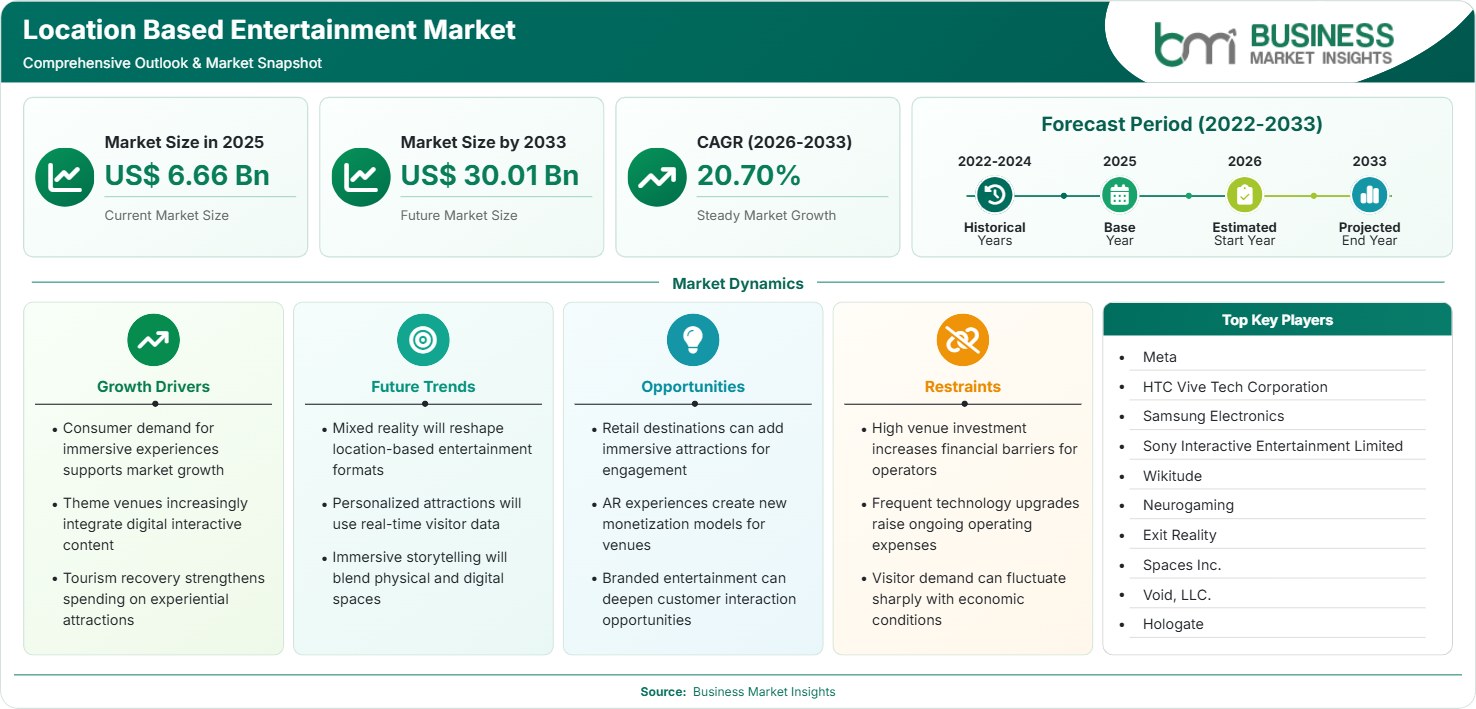
The Location Based Entertainment Market was valued at US$ 6.66 billion in 2025 and is projected to reach US$ 30.01 billion by 2033, growing at a CAGR of 20.70% during 2026–2033. Consumer demand for immersive experiences, digital attraction integration, retail diversification, tourism activity, and technology-enabled entertainment formats supports expansion across multiple venue types.

Report Coverage
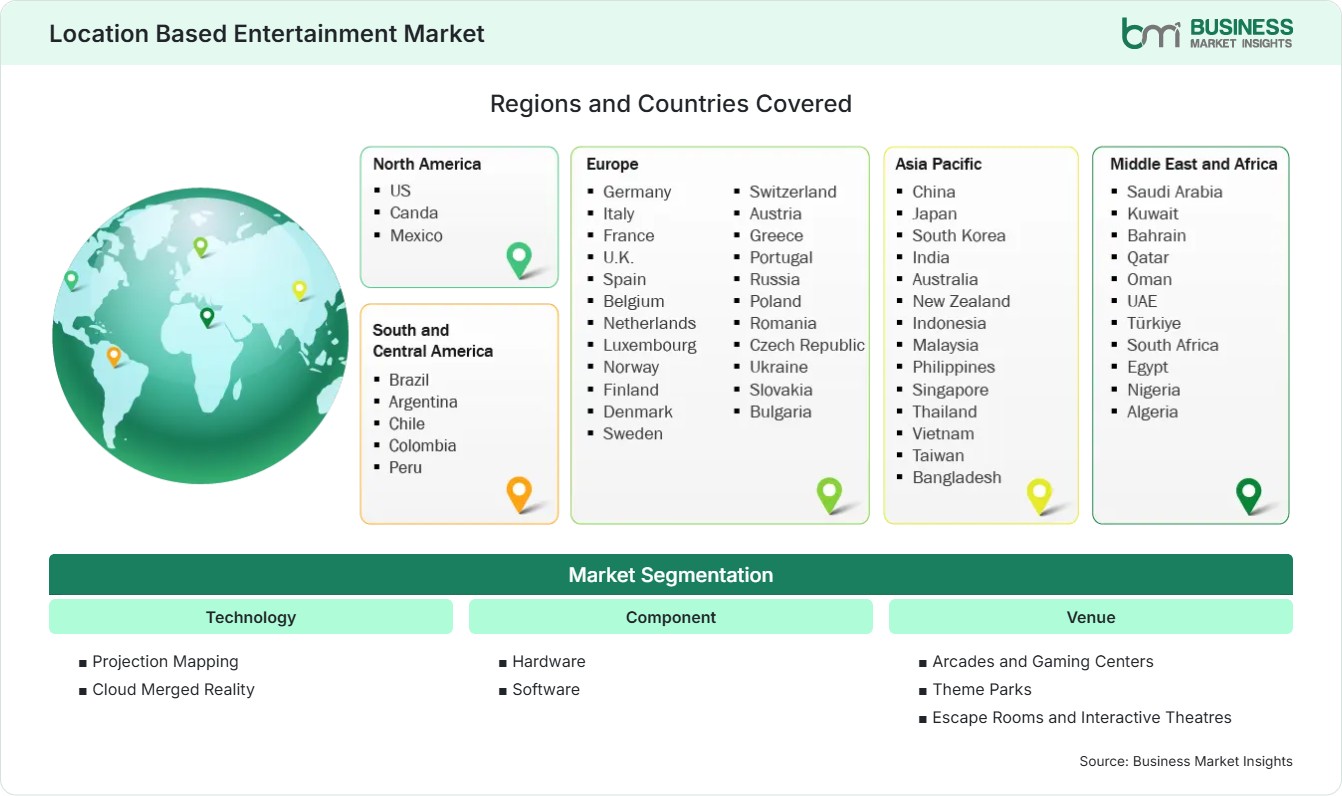
  • Technology: Projection Mapping, Cloud Merged Reality
  • Component: Hardware, Software
  • Venue: Arcades and Gaming Centers, Theme Parks, Escape Rooms and Interactive Theatres
US$ 6.66 Bn Market size in 2025
US$ 30.01 Bn Market Size by 2033
20.70% CAGR, 2026 - 2033
2026-2033 Forecast Period

01 AI Overview

Location Based Entertainment Market Summary

  • North America Region: North America is estimated to hold a 32%–35% share in 2025, with a 19.0%–21.0% CAGR during 2026–2033. Established entertainment infrastructure, gaming culture, theme parks, retail destinations, immersive attractions, and technology adoption create a strong foundation for continued venue innovation and investment. The U.S. represents the region's principal market, supported by diversified entertainment infrastructure and adoption of immersive technologies.
  • Fastest Growing Region: Asia Pacific is estimated to account for a 24%–27% share in 2025, with a 22.0%–24.0% CAGR during 2026–2033. Urban entertainment development, tourism, shopping-center investment, gaming culture, digital technology adoption, and rising interest in interactive leisure experiences create opportunities for new venue formats.
  • Leading Segment: Theme Parks are estimated to represent a 38%–41% share in 2025, with a 19.0%–21.0% CAGR during 2026–2033. High visitor capacity, established infrastructure, immersive storytelling, digital attraction integration, branded experiences, and technology-enhanced rides support the segment's leading position.
  • High Growth Segment: Cloud Merged Reality is estimated to hold a 22%–25% share in 2025, with a 23.0%–25.0% CAGR during 2026–2033. Connected environments, centralized content management, multiplayer interaction, software-driven updates, scalable deployment, and integration between physical and digital spaces support adoption.
  • Key Market Opportunity: Retail destinations can incorporate immersive attractions into underutilized areas, combining ticketing, entertainment, merchandise, food, sponsorship, branded content, and social interaction to create diversified visitor engagement and additional commercial value.
  • Major Market Players: Meta; HTC Vive Tech Corporation; Samsung Electronics; Sony Interactive Entertainment Limited; Wikitude; Neurogaming; Exit Reality; Spaces Inc.; Void, LLC.; Hologate.
02 Strategic Insights

Location Based Entertainment Market: Strategic Insights

Location Based Entertainment Market Strategic Framework
FREE PDF
Request your free sample
Request free sample
03 Stakeholder View

Key Takeaways

  • The ecosystem spans immersive hardware, software, content development, venue operations, property ownership, entertainment licensing, system integration, and visitor services. Competitive positioning increasingly depends on how effectively these components operate together.
  • Theme parks provide large-scale deployment opportunities, while arcades, gaming centers, escape rooms, interactive theatres, retail properties, and hospitality venues offer additional pathways for immersive entertainment adoption.
  • Software-controlled environments, projection, cloud-connected systems, interactive interfaces, spatial technologies, and virtual or mixed-reality platforms are broadening the range of experiences that physical venues can provide.
  • Asia Pacific offers an attractive expansion environment because urban entertainment development, tourism, gaming culture, shopping destinations, and technology-oriented consumer experiences can support multiple attraction concepts.
  • Operators need to assess capital expenditure, visitor throughput, equipment lifecycle, content refresh requirements, staffing, maintenance, pricing, and revenue diversification when evaluating immersive attraction projects.
  • Attractions capable of changing digital content without extensive reconstruction can support seasonal programming, new narratives, entertainment partnerships, branded experiences, and repeat visitation.
04 Geographic Outlook

Location Based Entertainment Market Regional Highlights

North America Location Based Entertainment Market

North America is estimated to hold a 32%–35% Location Based Entertainment Market share in 2025, with a 19.0%–21.0% CAGR during 2026–2033. Established theme parks, gaming venues, immersive attractions, shopping destinations, and entertainment districts provide a broad deployment base. Operators can upgrade existing facilities with digital content, interactive systems, projection environments, and virtual experiences. The region's diversified venue ecosystem also supports experimentation across family entertainment, gaming, branded attractions, interactive theatres, and premium experiences. The Location Based Entertainment Market share reflects this established commercial infrastructure and technology adoption.

  • Established entertainment infrastructure provides multiple deployment opportunities for immersive systems, allowing operators to integrate digital experiences into existing attractions rather than relying exclusively on new venue construction.
  • Retail destinations can introduce immersive rooms, gaming centers, and interactive attractions to diversify visitor activity while complementing restaurants, cinemas, merchandise stores, and conventional shopping.
  • Gaming culture supports multiplayer experiences combining physical participation and digital interaction, creating opportunities for competitive formats, social entertainment, recurring visits, and rotating content.
  • Branded attractions can combine recognizable intellectual property with immersive environments, enabling operators to connect admission revenue with merchandise, food, sponsorship, licensing, and premium experiences.

US Location Based Entertainment Market

The U.S. is estimated to represent 70%–73% of North American demand in 2025, with a 19.5%–21.5% CAGR during 2026–2033. The market benefits from diversified entertainment infrastructure spanning theme parks, gaming centers, immersive exhibitions, escape rooms, interactive theatres, and technology-led attractions. Established operators can test new concepts across urban locations and destination venues.

  • Urban entertainment districts provide opportunities for smaller-footprint immersive attractions positioned near consumers, particularly within shopping centers, mixed-use properties, hospitality developments, and established leisure clusters.
  • Technology suppliers can collaborate with venue operators through integrated hardware, software, content, maintenance, analytics, and platform offerings designed around individual attraction requirements.
  • Interactive theatres and escape rooms can combine projection, digital storytelling, physical environments, spatial audio, and participation to create differentiated experiences without traditional amusement-park infrastructure.

Europe Location Based Entertainment Market

Europe is estimated to account for a 25%–28% Location Based Entertainment Market share in 2025, with a 19.0%–21.0% CAGR during 2026–2033. Theme parks, cultural attractions, gaming venues, retail centers, tourism destinations, and immersive exhibitions create varied applications. The United Kingdom, Germany, France, Italy, and Spain provide diverse commercial environments for interactive entertainment. Tourism-oriented destinations can combine immersive attractions with cultural storytelling, hospitality, dining, and shopping.

  • The United Kingdom provides opportunities for immersive theatre, gaming, experiential retail, interactive attractions, and entertainment concepts positioned within established urban leisure environments.
  • France can integrate immersive technology into tourism, cultural attractions, theme parks, retail destinations, and entertainment facilities where storytelling can strengthen visitor engagement.
  • Germany provides opportunities across gaming centers, family entertainment, exhibitions, and technology-focused leisure facilities that combine physical participation with digital content.
  • Italy and Spain can connect immersive entertainment with tourism by presenting cultural, historical, entertainment, and destination-specific stories through interactive digital environments.

Asia Pacific Location Based Entertainment Market

Asia Pacific is estimated to hold a 24%–27% Location Based Entertainment Market share in 2025, with a 22.0%–24.0% CAGR during 2026–2033. Opportunities exist in China, Japan, India, South Korea, Australia, and the markets of Southeast Asia in the areas of theme parks, shopping malls, gaming sites, tourism spots, and interactive entertainment. Urbanization provides the foundation for leisure infrastructure creation, while the already existing culture of gaming motivates engagement-based entertainment. The localized content could increase the relevancy of attraction, while technology-based entertainment offers differentiating possibilities.

  • China provides opportunities across large entertainment destinations, shopping complexes, gaming facilities, tourism developments, and technology-enabled attractions designed around high visitor volumes.
  • Japan combines established entertainment culture with advanced technology adoption, supporting interactive theatres, gaming venues, immersive exhibitions, theme parks, and specialized digital entertainment.
  • India provides opportunities across shopping centers, family entertainment facilities, gaming venues, tourism destinations, and branded attractions as urban leisure ecosystems continue diversifying.
  • South Korea supports technology-intensive entertainment through gaming engagement, digital content, interactive experiences, and consumer familiarity with immersive technology.
  • Southeast Asian markets can connect tourism, hospitality, retail, and entertainment investments through modular attractions capable of operating within flexible commercial footprints.

Rest of World Location Based Entertainment Market

Rest of World is estimated to represent a 13%–16% share in 2025, with a 18.0%–20.0% CAGR during 2026–2033. South and Central American markets provide opportunities through shopping centers, tourism destinations, gaming facilities, family entertainment, and cultural attractions. Modular immersive formats can provide flexible deployment options where operators seek controlled investment. Destination-specific storytelling can also connect entertainment with tourism and retail activity. Location Based Entertainment Market Growth is supported by expanding tourism, rising demand for immersive attractions, and greater integration of entertainment with commercial and cultural destinations.

Middle Eastern and African markets offer opportunities through hospitality, tourism, retail, entertainment districts, cultural destinations, and newly developed leisure infrastructure. Large destination projects can incorporate immersive entertainment into broader visitor journeys, while established properties can introduce smaller attractions. Integrated entertainment models combining attractions with dining, merchandise, hospitality, and tourism activities can broaden commercial value.

  • Middle Eastern entertainment developments can incorporate immersive attractions alongside retail, hospitality, dining, and tourism facilities, supporting integrated visitor journeys and diversified commercial activity.
  • Gulf destinations can use premium interactive experiences to differentiate entertainment districts and create technology-led attractions within broader tourism and hospitality environments.
  • Latin American shopping centers can introduce gaming, immersive rooms, and interactive attractions to strengthen family entertainment offerings and diversify visitor activity.
Global Market Geography
FREE PDF
Request your free sample
Request free sample
05 Segment Analysis

Location Based Entertainment Market Segmentation

Technology

Technology forms the foundation of immersive attraction delivery, with Projection Mapping estimated at 55%–58% share in 2025 and a 19.0%–21.0% CAGR during 2026–2034. Projection enables flexible environmental transformation across venues, while Cloud Merged Reality supports connected experiences and centralized content. Technology adoption depends on equipment reliability, content flexibility, venue economics, visitor interaction, and upgrade requirements. The Location Based Entertainment Market scope increasingly encompasses integrated physical-digital entertainment environments.

  • Projection Mapping: Projection mapping transforms walls, floors, structures, and objects into dynamic environments, supporting storytelling, themed attractions, exhibitions, entertainment events, and seasonal programming.
  • Cloud Merged Reality: Cloud-connected immersive environments enable centralized content management, synchronized interaction, multiplayer participation, remote updates, scalable deployment, and flexible experiences across multiple entertainment locations.

Component

Hardware is estimated to hold 52%–55% Location Based Entertainment Market share in 2025, with a 19.0%–21.0% CAGR during 2026–2034. Displays, projection equipment, computing systems, sensors, tracking equipment, and networking provide essential physical infrastructure. Software increasingly controls content, interaction, analytics, synchronization, personalization, and system operations. Adoption depends on equipment reliability, integration capability, upgrade flexibility, and the ability to support multiple attraction concepts throughout the technology lifecycle.

  • Hardware: Displays, projectors, sensors, computing systems, tracking equipment, networking infrastructure, and interactive interfaces provide the physical foundation for immersive venue deployment.
  • Software: Software coordinates content, interaction, analytics, personalization, synchronization, and operations, allowing attractions to refresh experiences while retaining core physical infrastructure.

Venue

Theme Parks are estimated to represent 38%–41% Location Based Entertainment Market share in 2025, with a 19.0%–21.0% CAGR during 2026–2034. Large visitor volumes, established infrastructure, immersive storytelling, branded content, and technology-enhanced attractions support leadership. Arcades and Gaming Centers provide social interaction and repeat-visit opportunities, while Escape Rooms and Interactive Theatres offer specialized participation-based formats. Technology adoption across venues increasingly emphasizes flexible content and differentiated visitor experiences.

  • Arcades and Gaming Centers: These venues combine social competition, multiplayer interaction, physical activity, and digital entertainment, supporting repeat visits through rotating games and technology-enabled experiences.
  • Theme Parks: Theme parks can integrate immersive systems into rides, shows, queues, environments, and branded attractions, strengthening storytelling and creating differentiated visitor experiences.
  • Escape Rooms and Interactive Theatres: These formats transform physical spaces into participatory environments using puzzles, performance, projection, digital effects, spatial audio, and interactive storytelling.
06 Market Forces

Location Based Entertainment Market Dynamics

Key Market Drivers

Consumer demand for immersive experiences supports market growth

The consumers of today are demanding experiences which allow them to participate, interact socially, be physically present, compete, and create meaningful stories. The immersive spaces provide an answer by integrating digital content into physical spaces, where visitors can affect the setting, interact with characters, overcome challenges, or simply play alongside others in multiplayer modes. There are several options for projection mapping, interactive display systems, video gaming, and spatial technologies. Experience design for different customers is on the way too. The Location Based Entertainment Market trends increasingly center on social immersion, interactive storytelling, software-driven environments, and attraction concepts capable of generating revenue through tickets, memberships, merchandise, food, sponsorship, events, and branded entertainment.

Theme venues increasingly integrate digital interactive content

Theme parks are evolving from static spaces into dynamic ones through the integration of digital effects, character interactions, projection screens, lighting, audio, motion detection, and gaming elements. Such technology enables physical attractions to offer various storylines, activities, and seasonal offerings by controlling the content using software. Theme park operators are thus able to increase the value of their physical infrastructure while keeping it novel for visitors.

Tourism recovery strengthens spending on experiential attractions

Tourism creates a natural customer base for location-based entertainment because visitors seek activities that complement accommodation, dining, sightseeing, shopping, and destination experiences. Immersive attractions can help enhance the duration of visitor experience and provide local-specific motives for visiting specific venues and entertainment areas. Theme parks thrive on large numbers of tourists, whereas smaller immersive attractions can capitalize on tourists in shopping malls, hospitality centers, cultural centers, and mixed-use venues. Operators can reinforce their tourism offerings through local storytelling, entertainment brands, interactive settings, and sharing experiences.

Key Market Opportunities

Retail destinations can add immersive attractions for engagement

Shopping centers are becoming increasingly dependent on experiences that give consumers a reason to visit physical places beyond regular shopping. Immersive attractions could help turn unused spaces into paid experiences while enabling restaurants, retail stores, cinemas, and other services. The small size of immersive rooms, game areas, interactive theaters, and projections makes them perfect for use in the urban environment. These attractions can be changed through introducing new digital content without the need to completely redesign the physical space. The Location Based Entertainment Market Forecast is, thus, increasingly relying on the ability of operators to integrate attraction economics into other strategies.

AR experiences create new monetization models for venues

Augmented and mixed-reality experiences can extend entertainment beyond the boundaries of fixed attractions while retaining a physical-location component. Environments, tasks, collecting virtual goods, competing against other users, unlocking content, and engaging with brand experiences are all available to guests. Such formats allow for tiered ticket prices, exclusive offers, subscriptions, return visit inducements, sponsorship opportunities, and branded virtual programming. Their value is in the fact that software can be updated more often than physical experiences can be replaced. Experiences can be tested before they are scaled.

Branded entertainment can deepen customer interaction opportunities

Entertainment brands can turn passive audiences into active participants by translating recognizable characters, stories, games, music, sports themes, and franchises into physical experiences. Such attractions can incorporate digital elements, interactivity, merchandising, food and drink, sponsorships, licensing and exclusive access. From the perspective of operators, familiar intellectual property will help enhance communication with customers and develop a stronger attraction offer. For brand holders, real experiences represent an additional engagement medium alongside traditional and digital media channels. The potential is greater when technology enables real interactivity rather than just visual enhancements.

Market Restraints and Challenges

High venue investment increases financial barriers for operators

Factor: Immersive venues require expenditure on displays, projection equipment, computing infrastructure, sensors, networking, physical construction, safety systems, content development, installation, and specialist personnel. Impact: Higher initial costs may limit entry by small businesses and create financial risk where the number of visitors fails to meet the expectations. The need for customized construction or technology will also result in higher capital costs. Lower capital intensity can be achieved through modularization, which enables the use of standard systems on smaller footprints; however, capacity limits may affect the potential earnings. Technology suppliers, property owners, entertainment firms, and investors can provide capital.

Frequent technology upgrades raise ongoing operating expenses

Factor: Immersive entertainment depends on evolving hardware, software, content, connectivity, display systems, tracking technologies, and computing infrastructure. Impact: Operators can incur recurring costs for equipment replacement, software updates, content refresh, maintenance, integration, and training. Unchanging attractions can become unidentifiable to customers as they become familiar with the current experience, but upgrading too often can lead to compatibility issues and higher upgrade costs. Operators require technology plans that will accommodate multiple generations of content and make upgrades possible without rebuilding.

07 Company Analysis

Competitive Landscape

The competitive ecosystem spans immersive technology companies, gaming specialists, virtual-reality providers, augmented-reality developers, consumer electronics companies, interactive entertainment businesses, and specialized location-based experience providers. Location Based Entertainment Market analysis therefore requires assessment of technology capabilities, venue integration, content flexibility, platform scalability, equipment requirements, and the ability to deliver repeatable commercial experiences.

Company Name

Overview

Products and Services Relevant to this Market

Meta

Technology company with capabilities spanning immersive hardware, virtual reality, mixed reality, software, and digital ecosystems.

Virtual-reality and mixed-reality technologies, immersive platforms, developer tools, digital experiences, and related ecosystem capabilities.

HTC Vive Tech Corporation

Immersive technology provider focused on virtual-reality hardware, enterprise solutions, software, and interactive applications.

VR headsets, tracking technologies, immersive platforms, enterprise VR solutions, and location-based virtual-reality applications.

Samsung Electronics

Global electronics company with capabilities across displays, computing, connected devices, and digital hardware.

Display technologies, connected hardware, computing systems, immersive interfaces, and technologies applicable to entertainment environments.

Sony Interactive Entertainment Limited

Interactive entertainment company focused on gaming hardware, software, digital content, and virtual-reality experiences.

Gaming platforms, VR technologies, interactive content, immersive gaming applications, and entertainment ecosystem capabilities.

Wikitude

Augmented-reality technology specialist associated with location-aware and image-recognition applications.

AR technologies, image recognition, location-aware experiences, computer-vision capabilities, and interactive application development tools.

Neurogaming

Immersive entertainment technology company focused on interactive gaming and virtual-reality experiences.

VR gaming concepts, immersive experiences, interactive systems, venue-oriented gaming technologies, and entertainment applications.

Exit Reality

Immersive entertainment company focused on virtual-reality experiences and location-based applications.

VR entertainment, immersive content, interactive experiences, venue solutions, and technology-enabled attraction concepts.

Spaces Inc.

Immersive entertainment developer focused on virtual reality, interactive experiences, and location-based content.

VR attractions, immersive content, interactive experiences, venue concepts, and branded entertainment applications.

Void, LLC.

Immersive entertainment company associated with physical and virtual-reality storytelling environments.

Location-based VR experiences, interactive storytelling, physical-digital environments, immersive attractions, and branded experiences.

Hologate

Location-based virtual-reality entertainment platform focused on multiplayer experiences and venue deployment.

Multiplayer VR attractions, immersive gaming systems, venue technologies, content platforms, and operator-oriented entertainment solutions.

10 Trust & Transparency

Research Methodology

The market analysis combines proprietary research with secondary data from government agencies, company disclosures, regulatory filings, industry databases and expert interviews. Market estimates are validated through data triangulation, cross-market benchmarking and analyst review.

View Full Research Methodology

11 Questions Answered

Frequently Asked Questions

Which venue formats can benefit from immersive technology?

Theme parks, arcades and gaming centers, escape rooms, interactive theatres, retail destinations, hospitality properties, cultural attractions, and mixed-use entertainment districts can incorporate immersive technology when the experience fits visitor demand and venue economics.

What role can software play in venue economics?

Software can manage content, interaction, analytics, synchronization, personalization, and system operation. A software-driven model can allow operators to refresh experiences without replacing every physical component, potentially improving flexibility and supporting recurring content-based revenue.

How can operators improve repeat visitation?

Operators can rotate content, introduce new narratives, use memberships, create competitive experiences, develop seasonal programming, and connect attractions with merchandise or branded entertainment. Repeat visitation becomes stronger when customers have a reason to experience something materially different during subsequent visits.

Why are flexible attraction formats commercially attractive?

Flexible formats allow operators to modify content without reconstructing the entire venue. This can support seasonal programming, branded collaborations, new game concepts, event-based experiences, and recurring customer visits while extending the usefulness of installed infrastructure.

What is the Location Based Entertainment Market Report focused on?

It focuses on entertainment experiences delivered at physical venues using technologies such as projection mapping, cloud merged reality, hardware, software, gaming systems, interactive environments, and digital content across theme parks, arcades, gaming centers, escape rooms, and interactive theatres.

Access the Full Location Based Entertainment Market Report

Get segment-level forecasts, regional estimates, competitive benchmarking, company profiles and downloadable Excel datasets.

Access the full Location Based Entertainment Market Report
350 pages PDF & Excel | 2026-08-19