
Location Intelligence Market Outlook: Size, Share, Trends, Growth Analysis, Competitive Landscape & Forecast, 2026–2033

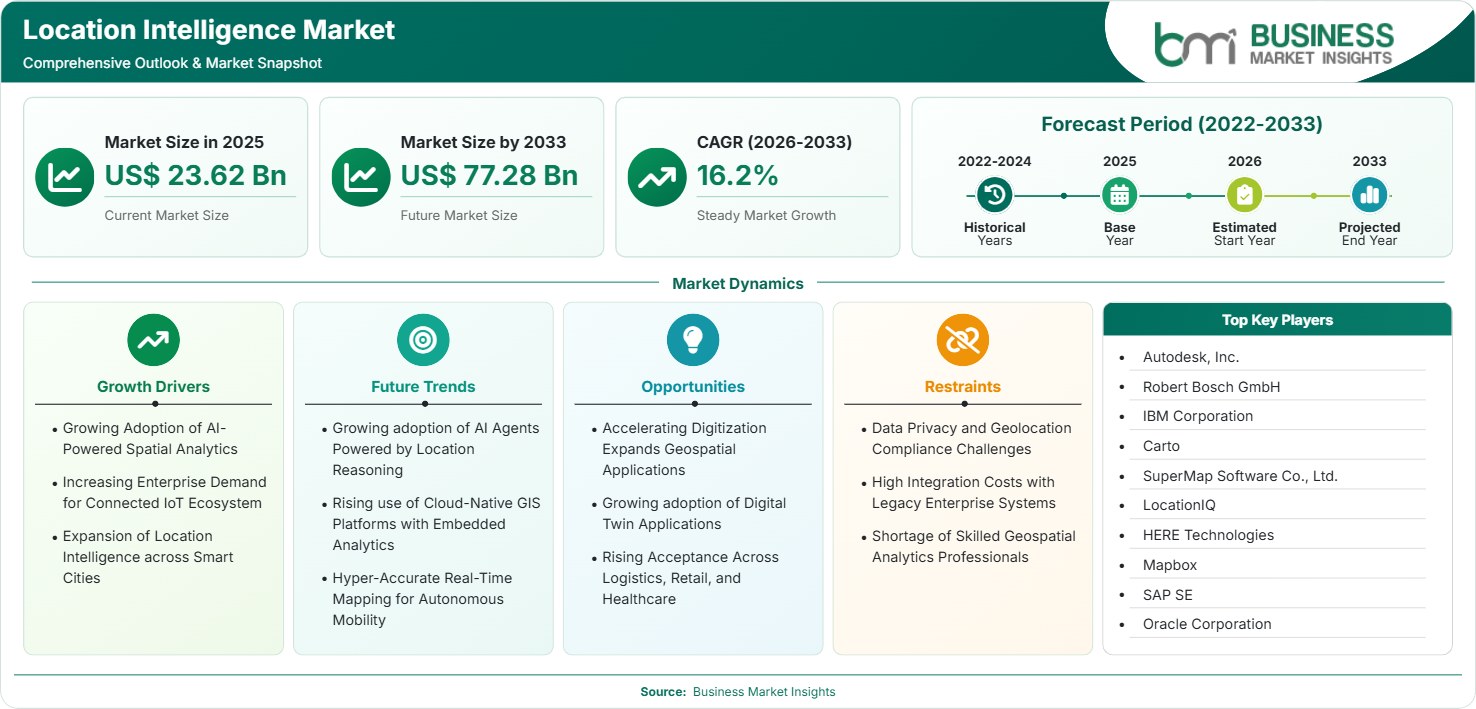
The Location Intelligence Market size was valued at US$ 23.62 Billion in 2025 and is projected to reach US$ 77.28 Billion by 2033, growing at a CAGR of 16.2% during 2026–2033. Growing adoption of AI-powered spatial analytics, increasing enterprise demand for connected IoT ecosystems, and expanding smart city initiatives are accelerating market expansion.

Report Coverage
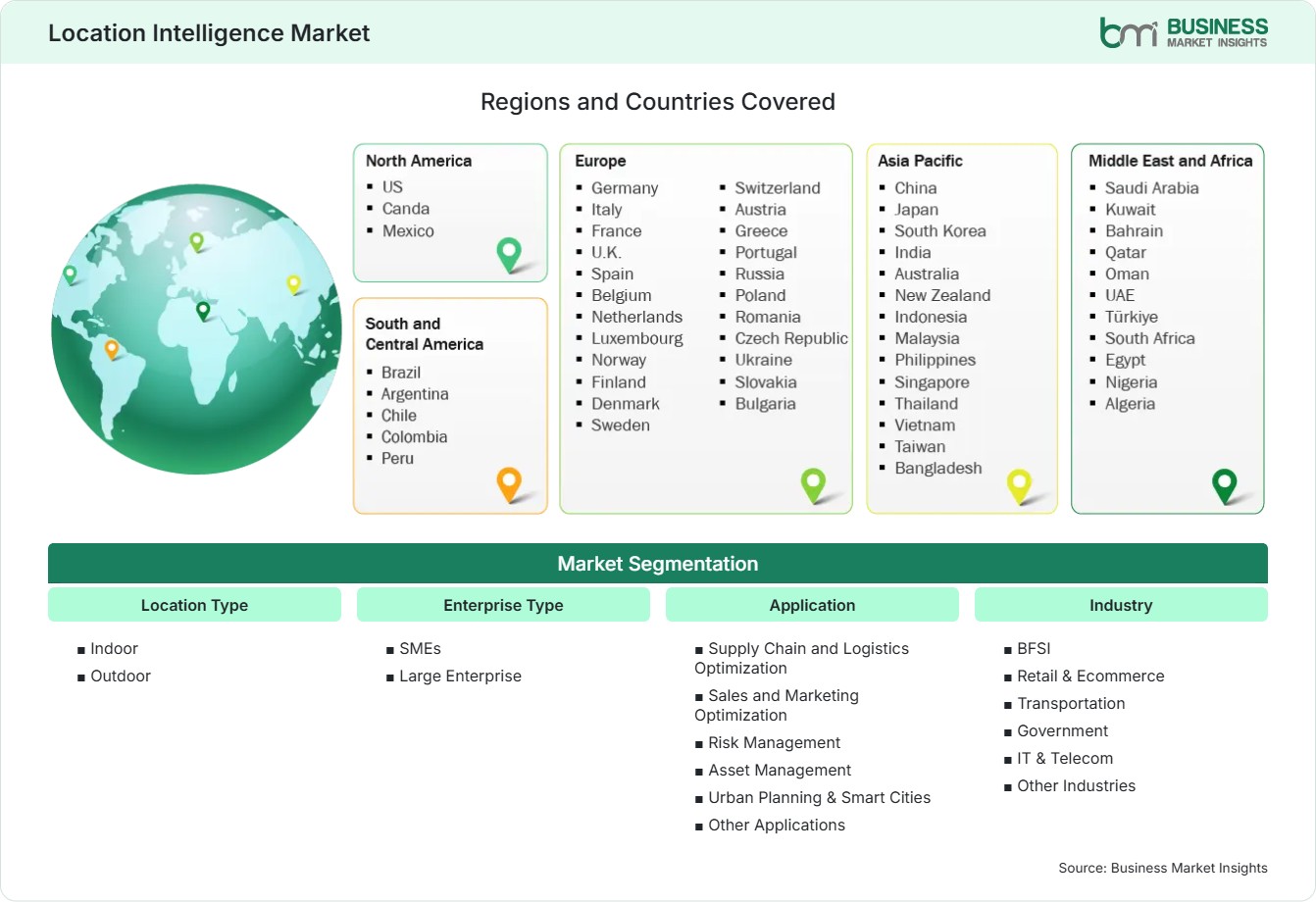
  • Location Type: Indoor, Outdoor
  • Enterprise Type: SMEs, Large Enterprise
  • Application: Supply Chain and Logistics Optimization, Sales and Marketing Optimization, Risk Management, Asset Management, Urban Planning & Smart Cities, Other Applications
  • Industry: BFSI, Retail & Ecommerce, Transportation, Government, IT & Telecom, Other Industries
US$ 23.62 Bn Market size in 2025
US$ 77.28 Bn Market Size by 2033
16.2% CAGR, 2026 - 2033
2026-2033 Forecast Period

AI Overview

Location Intelligence Market Summary

  • North America Region: North America holds 34%–37% share in 2025, growing at a CAGR of 11%–13.5% during 2026–2033. Strong cloud adoption, advanced geospatial infrastructure, enterprise digitalization initiatives, and increasing AI-based analytics deployment support regional growth. The US market benefits from strong technology investments, expanding enterprise analytics adoption, and advanced smart city deployments, growing at a CAGR of 15.5%–16.1%.
  • Fastest Growing Region: Asia Pacific accounts for 23%–27% share in 2025 and is projected to grow at a CAGR of 20.5%–23.5% during 2026–2033. Expanding urbanization programs, smart infrastructure investments, digital transformation initiatives, and increasing adoption of geospatial technologies continue supporting regional demand growth.
  • Leading Segment: Outdoor location intelligence accounts for 63%–65% share in 2025 and is expected to expand at a CAGR of 14.2%–15.6% during 2026–2033. Demand is driven by transportation monitoring, logistics optimization, fleet management, and smart infrastructure development projects.
  • High Growth Segment: Supply Chain and Logistics Optimization accounts for 22%–25% share in 2025 and is forecast to grow at a CAGR of 18.5%–21.2% during 2026–2033. Real-time tracking requirements, route optimization initiatives, and increasing supply chain visibility investments continue supporting growth.
  • Key Market Opportunity: Accelerating enterprise digitization and wider deployment of digital twin technologies are creating opportunities for advanced location-based analytics solutions, supporting operational optimization, predictive decision-making, and resource management applications globally.
  • Major Market Players: Autodesk, Inc., Robert Bosch GmbH, IBM Corporation, CARTO, SuperMap Software Co., Ltd., LocationIQ, HERE Technologies, Mapbox, SAP SE, and Oracle Corporation.
Strategic Insights

Location Intelligence Market: Strategic Insights

Location Intelligence Market Strategic Framework
FREE PDF
Request your free sample
Request free sample
Stakeholder View

Key Takeaways

  • The market value chain is becoming increasingly concentrated in cloud geospatial platforms, maps, analytics software, IoT device manufacturing companies, and enterprise software, creating a closely interrelated environment.
  • Supply chain and logistics optimization is one of the most promising areas of development due to its focus on real-time monitoring, efficiency, and forecasting.
  • The AI-enabled spatial analytics changes the concept of maps by making them a predictive intelligence platform.
  • The Asia Pacific region is the most compelling investment opportunity due to its urbanization, infrastructure upgrades, and the development of smart cities with government support.
  • Synergies among mapping technologies, cloud computing solutions, and business software firms will promote innovation and create new commercial opportunities.
  • The growing adoption of digital twin technologies across infrastructure, transport, manufacturing, and urban management systems creates promising future revenue streams for vendors.
Geographic Outlook

Location Intelligence Market Regional Highlights

North America Location Intelligence Market

North America accounted for 34%–37 Location Intelligence Market share in 2025 and is projected to expand at a CAGR of 11%–13.5% during 2026–2033. Strong adoption of cloud computing, AI-enabled analytics platforms, and enterprise digital transformation initiatives continues supporting market expansion. Organizations across logistics, retail, BFSI, and government sectors increasingly utilize spatial intelligence technologies to strengthen decision-making and operational efficiency.

  • Enterprises increasingly integrate location analytics with cloud and AI platforms to improve operational visibility, business planning, and customer intelligence across multiple industries.
  • Transportation and logistics organizations utilize geospatial intelligence for route optimization, fleet visibility, and real-time asset tracking, supporting operational efficiency improvements.
  • Smart infrastructure projects accelerate deployment of mapping platforms, geographic information systems, and advanced spatial analytics across cities and public agencies.
  • Growing investments in connected mobility and autonomous transportation solutions are increasing demand for advanced location-based analytics capabilities.
  • Businesses continue prioritizing real-time insights and predictive analytics, strengthening demand for enterprise-grade geospatial intelligence platforms.

US Location Intelligence Market

The United States accounted for approximately 74%–78% of North American revenue in 2025 and is anticipated to register a CAGR of 15.5%–16.1% during 2026–2033. AI technologies are widely adopted, cloud computing capabilities are strong, and advanced geospatial technology is used extensively in the nation. Digital Twin technology, smart transport technology, and enterprise analytics continue to be invested in to ensure the market's sustainable growth.

  • Technology companies continue advancing geospatial analytics capabilities through integration of artificial intelligence, machine learning, and cloud-native platforms.
  • Retail organizations increasingly leverage spatial intelligence to optimize site selection, customer engagement strategies, and regional sales planning initiatives.
  • Logistics service providers continue investing in route-planning solutions and location-enabled operational platforms to improve supply chain performance.
  • Government agencies utilize geospatial technologies for infrastructure planning, emergency management, and public service optimization initiatives.

Europe Location Intelligence Market

Europe represented 25%–28% share in 2025 and is forecast to grow at a CAGR of 13.8%–16.4% during 2026–2033. Growing smart city investments, increasing adoption of sustainable transportation systems, and expanding digital government initiatives continue supporting market development. Germany remains the leading market due to extensive industrial digitalization activities, while Spain is emerging as a high-growth market during the forecast period.

  • Government-backed smart city programs continue driving demand for advanced mapping, urban planning, and real-time infrastructure monitoring solutions.
  • Enterprises increasingly deploy location-based analytics platforms to improve operational visibility and support data-driven strategic planning.
  • Germany leads regional adoption due to strong industrial automation investments and increasing implementation of spatial intelligence technologies.
  • Spain is demonstrating accelerated growth supported by digital transformation strategies, smart mobility projects, and infrastructure modernization initiatives.
  • Demand for climate monitoring, environmental assessment, and sustainable transportation planning continues strengthening utilization of geospatial analytics solutions.

Asia Pacific Location Intelligence Market

Asia Pacific held 23%–27% share in 2025 and is expected to expand at a CAGR of 20.5%–23.5% during 2026–2033, making it the fastest-growing regional market. Rapid urbanization, expanding digital infrastructure, and increasing smart city investments are driving widespread technology adoption China remains the leading regional market due to extensive infrastructure investments, while India represents the fastest-growing country through the forecast period.

  • Smart city development initiatives continue generating demand for advanced mapping platforms, urban intelligence solutions, and geographic analytics systems.
  • China maintains leadership through large-scale infrastructure programs and extensive adoption of digital governance technologies.
  • India is witnessing rapid expansion driven by digital transformation programs, urban development projects, and increasing enterprise analytics investments.
  • Rising deployment of IoT devices and connected infrastructure continues generating vast quantities of location-based data for analysis.
  • Transportation modernization initiatives are accelerating adoption of location-driven insights across mobility, logistics, and public-sector applications.

Rest of World Location Intelligence Market

Rest of World accounted for 6%–9% share in 2025 and is projected to grow at a CAGR of 15.1%–20% during 2026–2033. South & Central America is experiencing rising adoption of geospatial intelligence technologies across transportation, retail, and government applications. Brazil remains the leading market due to ongoing investments in digital infrastructure and smart urban development.

The Middle East & Africa region is increasingly adopting location intelligence solutions for infrastructure planning, urban management, and resource optimization. The United Arab Emirates represents a high-growth market supported by advanced smart city investments and digital transformation initiatives.

  • Governments are increasing investments in digital infrastructure and location-based analytics to support planning and resource allocation.
  • Brazil benefits from growing enterprise digitalization and increasing demand for operational intelligence solutions.
  • Smart city programs across Gulf countries are creating opportunities for spatial analytics and urban management platforms.
  • Transportation and logistics sectors increasingly deploy geospatial technologies to improve visibility and operational efficiency.
  • Expanding telecom networks and connected device ecosystems continue supporting wider adoption of location intelligence applications.
Global Market Geography
FREE PDF
Request your free sample
Request free sample
Segment Analysis

Location Intelligence Market Segmentation

Location Type

Location-based intelligence solutions are increasingly deployed across both indoor and outdoor environments to improve navigation, monitoring, and decision-making capabilities. Outdoor applications maintained the largest share at approximately 63-65% in 2025 and are projected to grow at a CAGR of 14.2%–15.6% during 2026–2033. The Location Intelligence Market scope continues expanding as organizations utilize spatial insights across transportation systems, retail networks, infrastructure projects, and public-sector operations.

  • Indoor: Indoor intelligence platforms support navigation, workforce monitoring, facility management, and customer engagement within commercial buildings, hospitals, airports, and retail environments.
  • Outdoor: Outdoor solutions dominate due to extensive deployment across transportation networks, logistics operations, smart city projects, and asset monitoring applications.

Enterprise Type

Enterprise adoption continues increasing as organizations seek improved visibility, operational efficiency, and data-driven planning capabilities. Large enterprises accounted for approximately 68%–71% share in 2025 and are expected to grow at a CAGR of 15.0%–16.5% during 2026–2033. The increasing availability of cloud-based analytics platforms is also encouraging adoption among smaller organizations across multiple sectors.

  • SMEs: Small and medium enterprises increasingly utilize cloud-based geospatial analytics solutions to improve market planning, operational visibility, and customer targeting capabilities.
  • Large Enterprise: Large organizations remain the dominant adopters due to extensive operational complexity, significant data volumes, and broader digital transformation strategies.

Application

Application demand continues expanding as enterprises increasingly integrate geospatial intelligence into operational workflows and strategic planning. Supply Chain and Logistics Optimization represented the largest opportunity segment, accounting for 22%–25% share in 2025 and growing at a CAGR of 18.5%–21.2% during 2026–2033. The Location Intelligence Market trends indicate rising demand for real-time visibility, predictive analytics, and intelligent operational management.

  • Supply Chain and Logistics Optimization: Organizations leverage spatial intelligence to improve route planning, shipment tracking, inventory visibility, and transportation efficiency across global supply chains.
  • Sales and Marketing Optimization: Location-based analytics help businesses understand customer behavior, improve targeting strategies, and enhance regional marketing performance.
  • Risk Management: Geospatial intelligence supports threat assessment, disaster preparedness, compliance planning, and operational risk mitigation strategies.
  • Asset Management: Enterprises utilize real-time location insights to improve asset tracking, maintenance planning, and infrastructure performance monitoring.
  • Urban Planning & Smart Cities: Governments increasingly deploy location intelligence solutions to enhance urban mobility, infrastructure development, and public service delivery.

Industry

Industry-specific demand remains strong as organizations increasingly utilize geospatial analytics, AI-enabled mapping platforms, and real-time location data to improve operational efficiency and decision-making. This segment accounted for approximately 29%–32% share in 2025 and is projected to grow at a CAGR of 16.7%–17.3% during 2026–2033. The Location Intelligence Market continues expanding across both public and private sectors as enterprises prioritize location-driven strategies, digital transformation initiatives, and intelligent infrastructure management.

  • BFSI: Financial institutions leverage location intelligence for branch optimization, risk assessment, fraud detection, customer segmentation, and market expansion strategies supported by spatial analytics.
  • Retail & Ecommerce: Retailers utilize geospatial insights to improve store selection, hyperlocal marketing, customer behavior analysis, delivery optimization, and demand forecasting capabilities.
  • Transportation: Transportation providers deploy location intelligence for route optimization, fleet monitoring, traffic management, shipment visibility, and infrastructure planning applications.
  • Government: Government agencies increasingly adopt geospatial technologies for urban planning, emergency response management, infrastructure development, public safety, and resource allocation initiatives.
  • IT & Telecom: Telecom operators utilize spatial intelligence to optimize network planning, manage infrastructure assets, improve service coverage, and support next-generation connectivity deployment.
Market Forces

Location Intelligence Market Dynamics

Key Market Drivers

Growing Adoption of AI-Powered Spatial Analytics

Organisations are rapidly adopting the use of artificial intelligence within geospatial applications to convert geographic information into useful business intelligence. The role of AI-based spatial analytics includes predictive modeling, automated routing, demand prediction, and customer behavior analysis. The Location Intelligence Market growth is being driven by enterprises seeking real-time operational visibility and faster decision-making capabilities. The machine learning technology makes location data analysis more efficient by revealing patterns which cannot be easily discovered by conventional mapping technologies. Various organizations including retailers, logistics companies, banks, and government organizations have increased their focus on intelligent geospatial technologies for improving efficiency, optimizing their resources, and competing more effectively.

Increasing Enterprise Demand for Connected IoT Ecosystem

Rapid growth in sensors, intelligent devices, and IoT networks is producing vast amounts of geospatial data. Businesses need sophisticated geolocation intelligence tools that will allow them to convert data into actionable insights for more effective and efficient business operations. Real-time tracking of vehicles, equipment, inventory, and other assets is a must in the current business environment. The Location Intelligence Market benefits from growing integration between IoT frameworks and analytics platforms that provide enhanced visibility into business operations. Transportation companies, utilities, manufacturers, and telecommunications providers increasingly depend on connected ecosystems to optimize workflows, reduce downtime, and improve service delivery. Strong IoT adoption is expected to remain a major market growth catalyst.

Expansion of Location Intelligence across Smart Cities

Governments worldwide continue investing in smart city initiatives designed to improve urban mobility, infrastructure management, environmental monitoring, and public safety. Location intelligence technologies play a central role in enabling data-driven urban planning and operational decision-making. The Location Intelligence Market is benefiting from increasing deployment of intelligent transportation systems, digital governance platforms, and urban resource management solutions. Geo-spatial analysis facilitates traffic optimization, emergency preparedness, utility networks management, and sustainable urban planning. Geo-location-based analysis is becoming more common in cities due to the growing need for efficient infrastructure. Due to increasing urbanization, the demand for spatial intelligence solutions in smart cities is forecast to grow significantly over the projection period.

Key Market Opportunities

Accelerating Digitization Expands Geospatial Applications

Digital transformation initiatives are creating substantial opportunities for geospatial intelligence providers across public and private sectors. Organizations are increasingly digitizing operations, customer engagement processes, and infrastructure management systems, generating strong demand for location-enabled analytics. The Location Intelligence Market Forecasts indicate growing adoption across transportation, telecommunications, utilities, and retail sectors. Companies are using geospatial technology to enhance efficiency, identify growth areas, and support decision-making. Cloud adoption models are enabling businesses of all sizes to use location analytics. With the increasing adoption of digital models by businesses, the demand for location intelligence solutions will grow significantly.

Growing Adoption of Digital Twin Applications

Digital twin technology is emerging as a major opportunity area because accurate virtual representations require high-quality geospatial intelligence and real-time location data. Organizations use digital twins to simulate, monitor, and optimize infrastructure assets, production facilities, transportation networks, and urban environments. There are many potential benefits that the inadoptionly to see from increased the adoption of digital twins in smart cities, manufacturing, construction, and utilities industries. Advanced mapping technology, real-time monitoring, and predictive analytics software are key elements in creating effective digital twins. Increased investments in modernizing infrastructure and intelligent asset management are paving the way for greater adoption possibilities.

Rising Acceptance Across Logistics, Retail, and Healthcare

The adoption of location intelligence is becoming increasingly widespread outside the conventional use cases associated with map-based systems and now finds use in logistics, retail, and healthcare organizations. Logistics firms are making use of geospatial analytics for route optimization, tracking shipments, and business planning. The retail industry employs location data to enhance site selection, customer segmentation, and regional market analysis. The healthcare sector has also been increasingly adopting spatial intelligence in resource management, facility planning, and assessing service delivery. The market is gaining from the versatility of geospatial technologies in varied operating environments.

Market Restraints and Challenges

Data Privacy and Geolocation Compliance Challenges

Factor: Location intelligence solutions frequently process sensitive geospatial information, customer movement patterns, and operational location data that are subject to evolving privacy regulations and compliance requirements. Impact: Organizations may face higher compliance costs, implementation complexity, and limitations in how they collect data. The market should find solutions to address emerging issues in data governance, cybersecurity, consent management, and regulatory compliance. Different privacy laws across geographic regions make implementation even more complicated for multinational corporations. Organizations invest more money in protecting their data and analytics platforms. Nevertheless, regulatory complexity is an important issue affecting adoption.

High Integration Costs with Legacy Enterprise Systems

Factor: Many organizations continue operating legacy infrastructure that was not designed to support modern geospatial analytics, cloud-native platforms, or AI-enabled location intelligence capabilities. Impact: Integration projects often require significant investment, extended deployment timelines, and specialized technical expertise. The Location Intelligence Market faces challenges when prospective users evaluate implementation costs against expected operational benefits. Complex data migration processes, interoperability requirements, and infrastructure modernization efforts may delay adoption. Small and medium-sized organizations can be particularly affected by budget limitations. Although vendors increasingly provide scalable and cloud-based deployment options, integration complexity continues to represent a barrier to broader market penetration.

Company Analysis

Competitive Landscape

The Location Intelligence Market analysis reflects a competitive environment shaped by geospatial technology providers, enterprise software vendors, cloud-platform operators, and mapping specialists. Innovation in AI-driven spatial analytics, digital twins, location-based services, and real-time intelligence remains a key differentiating factor.

Company Name

Overview

Products and Services Relevant to this Market

Autodesk, Inc.

Global software company supporting digital design, infrastructure planning, and geospatial project workflows.

Digital twin solutions, infrastructure planning software, spatial modeling tools, and location-enabled engineering applications.

Robert Bosch GmbH

Technology leader offering connected mobility, IoT, and smart infrastructure solutions.

Geospatial mobility services, connected device ecosystems, IoT-enabled analytics, and smart city technologies.

IBM Corporation

Enterprise technology provider with strong capabilities in AI, analytics, and cloud computing.

AI-powered analytics, geospatial intelligence platforms, hybrid cloud solutions, and business intelligence tools.

CARTO

Specialized provider focused on cloud-native spatial analytics and location intelligence platforms.

Spatial analytics software, geospatial data visualization, mapping solutions, and location-based business intelligence.

SuperMap Software Co., Ltd.

Major GIS software company serving government, infrastructure, and enterprise customers.

Geographic information systems, spatial analytics solutions, mapping platforms, and digital city applications.

LocationIQ

Location data provider supporting developers and enterprises with geospatial services.

Geocoding, mapping APIs, location datasets, and spatial intelligence tools.

HERE Technologies

Leading provider of location data and digital mapping services worldwide.

Digital maps, real-time location services, navigation solutions, and mobility intelligence platforms.

Mapbox

Developer-focused mapping and geospatial platform serving global enterprises.

Mapping APIs, navigation services, geospatial visualization tools, and location data solutions.

SAP SE

Enterprise software company integrating location capabilities into business operations.

Enterprise analytics, supply-chain intelligence, business planning software, and geospatial integration solutions.

Oracle Corporation

Technology provider delivering cloud, data management, and analytics solutions globally.

Spatial databases, cloud analytics platforms, enterprise intelligence solutions, and location-enabled applications.

Trust & Transparency

Research Methodology

The market analysis combines proprietary research with secondary data from government agencies, company disclosures, regulatory filings, industry databases and expert interviews. Market estimates are validated through data triangulation, cross-market benchmarking and analyst review.

View Full Research Methodology

Questions Answered

Frequently Asked Questions

What does a Location Intelligence Market Report typically evaluate?

A Report generally assesses market size, technology trends, regional performance, competitive positioning, demand drivers, growth opportunities, end-user adoption patterns, and future industry outlook.

How do digital twins support market expansion?

Digital twins depend on accurate geospatial information and real-time location data to create virtual representations of physical assets, enabling monitoring, simulation, predictive maintenance, and infrastructure optimization.

Why are enterprises investing in AI-enabled location analytics?

Organizations use AI-powered location analytics to automate decision-making, optimize logistics operations, forecast demand patterns, identify market opportunities, and improve real-time operational visibility.

Which region is expected to experience the fastest expansion?

Asia Pacific is projected to record the fastest growth due to increasing urbanization, rapid digital transformation, smart city investments, and expanding deployment of geospatial analytics across enterprises and governments.

What is the primary purpose of location intelligence solutions?

Location intelligence solutions combine geographic, operational, and business data to deliver actionable insights that improve planning, operational efficiency, customer engagement, asset monitoring, and strategic decision-making.

Access the Full Location Intelligence Market Report

Get segment-level forecasts, regional estimates, competitive benchmarking, company profiles and downloadable Excel datasets.

Access the full Location Intelligence Market Report
350 pages PDF & Excel | 2026-09-07