
Ambient Intelligence Market Outlook: Size, Share, Trends, Growth Analysis, Competitive Landscape & Forecast, 2026-2033

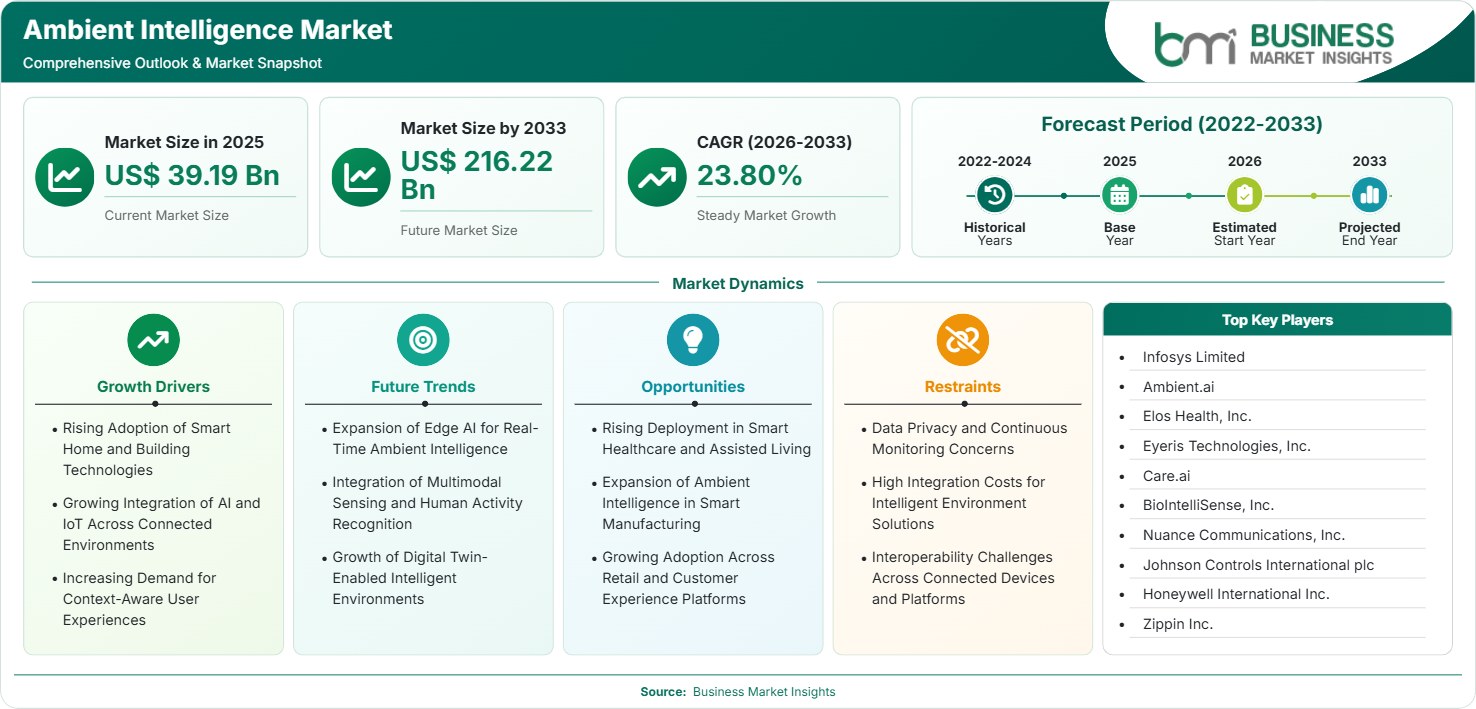
The Ambient Intelligence Market size was valued at US$ 39.19 Billion in 2025 and is projected to reach US$ 216.22 Billion by 2033, growing at a CAGR of 23.80% during 2026–2033. Growing penetration of AI-driven smart environments, growth of Internet of Things (IoT) ecosystem, increasing implementation of intelligent healthcare infrastructure, and growing investment in smart buildings are factors fueling the market growth and providing opportunities for context-aware automation and personalization.

Report Coverage
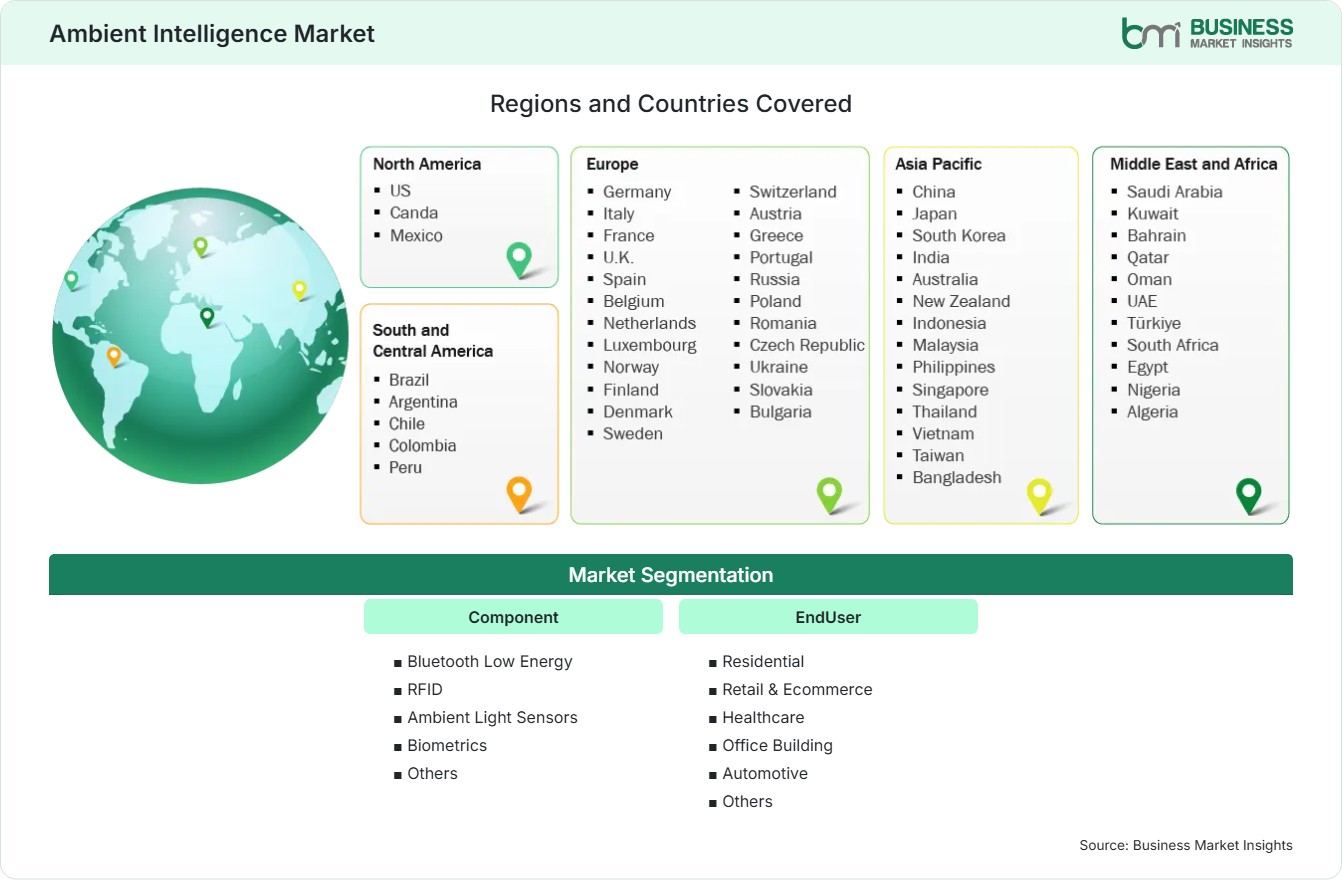
  • Component: Bluetooth Low Energy, RFID, Ambient Light Sensors, Biometrics, Others
  • EndUser: Residential, Retail & Ecommerce, Healthcare, Office Building, Automotive, Others
US$ 39.19 Bn Market size in 2025
US$ 216.22 Bn Market Size by 2033
23.80% CAGR, 2026 - 2033
2026-2033 Forecast Period

AI Overview

Ambient Intelligence Market Summary

  • North America Region: North America holds 36%–39% ambient intelligence market share in 2025 and is projected to grow at a CAGR of 22.4%–23.0% during 2026–2033. Strong investments in artificial intelligence, widespread deployment of connected infrastructure, and increasing enterprise automation continue supporting market growth.
  • Fastest Growing Region: Asia Pacific accounts for 28%–31% market share in 2025 and is expected to expand at a CAGR of 25.8%–26.5%. Expanding smart city initiatives, increasing digital infrastructure investments, rapid IoT adoption, and favorable government policies continue accelerating regional demand.
  • Leading Segment: Bluetooth Low Energy accounts for 29%–32% market share in 2025 while growing at a CAGR of 24.2%–24.8%. Low energy consumption, reliable wireless connectivity, and growing deployment across intelligent environments continue supporting segment leadership.
  • High Growth Segment: Healthcare represents 24%–27% market share in 2025 and is projected to register a CAGR of 26.4%–27.0% owing to increasing adoption of AI-assisted patient monitoring, intelligent hospitals, and remote healthcare technologies.
  • Key Market Opportunity: Growing adoption of intelligent healthcare infrastructure, smart workplaces, autonomous retail environments, and AI-powered context-aware computing platforms is creating long-term opportunities for ambient intelligence solution providers.
  • Major Market Players: Infosys Limited, Ambient, Inc., Elos Health, Inc., Eyeris Technologies, Inc., care.ai, BioIntelliSense, Inc., Nuance Communications, Inc., Johnson Controls International plc, Honeywell International Inc., and Zippin Inc.
Strategic Insights

Ambient Intelligence Market: Strategic Insights

Ambient Intelligence Market Strategic Framework
FREE PDF
Request your free sample
Request free sample
Stakeholder View

Key Takeaways

  • The ambient intelligence market ecosystem continues evolving through close collaboration among artificial intelligence developers, cloud service providers, IoT device manufacturers, semiconductor companies, building automation specialists, and enterprise software vendors.
  • Healthcare, smart buildings, and retail continue representing the most attractive commercial opportunities because organizations increasingly require automated monitoring, predictive analytics, intelligent security, and personalized user engagement capabilities that improve operational efficiency while reducing long-term costs.
  • Product innovation increasingly focuses on multimodal sensing, edge artificial intelligence, computer vision, natural language processing, biometric authentication, and digital twin technologies that improve contextual awareness while enabling faster decision-making without excessive dependence on centralized cloud infrastructure.
  • Asia Pacific continues emerging as the fastest-growing regional investment destination due to large-scale smart city initiatives, expanding manufacturing automation, growing digital infrastructure, and increasing government support for artificial intelligence adoption across public and private sectors.
  • Strategic partnerships between healthcare providers, enterprise technology companies, smart infrastructure developers, and AI software vendors continue accelerating commercialization of intelligent environments capable of supporting predictive maintenance, autonomous operations, and personalized digital services.
Geographic Outlook

Ambient Intelligence Market Regional Highlights

North America Ambient Intelligence Market

North America accounted for approximately 36%–39% of global revenue in 2025 and is projected to register a CAGR of 22.4%–23.0% through 2033. The Ambient Intelligence Market share remains the largest globally due to widespread deployment of artificial intelligence, mature cloud infrastructure, strong IoT ecosystems, and substantial investments in enterprise automation. Technology companies continue collaborating with healthcare providers, commercial building operators, and industrial enterprises to develop intelligent environments capable of delivering predictive insights, automated decision-making, and enhanced user experiences.

  • Strong adoption of smart buildings, intelligent workplaces, and connected healthcare infrastructure continues driving enterprise demand for context-aware automation technologies across commercial and institutional environments.
  • Major cloud service providers and AI software companies continue investing in edge computing, computer vision, and intelligent analytics platforms supporting next-generation ambient intelligence deployments.
  • Increasing government investments in digital infrastructure, cybersecurity, and smart public services continue encouraging deployment of intelligent sensing technologies throughout transportation, healthcare, and public administration.
  • Growing adoption of intelligent retail solutions, autonomous checkout technologies, and customer analytics platforms strengthens commercial implementation of ambient intelligence across large retail chains.

US Ambient Intelligence Market

The United States represents approximately 85%–88% of North American revenue and is expected to expand at a CAGR of 22.7%–23.3% during the forecast period. Strong artificial intelligence innovation, advanced semiconductor capabilities, mature cloud infrastructure, and extensive enterprise digital transformation continue supporting sustained ambient intelligence market expansion. Healthcare organizations, technology enterprises, retailers, and commercial real estate developers increasingly deploy intelligent automation platforms that improve operational performance, energy efficiency, and customer experiences.

  • AI investment by leading technology companies continues accelerating commercialization of intelligent context-aware computing platforms.
  • Healthcare providers increasingly deploy AI-powered patient monitoring, intelligent clinical workflows, and remote care technologies.
  • Smart building modernization programs encourage deployment of intelligent lighting, climate control, and occupancy management systems.
  • Enterprise investments in workplace automation and employee experience technologies continue supporting long-term market growth.

Europe Ambient Intelligence Market

Europe accounted for approximately 24%–27% of the global market in 2025 and is projected to expand at a CAGR of 22.0%–22.6% through 2033. The region benefits from strong adoption of Industry 4.0 technologies, intelligent building automation, digital healthcare initiatives, and smart city investments. Governments and enterprises continue supporting artificial intelligence deployment through research funding, sustainability policies, and digital transformation programs. Germany leads regional revenue owing to its advanced manufacturing ecosystem and industrial automation capabilities, while the Nordic countries and the Netherlands demonstrate strong adoption of intelligent commercial buildings and connected infrastructure.

  • Germany dominates regional demand through large-scale deployment of smart manufacturing, intelligent factories, and AI-enabled industrial automation systems integrated with connected sensors and edge computing platforms.
  • The United Kingdom continues strengthening adoption through digital healthcare investments, intelligent public infrastructure, and expanding enterprise cloud transformation initiatives supported by public and private sector funding.
  • France accelerates market development through smart city projects, AI research initiatives, and increasing deployment of intelligent transportation systems that utilize real-time contextual analytics and predictive automation.
  • Nordic countries remain early adopters of intelligent building technologies, energy-efficient infrastructure, and digital public services supported by advanced connectivity and high technology acceptance.
  • Poland and Central European economies continue attracting investments in smart manufacturing, logistics automation, and connected industrial facilities, supporting the region's long-term expansion.

Asia Pacific Ambient Intelligence Market

Asia Pacific represented approximately 28%–31% of global revenue during 2025 and is projected to register the fastest CAGR of 25.8%–26.5% throughout the forecast period. Rapid digitalization, expanding urban populations, increasing government investment in smart city infrastructure, and strong electronics manufacturing capabilities continue driving market growth. China remains the largest regional market due to extensive AI deployment, industrial automation, and intelligent infrastructure projects, while India records the fastest growth supported by digital transformation programs, and increasing adoption of smart healthcare and connected enterprise solutions.

  • China leads regional revenue through large-scale deployment of AI-enabled surveillance, smart transportation, industrial automation, and connected urban infrastructure projects.
  • India records the highest regional growth due to expanding digital public infrastructure, increasing enterprise AI adoption, smart healthcare initiatives, and government support for intelligent technologies.
  • Japan continues investing in robotics, elderly care technologies, intelligent healthcare systems, and smart manufacturing environments utilizing advanced sensing and artificial intelligence.
  • South Korea strengthens ambient intelligence market expansion through advanced semiconductor production, smart building technologies, 5G infrastructure, and connected consumer electronics ecosystems.

Rest of World Ambient Intelligence Market

The Rest of World accounted for approximately 8%–10% of global revenue in 2025 and is expected to expand at a CAGR of 22.8%–23.5% during 2026–2033. Market growth is supported by increasing investments in digital infrastructure, smart government initiatives, intelligent healthcare modernization, and connected commercial buildings. Brazil leads adoption across South and Central America owing to expanding enterprise digital transformation and smart city investments.

  • Brazil remains the leading Latin American market through growing adoption of intelligent enterprise solutions, connected healthcare systems, and smart commercial infrastructure projects.
  • Mexico continues strengthening industrial automation and intelligent manufacturing investments supported by expanding automotive and electronics production facilities.
  • The United Arab Emirates leads Middle Eastern adoption through smart government programs, intelligent transportation infrastructure, and AI-enabled commercial real estate developments.
  • Saudi Arabia records the fastest regional growth due to Vision 2030 investments, digital transformation initiatives, and increasing deployment of intelligent public infrastructure.
Global Market Geography
FREE PDF
Request your free sample
Request free sample
Segment Analysis

Ambient Intelligence Market Segmentation

Component

The Component segment accounted for approximately 52%–55% of the market in 2025 and is projected to grow at a CAGR of 24.0%–24.6% during 2026–2033. Ambient intelligence platforms rely on a combination of sensing, connectivity, and identification technologies that continuously collect environmental information and enable intelligent decision-making. The Ambient Intelligence Market scope continues expanding as organizations increasingly invest in integrated sensor ecosystems capable of delivering contextual awareness, predictive automation, and personalized user experiences.

  • Bluetooth Low Energy: Bluetooth Low Energy dominates the component segment owing to its ultra-low power consumption, reliable wireless communication, seamless interoperability with IoT devices, and extensive deployment across smart homes, wearable devices, healthcare equipment, and intelligent commercial infrastructure.
  • RFID: RFID technology supports automatic identification, inventory management, asset tracking, patient monitoring, warehouse automation, and intelligent logistics operations by enabling continuous object recognition with minimal manual intervention across multiple industries.
  • Ambient Light Sensors: Ambient light sensors improve energy efficiency by automatically adjusting lighting intensity based on surrounding conditions, enhancing occupant comfort while supporting sustainable building management and intelligent workspace optimization.
  • Biometrics: Biometric technologies enhance authentication, personalized access control, healthcare monitoring, employee verification, and security management by recognizing unique physiological and behavioral characteristics within connected intelligent environments.
  • Others: Additional technologies including motion sensors, microphones, cameras, proximity sensors, humidity sensors, temperature sensors, pressure sensors, and environmental monitoring devices significantly expand the capabilities of ambient intelligence platforms across diverse applications.

End-User

Growing digital transformation across multiple industries continues accelerating adoption of ambient intelligence technologies among diverse end users. The End-User segment represented approximately 24%–27% of market revenue in 2025 and is projected to register the fastest CAGR of 26.4%–27.0% during the forecast period. The Ambient Intelligence Market trends demonstrate increasing enterprise investments in intelligent environments that improve operational efficiency, user engagement, sustainability, safety, and automated decision-making across residential, healthcare, commercial, and industrial settings.

  • Residential: Residential environments increasingly deploy ambient intelligence for intelligent lighting, home security, energy optimization, and personalized living experiences through connected smart home ecosystems.
  • Retail & E-commerce: Retail organizations utilize ambient intelligence to enhance customer engagement through cashier-less shopping, intelligent inventory management, personalized promotions, in-store analytics, customer behavior monitoring, and automated retail operations.
  • Healthcare: Healthcare remains the fastest-growing end-user segment as hospitals and healthcare providers increasingly implement AI-assisted patient monitoring, intelligent hospital rooms, remote healthcare platforms, clinical workflow automation, and predictive care management systems.
  • Office Building: Commercial office buildings deploy ambient intelligence technologies to optimize occupancy management, workspace utilization, predictive maintenance, and integrated building security operations.
  • Automotive: Automotive manufacturers integrate ambient intelligence technologies into connected vehicles for driver monitoring, occupant recognition, personalized cabin environments, adaptive safety systems, and intelligent human-machine interaction capabilities.
  • Others: Hospitality, education, transportation, logistics, airports, public infrastructure, entertainment venues, and industrial manufacturing continue adopting ambient intelligence solutions to improve operational performance, safety, automation, and customer experiences.
Market Forces

Ambient Intelligence Market Dynamics

Key Market Drivers

Rising Adoption of Smart Home and Building Technologies

The fast-growing adoption of smart homes and smart commercial buildings has greatly increased the need for ambient intelligence solutions around the world. More building owners now use lighting, HVAC, access control, security, occupancy sensing, and energy management solutions that use contextual decision making enabled by artificial intelligence. As noted by the International Energy Agency, buildings make up 29% of total final energy consumption on Earth and therefore encourage the adoption of intelligent building automation to increase their energy efficiency. The Ambient Intelligence Market growth continues benefiting from the integration of wireless sensors, cloud platforms, and edge computing technologies capable of delivering real-time environmental awareness, predictive maintenance, and enhanced occupant experiences across residential, commercial, healthcare, and institutional infrastructure.

Growing Integration of AI and IoT Across Connected Environments

The connection between AI and IoT is growing tighter in business, industrial, and consumer applications. Intelligent ambient environments today consist of sensor networks, machine learning, computer vision, cloud-based analytics, and edge computing to achieve autonomous reactions according to user behavior and the environment. Businesses use such intelligent environments for increasing efficiency, lowering expenses, efficient energy usage, and better security. Advances in semiconductor technology, wireless connectivity, and AI inference make it possible to do real-time context analysis in factories, hospitals, office buildings, stores, and infrastructure.

Increasing Demand for Context-Aware User Experiences

There is an increasing expectation for intelligent digital systems that can detect user preference, analyze behavior, and provide a customized experience in a proactive manner, without requiring any form of human interaction. Through ambient intelligence techniques, intelligent environment solutions that can automatically regulate lighting, temperature, security measures, health care facilities, and office settings based on individual needs can be provided. There is an ongoing increase in the use of computer vision, voice recognition, behavioral analysis, and multimodal sensing technology that is enhancing the ability to detect contextual information.

Key Market Opportunities

Rising Deployment in Smart Healthcare and Assisted Living

Healthcare providers increasingly implement ambient intelligence solutions to improve patient safety, clinical efficiency, elderly care, and remote healthcare delivery. Intelligent hospital rooms equipped with connected sensors, wearable monitoring devices, AI-powered analytics, and predictive alert systems enable continuous patient observation while reducing caregiver workloads. The Ambient Intelligence Market Forecasts remain highly favorable as aging populations, rising chronic disease prevalence, and expanding telehealth services continue increasing demand for intelligent healthcare environments. Technology providers capable of delivering interoperable, privacy-focused, and clinically validated solutions are expected to secure substantial long-term growth opportunities across hospitals, rehabilitation centers, and assisted living facilities.

Expansion of Ambient Intelligence in Smart Manufacturing

The manufacturing industry keeps on making huge investments in technologies related to Industry 4.0 including artificial intelligence, industrial internet of things (IIoT), robotics, and predictive analytics. The use of ambient intelligence allows factories to measure the health of machines, schedule production in an efficient manner, increase employee safety, save energy, and improve the quality of products by continuously measuring the environment. There are great business opportunities for vendors offering scalable intelligent manufacturing solutions for integration with operational technologies.

Growing Adoption Across Retail and Customer Experience Platforms

Ambient intelligence is increasingly used by retailers to provide a personalized shopping experience along with operational efficiencies and greater inventory visibility. Ambient intelligence using computer vision, smart shelves, automated checkouts, occupancy monitoring, digital signs, and customer behavior monitoring can help retailers improve their store layout and engage customers better. The growth in omnichannel commerce and smart stores makes ambient intelligence technologies an attractive area for solution providers that can offer ambient intelligence capabilities.

Market Restraints and Challenges

Data Privacy and Continuous Monitoring Concerns

Factor: Ambient intelligence solutions continuously collect behavioral, biometric, environmental, audio, video, and location data using interconnected sensors, cameras, and intelligent monitoring platforms operating across multiple connected environments.

Impact: Continuous monitoring raises significant concerns regarding user privacy, cybersecurity, data ownership, regulatory compliance, and ethical AI deployment. Organizations must implement robust encryption, secure identity management, transparent user consent mechanisms, and compliance with evolving privacy regulations such as GDPR and other regional frameworks.

High Integration Costs for Intelligent Environment Solutions

Factor: The successful rollout of an AI solution will require considerable spending on AI software, sensing technologies, cloud computing infrastructure, networking hardware, cybersecurity, edge computing devices, systems integration, training, and support services.

Impact: Significant costs associated with implementing an AI solution can be seen as a major obstacle for smaller companies without large budgets allocated to digital transformation initiatives. Integration of new AI systems with existing IT systems, operations technology, and different IoT devices may cause additional difficulties for deployment projects. Vendors of AI solutions try to cope with this problem by using modular system design, cloud subscriptions, managed services, and other methods.

Company Analysis

Competitive Landscape

The Ambient Intelligence Market analysis include the intense rivalry between artificial intelligence firms, healthcare IT vendors, smart building solutions firms, and intelligent automation vendors in the market. The firms continue making investments in technologies such as AI-enabled analytics, edge computing, sensor technology, computer vision, and cloud-native intelligent platforms.

Company Name

Overview

Products and Services Relevant to this Market

Infosys Limited

Infosys Limited provides digital transformation, artificial intelligence, cloud computing, and enterprise automation solutions supporting intelligent connected environments across multiple industries.

AI platforms, IoT integration services, intelligent automation, cloud analytics, digital transformation solutions, and smart infrastructure consulting.

Ambient, Inc.

Ambient, Inc. develops intelligent sensing and context-aware technologies supporting connected environments and real-time environmental intelligence applications.

Ambient sensing platforms, intelligent monitoring solutions, IoT connectivity technologies, environmental analytics, and smart infrastructure solutions.

Elos Health, Inc.

Elos Health develops AI-enabled healthcare solutions that improve patient monitoring, clinical workflow automation, and intelligent healthcare environments.

AI healthcare platforms, patient monitoring systems, predictive analytics, remote care technologies, and clinical intelligence software.

Eyeris Technologies, Inc.

Eyeris Technologies specializes in in-cabin artificial intelligence and vision technologies that enhance human behavior understanding and contextual awareness.

Computer vision software, occupant monitoring systems, driver monitoring technologies, facial analytics, and AI-powered behavioral intelligence solutions.

care.ai

care.ai delivers autonomous healthcare intelligence solutions enabling continuous patient monitoring and operational automation across healthcare facilities.

Ambient intelligence platforms, AI patient monitoring, virtual nursing technologies, clinical automation software, and healthcare analytics solutions.

BioIntelliSense, Inc.

BioIntelliSense develops continuous health monitoring technologies combining wearable biosensors, AI analytics, and remote patient management capabilities.

Wearable biosensors, physiological monitoring devices, predictive health analytics, remote patient monitoring, and AI-powered healthcare platforms.

Nuance Communications, Inc.

Nuance Communications develops conversational AI and clinical intelligence solutions supporting healthcare automation and enterprise productivity improvements.

Speech recognition, conversational AI, clinical documentation software, voice-enabled automation, and intelligent workflow solutions.

Johnson Controls International plc

Johnson Controls provides smart building technologies integrating AI, automation, security, and intelligent facility management solutions worldwide.

Smart building platforms, building automation systems, intelligent HVAC controls, energy management, occupancy monitoring, and security solutions.

Honeywell International Inc.

Honeywell develops intelligent building, industrial automation, and connected infrastructure solutions supported by advanced sensing and AI technologies.

Building management systems, industrial IoT platforms, environmental sensors, intelligent security systems, and automation software.

Zippin Inc.

Zippin develops AI-powered autonomous retail technologies enabling cashier-less shopping and intelligent customer experience management.

Computer vision platforms, autonomous checkout systems, retail analytics, AI-powered store automation, and intelligent retail management software.

Trust & Transparency

Research Methodology

The market analysis combines proprietary research with secondary data from government agencies, company disclosures, regulatory filings, industry databases and expert interviews. Market estimates are validated through data triangulation, cross-market benchmarking and analyst review.

View Full Research Methodology

Questions Answered

Frequently Asked Questions

What does an Ambient Intelligence Market Report include?

The report provides comprehensive analysis of market size, segmentation, technology trends, regional outlook, competitive landscape, investment opportunities, regulatory developments, and long-term growth forecasts.

Why is edge AI becoming important in ambient intelligence?

Edge AI enables faster decision-making, reduces latency, improves privacy, lowers bandwidth requirements, and supports real-time contextual processing without relying entirely on centralized cloud infrastructure.

Which industry is expected to witness the fastest adoption?

Healthcare is expected to experience the fastest adoption due to increasing deployment of remote patient monitoring, AI-assisted clinical workflows, intelligent hospitals, elderly care solutions, and digital health infrastructure.

Which component dominates the ambient intelligence market?

Bluetooth Low Energy leads the market because it provides reliable wireless connectivity, low power consumption, cost-effective deployment, and seamless integration across smart homes, healthcare devices, wearable technologies, and intelligent buildings.

What is ambient intelligence?

Ambient intelligence refers to intelligent digital environments that use artificial intelligence, sensors, connected devices, and contextual awareness to automatically respond to user behavior, preferences, and environmental conditions with minimal human intervention.

Access the Full Ambient Intelligence Market Report

Get segment-level forecasts, regional estimates, competitive benchmarking, company profiles and downloadable Excel datasets.

Access the full Ambient Intelligence Market Report
350 pages PDF & Excel | 2026-08-07
Similar Research

Related Market Reports