
Drilling Services Market Outlook: Size, Share, Trends, Growth Analysis, Competitive Landscape & Forecast, 2026–2033

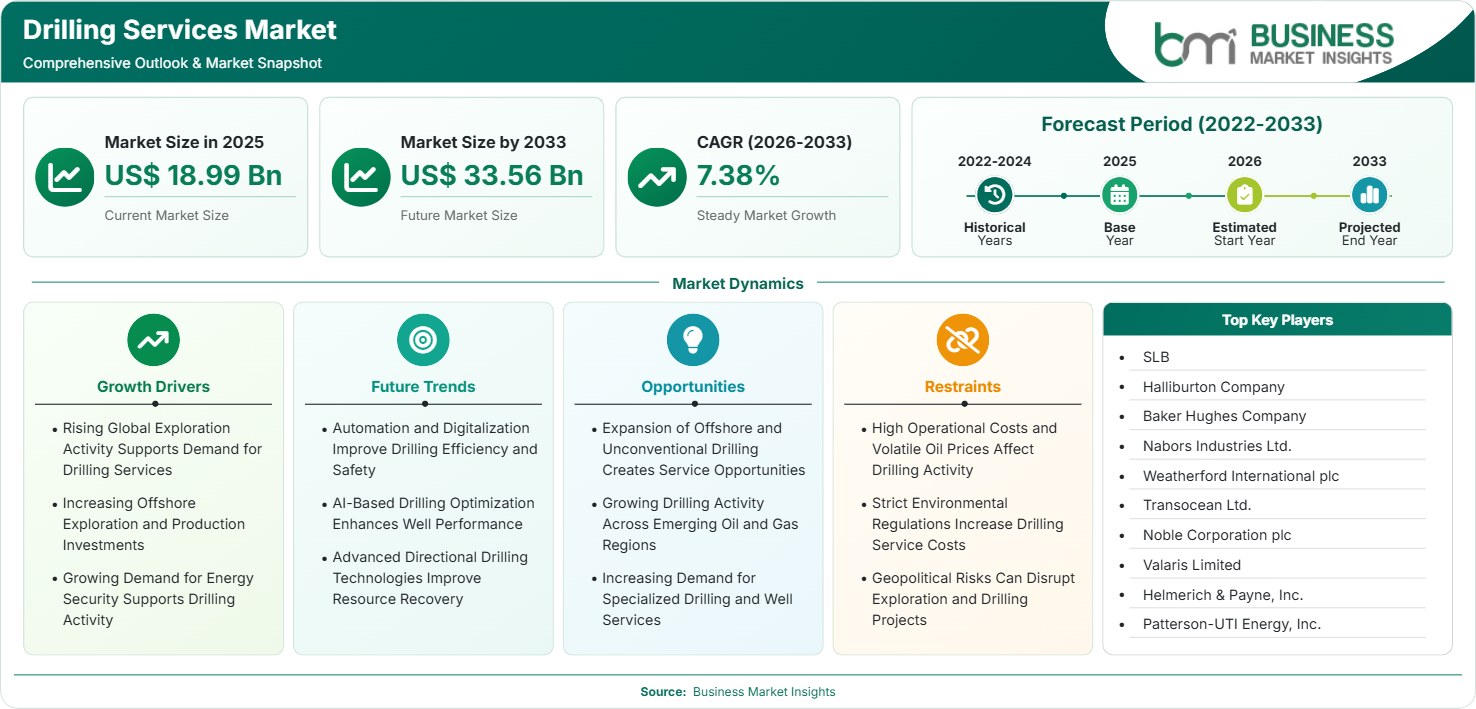
The Drilling Services Market size was valued at US$ 18.99 Billion in 2025 and is projected to reach US$ 33.56 Billion by 2033, growing at a CAGR of 7.38% during 2026–2033, supported by exploration, offshore development, energy security priorities, unconventional resources, and specialized drilling technologies.

Report Coverage
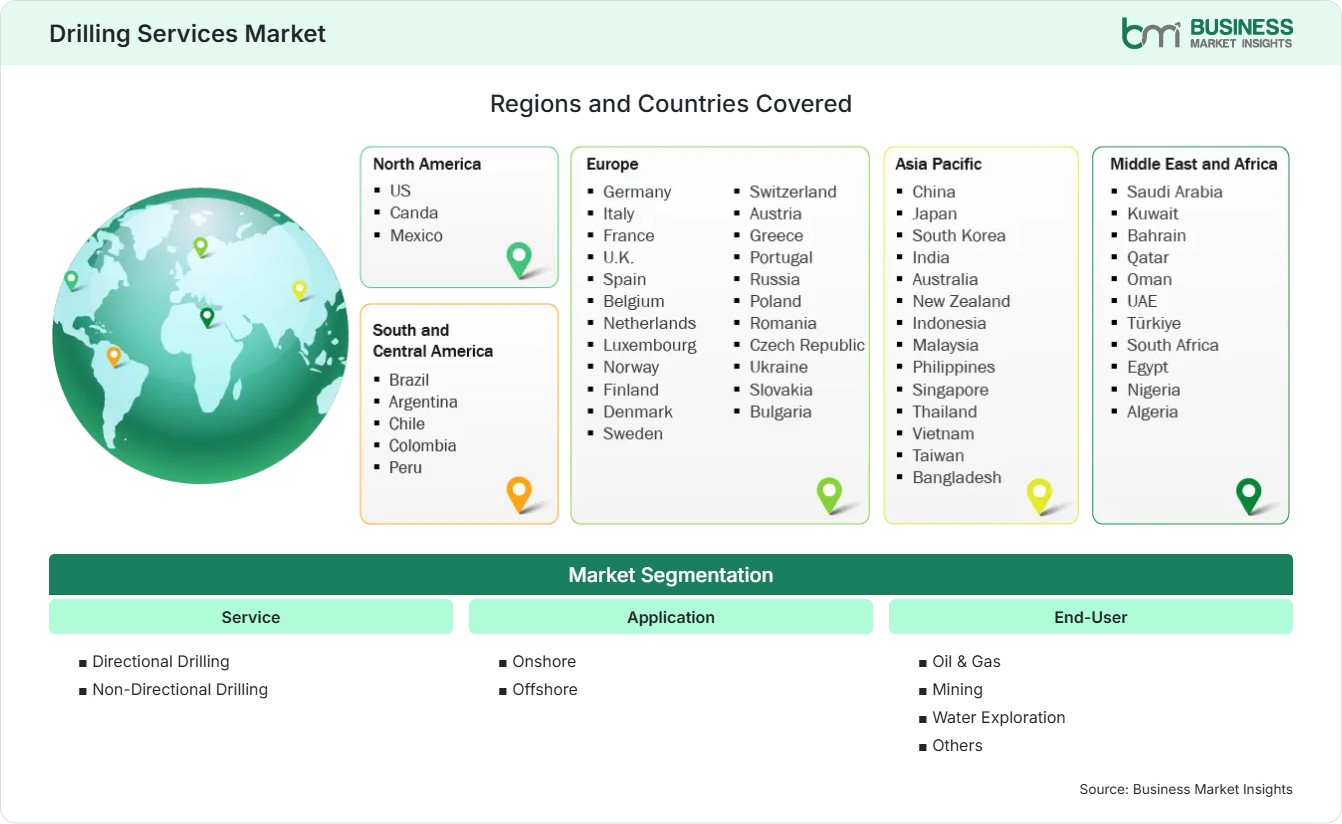
  • Service: Directional Drilling, Non-Directional Drilling
  • Application: Onshore, Offshore
  • End-User: Oil & Gas, Mining, Water Exploration, Others
US$ 18.99 Bn Market size in 2025
US$ 33.56 Bn Market Size by 2033
7.38% CAGR, 2026 - 2033
2026-2033 Forecast Period

AI Overview

Drilling Services Market Summary

  • North America Region: North America holds a modeled 32%–35% Drilling Services Market share in 2025 and is advancing at a 6.8%–7.4% CAGR, supported by shale activity, mature-field redevelopment, drilling automation, well optimization, and demand for efficient land-based services.
  • Fastest Growing Region: Middle East and Africa represent the fastest-growing regional opportunity, supported by offshore developments, field redevelopment, unconventional exploration, national energy strategies, and increasing requirements for integrated drilling and well-construction services.
  • Leading Segment: Directional Drilling holds a modeled 56%–60% share in 2025 and is expanding at a 7.7%–8.3% CAGR, supported by complex well profiles, reservoir targeting, extended-reach wells, and improved drilling precision.
  • High Growth Segment: Offshore applications represent a modeled 31%–35% share in 2025 and are growing at a 7.8%–8.5% CAGR, supported by deepwater discoveries, field developments, advanced rigs, subsea infrastructure, and specialized well-construction requirements.
  • Key Market Opportunity: Service providers can capture additional value through integrated drilling, automation, directional technologies, digital well planning, managed pressure drilling, specialized offshore capabilities, and localized technical support.
  • Major Market Players: SLB, Halliburton Company, Baker Hughes Company, Nabors Industries Ltd., Weatherford International plc, Transocean Ltd., Noble Corporation plc; Valaris Limited, Helmerich & Payne, Inc., Patterson-UTI Energy, Inc.
Strategic Insights

Drilling Services Market: Strategic Insights

Drilling Services Market Strategic Framework
FREE PDF
Request your free sample
Request free sample
Stakeholder View

Key Takeaways

  • The industry is evolving from individual service procurement toward integrated well-construction partnerships, increasing the importance of engineering depth, equipment availability, digital workflows, and the ability to coordinate multiple drilling disciplines.
  • Directional drilling offers strong value creation because increasingly complex reservoirs require precise well placement, extended-reach capabilities, trajectory management, and improved reservoir contact while controlling operational complexity.
  • Automation and digitalization are becoming central competitive differentiators as drilling contractors integrate real-time data, automated controls, digital well planning, remote monitoring, and predictive maintenance into conventional service offerings.
  • Offshore markets present an attractive investment case because deepwater and field-development projects require sophisticated rigs, specialized crews, advanced well-construction technologies, and integrated service capabilities that create higher-value contracts.
  • Strategic investment is increasingly directed toward high-specification equipment, fleet modernization, digital platforms, technology partnerships, and geographic expansion, strengthening the competitive position of companies capable of supporting complex projects.
  • Service providers with exposure to multiple end-user industries can reduce dependence on conventional hydrocarbon cycles by applying drilling expertise to mining, geothermal development, water exploration, carbon management, and other subsurface applications.
Geographic Outlook

Drilling Services Market Regional Highlights

North America Drilling Services Market

North America accounts for a modeled 32%–35% share in 2025 and North America Drilling Services Market forecast to grow at a 6.8%–7.4% CAGR through 2033. The region benefits from established drilling infrastructure, unconventional resource development, mature-field activity, advanced service ecosystems, and strong adoption of automation. The United States remains the principal market, supported by land drilling and sophisticated horizontal well programs. Canada contributes through unconventional resources, oil sands-related activity, and technically demanding drilling environments.

  • U.S. land drilling remains a major demand center, with operators prioritizing faster drilling cycles, accurate well placement, automated controls, and service packages designed to reduce nonproductive time.
  • Canada provides opportunities for specialized drilling providers through technically demanding formations, harsh operating environments, unconventional resource development, and demand for reliable high-performance equipment.
  • Automation is strengthening competitive differentiation as contractors integrate rig controls, downhole measurements, remote monitoring, and data-driven optimization into established drilling workflows.
  • Mature-field redevelopment supports demand for directional drilling, workover-related capabilities, well optimization, and specialized services designed to improve recovery from established assets.

US Drilling Services Market

The U.S. Drilling Services Market represents a modeled 86%–89% share of North American demand in 2025 and is advancing at a 6.9%–7.5% CAGR. The market is characterized by strong land-drilling capabilities, advanced horizontal well practices, sophisticated service companies, and widespread adoption of digital technologies.

  • Horizontal and directional drilling remain important service areas because operators require precise reservoir access, longer well trajectories, and consistent drilling performance across complex formations.
  • Digital rig technologies are improving operational visibility by connecting equipment, downhole information, engineering workflows, and remote support capabilities into more coordinated drilling environments.
  • Consolidated service offerings allow operators to reduce coordination requirements while enabling providers to capture greater value through integrated drilling, evaluation, completion, and optimization services.

Europe Drilling Services Market

Europe Drilling Services Market represents a modeled 14%–17% share in 2025 and grows at a 5.9%–6.6% CAGR. Norway and the United Kingdom remain leading markets because of established offshore expertise, mature infrastructure, and ongoing field development and redevelopment programs. Turkiye and selected Eastern European markets provide additional growth opportunities.

  • Norway remains a leading market because offshore operators require sophisticated drilling, well-planning, intervention, and completion capabilities across mature and new developments.
  • The United Kingdom supports demand through North Sea redevelopment, infrastructure utilization, field optimization, and specialized offshore services for increasingly complex operating conditions.
  • Türkiye provides emerging opportunities as domestic exploration and energy-development programs encourage investment in drilling equipment, technical services, and subsurface capabilities.
  • European service providers face strong pressure to improve operational efficiency and environmental performance, encouraging automation, optimized logistics, and technologies that reduce unnecessary operational activity.

Asia Pacific Drilling Services Market

Asia Pacific accounts for a modeled 22%–26% share in 2025 and expands at a 7.3%–8.0% CAGR. China, Australia, and Southeast Asia remain important demand centers, while India, Indonesia, and selected regional markets offer stronger expansion potential. Offshore exploration, mature-field redevelopment, domestic energy strategies, and unconventional opportunities support service requirements.

  • China provides significant demand through domestic exploration, mature-field development, unconventional resources, and continued investment in drilling technologies designed for increasingly challenging geological conditions.
  • Australia offers specialized opportunities across offshore developments, natural gas projects, and technically demanding drilling environments where high-performance equipment and experienced service personnel are essential.
  • India provides growing opportunities as domestic exploration, offshore activity, and energy-security priorities encourage investment in drilling capabilities and integrated well services.
  • Southeast Asia is becoming increasingly attractive as offshore developments, mature-field programs, and new exploration initiatives require specialized directional drilling and well-construction expertise.

Rest of World Drilling Services Market

Rest of World accounts for a modeled 25%–29% share in 2025 and expands at a 7.6%–8.3% CAGR through 2033. South and Central America benefit from offshore development and unconventional resources, while the Middle East and Africa gain from field redevelopment, exploration programs, and energy-security priorities. Brazil, Argentina, Saudi Arabia, and the United Arab Emirates remain leading markets, while Guyana and selected African countries offer stronger expansion opportunities for specialized drilling and integrated well services. Latin America provides substantial opportunities across Brazil, Argentina, Guyana, Mexico, and Colombia, supported by offshore developments, unconventional resources, and exploration programs. The Middle East and Africa provide strong long-term opportunities through field redevelopment, offshore exploration, unconventional resources, and national energy strategies.

  • Brazil requires high-specification offshore drilling capabilities because deepwater developments demand sophisticated rigs, directional expertise, subsea coordination, and integrated well-construction services.
  • Argentina offers opportunities through unconventional resource development, encouraging demand for directional drilling, horizontal well expertise, hydraulic-fracturing support, and efficient land-based drilling operations.
  • Saudi Arabia and the United Arab Emirates support specialized service demand through large-scale field development, redevelopment, drilling optimization, and adoption of advanced well-construction technologies.
  • Guyana and Suriname provide emerging offshore opportunities as new developments require high-specification drilling contractors, experienced crews, specialized equipment, and coordinated well-development services.
Global Market Geography
FREE PDF
Request your free sample
Request free sample
Segment Analysis

Drilling Services Market Segmentation

Service

Service represents the core operational structure, with Directional Drilling holding a modeled 56%–60% share in 2025 and expanding at a 7.7%–8.3% CAGR through 2033. Increasing well complexity, reservoir targeting, and extended-reach requirements support adoption, while non-directional drilling remains important for conventional wells and applications prioritizing simpler trajectories.

  • Directional Drilling: Enables precise well placement, complex trajectories, extended reservoir contact, and improved access to challenging formations, supporting demand across unconventional, offshore, and mature-field development programs.
  • Non-Directional Drilling: Serves conventional well profiles and applications where straightforward trajectories provide adequate reservoir access, maintaining demand across established drilling programs and less complex geological environments.

Application

Offshore applications account for a modeled 31%–35% share in 2025 and are projected to grow at a 7.8%–8.5% CAGR through 2033, supported by deepwater exploration, field developments, and specialized well requirements. Onshore drilling remains the larger operational base because of established land infrastructure and unconventional resources.

  • Onshore: Supports conventional and unconventional drilling across established land-based fields, with demand driven by directional drilling, automation, faster drilling cycles, equipment efficiency, and well productivity requirements.
  • Offshore: Requires specialized rigs, directional technologies, subsea coordination, experienced personnel, and integrated well services, with deepwater developments creating opportunities for technologically advanced drilling contractors.

End-User

Oil & Gas remains the dominant end-user category, supported by exploration, development, field redevelopment, production optimization, and unconventional resources. Mining, water exploration, and other subsurface applications provide diversification opportunities as drilling technologies become transferable across industries. Providers increasingly develop multidisciplinary capabilities around geological interpretation, directional control, drilling optimization, and equipment management.

  • Oil & Gas: Remains the primary customer base, requiring exploration, development, directional drilling, well construction, intervention, and optimization services across onshore and offshore assets.
  • Mining: Uses specialized drilling capabilities for resource evaluation, exploration, production support, geological investigation, and challenging subsurface environments where accuracy and equipment reliability are essential.
  • Water Exploration: Requires drilling expertise for groundwater assessment, well construction, resource development, and infrastructure support, creating opportunities for contractors with adaptable drilling equipment and field capabilities.
Market Forces

Drilling Services Market Dynamics

Key Market Drivers

Rising Global Exploration Activity Supports Demand for Drilling Services

Exploration activity is one of the main demands drivers due to the resource discoveries need drilling operations for confirmation of the geological structure and reservoir characteristics as well as development potential. Drilling efficiency is becoming more important for operators in view of increasing geologic complexity and financial considerations. Service providers are offering such services as planning, direction control, measurement technology, automation control, and real-time support to increase efficiency and reduce unnecessary downtime. Thus, the Drilling Services Market growth will be driven not only by the quantity of wells but also their technical complexity.

Increasing Offshore Exploration and Production Investments

Offshore drilling will create new demands for high-end drilling technologies since companies seek to exploit resources from technically difficult areas. Deepwater and ultra-deepwater drilling will require high-end drilling rigs, highly technical directional drilling, reliable downhole measurements, control techniques and sub-sea operations. Offshore-experienced service companies can offer their expertise in planning, drilling, evaluations, completion and intervention operations. Consequently, customers will find greater importance of contractors who have reliable equipment, technical expertise, monitoring capacity and safety systems. Such an environment will allow for premium positioning of high-end services.

Growing Demand for Energy Security Supports Drilling Activity

Energy security priorities are encouraging governments and operators to maintain domestic exploration and production capabilities across established and emerging resource regions. This strategic focus supports drilling activity even when individual projects face changing commodity conditions because reliable supply increasingly influences national industrial and infrastructure planning. Service providers can benefit by establishing regional equipment bases, training programs, engineering centers, and integrated service teams. These priorities also reinforce Drilling Services Market trends around localization, technology transfer, operational resilience, and deeper relationships between operators and service providers.

Key Market Opportunities

Expansion of Offshore and Unconventional Drilling Creates Service Opportunities

Unconventional and offshore development provides opportunities for the service company as these areas of exploration require drilling technology along with skilled operation. High-end rig equipment, directional drilling, well control technology, subsea coordination, and engineering are needed in the case of offshore development, whereas in the case of unconventional development, there is a need for repetition in horizontal drilling, trajectory control, drilling optimization, and pad drilling. Providers that combine these capabilities can build stronger customer relationships and participate across broader project scopes.

Growing Drilling Activity Across Emerging Oil and Gas Regions

Emerging oil and gas regions provide attractive expansion opportunities as national exploration programs, offshore developments, and domestic production strategies create new drilling requirements. International service providers can capture these opportunities through local partnerships, technical training, equipment bases, and regionally adapted operating models. Localization is becoming increasingly important because customers require rapid access to equipment and personnel while governments seek greater domestic participation in energy projects. Providers can strengthen market access by developing relationships with national oil companies, local contractors, and equipment suppliers.

Increasing Demand for Specialized Drilling and Well Services

Complexity is creating opportunities for specialized services that address technical challenges beyond conventional drilling execution. Managed pressure drilling, directional drilling, drilling optimization, real-time monitoring, formation evaluation, and specialized well construction can help operators improve reservoir access and manage difficult operating conditions. Customers increasingly prefer service providers capable of combining multiple technical disciplines because integrated execution reduces coordination requirements and can improve decision-making.

Market Restraints and Challenges

High Operational Costs and Volatile Oil Prices Affect Activity

Factor: Drilling entails considerable amounts of machinery, manpower, logistics, maintenance, fuel, insurance, and technical inputs, with project economics being vulnerable to the pricing situation for commodities. There is potential for high mobilization and operation costs associated with offshore activities, which makes one more susceptible to variations in customer expenditures. Impact: Cost concerns have the potential to delay drilling plans, lower equipment efficiency, trigger renegotiations of contracts, and cause stiff competition amongst suppliers of services.

Strict Environmental Regulations Increase Drilling Service Costs

Factor: Drilling operations must increasingly address emissions, waste handling, water management, well integrity, environmental protection, and site-specific permitting requirements. Regulatory expectations can require additional monitoring systems, specialized equipment, engineering studies, workforce training, and compliance procedures. Impact: Higher compliance requirements can increase project preparation time, equipment costs, operational complexity, and service-provider overhead. Offshore projects can face particularly demanding environmental and safety requirements because operations occur in sensitive marine environments and require extensive coordination.

Company Analysis

Competitive Landscape

The Drilling Services Market analysis shows that competition in market relies not only on price but on factors such as technology strength, fleet capabilities, geographic footprint, service integration, digitization, safety record, and customer relationship management. The major companies are moving from single drilling operations to an integrated well construction approach.

Company Name

Overview

Products and Services relevant to this market

SLB

Global energy technology company providing integrated solutions across drilling, well construction, evaluation, production, and digital operations.

Directional drilling, drilling fluids, well testing, wireline, mud logging, well construction, completions, and digital drilling solutions.

Halliburton Company

Major global energy services provider with extensive drilling, evaluation, completion, and production capabilities across international markets.

Directional drilling, drilling fluids, formation evaluation, well construction, drilling optimization, digital workflows, and integrated drilling services.

Baker Hughes Company

Energy technology provider offering drilling, well construction, measurement, automation, and subsea capabilities for complex projects.

Directional drilling, drilling automation, MWD and LWD, drilling optimization, drill bits, fluids, casing, and subsea well construction.

Nabors Industries Ltd.

Drilling contractor focused on land drilling, rig technology, automation, and performance-enhancing solutions for energy customers.

Land drilling rigs, directional drilling, drilling automation, rig services, performance optimization, and digital drilling technologies.

Weatherford International plc

Global energy services company providing drilling, evaluation, well construction, intervention, and production-related technologies.

Drilling services, managed pressure drilling, directional drilling, drilling optimization, formation evaluation, and well construction technologies.

Transocean Ltd.

Offshore drilling contractor specializing in high-specification mobile offshore drilling units and deepwater operations.

Deepwater drilling, ultra-deepwater services, drillships, semisubmersibles, offshore rig operations, and integrated drilling support.

Noble Corporation plc

Offshore drilling contractor operating high-specification rigs for international oil and gas development programs.

Drillships, semisubmersibles, jackups, offshore drilling services, rig operations, and specialized deepwater capabilities.

Valaris Limited

Offshore drilling contractor serving international markets through a fleet of drillships, semisubmersibles, and jackups.

Offshore drilling, deepwater drilling, drillships, jackups, semisubmersibles, and rig-based well-construction services.

Helmerich & Payne, Inc.

Drilling contractor and technology provider with strong capabilities in land drilling and automated drilling solutions.

Land drilling rigs, directional drilling, automation, drilling optimization, rig technologies, and performance services.

Patterson-UTI Energy, Inc.

North American drilling and energy-services provider with capabilities spanning contract drilling and related oilfield services.

Land drilling, directional drilling, drilling equipment, pressure pumping, well services, and technology-enabled drilling solutions.

Trust & Transparency

Research Methodology

The market analysis combines proprietary research with secondary data from government agencies, company disclosures, regulatory filings, industry databases and expert interviews. Market estimates are validated through data triangulation, cross-market benchmarking and analyst review.

View Full Research Methodology

Questions Answered

Frequently Asked Questions

How can drilling companies reduce exposure to oil and gas cycles?

Companies can diversify through mining, geothermal, water exploration, carbon management, specialized subsurface services, technology licensing, and digital solutions while maintaining core capabilities in drilling and well construction.

Which applications offer the strongest service opportunities?

Offshore applications offer attractive opportunities because deepwater and complex developments require specialized rigs, and integrated services across multiple drilling disciplines.

How is digitalization changing drilling service delivery?

Digitalization is connecting planning, rig controls, downhole measurements, engineering workflows, and operational monitoring. This enables faster decision-making, improved drilling consistency, and greater visibility into well performance.

Why is directional drilling strategically important?

Directional drilling enables operators to reach targeted reservoir zones with greater precision, and improve access to formations that cannot be efficiently developed through simple vertical wells.

What is driving demand in drilling services market report?

Demand is being driven by increasingly complex well trajectories, deeper reservoirs, offshore development, unconventional resources, automation requirements, and the need to improve drilling efficiency while controlling operational risk.

Access the Full Drilling Services Market Report

Get segment-level forecasts, regional estimates, competitive benchmarking, company profiles and downloadable Excel datasets.

Access the full Drilling Services Market Report
350 pages PDF & Excel | 2026-08-20